By Mirko Testa
VATICAN CITY, JAN. 28, 2009 (Zenit.org).- Benedict XVI expressed solidarity with Jews and strongly condemned the use of concentration camps during World War II in his response to the uproar caused by lifting the excommunication of a holocaust-denying bishop.
Speaking today after delivering his weekly general audience address, the Pope addressed for the first time a rift that began Saturday when the Vatican lifted the excommunication of Lefebvrite Bishop Richard Williamson.
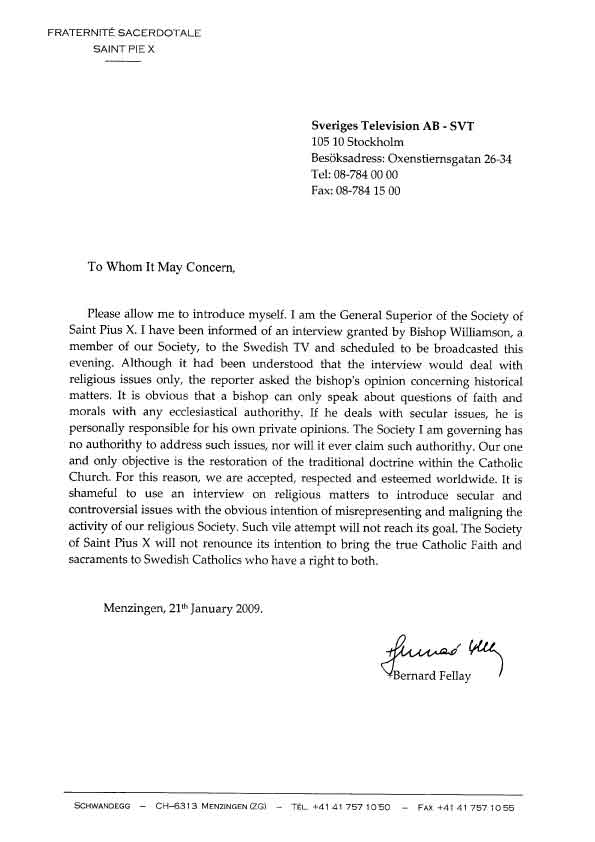
The bishop had appeared days earlier on Swedish television claiming that historical evidence denies the gassing of Jews in Nazi concentration camps. He also alleged that no more than 300,000 Jews were killed during World War II.
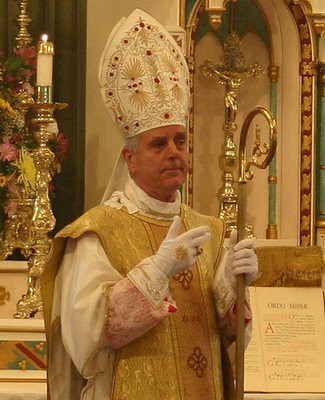
Bishop Williamson was one of four prelates of the Society of St. Pius X who were illicitly ordained to the episcopate by Archbishop Marcel Lefebvre in 1988. The excommunication was also lifted for the other three bishops, and was meant to be a step toward healing the division caused by the ordinations some 20 years ago.
Today the Pontiff acknowledged the horror of the Holocaust, and especially the death camps such as Auschwitz, which he said "carried out the brutal massacre of millions of Jews, innocent victims of a blind racial and religious hate."
The Pope expressed his "hope that the memory of the Shoah moves humanity to reflect on the unpredictable power of evil when it conquers the human heart," and that the Holocaust "be for everyone a warning against forgetting, against negating or reductionism, because violence committed against even one human being is violence against all."
"No man is an island," Benedict XVI continued, referring to the English Poet John Donne (1571-1631).
"May the Shoah teach especially, as much the old generations as the new ones, that only the tiring path of listening and dialogue, of love and pardon, leads peoples, cultures and religions of the world to the desired encounter of fraternity and peace in the world," he said. "May violence never again humiliate the dignity of man!"
Sufficient
Jesuit Father Federico Lombardi, director of the Vatican press office, said immediately following the audience that the Pope's statements on the Holocaust "should be more than sufficient to respond to the questions of those who doubt the position of the Pope and the Catholic Church."
Since the weekend, reports had been circulating that the Rabbinate of Israel would indefinitely sever ties with the Vatican, which were established in 2000 when Pope John Paul II visited Israel, and cancel a meeting of the Commission for Religious Relations of the Holy See set for March.
The Vatican and the state of Israel have had their own, separate relationship since establishing diplomatic ties in 1993, and the current situation does not affect state relations.
Father Lombardi said today he hoped that "the difficulties presented by the Rabbinate of Israel can be the object of a subsequent and more profound reflection," and that Vatican-Jewish relations "can go forward fruitfully and serenely."
In an interview that aired today on Italian television, Oded Wiener, the director-general of the Rabbinate of Israel, affirmed the importance of relations with the Vatican: "I think that it is fundamental as much for us as for the Vatican itself."
Regarding Benedict XVI's comments after the general audience, Wiener underlined: "In the first place I believe that the declaration of the Pope this morning have been extremely important, for us and for the entire world. There is no place for people such as Williamson that deny the existence of the Holocaust."
"I think it has been a big step forward," he added.
The Israeli ambassador to the Holy See, Mordechay Lewy, said he was "very happy for a declaration from such a high level by the Holy See that clarifies and helps to overcome these misunderstanding."
"I think that it is erroneous, now, to personalize the question concentrating on a single bishop," he added.
With regard to the intention of Benedict XVI to travel to the Holy Land in May, the Israeli ambassador said "the Pope is welcome in Israel today, as he was welcomed yesterday and the day before."
[Adapted by Karna Swanson]
Wednesday, March 18, 2015
Interview with Fr. Faure (soon to be Consecrated by Bishop Williamson)
Translated by Michael cruzadoparalaverdad@gmail.com
How about a little history to begin, Father, how did you get to know Tradition and Archbishop Lefebvre?
In 1968, while in Argentina, I visited the Archbishop of Paraná, who told me: "Do you want to defend Tradition? In the Council I defended Tradition together with a brave Bishop, a friend of mine, Archbishop Lefebvre." It was the first time I had heard of Archbishop Lefebvre. I went to look for Archbishop Lefebvre in Switzerland in 1972, and during Holy Week was went I first met him there.
Where were you born? Why were you living in South America?
I was born in Algeria and my family, after the independence, acquired a plot of land in Argentina, close to Paraná. My family was deported from Algeria because the French government seceded power to the militant Moslems that committed horrendous massacres during the course of the process of the independence. My grandparents, parents and uncles worked in agriculture there since 1830.
Returning to the story, how your apostolate in the Society come about?
Archbishop Lefebvre ordained me in 1977 in Econe, and 15 days later I went with him on a trip through the southern United States, Mexico (where the government refused our entry), Colombia, Chile, and Argentina. The Archbishop put me in charge of starting an apostolate in this region. During the first year 2 Argentinian priests helped me and the following year another Spanish priest (of the Society). After this the South American district of the United States was formed as was my position and responsibility and I began to preach retreats as far north as Mexico. The first year there were 12 vocations that were put in the Priory of Buenos Aires that was in a large enough house. Following this, around 1980, the seminary in La Reja (Buenos Aires) was built, where Archbishop Lefebvre put me as rector. I stayed there until 1985, when I was named superior of the District of Mexico. That was when they built the churches in Mexico City and Guadalajara. I looked after the country and its distinct places together with Frs. Calderon, Angles, and Tam. Later I was in France for some years. After all of this I was named as professor of history in the Seminary in Argentina and I was there until the expulsion of Bishop Williamson from Argentina (2009).
Did Archbishop Lefebvre confide in you?
Archbishop Lefebvre gave me free access to his mail and correspondence and he put me in charge of certain records. He had a certain kind of trust for me: in 1977 in Albano he asked me what I thought about consecrations. In this opportunity he confided in me that "they are waiting for me" (the rector in Econe and the professors). They would suggest accepting the New Mass and the Council in order to preserve the Tridentine Mass. They said to him: " now we are confronted with Rome. If we conserve the Mass (Traditional) we must accept the Council." They tried to persuade the Archbishop to retire in a beautiful house in Germany, but he told them that they were free to leave if they wanted to. He got rid of them.
Is it true that Archbishop Lefebvre asked you to accept being consecrated a bishop?
In 1986, while on a visit to Econe, he called me aside after a meal and asked me if I would accept being consecrated a bishop. Knowing what happened, I suppose I must accept.
Then you did not accept?
I told him that it seemed to me that Bishop De Galerreta would be the most adequate.
Can you summarize what happened in 2012?
In that year we were very close to an accord and it failed at the last moment, probably, because of the issue with Bishop Williamson. The deal failed because of that matter and the letter of the three bishops. Both of these caused the deal to fail.
It is said that the key to the ad intra strategy of Bishop Fellay is the backside of the General Chapter. Can you tell us something about this?
The General Chapter was very well prepared by Bishop Fellay and the they (the accordistas) accomplished their objectives. That was when I had understood what Archbishop Lefebvre and his friends felt like in the Second Vatican Council. Bishop Fellay had taken the decision of a policy of getting close to Rome and he had fixed it in order to have the the general support of the Chapter in expelling Bishop Williamson, who was the only one capable of obstructing this policy.
According to your judgement, what should be the conditions required to make a deal with Rome?
Archbishop Lefebvre told us that while there were no real changes in Rome a deal would be impossible, because these people were not loyal, and one cannot intend to change one's superiors. It is the cat that chases the mouse and not the mouse that chases the cat. A deal would be equal to handing over oneself to the modernists, and consequently, it must be absolutely refused. It is impossible. We must wait for God's intervention.
Can you tell us what you think the visits of evaluation of various modernist prelates to the Seminaries of the Society? Is it true that once Archbishop Lefebvre received some prelates? What is the difference now?
It dealt with exceptional visits during which Cardinal Gagnon never had the possibility of defending the Council, while on the other hand now it deals with the first steps of a reintegration (of the Society) into the conciliar church.
What do you think about an eventual unilateral recognition on the part of Rome to the Society?
It is a trick.
Between the 2006 chapter and the crisis started in 2012 certain changes are observed and attitudes of the authorities of the Society Of St. Pius x in respect to Rome? What is the reason for this change?
It is the decision of this appears to be reintegrated into the conciliar church. Since 1994 or 1995 there were some context with GREC that were significant steps towards a reconciliation, like what had been seen with the ambassador Perol (represents tatie of France in Italy) who is the inventor of the lifting of the excommunications (2009) and the Motu Proprio (2007). That must have had another relative act of recognizing the Council.
What would Archbishop Lefebvre do in the current situation?
He would follow in the line that he indicated to us after the consecrations, doing away completely with the possibility of a deal.
If in the future you were invited to go to Rome and speak with the pope would you go? What would you say?
First, I would consult with all of my friends in the resistance. I would go with Bishop Williamson and the other excellent priests that accept the combat of the resistance with much valor. And I would keep all of our friends well-informed with all transparency.
Bishop Fellay has said that the Society is in agreement with 95% of the Second Vatican Council. What do you think of this?
Archbishop Lefebvre answered that all of the Council is invaded by a subjectivist spirit that is not Catholic.
Is Francis, being an effective devastation of the Church and objective destroyer of the Faith, a true pope?
In my opinion, it cannot be said that Francis is worse than Paul VI, who was who put the Church on the wrong course, and so we must conserve the attitude that was the same of Archbishop Lefebvre, a prudential attitude that excluded sedevacantism. Archbishop Lefebvre always refused to ordain a seminarian that was sedevacantist. And that was the policy in the SSPX until his death. So don't let it be said that the Archbishop did this or said that.
What is the state of the process of your expulsion from the Society?
The last news that I had heard was by chance a second warning in an email. After tomorrow, therefore, the Society of St. Pius X will again have 4 bishops! They better throw me out quickly. Deo gratias!
This decision of consecrating a bishop must've been thought about and meditated during much time. Just like Archbishop Lefebvre, you, Bishop Williamson and the priests of the resistance have not wanted to collaborate in the destruction of the Church. It is for conserving the faith intact that they have persecuted you all, condemning you all and calumniating you all many times. Your episcopal consecration could run the risk of resulting in an alleged excommunication. What were the principal reasons for bringing about this consecration?
The main reason is that that we cannot leave the resistance without bishops. Just like Archbishop Lefebvre said, Catholic bishops are indispensable for the conservation of the true doctrine and faith and the sacraments.
Archbishop Lefebvre thought of you in the consecration of bishop and now Bishop Williamson is finalizing this wish. What will be your main concern?
Maintaining the strength of the work of Archbishop Lefebvre and the way that he had went, without deviating too much to the right or to the left.
Where will your place of residence be?
In France where we have been thinking about opening a seminary close to the Dominicans of Avrille.
Would you like to say any words to the priests and faithful that are still under the structure of the society but that are not satisfied with the liberal ways in the last years?
That they return to read into meditate upon the texts of their founder.
Can you explain to us the essential of your coat of arms?
In the sensual is the lamb of apocalypse and Alpha and the Omega the lamb of god that takes away the sins of the world announced by Isaiah. The hearts are symbols of the Vendeé martyrs and the revolution and the flor de lis is the emblem of Catholic France. The motto, ipsa cónteret (she will crush you) is taken from the Vulgate, Genesis 3, 15 where God promises the victory of the Virgin Mary against the dragon.
Is there anything more you would like to add?
We conserve Faith, Hope, and Charity. There is nothing to doubt and we must beg of God and Our Lady that we are maintained in these virtues.
Father, we greatly thank God, His Most Holy Mother, and Saint Joseph protector of the Church for this great grace. We ask of God that he may protect and conserve you. We thank you for having accepted this tremendous position and Bishop Williamson for consecrating you as one of the successors of the Apostles. Deo Gratias!
Link:
Related:
Thursday, October 18, 2012
Confirmed: Bishop Williamson is set to be expelled from the SSPX by Bishop Fellay
From Stephen Heiner, Bishop Williamson's former newsletter editor:
It is confirmed that Bishop Fellay has ordered Bishop Williamson to shut down dinoscopus.org, end Eleison Comments, make "public apology" for the harm he has caused to the SSPX and the Church by publishing Eleison Comments, and commit to making "reparation" for the remainder of his days. Failure to comply with these conditions (interestingly, there is no parsing of "required" and "desirable") in toto would result in his expulsion on or around one week from today's date: the 23rd of October, 2012...Link:
Related:
- Bishop Williamson to be Expelled from SSPX?
- Splitters: A few priests form the Society of St. Pius X of the Strict Observance
- Another hurtful article by Nicole Winfield of AP about the SSPX
- Archbishop Müller on the SSPX and His Controversial Writings
- Bishop Fellay’s “Conditions”
- On the SSPX
- Bishop Williamson Silenced by SSPX
Saturday, October 13, 2012
Bishop Williamson to be Expelled from SSPX?
: According to the blog Avec l'Immaculée which cites the forum Un évêque s'est levé!, allegedly Bishop Williamson was sent a letter by Bishop Fellay who informed Bishop Williamson that he had ten days to shut down his web site and apologize for causing "confusion among priests and faithful of the SSPX" by "criticizing decisions of the chapter." The source indicates that if Bishop Williamson refuses, he will be "permanently excluded from the SSPX." (Google translation.) The tenth day is tomorrow, October 14th.
Link:
Related:
- Splitters: A few priests form the Society of St. Pius X of the Strict Observance
- Another hurtful article by Nicole Winfield of AP about the SSPX
- Archbishop Müller on the SSPX and His Controversial Writings
- Bishop Fellay’s “Conditions”
- On the SSPX
- Bishop Williamson Silenced by SSPX
Friday, October 5, 2012
Archbishop Müller on the SSPX and His Controversial Writings
(National Catholic Register) In the second part of this interview with Archbishop Gerhard Ludwig Müller (Part 1 can be read here), the new CDF prefect discusses the latest on efforts to bring the Society of St. Pius X back into full communion with the Church, the current situation regarding the Leadership Conference of Women Religious, and responds to what some saw as controversies over some of his previous writings on the perpetual virginity of the Blessed Virgin Mary and on the Eucharist.
What stage have we reached in the dialogue between the Vatican and the Society of St. Pius X?
I wouldn’t call it a dialogue between two Church partners. This was a brotherly colloquium to overcome difficulties with an authentic interpretation of Catholic doctrine. This authentic interpretation is guaranteed by the Pope. The SSPX must accept the Holy Father, the Pope, as the visible head of the Church. They have a great respect for Tradition. They must, therefore, accept the position of the Pope as stated in the First Vatican Council. They must also accept the doctrinal pronouncements made since the Second Vatican Council, which have been authorized officially by the Pope.
Part of the problem is that, after 30 or more years of separation from the Church, some groups or persons can be very closed in their own dynamic, in their own groups, and very fixed on these points. I believe that these questions will be resolved in the long term.
Is it possible for reconciliation with Bishop Richard Williamson within the society?
Williamson is a separate problem to this reconciliation process. It is simply unacceptable that a Christian or even more a bishop — of course he is not a Catholic bishop, as a bishop is only Catholic when he is in full communion with the Pope, the Successor of Peter, which Williamson is not — denies all that the Nazis had done against the Jewish people, their exterminations. How is it possible to be so cold-hearted about this? It is absolutely unacceptable, but this is a separate problem.
They [SSPX] need to accept the complete doctrine of the Catholic Church: the confession of faith, the Creed, and also accept the magisterium of the Pope as it is authentically interpreted. That is necessary. They also need to accept some forms of development in the liturgy. The Holy Father recognized the perennial validity of the extraordinary form of the liturgy, but they also must accept that the new ordinary form of the liturgy, developed after the Council, is valid and legitimate.
Some argue the Second Vatican Council was merely pastoral and, therefore, not binding. How do you respond to this?
The problem here is the interpretation of the word “pastoral.” All councils are pastoral, in that they are concerned with the work of the Church — but this does not mean that they are merely “poetic” and therefore not binding. Vatican II is an official ecumenical council, and all that was said in the Council is therefore binding for everyone, but at different levels. We have dogmatic constitutions, and you are certainly obliged to accept them if you are Catholic. Dei Verbum discusses divine Revelation; it speaks about the Trinitarian God revealing himself and about the Incarnation as fundamental teaching. These are not only pastoral teachings — they are basic elements of our Catholic faith.
Some practical elements contained in the various documents could be changed, but the body of the doctrine of the Council is binding for everyone.
In view of all this, are you nevertheless confident and optimistic there will be reconciliation with the Society of St. Pius X?
I’m always confident in our faith and optimistic. We have to pray for goodwill and for unity in the Church. The SSPX is not the only breakaway group in the Church. There are worse ones on the opposite side, too. These movements are worse because they are often denying essentials of Christianity. We must work for unity, and so it is also my task to invite all to come back into full communion with the Catholic Church, which is led by the supreme shepherd, the pope — who is the Vicar of Christ.
If they do come back, what positive aspects could they bring to the Church?
They could underline what Tradition is, but they also must become broader in their perspective, because the apostolic Tradition of the Church is not only about a few elements. The Tradition of the Church is large and wide. On the other hand, there must also be a renewal in the celebration of the liturgy, because we have had a lot of abuses of the liturgy, which have damaged the faith of many people.
Could they perhaps help correct some of the abuses?
That is not their task, but ours. One extreme cannot be the equivalent of the other. The extremes must be corrected by the center... (continued)
Wednesday, July 25, 2012
SSPX Bishop Williamson: "Bishop Fellay and his gang"
Related Links:
- The SSPX’s “sine quibus non” conditions
- QUAERITUR: How many priests are in the SSPX?
- UPHELD: Williamson exclusion maintained by SSPX General Chapter
- Proposal and Counter-Proposals for Pope Benedict and the SSPX
- VATICAN: COMMUNIQUE CONCERNING PRIESTLY SOCIETY OF ST. PIUS X
- Society of St. Pius X General Chapter Statement
- On the SSPX
- Card. Burke on the SSPX (video)
- Cardinal Burke Urges Catholics to Pray for the Reconciliation of the SSPX
- Monsignor Nicola Bux's letter to Bishop Fellay and the Priests of the SSPX
Monday, July 2, 2012
On the SSPX
I get lots of questions, and hate mail, about
this, and in the spirit of getting things wrapped-up and saying
everything I have on my little list to say while I can, here's my screed
on the SSPX.The Society of Saint Pius the Tenth (SSPX) is a group of traditionalist Catholics who broke away from Rome in 1970 after Vatican II when they were told by evil Marxist infiltrators inside the Church that they were forbidden from saying the Tridentine Latin Mass. They were led by an Archbishop named Marcel Lefebvre, hence the term "Lefebvrists" sometimes used to describe those in the SSPX.
The legalisms are EXTREMELY confusing, but as I understand it, Vatican II never actually forbade the saying of the Tridentine Mass. That was all a lie by the Marxist-homosexualist infiltrators. But, instead of hanging around and fighting the good fight, the SSPX took off on its own.
There have been steps toward reconciliation over the last 40 years, and as I understand it, SSPX Masses are indeed valid, but they are still not in full communion with the Church.
I totally sympathize with them - I can't imagine the fury and heartbreak that so many felt in 1970 as the Mass was literally eviscerated before their eyes and turned into a Protestant off-Broadway performance vehicle for homosexual priests and nuns, specifically designed to degrade the Church from the inside-out and ultimately destroy it by turning it into a neo-pagan Marxist-homosexualist cult.
But apparently ol' Annibale Bugnini and his masonic cohorts didn't take Christ Almighty seriously:
"Thou art Peter (Cephah) and upon this rock (cephah) I will build My Church, and the gates of hell shall not prevail against it."
You ain't gonna win, boys. And that goes for the uber-right contingent every bit as much as the Marxist-homosexualist infiltrators. The gates of hell will not prevail against the Church, and Peter is the Rock upon which Christ built, and builds, His Church.
It does not get any clearer than that. Any argument or confusion on this point is a direct result of satanic-inspired heresy aimed at destroying the Church by tearing it into utter chaos (40,000 protestant sects in the U.S. alone, all gleefully ratifying mortal sin, and counting!), ripping people away from the Eucharist, and ultimately resulting in people being lost eternally to hell. Period. You don't agree? You don't like that? You want to be your own pope? You want to "vote" on what the Truth is? Wow. I SOOOOOO don't care what you "want", "like", "feel" or "believe." I care about what the Truth is, and scripture makes it crystal, crystal clear on this point for anyone who isn't blinded by their own pride.
So, think of the SSPX as Protestants, but on the other side of the spectrum.
Today, the head of the SSPX is a bishop named Bernard Fellay, and he is working very hard to try to get the SSPX fully reconciled to Rome and thus 100% back inside the Barque of Peter. Everything I have read and listened to from Fellay seems extremely sensible, faithful and sincere. He fully comprehends that he is a shepherd and that he needs to get his flock back into the Church, and he is trying very hard to get that done before the manure hits the spinning airfoils.
The other three SSPX bishops? Not so much. The nutty wing of the SSPX is led by a bishop named Williamson. Williamson is nuts. Just stone-cold bonkers. He is a vicious anti-Semite (and there is a considerable problem with this inside the SSPX), holocaust denier, and naturally flowing from that evil and insanity, Williamson is a 9/11 truther. Like I said, the dude is nuts. Once you know that information, you know everything you need to know about Williamson and his wing.
Now you might think that all the traddy Catholics *lurv* me and that I have bunches and bunches of "friends." Oh, you'd be dead wrong. Most of the traddy Catholics hate me too, because people like me just can't win for losing. They send me lovely emails telling me how much they hate me on a fairly regular basis. They also send me Williamson propaganda. So, I have a pretty solid dossier of evidence on this point.
Would you like to hear what they tell me? Sure you would.
A. If you are 35 and unmarried, you must be a lesbian. We hate you.
(And all this time I thought it was a combination of my shrewish personality, dull wit and acrid body odor. Huh.)
B. You're a convert. We hate converts. We hate you.
(The Blessed Virgin Mary, the first Convert to Christianity, was unavailable for comment. Her press secretary simply referred all inquiries on this topic to the First Joyful Mystery, the Annunciation. Oh, and the Great Commission of her Son.)
C. You speak to Jews. We hate you.
(If your stupid asses don't even understand Catholicism, how do you expect the Jews today to understand it, much less convert to it? Maybe if you learned your faith, understood how every aspect of the Church and the Mass is a perfected fulfillment of Judaism, and could then EXPLAIN that to people, you might actually win some converts. Oh, but I forgot. You hate converts.)
D. You're ugly. Your hair is ugly. You have horse teeth and bug eyes. We hate you.
(Are you sure THAT isn't the reason I'm not married? Because I'm so freakishly physically repellant? Just sayin'.)
And, finally, my personal favorite:
E. You prophesy before men UNVEILED. We hate you.
(Okay, I can't win here. If I say to myself, "Ahem, I am going to PROPHESY now," and put on a veil to make a video or give a talk, then I'm a delusional, megalomaniacal nutcase. If I don't, some kooky dude sends me emails telling me that I'm going to hell for my failure to accessorize. Dude, throw me a bone. Seriously.)
That's all good for a chuckle, but let me explain with an analogy what these people's error is, and it isn't just them. It is the error of any schismatic.
Let's say your wife was diagnosed with cancer. Would you suddenly hate your wife? Would you argue that you didn't marry a body riddled with cancer, and therefore she was no longer the person you married, and then leave her in a smug huff?
Would you hate your wife's body, and thus hate your wife? No. You would love your wife and her body, perhaps even more than before, when you saw her under attack from the cancer. You would want to fight the cancer - chemotherapy, radiation, surgery - anything to get rid of the cancer and bring your wife back to full health and vigor.
This is exactly the situation in the Church today. The Church has cancer. Bad. Fully metastasized, all over-type cancer. It is called Marxist-homosexualism, and the cancer was first observed and diagnosed 45 years ago. Sadly, instead of clinging to the Bride of Christ and fighting the cancer, some people abandoned Her, claiming that the cancer WAS her body, instead of just an invading infection. Others left out of indifference. Others stayed and embraced the cancer as a "good thing" and "progress". A tiny, tiny contingent stayed, held Her hand, and have lovingly administered as much medicinal therapy to her as they possibly could.
The Williamson wing of the SSPX hates the Bride of Christ and will never rejoin her no matter what, because they are too prideful and dim to make the distinction between the Body and the cancer. They want a new wife, one of their own making, and "cancer free." And that is what they will get, but they will quickly find out that their new bride isn't really a bride at all, but just another cheap whore. A true and loving Bride with a bad case of cancer beats a whore in her prime.
So, Fellay needs to get back into the Church ASAP, and let the chips fall where they may with the SSPXers. Even if it is just Fellay and one other person coming back into the Church, it will be worth it for that ONE person, and Fellay will have done his job as a shepherd. Our Lord made clear that men will be sifted. People will have to choose. Wheat or chaff? Sheep or goats? This is one of those "siftings."
Get back in the Barque of Peter, Bishop Fellay and all SSPXers of good will, of which there are many. Because the gates of hell and its cancer WILL NOT PREVAIL. There is going to be a miraculous cure, and your Bride wants you there to share in the joy of the healing, which is explicitly guaranteed by Our Lord Himself.

Link:
Saturday, August 28, 2010
Rampant Unreality
"On a private visit two weeks ago to the USA, my first since 2008, I was able to enter and leave the country with no personal problems, but on a two-hour tour which a friend gave me of a major American city, devastated by the recent economic downturn, I observed some daunting social problems:-- As we drove towards the city past a handsome housing estate in the country, he said, "You see all these expensive-looking houses ? They are in fact poorly built, cookie-cutter houses, way over-priced, bought with money out of nowhere from the Clinton era (1992-2000), by people living in a dream, from paycheck to paycheck, in a false paradise of high credit, materialism and excessive spending. If they lose their jobs, as many are doing, they will be lucky to get half their money back on their houses. The men have no real skill or trade. Theirs is a world of slick tongue nonsense...
"They are mostly white people who have fled from the inner city suburbs where we are now arriving. Look around you at all the houses boarded up, abandoned, dilapidated, with huge gaps in between where the housing has been destroyed to give the illusion of prosperity. But the lost jobs will not come back, so there is no real basis for a return to prosperity. The neat houses you do see have been repaired or re-built with Government money borrowed by the broke city in accordance with unreal housing projects, because the neat houses will not usually be cared for, but will soon be dilapidated again. There is a kind of Government aid which can do more harm than good to the people it is supposed to help, by trapping them in their dependence on it...
"Now we are coming into the downtown where you see tall handsome buildings, but also few people circulating. The buildings go back to the 1920's when this city was a great industrial centre, but after World War II the USA began to lose its industrial pre-eminence. Around the Reagan years (1980-1988) began, as I see it, a false stimulus by the credit card being made available to the common man. In the 1990's a non-white mayor was elected here who did his serious best to bring business back to the city, and some of these handsome buildings are due to him, but he was voted out by his own people because he was not like one of them...
"The economy is hanging on a thread, yet most people think everything will be fine in a year's time. They think it is lovely if the Government just prints or digitalizes more and more money. Five per cent of the people, or less, understand just how grave the situation is, and less than one per cent see religion as playing any part in their country's downfall. People look only for band-aids, not for deep or real solutions. The whites have allowed themselves to be given a huge guilt complex, and they have caved in without admitting it. There is a huge problem that everybody senses and knows, but they are too afraid to talk about it..."
Yet within 50 miles of this city thrives an SSPX parish and school, unknown or disdained, yet embodying the one true solution: God.
Kyrie eleison."
- RAMPANT UNREALITY
- SSPX Bp. Williamson v. The Pope of Christian Unity
- To the SSPX Folks
- SSPX Regularization Might Only Require Acceptance of the Catechism of the Catholic Church?
Sunday, April 5, 2009
Christ's Suffering

Secondly, by normal human knowledge, Christ suffered in his soul from observing all the kinds of people contributing to his Passion: Jew and Gentile, man and woman (e.g. the serving-girl mocking Peter), leaders and people, friend and foe. In particular, says St. Thomas, Christ suffered in his soul from being hated by his own people, then still God's Chosen People, and - worst of all - from being abandoned and betrayed by his very own Apostles. Thirdly, like any man, Christ suffered in his soul from having to die, and the more innocent and perfect his life had been, the more keenly he suffered its loss and the injustice of its loss.
Now what other human being, or mass of human beings, have lived a perfect and innocent life: have chosen to lay it down by a death anything like as terrible as crucifixion: have been able to see all sins of all men and wish to pay for them; finally have observed abandonment all around them to the point of feeling deserted even by God ("lama, lama, sabactani")? Were there any such men, still they could not claim that their sacrifice was informed with anything like a charity such as that of Christ, with his overwhelming love for every one of us poor sinners. So their sacrifice would still not be comparable to His. Kyrie eleison.
London, England
Sunday, March 29, 2009
Busted Compromising
Between the crisis of the Church, still compounding, and the economic crash now, as Americans say, barreling down the pike, there is an interesting parallel to be drawn. Only those who think religion and economics have nothing to do with one another, need be surprised. Both are seated in the same human beings and societies.
In both cases, according as, say over the last 300 years, man has moved further and further away from God, so he has made more and more compromises with the Truth and Laws of God and nature. But the nature of God and man and things cannot be changed, so that the moment comes when the compromising stretches too far from reality, and breaks down.
That moment is today.
In economics, the founding of the Bank of England in 1694 was a major step on the way towards modern finance: central banks taking control of the money supply and therefore of the real government of the nations, by progressively replacing real deposits as the foundation of credit with fictitious credit as the foundation of "deposits". Fake finance became global in the 20th century, and is being crashed in the 21st century to give to the money-men final control of world government. Alas, the sense of economic realities may have been lost too far back in the past for even real suffering and real riots to wrest that control from those who are masters of the mass of minds by their vile media.In the Church, the steady diminution of the Faith over the 17th and 18th centuries gave rise to Concordats in the 19th and 20th centuries, by which the Church would renounce certain of her natural privileges in order to establish her most important rights by at least a contractual agreement with States where those privileges were no longer believed in. So it came to seem that instead of the human resting on the divine, the divine rested on the human, with the result that Catholic dogma may have remained for the 19th century anchored in God's Truth, but when with the 20th century's modernism and Vatican II the same shift towards man took over even Catholic doctrine, then the Church's very structures immediately began to fall in ruins, today still piling up.
In both economics and religion, the remedy can only be to go in time forward by going back to healthy basics, and by giving up on trying to extend the series of unhealthy compromises with a world that has run itself onto the rocks. However, whereas in economics the enemies of mankind may win, in religion we have God's own promise (Mt. XVI, 18-20) that they will not prevail over the Catholic Church. So we prepare to suffer, but we pray, especially for the Pope, with an unshakable trust in God. Kyrie eleison.
London, England Posted by Bishop Richard Williamson at 9:18 AM
Thursday, March 12, 2009
LETTER OF HIS HOLINESS POPE BENEDICT XVI TO THE BISHOPS OF THE CATHOLIC CHURCH
LETTER OF HIS HOLINESS POPE BENEDICT XVI
TO THE BISHOPS OF THE CATHOLIC CHURCH
concerning the remission of the excommunication
of the four Bishops consecrated by Archbishop Lefebvre
Dear Brothers in the Episcopal Ministry!
The remission of the excommunication of the four Bishops consecrated in 1988 by Archbishop Lefebvre without a mandate of the Holy See has for many reasons caused, both within and beyond the Catholic Church, a discussion more heated than any we have seen for a long time. Many Bishops felt perplexed by an event which came about unexpectedly and was difficult to view positively in the light of the issues and tasks facing the Church today. Even though many Bishops and members of the faithful were disposed in principle to take a positive view of the Pope’s concern for reconciliation, the question remained whether such a gesture was fitting in view of the genuinely urgent demands of the life of faith in our time. Some groups, on the other hand, openly accused the Pope of wanting to turn back the clock to before the Council: as a result, an avalanche of protests was unleashed, whose bitterness laid bare wounds deeper than those of the present moment. I therefore feel obliged to offer you, dear Brothers, a word of clarification, which ought to help you understand the concerns which led me and the competent offices of the Holy See to take this step. In this way I hope to contribute to peace in the Church...
Wednesday, March 11, 2009
Holy Father’s Letter to Bishops About the SSPX Excommunications

Pope Benedict XVI kneels to pray at Saint Mary Major Basilica in Rome May 3, 2008
From Anna Arco via Father Z, with Father's emphases and comments:
"I am particularly moved by this:
Sometimes one has the impression that our society needs at least one group to which it needs to show no tolerance, which one is allowed to attack with hatred, unquestioned. And whoever dares to touch them—in this case the Pope— has also himself lost the right to tolerance and was allowed to be thought of with hatred, without shyness or restraint.My emphases and comments.
Wednesday March 11A couple things.
The Holy Father’s letter, sections of which have already appeared, in full, translated from the version which appeared in the Frankfurter Allgemeine Zeitung.
Dear brothers in episcopal service!
The lifting of the excommunications for the four bishops consecrated by Archbishop Lefebvre in the year 1988 without the mandate of the Holy See caused an uproar led with a ferocity which we haven’t seen for a long time, both within and outside of the Catholic Church for a multiplicity of reasons. Many bishops felt helpless faced with an event that came unexpectedly and that could barely fit positively into the questions and duties of the Church of today. Even though many shepherds and faithful were willing to gauge the Pope’s desire for reconciliation as fundamentally positive, the question of the appropriateness of such a gesture in the face of the real priorities of faithful life in our time stood against it.
A variety of groups on the other hand openly accused the Pope of wanting to reverse the Council; an avalanche of protests set itself into motion, the bitterness of which has made wounds visible which reached far further than the instance. So I feel pushed, dear confreres, to direct a clarifying word towards you, that should help to understand the intentions which led me and the respective organs of the Holy See in this step. In this way I hope to help to bring peace to the Church. [His Holiness is a great optimist.]
One of the for me not foreseeable glitch/breakdown existed therein that the lifting of the excommunication was overshadowed by the Williamson Case. The quiet gesture of mercy [this is a key point] towards four validly but not licitly ordained bishops appeared suddenly to be something completely different: as a rejection of the Christian-Jewish reconciliation, as a retraction of that on which matter the Council declared it to be the direction/path of the Church.
From an invitation to reconciliation for an ecclesiastical group that was separating itself from the Church, it became in this way the opposite, a seeming backtracking behind all the steps to the reconciliation between Christians and Jews which have been made since the Council—with which I have made it the goal of my theological work from the beginning to walk along with and move ahead.
I can only deeply lament the fact that this superimposition of two conflicting processes entered and for a moment disrupted the peace between Christians and Jews as well as the peace of the Church. [This is interesting: a direct mention of the use of the internet by a Roman Pontiff] I understand/hear, that careful following of the news available/accessible from the internet might have allowed one to become aware of the problem in time. I have learned from it that we at the Holy See shall have to be more watch this source of news more attentively in the future. [I am available. o{]:¬) ] I was saddened that also Catholics, who really should have known better, felt the need to lash out at me with jump-ready enmity. [Of course they did know better, but their enmity was greater than their respect or their sense of justice.] All the more do I thank the Jewish friends who helped to quickly rid the world of the misunderstanding and to re-establish the atmosphere of friendship and trust which—as in days of Pope John Paul II—also continued to exist through the whole period of my Pontificate and God be praised, will continue to exist.
A further mishap that I honestly regret exists therein that the border and the extent of the measure of January 21, 2009 which were not clearly enough explained with the publication of the process. The excommunications concern the persons, not the institutions. [good clarification] The consecration of bishops without a Papal mandate signals the danger of a schism [NB: "danger" of schism… not the present fact of schism.] because it calls into question the unity of the College of bishops with the Pope. Therefore the Church has to react with the severest punishment, excommunication, in order to to call back those that were thus punished to penitence and so to unity. Twenty years after the consecrations this goal has sadly still not been achieved. The lifting of the excommunications serves the same goal as the punishment itself; to once again invite the four bishops to return. [That is why he lifted the excommunications.] This gesture was possible after the involved parties expressed their fundamental acknowledgement of the Pope and his power as shepherd, even though with the exception of that which deals with obedience to his teaching authority and against that of the Council. [NB: "obedience to his teaching authority"] With that I return to distinction between person and institution. The dissolution of the excommunication was a measure in the area of Church Discipline: The persons were freed from the weight on their conscience of the heaviest Church punishment. This disciplinary field should be distinguished from the doctrinal area. [The doctrinal problems are still not resolved.] That the Society of St Pius X has no canonical status in the Church does not actually rest on a disciplinary but on a doctrinal foundation. [This is a very interesting statement. The point seems to me to be that the doctrinal differences are the real problem and not, in the mind of the Roman Pontiff, the matter of obedience to the Bishop of Rome in matters of discipline. There is a difference between respecting the Pope’s authority to govern the Church and the Pope’s authority to teach and the Church’s authority to have a Council and promulgate documents of any nature, dogmatic or pastoral.] As long as the Society has no canonical status in the church, their holders of office do not hold legal offices in the Church.
One must also differentiate between the persons as persons disciplinary level and the doctrinal level, [again the distinction…] with which both office and institution are in question. To repeat: so long as the doctrinal questions are not clarified, the society has no canonical status in the Church and therefore for that time its office holders, even if they are freed from the punishment of the Church, hold/practice no legal offices in the Church. [Good: The real problem is doctrine. I have been saying this all along. The liturgical or disciplinary problems can be solved with the stroke of a pen. The doctrinal issues must be hammered out.]
[This is important….] In the face of the situation, I intend to combine the Papal Commission Ecclesia Dei which has, since 1988, been responsible for those communities and persons, who have come from the Society of St Pius X or similar groups and would like to return to full communion with the Pope, with the Congregation of the Doctrine of the Faith. This should make clear that the problems that are now to be dealt with are of a doctrinal nature, especially that which deals with acceptance of the Second Vatican Council and the post-Concilliar teaching of the Pope. [This is very imporant. More on this below.] The collegial organs, with which the Congregation deals with the incidental questions (especially the regular meeting of the Cardinals on Wednesdays and the one to two yearly full meeting) guaranty that the prefects of the different Roman Congregations and the world wide episcopate will be brought into any decisions that will be made. [read: there will be wider consultation once the PCED is involved more closely with the CDF] One cannot freeze the teaching authority of the Church in the year 1962—the society has to be clear about that. [That was a direct instruction to the SSPX.] But some of those who play the great defenders of the Council, [I like that "play the defenders"... which isn’t really their role in the Church.] need to be reminded that the Second Vatican Council carries with it the whole teaching history of the Church. Whoever wants to be obedient to it, must accept the faith of centuries and may not cut the roots from which the tree lives. [Thus, a hermeneutic of continuity.]
I hope, dear brothers, that the positive meaning as well as the the boundaries of the measures of January 21, 2009 have been clarified. But now the question remains: Was it necessary? Was it really a priority? Are there not more important things? Naturally there are more important and urgent things. [The idea here is this: Why risk damaging relations with the Jews by doing this? Why give the impression that you are rolling back the Council? Etc. Pick your issue.] I think that I have made the priorities of this pontificate clear in my speeches at its beginning. What I said then remains my unchanged guidelines.
[Watch] The Lord unmistakably fixed the first priority for the successor of Peter at the Last Supper. “You however strengthen your brothers” (Lk 222, 32) Peter himself formulated this priority in his first letter anew: “Be constantly ready, to give everyone a speech and answer, who asks for the Hope that is in you.” 1 Peter 3,15) In our days, in which our faith threatens in broad stretches of the world to be extinguished like a flame which no longer finds food, it is the highest priority to make God present in this world and to open the access to God. Not just to any God, but to the God who spoke on the Sinai, to the God whose face in the love to the end (John 13,1) is recognized in the crucified and resurrected Jesus Christ. [This next part is marvelous. It is a gem of the letter…. ] The actual problem of our point in history is that God is disappearing out of humankind’s horizon and with the extinguishing of the from God-coming-light the lack/inability to of direction breaks into humanity, the destructive effects of which we are seeing ever more of.
Bringing mankind to God, the God who speaks in the Bible, is the highest and most fundamental priority of the Church and the successor of Peter in these times. That we should be occupied with the unity of the Faithful will arise from that on its own. For her quarrel, her inner contradiction/disaccord — calls the speech of God into question. For that reason the struggle for a common witness of faith of Christians — for Ecumenism — is included in the highest priority. To that also comes the necessity that all those who believe in God search for peace together, attempt to come closer to one another in order to, through the variety of the their image of God, approach the source fo the Light together — the interreligious dialogue. Whoever proclaims God as love until the end must give the witness of love: turned towards the suffering in love, stave off hatred and enmity, the social dimension of the Christian Faith, of which I spoke in the encyclical Deus Caritas Est.
If the struggle for faith, hope and love in the world represents the true priority for the Church in this our (and always in different forms), then the smaller and the larger reconciliations also make up a part of it. [I like that: even small acts of reconciliation play a part in the larger reconciliation we must pursue.] We need to recognize that the quiet gesture of an outstretched hand became such a great noise [excellent] and so exactly the opposite of reconciliation. But now I still ask: Was and is it really wrong to come towards the brother “who bears a grudge against you” and attempt reconciliation (Cf. Mt 5, 23f)?
Should civilized society not also attempt to anticipate radicalization, to tie back her potential agents, if it is possible, with the great creative force of social life in order to prevent seclusion and all its consequences? Can it be completely wrong to strive for solutions to cramps and narrowing and to give room for the positive and which can be tied into the whole? [This is classic Ratzinger. It shows you something of his heart.] I myself experienced in the years after 1988 how much the internal climate of communities which were breaking away from Rome changed through their homecoming; how the homecoming into a great broad and common church overcame one-sidedness and unraveled knots, so that positive strength for the whole came out of them.
[This is good. It shows that those who resist Pope Benedict in this matter are really pretty small minded.] Can we be apathetic about a community in which there are 491 priests, 215 seminarians, six seminaries, 88 schools, two university institutes, 117 brothers and 164 sisters? Should we really allow them to drift away from the church with quiet minds. [That is what is happening and we must ACT.] I think for example of the 491 priests. [NB: I noted on many occasions that Summorum Pontificum was especially a gift to priests. Benedict is especially concerned for the priests of the SSPX.] We cannot know the weave of their motivations. But I think that they would not have chosen the priesthood if the love to Christ and the will to proclaim him and with him the living God. Should we simply exclude them from the search for reconciliation and unity as the representatives of a radical fringe group? What would happen then? [Excellent. I hope SSPX priests are paying attention.]
To be sure, we have for a long time and again on this given occasion heard many discordant notes from representatives of this community — arrogance and condescension, obsessing into the one-sided-nesses and so on. [SSPXers take note: This is PETER saying this to you.] To this I need to add for the sake of the Truth that I have also received a series of moving proofs of gratitude in which an opening of hearts was noticeable. [Again, this is PETER speaking.]
But should the larger Church not also be able to be generous in the knowledge of the long breath that it has, in the knowledge of the promise that was given to it? [People of good will should be able to disagree and work things out.] Should we not, like righteous educators, be able to overhear many an offense and strain ourselves to quietly lead out of the impasse? And must we not admit that discord has also come from Church circles? [This next part is fantastic!] Sometimes one has the impression that our society needs at least one group to which it needs to show no tolerance, which one is allowed to attack with hatred, unquestioned. And whoever dares to touch them—in this case the Pope— has also himself lost the right to tolerance and was allowed to be thought of with hatred, without shyness or restraint. [Amazing.]
Dear brothers, in the days in which I bethought myself to write this letter, it so happened that I had to explain and comment on a section from Gal 5,13-15 in the seminary in Rome. I was surprised who directly the sections spoke of the present of that hour : “Do not take freedom as an excuse for the flesh, but serve one another in love. The whole law is summarized in the one world: You shall love your neighbor as yourself. And when you bite and rip each other apart, then take care that you do not kill each other.” I was always inclined to see this sentence as one of those rhetorical hyperbole that occasionally appear in St Paul. In some ways it may well be. But unfortunately that “biting and ripping” is also present in the Church today as an expression of a badly understood notion of freedom. [The Holy Father’s personal experience has shed light for him on that verse of Scripture.]
Is it an wonder that we are not better than the Galatians? That we are at least threatened by the same temptations? That we need to learn the right uses of freedom anew? And that we always have to newly learn that highest priority: Love?
On that day, on which I had to speak about it at the seminary, Rome celebrated the feast of the Madonna della Fiducia, Our Lady of Trust. Indeed Mary teaches us trust. She leads us to the Son, whom we may all trust. He will lead us—even in turbulent times. So as I conclude I would like tho thank the many bishops who gave me moving tokens of trust and sympathy, but above all gave your prayers. This thanks also goes to all the faithful who gave me witness of their unchanging loyalty to th successor of St Peter. The Lord protect us all and leads in the path of freedom. [And interesting word, here.] That is a wish that has risen spontaneously, especially now at the beginning of Lent, a liturgical time when the inner cleansing is particularly beneficial and which invites us all to look with new hope at the glowing destination of the Easter feast.
With a special apostolic blessing I remain
Yours in the Lord
From the Vatican March 10, 2009
First, I was strongly moved by his description of a group to whom no tolerance may be shown and if anyone defends them, they too are harassed.
It is said that the last acceptable prejudice is anti-Catholic bigotry. But within the Church the same dynamic applies. I often refer to Summorum Pontificum as a kind of "emancipation proclamation". I describe not seldom, traditionalists as being treated in by progressivists in power as black were before the civil rights movment took hold in the USA: they can go to the back door of the restaurant for their food, but can’t sit in the nice chairs in the main room with decent folks.
Second, some would have thought that the Pontifical Commission Ecclesia Dei would be incorporated, perhaps, with the Cong. for Divine Worship. The Pope is saying rather that it should be with the CDF.
This to my mind signals a couple things. On the one hand, the liturgical issue is concluded in large part. The Holy Father established that there is one Roman Rite in two uses. Juridically the matter is concluded. Details can be worked out, but this is a done deal.
On the other hand, the more difficult problem remains, and it is not so must a matter of liturgical use but is rather doctrinal. Putting the PCED with e CDF opens the way to creating a framework for doctrinal talks with the SSPX. Issues of canonical status of the SSPX priests, the whole of the SSPX, etc…. that is a matter of paperwork, difficult paperwork, but paperwork nonetheless. The real sticking points are now doctrinal, as the Holy Father describes in the letter above."

Tuesday, March 10, 2009
Pope Benedict to the world’s bishops about SSPX Bp. Williamson
"At noon on Thursday there will be made public a seven-page letter which Benedict XVI is sending to all the bishops of the Catholic Church to contend with the case of the revocation of the excommunication of the Lefebvrite bishops and the polemics resulting from the Bishop Williamson’s interview denying the gas chambers."
Saturday, February 28, 2009
Bishop Fellay: apology "an important step"
Bishop Bernard Fellay, head of the ultra-conservative Society of St. Pius X (SSPX) told a German weekly that the apology from British Bishop Richard Williamson, also a member of SSPX, was honest.
"It is a first request for forgiveness and an important step in the right direction," Fellay told Der Spiegel...
Fellay reiterated that Williamson had damaged the SSPX and sought to put distance between himself and the bishop.
Asked why the SSPX did not exclude Williamson, Fellay said:
"If he denies the Holocaust again, that will happen. It is probably better if he stays quiet and stays in a corner somewhere." He added it was, in his view, unlikely that the Vatican would excommunicate Williamson again.
Thursday, February 12, 2009
Rabbi: left-wing is destroying the Catholic Church
"A friend alerted me to this great article from LifeSite!
I ask bloggers, please, to consider posting this on your own sites.
My emphases and comments.
Left Wing of the Catholic Church Destroying the Faith Says Orthodox RabbiOh, what a great article.
By Hilary White, Rome correspondent
Wednesday February 11, 2009
ROME, February 11, 2009 (LifeSiteNews.com) – The dissident, leftist movement in the Catholic Church over the last forty years has severely undermined the teaching of the Catholic Church on the moral teachings on life and family, [fantastic!] a prominent US Orthodox rabbi told LifeSiteNews.com. Rabbi Yehuda Levin, the head of a group of 800 Orthodox rabbis in the US and Canada, also dismissed the accusations that the Holy See had not sufficiently distanced itself from the comments made by Bishop Richard Williamson of the Society of St. Pius X (SSPX) on the Holocaust.
"I support this move" to reconcile the traditionalist faction in the Church, he said, "because I understand the big picture, which is that the Catholic Church has a problem. There is a strong left wing of the Church that is doing immeasurable harm to the faith." [Peter was Jewish. Can Rabbi Levin be Pope after Pope Benedict? Maybe 20 years from now?]
Rabbi Levin said that he understands "perfectly" why the reconciliation is vital to the fight against abortion and the homosexualist movement. [The man-centered view of the left detaches morals from reality.]
"I understand that it is very important to fill the pews of the Catholic Church not with cultural Catholics and left-wingers who are helping to destroy the Catholic Church and corrupt the values of the Catholic Church." This corruption, he said, "has a trickle-down effect to every single religious community in the world." [What an admission!]
"What’s the Pope doing? He’s trying to bring the traditionalists back in because they have a lot of very important things to contribute the commonweal of Catholicism. [YES YES YES!]
"Now, if in the process, he inadvertently includes someone who is prominent in the traditionalist movement who happens to say very strange things about the Holocaust, is that a reason to throw out the baby with the bathwater and start to condemn Pope Benedict? Absolutely not."
During a visit to Rome at the end of January, Rabbi Levin told LifeSiteNews.com that he believes the media furore over the lifting of the excommunications of the four bishops of the Society of Saint Pius X is a red herring. He called "ridiculous" the accusations that in doing so Pope Benedict VXI or the Catholic Church are anti-Semitic and described as "very strong" the statements distancing the Holy See and the Pope from Williamson’s comments.
Rabbi Levin was in Rome holding meetings with high level Vatican officials to propose what he called a "new stream of thinking" for the Church’s inter-religious dialogue, one based on commonly held moral teachings, particularly on the right to life and the sanctity of natural marriage.
"The most important issue," he said, is the work the Church is doing "to save babies from abortion, and save children’s minds, and young people’s minds, helping them to know right and wrong on the life and family issues."
"That’s where ecumenism and inter-religious dialogue has to go."
Although numbers are difficult to determine, it is estimated that the Society of St. Pius X has over a million followers worldwide. The traditionalist movement in the Catholic Church is noted for doctrinal orthodoxy and enthusiasm not only for old-fashioned devotional practices, but for the Church’s moral teachings and opposition to post-modern secularist sexual mores. [And this is why progressivists will fight their reintegration in the mainstream Church.] Liberals in the Church, particularly in Europe, have bitterly opposed all overtures to the SSPX and other traditionalists, particularly the Pope’s recent permission to revive the traditional Latin Mass. [The TLM is the monster under their bed.]
The Vatican announced in early January that, as part of ongoing efforts to reconcile the breakaway group, the 1988 decree of excommunication against the Society had been rescinded. Later that month, a Swedish television station aired an interview, recorded in November 2008, in which Bishop Richard Williamson, one of the four leaders of the Society, said that he did not believe that six million Jews were killed in the Nazi death camps during World War II.
At that time, the media erupted with protests and accusations that the Catholic Church, and especially Pope Benedict XVI, are anti-Semitic.
Rabbi Levin particularly defended Pope Benedict, saying he is the genius behind the moves of the late Pope John Paul II to reconcile the Church with the Jewish community. [HO HO! The libs aren’t going to like that suggestion! They will attack the Rabbi especially on this point, suggesting that it was all JP II and had nothing to do with Card. Ratzinger… who is German, btw.]
"Anyone who understands and follows Vatican history knows that in the last three decades, one of the moral and intellectual underpinnings of the papacy of Pope John Paul II, was Cardinal Ratzinger.
"And therefore, a lot of the things that Pope John Paul did vis-à-vis the Holocaust, he [Benedict] might have done himself, whether it was visiting Auschwitz or visiting and speaking in the synagogues or asking forgiveness. A lot of this had direct input from Cardinal Ratzinger. Whoever doesn’t understand this doesn’t realise that this man, Pope Benedict XVI, has a decades-long track record of anti-Nazism and sympathy for the Jews."
Share this one around, folks! E-mail it. Bloggers! Highlight it!"
Monday, February 9, 2009
"In an e-mail message sent to the most prestigious Argentinian daily, La Nación (Monday edition), the superior for the South American District of the Priestly Fraternity of Saint Pius X (FSSPX / SSPX), Father Christian Bouchacourt, confirmed that Bishop Richard Williamson "was removed from his charge as head of the seminary" of Nuestra Señora Corredentora of La Reja (Province of Buenos Aires, Argentina)."
"Related: Der Spiegel interviews Bishop Williamson (in English), including a comment with which all reasonable observers will agree: "Apparently Germany's leftist Catholicism has not yet forgiven Ratzinger for becoming pope.""UPDATE (1200 GMT): The official news agency of the SSPX, DICI, has now confirmed the following:Bishop Williamson, as he declared in his interview [to Der Spiegel] does not wish to "hurt in any way the work of the Fraternity"; that is why he accepted, on January 31, the decision of the Superior General [Bishop Fellay] to relieve him of his position as director of the Seminary of La Reja (Argentina). [In French: DICI - permanent link]"
Friday, January 30, 2009
Apology Letter of Bishop Richard Williamson
To His Eminence Cardinal Castrillón HoyosYour EminenceAmidst this tremendous media storm stirred up by imprudent remarks of mine on Swedish television, I beg of you to accept, only as is properly respectful, my sincere regrets for having caused to yourself and to the Holy Father so much unnecessary distress and problems.For me, all that matters is the Truth Incarnate, and the interests of His one true Church, through which alone we can save our souls and give eternal glory, in our little way, to Almighty God. So I have only one comment, from the prophet Jonas, I, 12:"Take me up and throw me into the sea; then the sea will quiet down for you; for I know it is because of me that this great tempest has come upon you."Please also accept, and convey to the Holy Father, my sincere personal thanks for the document signed last Wednesday and made public on Saturday. Most humbly I will offer a Mass for both of you.Sincerely yours in Christ+Richard Williamson
Thursday, January 29, 2009
Benedict XVI Expresses Solidarity With Jews
Vatican Spokesman Hopes Statement Clarifies Church Position
Friday, January 23, 2009
Tuesday, December 2, 2008
Drama at Fatima
Shrine Authorities Disrupt Pilgrimage of Reparation
The four bishops from the Society of Saint Pius X, along with the pilgrims, kneel in front of the Little Chapel of the Apparitions, making reparation for the Hindu ceremony enacted there on May 5, 2004.
by John Vennari
“I think they would have been more intelligent to leave us alone,” said Bishop Richard Williamson. “As it is, they fired up a sense of combat in quite a few combative Catholics.”
A unique Pilgrimage of Reparation was organized, primarily by the Society of Saint Pius X, to make public reparation for the May 5, 2004 desecration of the Fatima Shrine. On that day, as documented in Catholic Family News with pictures from a television broadcast of the event, Hindus were permitted by the Shrine Rector to commandeer the sanctuary. A Hindu priest at the Catholic altar in the Little Chapel of the Apparitions chanted a prayer for peace to the false gods of Hinduism. A Hindu congregation chanted Hindu responses.
This public defilement called for public atonement. On August 21 and 22, thousands of concerned Catholics from around the world converged on Fatima to make this Act of Reparation. I traveled to Portugal for the event with a Pilgrimage organized by Father Gruner’s Fatima Center. I file this report from Fatima on the day of the Act of Reparation.
From the time that the Hindus desecrated the Sanctuary, Fatima Shrine Rector Luciano Guerra has been hostile to traditional Catholics protesting the outrage. That hostility reared its head during the day of reparation on August 22.
![]() |
| Procession into the Fatima Shrine for the Act of Reparation. The hideous new modernist basilica is seen under construction in the background. |
On the previous day — Sunday, August 21 — a solemn High Mass was celebrated for the pilgrims in a field about a mile from the Fatima Shrine. Bishop Bernard Fellay, Superior General of the Society of Saint Pius X, was celebrant. Then on Monday, a low Mass was held at the same outdoor site, followed by a procession to the Shrine.
Upon arriving at the Shrine, the hundreds of priests, four bishops, many religious, and thousands of faithful, confronted a barricade that blocked their way to the Little Chapel of the Apparitions, even though the SSPX had made an agreement with Shrine authorities to be at the Little Chapel at that hour.
This coincided with another oddity. We arrived at 1:30 p.m. as had been long-planned and announced, and the Shrine had their charwomen vacuuming the sanctuary. One priest who has often been to Fatima said he never saw this before — women vacuuming the sanctuary in the middle of the day.
![]() |
| Pilgrims praying during the Act of Reparation, despite the attempts by Shrine authorities to disrupt their prayers. |
The men from the procession opened up the barricade themselves, and the huge crowd took its place in front of the Little Chapel of the Apparitions. We never entered the Chapel itself. The four bishops of the Society of Saint Pius X knelt in front of the Little Chapel. The ensemble of pilgrims chanted the Litany of the Sacred Heart, and then began to pray the Rosary in Latin.
At about the third decade of the Rosary, three nuns from the Fatima Shrine approached the podium in the sanctuary, as if they were going to start a ceremony of their own. We had just finished a decade, so we began to sing Christus Vinces. Immediately after we started our hymn, the nuns from the Shrine began to sing over the microphone a different hymn from ours, in an attempt to disrupt our prayers.
It was a dramatic standoff. We stood at full height and sang louder. The nuns continued the challenge, singing their own hymns over the microphone. It was as bizarre as it was childish. Tension mounted. We were outraged that the Shrine representatives would hurl such contempt at our group, which was merely praying the Rosary at the Fatima Shrine.
This “got the Irish up” of an Irish Brother who stepped over the small outside wall around the Little Chapel and made his way toward the nuns. His plan, he later told me, was to pull the microphone away from these peculiar Sisters treating us with derision.
![]() |
| Part of the procession from the outdoor Mass site to the Shrine. |
As he approached the nuns, he was seized by Shrine guards. A scuffle ensued. Various pilgrims in the crowd gasped in horror. Bishop Alfonso de Galarreta from the SSPX rose to his feet to establish calm. The guards released the Brother. The Shrine nuns withdrew from the sanctuary and we continued our prayers.
Within two minutes, the Shrine authorities retaliated.
Sacred music suddenly began to blast from the Shrine’s sound system. It was full volume, so loud that I could barely hear the Rosary recited by the people around me. The entire esplanade vibrated from the Shrine’s state-of-the-art sound system, designed to project sound to tens-of-thousands of people.
Later, a hotel owner who has been in Fatima for twenty years, and whose establishment is a twenty minute walk from the Shrine, said he has never heard Shrine music from his hotel before. Today was the first time.
It was Sacred music used as a weapon against traditional Catholics. Clearly, the Shrine authorities blasted the music to drown us out and drive us out.
They may have drowned us out, but they did not get rid of us.
We continued the Rosary as the music blared. The bishops, priests and people renewed the Act of Consecration to the Immaculate Heart of Mary. The pilgrims sang a final hymn to Our Lady and broke into applause while doing so. Then the entire group solemnly processed from the Little Chapel.
The Act of Reparation was concluded. We completed what we set out to do, despite the Shrine authorities’ clumsy attempt at disruption.
Afterwards, I interviewed priests and bishops from the Society of Saint Pius X for their reaction.
Australia’s Father Kevin Robinson said, “We’ve just witnessed an incredible scene. This is the power of Tradition over the devil-inspired new religion. I think everybody here is very happy to have experienced the Consecration of the Society. And please God we can overcome these modernists.”
I asked Father Robinson if he sensed that when the Shrine authorities cranked up the music, it strengthened the resolve of the entire group. It bolstered everyone to stand taller, pray longer and sing louder.
“That’s exactly what happened,” he responded. “They provoked us to pray more, to pray for their conversion. This is the place where conversions happen.”
Bishop Bernard Fellay, Superior General of the Society of Saint Pius X, said, “We had, during our little Act of Reparation, a very, very nasty reaction from the side of the Sanctuary. They provoked, but there was a happy end.” The happy end he refers to is the fact that the priest and pilgrims did not budge. They completed the Act of Reparation as they had set out to do.
Father Geraldo Zendejas, Prior of Saint Ignatius Retreat House, said, “We came here for a public act of Reparation. And we received the answer from them (the Shrine). They want to silence us. Everybody’s accepted here, even the Hindus. But today, we were rejected. We were 2,000 people just praying on our knees for the glory of God ...”
This is true. Under Rector Guerra, Hindus were welcome to pray at the altar. Interfaith Congresses were held at the Fatima Shrine’s conference center. Anglicans have conducted retreats at the Shrine. But Traditional Catholics, who believe everything the Church has always taught and practiced, are not welcome.
Father Jean Violette, District Superior of Canada, made a similar point: “I’m sure if we would have worn turbans, the Rector would have greeted us at the Statue. We all would have held hands, and we would have had a nice ecumenical meeting. Instead, we were received very rudely — a typical, Novus Ordo, ecumenical gesture.”
Father Anthony Mary from the traditionalist Redemptorists in Great Britain, said, “I heard from Father Schmidberger that everything had been organized. They (at the Shrine) knew we were coming.” Conditions, he explained, were agreed to with the Shrine regarding the public prayer in front of the Little Chapel. “We kept the conditions to do the consecration ... and Father Schmidberger said that he was very surprised that they broke the conditions (the agreement). And once they at the Shrine broke the conditions of keeping the arrangement, then, well, we actually had to break through the barriers to get through. So I think the whole attitude of them was despicable. The least they could have had was the simple, natural charity to let us say our prayers and not try to interrupt it. But it’s wonderful that we managed to do what we had to do and I’m sure graces will be won for the Fraternity (SSPX), for Tradition, and reparation done as well.”