Showing posts with label ecumenism. Show all posts

Friday, October 24, 2014

Pope Benedict: Relativistic Ideas of Religious Truth “Lethal to Faith”


From Fr. Z:

From CNS:
Retired pope says interreligious dialogue no substitute for mission
VATICAN CITY – Retired Pope Benedict XVI said dialogue with other religions is no substitute for spreading the Gospel to non-Christian cultures, and warned against relativistic ideas of religious truth as “lethal to faith.” He also said the true motivation for missionary work is not to increase the church’s size but to share the joy of knowing Christ.
The retired pope’s words appeared in written remarks to faculty members and students at Rome’s Pontifical Urbanian University, [Urbaniana] which belongs to the Congregation for the Evangelization of Peoples. Archbishop Georg Ganswein, prefect of the papal household and personal secretary to retired Pope Benedict, read the 1,800-word message aloud Oct. 21, at a ceremony dedicating the university’s renovated main lecture hall to the retired pope.
The speech is one of a handful of public statements, including an interview and a published letter to a journalist, that Pope Benedict has made since he retired in February 2013.
“The risen Lord instructed his apostles, and through them his disciples in all ages, to take his word to the ends of the earth and to make disciples of all people,” retired Pope Benedict wrote. [Watch this...] “‘But does that still apply?’ many inside and outside the church ask themselves today. [Classic Ratzinger.  He brings up a theme and then asks a question.] ‘Is mission still something for today? Would it not be more appropriate to meet in dialogue among religions and serve together the cause of world peace?’ The counter-question is: ‘Can dialogue substitute for mission?’  [No!]
“In fact, many today think religions should respect each other and, in their dialogue, become a common force for peace. According to this way of thinking, it is usually taken for granted that different religions are variants of one and the same reality,” the retired pope wrote. [Do I hear an "Amen!"] “The question of truth, that which originally motivated Christians more than any other, is here put inside parentheses. It is assumed that the authentic truth about God is in the last analysis unreachable and that at best one can represent the ineffable with a variety of symbols. This renunciation of truth seems ["seems"] realistic and useful for peace among religions in the world.
“It is nevertheless lethal to faith.  [How I have missed you.] In fact, faith loses its binding character and its seriousness, everything is reduced to interchangeable symbols, capable of referring only distantly to the inaccessible mystery of the divine,” he wrote.
Pope Benedict wrote that some religions, particularly “tribal religions,” are “waiting for the encounter with Jesus Christ,” but that this “encounter is always reciprocal. Christ is waiting for their history, their wisdom, their vision of the things.[Inculturation takes place at this intersection of Christ and cultures.] This encounter can also give new life to Christianity, which has grown tired in its historical heartlands, he wrote. [He has a special preoccupation about Europe.]
“We proclaim Jesus Christ not to procure as many members as possible for our community, and still less in order to gain power,” the retired pope wrote. “We speak of him because we feel the duty to transmit that joy which has been given to us.” [He has a book entitled "Minister of Your Joy" about priestly formation and spirituality.   It is also, perhaps, a nod to... someone else who - contrary to some - didm' invent joy.]


Links:
Related:

Monday, July 28, 2014

Pope Francis Becomes First Pope To Visit A Pentecostal Church In Outreach To Evangelicals


VATICAN CITY (AP) - Pope Francis has become the first pope to visit a Pentecostal church, pressing his outreach to evangelicals who represent Catholicism's greatest competition for Christian souls around the globe.

Francis flew by helicopter Monday to visit the under-construction Pentecostal Church of Reconciliation in the southern city of Caserta. He met privately with a Pentecostal preacher who is an old friend, Giovanni Traettino.

Speaking to some 350 Pentecostal faithful in the church, Francis apologized for Catholic persecution of Pentecostals during Italy's fascist regime and stressed that there was unity in diversity within Christianity.

He acknowledged the remarkable nature of his visit, saying: "Someone will be surprised: 'The pope went to visit the evangelicals?' But he went to see his brothers."

Francis has met unofficially with several Pentecostal and evangelical preachers recently.

Link:

Tuesday, April 1, 2014

New Ecumenical English Missal? Committee members named?


By Fr. John Zuhlsdorf

I am sure that you have all seen this piece by now from this liturgy site HERE.  My emphases and comments:

New Ecumenical English Missal

A rumour has been growing about a possible review of the Roman Catholic missal translation, but no one anticipated the announcement of a New Ecumenical English Missal Project, which will mean that the words for the whole Eucharist will be the same across a number of significant English-speaking denominations. [Wound't haters of the new translation be thrilled?]

Pope Francis, ever taking people by surprise, in only the second year of his papacy, pointedly, on the feast day of a woman saint, St Theodora (April 1), is formally signing [So... did he sign it "informally" earlier ... or not sign it at all?] the declaration that he has the agreement of significant English-speaking churches and ecclesial communities to work [discrimination against the insignificant!] towards a new Ecumenical English Missal... (continued)

Link:

Tuesday, December 18, 2012

Christ's Meaningless Words


By Michael Voris

Hello everyone and welcome to The Vortex where lies and falsehoods are trapped and exposed. I’m Michael Voris.

Picking up with yesterday’s theme .. the heresy of Protestantism has spawned the destruction of a nation.

The calculus is really very simple .. because Protestantism distorts the truth of Christ .. it will result in the perversion of morality .. which when played out over sufficient time ..will bring about the ruin of a nation.

Now .. case in point .. just one central point. A protestant pastor and I had a brief passing encounter at a radio station a couple of years ago. During our short encounter .. he made reference to my Catholicism and then said .. well what matters is that we all agree on the essentials.

Not having really heard that before .. I asked what he meant. His answer was revelatory indeed because it revealed a mindset of the very snake lying all coiled up under the Protestant table.

Listen to his answer. He said .. well , we shouldn’t waste time fussing over the nonessentials.

“What non-essentials?”, I asked, having never even thought that some points of Catholic doctrine were non-essential .. or even Protestant doctrine for that point. I think Martin Luther and John Calvin would take exception to this descendant of theirs would be referring to parts or some of their teachings as “non-essential”.

His response was nothing less than flat out stupid. He proposed that what Jesus said about divorce and remarriage was a “non-essential”. Imagine this for a moment.

Stop what you’re doing for five seconds and consider the full import here .. five seconds ..

[ five second countdown ]

Did your consideration carry you to the logical conclusions which must follow from his beliefs?

First .. God said a non-essential thing. Second, if he says ONE non-essential thing, how many more did He say? And if He did say more than one, how many MORE? And if he does utter non-essentials, how can we know which ones? Who determines which ones are non-essential? What’s the criteria for determining.

And on a philosophical note – why would the all perfect knowing Being blabber out nonessential things? What would be the point?

This whole stupid line of discussion is the direct result of the Protestant heresy .. and it has VERY REAL effects. It misleads souls in their ability to make moral choices .. moral choices that will determine their eternal destinies.

This farcical notion that some teachings of Almighty God’s are non-essential is the final destination of Protestantism .. because having declared that the Church He personally established is non-essential .. then how could they NOT arrive at the place they have come to now .. that other things He declared are non-essential.

I was in a 3 hour discussion this weekend with a young man who attends a Baptist congregation. When I asked him why he goes there, he said, he likes the way the preacher preaches.

A while later, he willingly offered up something that was decidedly non-Baptist and when I noted that his Baptist preacher wouldn’t agree with that, he said he doesn’t REALLY consider himself a Baptist.

When I asked him what he thought of Calvinism .. he scoffed and said he had bigger problems with Calvinism than he did with Catholicism. So when we got into a deeper discussion .. on a more philosophical level than theological .. but surely with theological consequences .. it became clear he was just making up his own religion.

Now to be fair .. he wasn’t saying that others had to believe his line of reasoning .. but he was giving his line of reasoning equal footing with any other religion .. especially Catholicism since that was the focus of our talk .. some Catholic doctrines.

At the end of the day .. for him .. it boiled down to the simple point that HE has the final say so in interpreting Scripture, teachings, and so forth. Interpretation of the word of God belongs to him and him alone FOR HIM - in short .. theological relativism.

And in the Protestant world .. of course it does. What Protestant can tell another Protestant that his opinion is wrong – based on what? In the Protestant heresy, there is no final arbiter of the truth, no final interpreter and for wimpy Catholics to refuse to talk about this or refuse to accept this horror and even more to challenge it is disgraceful.

It’s beyond disgraceful – it will be a point of shame for them when they stand before the judgment seat of God. God is truth and He desires and commands that truth be preached.

Protestantism is a heresy because .. like all heresies .. it distorts truth ever so subtly and prevents those who fall in its pit from reaching the fullness of the truth.

And that there Catholics who are not only aware of this perversion but attempt to silence by intimidation and insult and invective other Catholics who speak from GENUINE charity for the souls of those infected with heresy is perhaps one of the greatest failings of the past fifty years.

This false ecumenism .. the promotion or tolerance of religious parity has reigned down moral terror on this nation and many other nations.

Since so many of these religions offer competing and contradicting views of God .. truth .. morality .. how can they all be worthy of consideration? How can they all be viewed as equal or equally worthy?

They can’t. You cannot have one religion saying the words of Our Lord on the question of divorce and remarriage are non-essential and another saying they must be understood literally and lived by.

You can’t have one religion saying murdering children in the womb is a viable alternative .. however perhaps regrettable, while another says it is an unspeakable crime.

Likewise with so-called same-sex marriage .. In Vitro Fertilization .. contraception.

Yet we have Catholics .. CATHOLICS howling whenever these discrepancies and contradictions are pointed out.

They have drunk the koolaid of the religious relativism because they have a misplaced sense of compassion .. they are driven by their feelings and have switched off their intellects.

They have as horrible a sense and understanding of GOD Himself as the Protestant heresy that they have no problems with.

While this is understandable .. owing to the fact that the catechesis huge numbers of Catholics have received and still get pumped into them from clergy and religious has been essentially Protestant at its core .. that alone is not enough to let lukewarm Catholics off the hook.

They have eyes. They have ears. They can see parishes being closed down by the thousands .. vocations at a point of crisis .. family members leaving the faith in hordes.

And these objective realities demand an honest .. an intellectually honest evaluation.

Any Catholic who steps back and takes a level-headed honest look at where the Church is right now .. must conclude that the Protestant heresy has infected the Church to a tremendous degree .. much like Arianism did in the fourth century .. and a massive falling away from the faith has resulted.

This heresy must be fought against and the wimpy response of “don’t hurt people’s feelings” has to be taken on defeated as well. The Church on earth isn’t called the Church Militant for nothing.

GOD Love you,

I’m Michael Voris

Link:

Tuesday, November 20, 2012

Church of England rejects female bishops by six votes

Church of England rejects female bishops by six votes
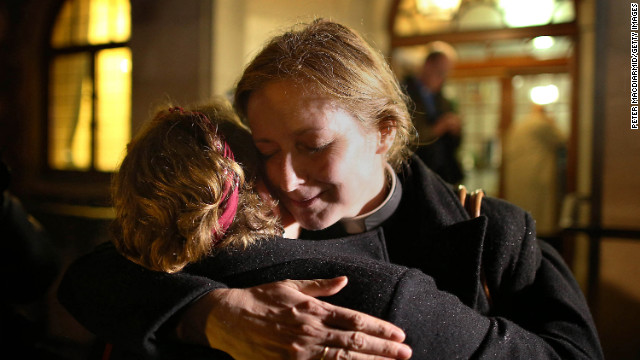
Reverend Marie-Elsa Bragg (R) hugs Reverend Angie Nutt after leaving Church House on November 20, 2012 in London, England. The Church of England's governing body, known as the General Synod, has voted against allowing women to become bishops.

By Eric Marrapodi, CNN Belief Blog Co-Editor

(CNN)– After decades of debate, the Church of England formally voted down draft legislation that would have allowed women to become bishops.

Debate on the draft legislation Tuesday spanned seven hours and saw more than 100 people voice support or opposition for the draft legislation.

At its General Synod meeting, despite the ardent support of the incoming Archbishop of Canterbury, the Rt. Rev. Justin Welby, the measure failed to secure a two-thirds majority in all of the three voting bodies of the church, the House of Bishops, the House of Clergy and the House of Laity...

 Archbishop of Canterbury-designate Justin Welby. Photo: Dylan Martinez/Reuters

"The ministry of women priests," Welby, the current Bishop of Durham and archbishop-designate, told the Synod, "has been powerful in all areas of the church except as part of the episcopacy."

"It is time to finish the job and vote for this measure. But also the Church of England needs to show how to develop the mission of the church in a way that demonstrates that we can manage diversity of view without division; diversity in amity, not diversity in enmity," he said, according to a copy of his statement posted on the church's website.

During the debate, Jane Pattison, from the Diocese of Sheffield, voiced opposition to the measure, according to the Episcopal News Service. She told the assembly that it would “promote the loss of conservative evangelical and traditional catholic ministry in the Church of England. I suggest that the church cannot afford this loss. … England cannot afford this loss if we are serious about sharing the Gospel with the nation...”

The legislation titled "Draft Bishops and Priests (Consecration and Ordination of Women) Measure" received broad support by the House of Bishops with 44 votes for, three against and two abstentions. The House of Clergy was similarly supportive with 148 in favor and 45 against. Both votes cleared the needed two-thirds majority.  But the 132 for and 74 against vote in the House of Laity came up six votes shy needed for the measure to pass.

The Bishop of Bristol said in a statement the vote was disastrous.

"Whilst I have never believed it necessary for anyone to leave the church on the basis of the measure before us today, others clearly took another view," the Rt. Rev. Mike Hill said in a statement posted by the Diocese of Bristol.

“It will be very difficult for those of us who have supported the ordination of women bishops to process our disappointment in the days ahead. My prayers are with the many people who are hurting, particularly women in our churches and those within and outside the church who are bemused and disillusioned by such a failure," Hill said.

The House of Bishops of the Church of England will hold an emergency session to consider the consequences of the vote on Wednesday morning according to a statement by the Church of England.

Link:

Sunday, April 22, 2012

Patrick Madrid's Advice to Catholic Parents: Don’t Let Your Kids Date Non-Catholics

By Patrick Madrid

I know, this is hardly revolutionary or unique advice, but I was recently asked about this issue by a young Catholic man who called my “Open Line” radio show (heard every Thursday at 3:00 p.m. ET). He had been dating a devoutly Presbyterian girl, and her father didn’t like it one bit that the guy was Catholic.

I think my response to his “what do I do now?” question may have surprised him. (It apparently surprised and even dismayed a few of my listeners, judging from some of the e-mails that came in after that show.)
My basic premise, which I advert to in this audio segment is that, more often than not, mixed marriages (i.e., when a Catholic marries a non-Catholic) are a recipe for serious problems down the road in that marriage.

My advice to Catholic parents is, teach your children well the importance of finding a devoutly Catholic spouse. Eventually, if you haven’t taught them this maxim and they, as a result, do not act on it, you will very likely see problems springing up in your extended family due to your sons and daughters being, in a certain sense, unequally yoked with non-Catholics. Word to the wise.


Link:

Friday, May 28, 2010

The Archbishop of Canterbury’s Pentecost letter to the Anglican Communion


Church of England Archbishop Rowan Williams:

"And when a province through its formal decision-making bodies or its House of Bishops as a body declines to accept requests or advice from the consultative organs of the Communion, it is very hard (as noted in my letter to the Communion last year after the General Convention of TEC) to see how members of that province can be placed in positions where they are required to represent the Communion as a whole. This affects both our ecumenical dialogues, where our partners (as they often say to us) need to know who it is they are talking to, and our internal faith-and-order related groups.

I am therefore proposing that, while these tensions remain unresolved, members of such provinces – provinces that have formally, through their Synod or House of Bishops, adopted policies that breach any of the moratoria requested by the Instruments of Communion and recently reaffirmed by the Standing Committee and the Inter-Anglican Standing Commission on Unity, Faith and Order (IASCUFO) – should not be participants in the ecumenical dialogues in which the Communion is formally engaged. I am further proposing that members of such provinces serving on IASCUFO should for the time being have the status only of consultants rather than full members. This is simply to confirm what the Communion as a whole has come to regard as the acceptable limits of diversity in its practice...

In our dealings with other Christian communions, we do not seek to deny our diversity; but there is an obvious problem in putting forward representatives of the Communion who are consciously at odds with what the Communion has formally requested or stipulated. This does not seem fair to them or to our partners...."

Thursday, February 25, 2010

Lutheran Church widens its tent

By Catherine Buday
Posted Feb 25, 2010 @ 10:30 AM

After St. Ann’s Catholic Church was closed in 2004, Stacie LaBoissiere and her husband began looking for another spiritual home. But they ruled out joining another Catholic parish.

“My sister is a lesbian, married to a woman,” LaBoissiere explained. “I knew that I did not want to remain Catholic as a result of their views on homosexuality. I could not become a member of a church that would condemn my sister. If a church would not accept my sister, then they would not accept me.”

The couple joined Marlborough’s St. Stephen Lutheran Church, after its pastor Scott Howard reassured them that the church welcomed everyone....

More


Full Text of Catholic Catechism Regarding Homosexuality

#2357 Homosexuality refers to relations between men or between women who experience an exclusive or predominant sexual attraction toward persons of the same sex. It has taken a great variety of forms through the centuries and in different cultures. Its psychological genesis remains largely unexplained. Basing itself on Sacred Scripture, which presents homosexual acts as acts of grave depravity, tradition has always declared that “homosexual acts are intrinsically disordered.” They are contrary to the natural law. They close the sexual act to the gift of life. They do not proceed from a genuine affective and sexual complementarity. Under no circumstances can they be approved.

#2358 The number of men and women who have deep-seated homosexual tendencies is not negligible. This inclination, which is objectively disordered, constitutes for most of them a trial. They must be accepted with respect, compassion, and sensitivity. Every sign of unjust discrimination in their regard should be avoided. These persons are called to fulfill God’s will in their lives and, if they are Christians, to unite to the sacrifice of the Lord’s Cross the difficulties they may encounter from their condition.

#2359 Homosexual persons are called to chastity. By the virtues of self-mastery that teach them inner freedom, at times by the support of disinterested friendship, by prayer and sacramental grace, they can and should gradually and resolutely approach Christian perfection.

Friday, January 15, 2010

Pope defends invitation to Anglicans to convert

By NICOLE WINFIELD
The Associated Press
Friday, January 15, 2010; 8:20 AM

VATICAN CITY -- Pope Benedict XVI defended his decision to invite disaffected Anglicans to join the Catholic Church en masse, saying Thursday it was the "ultimate aim" of ecumenism.

Benedict told members of the Vatican's Congregation for the Doctrine of the Faith that the invitation wasn't an attack on the church's reunification efforts with other Christians but designed to help them by bringing about "full and visible communion."

The Vatican in October announced it was making it easier for traditional Anglicans upset over women priests and gay bishops to join the Catholic Church while retaining many of their Anglican traditions, including married priests.

The move roiled the 77-million Anglican Communion, already on the verge of schism over woman and gay clergy, particularly since its spiritual leader, Archbishop Rowan Williams, wasn't consulted and was only informed at the last minute.

Anglicans split from Rome in 1534 when English King Henry VIII was refused a marriage annulment. For decades, the two churches have held theological discussions on trying to reunite, part of the Vatican's broader, long-term ecumenical effort to unify all Christians who have separated from Rome over the centuries.

The Vatican denied that it was poaching for converts in the Anglican pond and said its unprecedented invitation was merely a response to the many Anglican requests to join the Catholic Church.

The Vatican's invitation "is not in any way contrary to the ecumenical movement but shows, instead, its ultimate aim which consists of reaching full and visible communion of the Lord's disciples," Benedict told the members of the congregation, which he headed for a quarter century before becoming pope.

Benedict has made healing the divisions in the church a priority of his papacy, reaching out not only to Anglicans but also to Orthodox Christians and breakaway Catholics as well in a bid to unify all the faithful.

In that vein, he told congregation members that he hoped they resolve the remaining doctrinal problems with a group of traditionalist conservatives, the Society of St. Pius X, which includes a Holocaust-denying bishop.

The society, founded in 1969 by the late ultraconservative Archbishop Marcel Lefebvre, split from Rome over the modernizing reforms of the Second Vatican Council, particularly its outreach to Jews. Lefebvre and four bishops were excommunicated in 1988 after Lefebvre consecrated them without papal consent.

Last year, Benedict removed the excommunications, sparking outrage because one of the bishops, Bishop Richard Williamson, had denied that any Jews were gassed during the Holocaust.

Benedict apologized for mistakes in the Williamson affair but has insisted that his overall aim of bringing the society back under Rome's wing was necessary to prevent greater division in the church and promote unity.

"Achieving the common witness to faith of all Christians is a priority of the Church at all times," Benedict said Friday. "In this spirit, I trust in the commitment of the (congregation) so that the doctrinal problems that remain with the Society of St. Pius X ... can be overcome."

Tuesday, October 20, 2009

Left Freaks Out

The New York Times:

"And many Anglican and Catholic leaders expressed surprise, even shock, at something they said would undermine efforts at ecumenical dialogue and capitalize on deep divisions within the Anglican Church over issues like the ordination of gay bishops and blessing same-sex unions..."

JOINT STATEMENT BY THE ARCHBISHOP OF WESTMINSTER AND THE ARCHBISHOP OF CANTERBURY

http://d.yimg.com/a/p/ap/20091020/capt.1855481ee05b4218b7caa0057d19fbb2.britain_vatican_anglicans_lmd111.jpg?x=400&y=269&q=85&sig=zYiqLO_S2qjGjU6U8FJP7A--

Today’s announcement of the Apostolic Constitution is a response by Pope Benedict XVI to a number of requests over the past few years to the Holy See from groups of Anglicans who wish to enter into full visible communion with the Roman Catholic Church, and are willing to declare that they share a common Catholic faith and accept the Petrine ministry as willed by Christ for his Church.

Pope Benedict XVI has approved, within the Apostolic Constitution, a canonical structure that provides for Personal Ordinariates, which will allow former Anglicans to enter full communion with the Catholic Church while preserving elements of distinctive Anglican spiritual patrimony.

The announcement of this Apostolic Constitution brings to an end a period of uncertainty for such groups who have nurtured hopes of new ways of embracing unity with the Catholic Church. It will now be up to those who have made requests to the Holy See to respond to the Apostolic Constitution.

The Apostolic Constitution is further recognition of the substantial overlap in faith, doctrine and spirituality between the Catholic Church and the Anglican tradition. Without the dialogues of the past forty years, this recognition would not have been possible, nor would hopes for full visible unity have been nurtured. In this sense, this Apostolic Constitution is one consequence of ecumenical dialogue between the Catholic Church and the Anglican Communion.

The on-going official dialogue between the Catholic Church and the Anglican Communion provides the basis for our continuing cooperation. The Anglican Roman Catholic International Commission (ARCIC) and International Anglican Roman Catholic Commission for Unity and Mission (IARCCUM) agreements make clear the path we will follow together.

With God’s grace and prayer we are determined that our on-going mutual commitment and consultation on these and other matters should continue to be strengthened. Locally, in the spirit of IARCCUM, we look forward to building on the pattern of shared meetings between the Catholic Bishops Conference of England and Wales and the Church of England’s House of Bishops with a focus on our common mission. Joint days of reflection and prayer were begun in Leeds in 2006 and continued in Lambeth in 2008, and further meetings are in preparation. This close cooperation will continue as we grow together in unity and mission, in witness to the Gospel in our country, and in the Church at large.

London, 20 October 2009

+ Vincent Gerard Nichols

+ Rowan Williams


NOTE OF THE CONGREGATION FOR THE DOCTRINE OF THE FAITH ABOUT PERSONAL ORDINARIATES FOR ANGLICANS ENTERING THE CATHOLIC CHURCH

With the preparation of an Apostolic Constitution, the Catholic Church is responding to the many requests that have been submitted to the Holy See from groups of Anglican clergy and faithful in different parts of the world who wish to enter into full visible communion.

In this Apostolic Constitution the Holy Father has introduced a canonical structure that provides for such corporate reunion by establishing Personal Ordinariates, which will allow former Anglicans to enter full communion with the Catholic Church while preserving elements of the distinctive Anglican spiritual and liturgical patrimony. Under the terms of the Apostolic Constitution, pastoral oversight and guidance will be provided for groups of former Anglicans through a Personal Ordinariate, whose Ordinary will usually be appointed from among former Anglican clergy.

The forthcoming Apostolic Constitution provides a reasonable and even necessary response to a world-wide phenomenon, by offering a single canonical model for the universal Church which is adaptable to various local situations and equitable to former Anglicans in its universal application. It provides for the ordination as Catholic priests of married former Anglican clergy. Historical and ecumenical reasons preclude the ordination of married men as bishops in both the Catholic and Orthodox Churches. The Constitution therefore stipulates that the Ordinary can be either a priest or an unmarried bishop. The seminarians in the Ordinariate are to be prepared alongside other Catholic seminarians, though the Ordinariate may establish a house of formation to address the particular needs of formation in the Anglican patrimony. In this way, the Apostolic Constitution seeks to balance on the one hand the concern to preserve the worthy Anglican liturgical and spiritual patrimony and, on the other hand, the concern that these groups and their clergy will be integrated into the Catholic Church.

Cardinal William Levada, Prefect of the Congregation for the Doctrine of the Faith which has prepared this provision, said: "We have been trying to meet the requests for full communion that have come to us from Anglicans in different parts of the world in recent years in a uniform and equitable way. With this proposal the Church wants to respond to the legitimate aspirations of these Anglican groups for full and visible unity with the Bishop of Rome, successor of St. Peter."

These Personal Ordinariates will be formed, as needed, in consultation with local Conferences of Bishops, and their structure will be similar in some ways to that of the Military Ordinariates which have been established in most countries to provide pastoral care for the members of the armed forces and their dependents throughout the world. "Those Anglicans who have approached the Holy See have made clear their desire for full, visible unity in the one, holy, catholic and apostolic Church. At the same time, they have told us of the importance of their Anglican traditions of spirituality and worship for their faith journey," Cardinal Levada said.

The provision of this new structure is consistent with the commitment to ecumenical dialogue, which continues to be a priority for the Catholic Church, particularly through the efforts of the Pontifical Council for the Promotion of Christian Unity. "The initiative has come from a number of different groups of Anglicans," Cardinal Levada went on to say: "They have declared that they share the common Catholic faith as it is expressed in the Catechism of the Catholic Church and accept the Petrine ministry as something Christ willed for the Church. For them, the time has come to express this implicit unity in the visible form of full communion."

According to Levada: "It is the hope of the Holy Father, Pope Benedict XVI, that the Anglican clergy and faithful who desire union with the Catholic Church will find in this canonical structure the opportunity to preserve those Anglican traditions precious to them and consistent with the Catholic faith. Insofar as these traditions express in a distinctive way the faith that is held in common, they are a gift to be shared in the wider Church. The unity of the Church does not require a uniformity that ignores cultural diversity, as the history of Christianity shows. Moreover, the many diverse traditions present in the Catholic Church today are all rooted in the principle articulated by St. Paul in his letter to the Ephesians: ‘There is one Lord, one faith, one baptism’ (4:5). Our communion is therefore strengthened by such legitimate diversity, and so we are happy that these men and women bring with them their particular contributions to our common life of faith."

Background information

Since the sixteenth century, when King Henry VIII declared the Church in England independent of Papal Authority, the Church of England has created its own doctrinal confessions, liturgical books, and pastoral practices, often incorporating ideas from the Reformation on the European continent. The expansion of the British Empire, together with Anglican missionary work, eventually gave rise to a world-wide Anglican Communion.

Throughout the more than 450 years of its history the question of the reunification of Anglicans and Catholics has never been far from mind. In the mid-nineteenth century the Oxford Movement (in England) saw a rekindling of interest in the Catholic aspects of Anglicanism. In the early twentieth century Cardinal Mercier of Belgium entered into well publicized conversations with Anglicans to explore the possibility of union with the Catholic Church under the banner of an Anglicanism "reunited but not absorbed".

At the Second Vatican Council hope for union was further nourished when the Decree on Ecumenism (n. 13), referring to communions separated from the Catholic Church at the time of the Reformation, stated that: "Among those in which Catholic traditions and institutions in part continue to exist, the Anglican Communion occupies a special place."

Since the Council, Anglican-Roman Catholic relations have created a much improved climate of mutual understanding and cooperation. The Anglican-Roman Catholic International Commission (ARCIC) produced a series of doctrinal statements over the years in the hope of creating the basis for full and visible unity. For many in both communions, the ARCIC statements provided a vehicle in which a common expression of faith could be recognized. It is in this framework that this new provision should be seen.

In the years since the Council, some Anglicans have abandoned the tradition of conferring Holy Orders only on men by calling women to the priesthood and the episcopacy. More recently, some segments of the Anglican Communion have departed from the common biblical teaching on human sexuality—already clearly stated in the ARCIC document "Life in Christ"—by the ordination of openly homosexual clergy and the blessing of homosexual partnerships. At the same time, as the Anglican Communion faces these new and difficult challenges, the Catholic Church remains fully committed to continuing ecumenical engagement with the Anglican Communion, particularly through the efforts of the Pontifical Council for the Promotion of Christian Unity.

In the meantime, many individual Anglicans have entered into full communion with the Catholic Church. Sometimes there have been groups of Anglicans who have entered while preserving some "corporate" structure. Examples of this include, the Anglican diocese of Amritsar in India, and some individual parishes in the United States which maintained an Anglican identity when entering the Catholic Church under a "pastoral provision" adopted by the Congregation for the Doctrine of the Faith and approved by Pope John Paul II in 1982. In these cases, the Catholic Church has frequently dispensed from the requirement of celibacy to allow those married Anglican clergy who desire to continue ministerial service as Catholic priests to be ordained in the Catholic Church.

In the light of these developments, the Personal Ordinariates established by the Apostolic Constitution can be seen as another step toward the realization the aspiration for full, visible union in the Church of Christ, one of the principal goals of the ecumenical movement.

Monday, October 19, 2009

Italian media speculates: Vatican will announce massive reception of Anglicans into Catholic Church tomorrow

.- Several Italian newspapers speculated on Monday that the Vatican may welcome a large number of members from the Traditional Anglican Communion into the Catholic Church tomorrow. The group previously separated from the Anglican Communion due to issues such as the ordinations of both women and sexually active homosexuals.

According to Giacomo Galeazzi from the Italian daily La Stampa, the press conference to be held tomorrow at the Vatican press office by Cardinal William Joseph Levada, Prefect of the Congregation for the Doctrine of the Faith; and Archbishop Augustine DiNoia, Secretary of the Congregation for the Divine Worship and Discipline of the Sacraments, will be the occasion in which the reception of the Anglican group, which claims to have some 500,000 members –among clergy and laity- will be officially announced.

“The news story, already anticipated by some Australian media, could be finally confirmed during the press briefing that was announced this afternoon by the Vatican press office,” Galeazzi wrote.

Galeazzi also claimed that the Traditionalist Anglicans have already signed a document of adherence to the Catechism of the Catholic Church and have symbolically deposited it at a Marian shrine in England.

“Once reunited with Rome, they may keep most of the Liturgical celebrations according to their tradition, which is closer to the Tridentine Mass,” La Stampa explained, adding that they would also “keep their married clergy but not married bishops.”

The Italian Vatican reporter also noted that since the Anglican priestly ordination is not valid, those who want to remain priests within the Catholic Church would have to be ordained, most likely after passing a theological exam.

The move by the Traditionalists could have a significant impact on other Anglicans who still remain within the communion, but are extremely frustrated not only with the ordination of women as Anglican priests and bishops, but especially with the decision of the American Episcopalians – members of the Anglican communion- to ordain sexually active homosexuals as priests and bishops.

The ordination of Eugene Robinson as the first actively homosexual bishop in 2004, sparked an unprecedented division inside the Anglican Communion.

According to Galeazzi, the group of Anglicans that could be received into the Catholic Church tomorrow may be erected as a personal prelature, which has the same canonical status held by Opus Dei.

Tuesday, September 22, 2009

Will the "Third Rome" Reunite With the "First Rome"?

Recent Meeting Could Mark Turning Point

By Robert Moynihan

WASHINGTON, D.C., SEPT. 21, 2009 (Zenit.org)- Sometimes there are no fireworks. Turning points can pass in silence, almost unobserved.

It may be that way with the "Great Schism," the most serious division in the history of the Church. The end of the schism may come more quickly and more unexpectedly than most imagine.

On Sept. 18, inside Castel Gandolfo, the Pope's summer palace about 30 miles outside Rome, a Russian Orthodox Archbishop named Hilarion Alfeyev, 43 (a scholar, theologian, expert on the liturgy, composer and lover of music), met with Benedict XVI, 82 (also a scholar, theologian, expert on the liturgy and lover of music), for almost two hours, according to informed sources. (There are as yet no "official" sources about this meeting -- the Holy See has still not released an official communiqué about the meeting.)

The silence suggests that what transpired was important -- perhaps so important that the Holy See thinks it isn't yet prudent to reveal publicly what was discussed.

But there are numerous "signs" that the meeting was remarkably harmonious.

If so, this Sept. 18 meeting may have marked a turning point in relations between the "Third Rome" (Moscow) and the "First Rome" (Rome) -- divided since 1054.

Archbishop Hilarion was in Rome for five days last week as the representative of the new Russian Orthodox Patriarch Kirill of Moscow.

One key person Archbishop Hilarion met with was Cardinal Walter Kasper. On Sept. 17, the cardinal told Vatican Radio that he and Archbishop Hilarion had a "very calm conversation."

Cardinal Kasper also revealed something astonishing: that he had suggested to the archbishop that the Orthodox Churches form some kind of "bishops' conference at the European level" that would constitute a "direct partner of cooperation" in future meetings.

This would be a revolutionary step in the organization of the Orthodox Churches.

Papal-Patriarch encounter?

Cardinal Kasper said a Pope-Patriarch meeting was not on the immediate agenda, and would probably not take place in Moscow or Rome, but in some "neutral" place (Hungary, Austria and Belarus are possibilities).

Archbishop Hilarion himself revealed much about how his Rome visit was proceeding when he met on the evening of Sept. 17 (before his meeting with the Pope) with the Community of Sant'Egidio, an Italian Catholic group known for its work with the poor in Rome.

"We live in a de-Christianized world, in a time that some define -- mistakenly -- as post-Christian," Archbishop Hilarion said. "Contemporary society, with its practical materialism and moral relativism, is a challenge to us all. The future of humanity depends on our response… More than ever before, we Christians must stand together."

A report from Interfax, the news service of the Moscow Patriarchate, on Sept. 18 revealed that Archbishop Hilarion spoke to the Pope about "cooperation between the Russian Orthodox and Roman Catholic Churches in the area of moral values and of culture" -- in particular during the "Days of Russian Spiritual Culture," a type of exhibit with lectures scheduled for spring 2010 in Rome. (One might imagine that the Pope himself could attend such an exhibition).

In memory of the visit, Archbishop Hilarion gave the Pope a pectoral cross, made in workshops of Russian Orthodox Church, the report said, Interfax reported.

Today, an Interfax report supplied details of Hilarion's remarks this morning in the catacombs of St. Callixtus.

"Denied by the world, far from human eyes, deep under ground in caves, the first Roman Christians performed the feat of prayer," Hilarion said. "Their life brought the fruit of holiness and martyr heroism. The Holy Church was built on their blood shed for Christ."

Then the Church came out of the catacombs, but Christian unity was lost, the archbishop said.

Archbishop Hilarion said that human sin is the cause of all divisions, while Christian unity can be restored only in the way of sanctity.

"Each of us, conscientiously fulfilling a task the Church has given him or her, is called to personally contribute to the treasury of Christian sanctity and work to achieve God-commanded Christian unity," the archbishop said.

A second Interfax report today added further information about the meeting with the Pope.

Growing influence

"During a talk with Pope Benedict XVI, Archbishop Hilarion of Volokolamsk pointed out the status of Orthodox believers in Western Ukraine where three Orthodox dioceses had been almost eliminated as a result of coercive actions of Greek Catholics in late 1980s and early 1990s," Interfax reported.

Archbishop Hilarion "stated the need to take practical steps to improve the situation in Western Ukraine," within the territories of Lvov, Ternopol and Invano-Frankovsk Dioceses, the report said.

Meanwhile, in Russia itself, the influence of the Russian Orthodox Church, headed by Patriarch Kirill, seems to be growing, though not without opposition.

The rise in Russia of Kirill and his increasing influence in legislative matters seems to be arousing opposition from the "siloviki," forces connected with the old KGB.

In an article in the current issue of Argumenty Nedeli, Andrey Uglanov says that Kirill's extraordinary activity has attracted attention from some who do not like to have their positions questioned, let alone challenged. And that has become Kirill's "big problem."

These "siloviki," Uglanov says, have been offended by Kirill's "anti-Stalinist and anti-Bolshevik actions," including his appearance at the Solovetsky stone in Moscow's Lubyanka Square on the very Day of the Memory of the Victims of Political Repression.

In this context, Hilarion's visit to Rome takes on even more importance.

The Russian Orthodox Church is a power in Russia, but it faces opposition and needs allies.

What is occurring in Hilarion's visit to Rome, then, may have ramifications not only for the overcoming of the "Great Schism," but also for the cultural, religious and political future of Russia, and of Europe as a whole.

It is especially significant, in this context, that Hilarion, Kirill's "Foreign Minister," has some of the same deep interests as Benedict XVI: the liturgy, and music.

"As a 15-year-old boy I first entered the sanctuary of the Lord, the Holy of Holies of the Orthodox Church,” Hilarion once wrote about the Orthodox liturgy. “But it was only after my entrance into the altar that the 'theourgia,' the mystery, and 'feast of faith' began, which continues to this very day.

"After my ordination, I saw my destiny and main calling in serving the Divine Liturgy. Indeed, everything else, such as sermons, pastoral care and theological scholarship were centered around the main focal point of my life -- the liturgy."

Liturgy

These words seem to echo the feelings and experiences of Benedict XVI, who has written that the liturgies of Holy Saturday and Easter Sunday in Bavaria when he was a child were formative for his entire being, and that his writing on the liturgy (one of his books is entitled "Feast of Faith") is the most important to him of all his scholarly endeavors.

"Orthodox divine services are a priceless treasure that we must carefully guard," Hilarion has written. "I have had the opportunity to be present at both Protestant and Catholic services, which were, with rare exceptions, quite disappointing… Since the liturgical reforms of the Second Vatican Council, services in some Catholic churches have become little different from Protestant ones."

Again, these words of Hilarion seem to echo Benedict XVI's own concerns. The Pope has made it clear that he wishes to reform the Catholic Church's liturgy, and preserve what was contained in the old liturgy and now risks being lost.

Hilarion has cited the Orthodox St. John of Kronstadt approvingly. St. John of Kronstadt wrote: "The Church and its divine services are an embodiment and realization of everything in Christianity... It is the divine wisdom, accessible to simple, loving hearts."

These words echo words written by Cardinal Ratzinger, now Benedict XVI, who often said that the liturgy is a "school" for the simple Christian, imparting the deep truths of the faith even to the unlearned through its prayers, gestures and hymns.

Hilarion in recent years has become known for his musical compositions, especially for Christmas and for Good Friday, celebrating the birth and the Passion of Jesus Christ. These works have been performed in Moscow and in the West, in Rome in March 2007 and in Washington DC in December 2007.

Closer relations between Rome and Moscow, then, could have profound implications also for the cultural and liturgical life of the Church in the West. There could be a renewal of Christian art and culture, as well as of faith.

All of this was at stake in the quiet meeting between Archbishop Hilarion and Benedict XVI on Friday afternoon, in the castle overlooking Lake Albano.

Tuesday, July 21, 2009

The Semi-Permeable Membranes of the Various Protestantisms


by Mark P. Shea
7/21/09

One basic rule of thumb to understand in Catholic/Protestant conversations is that it is not the case that Catholics rely on Sacred Tradition and Protestants don't. Rather, Catholics (and by this I mean "educated Catholics speaking out of the Magisterial teaching of the Church") rely on Sacred Tradition and know they do, while Protestants rely on (parts) of Sacred Tradition and (usually) don't know they do.

So, for instance, despite Paul's prescriptions (directed only at clergy of his day) that a man must be the husband of but one wife, nowhere in the text of Scripture is it made clear that Christian marriage must be monogamous for all (a fact that did not escape Luther or John Milton). Nowhere does Scripture spell out that the Holy Spirit is a person, much less the Third Person of the Blessed Trinity, consubstantial with the Father and the Son. Similarly, you will look in vain for instructions in Scripture on how to contract a valid marriage (unless you buy this list of "Top 10 Ways to Find a Wife, According to the Bible"):
10. Find an attractive prisoner of war, bring her home, shave her head, trim her nails, and give her new clothes. Then she's yours (Dt 21:11-13).
9. Find a prostitute and marry her (Hos 1:1-3).
8. Find a man with seven daughters, and impress him by watering his flock (Moses, Ex 2:16-21).
7. Purchase a piece of property, and get a woman as part of the deal (Boaz, Ru 4:5-10).
6. Go to a party and hide. When the women come out to dance, grab one and carry her off to be your wife (Benjaminites, Jgs 21:19-25).
5. Have God create a wife for you while you sleep (Adam, Gn 2:19-24).
4. Kill any husband and take his wife (David, 2 Sm 11).
3. Cut 200 foreskins off of your future father-in-law's enemies and get his daughter for a wife (David, 1 Sm 18:27).
2. Even if no one is out there, just wander around a bit and you'll definitely find someone (Cain, Gn 4:16-17).
1. Don't be so picky. Make up for quality with quantity (Solomon, 1 Kgs 11:1-3).

Of course, this doesn't really help much. The fact is, the Bible says "marriage is good" but gives us not one word of instruction on how to do it. That's because Scripture is not and never was intended to be the Big Book of Everything. And yet, of course, Protestants all over the world get married, believe in God the Holy Spirit, and have but one spouse because, as James Dobson says, God's plan is one man and one woman. How do they do this when Scripture is so unclear?
Whether they realize it or not, they do it by accepting Sacred Tradition percolated to them from the Catholic Church through the Protestant tradition. It's the same way they know that the books of the Bible they accept are supposed to be books of the Bible. It's the same way they know that public revelation closed with the death of the apostles, even though Scripture is completely silent on the matter (Revelation 22:18-19 doesn't count since that passage refers to the Book of Revelation, not to the Bible, which was not fully collated -- and from which Revelation was sometimes excluded -- before the late fourth century).
Retention of Catholic Sacred Tradition fragments has kept Protestantism in such sanity as it still possesses. So when the Bible Answer Man appeals to "historic Christianity" in understanding what the Bible means, that's typically a good thing. He's appealing to Sacred Tradition and agreeing with the Church. It's Eupocrisy in action!

However, in those places where Protestantism attempts to reject Catholic Sacred Tradition, the narrative suddenly and wrenchingly changes. Suddenly, the demand is made for nothing less than an explicit proof text from the Bible. It works like this:
  1. If a thing is condemned by the Church but permitted by the Protestant (say, gay marriage), the demand is for an explicit text forbidding it. ("Show me where Jesus said one word about not allowing gay marriage! That's just the Church imposing its purely human ideas on what Jesus came to say.")
  1. Conversely, if a thing is allowed by the Church but condemned by the Protestant, the demand is for an explicit text commanding it. ("Where in the Bible do you find anyone asking us to pray to dead people? That's just the Church imposing it's purely human ideas on what Jesus came to say.")
Note how the terms of the argument shift to suit the "Heads I win, tails the Church loses" agenda. It's no longer good enough to say (as the Protestant generally does when, for instance, arguing for the divinity of the Holy Spirit), "Here are biblical passages which, taken together, point to the reality that the Holy Spirit is a Divine Person even though there is no text that says 'The Holy Spirit is the third person of the Trinity.'"

No, arguing from such obvious implication is out the window. In many circles, even a nearly algebraic piece of logic like
  1. Jesus is God.
  2. Mary is His Mother.
  3. Therefore, Mary is the Mother of God.
. . . gets rejected as "inbred reasoning" since Catholics can't produce the Bible verse that says explicitly, "Mary is the Mother of God." Suddenly, only direct, explicit testimony and instruction in legally watertight language will do.
How this works on the ground can be seen everywhere. The Protestant who wants to permit abortion points out that there is no unequivocal commandment in either the Old or New Testament saying, "You shall not have an abortion," and evinces absolutely no interest in how the texts we do have ("You shall not murder," for instance) have been universally read by the Church from the earliest times. Likewise, the Protestant who dogmatically rejects, say, prayer to the saints simply ignores you if you point to the fact that Scripture shows us that the dead (like Moses on the Mount of Transfiguration) are aware of what's happening on earth, that we are told that "we shall be like Christ" (who intercedes for us), that the Body of Christ is One (not split in two by death), and that the early Church understood all this to imply that we can ask prayers of the dead just as we ask them of the living.

As remote as the flaky pro-choice Episcopalian and the starchy Bible-thumping Fundamentalist preacher may seem to be from each other, they share a deep commonality in the way they reject whatever aspect of Catholic teaching they dislike. From liberal to conservative, the argument proceeds: "Unless the Bible explicitly commands what I forbid or forbids what I want to do, then the Catholic teaching I dislike is 'unbiblical.'" (Of course, the word "Bible" is not unbiblical -- even though it also never appears in Scripture -- because the word "Bible" is a fragment of extra-biblical Christian tradition generally acceptable to Protestants.)

Indeed all the various forms of Protestantism have this (and only this) one feature in common. They may differ on Mary or baptism or the divinity of Jesus or even the existence of God (if you include Unitarians as a particularly robust form of Protestantism that has jettisoned more of Catholic teaching than its predecessors). But they all agree on erecting semi-permeable membranes in which some (but not all) elements of Sacred Tradition are allowed through (different bits for different groups).
Those elements that are allowed through are called "the witness of historic Christianity" or "the clear implication of Scripture" or "the obviously reasonable position." Those not allowed through are called "human tradition" or "myths" or "the unbiblical teachings of Rome" or "relics of patriarchy" or "ancient superstition" (even when they are the obvious testimony and practice of all the apostolic communions in the world since the beginning of the Church.) Finally, to the filtered-in elements of real apostolic theological and moral teaching are stapled sundry human traditions like sola scriptura or some theory about predestinarianism or the "perspicuity of Scripture" or the need to speak in tongues or (in the past) the curse on Canaan as a biblical basis for American chattel slavery or (more recently) the glories of homosexuality or abortion.


Of course, as history goes on and at least some sectors in Protestantism allow the centrifugal force of Private Judgment to move them further and further from both Sacred Tradition and (inevitably, given the logic) Sacred Scripture as well, you reach a point where appeals to Scripture as an authority in debate don't matter, since Scripture is, after all, simply the written aspect of Tradition. Sooner or later, it occurs to people trending away from acceptance of Apostolic Tradition to ask, "If I've rejected everything else the Church says, why should I care about its 'holy' writings? I can find a hundred German theologians who say of the supposed 'word of God' what I've been saying of 'Sacred Tradition' all along."

For the present, many (graying) Evangelicals still retain a deep reverence for the sacred writings of Holy Church (though there are some signs that the itch to deconstruct Scripture will wreak enormous damage among those who come to clearly face the choice between the pole in Protestantism that seeks the Apostolic Tradition and the pole that seeks to keep deconstructing until nothing, including Scripture, is left).

For those still in this betwixt-and-between stage, who reverence Scripture and have this conflicted grasp of an Apostolic Tradition coming to them through a semi-permeable membrane, what is needed is a paradigm shift: the realization first of the shell game that is played in order to filter out Catholic traditions according to the preferences of the particular Protestant tradition one adheres to and, second, a willingness to acknowledge the possibility that when this is honestly done, it will be found that no Catholic doctrine -- none whatsoever --actually contradicts Scripture and that all that is essential in Scripture is also essential in Catholic teaching.
That's a terrifying prospect if one has accepted any of the various myths by which the sundry Protestantisms justify the rejection of whichever bits of Catholic teaching they reject. All the myths -- ranging from "I listen only to the Bible alone and not to the traditions of men!" to "I accept Tradition within reason, except that church tradition is never accepted as equal in authority to canonical Scripture; it is always subject to revision provided a scriptural basis can be found" -- are equally doomed if that turns out to be so, which is why those committed to the sundry Protestant schemas require not new information but an alteration of the will: a willingness to consider the possibility that there is no conflict between Catholic Tradition and Scripture and that every apparent conflict is just that -- apparent and not real.
Once that possibility is squarely faced and accepted, the argument for receiving all of Sacred Tradition rather than simply the bits you like can naturally follow in a rather reasonable way. But first, the membrane(s) must go.

Mark P. Shea is a senior editor for
www.CatholicExchange.com and a columnist for InsideCatholic. Visit his blog at markshea.blogspot.com.

Thursday, July 16, 2009

Radio Replies First Volume - "Bible Only" a false principle

565. The Gospel of Christ is simplicity itself.

In one way it is. It tells us clearly that Christ established a definite Church which He commissioned to teach all nations. It is very simple from this point of view, for men have but to accept the Catholic Church, and be taught by that Church.

But the Gospel is not simplicity itself in the way you intend. Men have devoted their lives to the study of the Gospels, preparing themselves for the task by profound research in the Hebrew, Syrian, Arabic, Greek, and Latin languages. And even then, many passages are most difficult to understand.

566. But at least the plan of salvation can be understood by the simplest person. We Protestants even tell our children to read their Bibles in order to discern it.

According to the findings of your simple readers there must be hundreds of conflicting plans of salvation, all revealed by the one Christ! As for the capacity of your children, you might as well give them the article in the Encyclopaedia Brittanica on Spectroscopic Analysis as the subject matter of their studies. But the Bible itself is against your theory. Thus St. Peter says that in Scripture there are certain things "hard to be understood, which the unlearned and unstable wrest, as they do also the other Scriptures, to their own destruction." 2 Pet 3:16. To his mind the private interpretation of Scripture can be most dangerous.

567. God has given us brains to think for ourselves. We do not need Help to understand Scripture.

God had given men brains before He came to teach them Himself, and He came to teach them precisely because their brains could not succeed in finding out the things which were to their peace. If you say that His revealed teachings in the Scriptures together with our brains are enough, those very revealed teachings tell you that they are not. Even in the Old Law God said, "The lips of the Priest shall keep knowledge, and they shall seek the law at his mouth." Mal 2:7. In the New Law Christ sent His Church to teach men, transferring to His Church that authority of God once possessed by the Priests of the Old Law. In the New Testament itself we find Philip the Deacon saying to the Ethiopian, who was reading the Scriptures, "Thinkest thou that thou understandest what thou readest?" and the Ethiopian replying, "And how can I unless some man show me?" Acts 8:30. St. Peter, too, explicitly refutes your ideas. "No prophecy of Scripture," he writes, "is of any private interpretation." 2 Pet 1:20.

568. St. Peter means that the Prophets did not prophesy by their own will, but by the Holy Spirit. He does not refer to interpretation by us.

Your own Protestant Bishop Ellicott says of these verses, "The words private interpretation might seem to mean that the sacred writers did not get their prophecies by private interpretation, but by divine inspiration. But this is certainly not the meaning. The real meaning is that the reader must not presume to interpret privately that which is far more than ordinary human thought."

569. Any man who can think has the moral right to interpret anything.

He has not. The very laws of the state are not subject to the interpretation of each and every citizen. There is such a thing as thinking erroneously. In difficulties of civil law a man consults a lawyer who knows legal practice and parallel statutes. Who gives you the right to take greater liberties with divine legislation? A man who knows nothing of Hebrew or Greek, and is quite untrained in Scriptural exegesis, would misapprehend the sense of Scripture in hundreds of places.

570. Did not Christ promise that He would send the Holy Spirit to teach us all truth?

He did not promise that the Holy Spirit would teach each individual separately. If every individual were under the guidance of the Holy Spirit, all who read Scripture sincerely should come to the same conclusion. But they do not. The frightful chaos as to the meaning of Scripture is proof positive that the Holy Spirit has not chosen this way of leading men to the truth. It is blasphemy to say that the Holy Spirit does not know His own mind, and that He deliberately leads men into contradictory notions. Christ promised to preserve His Church as a Church by the guidance of the Holy Spirit, and the only Church which shows signs of having been preserved is the consistent Catholic Church. The individual is guided by the Holy Spirit to a certain extent in the ways of holiness, but in the knowledge of revealed truth he is to be guided by the Catholic Church which Christ sent to teach all nations.

571. I don't see the need of learning to understand a simple story for simple people.

The Bible is not a simple story for simple people. We live thousands of years after the Bible was written, and our language and customs are very different now. No book written at one age is easy for another age. The study of antiquities demands a knowledge of primitive languages of which few are capable, and for which still fewer have the time. Anyway God never intended the Bible to be the sole guide to religion for all time. Christ taught orally and with authority, and He sent His Church to teach in the same way and with the same authority.

572. Hoiv does it help to know Hebrew or Greek?

Because one must know what the original words meant in the language in which Scripture was written. A knowledge of Hebrew and Greek soon shows that the translators do not always find an English word to express the exact sense of the original. God inspired the thoughts of the original writers, not the work of the translators. And if you read a sense into Scripture which God did not intend at all, you no longer have God's Word.

573. Christ chose poor fishermen, not learned men.

He trained them personally, and infused into their minds an exact knowledge of His doctrine. We cannot claim to have received a similar revelation, that we should rank ourselves with them.

574. Then Catholics have to believe just what the Priest likes to tell them?

The Priest cannot tell the people just what he likes. He is obliged to teach just what Christ taught, and which has been taught him in the Name of Christ by the infallible Catholic Church.

575. Is your Church afraid that people will form opinions for themselves?

If we consider some of the opinions people have formed for themselves from their private reading of Scripture there is need to be afraid. Christ's method was to establish a teaching Church. Protestants have a peculiar method of their own, but you cannot blame the Catholic Church for not using the Protestant method, a method which has led to nothing but uncertainty and widespread unbelief.

576. Admitting the necessity of guidance, are not our Protestant ministers as capable as Catholic Priests in telling us what Scripture means?

They might be, if Priests had not an infallible Catholic Church to guide them. The Catholic Church rejoices in the special assistance of the Holy Spirit, and the Priest has the help of her defined doctrines and the constant Catholic tradition as a safeguard. But your Protestant ministers do not claim to be spokesmen of an infallible Church. On their own principles they have to admit that they are possibly wrong. And as a matter of fact, where all Priests are agreed in the essential teachings of Scripture, your ministers come to all kinds of contradictory conclusions. The unity of teaching among Catholic Priests is a greater indication of capability than the chaos which prevails outside the Catholic Church. But the capability of Catholic Priests has little to do with relative personal attainments. It is derived from the authority of the infallible Catholic Church.

577. You speak of the authority of the Church and the weight of tradition. But I have been taught that Scripture is the only rule of faith.

You have been taught wrongly. Scripture itself denies that it is the only rule of faith. The last verse of St. John's Gospel tells us that not all concerning Our Lord's work is contained in Scripture. St. Paul tells us over and over again that much of Christian teaching is to be found in tradition. One who clings to the reading of the Bible only might be able to cite hundreds of texts yet not know Christian doctrine by any means. In fact, the adoption of the Bible only has led to as many opinions as there are men amongst non-Catholics. Finally, Scripture tells us most clearly that the Catholic Church is the rule of faith, that Church which Christ sent to teach all nations and which He commanded men to hear and obey. He who believes in Scripture as his only guide ends by believing in his own mistaken interpretations of the Bible, and that means that he ends by believing in himself.

578. Is not the Church built on the knowledge it gets from the Bible?

No. The Catholic Church was built by Christ and upon Christ before a line of the New Testament was written. She received her doctrine immediately from the lips of Christ, and is safeguarded from error in her teaching by the Holy Spirit. Between 40 and 80 years after her foundation, some of her members wrote the Books of the New Testament. If the Gospels were the only rule of faith, then before they were written there could have been no Christian rule of faith at all!

579. Christ gave us the command to search the Scriptures. Jn 5:39.

That was a retort, not a command, and you cannot turn a particular rebuke into a universal law. Were it a universal law, it would have been impossible of fulfillment by the vast majority during the fourteen centuries prior to the invention of the printing press! But take the context. The Jews, who boasted of their fidelity to the Mosaic Law, would not believe in Christ. He challenged them: "(You) search the Scriptures, for you think in them to have life everlasting; and the same are they that give testimony of me." The Catholic Church could say in the same way to Protestants: "You are ever speaking of searching the Scriptures as opposed to my methods, and think in them to have everlasting life independently of me; yet the same are they that give testimony of me."

580. Do we not read that the early Christians searched the Scriptures daily? Acts 17:11.

They first received the true doctrine from the teaching Church, and then merely checked it in the Scriptures. That is the right procedure, and Catholics today do the same. But your way is not first to be taught by the Church, and then verify, but to try to make out your own religion from the Bible with an untrained mind and by that private interpretation which Scripture itself forbids.

581. Well, I am afraid of nothing as long as I have the pure Word of God to fall back upon.

Without the Catholic Church you cannot prove it to be the pure Word of God. Nor need anyone be afraid of the pure Word of God. What we must fear is the Word of God adulterated by people who read into it whatever they like.

Saturday, July 11, 2009

Radio Replies First Volume: "Outside the Church no salvation"

536. Do you maintain that one is obliged to join your infallible, one, holy, catholic, apostolic, and indefectible Church, if he wishes to be saved?

If a man realizes that the Catholic Church is the true Church, he must join it if he wishes to save his soul. That is the normal law. But if he does not realize this obligation, is true to his conscience, even though it be erroneous, and dies repenting of any violations of his conscience, he will get to Heaven. In such a case, it would not have been his fault that he was a non-Catholic and God makes every allowance for good faith.

537. So I deserve Hell because I am a non-Catholic?

If you say, "I know quite well that the Catholic Church is the true Church, which God obliges me to join, but what of that!" then you deserve Hell. That would be a serious sin. But apparently you do not realize this obligation. Your position is based upon insufficient or false information, and this leads you to a wrong if sincere conclusion.

538. If one has to be a Catholic to get to Heaven I shall be glad to stay outside.

That is an absurd statement, for there is no eternal happiness outside Heaven. But I understand what you mean. You believe the Catholic Church to be wrong, and you will not do what you believe to be evil that good may come. But God does not want you to do that. Nor do I. As long as you believe the Catholic Church to be wrong, you are obliged not to join it. Yet if ever God gives you the grace to perceive its truth, you will be obliged to join it, no matter what the cost in renouncing your previous attachments.

539. If a Catholic leaves his Church, and outside that Church lives a good and devout life, could he be saved?

You give an impossible case. To live a devout life is to live a life devoted to God. Now no Catholic can have a really sufficient reason to doubt the truth of his Church. If doubts do come, he owes it to God to make sure of his position before he acts, and inquiry will show such doubts to be unfounded. If he leaves without such inquiry, he is to blame for throwing away the best of God's gifts. If he inquires sincerely, he stays.

540. But what if he be fully convinced that the Catholic Church is wrong, even though his conscience be erroneous, would you blame him for leaving rather than violate his conscience by remaining?

I would blame him for allowing his conscience to become so convinced by insufficient reasons, and for not studying the grounds which absolutely guarantee the Catholic Church as the only completely Christian Church. His first difficulties should have led him to seek advice from competent guides.

541. So if a Catholic becomes a Protestant, he has no hope?

While there is life there is always hope. Such a man may return to the Catholic Church, or at least die sincerely repenting of ever having left it.

542. Are Protestants free to leave the Protestant Church, yet Catholics not free to leave the Catholic Church?

One may always renounce error for truth; but no one is free to forsake truth for error.

543. Christ died for all. He did not say that we must all be Catholics.

Since Christ died for all, it follows that He wants all to belong to the one Church He established and endowed with His authority.

544. Many clever men have examined the Roman claims and have rejected them. They do not think it necessary to join the Catholic Church.

Equally clever men are convinced of its necessity. After all, there are clever men who reject Christianity itself, but that does not make the truth of Christianity uncertain. We cannot argue from the degrees of intelligence in those who accept or reject the Catholic claim. Such differences of human thought prove nothing except that men differ. The real question is not affected. We must study carefully the value of the foundations upon which the claim rests.

545. You said that a Protestant in good faith could be saved. Does not that admit that his religion is sufficiently true?

No. Such Protestants are saved not because of, but in spite of their erroneous religion. They have simply been true to a conscience which was erroneous through no fault of their own.

546. What are the conditions for the salvation of such a good Protestant?

He must have Baptism at least of desire; he must be ignorant of the fact that the Catholic Church is the only true Church; he must not be responsible for that ignorance by deliberately neglecting to inquire when doubts have perhaps come to him about his position; and he must die with perfect contrition for his sins, and with sincere love of God. But such good dispositions are an implicit will to be a Catholic. For the will to do God's will is the will to fulfill all that He commands. Such a man would join the Catholic Church did he realize that that was part of God's will. In this sense the Catholic Church is the only road to Heaven, all who are saved belonging to her either actually or implicitly.

547. Since Protestants can be saved, and it is ever so much easier to be a Protestant, where is the advantage in being a Catholic?

Firstly, remember the conditions of salvation for a Protestant. If he has never suspected his obligation to join the Catholic Church, it is possible for him to be saved. But it is necessary to become a Catholic or be lost if one has the claims of the Catholic Church sufficiently put before him. I myself could not attain salvation did I leave the Catholic Church, unless, of course, I repented sincerely of so sinful a step before I died.

Secondly, it is easier to live up to Protestant requirements than to live up to Catholic requirements. Non-Catholic Churches do not exact so high a standard of their followers as does the Catholic Church of hers. But that is not the question. It is much easier to be a really good Christian in the full sense of the word as a Catholic than as a Protestant, and surely that is what we wish. What advantages contribute to this? They are really too many to enumerate in a brief reply. The Catholic is a member of the one true Church established by Christ. He has the glorious certainty of the true Faith, and complete knowledge of the whole of Christian truth is much better than partial information, if not erroneous information. By submission to the authority of Christ in His Church he has the advantage of doing God's will just as God desires. If he fails at times by sin, he has the certainty of forgiveness by sacramental absolution in the Confessional. He has the privilege of attending Holy Mass Sunday after Sunday, and the immense help of Holy Communion by which he may receive Our Lord Himself as the very food of his soul. He has the privilege of sharing in the sufferings of Christ, by observing the precepts of fasting and mortification. He receives innumerable graces from Sacramentals and from the special blessings of the Church. He may gain very useful indulgences, cancelling much of the expiation of his sins which would otherwise have to be endured in Purgatory. And he is more loved by God in virtue of his being a Catholic even as God loves the Catholic Church more than any other institution on the face of the earth. In short, even as there is an advantage in being a Christian rather than a pagan, so there is an immense advantage in being a true Christian and belonging to the one true Church rather than to some false form of Christianity. Thus a good Catholic has many advantages over and above those possessed by a good and sincere Protestant. But, as I have remarked, if a Protestant begins to suspect his own Church to be defective, inquires into the matter, and becomes convinced that the Catholic Church is the true Church, he has no option but to join that Church if he desires to avoid the risk of eternal loss.