By John Bingham, Religious Affairs Editor
(The Telegraph) A group of parishes is preparing
what could be the first step towards a formal split in the Church of
England over issues such as homosexuality, with the creation of a new
“shadow synod” vowing to uphold traditional teaching.
Representatives of almost a dozen congregations in the Home Counties
are due to gather in a church hall in Tunbridge Wells, Kent, later this
week for the first session of what they say could eventually develop
into an alternative Anglican church in England.
Organisers, drawn from the conservative evangelical wing of
Anglicanism, say they have no immediate plans to break away - but are
setting up the “embryonic” structures that could be used to do so if the
established church moves further in what they see as a liberal
direction.
The new alliance will be viewed as a “church within a church” but founders have not ruled out full separation if, for example, the Church of England offers blessing-style services for same-sex unions - a move expected to be considered by bishops in the next few months... (continued)
Link:

Showing posts with label Church of England. Show all posts
Showing posts with label Church of England. Show all posts
Sunday, August 28, 2016


Thursday, January 14, 2016
BREAKING: Episcopal Church suspended from Anglican Communion
By Kimberly Winston
(RNS) The Anglican Communion voted to censure its American branch, the Episcopal Church, during a meeting in Canterbury, England, called to reflect on the future of the communion.
The vote Thursday (Jan. 14) to suspend the Episcopal Church from voting and decision-making for a period of three years was leaked a day ahead of a press conference that had been scheduled for Friday.
Details of the suspension were first reported by Anglican Ink, which said they came from a leaked communique. The vote passed by a two-thirds margin, according to the publication, which is based in Milford, Conn., and included prominent voices among African bishops who have loudly condemned the American church for its liberal stance on gays.
The dramatic demotion follows a string of Episcopal Church decisions stretching back to 2003, when it elected Gene Robinson, an openly gay man, as a bishop of New Hampshire. That decision led dozens of U.S. churches to break away from the Episcopal Church and declare their allegiance to a series of rival groups, including the Anglican Church in North America.
In July, the Episcopal Church voted to allow its clergy to perform same-sex marriages, a move not taken by the majority of churches in the Anglican Communion.
“Given the seriousness of these matters we formally acknowledge this distance by requiring that for a period of three years The Episcopal Church no longer represent us on ecumenical and interfaith bodies . . . ” a statement issued by the Anglican Communion reads. “They will not take part in decision making on any issues pertaining to doctrine or polity.”
“The traditional doctrine of the church in view of the teaching of Scripture, upholds marriage as between a man and a woman in faithful, lifelong union,” the statement also notes. “The majority of those gathered reaffirm this teaching...” (continued)
Link:
(RNS) The Anglican Communion voted to censure its American branch, the Episcopal Church, during a meeting in Canterbury, England, called to reflect on the future of the communion.
The vote Thursday (Jan. 14) to suspend the Episcopal Church from voting and decision-making for a period of three years was leaked a day ahead of a press conference that had been scheduled for Friday.
Details of the suspension were first reported by Anglican Ink, which said they came from a leaked communique. The vote passed by a two-thirds margin, according to the publication, which is based in Milford, Conn., and included prominent voices among African bishops who have loudly condemned the American church for its liberal stance on gays.
The dramatic demotion follows a string of Episcopal Church decisions stretching back to 2003, when it elected Gene Robinson, an openly gay man, as a bishop of New Hampshire. That decision led dozens of U.S. churches to break away from the Episcopal Church and declare their allegiance to a series of rival groups, including the Anglican Church in North America.
In July, the Episcopal Church voted to allow its clergy to perform same-sex marriages, a move not taken by the majority of churches in the Anglican Communion.
“Given the seriousness of these matters we formally acknowledge this distance by requiring that for a period of three years The Episcopal Church no longer represent us on ecumenical and interfaith bodies . . . ” a statement issued by the Anglican Communion reads. “They will not take part in decision making on any issues pertaining to doctrine or polity.”
“The traditional doctrine of the church in view of the teaching of Scripture, upholds marriage as between a man and a woman in faithful, lifelong union,” the statement also notes. “The majority of those gathered reaffirm this teaching...” (continued)
Link:
Monday, June 9, 2014
Transgendered priest to give sermon at Episcopal Washington National Cathedral
By Meredith Somers
(The Washington Times) The Washington National Cathedral is welcoming the first openly transgendered Episcopal priest to its altar this month.
The Rev. Cameron Partridge, a transgendered man, is set to give the June 22 sermon at the cathedral, a fixture in the D.C. skyline and one of the nation’s most well-known houses of worship.
Dean of the cathedral, the Rev. Gary Hall, said in a statement that he hopes Mr. Partridge’s presence would send a message of support for the transgender community.
“We at Washington National Cathedral are striving to send a message of love and affirmation, especially to LGBT youth who suffer daily because of their gender identity or sexual orientation,” Mr. Hall said. “We want to proclaim to them as proudly and unequivocally as we can: Your gender identity is good and your sexual orientation is good because that’s the way that God made you.”
Mr. Partridge is the Episcopal chaplain at Boston University and a lecturer and counselor for Episcopal and Anglican students at the Harvard Divinity School. He completed his transition to male in 2001, according to Boston University, and has a wife and two children.
Rev. Hall also announced that the Right Rev. Gene Robinson, the first openly gay Episcopal priest, would be presiding the same service with Mr. Partridge. He retired from his post as a bishop in New Hampshire and now works at the Center for American Progress.
The service caps two weeks of LGBT advocacy for the cathedral. It participated in this year’s Capital Pride events, and Mr. Hall said the service would include readings by local LGBT community members.
Last year the National Cathedral made headlines when its leaders announced that the church would perform same-sex marriages.
Link:
(The Washington Times) The Washington National Cathedral is welcoming the first openly transgendered Episcopal priest to its altar this month.
The Rev. Cameron Partridge, a transgendered man, is set to give the June 22 sermon at the cathedral, a fixture in the D.C. skyline and one of the nation’s most well-known houses of worship.
Dean of the cathedral, the Rev. Gary Hall, said in a statement that he hopes Mr. Partridge’s presence would send a message of support for the transgender community.
“We at Washington National Cathedral are striving to send a message of love and affirmation, especially to LGBT youth who suffer daily because of their gender identity or sexual orientation,” Mr. Hall said. “We want to proclaim to them as proudly and unequivocally as we can: Your gender identity is good and your sexual orientation is good because that’s the way that God made you.”
Mr. Partridge is the Episcopal chaplain at Boston University and a lecturer and counselor for Episcopal and Anglican students at the Harvard Divinity School. He completed his transition to male in 2001, according to Boston University, and has a wife and two children.
Rev. Hall also announced that the Right Rev. Gene Robinson, the first openly gay Episcopal priest, would be presiding the same service with Mr. Partridge. He retired from his post as a bishop in New Hampshire and now works at the Center for American Progress.
The service caps two weeks of LGBT advocacy for the cathedral. It participated in this year’s Capital Pride events, and Mr. Hall said the service would include readings by local LGBT community members.
Last year the National Cathedral made headlines when its leaders announced that the church would perform same-sex marriages.
Link:
Friday, May 30, 2014
Anglican Blogger and his Family Become Catholic
By Greg Griffith
After more than ten years on the front lines of the Anglican wars, I have made a major change. This past Easter vigil, my family and I were confirmed in the Roman Catholic Church.
It’s a measure of what a long and strange journey it’s been for me over this past decade that I’ve even had to entertain the question of what kind of reaction this might cause among people I’ve never even met, or the political ripples it might send out through the various quarters of my allies and opponents.
I was raised in a straight-from-central-casting, large Southern Baptist church: The building occupying an entire city block, the Sunday service televised, communion (as it were) once a year, consisting of saltine crackers and Welch’s grape juice.
After about a decade as a more or less unchurched young adult, I married a Catholic girl, in the Catholic church, but due to a dismal experience in pre-marriage counseling classes, we quickly drifted away from the church. Following her parents - who reconciled a Catholic/Methodist marriage by joining the Episcopal Church - within a few years we were also received into the Episcopal Church. Nearly a decade of quiet, uneventful participation was followed by another decade of, shall we say, intense participation, beginning with the fallout from the consecration of Gene Robinson in 2003 : Before that, I was sitting quietly in the back pews. Soon after, I was one of the most visible Anglican laymen on Planet Earth.
That is not how I planned it to be, or even how I would have predicted it would be, but as we all know, God has his own plans for us and they are rarely what we would have chosen if left to our own devices.... (continued)
Link:
After more than ten years on the front lines of the Anglican wars, I have made a major change. This past Easter vigil, my family and I were confirmed in the Roman Catholic Church.
It’s a measure of what a long and strange journey it’s been for me over this past decade that I’ve even had to entertain the question of what kind of reaction this might cause among people I’ve never even met, or the political ripples it might send out through the various quarters of my allies and opponents.
I was raised in a straight-from-central-casting, large Southern Baptist church: The building occupying an entire city block, the Sunday service televised, communion (as it were) once a year, consisting of saltine crackers and Welch’s grape juice.
After about a decade as a more or less unchurched young adult, I married a Catholic girl, in the Catholic church, but due to a dismal experience in pre-marriage counseling classes, we quickly drifted away from the church. Following her parents - who reconciled a Catholic/Methodist marriage by joining the Episcopal Church - within a few years we were also received into the Episcopal Church. Nearly a decade of quiet, uneventful participation was followed by another decade of, shall we say, intense participation, beginning with the fallout from the consecration of Gene Robinson in 2003 : Before that, I was sitting quietly in the back pews. Soon after, I was one of the most visible Anglican laymen on Planet Earth.
That is not how I planned it to be, or even how I would have predicted it would be, but as we all know, God has his own plans for us and they are rarely what we would have chosen if left to our own devices.... (continued)
Link:
Sunday, September 22, 2013
Why Catholicism? A Former Episcopalian Priest’s Story
By Jürgen Liias
(Catholic Exchange) Since announcing my decision to become a Catholic and to seek ordination through the Personal Ordinariate of the Chair of Saint Peter, I have had many an inquiry from folk wondering, “Why?” Some of these were authentic expressions of inquisitiveness; others came with perplexity; not a few came with consternation and dismay.
 My first reason is this decision is an act of obedience to the guidance of the Holy Spirit. As my Spiritual Autobiography details,
this has been a long personal journey, of twenty-five years or more.
However, I would add that, as personal as it is, it is not just a
private or uniquely individual call. It is not simply a private denominational predilection.
My first reason is this decision is an act of obedience to the guidance of the Holy Spirit. As my Spiritual Autobiography details,
this has been a long personal journey, of twenty-five years or more.
However, I would add that, as personal as it is, it is not just a
private or uniquely individual call. It is not simply a private denominational predilection.
There is in the Christian life a force of gravity which draws the believer ever deeper into union with Christ. That union is not only a private mystical union—though it is that–but a deepening union with the mystical body of Christ, the Church. It is a dogmatic principle of the Catholic Church that “this Church, constituted and organized as a society in the present world, subsists in the Catholic Church.” (Lumen Gentium). If this is true, then this gravitational pull of Christ’s Spirit is universally active, drawing all humanity to Christ the Head and to the fullness of his saving grace which he mediates through His Body the Church. John Henry Newman, an Anglican convert to Rome, insightfully quipped there was no steady state between Atheism and Catholicism! There is always in the human soul that spiritual battle—the psychomachia—between the centrifugal forces of the world, the flesh, and the devil drawing us away from the Love of God, and the centripetal dynamic of the Holy Spirit pulling us ever deeper into the love of God. There is a gravitas to the Catholic Church, to the See of Peter, that is, I believe, a true and objective charism intended by Christ to draw his followers into union with him in the fellowship of the Catholic Church. Whatever the individual contours of my own movement into the Catholic church have been, I believe they are part of this larger, universal gravitational grace that emanates from the Heart of Jesus which is in his Body.
That, of course, already displays the second reason for my decision: theology. The great divide between the churches of the Reformation and the Catholic church is in the domain of Ecclesiology—What is the church? In the protestant world Anglicanism has sought to maintain a catholic ecclesiology; that is to say an ordering of the body that is organic, universal, and apostolic. Bishops; creeds; sacraments; and conciliarism have been maintained as integral pieces of Anglican ecclesiology – Papal Primacy alone being set aside. Within that catholic structure, Anglicanism has also asserted a principle of theological freedom and diversity: one may believe in spiritual regeneration in baptism, but one may not; one may believe in the Real Presence in the eucharist, but one may not; one may believe in the authority of scripture, but one may not; one may believe in the sanctity of marriage but one may not. For much of my life as an Anglican, that freedom was a pleasant gift; but increasingly it had become a source of distress and a profound impediment to my priestly work as a pastor and preacher. How could I proclaim from the pulpit, “the Bible teaches…” or “Christianity asserts…” when my Bishop says quite the opposite? How could I advise a person in the confessional, when the priest in the neighboring parish would advise the opposite?; and I speak here of matters essential and primary. My authority as a teacher and confessor needed to be based on something other than my own best opinion (of course, this quandary becomes even more confusing, on almost any given point of doctrine or morality, in the vast panoply of protestant denominational theologies)... (continued)
Link:
(Catholic Exchange) Since announcing my decision to become a Catholic and to seek ordination through the Personal Ordinariate of the Chair of Saint Peter, I have had many an inquiry from folk wondering, “Why?” Some of these were authentic expressions of inquisitiveness; others came with perplexity; not a few came with consternation and dismay.
My first reason is this decision is an act of obedience to the guidance of the Holy Spirit. As my Spiritual Autobiography details,
this has been a long personal journey, of twenty-five years or more.
However, I would add that, as personal as it is, it is not just a
private or uniquely individual call. It is not simply a private denominational predilection.There is in the Christian life a force of gravity which draws the believer ever deeper into union with Christ. That union is not only a private mystical union—though it is that–but a deepening union with the mystical body of Christ, the Church. It is a dogmatic principle of the Catholic Church that “this Church, constituted and organized as a society in the present world, subsists in the Catholic Church.” (Lumen Gentium). If this is true, then this gravitational pull of Christ’s Spirit is universally active, drawing all humanity to Christ the Head and to the fullness of his saving grace which he mediates through His Body the Church. John Henry Newman, an Anglican convert to Rome, insightfully quipped there was no steady state between Atheism and Catholicism! There is always in the human soul that spiritual battle—the psychomachia—between the centrifugal forces of the world, the flesh, and the devil drawing us away from the Love of God, and the centripetal dynamic of the Holy Spirit pulling us ever deeper into the love of God. There is a gravitas to the Catholic Church, to the See of Peter, that is, I believe, a true and objective charism intended by Christ to draw his followers into union with him in the fellowship of the Catholic Church. Whatever the individual contours of my own movement into the Catholic church have been, I believe they are part of this larger, universal gravitational grace that emanates from the Heart of Jesus which is in his Body.
That, of course, already displays the second reason for my decision: theology. The great divide between the churches of the Reformation and the Catholic church is in the domain of Ecclesiology—What is the church? In the protestant world Anglicanism has sought to maintain a catholic ecclesiology; that is to say an ordering of the body that is organic, universal, and apostolic. Bishops; creeds; sacraments; and conciliarism have been maintained as integral pieces of Anglican ecclesiology – Papal Primacy alone being set aside. Within that catholic structure, Anglicanism has also asserted a principle of theological freedom and diversity: one may believe in spiritual regeneration in baptism, but one may not; one may believe in the Real Presence in the eucharist, but one may not; one may believe in the authority of scripture, but one may not; one may believe in the sanctity of marriage but one may not. For much of my life as an Anglican, that freedom was a pleasant gift; but increasingly it had become a source of distress and a profound impediment to my priestly work as a pastor and preacher. How could I proclaim from the pulpit, “the Bible teaches…” or “Christianity asserts…” when my Bishop says quite the opposite? How could I advise a person in the confessional, when the priest in the neighboring parish would advise the opposite?; and I speak here of matters essential and primary. My authority as a teacher and confessor needed to be based on something other than my own best opinion (of course, this quandary becomes even more confusing, on almost any given point of doctrine or morality, in the vast panoply of protestant denominational theologies)... (continued)
Link:
Sunday, March 3, 2013
My One Mass with Pope Benedict - It Brought Me Into the Catholic Church!

By Taylor Marshall
(Canterbury Tales) In 2006, when I was still an Episcopalian priest, Joy and I visited Rome. Intellectually we were coming to recognize that the Catholic Church was the true Church, but we needed the emotional push to bring the decision to fulfillment.
In Rome, we were able to take the Scavi tour underneath Saint Peter's Basilica. At the end of the tour, we saw the bones of Saint Peter. I prayed earnestly that I would soon enter into full communion with Saint Peter and his successor on earth, Pope Benedict XVI.
After the tour, the Belgian priest, who had been our tour guide, stayed behind and struck up a conversation with us. We had been so excited and impressed by the tour. When I told him that we were not Catholics, but that I was an Episcopalian priest, his face lit up. He was writing his dissertation in Rome on some ecumenical matter.
Then he surprised us with a question: “Would you like to attend Holy Mass with the Pope this evening?” The answer to that question was obvious. The Belgian priest was pleased to make arrangements. We walked from the Scavi entrance on the south side of Saint Peter’s, across Saint Peter’s Square, and then up a staircase to the north. At the top were two Swiss Guards with pikes. The Belgian priest told us to wait there. He mumbled some Italian to the guards and disappeared.
A few minutes later he returned with two orange tickets, which were marked with that evening’s date and were issued by the Palazzo Apostolico Vaticano. The Belgian priest told us to return to Saint Peter’s an hour before the Mass with those tickets. We had a nice chat, and the priest went about his business. To my shame, I don’t know his name. (Father, if you're out there, let me know!)
That evening, my wife and I attended the Holy Mass of the Purification with Pope Benedict. At this particular Holy Mass the Holy Father recognized the various religious orders of the world. We were in line with hundreds of nuns, friars, and monks. We were clearly out of place—a married Episcopalian priest in a cassock with a pregnant wife. My dear! I hope we did not scandalize all those nuns.
The Holy Mass was glorious. It began in total darkness. Pope Benedict XVI entered the back doors with only a candle. From this candle was lit all the candles of the nuns, monks, and friars. For the whole Mass, we were near the bronze statue of Saint Peter. I could see the Holy Father clearly. I knew that His Holiness was the true successor of the Fisherman, and recalling that just that morning I had been deep underneath that altar at the bones of Saint Peter, the connection between the ministry of Saint Peter the First Pope and that of Benedict XVI the present Pope was made manifest right before my eyes.
When it came time for Holy Communion, I knew that I could not go forward to receive. Although the Basilica was now lit with glorious light and joy, my soul remained in the darkness.
I was not a Catholic. I was not in communion with the Holy Father. I was in schism. It was a sickening feeling... (continued)
Link:
Sunday, February 10, 2013
Anglicans swimming the Tiber, one year later
By Terry Mattingly
(Knoxville News Sentinel) ...Even though Pope Benedict XVI didn't make it to America in person, the Rev. Jason Catania still appreciated the message he sent to the former Episcopal priests and others who swam the Tiber to Rome after the pontiff's controversial "Anglicanorum Coetibus ("groups of Anglicans") pronouncement in 2009.
"We didn't just wake up one morning last year and said, 'Why don't we join the Catholic Church?' Many of us have made personal and financial sacrifices over the years to do this," said Catania, who leads Mount Calvary Church in Baltimore. This was the first American parish that voted to enter one of the new "personal ordinariates" — the equivalent of nationwide dioceses — that would allow Anglicans to retain key elements of their liturgy, music, art and other traditions, such as married priests.
"We were very intentional and took many steps toward Rome on this journey," he said. "Now we're starting to see the results of the Vatican's strategic step toward us."
Clergy and supporters of the Ordinariate of the Chair of St. Peter gathered at its home base in Houston last week to mark the first anniversary of this outreach effort in America. Archbishop Gerhard Ludwig Muller, the new leader of the Vatican's powerful Congregation for the Doctrine of the Faith, offered his share of theological commentary on this project, but made it clear that his main message was personal.
"For most of you, this has been a journey into the unknown. ... I want you to know that the Holy Father is following with great interest the establishment and development of the ordinariate," he said, in his prepared Feb. 2 text. It is common knowledge in Rome, he added, that this is "very much the 'pope's project.' I have come to understand how true that is. You are very much in his thoughts and prayers..."
During the first year of its work — while leaders wrestled with thickets of legal and liturgical questions — the North American ordinariate ordained or accepted 30 new priests, all former Anglicans, and took in 1,600 members from 36 parish communities. It is now expanding into Canada, preparing for a second wave of incoming clergy and making plans for its own chancery facilities in Houston... (continued)
(Knoxville News Sentinel) ...Even though Pope Benedict XVI didn't make it to America in person, the Rev. Jason Catania still appreciated the message he sent to the former Episcopal priests and others who swam the Tiber to Rome after the pontiff's controversial "Anglicanorum Coetibus ("groups of Anglicans") pronouncement in 2009.
"We didn't just wake up one morning last year and said, 'Why don't we join the Catholic Church?' Many of us have made personal and financial sacrifices over the years to do this," said Catania, who leads Mount Calvary Church in Baltimore. This was the first American parish that voted to enter one of the new "personal ordinariates" — the equivalent of nationwide dioceses — that would allow Anglicans to retain key elements of their liturgy, music, art and other traditions, such as married priests.
"We were very intentional and took many steps toward Rome on this journey," he said. "Now we're starting to see the results of the Vatican's strategic step toward us."
Clergy and supporters of the Ordinariate of the Chair of St. Peter gathered at its home base in Houston last week to mark the first anniversary of this outreach effort in America. Archbishop Gerhard Ludwig Muller, the new leader of the Vatican's powerful Congregation for the Doctrine of the Faith, offered his share of theological commentary on this project, but made it clear that his main message was personal.
"For most of you, this has been a journey into the unknown. ... I want you to know that the Holy Father is following with great interest the establishment and development of the ordinariate," he said, in his prepared Feb. 2 text. It is common knowledge in Rome, he added, that this is "very much the 'pope's project.' I have come to understand how true that is. You are very much in his thoughts and prayers..."
During the first year of its work — while leaders wrestled with thickets of legal and liturgical questions — the North American ordinariate ordained or accepted 30 new priests, all former Anglicans, and took in 1,600 members from 36 parish communities. It is now expanding into Canada, preparing for a second wave of incoming clergy and making plans for its own chancery facilities in Houston... (continued)
Wednesday, January 30, 2013
Leaders of Catholic and Episcopal churches differ on gay marriage in Pennsylvania
By
The heads of the Catholic and Episcopal churches in south central Pennsylvania on Wednesday struck contrasting reactions to findings of a poll that shows voters would be in favor of approving gay marriage legislation.
The Rev. Joseph McFadden, bishop of the Catholic Diocese of Harrisburg, decried the narrow favoring for gay marriage, while the Rev. Nathan Baxter, bishop of the Episcopal Diocese of Central Pennsylvania welcomed it as good news.
The Quinnipiac University poll found that Pennsylvanians narrowly favor gay marriage -- 47 percent of voters indicating they would approve gay marriage, and 43 percent opposing it. The poll found greater disparities along religious lines.
White Catholics indicated support for same-sex marriage 50-40 percent, while white Protestants oppose it 60-31 percent, the poll found. Voters under 35 also support same-sex marriage 68-25 percent, as do voters aged 35 to 54 years old 48-41 percent. But commonwealth voters over 55 oppose it 52-39 percent.
The Patriot-News will continue to update reaction from across a broad swath of community and public figures throughout the day. Join the conversation here on PennLive with your thoughts on the comments stream.
Reactions from the bishops are provided in their entirety:
The Rev. Joseph McFadden, bishop of the Diocese of Harrisburg:
“We believe and teach that the gift of marriage is something we receive from God, it is not something we construct or can change to fit our purposes. That is why one of the most troubling developments in today’s culture is the proposition that persons of the same sex can marry. This proposal attempts to redefine the nature of marriage and the family and, as a result, harms both the intrinsic dignity of every human person and the common good of society. Marriage is the basis for family formation and is not simply a way of legitimizing sex.”
“Marriage is a unique union, a relationship different from all others. It has two fundamental purposes, the good of the spouses as well as the procreation of children. They cannot be separated.”
“Basic human rights must be afforded to all people. This can and should be done without sacrificing the bedrock of society that is marriage and the family and without violating the religious liberty of persons and institutions.”
“Treating different things differently is not unjust discrimination. It’s respecting the unique reality of the relationship between a husband and a wife, who alone are capable of forming a union open to new life.”
The Rt. Rev. Nathan D. Baxter, Bishop, The Episcopal Diocese of Central Pennsylvania:
“I am pleased to see the results of the recent Quinnipiac University Poll results concerning Pennsylvanian views on gun control and same-gender marriage.
While matters of improved background checks, enforcement of existing laws and better mental health access is critical to the conversation about public safety, the openness to consider regulation of assault weapons is vital. The best solutions come from comprehensive and open conversation. Finding the best solutions to public safety is only limited by what is politically unacceptable to consider.
Same-gender marriage is an issue which, while culturally and religiously controversial, has not been a politically limited conversation. That almost half of Pennsylvanians have moved towards support of marriage equality says that, in time, even with our differences on the issue, we will come to a just and respectful consensus.”
Link:
The heads of the Catholic and Episcopal churches in south central Pennsylvania on Wednesday struck contrasting reactions to findings of a poll that shows voters would be in favor of approving gay marriage legislation.
The Rev. Joseph McFadden, bishop of the Catholic Diocese of Harrisburg, decried the narrow favoring for gay marriage, while the Rev. Nathan Baxter, bishop of the Episcopal Diocese of Central Pennsylvania welcomed it as good news.
The Quinnipiac University poll found that Pennsylvanians narrowly favor gay marriage -- 47 percent of voters indicating they would approve gay marriage, and 43 percent opposing it. The poll found greater disparities along religious lines.
White Catholics indicated support for same-sex marriage 50-40 percent, while white Protestants oppose it 60-31 percent, the poll found. Voters under 35 also support same-sex marriage 68-25 percent, as do voters aged 35 to 54 years old 48-41 percent. But commonwealth voters over 55 oppose it 52-39 percent.
| "...The gift of marriage is something we receive from God, it is not something we construct or can change to fit our purposes." Bishop Joseph McFadden |
Reactions from the bishops are provided in their entirety:
The Rev. Joseph McFadden, bishop of the Diocese of Harrisburg:
“We believe and teach that the gift of marriage is something we receive from God, it is not something we construct or can change to fit our purposes. That is why one of the most troubling developments in today’s culture is the proposition that persons of the same sex can marry. This proposal attempts to redefine the nature of marriage and the family and, as a result, harms both the intrinsic dignity of every human person and the common good of society. Marriage is the basis for family formation and is not simply a way of legitimizing sex.”
“Marriage is a unique union, a relationship different from all others. It has two fundamental purposes, the good of the spouses as well as the procreation of children. They cannot be separated.”
“Basic human rights must be afforded to all people. This can and should be done without sacrificing the bedrock of society that is marriage and the family and without violating the religious liberty of persons and institutions.”
“Treating different things differently is not unjust discrimination. It’s respecting the unique reality of the relationship between a husband and a wife, who alone are capable of forming a union open to new life.”
The Rt. Rev. Nathan D. Baxter, Bishop, The Episcopal Diocese of Central Pennsylvania:
“I am pleased to see the results of the recent Quinnipiac University Poll results concerning Pennsylvanian views on gun control and same-gender marriage.
While matters of improved background checks, enforcement of existing laws and better mental health access is critical to the conversation about public safety, the openness to consider regulation of assault weapons is vital. The best solutions come from comprehensive and open conversation. Finding the best solutions to public safety is only limited by what is politically unacceptable to consider.
Same-gender marriage is an issue which, while culturally and religiously controversial, has not been a politically limited conversation. That almost half of Pennsylvanians have moved towards support of marriage equality says that, in time, even with our differences on the issue, we will come to a just and respectful consensus.”
Link:
Tuesday, January 8, 2013
Same-sex weddings to begin at the Episcopal Church's Washington National Cathedral
By
(The Washington Post) Washington National Cathedral — the seat of the Episcopal Church, one of the world’s largest cathedrals and the host of the official prayer service for the presidential inauguration later this month — has decided to start hosting same-sex weddings...
Even though it is known that the Episcopal Church, a small but prominent part of American Christianity, has been supportive of equality for gay men and lesbians, “it’s something for us to say we are going to do this in this very visible space where we pray for the president and where we bury leaders,” said the Rev. Gary Hall, who became dean of Washington National Cathedral in the fall. “This national spiritual space is now a place where [lesbian, gay, bisexual and transgender] people can come and get married...”
Hall said he would have approved the marriages at the cathedral soon anyway but was encouraged by having the formal rite, which he said gives same-sex couples a theologically proper ceremony.
The “heterosexual marriage [ritual] still has some vestiges of patriarchy, with woman being property. There’s hope in same-sex marriage that it is a teachable moment for heterosexual couples. The new rite is grounded in baptism and radical equality of all people before God,” said Hall, who has been blessing ceremonies for same-sex couples for decades. “I’d like to use it for heterosexual weddings because I think it’s so much better than our marriage services.”
Mark Masci, a senior researcher at the Pew Forum who has focused on the issue of same-sex marriage and religion, noted that it is the mainline Protestant denominations in American religion — among them Episcopalians, Presbyterians and United Methodists — who have experienced the most turmoil about the subject. The larger faith communities — the Catholic Church, the Southern Baptist Convention and most of the nondenominational Christian world — “aren’t even considering these sorts of things.”
He said it’s impossible to predict where the issue is headed, but he noted that younger evangelicals generally seem more open on the topic of homosexuality than middle-aged or older ones.
The cathedral’s decision is the second time in recent weeks that Washington’s new Episcopal leadership has made headlines. Hall and Washington Bishop Mariann Budde, who arrived in the fall of 2011, were among the religious figures who quickly called for gun-control legislation after last month’s massacre in Newtown, Conn.
Link:
Related:
(The Washington Post) Washington National Cathedral — the seat of the Episcopal Church, one of the world’s largest cathedrals and the host of the official prayer service for the presidential inauguration later this month — has decided to start hosting same-sex weddings...
Even though it is known that the Episcopal Church, a small but prominent part of American Christianity, has been supportive of equality for gay men and lesbians, “it’s something for us to say we are going to do this in this very visible space where we pray for the president and where we bury leaders,” said the Rev. Gary Hall, who became dean of Washington National Cathedral in the fall. “This national spiritual space is now a place where [lesbian, gay, bisexual and transgender] people can come and get married...”
Hall said he would have approved the marriages at the cathedral soon anyway but was encouraged by having the formal rite, which he said gives same-sex couples a theologically proper ceremony.
The “heterosexual marriage [ritual] still has some vestiges of patriarchy, with woman being property. There’s hope in same-sex marriage that it is a teachable moment for heterosexual couples. The new rite is grounded in baptism and radical equality of all people before God,” said Hall, who has been blessing ceremonies for same-sex couples for decades. “I’d like to use it for heterosexual weddings because I think it’s so much better than our marriage services.”
Mark Masci, a senior researcher at the Pew Forum who has focused on the issue of same-sex marriage and religion, noted that it is the mainline Protestant denominations in American religion — among them Episcopalians, Presbyterians and United Methodists — who have experienced the most turmoil about the subject. The larger faith communities — the Catholic Church, the Southern Baptist Convention and most of the nondenominational Christian world — “aren’t even considering these sorts of things.”
He said it’s impossible to predict where the issue is headed, but he noted that younger evangelicals generally seem more open on the topic of homosexuality than middle-aged or older ones.
The cathedral’s decision is the second time in recent weeks that Washington’s new Episcopal leadership has made headlines. Hall and Washington Bishop Mariann Budde, who arrived in the fall of 2011, were among the religious figures who quickly called for gun-control legislation after last month’s massacre in Newtown, Conn.
Link:
Related:
- Episcopal Church liturgy for blessing same-gender relationships begins provisional use
- Former dean of Advent Cathedral in Birmingham and ex-rector of nation's largest Episcopal church jumps to Catholic Church
- South Carolina Episcopal Parish Members to Convert to Catholic Church
- Catholic vs. Katholyc
- Local Episcopal priest to convert to Catholicism
- July 10, 2012: Episcopalians Approve Rite to Bless Same-Sex Unions
- Episcopal Church expected to OK liturgy for same-sex couples
- Reason #2775 for Anglicanorum coetibus
- Leader of Australian Ordinariate to Be Named June 15
- The Customary of Our Lady of Walsingham
- Vatican Wolves
- Anglican preacher barred from pulpit over opposition to gay marriage
- Priest Who Calls Abortion a ‘Blessing’ Tells Congress She'd Break Law to Help Minor Cross State Line to Get One
- Anglican Clergymen Become Catholic Priests: Taking the Final Steps to Ordination
- Ordinariate for former Anglicans visits Pope and Rome
- Ordinariate of the Chair of Peter for Anglicans / Episcopalians Seeking to Enter Into Full Communion With the Catholic Church
- Episcopal Diocese Sends Homosexual Priest to Soon-to-be-Catholic Calvary Episcopal Church
- New questions, challenges confront Episcopal-turned-Catholic leader
- Gay brother makes Anne Hathaway quit Catholic Church for Episcopalianism
- Pope defends invitation to Anglicans to convert
- Former clinic director: Episcopal Church chilly to my pro-life turn
Thursday, December 13, 2012
Eleven Anglican Sisters to be received into the Catholic Church
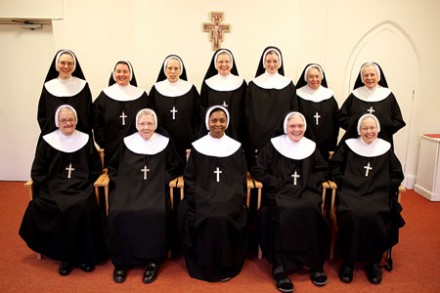
The Sisters intend to follow the Rule of St Benedict (Photo: Fr James Bradley)
By Mark Greaves
(Catholic Herald) Eleven Anglican Sisters will be received into the Catholic Church via the ordinariate, it emerged this week.
The Sisters, from the Community of St Mary the Virgin in Wantage, Oxfordshire, will be received into the Church by Mgr Keith Newton, leader of the ordinariate in England and Wales, on New Year’s Day.
The group, which ranges in age from 45 to 83, includes the mother superior of the community and a Sister who was once a minister in the Church of England. Three are in their 80s.
Next year they will stay for six weeks at a Benedictine convent. After that, they do not know where they will live and they have no endowments to keep them afloat financially.
Mother Winsome said: “We’ve got an uncertain future. But we are doing this because we truly believe this is God’s call. The Bible is full of people called to step out in faith not knowing where they were going or how they will be provided for and that truly is the situation we are following.”
The community, inspired by the Oxford Movement and founded in 1848, streams its daily offices live on its website and offers retreats and meditations online.
Mother Winsome, in a letter to friends and associates, said Sisters had been coming to speak to her privately about joining the ordinariate since 2009. Once there was a “critical mass”, and after gaining permission from each Sister, she raised the subject with the community.
The decision by 11 of the Sisters, she said, had been reached “after constant prayer and in discussion with spiritual advisers”.
They will leave 30 or so members behind in Wantage. Mother Winsome said they had wanted to stay at the convent, with Anglican and Catholic Sisters worshipping together, though with “appropriate Eucharistic provision”. That way, she said, they could carry on caring for Sisters who were elderly and frail.
But she wrote: “After considerable discussion with the authorities of the Church of England and the ordinariate, it has become clear that this would not be possible.”
The 11 Sisters, she wrote, “are in the main, but not exclusively, the able bodied members who provide the work and management to keep the Community going, so, since the ordinariate community do have to relocate, considerable time has been spent and will continue to be devoted to ensure that the remaining members of CSMV will be well cared for: spiritually, physically, emotionally as well as financially.”
Mother Winsome said the Sisters were likely to return to Wantage as guests until they found a permanent home.
The community, which will be called the Sisters of the Blessed Virgin Mary, will be joined by one of the three Walsingham Sisters received into the Church before the ordinariate was first launched. They are intending to follow the Rule of St Benedict.
Sister Patricia Ann, who used to be a minister in the Church of England, said in a statement that she was not the first Anglican woman priest to “lay down” her ordination within the Anglican Church.
Mgr Newton, the ordinary of the Personal Ordinariate of Our Lady of Walsingham, said the Community of St Mary the Virgin had been “at the heart of the Church of England’s religious life” since it was founded.
He said: “The contribution of the community to the life of the Anglican Communion has been significant, not least through the community’s care for those marginalised by society in Britain, and also in India and South Africa.
“Those formed in the tradition of the Oxford Movement cannot help but be moved to respond to Pope Benedict’s generous invitation to Anglicans. The sisters have always prayed for the unity of Christians with the See of Peter, now this is to become a reality for them by means of the ordinariate. We are truly grateful for their faith, courage, and resolve.”
In a statement Mother Winsome said: “We believe that the Holy Father’s offer is a prophetic gesture which brings to a happy conclusion the prayers of generations of Anglicans and Catholics who have sought a way forward for Christian unity. The future of our community is a fulfilment of its origins, and as part of the Personal Ordinariate of Our Lady of Walsingham we will continue with many of our customs and traditions, whilst also seeking to grow in Christ through our relationship with the wider Church.”
Link:
(Catholic Herald) Eleven Anglican Sisters will be received into the Catholic Church via the ordinariate, it emerged this week.
The Sisters, from the Community of St Mary the Virgin in Wantage, Oxfordshire, will be received into the Church by Mgr Keith Newton, leader of the ordinariate in England and Wales, on New Year’s Day.
The group, which ranges in age from 45 to 83, includes the mother superior of the community and a Sister who was once a minister in the Church of England. Three are in their 80s.
Next year they will stay for six weeks at a Benedictine convent. After that, they do not know where they will live and they have no endowments to keep them afloat financially.
Mother Winsome said: “We’ve got an uncertain future. But we are doing this because we truly believe this is God’s call. The Bible is full of people called to step out in faith not knowing where they were going or how they will be provided for and that truly is the situation we are following.”
The community, inspired by the Oxford Movement and founded in 1848, streams its daily offices live on its website and offers retreats and meditations online.
Mother Winsome, in a letter to friends and associates, said Sisters had been coming to speak to her privately about joining the ordinariate since 2009. Once there was a “critical mass”, and after gaining permission from each Sister, she raised the subject with the community.
The decision by 11 of the Sisters, she said, had been reached “after constant prayer and in discussion with spiritual advisers”.
They will leave 30 or so members behind in Wantage. Mother Winsome said they had wanted to stay at the convent, with Anglican and Catholic Sisters worshipping together, though with “appropriate Eucharistic provision”. That way, she said, they could carry on caring for Sisters who were elderly and frail.
But she wrote: “After considerable discussion with the authorities of the Church of England and the ordinariate, it has become clear that this would not be possible.”
The 11 Sisters, she wrote, “are in the main, but not exclusively, the able bodied members who provide the work and management to keep the Community going, so, since the ordinariate community do have to relocate, considerable time has been spent and will continue to be devoted to ensure that the remaining members of CSMV will be well cared for: spiritually, physically, emotionally as well as financially.”
Mother Winsome said the Sisters were likely to return to Wantage as guests until they found a permanent home.
The community, which will be called the Sisters of the Blessed Virgin Mary, will be joined by one of the three Walsingham Sisters received into the Church before the ordinariate was first launched. They are intending to follow the Rule of St Benedict.
Sister Patricia Ann, who used to be a minister in the Church of England, said in a statement that she was not the first Anglican woman priest to “lay down” her ordination within the Anglican Church.
Mgr Newton, the ordinary of the Personal Ordinariate of Our Lady of Walsingham, said the Community of St Mary the Virgin had been “at the heart of the Church of England’s religious life” since it was founded.
He said: “The contribution of the community to the life of the Anglican Communion has been significant, not least through the community’s care for those marginalised by society in Britain, and also in India and South Africa.
“Those formed in the tradition of the Oxford Movement cannot help but be moved to respond to Pope Benedict’s generous invitation to Anglicans. The sisters have always prayed for the unity of Christians with the See of Peter, now this is to become a reality for them by means of the ordinariate. We are truly grateful for their faith, courage, and resolve.”
In a statement Mother Winsome said: “We believe that the Holy Father’s offer is a prophetic gesture which brings to a happy conclusion the prayers of generations of Anglicans and Catholics who have sought a way forward for Christian unity. The future of our community is a fulfilment of its origins, and as part of the Personal Ordinariate of Our Lady of Walsingham we will continue with many of our customs and traditions, whilst also seeking to grow in Christ through our relationship with the wider Church.”
Link:
Tuesday, December 11, 2012
Same-Sex "Marriage" Plans for England
Churches Speak Out Against Proposal
LONDON, DEC. 11, 2012 (Zenit.org).- The British government is expected to soon announce its plans to introduce legislation to legalize same-sex "marriage." In recent days the debate over the issue has heated up.
In Scotland, Bishop Joseph Devine of the Diocese of Motherwell, sent a letter to British Prime Minister David Cameron expressing his strong disapproval of introducing same-sex "marriage."
According to a report in Sunday’s Scotsman newspaper he accused Cameron of being “out of his depth” and suggested he is “devoid of moral competence.”
The article also reported that Bishop Devine said that Cameron is responsible for a political culture in which “words mean nothing” and is guilty of using “graceless … offensive” language when dealing with clerical affairs.
The Church of England has also expressed firm opposition to the idea of same-sex "marriage."
“It is important to be clear that insistence on the traditional understanding of marriage is not knee-jerk resistance to change but is based on a conviction that the consequences of change will not be beneficial for society as a whole,” the Dec. 7 statement by the Church of England said.
Marriage between a man and a woman is unique, the statement explained. Unique in that it “embodies the underlying, objective, distinctiveness of men and women.”
“This distinctiveness and complementarity are seen most explicitly in the biological union of man and woman which potentially brings to the relationship the fruitfulness of procreation,” the statement continued.
“To remove from the definition of marriage this essential complementarity is to lose any social institution in which sexual difference is explicitly acknowledged.”
A number of reports in the English media also point to deep divisions within Cameron’s Conservative Party over the issue.
According to the BBC more than 100 members of Parliament from Cameron’s own party are expected to oppose the legislation. The proposal is likely to be introduced into Parliament early next year.
Link:
LONDON, DEC. 11, 2012 (Zenit.org).- The British government is expected to soon announce its plans to introduce legislation to legalize same-sex "marriage." In recent days the debate over the issue has heated up.
In Scotland, Bishop Joseph Devine of the Diocese of Motherwell, sent a letter to British Prime Minister David Cameron expressing his strong disapproval of introducing same-sex "marriage."
According to a report in Sunday’s Scotsman newspaper he accused Cameron of being “out of his depth” and suggested he is “devoid of moral competence.”
The article also reported that Bishop Devine said that Cameron is responsible for a political culture in which “words mean nothing” and is guilty of using “graceless … offensive” language when dealing with clerical affairs.
The Church of England has also expressed firm opposition to the idea of same-sex "marriage."
“It is important to be clear that insistence on the traditional understanding of marriage is not knee-jerk resistance to change but is based on a conviction that the consequences of change will not be beneficial for society as a whole,” the Dec. 7 statement by the Church of England said.
Marriage between a man and a woman is unique, the statement explained. Unique in that it “embodies the underlying, objective, distinctiveness of men and women.”
“This distinctiveness and complementarity are seen most explicitly in the biological union of man and woman which potentially brings to the relationship the fruitfulness of procreation,” the statement continued.
“To remove from the definition of marriage this essential complementarity is to lose any social institution in which sexual difference is explicitly acknowledged.”
A number of reports in the English media also point to deep divisions within Cameron’s Conservative Party over the issue.
According to the BBC more than 100 members of Parliament from Cameron’s own party are expected to oppose the legislation. The proposal is likely to be introduced into Parliament early next year.
Link:
Sunday, December 9, 2012
Episcopal Church liturgy for blessing same-gender relationships begins provisional use

 “The love that she shares with her partner is unconditional and
speaks to the ideal relationships all of us should strive to have,” he
told the House of Deputies on July 10 in Indianapolis. “I often get
asked by churchgoers and nonchurchgoers why I am a part of this body.
The reason I return is for my sister. I seek to assure that she not only
has the same rites as myself but also the same privileges.”
“The love that she shares with her partner is unconditional and
speaks to the ideal relationships all of us should strive to have,” he
told the House of Deputies on July 10 in Indianapolis. “I often get
asked by churchgoers and nonchurchgoers why I am a part of this body.
The reason I return is for my sister. I seek to assure that she not only
has the same rites as myself but also the same privileges.”The new rite, “The Witnessing and Blessing of a Lifelong Covenant,” was authorized for use with diocesan episcopal permission beginning Dec. 2, the first Sunday of Advent.
On Dec. 29, Louisa Hallas, 25, and Clare Kemock, 30, will have their union blessed at their home parish of Holy Nativity Episcopal Church in Clarendon Hills, Illinois. The couple, engaged for just over a year, met working backstage at the Illinois Shakespeare Festival. Kemock is a costume designer; Hallas now works as administrative assistant for the Chicago diocese’s director of ministries...
“Because we’re a church who learns as we pray and our theology develops through our experiences of worship, we’ll learn more about what it means to bless the relationships of same-sex couples through our experience of these liturgies,” Meyers said. “So the commission will be developing a process of review and will want to learn from clergy and couples and congregations who are using these materials, and there may well be some refinements to the material...”
Link:
Related:
- Former dean of Advent Cathedral in Birmingham and ex-rector of nation's largest Episcopal church jumps to Catholic Church
- South Carolina Episcopal Parish Members to Convert to Catholic Church
- Katharine Jefferts Schori Takes Action Against the Episcopal Bishop and Diocese of South Carolina
- Catholic vs. Katholyc
- Local Episcopal priest to convert to Catholicism
- July 11, 2012: SC Bishop Mark Lawrence leads his delegation out of General Convention
- July 10, 2012: Episcopalians Approve Rite to Bless Same-Sex Unions
- Episcopal Church expected to OK liturgy for same-sex couples
- Reason #2775 for Anglicanorum coetibus
- Leader of Australian Ordinariate to Be Named June 15
- The Customary of Our Lady of Walsingham
- Vatican Wolves
- Anglican preacher barred from pulpit over opposition to gay marriage
- Priest Who Calls Abortion a ‘Blessing’ Tells Congress She'd Break Law to Help Minor Cross State Line to Get One
- Anglican Clergymen Become Catholic Priests: Taking the Final Steps to Ordination
- Ordinariate for former Anglicans visits Pope and Rome
- Ordinariate of the Chair of Peter for Anglicans / Episcopalians Seeking to Enter Into Full Communion With the Catholic Church
- Episcopal Diocese Sends Homosexual Priest to Soon-to-be-Catholic Calvary Episcopal Church
- New questions, challenges confront Episcopal-turned-Catholic leader
- Gay brother makes Anne Hathaway quit Catholic Church for Episcopalianism
- Pope defends invitation to Anglicans to convert
- Former clinic director: Episcopal Church chilly to my pro-life turn
Wednesday, December 5, 2012
Former dean of Advent Cathedral in Birmingham and ex-rector of nation's largest Episcopal church jumps to Catholic Church
By
(The Birmingham News) The Rev. Larry Gipson, who was dean of the Cathedral Church of the Advent in Birmingham from 1982-94 and rector at the largest Episcopal church in the nation from 1994-2008, has become a Roman Catholic.
Gipson retired in 2008 from the 8,000-member St. Martin's Episcopal Church in Houston, where his parishioners included former President George H.W. Bush and his wife, Barbara.
Last month, Gipson was accepted as a Catholic into the Personal Ordinariate of the Chair of St. Peter, a structure set up by Pope Benedict XVI to accept former Anglicans into the Catholic Church.
"The nature of authority in the Catholic Church is what attracted me to it," Gipson said in a telephone interview from his home in Houston. "After I retired, I was concerned and had been for many years about the Episcopal Church's authority structure."
Gipson will be among 69 candidates for Catholic priesthood attending a Formation Retreat this weekend in Houston, where the headquarters for the Ordinariate is based.
Among those leading seminars at the Formation Retreat in Houston will be the Rev. Jon Chalmers, who was ordained a Catholic priest in June, the second former Episcopal priest to be accepted as a priest under the Ordinariate. Chalmers served as curate, associate priest and interim rector at Canterbury Chapel in Tuscaloosa from 2007-2009.
His wife, Margaret Chalmers, former canon lawyer for the Catholic Diocese of Birmingham and now chancellor of the Ordinariate, will also be a presenter at the weekend retreat that runs Friday night through Sunday, Dec. 2.
"It's a really big deal," she said. "Larry Gipson, who was the priest of the largest Episcopal Church in America, is now a Catholic."
Although married Episcopal priests have been accepted as Catholic priests since 1983 under Pope John Paul II, only just over 100 came in during that process, Margaret Chalmers said.
This year, the Ordinariate through its faster process has already ordained 24 priests, with 69 in preparation. Her husband was accepted as a Catholic in January and ordained as a Catholic priest in June.
The Rev. Matthew Venuti of Mobile was the first ex-Episcopal priest ordained a Catholic priest in the Ordinariate, which covers the United States and Canada.
Venuti and Chalmers both have young children, as do many of the new Catholic priests, Mrs. Chalmers said. "There are lots of young priests with young kids," she said.
The Ordinariate allows the new Catholics to keep their Anglican form of worship, including the Book of Common Prayer.
Gipson and his wife of 48 years, Mary Frances, attend the headquarters church of the Ordinariate, Our Lady of Walsingham in Houston.
"All their services are Prayer Book services," Gipson said. "The music is from the 1940 (Episcopal) hymnal. It is the Anglican Rite One prayer book. It's the opportunity to come into the Catholic Church while maintaining Anglican tradition."
Although many Episcopalians have left the denomination over issues such as consecrating openly homosexual bishops and rites for same-sex unions, Gipson said he didn't leave the U.S. Episcopal Church and worldwide Anglican Communion in anger.
"I don't have the right to ask the Anglican Church to change its traditions for me," he said. "I'm the one who has got to make the changes. Anglicanism has always been hesitant to define doctrine because it has opposing factions. It has left doctrine blurry. People can believe almost mutually opposing beliefs."
Gipson, who turned 70 on Oct. 23, started attending an Episcopal church with his future wife when he was 14 in Memphis. "I'm thankful to the Episcopal Church," he said. "I spent my life there. All my friends and people I love are in it. I do not in any way wish to denigrate it. I'm not angry. I was seeking something that I've been longing for, for a long time."
Now, he's looking forward to the possibility of being ordained as a Catholic priest. Earlier this year he earned a master's degree in Catholic theology from St. Thomas University, although he already had a master of divinity degree from Yale University.
"I was an Episcopal priest for 42 years," he said. "I can't imagine not being a priest. I'm anxious to get back to priestly work."
Link:
(The Birmingham News) The Rev. Larry Gipson, who was dean of the Cathedral Church of the Advent in Birmingham from 1982-94 and rector at the largest Episcopal church in the nation from 1994-2008, has become a Roman Catholic.
Gipson retired in 2008 from the 8,000-member St. Martin's Episcopal Church in Houston, where his parishioners included former President George H.W. Bush and his wife, Barbara.
Last month, Gipson was accepted as a Catholic into the Personal Ordinariate of the Chair of St. Peter, a structure set up by Pope Benedict XVI to accept former Anglicans into the Catholic Church.
"The nature of authority in the Catholic Church is what attracted me to it," Gipson said in a telephone interview from his home in Houston. "After I retired, I was concerned and had been for many years about the Episcopal Church's authority structure."
Gipson will be among 69 candidates for Catholic priesthood attending a Formation Retreat this weekend in Houston, where the headquarters for the Ordinariate is based.
Among those leading seminars at the Formation Retreat in Houston will be the Rev. Jon Chalmers, who was ordained a Catholic priest in June, the second former Episcopal priest to be accepted as a priest under the Ordinariate. Chalmers served as curate, associate priest and interim rector at Canterbury Chapel in Tuscaloosa from 2007-2009.
His wife, Margaret Chalmers, former canon lawyer for the Catholic Diocese of Birmingham and now chancellor of the Ordinariate, will also be a presenter at the weekend retreat that runs Friday night through Sunday, Dec. 2.
"It's a really big deal," she said. "Larry Gipson, who was the priest of the largest Episcopal Church in America, is now a Catholic."
Although married Episcopal priests have been accepted as Catholic priests since 1983 under Pope John Paul II, only just over 100 came in during that process, Margaret Chalmers said.
This year, the Ordinariate through its faster process has already ordained 24 priests, with 69 in preparation. Her husband was accepted as a Catholic in January and ordained as a Catholic priest in June.
The Rev. Matthew Venuti of Mobile was the first ex-Episcopal priest ordained a Catholic priest in the Ordinariate, which covers the United States and Canada.
Venuti and Chalmers both have young children, as do many of the new Catholic priests, Mrs. Chalmers said. "There are lots of young priests with young kids," she said.
The Ordinariate allows the new Catholics to keep their Anglican form of worship, including the Book of Common Prayer.
Gipson and his wife of 48 years, Mary Frances, attend the headquarters church of the Ordinariate, Our Lady of Walsingham in Houston.
"All their services are Prayer Book services," Gipson said. "The music is from the 1940 (Episcopal) hymnal. It is the Anglican Rite One prayer book. It's the opportunity to come into the Catholic Church while maintaining Anglican tradition."
Although many Episcopalians have left the denomination over issues such as consecrating openly homosexual bishops and rites for same-sex unions, Gipson said he didn't leave the U.S. Episcopal Church and worldwide Anglican Communion in anger.
"I don't have the right to ask the Anglican Church to change its traditions for me," he said. "I'm the one who has got to make the changes. Anglicanism has always been hesitant to define doctrine because it has opposing factions. It has left doctrine blurry. People can believe almost mutually opposing beliefs."
Gipson, who turned 70 on Oct. 23, started attending an Episcopal church with his future wife when he was 14 in Memphis. "I'm thankful to the Episcopal Church," he said. "I spent my life there. All my friends and people I love are in it. I do not in any way wish to denigrate it. I'm not angry. I was seeking something that I've been longing for, for a long time."
Now, he's looking forward to the possibility of being ordained as a Catholic priest. Earlier this year he earned a master's degree in Catholic theology from St. Thomas University, although he already had a master of divinity degree from Yale University.
"I was an Episcopal priest for 42 years," he said. "I can't imagine not being a priest. I'm anxious to get back to priestly work."
Link:
Tuesday, November 20, 2012
Church of England rejects female bishops by six votes
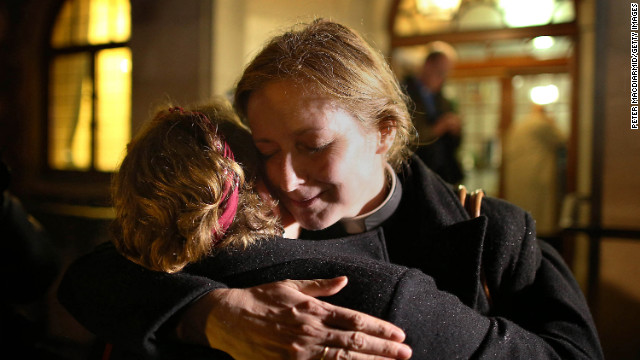
Reverend Marie-Elsa Bragg (R) hugs Reverend Angie Nutt after leaving
Church House on November 20, 2012 in London, England. The Church of
England's governing body, known as the General Synod, has voted against
allowing women to become bishops.
By Eric Marrapodi, CNN Belief Blog Co-Editor
(CNN)– After decades of debate, the Church of England formally voted down draft legislation that would have allowed women to become bishops.
Debate on the draft legislation Tuesday spanned seven hours and saw more than 100 people voice support or opposition for the draft legislation.
At its General Synod meeting, despite the ardent support of the incoming Archbishop of Canterbury, the Rt. Rev. Justin Welby, the measure failed to secure a two-thirds majority in all of the three voting bodies of the church, the House of Bishops, the House of Clergy and the House of Laity...

Archbishop of Canterbury-designate Justin Welby. Photo: Dylan Martinez/Reuters
"The ministry of women priests," Welby, the current Bishop of Durham and archbishop-designate, told the Synod, "has been powerful in all areas of the church except as part of the episcopacy."
"It is time to finish the job and vote for this measure. But also the Church of England needs to show how to develop the mission of the church in a way that demonstrates that we can manage diversity of view without division; diversity in amity, not diversity in enmity," he said, according to a copy of his statement posted on the church's website.
During the debate, Jane Pattison, from the Diocese of Sheffield, voiced opposition to the measure, according to the Episcopal News Service. She told the assembly that it would “promote the loss of conservative evangelical and traditional catholic ministry in the Church of England. I suggest that the church cannot afford this loss. … England cannot afford this loss if we are serious about sharing the Gospel with the nation...”
The legislation titled "Draft Bishops and Priests (Consecration and Ordination of Women) Measure" received broad support by the House of Bishops with 44 votes for, three against and two abstentions. The House of Clergy was similarly supportive with 148 in favor and 45 against. Both votes cleared the needed two-thirds majority. But the 132 for and 74 against vote in the House of Laity came up six votes shy needed for the measure to pass.
The Bishop of Bristol said in a statement the vote was disastrous.
"Whilst I have never believed it necessary for anyone to leave the church on the basis of the measure before us today, others clearly took another view," the Rt. Rev. Mike Hill said in a statement posted by the Diocese of Bristol.
“It will be very difficult for those of us who have supported the ordination of women bishops to process our disappointment in the days ahead. My prayers are with the many people who are hurting, particularly women in our churches and those within and outside the church who are bemused and disillusioned by such a failure," Hill said.
The House of Bishops of the Church of England will hold an emergency session to consider the consequences of the vote on Wednesday morning according to a statement by the Church of England.
Link:
Tuesday, November 13, 2012
South Carolina Episcopal Parish Members to Convert to Catholic Church

Five families will follow the Rev. Patrick Allen, curate at Holy Communion, into the arms of the Roman Catholic Church.
The Rev. Dow Sanderson, rector of Holy Communion, will remain part of the Episcopal Church, along with most of the congregation, and strive to be neutral as the drama plays out, he said.
The fracture comes as no surprise; worshippers at this historic downtown parish at 218 Ashley Ave. have long preferred to uphold Catholic traditions.
Holy Communion adheres to the Oxford Movement’s assertion that the Church of England (and other Anglican Church bodies) has been, and is now, an apostolic church, a direct descendant of St. Peter’s church, a true inheritor of the word of Christ.
Protestantism, instead, holds that there is no “one true church,” that individuals have the authority to forge a personal relationship with Christ and don’t really require the aid of an institution.
The 19th-century Oxford Movement asserts that the doctrine of apostolic succession accommodates “One True Church” with three branches: Roman Catholicism, Orthodoxy and Anglicanism. Its ideas were promoted in a series of pamphlets called “Tracts for the Times” (1833-41).
Allen said the process of becoming Catholic will take several months.

“I will continue to serve as curate at Holy Communion through the end of the year,” he said. “Of the families who are making this move, several adults are involved in ministry and leadership positions here, so they will serve out their terms.”
In January, Allen and the others will join the congregation at St. Mary Catholic Church on Hasell Street to worship. Allen said he hopes to be confirmed as a priest in the Catholic Church by late spring or early summer.
“At that point, we will begin having our own ordinariate (Catholic community of former Anglicans) and Mass,” he said. The group will share St. Mary’s.
More than a year ago, Holy Communion, as a parish, considered opting out of the Episcopal Church and joining the Catholic Diocese of Charleston, but that possibility faded, according to Allen, who addressed the matter in a Nov. 7 letter to the congregation.

“Mine is a move forward to the Catholic Church, and I am nothing but grateful for my own years in the Episcopal Church and the Diocese of South Carolina,” Allen wrote.
Link:
Related:
Tuesday, October 2, 2012
Saturday, September 29, 2012
Church of England fails to agree successor for Archbishop of Canterbury

By Ruth Gledhill - Religion Correspondent
(The Times) The body responsible for choosing the next Archbishop of Canterbury has failed to agree who should be the successor to Dr Rowan Williams.
Despite a three day session, aided by prayers invoked on Twitter with the hashtage #prayforthecnc, the 16-member committee has been unable to decide on who should take on the job that the present incumbent today implied was “impossible”...
Link:
Friday, July 6, 2012
Episcopal Church expected to OK liturgy for same-sex couples

(L.A. Times) Sixteen years after allowing gays and lesbians to become priests, the Episcopal Church appears poised to introduce a rite that would specifically bless the unions of same-sex couples.
If the liturgy is approved, which is expected, Episcopalians will become the first major denomination to endorse such a ritual for homosexual couples.
On its face, the blessing seems similar to that of a marriage rite -- including “I do,” “we have gathered together today” and an exchange of rings. Notably absent are the words “husband,” “wife” and “marriage.”
Supporters of the liturgy emphasize that the rite would acknowledge and bless same-sex unions, but would not sanctify them as marriage in most states. Churches in states where gay marriage is legal -- six, as well as Washington, D.C. -- have had the option of blessing gay marriage, but do not currently use a formal liturgy.
“While the liturgy we have developed is not called ‘marriage,’ we recognize significant parallels,” the committee wrote in its handbook on blessing same-sex marriages, called "I Bless You, And You Will Be a Blessing." “Two people publicly make a lifelong, monogamous commitment to one another with the exchange of solemn vows in a ritual that pronounces God’s blessing on their life together...”
Friday, May 4, 2012
Anglican preacher barred from pulpit over opposition to gay marriage
An Anglican lay preacher has been banned from the pulpit after encouraging
parishioners to oppose against gay marriage – in line with official Church
teaching.

By John Bingham, Religious Affairs Editor
(The Telegraph) Peter Gowlland, 78, was accused of sowing discord among worshippers at the liberal-leaning All Saints Church in Sanderstead, Surrey, by inviting them to sign a petition against the Government plans to introduce same-sex weddings.
Despite being told by his Archdeacon to “withdraw” from ministry for two months as a result, Church authorities continued to insist last night that he had “not been suspended”.
The retired science teacher says he was told “we don’t do that here” by a fellow lay reader when he set out a pile of leaflets promoting the former Archbishop of Canterbury Lord Carey’s Coalition For Marriage before a Sunday service last month.
Matters came to a head shortly during the service when he urged parishioners in his sermon to be “bold like the apostles” and register their opposition to the redefinition of marriage.
It prompted what might pass in the Church of England for a public showdown: a brief and polite disagreement with two other lay readers in front of the congregation, a retired bishop and the visiting Worldwide President of the Mothers’ Union.
The two women who stood up in front of the church during the parish notices and advised parishioners told them not to sign the petition, adding: “There are other views”.
He Rt Revd David Atkinson, the retired Bishop of Thetford, who was leading the worship, stepped in to advise that the service was “not the correct time and place” to discuss the bitterly contentious issue, according to Mr Gowlland... (continued)
Peter Gowlland and his family in October 2006
By John Bingham, Religious Affairs Editor
(The Telegraph) Peter Gowlland, 78, was accused of sowing discord among worshippers at the liberal-leaning All Saints Church in Sanderstead, Surrey, by inviting them to sign a petition against the Government plans to introduce same-sex weddings.
Despite being told by his Archdeacon to “withdraw” from ministry for two months as a result, Church authorities continued to insist last night that he had “not been suspended”.
The retired science teacher says he was told “we don’t do that here” by a fellow lay reader when he set out a pile of leaflets promoting the former Archbishop of Canterbury Lord Carey’s Coalition For Marriage before a Sunday service last month.
Matters came to a head shortly during the service when he urged parishioners in his sermon to be “bold like the apostles” and register their opposition to the redefinition of marriage.
It prompted what might pass in the Church of England for a public showdown: a brief and polite disagreement with two other lay readers in front of the congregation, a retired bishop and the visiting Worldwide President of the Mothers’ Union.
The two women who stood up in front of the church during the parish notices and advised parishioners told them not to sign the petition, adding: “There are other views”.
He Rt Revd David Atkinson, the retired Bishop of Thetford, who was leading the worship, stepped in to advise that the service was “not the correct time and place” to discuss the bitterly contentious issue, according to Mr Gowlland... (continued)
Sunday, March 18, 2012
Williams quits as Anglican head, says successor needs "rhino skin"

Pope Benedict XVI (L) meets with Archbishop of Canterbury Rowan Williams during a private audience at Vatican March 10, 2012 (Reuters Pictures)
By Avril Ormsby
(Reuters) - Archbishop of Canterbury Rowan Williams, who has agonized about schisms in the Anglican Communion over women and gay bishops and same-sex unions, announced unexpectedly on Friday that he would step down at the end of the year.
He said it was time to move on after a decade as archbishop and his new post as master of Magdelene College at Cambridge University would give him the time "which I have longed for" to think and write about the Church.
"I would hope that my successor has the constitution of an ox and the skin of a rhinoceros," he said.
Williams, 61, a white-bearded and bushy-browed theologian, will leave behind a church split between progressives ready to allow women bishops and bless same-sex unions, and conservatives opposed to such modern reforms.
His resignation also appeared to spell the end for his faltering project to forge more unity in the Anglican Communion, an 80-million strong worldwide federation of 38 national and regional churches that see him as their spiritual leader.
He acknowledged these strains in an interview with Britain's Press Association, saying that crisis management was "never a favorite activity" and had actually been "major nuisance" during his tenure.
"There are some conflicts that won't go away, however long you struggle with them," he said. "Not everybody in the Anglican Communion or even in the Church of England is eager to avoid schism or separation."
UGANDA-BORN ARCHBISHOP TIPPED AS SUCCESSOR
![http://www.archbishopofyork.org/img.php?f=/york/data/images/ABY_Official_/250_Archbishop_speaking_at_Oscar_Romero_Commemorative_Service.jpg&p=toWidth&o=jpg&a[width]=260](http://www.archbishopofyork.org/img.php?f=/york/data/images/ABY_Official_/250_Archbishop_speaking_at_Oscar_Romero_Commemorative_Service.jpg&p=toWidth&o=jpg&a[width]=260) Frontrunner to replace him is the Church of England's second highest cleric, Archbishop of York John Sentamu. Born in Uganda, he fled to Britain in 1974 to escape from dictator Idi Amin.
Frontrunner to replace him is the Church of England's second highest cleric, Archbishop of York John Sentamu. Born in Uganda, he fled to Britain in 1974 to escape from dictator Idi Amin.Sentamu praised Williams as "God's apostle for our time", a courageous and holy man who had been "much maligned by people who should have known better".
Elizabeth Hunter, director of the London-based religious think tank Theos, described Sentamu as more conservative than Williams. But she did not see him making a sharp break in the Church or the Communion.
"Anyone who gets this post will not take a radical diversion from the path that Archbishop Rowan has been treading simply because there really isn't any other choice.
"They'll just continue with these slightly awkward compromises and uncomfortable conversations, where you sometimes get to wondering really is it one church at all, or two or three," she said... (continued)
Subscribe to:
Posts (Atom)