
Showing posts with label Pope Pius X. Show all posts
Showing posts with label Pope Pius X. Show all posts
Tuesday, October 2, 2012


Sunday, June 10, 2012
If this chalice cannot pass by me unless I drink it, may the will of God be done
From De vita contemplativa via RORATE CÆLI:
The Life and Thoughts of Cardinal Merry del Val - V
Cardinal Sarto and Abp. Merry del Val: a meeting that changed the Church
At the conclave of 1903, the Patriarch of Venice, Giuseppe Sarto, and the young Titular Archbishop of Nicaea, R. Merry del Val, met for the first time. In the unfathomable designs of Providence, these two men of the Church , so different in their culture and birth, would give unforgettable lessons to the history of the Church and prepare the triumph of the Catholic Faith in the face of the assaults of modernism.The Conclave of 1903On July, 20, 1903, the Holy Father, Leo XIII, died at ninety years of age. A few days before his death, Abp. Volpini, Secretary of the Sacred College of Cardinals who was to be the secretary of the future Conclave, died suddenly. Therefore, it was necessary to nominate a successor.The eyes of the Cardinals turned unanimously to Abp. Merry del Val, who was elected secretary of the future conclave, and that was due not only to his outstanding capacities, but above all to his eminent virtues, that rendered him the figure of a model priest, whom everyone looked upon with veneration. The young Archbishop of Nicaea sought to evade this election, showing forth his incapacity and inexperience in filling such a burdensome task, but nothing would convince the Cardinals who remained firm in their nomination.Merry del Val, seeing in that the evident manifestation of the will of God, resigned himself to it, and began preparing for the Conclave with zeal and an exactitude which revealed his profound and unconditional love for the Church. The task was arduous.25 long years had passed since the last Conclave and the situation had changed very much. But the Secretary of the Conclave was able to organize everything with extreme competence and decision, drawing upon himself the admiration even of those who did not know him. On July 31, the Cardinals entered the Sistine Chapel to start the Conclave.Though Merry del Val had worked for many years in the Vatican, he had never met the Patriarch of Venice, Giuseppe Sarto. He saw him at the Conclave for the first time, when the votes started to increase for him. Cardinal Sarto, bewildered and fearful, sought to convince the Cardinals not to elect him. In reality these attestations of the most profound humility drew upon him even more admiration and sympathy. And the number of votes increased.Then the Cardinal Dean charged the Secretary of the Conclave, Merry del Val, to go to Cardinal Sarto in order to beseech him, in the name of the Sacred College, not to persist in his refusal of the Pontificate. Merry del Val went to the Patriarch’s room, but he was not there. He found him, instead, completely alone, kneeling upon the floor, with his head in his hands, praying intently before the Blessed Sacrament in the Pauline Chapel. The Secretary kindly referred the message of the Cardinals to him. The Patriarch in tears, with imploring eyes, said: “No, no, tell the Cardinal Dean, I beg of you, that they must not consider me; ask them to do me this kindness!” to which Mgr. Merry del Val humbly added: “Courage, Eminence!” But at last the insistence of the Cardinals and the manifested will of the Sacred College overcame the Patriarch’s resistance who was thus elected as Pontiff. That was the first meeting between the future St. Pius X and his Secretary of State, who together would govern the Church during what was defined as the “Supernatural Pontificate”.In the act of accepting the Pontificate, Cardinal Sarto said: “If this chalice cannot pass by me unless I drink it, may the will of God be done.” When asked what name he would take, in a prophetic tone he replied: “Since the Popes who have suffered the most for the Church in this past century have taken the name of Pius, I will also take this name.”It was August 4, 1903. Having finished the most important of the duties, Mgr. Merry del Val, at the end of the audience, said to the new Pontiff: “Holy Father, my office as Secretary of the Conclave is over. I thank you for your kindness to me and ask you to forgive me my inefficiency and the mistakes I many have made in my official capacity. I leave to your Holiness these papers relating to the affairs still outstanding and on returning to my dear Academy, I beg your fatherly blessing.” Pius X looked at Merry del Val with those eyes of his which “seemed to go through eternity” and with a sweet and fatherly voice he said: “What, Monsignore, do you wish to leave me?” Deeply moved the young Secretary replied: “No, I have no wish to leave Your Holiness, but my office is at an end. The Secretary of State whom you will nominate will take my place and continue to direct affairs.” But Pius X replied: “Take back your papers, Monsignore. I beg you continue in your office as Pro-Secretary of State until I am ready to make a decision.” The young Archbishop of Nicaea could not resist the Pope’s plea and remained at his side.“We have a saintly Pope,” - he wrote during those days to an English friend - “he seems very prudent and alert; he is very mild and has a charming personality.”


[From: De vita contemplativa , Franciscan Sisters of the Immaculate, Italy. Translation: Contributor Francesca Romana]Link:
The Life and Thoughts of Cardinal Merry del Val - V
Cardinal Sarto and Abp. Merry del Val: a meeting that changed the Church
Tuesday, May 29, 2012
Thursday, August 19, 2010
On Pope St. Pius X

* * *
Dear brothers and sisters,
Today I would like to reflect on the figure of my predecessor St. Pius X, whose liturgical memorial will be observed Saturday, to emphasize some of his characteristics that can also be useful for the pastors and faithful of our time.

Giuseppe Sarto -- that was his name -- was born in Riese, Treviso, in 1835 to a peasant family. After studying in the Seminary of Padua, he was ordained a priest at age 23. First he was vice-parish priest in Tombolo, then parish priest in Salzano, then canon of the cathedral of Treviso with the office of episcopal chancellor and spiritual director of the diocesan seminary. During those years of rich and generous pastoral experience, the future Pontiff showed that profound love of Christ and of the Church, that humility and simplicity and that great charity toward the neediest, which were characteristics of his whole life.

In 1884 he was appointed bishop of Mantua and in 1893 patriarch of Venice. On Aug. 4, 1903, he was elected Pope, a ministry that he accepted with hesitation, because he did not think he measured up to the loftiness of such a task.
St. Pius X's pontificate has left an indelible mark on the history of the Church, and was characterized by a notable effort of reform, synthesized in the motto "Instaurare omnia in Christo," (To Renew All Things in Christ.) His intervention, in fact, embraced various ecclesial ambits. From the beginning he dedicated himself to the reorganization of the Roman Curia; then he gave a green light to the work of writing the Code of Canon Law, promulgated by his successor, Benedict XV. Moreover, he promoted the revision of studies and of the iter of formation for future priests; he also founded several regional seminaries, equipped with good libraries and competent professors.

Another important sector was the doctrinal formation of the People of God. In the years he was a parish priest, he himself wrote a catechism, and during his episcopacy in Mantua he worked to establish a single catechism, if not universal, at least Italian. As a genuine pastor, he understood that the situation of the age, also because of the phenomenon of emigration, made necessary a catechism that all the faithful could refer to, regardless of the place and circumstances of life. As Pontiff he prepared a text of Christian doctrine for the Diocese of Rome, which later spread to the whole of Italy and the world. The catechism called "of Pius X" was for many a sure guide in learning the truths of the faith because of its simple, clear and precise language and its explanatory effectiveness.
He dedicated notable attention to the reform of the liturgy, in particular sacred music, to lead the faithful to a life of more profound prayer and to fuller participation in the sacraments. In the motu proprio "Tra le sollecitudini" (1931), he stated that the true Christian spirit has its first and indispensable source in active participation in the sacred mysteries and in the public and solemn prayer of the Church (cf. ASS 36 [1903], 531). That is why he recommended the frequent reception of the sacraments, fostering daily, well-prepared reception of Holy Communion, and opportunely moving earlier children's First Communion to around 7 years of age, "when," he said, "the child begins to reason." (cf. S. Congr. de Sacramentis, Decretum Quam singulari: ASS 2 [1910], 582).

Faithful to the task of confirming brethren in the faith, St. Pius X intervened with determination in the face of tendencies that manifested themselves in the theological realm at the end of the 19th century and beginning of the 20th, condemning Modernism, to defend the faithful from erroneous concepts and to promote scientific reflection on revelation in harmony with the tradition of the Church. On May 7, 1909, with the apostolic letter "Vinea electa," he founded the Pontifical Biblical Institute. The last months of his life were embittered by the outbreak of the War. An appeal to the Catholics of the world launched on Aug. 2, 1914, to express "the acute grief" of that hour, was the suffering cry of a father who sees his children confront one another. He died shortly after, on Aug. 20, and his reputation for sanctity soon began to spread among the Christian people.
Dear brothers and sisters, St. Pius X teaches all of us that, at the foundation of our apostolic action, in the various fields in which we work, there must always be an intimate personal union with Christ, which must be cultivated and enhanced day after day. This is the kernel of all his teaching, of all his pastoral commitment. Only if we are enamored of the Lord will we be able to lead men to God and open them to his merciful love, and thus open the world to God's mercy.
[In English, he said:]
My dear brothers and sisters, today we recall Pope Saint Pius the Tenth, whose feast we celebrate this coming Saturday. He left an indelible mark in very many aspects of the Church’s life and activity, his overarching goal being to "renew all things in Christ" through our intimate personal union with our Saviour. By Pope Saint Pius’s prayers, may we grow daily in love for Christ and help open others to his love. God’s abundant blessings upon you all!

© Copyright 2010 - Libreria Editrice Vaticana
[At the end of the audience, the Pope made this final appeal:]
My thoughts go at this moment to the beloved peoples of Pakistan, affected recently by great floods, which have caused numerous victims and left many families homeless.
While I entrust to the merciful goodness of God all those who have tragically disappeared, I express my spiritual closeness to their families and to all those suffering because of this calamity. May these brothers of ours, so harshly tested, not lack our solidarity and the concrete aid of international solidarity.
[Translation by ZENIT]
Update:
Mary O'Regan just reminded me of another article that contained this:
Another example offered by the Vatican newspaper was Saint Pius X, whose mother, Margherita Sanson, raised him and numerous brothers and sisters. She taught them to pray first thing in the morning, communicate with God throughout the day in Mass and Scripture reading, and to end each day with prayer, bringing the family together for an open examination of conscience. After describing this tradition, a friend of the family said, "is it any wonder that a holy soul came out of there?"
Following her son's episcopal ordination and placement in Mantova, the future Pope Pius X visited his mother to thank her. After kissing his episcopal ring, she showed him her wedding ring and said, "Your ring is very beautiful, Giuseppe, but you wouldn't have it if I didn't have this."
Margherita lived to see her son become the Patriarch (Archbishop) of Venice...
Friday, January 29, 2010
Sunday, February 15, 2009

Saturday, November 1, 2008
Pope says no to chaos, points to God as author of universe
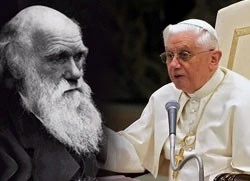
Pope Benedict’s 15 minute-long speech to the academics was packed with theological reflection and insight into the issues that the scientific and academic communities must grapple with to come to a fuller understanding of the universe.
The Holy Father began his talk by pointing out that both Pius XII and John Paul II emphasized that "there is no opposition between faith's understanding of creation and the evidence of the empirical sciences.”
Benedict XVI then traced the development of philosophical thought on the origins of the universe. “Philosophy in its early stages had proposed images to explain the origin of the cosmos on the basis of one or more elements of the material world. This genesis was not seen as a creation, but rather a mutation or transformation."
As the philosophical world further contemplated life’s origins, it came to realize that, "In order to develop and evolve, the world must first 'be,' and thus have come from nothing into being. It must be created, in other words, by the first Being who is such by essence," the Pope explained.
"To state that the foundation of the cosmos and its developments is the provident wisdom of the Creator is not to say," Benedict XVI said, referencing St. Thomas Aquinas, "that creation has only to do with the beginning of the history of the world and of life. It implies, rather, that the Creator founds these developments and supports them, underpins them and sustains them continuously."
The Pope also drew on Galileo who "saw nature as a book whose author is God in the same way that Scripture has God as its author." Contrary to those theories of evolution that describe creation as emerging from chaos, Pope Benedict asserted that "this image also helps us to understand that the world, far from originating out of chaos, resembles an ordered book; it is a cosmos."
Moreover, mankind is more than a “simple living being,” the Pope stressed, in fact, he is a “spiritual being” that has a capacity for God and is transcendent in nature. This is why, he concluded, "the Magisterium of the Church has constantly affirmed that 'every spiritual soul is created immediately by God - it is not 'produced' by the parents - and also that it is immortal.' This points to the distinctiveness of anthropology and invites exploration of it by modern thought."
Pope Benedict XVI closed his address by recalling the words of his predecessor John Paul II to the academy in November 2003: "scientific truth, which is itself a participation in divine Truth, can help philosophy and theology to understand ever more fully the human person and God’s Revelation about man, a Revelation that is completed and perfected in Jesus Christ. For this important mutual enrichment in the search for the truth and the benefit of mankind, I am, with the whole Church, profoundly grateful."
Monday, September 1, 2008
Birthplace of Pius X

"This is where the future Pope St. Pius X was born in 1835. Today it's a museum (the caretakers live on the left and when you ring the bell they appear and unlock the museum where he was born and raised on the right). It's located in the village of Riese Pio X (the town had been called Riese, but has since been renamed Riese Pio X) and it's well worth a visit. It's a magnificent experience to pray here and to feel the presence of Christ. All his life his mother lived here and even when he was Cardinal Patriarch of Venice he came back here to stay on a visit to see his elderly mother before she passed on."
Thursday, August 21, 2008
Memorial of Saint Pius X, Pope

Thus says the LORD:
I will prove the holiness of my great name,
profaned among the nations,
in whose midst you have profaned it.
Thus the nations shall know that I am the LORD, says the Lord GOD,
when in their sight I prove my holiness through you.
For I will take you away from among the nations,
gather you from all the foreign lands,
and bring you back to your own land.
I will sprinkle clean water upon you
to cleanse you from all your impurities,
and from all your idols I will cleanse you.
I will give you a new heart and place a new spirit within you,
taking from your bodies your stony hearts
and giving you natural hearts.
I will put my spirit within you and make you live by my statutes,
careful to observe my decrees.
You shall live in the land I gave your ancestors;
you shall be my people, and I will be your God.
R. (Ezekiel 36:25) I will pour clean water on you and wash away all your sins.
A clean heart create for me, O God,
and a steadfast spirit renew within me.
Cast me not out from your presence,
and your Holy Spirit take not from me.
R. I will pour clean water on you and wash away all your sins.
Give me back the joy of your salvation,
and a willing spirit sustain in me.
I will teach transgressors your ways,
and sinners shall return to you.
R. I will pour clean water on you and wash away all your sins.
For you are not pleased with sacrifices;
should I offer a burnt offering, you would not accept it.
My sacrifice, O God, is a contrite spirit;
a heart contrite and humbled, O God, you will not spurn.
R. I will pour clean water on you and wash away all your sins.
Jesus again in reply spoke to the chief priests and the elders of the people in parables saying,
“The Kingdom of heaven may be likened to a king
who gave a wedding feast for his son.
He dispatched his servants to summon the invited guests to the feast,
but they refused to come.
A second time he sent other servants, saying,
‘Tell those invited: “Behold, I have prepared my banquet,
my calves and fattened cattle are killed,
and everything is ready; come to the feast.”’
Some ignored the invitation and went away,
one to his farm, another to his business.
The rest laid hold of his servants,
mistreated them, and killed them.
The king was enraged and sent his troops,
destroyed those murderers, and burned their city.
Then the king said to his servants, ‘The feast is ready,
but those who were invited were not worthy to come.
Go out, therefore, into the main roads
and invite to the feast whomever you find.’
The servants went out into the streets
and gathered all they found, bad and good alike,
and the hall was filled with guests.
But when the king came in to meet the guests
he saw a man there not dressed in a wedding garment.
He said to him, ‘My friend, how is it
that you came in here without a wedding garment?’
But he was reduced to silence.
Then the king said to his attendants, ‘Bind his hands and feet,
and cast him into the darkness outside,
where there will be wailing and grinding of teeth.’
Many are invited, but few are chosen.”
Tuesday, August 12, 2008
Son of Pius X’s personal butler won gold medal in 1904 Olympic Games
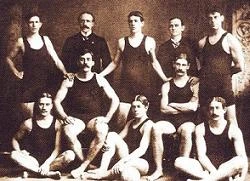
David Bratton, George Van Cleaf, Leo Goodwin, Louis Handley, David Hesser, Joseph Ruddy and James Steen
.- Luigi de Breda, a U.S. citizen of Italian origin, was the son of the personal butler of Popes Leo XIII and Pius X. In 1904 he participated in the sport of water polo in the Olympic Games at St. Louis in the United States, where he won the gold medal. The Vatican newspaper L’Osservatore Romano recently published an article recounting the story of Breda, who “at least ideally, made Vatican City present at the Games.”
Amidst the expectations over the opening of the Olympic Games in Beijing, L’Osservatore recalled the story of the son of Francis Montague Handley, who was the private butler of Pope Leo XIII and Pope Pius X.
Luigi was born on February 14, 1874 in Rome. According to the article by Maria Maggi, “He was friendly, with ruffled hair, physically well-built and a gentleman. He spoke Italian, English, French, Spanish and a little Latin and Greek.”
Luigi de Breda was not able to participate in the St. Louis Games as an Italian, despite having lived in Italy for 22 years, but only as an American under the name of Lou Handley.
Luigi, or Lou, used to swim in the Tevere River when it was still uncontaminated by pollution, Maggi explained, since at that time there were no swimming pools. “Historian Bill Mallon in his Encyclopedia of American Olympians would later recall that Lou triumphed in a mixed competition that consisted of six tests: walking, water polo, horsemanship, cycling, canoeing and swimming. Lou had already set a US swimming record in the 440-yard freestyle.”
“He was exceptional, above all, in water polo. He perfected a new shot, raising himself out of the water, which came to be known as ‘the salmon jump’,” Maggi wrote.
She noted that Lou “played water polo very well much before Johnny Weismuller—famous for playing the role of Tarzan—who won the bronze at the Paris Games of 1924, or Carlo Pedersoli—known more by the Italians as Bud Spencer—who was a key player in Italy’s 5-0 victory over Spain in 1955.”
Luigi Breda was the first coach for women’s water polo at the Anveres Games of 1920 and again at the Paris Games in 1924. He also joined the Swimming Association of New York and remained a member for 40 years. He wrote five books on sports and contributed to writing the section on swimming for the Encyclopedia Britannica. He died in New York on December 28, 1956.Tuesday, May 20, 2008
Traditional Mass at Our Lady of Mount Carmel
From The Society of St. Hugh of Cluny:


Today a Traditional Missa Cantata was celebrated with the assistance of members of our Society in the splendid surroundings of the Church of Our Lady of Mount Carmel on East 115th Street in New York. The Traditional Mass has been celebrated here each Sunday at 10 AM since 1988 – the promulgation of Ecclesia Dei. It is intended to celebrate a Missa Cantata here on the last Sunday of every month.
Our Lady of Mount Carmel is a magnificent church especially dear to the Italian-American community. Italian immigrants – including the women who carried bricks - built it at night in 1884. The statue of the Virgin was crowned with Vatican authorization in 1903 – one of only a handful of Crowned Virgins in North America. Pope Pius X contributed an emerald but the rest of the gold and jewels for the crowns of Our Lady and the Christ Child came from the wedding rings and other jewelry contributed by the Italian ladies of the parish. The feast and procession of Our Lady of Mount Carmel draws a huge crowd in the summer, but at other times the parish quietly ministers to a small flock, including nowadays “Hispanics” and Haitians.
We hope to support the parish’s effort to keep the Traditional Mass alive at Our Lady of Mount Carmel. They need more people to attend and more servers at the mass. The parish is easy to reach from the southbound FDR Drive and parking is available on Sundays nearby. Those of you who have a table at Rao’s a block away will be familiar with the location.
For more on the parish see:
http://www.mountcarmelofeastharlem.com/olmc.html
Subscribe to:
Posts (Atom)