Showing posts with label Russian Orthodox. Show all posts

Wednesday, March 14, 2012

Russian Orthodox Church calls for nationwide ban on homosexualist propaganda aimed at minors

by Matthew Cullinan Hoffman

March 13, 2012 (LifeSiteNews.com) - Officials of the Russian Orthodox Church are hailing a new law signed recently by St. Petersburg governor Georgy Poltavchenko, which prohibits homosexualist propaganda targeting minors, and asking that it be extended to the whole country.

“The law passed in St. Petersburg will help protect children from information manipulations by minorities promoting sodomy,” said Dimitri Pershin, a Russian Orthodox priest and expert with the State Duma Committee on Family, Women, and Children, in an interview with the Russian news agency Interfax.

“The persistence of sexual minorities and their intention to rally near children’s establishments indicate that this regional law is highly needed and should be urgently given federal status,” Pershin said, referring to homosexualist activist Nikolay Alexeyev’s stated intention to organize rallies near children’s establishments to protest the new law.

Vsevolod Chaplin, a spokesman for Moscow’s Orthodox leadership, said that while the Orthodox Church hadn’t initiated the legislation, “many believers” were eager to see its passage.

Homosexual propaganda, “should not take place where minors can feel its influence; the same is true about heterosexual lechery…. Public manifestations of this way of life are unacceptable for the majority of society. It is our duty to secure our children against it. They have no right to promote their way of life,” he said, as reported by the Christian Science Monitor.

St. Petersburg, Russia’s second largest city, now fines individuals up to $170 and companies up to $17,000 for “public actions aimed at promoting sodomy, lesbianism, bisexuality and transgenderism among minors.” The measure is similar to others that have been passed in the Astrakhan, Ryazan, and Kostroma regions, according to RIA Novosti. The same agency reports that an overwhelming majority of Russians, 74 percent, regard homosexuals as “amoral” and “mentally defective,” according to a 2010 poll by an independent agency

The success of the legislation reflects a growing desire in Russia and other Slavic countries to buck the international political and cultural establishment and resist the homosexual political agenda.

The government of Moscow is continuing to prohibit “gay pride” parades after years of pressure, despite a ruling against the city by the European Court of Human Rights.

Saturday, November 26, 2011

Russians flock to see Virgin Mary relic

http://msnbcmedia1.msn.com/j/ap/russia%20orthodox%20relic--936968107_v2.grid-6x2.jpg
Thousands of Orthodox believers, braving frosty weather, stand in a long line for hours Wednesday to get inside Christ the Savior Cathedral to kiss the relic.

(AP) MOSCOW — Braving freezing cold temperatures and ice-covered sidewalks, tens of thousands of Russians stood in line Wednesday to see and kiss a newly arrived relic of the Virgin Mary in Russia's largest Orthodox cathedral.

The Virgin Mary's Cincture, a belt that Christians believe was worn by Jesus' mother, was brought to Russia last month from Mount Athos, a monastic community in Greece.

Kissing the relic, which is encased in an ornamental box, is believed to help barren women conceive and heal other ailments.

The line of people, mostly women, waiting to enter the golden-domed Christ the Savior Cathedral stretched for 2.5 miles (4 kilometers) along the Moscow River despite temperatures that dropped to below minus 5 Celsius (23 Fahrenheit).

Police officers announced through bullhorns that it will take worshippers 24 hours to get to the relic as the line swelled to tens of thousands.

Hundreds of buses brought pilgrims from other Russian cities. Some 150 buses were parked along the embankment with their engines running so the faithful could get warm as they waited. The city provided free tea and food and put up portable toilets.

Some 1,500 police officers were deployed to prevent people from cutting in line.

Traffic in central Moscow has been snarled since the relic first went on display Saturday. By Wednesday afternoon, as many as 300,000 people had seen the relic, which will remain on display through Sunday.

The St. Andrew's Foundation, which brought the relic to Russia, said it was viewed by 2 million people in 14 other cities before arriving in Moscow.

The Russian Orthodox Church withered under eight decades of Soviet rule, but has enjoyed a resurgence over the past two decades. Russians adopted Christianity in 989 from Byzantine Greeks, and the Russian Orthodox Church has maintained close ties with Greek clergy and monasteries.

Tuesday, September 22, 2009

Will the "Third Rome" Reunite With the "First Rome"?

Recent Meeting Could Mark Turning Point

By Robert Moynihan

WASHINGTON, D.C., SEPT. 21, 2009 (Zenit.org)- Sometimes there are no fireworks. Turning points can pass in silence, almost unobserved.

It may be that way with the "Great Schism," the most serious division in the history of the Church. The end of the schism may come more quickly and more unexpectedly than most imagine.

On Sept. 18, inside Castel Gandolfo, the Pope's summer palace about 30 miles outside Rome, a Russian Orthodox Archbishop named Hilarion Alfeyev, 43 (a scholar, theologian, expert on the liturgy, composer and lover of music), met with Benedict XVI, 82 (also a scholar, theologian, expert on the liturgy and lover of music), for almost two hours, according to informed sources. (There are as yet no "official" sources about this meeting -- the Holy See has still not released an official communiqué about the meeting.)

The silence suggests that what transpired was important -- perhaps so important that the Holy See thinks it isn't yet prudent to reveal publicly what was discussed.

But there are numerous "signs" that the meeting was remarkably harmonious.

If so, this Sept. 18 meeting may have marked a turning point in relations between the "Third Rome" (Moscow) and the "First Rome" (Rome) -- divided since 1054.

Archbishop Hilarion was in Rome for five days last week as the representative of the new Russian Orthodox Patriarch Kirill of Moscow.

One key person Archbishop Hilarion met with was Cardinal Walter Kasper. On Sept. 17, the cardinal told Vatican Radio that he and Archbishop Hilarion had a "very calm conversation."

Cardinal Kasper also revealed something astonishing: that he had suggested to the archbishop that the Orthodox Churches form some kind of "bishops' conference at the European level" that would constitute a "direct partner of cooperation" in future meetings.

This would be a revolutionary step in the organization of the Orthodox Churches.

Papal-Patriarch encounter?

Cardinal Kasper said a Pope-Patriarch meeting was not on the immediate agenda, and would probably not take place in Moscow or Rome, but in some "neutral" place (Hungary, Austria and Belarus are possibilities).

Archbishop Hilarion himself revealed much about how his Rome visit was proceeding when he met on the evening of Sept. 17 (before his meeting with the Pope) with the Community of Sant'Egidio, an Italian Catholic group known for its work with the poor in Rome.

"We live in a de-Christianized world, in a time that some define -- mistakenly -- as post-Christian," Archbishop Hilarion said. "Contemporary society, with its practical materialism and moral relativism, is a challenge to us all. The future of humanity depends on our response… More than ever before, we Christians must stand together."

A report from Interfax, the news service of the Moscow Patriarchate, on Sept. 18 revealed that Archbishop Hilarion spoke to the Pope about "cooperation between the Russian Orthodox and Roman Catholic Churches in the area of moral values and of culture" -- in particular during the "Days of Russian Spiritual Culture," a type of exhibit with lectures scheduled for spring 2010 in Rome. (One might imagine that the Pope himself could attend such an exhibition).

In memory of the visit, Archbishop Hilarion gave the Pope a pectoral cross, made in workshops of Russian Orthodox Church, the report said, Interfax reported.

Today, an Interfax report supplied details of Hilarion's remarks this morning in the catacombs of St. Callixtus.

"Denied by the world, far from human eyes, deep under ground in caves, the first Roman Christians performed the feat of prayer," Hilarion said. "Their life brought the fruit of holiness and martyr heroism. The Holy Church was built on their blood shed for Christ."

Then the Church came out of the catacombs, but Christian unity was lost, the archbishop said.

Archbishop Hilarion said that human sin is the cause of all divisions, while Christian unity can be restored only in the way of sanctity.

"Each of us, conscientiously fulfilling a task the Church has given him or her, is called to personally contribute to the treasury of Christian sanctity and work to achieve God-commanded Christian unity," the archbishop said.

A second Interfax report today added further information about the meeting with the Pope.

Growing influence

"During a talk with Pope Benedict XVI, Archbishop Hilarion of Volokolamsk pointed out the status of Orthodox believers in Western Ukraine where three Orthodox dioceses had been almost eliminated as a result of coercive actions of Greek Catholics in late 1980s and early 1990s," Interfax reported.

Archbishop Hilarion "stated the need to take practical steps to improve the situation in Western Ukraine," within the territories of Lvov, Ternopol and Invano-Frankovsk Dioceses, the report said.

Meanwhile, in Russia itself, the influence of the Russian Orthodox Church, headed by Patriarch Kirill, seems to be growing, though not without opposition.

The rise in Russia of Kirill and his increasing influence in legislative matters seems to be arousing opposition from the "siloviki," forces connected with the old KGB.

In an article in the current issue of Argumenty Nedeli, Andrey Uglanov says that Kirill's extraordinary activity has attracted attention from some who do not like to have their positions questioned, let alone challenged. And that has become Kirill's "big problem."

These "siloviki," Uglanov says, have been offended by Kirill's "anti-Stalinist and anti-Bolshevik actions," including his appearance at the Solovetsky stone in Moscow's Lubyanka Square on the very Day of the Memory of the Victims of Political Repression.

In this context, Hilarion's visit to Rome takes on even more importance.

The Russian Orthodox Church is a power in Russia, but it faces opposition and needs allies.

What is occurring in Hilarion's visit to Rome, then, may have ramifications not only for the overcoming of the "Great Schism," but also for the cultural, religious and political future of Russia, and of Europe as a whole.

It is especially significant, in this context, that Hilarion, Kirill's "Foreign Minister," has some of the same deep interests as Benedict XVI: the liturgy, and music.

"As a 15-year-old boy I first entered the sanctuary of the Lord, the Holy of Holies of the Orthodox Church,” Hilarion once wrote about the Orthodox liturgy. “But it was only after my entrance into the altar that the 'theourgia,' the mystery, and 'feast of faith' began, which continues to this very day.

"After my ordination, I saw my destiny and main calling in serving the Divine Liturgy. Indeed, everything else, such as sermons, pastoral care and theological scholarship were centered around the main focal point of my life -- the liturgy."

Liturgy

These words seem to echo the feelings and experiences of Benedict XVI, who has written that the liturgies of Holy Saturday and Easter Sunday in Bavaria when he was a child were formative for his entire being, and that his writing on the liturgy (one of his books is entitled "Feast of Faith") is the most important to him of all his scholarly endeavors.

"Orthodox divine services are a priceless treasure that we must carefully guard," Hilarion has written. "I have had the opportunity to be present at both Protestant and Catholic services, which were, with rare exceptions, quite disappointing… Since the liturgical reforms of the Second Vatican Council, services in some Catholic churches have become little different from Protestant ones."

Again, these words of Hilarion seem to echo Benedict XVI's own concerns. The Pope has made it clear that he wishes to reform the Catholic Church's liturgy, and preserve what was contained in the old liturgy and now risks being lost.

Hilarion has cited the Orthodox St. John of Kronstadt approvingly. St. John of Kronstadt wrote: "The Church and its divine services are an embodiment and realization of everything in Christianity... It is the divine wisdom, accessible to simple, loving hearts."

These words echo words written by Cardinal Ratzinger, now Benedict XVI, who often said that the liturgy is a "school" for the simple Christian, imparting the deep truths of the faith even to the unlearned through its prayers, gestures and hymns.

Hilarion in recent years has become known for his musical compositions, especially for Christmas and for Good Friday, celebrating the birth and the Passion of Jesus Christ. These works have been performed in Moscow and in the West, in Rome in March 2007 and in Washington DC in December 2007.

Closer relations between Rome and Moscow, then, could have profound implications also for the cultural and liturgical life of the Church in the West. There could be a renewal of Christian art and culture, as well as of faith.

All of this was at stake in the quiet meeting between Archbishop Hilarion and Benedict XVI on Friday afternoon, in the castle overlooking Lake Albano.
Monday, July 27, 2009

Orthodox activists announce contest for church project to replace Lenin's Mausoleum

Moscow, July 17, Interfax - The Union of Orthodox Church Banner-Bearers announced a contest for the project of a Church of New Russian Martyrs and Confessors in the Red Square to replace Lenin's Mausoleum.

"Revival of Russia is impossible until the occult lab for destroying will and conscience of Russian people remains in the very heart of Moscow "the Third Rome." To this end, the Mausoleum should be destructed, body of the world proletarian leader should be taken away, this place should be consecrated and an Orthodox Church should be constructed at this place," the Union's Head Leonid Simonovich-Nikshich has told an Interfax-Religion correspondent on Friday.

He has already presented the first contest project and suggested building a small copy of Yekaterinburg Church-on-the-Blood erected at the site of the last Russian emperor's execution instead of "the main world Satan temple."

Simonovich-Nikshich said that the contest started on July 17 on the day of the 91st commemoration "of the ritual murder of the holy royal martyrs," thus the future church in place of the mausoleum should be consecrated in honor of "the assemble of new Russian martyrs and confessors suffered from atheistic rule."

"Sooner or later, God providence will destroy the Satan temple. Meantime, we should get ready for laying the first stone to the foundation of finally awaken Russia," he said.

The Union's website will present all projects for nation-wide discussions and due to the participants wish authors may comment them "for explaining their conception."

Sunday, July 5, 2009

Russian president: We want better Vatican ties

VATICAN CITY (AP) — Russia's president says Moscow plans to improve its ties with the Vatican.

Tensions between the Russian Orthodox and Roman Catholic churches over property disputes and other issues have so far made it impossible for any pope to visit Moscow.

Russian President Dmitry Medvedev told Italian reporters in an interview ahead of the G-8 summit in Italy this week that relations between his country and the Vatican will "in all likelihood be developed further." He also said the possibility of diplomatic ties is under discussion.

He declined to say if Pope Benedict XVI will travel to Russia anytime soon.

The previous pontiff, Polish-born John Paul II, was frustrated in his desire to go to Russia.

Part of the interview was shown Sunday on Italian state TV.

Wednesday, July 1, 2009

Orthodox in Australia Acquiring Abandoned Catholic, Protestant and Anglican Churches

Protopriest Michael Protopopov gives an interview to www.pravoslavie.ru to discuss the reasons why Catholics, Protestants and Anglicans are deserting their churches...

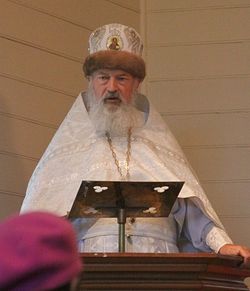
Загрузить увеличенное изображение. 600 x 900 px. Размер файла 137166 b.  Mitred Protopriest Michael Protopopov"The sale of church property on a gargantuan scale is an indication of the fact the Australian populace is living in a post-Christian age. More and more people are becoming secular as opposed to being religious and spiritual. Fifty years ago, the Australian populace was much more religious; the Catholic Church has begun to recede dramatically since the Second Vatican Council
of 1963. Likewise the Anglican Church has seen plummeting parishioner numbers since the introduction of homosexuality as not a ban to clergy, same sex marriages, female clergy and even female bishops.

The closure of Anglican, Protestant and Catholic churches in rural and populated areas is also due to the fact that they lack priests, nuns and seminarians. People have lost commitment.

Especially Catholics aren’t committed as they were before the Second Vatican Council of 1963. Those people that were once committed, those people who founded these churches, have wandered away from the Catholic Church, and their children have perhaps grown up not knowing Christianity at all. Thus, out of the youth there are hardly any candidates for seminary or monasticism. Without a solid seminary and monastic program, the Catholic Church can hardly expect a positive future.

http://www.pravoslavie.ru/sas/image/100226/22612.p.jpg

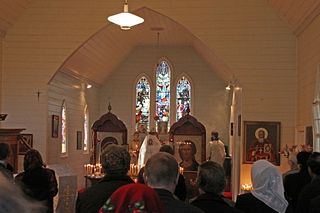
It is quite sad that Catholic and Anglican churches are being abandoned and sold. For example, at the Russian Orthodox parish in Warrnambool, there are beautiful, old stained glass windows which have inscriptions in memory of the founders of the church, brass candle sticks which have engraved in them names of parishioners who are now forgotten by their own people. Those parishioners and founders of the church are remembered in our prayers during every liturgy—as is standard practice in the Orthodox Church to pray for the “founders of this holy temple.”

Saturday, December 6, 2008

Metropolitan Kirill named interim leader of Russian Church

MOSCOW, December 6 (RIA Novosti) - The governing body of the Russian Orthodox Church, the Holy Synod, elected on Saturday Metropolitan Kirill of Smolensk and Kaliningrad as the interim leader of the Church.

Patriarch of Moscow and All Russia Alexy II, who led the Russian Church for 18 years, died at the age of 79 in his residency near the capital on Friday. His body will be lying in state in the Cathedral of Christ the Savior from Saturday evening.

Alexy II will be buried on Tuesday in the Annunciation side-chapel of Moscow's Epiphany Cathedral.

Photo

Alexy II became patriarch of the Russian Orthodox Church in 1990, shortly before the collapse of the atheist Soviet Union, and presided over a religious revival in Russia, with thousands of churches and monasteries being restored and hundreds of new ones built across the country.

A national council of bishops, priests, monks and laymen should be summoned in six months to elect a new patriarch for the Russian Church.

Friday, December 5, 2008

Russian Orthodox Church Patriarch Alexy II dies

http://img.beta.rian.ru/images/15005/68/150056854.jpg

MOSCOW (AP) — The Russian Orthodox Church says its Patriarch Alexy II has died.

The church says the 79-year-old died at his residence outside Moscow on Friday. It did not give the cause of death, but the patriarch had long suffered from a heart ailment.

The outspoken patriarch had led the world's biggest Orthodox church since 1990, presiding over a flock that by most estimates numbers two-thirds of Russia's population of 142 million.

St. Nicholas the Miracleworker (12th-13th c.)

http://i34.tinypic.com/2jcbolc.jpg
"The third icon among our examples, St. Nicholas the Miracleworker, with Scenes from His Life, also comes from Sinai, but it is a later work, from the end of the twelfth or the first half of the thirteenth century. The saint is an amalgamation of two St. Nicholases, a bishop of the fourth century and a pious monk of the sixth. By the twelfth century St. Nicholas has become one of the most beloved and popular saints, not only in the Byzantine Empire but in Russia and the West. He was considered the patron of sailors, seamen, and fishermen, scholars, students and teachers, merchants, traders, marriageable maidens, bankers, and even robbers and thieves. Hagiographical icons of the saint presented in the middle his bust (in Russia, also his standing figure) and a selection of episodes from his life and from his posthumous miracles framing the central image. The icon shown here includes 16 episodes, from the saint's birth to his death. The monumental character of the central panel is softened by an addition of interesting decorative details. The hair and the beard of the saint are fancifully outlined by flowing white curls and the crosses on the saint's omophorion show intricate design. Next to Nicholas' head are two small figures: on the left Christ with a Gospel book, and on the right the Virgin with an omophorion. These two figures allude to the story of the saint's presence at the First Ecumenical Synod in Nicaea in 325. According to the story, Nicholas, angered by the blasphemous words of the heretic Arius against the Holy Trinity, slapped him on the face. For this, he was put in prison and his bishop's attributes, the Gospel Book and the omophorion, were taken from him. However, at night, Christ and the Virgin appeared in his prison cell and returned the Gospel book and the omophorion to him, forcing Emperor Constantine to free the saint and reinstate him as a bishop. In Russia, St. Nicholas became the most popular saint of all, depicted in literally thousands of icons, ranging from simple busts to very elaborate hagiographical icons with more than forty border scenes."

Tuesday, October 7, 2008

Pope to Patriarch: We Need Unity Faster

Benedict XVI Tells Alexy II the Times Urge Haste

By Inmaculada Álvarez

VATICAN CITY, OCT. 6, 2008 (Zenit.org).- Benedict XVI sent a personal message to Russian Orthodox Patriarch Alexy II saying that modern times call for a hastening of the journey toward Christian unity.

The Sept. 22 message was hand-delivered to Alexy II by the archbishop of Naples, Cardinal Crescenzio Sepe, on an official visit to Moscow at the invitation of the patriarch. The cardinal gave the message to the patriarch in a meeting that lasted a little more than an hour last Thursday.

"I have a deep affection for all the Orthodox brethren, and I am particularly close to them in these most recent days when conflict has caused significant suffering to peoples so dear to me," the Holy Father said. "I never cease to offer daily prayers for peace, asking the Lord that the appeals of Your Holiness to resolve all hostility for the good of the nations may be heeded."

He added: "Faith in Our Lord Jesus Christ is a bond that unites hearts in a profound way and invites us all to strengthen our commitment to manifest to the world a shared witness of living together respectfully and peacefully.

"Our times, marked so often by conflict and grief, make it even more necessary to hasten the journey toward the full unity of all the disciples of Christ, so that the joyous message of salvation may be spread to all humanity."

Getting closer

Cardinal Sepe told Vatican Radio on the day of his meeting with Alexy II that the Orthodox and Catholic Churches are growing ever closer, "as the patriarch himself emphasized with emotion."

"The impression is that a very important step has been taken to create a climate of closeness and mutual respect, of fraternity and friendship," he added.

Bishop Vincenzo Paglia of Terni, president of the Italian bishops' ecumenism commission, who was also present in the meeting with Alexy II, said that the process of growing closer should proceed with meetings between the various pastors of both Churches.

On the path to unity, the bishop added, "meetings between experts are no longer sufficient." Rather, ecumenism "is a coming together of the Churches."

And, Bishop Paglia affirmed, ecumenism is more and more "a demand of contemporary society."

"The harmony between the Catholic Church and the Orthodox Church is ever more evident," he said, referring to the challenges presented to all Christians in Europe and contemporary society. "Certain limits and challenges can only be faced from a perspective of unity."

--- --- ---

On the Net:

Benedict XVI's letter: www.zenit.org/article-23823?l=english