Showing posts with label Father Federico Lombardi. Show all posts

Thursday, October 16, 2014

Synod Bishops revolt against leadership and get their way – UPDATE!

From Father Z:

Apparently the bishops at the Synod are tired of being manipulated.

They created a little lío of their own.

In full view of the Pope, they rose up pretty much as a body and rebelled against the way Card.
Baldisseri, who seems to be the chief architect of what may have been a pre-determined agenda, has been handling them.

I am reading Marco Tosatti’s piece at La Stampa.

My translation:
Synod, more censorship, protests
The General Secretary of the Synod [Card. Balidsseri] announced the decision not to publish the reports of the Circuli Minores [subcommittees by language groups, tasked with contributing elements to the final report]. The announcement provoked the protest of Card. Erdo [the president or chairman for this Synod], and numerous other Synodal Fathers. The Pope, silent and very serious. At last, Fr. Lombardi announced that the reports of the commissions would be made public.
[...]
Erdo took the floor, implicitly distancing himself from the report that bore his name, and saying that if that “disceptatio” had been made public, then the others of the Circulo Minores ought to be made public.
His speech was followed by an avalanche from many others along the same line, underscored by thunderous applause.
The Secretary of the Synod, Card. Balidisseri, was watching the Pope, as if in search of advice and lights, and the Pope remained silent and very serious.
Silent also were the Under-secretaries of the Synod, Fabene, Forte, Schoenborn and Maradiaga. [What a list.]
Kasper wasn’t there.
Finally, Fr. Lombardi announced that the reports of the Commission would be made public.
This is a big deal because the bishops didn’t simply roll over and let the appointees running the Synod run them over.... (continued)

Link:
Related:

Wednesday, July 16, 2014

Pope's hints on married priests trouble Vatican

By Olivier BAUBE

Vatican City (AFP) - Pope Francis's hints about a possible opening on the issue of married priests are sowing confusion in the Vatican and among Catholic reformists and conservatives alike.

Twice in three months, Francis has talked about changes to the tradition of celibate priests -- although he has never been precise about how exactly this could be reformed.

On a flight back from his trip to the Middle East, Francis pointed out that there were already married priests in the Ukrainian Greek Catholic and Coptic Catholic churches.

"The door is always open but we are not talking about it now as the order of the day," the Argentine pontiff said.

It is a priority, however, for the dozens of campaign groups that have sprung up -- many formed by men who have been forced to leave the priesthood to get married.

The European Federation of Married Catholic Priests estimated more than 100,000 former Catholic priests have got married over the years -- a figure which would make up around a quarter of the number of current priests.

Earlier this year, 26 women who said they were in love with priests living in Italy, wrote an open letter to the pope asking for a Vatican audience and speaking of their "suffering" because of the secret lives they have to lead.

- New bombshell -

Vatican expert Andrea Tornielli said at the time that Francis was particularly sensitive to the issue as, when he was the archbishop of Buenos Aires, he was close to an Argentine bishop who renounced the priesthood for love.

The pope's comments over the weekend have had the effect of a new bombshell after La Repubblica daily in an interview quoted him as saying on priestly celibacy: "There are solutions and I will find them."

The comments were immediately denied by Vatican spokesman Federico Lombardi who said that the interviewer -- the newspaper's 90-year-old founder, Eugenio Scalfari -- had not written down the exact quotations.

"This is not at all an interview in the normal sense of the word," Lombardi said of the one-to-one conversation between Francis and Scalfari, even accusing the newspaper of manipulating "naive readers" with inaccuracies.

It was the second time that a papal interview with Scalfari has raised some hackles in the Vatican, leading to the question of whether the pope could be using these conservations as a way of bypassing traditional Vatican communications.

Father Papas Jani Pecoraro, an Italy-based married priest from the Greek Byzantine church, which is under Vatican authority, welcomed the pope's reported comments.

Speaking to La Repubblica, he said: "The issue could not only change the relationship between the Catholic Church and the lay world but also with other churches."

"We have to read the times and there is no doubt that today's society raises questions that a married priest is definitely better able to cope with," he said.

A Vatican expert, speaking to AFP on condition of anonymity, said that as a whole Francis was seen as "an open pope".

"With his arrival, the progressives in the Church have regained hope," he said.

But a Vatican source said that merely pointing out that priestly celibacy is not a dogma was "no great discovery" and called for greater caution on over-interpreting papal comments.

The source said: "Some questions have been raised but this should not be seen as messages being passed on."

In the Repubblica interview, Francis pointed out that the ban on married priests was only instituted in the 10th century -- nine centuries after the death of Jesus Christ.

"The pope is sensitive to the issue," said the Vatican expert, although many observers are puzzled as to what kinds of "solutions" the pope could have in mind and few are expecting major changes any time soon.

Link:

Sunday, July 13, 2014

Pope Francis: 'About 2%' of Catholic clergy paedophiles

Earlier this month the Pope begged forgiveness from victims of child abusers within the Church

(BBC) Pope Francis has been quoted as saying that reliable data indicates that "about 2%" of clergy in the Catholic Church are paedophiles.

The Pope said that abuse of children was like "leprosy" infecting the Church, according to the Italian La Repubblica newspaper.

He vowed to "confront it with the severity it demands".

But a Vatican spokesman said the quotes in the newspaper did not correspond to Pope Francis's exact words.

The BBC's David Willey in Rome says there is often a studied ambiguity in Pope Francis' off-the-cuff statements.

Analysis: David Willey, BBC News, Rome

He wants to show a more compassionate attitude towards Church teaching than his predecessors, but this can sometimes cause consternation among his media advisers, our correspondent adds.

When is a papal interview not an interview? Sunday's edition of La Repubblica devotes its first three pages to an account of a conversation between Pope Francis and editor Eugenio Scalfari, which took place last Thursday. Papal spokesman Federico Lombardi said in a sharp note that it was not an interview in the normal sense of the word, although he admitted it conveyed the "sense and the spirit" of the conversation.

Mr Scalfari does not use a digital recorder, and Father Lombardi said Pope Francis never checked the accuracy of the interview.

Until now, the Vatican has declined to quantify the extent of clerical sexual abuse scandals in the worldwide Church. Statistics are usually available only for countries in the developed world. In the developing world, information is usually only sketchy.

In the interview, Pope Francis was quoted as saying that the 2% estimate came from advisers. It would represent around 8,000 priests out of a global number of about 414,000.

While the incidence of paedophilia as a psychiatric disorder in the general population is not accurately known, some estimates have put it at less than five percent.

"Among the 2% who are paedophiles are priests, bishops and cardinals. Others, more numerous, know but keep quiet. They punish without giving the reason," Pope Francis was quoted as saying.

"I find this state of affairs intolerable," he went on.

Above the interview La Repubblica ran the headline: "Pope says: Like Jesus, I shall use a stick against paedophile priests."

Vatican spokesman Father Federico Lombardi denied that Pope Francis had said that there were cardinals who were paedophiles.

Last year Pope Francis strengthened the Vatican's laws against child abuse and earlier this month begged forgiveness from the victims of sexual abuse by priests, at his first meeting with victims since his election.

Many survivors of abuse by priests are angry at what they see as the Vatican's failure to punish senior officials who have been accused of covering up scandals.

Asked in the same La Repubblica interview about the celibacy rule for priests, Pope Francis recalled that it was adopted 900 years after the death of Jesus Christ and pointed out that the Eastern Catholic Church allows its priests to marry.

"The problem certainly exists but it is not on a large scale. It will need time but the solutions are there and I will find them."

Father Lombardi also denied that these were the Pope's exact words.

Link:
Pope says about two percent of priests are pedophiles: paper

ROME (Reuters) - About two percent of Roman Catholic clerics are sexual abusers, an Italian newspaper on Sunday quoted Pope Francis as saying, adding that the pontiff considered the crime "a leprosy in our house".

But the Vatican issued a statement saying some parts of a long article in the left-leaning La Repubblica were not accurate, including one that quoted the pope as saying that there were cardinals among the abusers.

The article was a reconstruction of an hour-long conversation between the pope and the newspaper's founder, Eugenio Scalfari, an atheist who has written about several past encounters with the pope.

"Many of my collaborators who fight with me (against paedophilia) reassure me with reliable statistics that say that the level of paedophilia in the Church is at about two percent," Francis was quoted as saying.

"This data should hearten me but I have to tell you that it does not hearten me at all. In fact, I think that it is very grave," he was quoted as saying.

The pope was quoted as saying that, while most paedophilia took place in family situations, "even we have this leprosy in our house".

According to Church statistics for 2012, the latest available, there are about 414,000 Roman Catholic priests in the world.

The Vatican issued a statement noting Scalfari's tradition of having long conversations with public figures without taking notes or taping them, and then reconstructing them from memory. Scalfari, 90, is one of Italy's best known journalists.

While acknowledging that the conversation had taken place, Vatican spokesman Father Federico Lombardi issued a statement saying that not all the phrases could be attributed "with certainty" to the pope.

Lombardi said that, in particular, a quote attributed to the pope saying cardinals were among the sex abusers was not accurate and accused the paper of trying to "manipulate naive readers".

Last week, the Argentine pope held his first meeting with victims of sexual abuse by priests.

He told them the Church should "weep and make reparation" for crimes that he said had taken on the dimensions of a sacrilegious cult. He vowed zero tolerance for abusers and said bishops would be held accountable if they covered up crimes by priests in their diocese.

(Reporting By Philip Pullella; Editing by Rosalind Russell)

Link:
Related:

Friday, January 24, 2014

Pope Francis Meets Head of Medjugorje Commission Cardinal Camillo Ruini

By Edward Pentin

(National Catholic Register) Pope Francis today met Cardinal Camillo Ruini who chairs the Medjugorje Commission.

Vatican spokesman Fr. Federico Lombardi wasn't able to disclose the reasons for the meeting, telling the Register that "naturally the contents of a private conversation are not subject to communication."

However, the vicar general emeritus of the Vicariate of Rome will most probably have discussed the commission's findings on Medjugorje which it submitted last week to the Congregation for the Doctrine of the Faith. After being examined by the CDF, a proposal will be made to the Holy Father who will have the final say.

The timeline for a decision is not known, although Cardinal Vinko Puljic of Sarajevo, who is also a member of the commission, said this week that he expected the Pope to rule on the authenticity of the apparitions by the end of this year.

The cardinal also said the commission is "not opposed to Medjugorje as a place of faith where faithful pilgrims gather."

Link:
Related:

Thursday, May 2, 2013

Benedict returns to Vatican to live side-by-side with Pope Francis

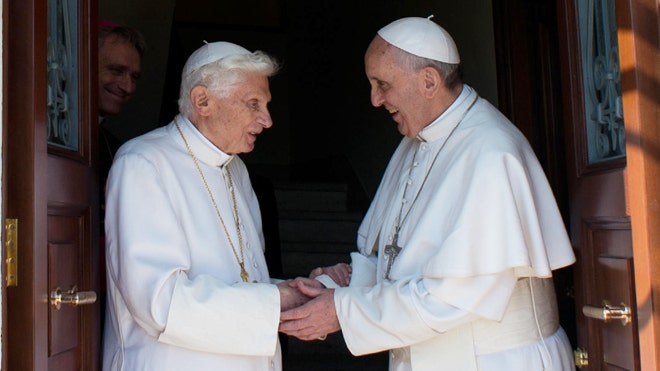
vatican_050213.jpg
May 2, 2013: In this photo provided by the Vatican newspaper L'Osservatore Romano, Pope emeritus Benedict XVI, left, is welcomed by Pope Francis as he returns at the Vatican from the pontifical summer residence of Castel Gandolfo. AP/Osservatore Romano)

From the Associated Press / FoxNews.com:

VATICAN CITY –  Emeritus Pope Benedict XVI came home to the Vatican on Thursday for the first time since he resigned Feb. 28, beginning an unprecedented era for the Catholic Church of having a retired pontiff living alongside a reigning one.

Pope Francis welcomed Benedict outside his new retirement home — a converted monastery on the edge of the Vatican gardens — and the two immediately went into the adjoining chapel to pray together, the Vatican said.

The Vatican said Benedict, 86, was pleased to be back and that he would — as he himself has said — "dedicate himself to the service of the church above all with prayer." Francis, the statement said, welcomed him with "brotherly cordiality."

A photo released by the Vatican showed the two men, arms clasped and both smiling, standing inside the doorway of Benedict's new home as Benedict's secretary looks on.

Unlike the live, door-to-door Vatican-provided television coverage that accompanied Benedict's emotional farewell in February, the Vatican provided no television images of his return Thursday.

The low-key approach followed the remarkable yet somewhat alarming images transmitted on March 23 when Francis went to visit Benedict at the papal retreat in Castel Gandolfo, south of Rome, where Benedict was living. In that footage, Benedict appeared visibly more frail and thinner only three weeks after resigning.

Some Vatican officials questioned whether those images should have been released, given how frail Benedict appeared. Thursday's photo showed no obvious signs of further decline.

The Vatican spokesman, the Rev. Federico Lombardi, has acknowledged Benedict's post-retirement decline but has insisted the 86-year-old German isn't suffering from any specific ailment and is just old.

"He is a man who is not young: He is old and his strength is slowly ebbing," Lombardi said this week. "However, there is no special illness. He is an old man who is healthy."

Benedict chose to leave the Vatican immediately after his resignation to physically remove himself from the process of electing his successor and from Pope Francis' first weeks as pontiff.

His absence also gave workers time to finish up renovations on the monastery tucked behind St. Peter's Basilica that until last year housed groups of cloistered nuns who were invited for a few years at a time to live inside the Vatican to pray.

In the compact, four-story building, Benedict will live with his personal secretary, Monsignor Georg Gaenswein, and the four consecrated women who look after him, preparing his meals and tending to the household. The building also has a small library, a study and a guest room for when his brother, Monsignor Georg Ratzinger, comes to visit.

"It is certainly small but well-equipped," Lombardi said.

When Benedict announced his intention to resign — the first pontiff to do so in 600 years — questions immediately swirled about the implications of having two popes living alongside one another inside the Vatican.

Benedict fueled those concerns when he chose to be called "emeritus pope" and "Your Holiness" rather than "emeritus bishop of Rome." He also raised eyebrows when he chose to continue wearing the white cassock of the papacy.

Given the political intrigues that plague the Vatican, it wasn't much of a stretch of the imagination to wonder if some cardinals, bishops and monsignors — not to mention ordinary Catholics — might continue making Benedict their point of reference rather than the new pope.

But Benedict made clear on his final day as pope that he was renouncing the job and pledged his "unconditional reverence and obedience" to his then-unknown successor. It was a pledge he repeated in person on March 23 when Francis went to have lunch with him.

It was during that visit that the world saw how weak Benedict had become: Always a man with a purposeful walk, he shuffled tentatively that day, using his cane.

Francis, for his part, seems utterly unfazed by the novel situation. He has frequently invoked Benedict's name and work and has called him on a half-dozen occasions, making clear he has no intention of ignoring the fact that there's another pope still very much alive and now living on the other side of the garden.

Francis' gestures to Benedict during that March 23 visit were also remarkable: He refused to pray on the special papal kneeler in the small chapel of Castel Gandolfo, preferring to join Benedict on a kneeler in the pews, and referring to his predecessor as his "brother."

Now that they're neighbors, they might bump into one another on walks in the Vatican gardens or at the shrine to the Madonna, which is just a stone's throw from Benedict's new home.

Link:

Thursday, January 29, 2009

Benedict XVI Expresses Solidarity With Jews

Vatican Spokesman Hopes Statement Clarifies Church Position

By Mirko Testa

VATICAN CITY, JAN. 28, 2009 (Zenit.org).- Benedict XVI expressed solidarity with Jews and strongly condemned the use of concentration camps during World War II in his response to the uproar caused by lifting the excommunication of a holocaust-denying bishop.

Speaking today after delivering his weekly general audience address, the Pope addressed for the first time a rift that began Saturday when the Vatican lifted the excommunication of Lefebvrite Bishop Richard Williamson.

The bishop had appeared days earlier on Swedish television claiming that historical evidence denies the gassing of Jews in Nazi concentration camps. He also alleged that no more than 300,000 Jews were killed during World War II.

Bishop Williamson was one of four prelates of the Society of St. Pius X who were illicitly ordained to the episcopate by Archbishop Marcel Lefebvre in 1988. The excommunication was also lifted for the other three bishops, and was meant to be a step toward healing the division caused by the ordinations some 20 years ago.

Today the Pontiff acknowledged the horror of the Holocaust, and especially the death camps such as Auschwitz, which he said "carried out the brutal massacre of millions of Jews, innocent victims of a blind racial and religious hate."

The Pope expressed his "hope that the memory of the Shoah moves humanity to reflect on the unpredictable power of evil when it conquers the human heart," and that the Holocaust "be for everyone a warning against forgetting, against negating or reductionism, because violence committed against even one human being is violence against all."

"No man is an island," Benedict XVI continued, referring to the English Poet John Donne (1571-1631).

"May the Shoah teach especially, as much the old generations as the new ones, that only the tiring path of listening and dialogue, of love and pardon, leads peoples, cultures and religions of the world to the desired encounter of fraternity and peace in the world," he said. "May violence never again humiliate the dignity of man!"

Sufficient

Jesuit Father Federico Lombardi, director of the Vatican press office, said immediately following the audience that the Pope's statements on the Holocaust "should be more than sufficient to respond to the questions of those who doubt the position of the Pope and the Catholic Church."

Since the weekend, reports had been circulating that the Rabbinate of Israel would indefinitely sever ties with the Vatican, which were established in 2000 when Pope John Paul II visited Israel, and cancel a meeting of the Commission for Religious Relations of the Holy See set for March.

The Vatican and the state of Israel have had their own, separate relationship since establishing diplomatic ties in 1993, and the current situation does not affect state relations.

Father Lombardi said today he hoped that "the difficulties presented by the Rabbinate of Israel can be the object of a subsequent and more profound reflection," and that Vatican-Jewish relations "can go forward fruitfully and serenely."

In an interview that aired today on Italian television, Oded Wiener, the director-general of the Rabbinate of Israel, affirmed the importance of relations with the Vatican: "I think that it is fundamental as much for us as for the Vatican itself."

Regarding Benedict XVI's comments after the general audience, Wiener underlined: "In the first place I believe that the declaration of the Pope this morning have been extremely important, for us and for the entire world. There is no place for people such as Williamson that deny the existence of the Holocaust."

"I think it has been a big step forward," he added.

The Israeli ambassador to the Holy See, Mordechay Lewy, said he was "very happy for a declaration from such a high level by the Holy See that clarifies and helps to overcome these misunderstanding."

"I think that it is erroneous, now, to personalize the question concentrating on a single bishop," he added.

With regard to the intention of Benedict XVI to travel to the Holy Land in May, the Israeli ambassador said "the Pope is welcome in Israel today, as he was welcomed yesterday and the day before."

[Adapted by Karna Swanson]

Related:

Thursday, July 24, 2008

WYD Madrid to help recover Christian identity of Europe, says Vatican spokesman

.- In an interview with Vatican Radio, the director of the Press Office of the Holy See, Father Federico Lombardi, said the next World Youth Day to be held in Madrid in 2001 will focus on the challenge of preventing Europe from losing its Christian identity.

Europe “is a continent where the confrontation between the faith and the problems of modern society, secularization and development, which the world imposes on the faith, is always alive,” Father Lombardi said. The effort to recover the Catholic identity of Europe will take place “without controversy and without trying to make comparisons with the world around us.”

“The Pope has spoken often of the risk that Europe might lose its fundamental values connected to the Christian tradition and the contribution the faith has made to this continent,” Father Lombardi explained. Therefore, he said, “this will be one of the issues and objectives of the next World Youth Day.”

He also recalled the success of the World Meeting of Families which took place in Valencia, Spain, “where the Pope’s message was completely positive, centered on the beauty of being a Christian and on the positive message for today’s family as well.”

“I think this will be the spirit also of the next World Youth Day in Spain: a message of hope, a message that says that the faith makes a beautiful and important contribution to the future of our society and our world,” Father Lombardi said.