Monday, February 9, 2009

The Sky in Motion


Inside the Eagle Nebula


From RORATE CÆLI:
"In an e-mail message sent to the most prestigious Argentinian daily, La Nación (Monday edition), the superior for the South American District of the Priestly Fraternity of Saint Pius X (FSSPX / SSPX), Father Christian Bouchacourt, confirmed that Bishop Richard Williamson "was removed from his charge as head of the seminary" of Nuestra Señora Corredentora of La Reja (Province of Buenos Aires, Argentina)."

"Related: Der Spiegel interviews Bishop Williamson (in English), including a comment with which all reasonable observers will agree: "Apparently Germany's leftist Catholicism has not yet forgiven Ratzinger for becoming pope."

"UPDATE (1200 GMT): The official news agency of the SSPX, DICI, has now confirmed the following:
Bishop Williamson, as he declared in his interview [to Der Spiegel] does not wish to "hurt in any way the work of the Fraternity"; that is why he accepted, on January 31, the decision of the Superior General [Bishop Fellay] to relieve him of his position as director of the Seminary of La Reja (Argentina). [In French: DICI - permanent link]"


St. Catherine of Alexandria
Marco Basaiti

Sunday, February 8, 2009

Pledge prayers by poll for the intentions of the Holy Father (closes 11 February 2009)

Snapshot: 11:39 PM - Feb. 9

Vote/Pledge

Pope Says True Healing Is in Truth and Love of God

Affirms Jesus Frees Us From Evil and Brings Life

VATICAN CITY, FEB. 8, 2009 (Zenit.org).- Jesus' healing work is continued in the Church through the sacraments, the charity of the community and an understanding of the meaning and value of illness, Benedict XVI is pointing out.

The Pope affirmed this today in St. Peter's Square before praying the midday Angelus with the faithful gathered there.

He spoke about the Gospel's account of Jesus curing many sick people, stating that "it invites us once again to reflect on the meaning and value of illness in every situation in which the human being can find himself."

The Pontiff referred to the World Day of the Sick, which will be celebrated on Feb. 11. He said, "Despite the fact that illness is part of human existence, we never manage to get used to it, not only because sometimes it comes to be burdensome and grave, but essentially because we are made for life, for complete life."

We think of God as "plenitude of life," he observed; thus "when we are tested by sickness and our prayers seem in vain, doubt wells up in us and, filled with anguish, we ask ourselves: What is God's will?"

The answer, said the Holy Father, is found in the Gospel. He explained: "Jesus does not leave room for doubt: God -- whose face he himself has revealed -- is the God of life, who frees us from all evil.

"The signs of this, his power of love are the healings that he carries out: He thus shows that the Kingdom of God is near, restoring men and women to their full integrity in spirit and body."

More importantly, he said, we "understand that man's truest and deepest illness is the absence of God, who is the fount of truth and love."

Benedict XVI added: "And only reconciliation with God can give us true healing, true life, because a life without love and without truth would not be a true life. The Kingdom of God is precisely the presence of truth and love, and thus it is healing in the depths of our being."

New Zealand town is in the dark — and proud of it

A stone chapel is shown on the edge of Lake Tekapo under the sparkling sky in By RAY LILLEY, Associated Press Writer Ray Lilley, Associated Press Writer Sun Feb 8, 11:03 am ET

AP – A stone chapel is shown on the edge of Lake Tekapo under the sparkling sky in New Zealand's South Island …

TEKAPO, New Zealand – This little town is in the dark and proud of it.

Where other places greet the night by lighting up their streets and tourist attractions, this one goes the other way — low-energy sodium lamps are shielded from above, and household lights must face down, not up.

The purpose: to bring out the stars.

The town of 830 people on New Zealand's South Island is on a mission to protect the sight of the night sky, even as it disappears behind light and haze in many parts of the world.

The ultimate prize would be UNESCO's approval for the first "starlight reserve," and already the "astro tourists" are coming.

A group of 25 are huddled at midnight on a bare New Zealand hilltop, their faces numbed by an icy wind as they gaze up at the Milky Way.

"It's awesome, I mean it's like beyond words," says Simon Venvoort, 46, a management consultant from Amsterdam. "You see so much you aren't aware of..."

More

Archbishop Chaput urges Catholics to stand up for Christian values in society

.- Speaking in Ireland on Saturday, Denver Archbishop Charles J. Chaput discussed the importance of truth in the public square and exhorted his listeners to bring Jesus to the world by being “vigorous and unembarrassed about our Catholic presence in society.”

Addressing the John Paul II Society in Ireland, the archbishop began his talk titled, “Render Unto Caesar: Personal Faith and Public Duty,” by noting that while there are differences between his usual audience of American Catholics and the current crowd of Irish Catholics, “being a ‘Catholic’ – and I mean genuinely Catholic -- makes us much more similar than we are different.” Yes, the mission of a Christian “changes it its details from country to country and age to age,” but the “basic mission is always the same – to bring the world to Jesus Christ; and Jesus Christ to the world,” he said.

The archbishop explained that his talk would address the “heart of the problems” Catholics “face in living our Christian vocation in the modern world.” We are being told two things: The Scriptures remind us to “make disciples of all nations,” and the mass media and political leaders tell us to “be ‘tolerant,’ to fit in, to ‘grow up’ and to stop making a lot of religious noise.”

“Obviously we can’t follow both voices at the same time.”

The archbishop then recalled the words “Render unto Caesar” from Matthew 22, when the Sadducees and Pharisees attempted to trap Jesus by asking if it was lawful to pay taxes to Caesar.

If he says yes, they’ll accuse him of being in collaboration with Rome, if he answers no, Rome “will see him as a rebel and troublemaker,” the Denver prelate explained. Jesus asks for a coin “with the image of the Emperor Tiberius” and says:

“Whose likeness and inscription is this?’ They said, ‘Caesar’s.” Then he said to them, ‘Render therefore to Caesar the things that are Caesar’s, and to God the things that are God’s.”

Through his actions and words in the passage, the archbishop noted, Jesus “acknowledges that Caesar does have rights,” but his rights are not over things that belong to God. It is our job, to determine what belongs to God and what belongs to Caesar, he summarized.

Acknowledging that this can be difficult, the archbishop pointed Christians toward the Scriptures, where we learn that “we owe secular leaders our respect and prayers; respect for the law; obedience to proper authority; and service to the common good,” not to be confused with “subservience, or silence, or inaction, or excuse-making or acquiescence to grave evil in the public life we all share.”

He went on to say that the “more we reflect on this biblical text,” the more obvious it is that everything about our life “belongs not to Caesar but to God: our intellect, our talents, our free will, the people we love, the beauty and goodness in the world, our soul, our moral integrity, our hope for eternal life. These are the things worth struggling to ennoble and defend, and none of them came from Tiberius or anyone who succeeded him.”

Archbishop Chaput, always seeking to make the faith applicable, then asked, “So what does that imply for our actions right now, today, in public life?”

He explained that Catholics must speak and act in truth, they must live out the true description of a “Catholic,” they must be faithful to the Church, form their conscience properly, remember that the Church is non-partisan, defend life, treat others with charity and remember that being a more faithful Catholic leads to becoming a better citizen of one’s country.

He also emphasized that we cannot “call ourselves Catholic, and then simply stand by while immigrants get mistreated, or the poor get robbed, or unborn children get killed. The Catholic faith is always personal, but it’s never private. If our faith is real, then it will bear fruit in our public decisions and behaviors, including our political choices,” he stressed.

After listing the ways to be a more faithful Catholic in the public life, the archbishop reminded his audience that even if they haven’t adhered to the Church’s teachings in the past, “every breath we take is an opportunity for conversion and a new beginning.”

“Our task today, as fellow Catholics – here in Ireland, in the United States and everywhere the Church preaches the Gospel of Jesus Christ – is to make ourselves helpers of God as He builds a culture of justice, mercy and life.”

Lest some balk at the seeming impossibility of building a culture of life in today’s society, Archbishop Chaput employed an example:

“Let’s imagine a society, with a complex economy and a strong military. It also includes many different religions, although religion tends to be a private affair or a matter of civic ceremony.”

“Within this society,” he continued, “not enough children are born to replenish the adult population or do the work to keep the society going.” Promiscuity, bisexuality, birth control and abortion are not only “widely practiced” but also “justified by leading intellectuals.”

“What society am I talking about? he asked. “Most of the Western world would broadly fit this description,” but “I just outlined the state of the Mediterranean world at the time of Jesus Christ.”

The archbishop then linked our current “post-Christian” society with the “pre-Christian” world. “The truth is, the challenges we face as European and American Catholics today are very much like those facing the first Christians.”

With these similarities, the prelate continued, “it might help to have a little perspective on how they went about evangelizing their culture. They did such a good job that within 400 years Christianity was the world’s dominant religion and the foundation of Western civilization...”

Early Christianity spread because “the Apostles and their successors, preached the Gospel of Jesus Christ. People believed in that Gospel,” which “meant changing their whole way of thinking and living. It was a radical transformation -- so radical they couldn’t go on living like the people around them anymore.”

“The early Christians understood that they were members of a new worldwide family of God more important than any language or national borders.” “They saw the culture around them, despite all of its greatness and power, as a culture of despair, a society that was slowly killing itself,” Archbishop Chaput said.

“Here’s the point I want to leave you with,” the archbishop said as he brought his address with a close. “If the world of pagan Rome and its Caesars could be won for Jesus Christ, we can do the same in our own day. But what it takes is the zeal and courage to live what we claim to believe.

“Each of us has the vocation to be a missionary of Jesus Christ where we live and work and vote. Each of us is called to bring Christian truth to the public debate, to be vigorous and unembarrassed about our Catholic presence in society, and to be a leaven in our nation’s public life,” he charged.

“All of us here today already have that hunger to make a difference in our hearts. Now we need to act on it. Now we need to live it. So let’s pray for each other, and encourage each other, and get down to the Lord’s work.”

Thursday, February 5, 2009

Spiritual Bouquet for the Holy Father

At BLOGGINGLourdes:

Pope Benedict XVI blesses the faithful during the weekly general ...

"The prayers for the Holy Father post has been by far the most popular post. However, people are shy about adding their contribution. The poll makes it much easier, both for you, as you remain anonymous, and for me, as it makes the tally to send in to the Holy Father all the easier to reckon. Vote as many times as you want, but remember, it is a pledge!" - Fr. George David Byers

Snapshot 10:24PM (2/07):

Click here to make a pledge

Sisters of Carmel

Carmelite Sisters chanting the Solemn Salve Regina

http://www.sistersofcarmel.com/pics/carmelite-clothing.jpg

http://www.sistersofcarmel.com/pics/carmelite-monastery-chapel-angel-window.jpg

http://www.sistersofcarmel.com/pics/carmelite-nuns-divine-office.jpg

http://www.sistersofcarmel.com/pics/making-rosary.jpg

http://www.sistersofcarmel.com/pics/carmelite-community-recreation.jpg

http://www.sistersofcarmel.com/pics/carmelite-nun-veiling-day.jpg

http://www.sistersofcarmel.com/pics/carmelite-sisters-sewing-vestments.jpg

http://www.sistersofcarmel.com/pics/carmelite-nun-shoveling-snow.jpg

http://www.sistersofcarmel.com/pics/carmelite-monastery.jpg

http://www.sistersofcarmel.com/pics/carmelite-nun-crocheting.jpg

http://www.sistersofcarmel.com/pics/carmelite-nuns-gardening.jpg

http://www.sistersofcarmel.com/pics/carmelite-novice-our-lady-of-mount-carmel.jpg

http://www.sistersofcarmel.com/pics/carmelite-monastery-convent-cell.jpg

http://www.sistersofcarmel.com/pics/carmelite-monastery-front.jpg

"The Carmelite nuns withdraw completely from the world and dedicate themselves entirely to a life of prayer and penance. But their sacrifices and their prayers reach out to the world they have left behind. They have not fled the world because they did not enjoy the life they had there. They love the world—they love life—and they have found it in all its richness and beauty...by giving themselves to God."

www.sistersofcarmel.com

Bishop Martino Asks Sen. Casey to Rescind Vote on Policy Affecting Overseas Abortions

Via Fr. Z:
"His Excellency Most Reverend, Joseph Martino, Bishop of SCranton, has just published his letter to Sen. Robert Casey (D-PA) regarding his vote against the Martinez amendment which would have prevented President Obama from rescinding the Mexico City policy.

Bishop Martino informs him that he is materially cooperating in abortion.

I have written of Bp. Martino before, here and here.

This was published online at here and is also in the Diocesan Newspaper, Catholic Light on p. 25"
January 30, 2009

Dear Senator Casey:

I wish to thank you for voting in favor of the Hatch Amendment to the Children’s Health Insurance Program Reorganization Act of 2009 which would have made unborn children eligible for child health assistance had it passed. I am grateful for what you have done on behalf of children in America who are without health care.

It is with deep regret, however, that I learned of your vote against the amendment offered by Senator Mel Martinez (R-FL) to the same Children’s Health Insurance Act. Senator Martinez’s amendment would have reinstated the Mexico City Policy. That policy, instituted in 1984, required foreign non-governmental organizations "to agree as a condition of their receipt of [U.S.] federal funds" that they would "neither perform nor actively promote abortion as a method of family planning . . . ." It also prohibited them from lobbying governments to make abortion legal. In effect, the reversal of the Mexico City policy will mean that over 450 million dollars of American foreign aid will go to organizations that are militant in promoting abortion as a method of population control, particularly in countries that find abortion objectionable on moral grounds. Senator, is not this vote a contradiction of your repeated claim that you support the protection of unborn life?

Contrary to a release issued by your office yesterday, the 1973 Helms Amendment does not provide the same restrictions as the Mexico City Policy. The Helms Amendment prohibits only U.S. funds from being used to pay for abortions or to motivate or coerce anyone to practice abortions. It in no way keeps U.S. federal funds from organizations which use their own money to pay for or support abortions. Nor does it place restrictions on organizations that lobby foreign governments to reverse anti-abortion laws. While I understand that the Helms Amendment is still in place, it does not have the same effect in limiting abortions abroad.

On Respect Life Sunday, October 5, I addressed the faithful of the Diocese of Scranton. In keeping with the obligations of my episcopal office, I called upon my brothers and sisters in faith to be vigilant against the objections to the Church’s teaching on life so prevalent in current political discourse. I vowed to be vigilant in correcting Catholics who are in error with regard to the sanctity of life. Your vote against the Mexico City Policy will mean the deaths of thousands of unborn children. This is an offense against life and a denial of our Catholic teaching on the dignity of every human being. This action is worthy of condemnation by all moral men and women.

Your release also says that you support "family planning . . . specifically because reducing unintended pregnancies reduces the number of abortions." I remind you that it is never permissible to use immoral means (e.g., artificial contraception) to achieve a good end.

As I have done on several occasions, Senator, I urge you to consider that Church documents speak clearly and compellingly on the special responsibility that falls to you as a lawmaker to oppose abortion and other clear evils, including contraception, infanticide, euthanasia and embryonic stem-cell research. To that end, I refer you to two documents:

1. Doctrinal Note on some questions regarding The Participation of Catholics in Political Life. It says, "Catholics . . . have the right and the duty to recall society to a deeper understanding of human life and to the responsibility of everyone in this regard. John Paul II, continuing the constant teaching of the Church, has reiterated many times that those who are directly involved in lawmaking bodies have a ‘grave and clear obligation to oppose’ any law that attacks human life."

2. Christifideles Laici. It states, "If, indeed everyone has the mission and responsibility of acknowledging the personal dignity of every human being and of defending the right to life, some lay faithful are given a particular title to this task: such as parents, teachers, health workers and those who hold economic and political power."

I remind you further that when he was Prefect for the Congregation for the Doctrine of the Faith, Cardinal Ratzinger sent a memo to the bishops of the United States advising them that advocacy of, or participation in, abortion and euthanasia can never be justified by invoking respect for the freedom of others or by appealing to the fact that civil law permits or requires it. He said there can be no diversity of opinion among Catholics regarding abortion and euthanasia.

It is my deepest wish, Senator, to convince you of the necessity of rescinding your vote on the Martinez Amendment. It is the height of irony that this amendment was defeated while the Senate passed legislation to provide health insurance for children who would otherwise be without it. What hypocrisy offers health insurance to children in one part of the world when children in another part will be deprived, by the stroke of the same pen, of their first breath?

I recognize and respect the burdens that you bear as a United States Senator; however, I remind you that your responsibilities as a Catholic bound by the faith of the Church exceed even those of your office. Your failure to reverse this vote will regrettably mean that you persist formally in cooperating with the evil brought about by this hideous and unnecessary policy.

As I have done several times before, I offer to make myself available to you to discuss the grave concerns that I raise here.

Sincerely yours in Christ,

Most Reverend Joseph F. Martino, D.D., Hist. E.D.
Bishop of Scranton
"Yes… a pectoral Cross on this guy has real meaning."


Separated at Birth?

Tuesday, February 3, 2009

Pope Urges Juridical Status for Church in Turkey

http://d.yimg.com/us.yimg.com/p/ap/20090202/capt.ed8a2427f4254312986b93a2fa204ca9.vatican_russia_alt124.jpg?x=400&y=274&q=85&sig=lIhsP3BtyGYPsU.0BwpKmg--

Reiterates Value of Religion-State Separation

VATICAN CITY, FEB. 2, 2009 (Zenit.org).- Given that Turkey is an officially secular state, Benedict XVI is urging the recognition of the Church's juridical status in that Muslim-majority nation.

The Pope made this appeal today when he received bishops from Turkey in Rome for their five-yearly visit.

Recalling the Church's celebration of the Pauline Jubilee Year, which marks the 2,000th anniversary of the Apostle's birth in modern-day Turkey, the Holy Father expressed his wish that authorities will facilitate pilgrimages to the Pauline sites and the possibility to worship there and in other areas that were home to some of the earliest Christian communities.

The Pontiff noted how the small number of Christians lives in a nation that is governed by a secular Constitution but in which almost all the inhabitants are Muslims.

"Therefore, it is very important that Christians and Muslims can commit themselves together in favor of man, of life, as well as of peace and justice," he said.

Benedict XVI affirmed that the distinction between state and religion "is certainly a value that should be protected."

"Nevertheless in this realm," he continued, "it corresponds to the state to effectively guarantee to all citizens and to all religious communities freedom of worship and religious liberty, as any violence against believers, whatever their religion, is unacceptable."

The Pope assured the bishops that he is aware of their willingness and desire to dialogue with Turkish authorities "and find a solution to the various problems facing your communities, such as that of the recognition of the juridical status of the Catholic Church and its goods."

This recognition, he contended, "would necessarily have positive consequences for everyone."

"(2) God uses the just consequences of our sin to aid us in coming close to Him, using our weakness to work for the mercy, using the just consequences of sin, this weakness, to work for the mercy that is so abundant in our sanctification. One has to love good irony in order to be a good Christian. Instead of weakness being so much of a danger to our spiritual lives — which is all that people concentrate on, stupidly, me included — weakness is instead used by our Lord as a teaching tool, teaching us, as we carry this cross of our weakness, that we are so weak that we might as well just give up on placing any trust in ourselves, but instead, put all our trust, all our confidence, in Christ. Humbly accepting that we are weak because of the just consequences of original sin and our own sin goes a long way in getting us to look beyond ourselves and only to Christ..."

- Père Georges David Byers, Chapelain des Sanctuaires Notre-Dame de Lourdes


A Blessing From Fr. Corapi


Windows Media format(388k)

Monday, February 2, 2009


RORATE CÆLI
Vergine Addolorata

The Man on the Flying Trapeze

Cake

New Blog

Check out Sanctus Belle's new blog: Stained Glass Splendor

"Thou art Peter, upon this rock I shall build my church" ~Jesus
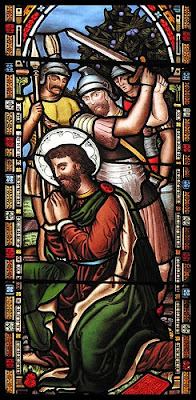
St. Edward's Catholic Church in Drayton, ND.

Here is the associated caption for this beautiful picture.

"Church Tradition teaches that St Paul suffered martyrdom in Rome and was beheaded, whence the sword is his symbol.According to Eusebius: "When the government of Nero was now firmly established, he began to plunge into unholy pursuits, and armed himself even against the religion of the God of the universe... Thus publicly announcing himself as the first among God's chief enemies, he was led on to the slaughter of the apostles. It is, therefore, recorded that Paul was beheaded in Rome itself, and that Peter likewise was crucified under Nero. This account of Peter and Paul is substantiated by the fact that their names are preserved in the cemeteries of that place even to the present day.This is one of the scenes from the window of St Paul's life in Melton Mowbray."

Pontiff Reflects on Messianic Secret

http://d.yimg.com/us.yimg.com/p/rids/20090201/i/r3568221324.jpg?x=400&y=245&q=85&sig=rnaP3F6bI8SJxXmpg6lviQ--

Says Suffering Was Key to Christ's Mission

VATICAN CITY, FEB. 1, 2009 (Zenit.org).- Christ knew that to fulfill his mission he had to suffer and die on the cross. For this reason, he took great strides to keep his identity hidden, says Benedict XVI.

Reflecting on today's Gospel (Mark 1:21-28) before praying the Angelus with those gathered in St. Peter's Square, the Pope spoke about the "so-called 'Messianic secret.'"

"For the moment, Jesus does not want anyone outside the restricted group of his disciples to know that he is the Christ, the Son of God," the Pontiff explained. "This is why he often admonishes the apostles and the sick people whom he heals to not reveal his identity to anyone."

"Not only does Jesus chase demons out of people, freeing them from the worst slavery, but he prohibits the demons themselves from revealing his identity," he added.

The Holy Father said Christ insisted on this secret "because the fulfillment of his mission is at stake, on which our salvation depends."

"He knows in fact that to liberate humanity from the dominion of sin he must be sacrificed on the cross as the true paschal lamb," Benedict XVI explained. "The devil, for his part, tries to divert his attention and direct it instead toward a human logic of a powerful and successful messiah."

The Pope continued: "The cross of Christ will be the demon’s ruin, and this is why Jesus does not cease to teach his disciples that in order to enter into his glory he must suffer much, be rejected, condemned and crucified. Suffering is an integral part of his mission."

"Jesus suffers and dies on the cross for love," he added. "When we consider this, we see that it is in this way that he gave meaning to our suffering, a meaning that many men and women of every age understood and made their own, experiencing profound serenity even in the bitterness of difficult physical and moral trials."