VATICAN CITY, FEB. 2, 2009 (Zenit.org).- Given that Turkey is an officially secular state, Benedict XVI is urging the recognition of the Church's juridical status in that Muslim-majority nation.
The Pope made this appeal today when he received bishops from Turkey in Rome for their five-yearly visit.
Recalling the Church's celebration of the Pauline Jubilee Year, which marks the 2,000th anniversary of the Apostle's birth in modern-day Turkey, the Holy Father expressed his wish that authorities will facilitate pilgrimages to the Pauline sites and the possibility to worship there and in other areas that were home to some of the earliest Christian communities.
The Pontiff noted how the small number of Christians lives in a nation that is governed by a secular Constitution but in which almost all the inhabitants are Muslims.
"Therefore, it is very important that Christians and Muslims can commit themselves together in favor of man, of life, as well as of peace and justice," he said.
Benedict XVI affirmed that the distinction between state and religion "is certainly a value that should be protected."
"Nevertheless in this realm," he continued, "it corresponds to the state to effectively guarantee to all citizens and to all religious communities freedom of worship and religious liberty, as any violence against believers, whatever their religion, is unacceptable."
The Pope assured the bishops that he is aware of their willingness and desire to dialogue with Turkish authorities "and find a solution to the various problems facing your communities, such as that of the recognition of the juridical status of the Catholic Church and its goods."
This recognition, he contended, "would necessarily have positive consequences for everyone."
Monday, June 15, 2015
Archbishop John Nienstedt Resigns after archdiocese charged with coverup
By NICOLE WINFIELD
VATICAN CITY (AP) — The archbishop of St. Paul, Minnesota, and a deputy bishop resigned Monday after prosecutors there charged the archdiocese with having failed to protect children from unspeakable harm from a pedophile priest.
The Vatican said Pope Francis accepted the resignations of Archbishop John Nienstedt and Auxiliary Bishop Lee Anthony Piche. They resigned under the code of canon law that allows bishops to resign before they retire because of illness or some other "grave" reason that makes them unfit for office.
Earlier this month, prosecutors charged the Archdiocese of St. Paul and Minneapolis as a corporation of having "turned a blind eye" to repeated reports of inappropriate behavior by a priest who was later convicted of molesting two boys. No individual was named in the indictment.
The resignations came just days after Pope Francis approved the creation of a new tribunal inside the Vatican to hear cases of bishops who failed to protect children from sexually abusive priests. Francis' decision followed years of criticism that the Vatican had never held bishops accountable for having ignored warnings about abusive priests and simply moved them from parish to parish rather than report them to police or remove them from ministry.
In April, Francis accepted the resignation of U.S. bishop Robert Finn, who had been convicted in a U.S. court of failing to report a suspected child abuser.
The criminal charges against the archdiocese stem from its handling of Curtis Wehmeyer, a former priest at Church of the Blessed Sacrament in St. Paul, who is serving a five-year prison sentence for molesting two boys and faces prosecution involving a third boy in Wisconsin.
Prosecutors say church leaders failed to respond to "numerous and repeated reports of troubling conduct" by Wehmeyer from the time he entered seminary until he was removed from the priesthood in 2015. The criminal complaint says many people — including parishioners, fellow priests and parish staff — reported issues with Wehmeyer, and many of those claims were discounted.
Link:
Wednesday, October 10, 2012
The Mainstream Media Falls for the Latest Hoax: The Case of Mrs. Jesus
Hoaxes gain credibility when they use respected sources. In 1938, Orson Welles’ adaptation of H.G. Wells’ War of the Worlds convinced thousands because it was broadcast on radio. Monsignor Knox did something similar on the sacrosanct BBC in 1926 with his amusing “Broadcast from the Barricades” which reported the toppling of Big Ben, by trench mortars and the torching of the lynching of a cabinet minister. That may actually have stirred up the devil in Welles. People today are inclined to believe hoaxes because they are mentioned witlessly in the mainstream media.
In 2002 The New York Times spent a lot of printer’s ink on a bogus ossuary reputed to be that of a “brother” of Christ. The “Times” as well as the Washington Post featured this on their front pages, although neither journal gives such publicity to huge events such as the annual Pro-Life gathering in the nation’s capital. Recently the same journal announced on its front page the discovery of a fourth century parchment translating a second century Greek text, claiming that there was a Mrs. Jesus. Shortly thereafter, the parchment was judged a forgery by Coptic experts. If a correction ever appears, it will be in fine print back in the shipping news section. Or at least on page 8 which is where, in the same week, The New York Times reluctantly reported Pope Benedict’s Mass for 350,000 in Lebanon—an event that astonished nearly everyone except our mainstream media.
As The New York Times generally gives the impression that anyone who takes the Scriptures seriously is archaic and arcane, there is an inconsistency in that newspaper’s affectation of interest in the Christology dormant in Abysinnian paleography. Since journalists often invoke pretentious scholarship to challenge the authenticity of the Shroud of Turin and the Tilma of Guadalupe, the question begged is, “Why do these people suddenly become so credulous about phenomena that contradict Christian inspiration?” The answer speaks for itself. The New York Times would be delighted to find that Christ did not radically contradict the norms of His age by forsaking all else and calling others to do the same as a proclamation of the Mystical Union between Christ as Bridegroom and the Church as Bride: “Let us rejoice and exult and give him the glory, for the marriage of the Lamb has come, and his Bride has made herself ready; it was granted her to clothe herself with fine linen, bright and pure—for the fine linen is the righteous deeds of the saints. And the angel said to me, ‘Write this: Blessed are those who are invited to the marriage supper of the Lamb.’ And he said to me, ‘These are the true words of God’ (Rev. 19:7-9).” But these are not the words of The New York Times whose editors do not include the Good News among “all the news that’s fit to print,” and whose inverted anthropology prefers to give frequent and gushing coverage in its “Styles” section to ceremonies uniting bridegrooms with bridegrooms and brides with brides.
Those branches of the media which of late have become flamboyant propagandists of state policies, should, but obviously do not, take the counsel of St. Paul, who probably would be fired after his first day at work as an editor of The New York Times: “I say again what we have said before: If anyone preaches any gospel other than that which you received, let him be anathema (Galatians 1:9).”
Link:
Wednesday, June 6, 2012
ROMAN MARTYROLOGY - JUNE 7
Martyrology-June 7th
Roman Martyrology-June 7th- on this date in various years-
For 2012 The Feast of the most Sacred Body of Christ.
At Constantinople, the birthday of St. Paul, bishop of that city. For the Catholic faith, he was often driven out of his see by the Arians, but restored to it by the Roman Pontiff, St. Julius I. Finally the Arian emperor Constantius banished him to Cucusum, a small town of Cappadocia. There, by the intrigue of the Arians, he was barbarously strangled, and thus departed for the heavenly kingdom. His body was taken to Constantinople with the greatest honour during the reign of Emperor Theodosius.
At Cordova in Spain, the holy martyrs Peter, a priest, Wallabonsus, a deacon, Sabinianus, Wistremund, Habentius, and Jeremias, all of whom were monks. Their throats were cut at the time of the Arab persecution because they had confessed Christ.
At Hermopolis in Egypt, St. Licarion, martyr, who had his body lacerated, was scourged with heated iron rods, and endured other horrible torments, after which his martyrdom was completed by beheading.
At Placentia, St. Anthony Mary Gianelli, bishop of Bobbio, and founder of the Congregation of Sisters of our Lady of the Garden. Pope Pius XII numbered him among the saints of heaven.
In England, St. Robert, an abbot of the Cistercian Order.
And elsewhere in divers places, many other holy martyrs, confessors, and holy virgins.
R. Thanks be to God.
Link:
Wednesday, July 8, 2009
The Pauline Chapel Reopened for Worship. With Two New Features
by Sandro Magister
ROME, July 6, 2009 - The illustrations reproduced above are two details from two frescoes by Michelangelo, facing each other in the Pauline Chapel: the conversion of Paul, and the crucifixion of Peter.
The Pauline Chapel is not open to visitors. Situated in the Vatican buildings just a few steps from the Sistine Chapel, it is a place of prayer reserved for the pope. After undergoing a complete restoration, it was reopened for worship on Saturday, July 4, by Benedict XVI, who presided over vespers there.
The news of the reopening of the Pauline Chapel for worship received scant coverage in the media, being overshadowed by the imminent publication of the encyclical "Caritas in Veritate" and by the meeting between the pope and Barack Obama.
But at least two new developments must be noted.
***
The first is that the renovation included a restructuring of the sanctuary, in fidelity to the liturgical tradition.
In 1975, Paul VI had replaced the altar turned toward the tabernacle with an oval-shaped altar detached from the wall, to be used while facing the faithful.
He had also eliminated the wooden communion rail, and replaced it with an ambo in carved marble. The floor was covered with a red carpet. So were the side walls, up to the level of the frescoes.
Benedict XVI has put the previous altar back in its place, although still a short distance from the tabernacle, restoring the celebration of all "facing the Lord." He has had the ambo removed, and the communion rail put back in its place. The red carpet has disappeared from both the floor and the walls, which have been restored to their original appearance.
***
The second important new development concerns the interpretation of the two frescoes by Michelangelo dedicated to St. Peter and St. Paul, in particular the interpretation of Peter's expression.
The traditional interpretation says that Peter - while he is about to be crucified upside down - is turned to look at everyone who enters the chapel, to remind him that martyrdom can be the fate of those who follow Jesus.
In support of this interpretation, it is recalled that until 1670, many conclaves were held in the Pauline Chapel. Peter was looking into the eyes of the cardinals preparing to elect his successor. And the newly elect, who from then on would go into that chapel to pray, would exchange glances each time with the first of the apostles.
Those in charge of the restoration, in presenting the renovated chapel to the public on June 30, also adhered substantially to this interpretative tradition.
So then, the new development is that Benedict XVI has distanced himself from it. In the homily for vespers with which he reopened the Pauline Chapel for worship, he gave a new interpretation of Peter's expression in the fresco by Michelangelo.
The pope said that Peter's gaze, instead of being directed at the visitor, is instead intended to be directed at the face of Paul on the opposite wall: at Paul, who bears within himself the light of the risen Christ. "It is as if Peter, in the hour of the supreme trial, were seeking that light which gave the true faith to Paul."
Naturally, the pope added, this does not change the fact that this dialogue of gazes between the two apostles is a great lesson for those who enter to pray in the Pauline Chapel, and in particular for the successors of Peter.
The following is the central passage of Benedict XVI's homily at vespers on July 4, 2009, in the Pauline Chapel, dedicated to the two apostles frescoed by Michelangelo:
"The two faces of Peter and Paul are across from each other . . ."
by Benedict XVI
[...] The eyes are drawn first of all by the faces of the two apostles. It is already clear from their position that these two faces play a central role in the iconographic message of the chapel. But, beyond their placement, they draw us immediately beyond the image: they question us, and prompt us to reflect.
First of all, let us examine Paul: why is he represented with such an old face? It is the face of an old man, while we know - and Michelangelo also knew this well - that the call of Saul on the road to Damascus took place when he was about thirty years old. The decision of the artist already brings us beyond pure realism, it makes us go beyond the simple narration of events in order to usher us into a more profound level. The face of Saul-Paul - which is actually that of the artist himself, elderly, restless, and in search of the light of truth - represents the human being in need of a light from above. This is the light of divine grace, indispensable for acquiring new vision with which to perceive the reality oriented to the "hope that waits for you in heaven" - as the apostle writes in the opening salutation of the letter to the Colossians, which we have just heard (1,5).
Having fallen to the ground, Saul's face is illuminated from above, by the light of the Risen One, and, in spite of its dramatic nature, the depiction inspires peace and infuses trust. It expresses the maturity of the man who is illuminated inside by Christ the Lord, while around him turns a disarray of events in which all of the figures look like they are caught up in a whirlwind. The grace and peace of God have enveloped Saul, they have conquered and transformed him from within. He will proclaim this same "grace" and this same "peace" to all of his communities on his apostolic voyages, with a seasoned maturity not of age, but of spirit, given to him by the Lord himself.
Here therefore, in the face of Paul, we can already perceive the heart of the spiritual message of this chapel: the miracle of Christ's grace, which transforms and renews man through the light of his truth and his love. This is what constitutes the novelty of conversion, of the call to faith, which finds its fulfillment in the mystery of the Cross.
From the face of Paul we move to that of Peter, depicted at the moment in which his inverted cross is being raised, who turns to look at those who are observing him. This face also surprises us. Here the age represented is correct, but it is the expression that amazes and puzzles us. Why this expression? It is not an image of suffering, and the figure of Peter communicates surprising physical vigor. The face, especially the forehead and the eyes, seem to express the interior state of a man facing death and evil: there is a sense of confusion, an expression reaching outward intently, almost as if seeking something or someone in the final hour. And the faces of the people around him are also remarkable for their eyes: a chain of restless expressions, some of them even fearful or dismayed.
What does all of this mean? It is what Jesus had told this apostle in advance: "when you are old, another will take you where you do not wish to go"; and the Lord had added: "Follow me" (John 21:18,19). And here it is, at this very moment is the culmination of discipleship: the disciple is not greater than his Master, and now experiences all of the bitterness of the cross, of the consequences of sin that separates from God, all the absurdity of violence and deceit. If one comes to meditate in this chapel, one cannot escape the radical nature of the question that is posed from the cross: the cross of Christ, head of the Church, and the cross of Peter, his vicar on earth.
The two faces that we have stopped to consider are across from each other. One could even believe that Peter's face is turned toward Paul, who, for his part, does not see, but bears within himself the light of the risen Christ. It is as if Peter, in the hour of the supreme trial, were seeking that light which gave the true faith to Paul.
And so it is that in this sense, the two icons can become two acts in a single drama: the drama of the Paschal mystery: cross and resurrection, death and life, sin and grace. The chronological order of the events represented may have been overturned, but what emerges is the plan of salvation, that plan which Christ himself realized in himself by bringing it to fulfillment, as we have just sung in the hymn from the letter to the Philippians.
For those who come to pray in this chapel, and for the pope first of all, Peter and Paul become teachers of faith. With their testimony, they invite us to go to the depths, to meditate in silence on the mystery of the cross, which accompanies the Church until the end of time, and to welcome the light of the faith, thanks to which the apostolic community can extend to the ends of the earth the missionary and evangelizing action entrusted to it by the risen Christ. Here there are no solemn celebrations with the people. Here the successor of Peter and his collaborators meditate in silence and adore the living Christ, present especially in the most holy sacrament of the Eucharist. [...]
__________
The complete text of the pope's homily on July 4, 2009:
> "Si realizza quest'oggi..."
__________
For more information on the chapel, on the Vatican website:
> Il restauro della Cappella Paolina
__________
More on these topics on www.chiesa:
> Focus on ART AND MUSIC
__________
English translation by Matthew Sherry, Ballwin, Missouri, U.S.A.
__________
6.7.2009
Monday, June 29, 2009
St. Paul Outside The Walls - Tomb Panorama

Use your mouse or arrow keys to pan around, scroll button or the onscreen "+" and "-" buttons to zoom in and out.
h/t to Fr. Z.
Sunday, June 28, 2009
Daily Bible Readings June 29 2009 Solemnity of Sts Peter and Paul, Apostles Mass During the Day
From Bob at A Catholic Site:
June 29 2009 Monday Solemnity of Saints Peter and Paul, Apostles – Mass During the Day
Saint of the Day – Sts. Peter and Paul
About the sources used. The readings on this site are not official for the Mass of Roman Rite of the Catholic Church in the USA, but are from sources free from copyright. They are here to present the comparable readings alongside traditional Catholic commentary as published in the Haydock Bible for your own personal study. Readings vary depending on your local calendar.
Official Readings of the Liturgy at – http://www.usccb.org/nab/readings/062909.shtml
Acts 12:1-11
Haydock New Testament

St Peter Freed by an Angel
AND at the same time Herod, the king, stretched forth his hands, to afflict some of the church. And he killed James, the brother of John, with the sword. And seeing that it pleased the Jews, he proceeded to apprehend Peter also. Now it was in the days of the azymes. Whom when he had apprehended, he cast into prison, delivering him to four files of soldiers, to be kept, intending after the Pasch to bring him forth to the people. Peter, therefore, was kept in prison. But prayer was made without ceasing, by the church, to God, for him. And when Herod would have brought him forth, that very night Peter was sleeping between two soldiers, bound with two chains: and the guards before the door kept the prison. And behold an Angel of the Lord stood by him: and a light shined in the room: and he striking Peter on the side, raised him up, saying:
Arise quickly.
And the chains fell off from his hands. And the Angel said to him:
Gird thyself, and put on thy sandals.
And he did so. And he said to him:
Cast thy garment about thee, and follow me.
And going out, he followed him, and knew not that what was done by the Angel was true: but thought he saw a vision. And having passed through the first and the second ward, they came to the iron gate that leadeth to the city, which of itself opened to them. And going out, they passed on through one street: and immediately the Angel departed from him. And Peter coming to himself, said:
Now I know truly, that the Lord hath sent his Angel, and hath delivered me out of the hand of Herod, and from all the expectation of the people of the Jews.
Responsorial Psalm 33:2-9
DR Challoner Text Only
I will bless the Lord at all times, his praise shall be always in my mouth.
In the Lord shall my soul be praised: let the meek hear and rejoice.
O magnify the Lord with me; and let us extol his name together.
I sought the Lord, and he heard me; and he delivered me from all my troubles.
Come ye to him and be enlightened: and your faces shall not be confounded.
This poor man cried, and the Lord heard him: and saved him out of all his troubles.
The angel of the Lord shall encamp round about them that fear him: and shall deliver them.
O taste, and see that the Lord is sweet: blessed is the man that hopeth in him.

Saint Paul in Prison
2 Timothy 4:6-8, 17-18
Haydock NT
For I am even now ready to be sacrificed: and the time of my dissolution is at hand. I have fought the good fight, I have finished my course, I have kept the faith. For the rest, there is laid up for me a crown of justice, which the Lord, the just judge, will render to me on that day: and not to me only, but to them also who love his coming. Make haste to come to me quickly.
But the Lord stood by me and strengthened me, that by me the preaching may be accomplished, and that all the Gentiles may hear: and I was delivered from the mouth of the lion. The Lord hath delivered me from every evil work: and will preserve me unto his heavenly kingdom, to whom be glory for ever and ever. Amen.
The Holy Gospel of Jesus Christ According to Saint Matthew 16:13-19
Haydock New Testament
And Jesus came into the parts of Cæsarea Philippi: and he asked his disciples saying:
Whom do men say that the Son of man is?
But they said:
Some John the Baptist, and others Elijah, and others Jeremiah, or one of the prophets.
But Jesus saith to them:
But whom do you say that I am?
Simon Peter answering said:
Thou art Christ, the Son of the Living God.
And Jesus answering, said to him:
Blessed art thou, Simon Bar-Jona: because flesh and blood hath not revealed it to thee, but my Father, who is in heaven. And I say to thee: That thou art Peter; and upon this rock I will build my church, and the gates of hell shall not prevail against it. And I will give to thee the keys of the kingdom of heaven. And whatsoever thou shalt bind upon earth, it shall be bound also in heaven: and whatsoever thou shalt loose upon earth, it shall be loosed also in heaven.
Haydock Commentary Acts 12:1-11
Notes Copied From Haydock Commentary Site
- Ver. 1. Herod. Agrippa, made king by the emperor Caius. See Jos. vi. 18. Antiq. c. viii. and l. xix. c. 5. put to death James the great, brother to John. Wi. — This man was the same as Agrippa, by which name he is most commonly known. He was brother to the famous Herodias, who was the cause of S. John the Baptist’s decollation, (Calmet) and son-in-law of Herod the Great, by his father Aristobulus. V.
- Ver. 2. S. James the elder, brother of S. John, the evangelist.
- Ver. 3. The days of the azymes. By this we may know about the time when S. James was executed. Peter was to be reserved till after the Pasch, because it was not usual for the Jews to put any one to a violent death on a festival day. They would not damp the joy of the solemnity by such actions. Menoch. — Nothing can be more illiberal, nothing more unfounded, and unjust, than the accusation advanced by the translators of the Bible dedicated to King James. In their preface they say, that the Catholics keep the words, azymes, holocaust, pasch, &c. in their version, purposely “to darken the sense, that since they must needs translate the Bible, yet by the language thereof, it may be kept from being understood.” See the splendid Oxford edit. an. 1770. — So far from this, we open the window, to let in the light; we bread the shell, that the kernel may be eaten: we put aside the curtain, that a sight may be had into the holy place; we remove the cover of the well, that the good and humble may get to the water of life. If we retain certain words in the original tongue, it is for the same reason as our adversaries retain others, such as Amen, Sabaoth, Alleluia, Jehova, &c.
- Ver. 4. To four files of soldiers.[1] To four times four soldiers, or to sixteen soldiers, each band or file consisting of four.
- Ver. 6. With these two chains, according to the Roman custom, S. Peter must have been fastened to the two soldiers, that guarded him. Yet Peter slept secure, trusting in that Providence which sleepeth not.
- Ver. 7. An Angel. This was probably his Angel guardian. It has always been the constant belief of the Church, that each individual is put under the protection of a tutelar Angel. A. — S. Bernard, on these words of the psalm, he has given his Angels charge over thee, thus expresses himself: Wonderful condescension! and truly great love! He has given his Angels charge over thee, to guard thee in all thy ways. What is man, O God, that thou shouldst thus be mindful of him, or the son of man, that thou shouldst look upon him! What reverence, devotion, and confidence, should this word inspire in us! Reverence their presence, be grateful for their good will; have confidence in their protection; walk with circumspection; your Angel is present. In every abode, in every place, respect his presence. Let us love them too, destined to be in future our co-heirs; in the mean time, our guardians and patrons. What have we to fear under such guides? They cannot be overcome nor seduced; much less can they lead us astray. They are faithful, they are prudent, they are powerful. Why do we fear? Let us follow them; let us stick close to them; and we shall dwell under the protection of the God of heaven. If a grievous temptation urges; if great tribulation hangs over you; call upon your leader your helper in opportunities, in tribulations; call upon him, and say, save us, or we perish, &c. S. Bern. Serm. in Psalm. Qui habitat. — A light shined in the room. To Peter only; not to the rest. Wi.
- Ver. 11. Peter coming to himself. Being now sensible that all was true. Wi.
2 Timothy 4:6-8, 17-18
- Ver. 6. I am even now ready to be sacrificed.[5] Lit. to be immolated. See Philip. ii. 17. — The time of my dissolution (lit. resolution) is at hand. This makes many judge that this letter was written during his last imprisonment; but the sense perhaps may be, that being old and worn out with labours, he could not live long. Wi.
- Ver. 7. I have fought a good fight, or strived a good strife.[6] The Latin and Greek may signify any kind of striving for a prize. — I have kept the faith, not only the Christian faith, the been faithful in my office. Wi.
- Ver. 8. A crown of justice, which the Lord, the just judge, will render to me. These words confirm the Catholic doctrine, that good works performed with the assistance of God’s grace, deserve and are meritorious of a reward in heaven: it is what is signified, 1. by a crown of justice, 2. from a just judge, 3. which he will render or give as a reward. Yet we own with S. Aug. that we have no merit, but what is also a gift of God from his grace and mercy, and grounded on his promises. Wi. — “A crown of justice,” which the Protestant translate, of righteousness; but let us see how the learned S. Austin, 1400 years ago, expounds the apostle’s meaning: “How should he repay as a just judge, unless he had first given as a merciful Father?” De grat. et lib. arb. c. vi. See Heb. vi. 10. God is not unjust, that he should forget your works; the the Protestants change into, God is not unrighteous.
- Ver. 17. The Lord stood, &c. All agree that Nero is here meant by the lion. S. Chrys. thinks that S. Paul was set at liberty after this first justification of his conduct, but that having afterwards converted the cupbearer of Nero, he was by him beheaded. S. Chrys. hom. x. p. 611. — But the Lord assisted and fortified me on this occasion by a vision, in which he assured me that he would prolong my life for the more perfect preaching of the gospel. V. — The times predicted by the apostle in this epistle, (v. 3. and 4.) are now arrived; and the warnings he gives to Timothy and to all preachers of the word, should be sedulously attended to: preach the word: be instant in season and out of season; reprove, entreat, rebuke with all patience and doctrine. There will arrive a time when men will not bear sound doctrine; eager in the extreme to hear what flatters, they will have recourse to a variety of teachers not lawfully sent or ordained, calculated to tickle their ears: Assentatores populi, multitudinis levitatem voluptate quasi titillantes. Cic. In the same sense Plutarch says: ta wta apoknaiousin. It is yours, adds S. Paul, wV kaloV stratiwthV Cristou Ihsou, as a valiant soldier of Jesus Christ, to oppose yourself as a wall to all these evils, to attend every branch of your ministerial duty, not to yield to either opponents or dangers, and to see that the gospel is both preached and practised in all its purity. Thus may the Church find in you, and in her other ministers, what she is soon to lose in me, knowing as I do that my course is nearly run. — That by me the preaching may be accomplished, (or fulfilled) and that all the Gentiles may hear it. This is an argument that he wrote this letter in his first imprisonment. — And I was delivered from the mouth of the lion; that is, according to the common exposition, from Nero. Wi.
Haydock Commentary Matthew 16:13-19
- Ver. 13. Cæarea Philippi, was first called Paneades, and was afterwards embellished and greatly enlarged by Philip the tetrarch, son of Herod the great, and dedicated in honour of Augustus, hence its name. There was moreover another Cæsarea, called Straton, situated on the Mediterranean: and not in this, but in the former, did Christ interrogate his disciples. He first withdrew them from the Jews, that they might with more boldness and freedom deliver their sentiments. S. Chry. hom. lv. — The Cæsarea here mentioned continued to be called by heathen writers Panea, from the adjoining spring Paneum, or Panium, which is usually taken for the source of the Jordan.
- Ver. 14. Some say, &c. Herod thought that Christ was the Baptist, on account of his prodigies. S. Mat. xiv. 2. Others that he was Elias: 1st. because they expected he was about to return to them, according to the prophecy of Malachias; behold I will send you Elias; 2d. on account of the greatness of his miracles; 3d. on account of his invincible zeal and courage in the cause of truth and justice. Others again said he was Jeremias, either on account of his great sanctity, for he was sanctified in his mother’s womb; or, on account of his great charity and love for his brethren, as it was written of Jeremias: he is a lover of his brethren. Or, again, one of the prophets, viz. Isaias, or some other noted for eloquence; for it was the opinion of many of the Jews, as we read in S. Luke, that one of the ancient prophets had arisen again. Dion. Carth.
- Ver. 15. Whom do you say that I am? You, who have been continually with me; you, who have seen me perform so many more miracles; you, who have yourselves worked miracles in my name? From this pointed interrogation, Jesus Christ intimates, that the opinion men had formed of him was very inadequate to the exalted dignity of his person, and that he expects they will have a juster conception of him. Chry. hom. lv.
- Ver. 16. Simon Peter answering. As Simon Peter had been constituted the first in the college of apostles, (Matt. x. 2.) and therefore surpasseth the others in dignity as much as in zeal, without hesitation, and in the name of all, he answers: thou art the Christ, the Redeemer promised to the world, not a mere man, not a mere prophet like other prophets, but the true and natural Son of the living God. Thus SS. Chrys. Cyril, Ambrose, Austin, and Tirinus. When our Saviour inquired the opinion of him, Peter, as the mouth of the rest, and head of the whole college, steps forth, and prevents the others. Chrys. hom. lv. — Tu es Christus, filius Dei vivi; or, as it is in the Greek, o cristoV, o uioV; The Christ, the Son, the Christ formerly promised by the law and the prophets, expected and desired by all the saints, the anointed and consecrated to God: o uios, the Son, not by grace only, or an adoptive filiation like prophets, to whom Christ is here opposed, but by natural filiation, and in a manner that distinguishes him from all created beings. — Thou art[1] Christ, the Son of the living God, not by grace only, or by adoption, as saints are the sons of God, but by nature, and from all eternity, the true Son of the living God. Wi.
- Ver. 17. Blessed art thou, Simon Bar-Jona. Simon is undoubtedly Sumewn, as written 2 Pet. i. 1. Bariwna is son of Jona, or John, an abridgment for Bariwanna. Bar, in Chaldaic, is son; hence S. Peter is called, in John xi, 16. and 17, Simon, son of John. It was customary with the Jews to add to a rather common name, for the sake of discrimination, a patrwnumikon, or patronymic, as appears from Matt. x. 3. and xxiii. 35. Mark ii. 14. John vi. 42. P.
- Ver. 18. Kagw. And I say to thee, and tell thee why I before declared, (John i. 42.) that thou shouldst be called Peter, for thou art constituted the rock upon which, as a foundation, I will build my Church, and that so firmly, as not to suffer the gates (i.e. the powers) of hell to prevail against its foundation; because if they overturn its foundation, (i.e. thee and thy successors) they will overturn also the Church that rests upon it. Christ therefore here promises to Peter, that he and his successors should be to the end, as long as the Church should last, its supreme pastors and princes. T. — In the Syriac tongue, which is that which Jesus Christ spoke, there is no difference of genders, as there is in Latin, between patra, a rock, and Petrus, Peter; hence, in the original language, the allusion was both more natural and more simple. V. –Thou art Peter;[2] and upon this (i.e. upon thee, according to the literal and general exposition of the ancient Fathers) I will build my church. It is true S. Augustine, in one or two places, thus expounds these words, and upon this rock, (i.e. upon myself:) or upon this rock, which Peter hath confessed: yet he owns that he had also given the other interpretation, by which Peter himself was the rock. Some Fathers have also expounded it, upon this faith, which Peter confessed; but then they take not faith, as separated from the person of Peter, but on Peter, as holding the true faith. No one questions but that Christ himself is the great foundation-stone, the chief corner-stone, as S. Paul tells the Ephesians; (C. ii, v. 20.) but it is also certain, that all the apostles may be called foundation-stones of the Church, as represented Apoc. xxi. 14. In the mean time, S. Peter (called therefore Cephas, a rock) was the first and chief foundation-stone among the apostles, on whom Christ promised to build his Church. Wi. — Thou art Peter, &c. As S. Peter, by divine revelation, here made a solemn profession of his faith of the divinity of Christ, so in recompense of this faith and profession, our Lord here declares to him the dignity to which he is pleased to raise him: viz. that he, to whom he had already given the name of Peter, signifying a rock, (John i. 42.) should be a rock indeed, of invincible strength, for the support of the building of the church; in which building he should be next to Christ himself, the chief foundation-stone, in quality of chief pastor, ruler, and governor; and should have accordingly all fulness of ecclesiastical power, signified by the keys of the kingdom of heaven. — Upon this rock, &c. The words of Christ to Peter, spoken in the vulgar language of the Jews, which our Lord made use of, were the same as if he had said in English, Thou art a rock, and upon this rock I will build my church. So that, by the plain course of the words, Peter is here declared to be the rock, upon which the church was to be built; Christ himself being both the principal foundation and founder of the same. Where also note, that Christ by building his house, that is, his Church, upon a rock, has thereby secured it against all storms and floods, like the wise builder. Matt. vii. 24, 25. — The gates of hell, &c. That is, the powers of darkness, and whatever Satan can do, either by himself or his agents. For as the Church is here likened to a house, or fortress, the gates of which, i.e. the whole strength, and all the efforts it can make, will never be able to prevail over the city or Church of Christ. By this promise we are fully assured, that neither idolatry, heresy, nor any pernicious error whatsoever shall at any time prevail over the Church of Christ. Ch. — The gates, in the Oriental style, signify the powers; thus, to this day, we designate the Ottoman or Turkish empire by the Ottoman port. The princes were wont to hold their courts at the gates of the city. V.
- Ver. 19. And I will give to thee the keys, &c. This is another metaphor, expressing the supreme power and prerogative of the prince of the apostles. The keys of a city, or of its gates, are presented or given to the person that hath the chief power. We also own a power of the keys, given to the other apostles, but with a subordination to S. Peter and to his successor, as head of the Catholic Church. — And whatsoever thou shalt bind, &c. All the apostles, and their successors, partake also of this power of binding and loosing, but with a due subordination to one head invested with the supreme power. Wi. — Loose on earth. The loosing the bands of temporal punishments due to sins, is called an indulgence: the power of which is here granted. Ch. — Although Peter and his successors are mortal, they are nevertheless endowed with heavenly power, says S. Chry. nor is the sentence of life and death passed by Peter to be attempted to be reversed, but what he declares is to be considered a divine answer from heaven, and what he decrees, a decree of God himself. He that heareth you, heareth me, &c. The power of binding is exercised, 1st. by refusing to absolve; 2d. by enjoining penance for sins forgiven; 3d. by excommunication, suspension or interdict; 4th. by making rules and laws for the government of the Church; 5th. by determining what is of faith by the judgments and definitions of the Church. T. — The terms binding and loosing, are equivalent to opening and shutting, because formerly the Jews opened the fastenings of their doors by untying it, and they shut or secured their doors by tying or binding it. V. — Dr. Whitby, a learned Protestant divine, thus expounds this and the preceding verse: “As a suitable return to thy confession, I say also to thee, that thou art by name Peter, i.e. a rock; and upon thee, who art this rock, I will build my making laws to govern my Church.” (Tom. i, p. 143.) Dr. Hammond, another Protestant divine, explains it in the same manner. And p. 92, he says: ” What is here meant by the keys, is best understand by Isaias xxii. 22, where they signified ruling the whole family or house of the king: and this being by Christ accommodated to the Church, denotes the power of governing it.”
Link
Pope: Scientific analysis done on St. Paul's bones

By NICOLE WINFIELD
Associated Press Writer
ROME (AP) -- The first-ever scientific test on what are believed to be the remains of the Apostle Paul "seems to confirm" that they do indeed belong to the Roman Catholic saint, Pope Benedict XVI said Sunday.
Archaeologists recently unearthed and opened the white marble sarcophagus located under the Basilica of St. Paul's Outside the Walls in Rome, which for some 2,000 years has been believed by the faithful to be the tomb of St. Paul.
Benedict said scientists had conducted carbon dating tests on bone fragments found inside the sarcophagus and confirmed that they date from the first or second century.
"This seems to confirm the unanimous and uncontested tradition that they are the mortal remains of the Apostle Paul," Benedict said, announcing the findings at a service in the basilica to mark the end of the Vatican's Paoline year, in honor of the apostle...
Oldest Icon of St. Paul the Apostle Discovered
"..here are some pictures of what is probably the oldest icon - in the sense of a cult image - of St. Paul the Apostle, probably dating from the end of the fourth century. It was discovered, as today's edition of L’Osservatore Romano reports, last Friday 19 June in the course of restoration works in the Roman catacombs of St. Thecla on the Via Ostiensis, not far from the burial place of St. Paul:"


- Papal Vespers for the Conclusion of the Pauline Year
- Oldest Icon of St. Paul discovered
- Grazie al laser è apparso l'inatteso...il volto dell'Apostolo Paolo (Osservatore Romano)
Tuesday, March 31, 2009
Archbishop Nienstedt Staunchly Opposes ‘Travesty’ of Obama Invite to Notre Dame Commencement
“The faithful owe a debt of prayerful thanks to Archbishop Nienstedt for his statement calling on Notre Dame to reconsider its planned honor for President Obama,” said Patrick Reilly, President of CNS.
In his letter dated last Thursday, March 26, and provided today to The Cardinal Newman Society, Archbishop Nienstedt wrote to Father Jenkins to “protest this egregious decision on your part,” calling the honor a “travesty.” Nienstedt wrote that President Obama is an “anti-Catholic politician” and whose “deliberate disregard of the unborn” does not deserve Notre Dame’s “public support.”
The following is the complete text of Archbishop John C. Nienstedt’s letter to Notre Dame President Father John Jenkins:
March 26, 2009
Rev. John I. Jenkins, C.S.C.
President, University of Notre Dame
400 Main Building
Notre Dame, IN 46556
Dear Father Jenkins:
I have just learned that you, as President of the University of Notre Dame, have invited President Barack Obama to be the graduation commencement speaker at the University’s exercises on May 17, 2009. I was also informed that you will confer on the president an honorary doctor of laws degree, one of the highest honors bestowed by your institution.
I write to protest this egregious decision on your part. President Obama has been a pro-abortion legislator. He has indicated, especially since he took office, his deliberate disregard of the unborn by lifting the ban on embryonic stem cell research, by promoting the FOCA agenda and by his open support for gay rights throughout this country.
It is a travesty that the University of Notre Dame, considered by many to be a Catholic University, should give its public support to such an anti-Catholic politician.
I hope that you are able to reconsider this decision. If not, please do not expect me to support your University in the future.
Sincerely yours,
The Most Reverend John C. Nienstedt
Archbishop of Saint Paul and Minneapolis
Sunday, March 15, 2009
Pope Benedict XVI's Book on Saint Paul
In this book, Pope Benedict XVI, a profound spiritual leader in his own right and a first-rate theologian and Bible commentator, explores the legacy of Paul. Pope Benedict follows the course of the Apostle’s life, including his missionary journeys and his relationship with the other apostles of Jesus such as St. Peter and St. James, and Paul’s martyrdom in Rome. Benedict also examines such questions as: Did Paul know Jesus during his earthly life and how much of Jesus’ teaching and ministry did he know of? Did Paul distort the teachings of Jesus? What role did Jesus’ death and resurrection play in Paul’s teaching? What are we to make of Paul’s teaching about the end of the world? What does Paul’s teaching say about the differences between Catholic and Protestant Christians over salvation and the roles of faith and works in the Christian life? How have modern Catholic and Protestant scholars come together in their understanding of Paul? What does Paul have to teach us today about living a spiritual life?
These and other important issues are addressed in this masterful, inspirational, and highly-readable presentation of St. Paul and his writings by one of today’s great spiritual teachers, Pope Benedict XVI.
“The Apostle Paul, an outstanding and almost inimitable yet stimulating figure, stands before us as an example of total dedication to the Lord and to his Church, as well as of great openness to humanity and its cultures.”
—Pope Benedict XVI
Wednesday, February 25, 2009
God will forgive, bless those who seek conversion, pope says

By Cindy Wooden
Catholic News Service
ROME (CNS) -- If people act on God's call to conversion, he will forgive them everything and bless them, Pope Benedict XVI said just before receiving ashes and distributing ashes to mark the beginning of Lent.
"As we prepare to receive the ashes on our foreheads as a sign of conversion and repentance, let us open our hearts to the life-giving action of the word of God," the pope told people gathered in Rome's Basilica of St. Sabina Feb. 25.
The evening Mass was preceded by a penitential procession from the nearby Church of St. Anselm.
In his homily, Pope Benedict said the readings chosen by the church for Ash Wednesday are meant to give guidance to Christians for the 40 days of Lent and to provide them with encouragement to follow the Lenten journey of conversion with courage.
The call to conversion is loud and clear in each part of the Ash Wednesday Mass from the opening prayer to the readings and hymns, he said.
"The promise of God is clear: If we listen to his invitation to convert, God will make his mercy triumph and his friends will be filled with innumerable blessings," the pope said.
The Gospel reading from Matthew, he said, puts Christians on guard against "ostentation and hypocrisy, superficiality and self-satisfaction, reaffirming the need to nourish an uprightness of heart."
At the same time, the Gospel explains that the way to grow in the purity of heart is to cultivate a closer relationship with God the Father, he said.
Pope Benedict said that during the year of St. Paul, marking the 2,000th anniversary of the apostle's birth, he wanted to focus in a special way on Paul's writings and conversion story.
"Paul experienced in an extraordinary way the power of the grace of God," which is also the grace of the death and resurrection of Jesus Christ, he said.
Catholics do not pretend during Lent that they do not already know that Jesus rose from the dead, the pope said, but as they prepare for Easter they are "already enlightened by the brightness of the paschal mystery" of Jesus' death and resurrection.
A Christian's Lenten journey of conversion must be, like St. Paul's, a call from the risen Christ to change, to accept the forgiveness won by Jesus on the cross and to dedicate one's life to following him, the pope said.
St. Paul's call to refuse to allow sin to reign in one's life is an affirmation that while salvation is a free gift of God an individual must take the step of accepting that gift, he said.
"On the one hand, this affirms the victory of Christ over sin once and for all with his death and resurrection," he said, and on the other hand, Christians are exhorted to not let sin re-enter their lives.
"So that Christ may reign fully in him, the baptized person must faithfully follow his teachings; he must never let down his guard so as to ensure the adversary cannot win back any territory," Pope Benedict said.
The Lenten emphasis on prayer, almsgiving and fasting highlights the three most effective defenses against evil, he said.
The pope prayed that a more frequent reading of the Bible, more intense prayer and "an austere and penitential style of life will be a stimulus to conversion and sincere love toward our brothers and sisters, especially the poorest and neediest."
Tuesday, February 24, 2009
Pope's "Lectio Divina" on Paul's Letter to Galatians
"Only a Shared Freedom Is Human Freedom"
VATICAN CITY, FEB. 23, 2009 (Zenit.org).- Here is a translation of the "lectio divina" Benedict XVI delivered Friday during a visit to Rome's Major Seminary on the eve of the feast of the seminary's patroness, Our Lady of Confidence. The "lectio divina" is a reflection on St. Paul's Letter to the Galatians.* * *
Lord Cardinal,
Dear Friends,
For me it is always a great joy to be in my seminary, to see the future priests of my diocese, to be with you under the sign of Our Lady of Confidence. We go forward with her, who helps and accompanies us, and who really gives us the certainty of always being helped by divine grace.
Let us now see what St. Paul says to us with this text: "You were called to freedom." At all times, freedom has been humanity's great dream, since the beginning, but particularly in modern times. We know that Luther was inspired by this text of the Letter to the Galatians, and his conclusion was that the monastic Rule, the hierarchy, the magisterium seemed a yoke of slavery from which he had to free himself. Subsequently, the age of the Enlightenment was totally guided, penetrated by this desire for freedom, which it was thought had already been attained. However, Marxism also presented itself as the path to freedom.
Tonight we ask: What is freedom? How can we be free? St. Paul helps us to understand the complicated reality which freedom is by inserting this concept in a context of fundamental anthropological and theological divisions. He says: "Do not use your freedom as an opportunity for the flesh, but through love be servants of one another." The rector has already told us that "flesh" is not the body, but, in St. Paul's language, it is the absolutizing of the I, of the I that wants to be all and have everything for itself. In short, the absolute I, which does not depend on anything or anyone, seems really to possess freedom. I am free if I do not depend on anyone, if I can do everything I wish. However, precisely this absolutizing of the I is "flesh," namely, the degradation of man, it is not the victory of freedom: libertinism is not freedom, instead, it is the failure of freedom.
And Paul dares to propose a strong paradox: "Through charity, be of service " (in Greek "douleuete"); in other words, paradoxically, freedom is realized in service: We are free if we become one another's servants. And so Paul puts the whole problem of freedom in the light of the truth of man. To reduce oneself to the flesh, apparently raising oneself to the rank of divinity -- "I, man alone" -- introduces a lie. Because in fact, it is not like this: Man is not an absolute, being able to isolate himself and behave according to his own will. This goes against the truth of our being. Our truth is, above all, that we are creatures, creatures of God and we live in relationship with the Creator. We are rational beings, and only by accepting this relationship do we enter into truth, otherwise we fall into falsehood and, in the end, are destroyed by it.
We are creatures, hence dependents of the Creator. In the age of the Enlightenment, especially for atheism, this dependency seemed like something from which it was necessary to free oneself. In reality, however, it would be a fatal dependency only if this Creator God was a tyrant, not a good Being, only if he was as human tyrants are. If, however, this Creator loves us and our dependence implies being in the realm of his love, in this case, in fact, dependency is freedom. Thus, we are, indeed, in the love of the Creator, we are united to him, to the whole of his reality, to all his power. This, therefore, is the first point: To be a creature means to be loved by the Creator, to be in this relationship of love that he gives us, with which he provides for us. From this derives above all the truth about ourselves, which at the same time is a call to love.
And because of this to see God, to orient oneself to God, to know God, to know the will of God, to insert oneself in his will, that is, in the love of God is to enter increasingly into the realm of truth. And this path of knowledge of God, of the relationship of love with God, is the extraordinary adventure of our Christian life: Because in Christ we know the face of God, the face of God who loves us even to the cross, to the gift of himself.
However, the creaturely relationship also implies a second type of relationship: We are in relationship with God but, at the same time, as human family, we are also in relationship with one another. In other words, human freedom is, on one hand, to be in the joy and great realm of the love of God, but it also implies being only one thing with the other and for the other. There is no freedom in being against the other. If I absolutize myself, I become the other's enemy, we can no longer coexist on earth and the whole of life becomes cruelty and failure. Only a shared freedom is human freedom; in being together we can enter the symphony of freedom.
Hence, this is another point of great importance: Only by accepting the other, by accepting also the apparent limitation that respect for the other implies for my freedom, only by inserting myself in the network of dependencies that makes us, finally, only one human family, will I be on the way to common liberation.
A very important element appears here. What is the measure of this sharing of freedom? We see that man needs order and law, to be able to realize his freedom, which is a freedom lived in common. And how can we find this just order, in which no one is oppressed, but each one can make his own contribution to form this sort of concert of freedom? If there is no common truth of man as it appears in the vision of God, only positivism remains and one has the impression of something imposed even in a violent manner. Hence the rebellion against order and law as if it was a question of slavery.
However, if we can find the order of the Creator in our nature, the order of truth that gives each one his place, order and law can be in fact instruments of freedom against the slavery of egoism. To serve one another becomes an instrument of freedom, and here we can include a whole philosophy of politics according to the social doctrine of the Church, which helps us to find this common order that gives each one his place in the common life of humanity. The first reality that must be respected, therefore, is truth: Freedom against truth is not freedom. To serve one another creates the common realm of freedom.
And then Paul continues, saying: "For the whole law is fulfilled in one word, 'You shall love your neighbor as yourself.'" After this affirmation the mystery of the Incarnate God appears, the mystery of Christ appears who in his life, Death and Resurrection becomes the living law.
Immediately, the first words of our reading -- "You were called to freedom" -- point to this mystery. We have been called by the Gospel, we have really been called in baptism, to participate in the death and resurrection of Christ, and in this way we have passed from the "flesh," from egoism, to communion with Christ. And so we are in the fullness of the law.
You probably all know St. Augustine's beautiful words: "Dilige et fac quod vis -- Love and do what you will." What Augustine says is the truth, if we have truly understood the word "love." "Love, and do what you will," but we must really be penetrated by communion with Christ, having identified ourselves with his death and resurrection, being united to him in the communion of his body. By participation in the sacraments, by listening to the Word of God, the Divine Will, the divine law really enters our will, our will identifies with his, they become only one will and thus we are really free, we can really do what we will, because we love with Christ, we love in truth and with truth.
Therefore, let us pray to the Lord that he will help us on this path that began with baptism, a path of identification with Christ that is always realized again in the Eucharist. In the third Eucharistic Prayer we say: "To be one body and one spirit in Christ." It is a moment in which, through the Eucharist and through our true participation in the mystery of the death and resurrection of Christ, we become one spirit with Him, we identify with his will, and thus we truly attain freedom.
After this word -- the law has been fulfilled -- after this unique word that becomes reality in communion with Christ, all the figures of the saints who have entered into this communion with Christ appear behind the Lord, in this unity of being, in this unity with his will. Above all, the Virgin appears, in her humility, her goodness, her love. The Virgin gives us this confidence, she takes us by the hand, guides us and helps us on the path of uniting ourselves with the will of God, as she was from the first moment, expressing this union in her "Fiat."
And, finally, after these beautiful things, the letter points out once more the rather sad situation of the community of the Galatians, when Paul says: "But if you bite and devour one another take heed that you are not consumed by one another ... walk by the Spirit." It seems to me that in this community -- which was no longer on the path of communion with Christ, but in the external law of the "flesh" -- naturally controversies also emerged and Paul says: "You become wild beasts, one bites the other." He refers thus to the controversies that arise when faith degenerates into intellectualism and humility is substituted by the arrogance of being better than the other.
We see clearly that also today there are similar things when, instead of being inserted in communion with Christ, in the Body of Christ which is the Church, each one wants to be better than the other and with intellectual arrogance wants to be regarded as the best. And thus controversies arise which are destructive, born is a caricature of the Church, which should be one soul and one heart.
In St. Paul's warning we should find today a reason to examine our conscience: not to think of being better than the other, but to meet one another in the humility of Christ, in the humility of the Virgin, to enter into the obedience of the faith. Precisely in this way the great realm of truth and freedom in love is really opened also for us.
Finally, we want to thank God because He has shown us his face in Christ, because he has given us the Virgin, the saints, because He has called us to be only one body, one spirit with him. And let us pray that He will help us to insert ourselves ever more in this communion with his will, so as to find love and joy in freedom.
[At the end of the dinner with the community of the Roman Seminary, the Holy Father said]
I am told that yet another word is expected from me. I have already spoken perhaps too much, but I would like to express my gratitude, my joy at being with you. In my conversation now at table I have learned something more about the history of the Lateran, begun by Constantine, Sixtus V, Benedict XIV, Pope Lambertini.
So I have seen all the problems of the history and ever-new rebirth of the Church in Rome. And I have understood that in the discontinuity of external historical events lies the great continuity of the unity of the Church at all times. And also in regard to the composition of the seminary, I have understood that it is an expression of the catholicity of our Church. From all the continents we are one Church and we have the future in common. Let us only hope that vocations will grow because, as the rector said, there is a need for laborers in the Lord's vineyard. Thank you all!
Tuesday, February 3, 2009
Pope Urges Juridical Status for Church in Turkey

Reiterates Value of Religion-State Separation
Monday, February 2, 2009
New Blog
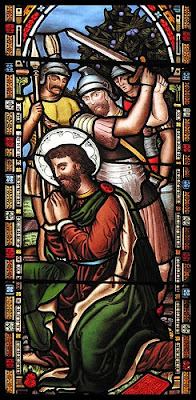
"Church Tradition teaches that St Paul suffered martyrdom in Rome and was beheaded, whence the sword is his symbol.According to Eusebius: "When the government of Nero was now firmly established, he began to plunge into unholy pursuits, and armed himself even against the religion of the God of the universe... Thus publicly announcing himself as the first among God's chief enemies, he was led on to the slaughter of the apostles. It is, therefore, recorded that Paul was beheaded in Rome itself, and that Peter likewise was crucified under Nero. This account of Peter and Paul is substantiated by the fact that their names are preserved in the cemeteries of that place even to the present day.This is one of the scenes from the window of St Paul's life in Melton Mowbray."
Thursday, January 15, 2009
Pope explores St. Paul's teaching on the Church as Bride of Christ

Vatican City, Jan 14, 2009 / 11:05 am (CNA).- More than 4,000 people gathered in the Vatican’s Paul VI Hall to hear Pope Benedict XVI deliver his continuing series of teachings on St. Paul, which today focused on the Apostle’s teaching about Christ as the head of the Church and the Church as his Bride.
As he began his Wednesday general audience, Pope Benedict explained that his reflections would focus on St. Paul’s “twin” letters of Colossians and Ephesians, which are “very close in their manner of expression, vocabulary, and exposition."
Similar in language, they are unique in developing the theme of Christ as "head" or kephalé of the Church. The Pope said that Christ “guides and is responsible for the Christian community as its leader and its Lord… The Church is subject to Him, both to follow His superior guidance and to receive all of the life that emanates from Him.”
Pope Benedict explained that Christ is considered as head of the heavenly powers and of the entire cosmos. Paul, he expounded, “says that God places Christ above every principality and power. His words assure us that Christ is above every hostile power, so that if we are close to him we have nothing to fear."
In the context of the entire cosmos being subject to Christ, the Holy Father referred to the depiction of Christ as "Pantocrator," shown enthroned over the world, on a rainbow. This depiction, the Pope said, "indicates His equality with God at Whose right hand He sits, and hence also His unrivalled role as the guide of human destinies.”
"Such a vision," he added, "can only be conceived by the Church, not in the sense that she wishes unduly to appropriate that which is not hers, but in another, dual, sense: both in that the Church recognizes that in any case Christ is greater than herself, because His lordship extends beyond her confines, and in that only the Church, and not the cosmos, is defined as the Body of Christ. This means we must give positive consideration to worldly things, because Christ recapitulates them in Himself, and at the same time we must fully live our specific ecclesial identity, which is the closest to the identity of Christ Himself."
Another aspect of the Apostle‘s two Letters is "the concept of mystery," "the inscrutable divine plan for the destiny of mankind, of peoples and of the world,” he said. It is for this reason that one “finds fulfillment in Christ,” the Holy Father noted.
Finally, the Holy Father touched on the recurring theme of "the Church as the bride of Christ.” According to St. Paul, the Pope said, Christ has "won" his bride, the Church, by giving his life for her, “the greatest possible demonstration of love."
“What greater sign of love could there be than this,” he remarked. Christ “is concerned for her beauty; not just the beauty acquired through Baptism, but also the beauty that must grow every day through a life of irreproachable moral behavior, without spot or blemish.”
"From here to the shared experience of Christian marriage is but a short step," he observed. “And in fact it is not clear what the initial point of reference was for the author of the Letter: whether the Christ-Church relationship provided a light in which to consider the union of man and woman; or whether experience of conjugal union was the light in which to examine the relations between Christ and the Church.”
"These two Letters are a great catechesis, from them we can learn how to be good Christians," Pope Benedict concluded.
"If we begin to understand that the cosmos is the mark of Christ, we understand what our relationship with the cosmos is, what problems are involved in its conservation. We learn to see it using reason, but a reason moved by love, respect and humility. If we remember that the Church is the Body of Christ, that Christ gave Himself for her, then we learn to live with Christ in mutual love, a love that unites us to God and brings us to see the image of Christ in others. Let us ask the Lord to help us meditate well on Sacred Scripture, his Word, and to really learn to live well.”
Wednesday, January 7, 2009
Benedict XVI Explains How to Truly Worship
Considers Pauline Concept of Praising God
VATICAN CITY, JAN. 7, 2009 (Zenit.org).- It is only in communion with Christ that Christians can offer God true worship, says Benedict XVI.
The Pope explained this today during the first general audience of 2009, in which he resumed his catechesis on St. Paul.
Speaking in a hoarsened voice after days of intense schedules during the holiday season, the Holy Father offered a lengthy explanation of the Pauline concept of "true worship," as it is explained in three passages of the Letter to the Romans.
Referring first to a reference Paul makes to a rite in the Old Testament, the Pontiff noted how the sacrifice of animals as expiation for human sins could never be sufficient.
"A more real contact between human fault and divine love was necessary," he said. "This contact has taken place with the cross of Christ. Christ, Son of God, who has become true man, has assumed in himself all our faults. He himself is the place of contact between human misery and divine mercy; in his heart, the sad multitude of evil carried out by humanity is undone, and life is renewed."
St. Paul speaks of this fundamental change in worship, explaining that "with the cross of Christ -- the supreme act of divine love, converted into human love -- the ancient worship with the sacrifice of animals in the temple of Jerusalem has ended," the Pope said. "This symbolic worship, worship of desire, has now been replaced by real worship: the love of God incarnated in Christ and taken to its fullness in the death on the cross.
"Therefore, this is not a spiritualization of the real worship, but on the contrary, this is the real worship, the true divine-human love, that replaces the symbolic and provisional worship."
Nevertheless, this spiritual worship has a prerequisite, the Bishop of Rome explained, and it is union with Christ.
"Paul," he said, "always supposes that we have come to be 'one in Christ Jesus,' that we have died in baptism and we live now with Christ, through Christ and in Christ. In this union -- and only in this way -- we can be in him and with him a 'living sacrifice,' to offer the 'true worship.'"
By taking on human nature, Christ is able to do for man what sacrificial animals could not, Benedict XVI affirmed.
"The sacrificed animals should have substituted man, the gift of self of man, and they could not," he said. "Jesus Christ, in his surrender to the Father and to us, is not a substitution, but rather really entails in himself the human being, our faults and our desires; he truly represents us, he assumes us in himself.
"In communion with Christ, accomplished in the faith and in the sacraments, we transform, despite our deficiencies, into living sacrifice: 'True worship' is fulfilled."
Wednesday, December 3, 2008
Pontiff: Christian Concept of Sin Veils Happy Fact
The Pope offered an explanation of original sin today during the general audience in St. Peter's Square, in which he reflected on St. Paul's teaching about Adam and Christ as found in the Letter to the Romans.
As "men of today," the Holy Father said, "we must ask ourselves: What is this original sin? […] Is this doctrine still tenable today? Many think that, in the light of the history of evolution, there is no longer a place for the doctrine of a first sin, which then spread to the whole history of humanity. And, consequently, the question of the Resurrection and of the Redeemer would also lose its foundation."
In answering if original sin exists, the Pontiff said that we must "distinguish two aspects of the doctrine on original sin. There is an empirical aspect, namely, a concrete, visible, I would say tangible reality for all, and a mysterious aspect, regarding the ontological foundation of this fact."
The empirical fact, he said, is clear: There is a contradiction within man, who wants to do good, but feels the impulse toward the contrary.
"This interior contradiction of our being is not a theory," Benedict XVI said. "Each one of us experiences it every day. […] Suffice it to think of the daily news on injustice, violence, falsehood, lust. We see it every day: It is a fact. […]
"Hence, the fact of the power of evil in the human heart and in human history is undeniable. The question is: How is this evil explained?"
Unique understanding
The Pope said that Christianity stands alone in the history of human thought with the explanation it offers.
In all other proposals, "there is a principal model of explanation, with several variations," he explained. "This model says: Being itself is contradictory, it bears within it good and evil. In ancient times this idea implied the opinion that two equally original principles existed: a good principle and an evil principle. […]
"In the evolutionist, atheist version of the world the same vision returns in a new way. Even if, in such a concession, the vision of being is monistic, it is implied that being as such from the beginning bears in itself evil and good. […] Evil is equally original as good, and human history would develop only the model already present in the whole of the preceding evolution."
"Deep down," the Holy Father affirmed, "it is a despairing vision: If it is so, evil is invincible. In the end, only self-interest matters."
But faith, he said, has a different proposal: "As a first point, it confirms the fact of the competition between the two natures, the fact of this evil whose shadow weighs on the whole of creation. […] Evil simply exists."
"As explanation, in contrast with the dualisms and monisms that we considered briefly and found desolating, faith tells us: There are two mysteries of light and one mystery of night, which is, however, shrouded by the mysteries of light. The first mystery of light is this: Faith tells us that there are not two principles, one good and one evil, but only one principle, the creator God, and this principle is good, only good, without a shadow of evil.
"As well, being is not a mixture of good and evil; being as such is good and because of this it is good to be, it is good to live. This is the happy proclamation of faith: there is only one good source, the Creator. And because of this, to live is good, it is a good thing to be a man, a woman, life is good."
The mystery of darkness follows, he said, "Evil does not come from the source of being itself, it is not equally original. Evil comes from a created liberty, from an abused liberty."
Still mysterious
How this happened, the Bishop of Rome contended, "remains obscure."
Images have offered explanation, like those of Chapter 3 of Genesis, but "it cannot explain how much in itself is illogical. We can guess, not explain. […] It remains a mystery of darkness, of night," he said.
"However, a mystery of light is immediately added," Benedict XVI affirmed. "Evil comes from a subordinate source. With his light, God is stronger and, because of this, evil can be overcome. Therefore, the creature, man, is curable; […] man is not only curable, he is in fact cured. God has introduced healing. He entered in person into history. To the permanent source of evil he has opposed a source of pure good. Christ crucified and risen, the new Adam."
The Pope concluded with an Advent reflection: "In the language of the Church the word Advent has two meanings: presence and expectation. Presence: The light is present, Christ is the new Adam, he is with us and in our midst. The light already shines and we must open the eyes of the heart to see the light and to enter the river of light. […]
"But Advent also means expectation. The dark night of evil is still strong. […] And we pray with insistence: Come Jesus; come, give force to light and goodness; come where falsehood, ignorance of God, violence and injustice dominate; come, Lord Jesus, give force to the good of the world and help us to be bearers of your light, agents of peace, witnesses of truth. Come Lord Jesus!"
Tuesday, December 2, 2008
Major Development in St. Paul
Michael J. Matt |
| Editor, The Remnant |
Father John Ubel Offers the Traditional Mass
at St. Agnes for the first time in 40 Years
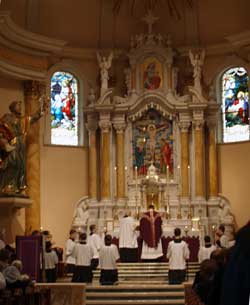
SAINT PAUL—The First Sunday in Advent (November 30, 2008) was an historic day here in the Archdiocese of St. Paul and Minneapolis. After forty years, the traditional Latin Mass returned to the altar of the grand and historic Church of St. Agnes here in Minnesota’s capital city.
After the passing of longtime pastor of St. Agnes, Monsignor Richard Schuler on April 20, 2007, the future of one of Minnesota’s most tradition-minded diocesan churches became uncertain. An inner city parish, St. Agnes now draws the majority of its parishioners from the suburbs and beyond. For decades, Catholic families have traveled from all over the state to find orthodox sermons, Latin Masses (Novus Ordo), Gregorian chant, and the traditional parish life (complete with frequent confession, Tuesday night devotions, Sunday vespers, etc.) for which St. Agnes is famous.
Over the years, the late Monsignor Schuler did significantly more than most to preserve the traditional dignity and sacrality of the Roman Rite here in Minnesota. Though he eventually came to offer the New Mass, his Church of St. Agnes was the only one in Minnesota to preserve at least one Latin Mass every Sunday. The Holy Week services at St. Agnes, for example, were (and are still) internationally recognized events, since they remained comparatively unchanged and retained much of the spirit and character of the old days.
After the Council, Monsignor Schuler eventually began offering the New Mass but in the manner he believed had been intended by the Council Fathers. There were no altar girls at St. Agnes...ever! There were (and are) no women in the sanctuary, no ‘sign of peace’, no Communion in the hand, no guitars, pianos, balloons or clowns. For this reason, thousands of Catholics (traditionalists and conservatives alike) came to appreciate Monsignor Schuler's stand against the liturgical experimentation that eventually led to wide scale loss of Faith, church closings, and empty seminaries. Not surprisingly, St. Agnes inspired more vocations to the priesthood in recent decades than any other diocesan parish in Minnesota.
Father John L. Ubel, the current pastor of St. Agnes, is doing his part to carry on the work of liturgical preservation at St. Agnes.
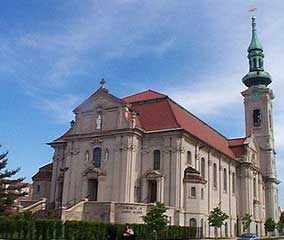
Church of St. Agnes
On November 30, 2008, St. Agnes took an historic step in the all important campaign to reestablish Catholic identity throughout this archdiocese and around the world. Upon request from a stable group of his parishioners, and thus in accordance with the wishes of Pope Benedict XVI, Father Ubel has restored the Traditional Mass to St. Agnes. After months of extensive training of St. Agnes’ famous altar server corps, Father Ubel used the First Sunday in Advent to inaugurate St. Agnes’ latest effort to preserve the traditional heritage of the Catholic Church here in Minnesota. The Mass was as beautiful as it was historic.
For this writer, the first Traditional Mass at St. Agnes was special on a number of fronts. My grandfather served on the building and planning committee of St. Agnes a hundred years ago. My father was baptized there and attended St. Agnes grade school. I attended St. Agnes grade school, as well, and received my first Holy Communion from Monsignor Schuler. This is a great day! The return of the Traditional Mass to this historic landmark means a great deal to us and to countless Catholic families here in Minnesota. May it bring an abundance of grace and even more vocations to the archdiocese! And may it come to pass one day soon that all the Masses in this beautiful, traditional building will be celebrated according to the liturgical tradition of the Roman Rite--the most beautiful thing this side of heaven.
To thank Father Ubel for his decision to generously respond to the Holy Father’s wishes where the Traditional Mass is concerned, send him an email at: rectory@stagnes.net