Showing posts with label astronomy. Show all posts

Sunday, April 19, 2015

Mercury


(Telegraph) An image of the planet Mercury produced by Nasa's MErcury Surface, Space ENvironment, GEochemistry, and Ranging (or MESSENGER) probe. These colors are not what Mercury would look like to the human eye, but rather the colours enhance the chemical, mineralogical, and physical differences between the rocks that make up Mercury's surface, according to Nasa. The MESSENGER spacecraft that made surprising discoveries of ice and other materials on Mercury will make a crash landing into the planet around April 30, scientists said. 

Picture: REUTERS/NASA/Johns Hopkins University Applied Physics Laboratory/Carnegie Institution of Washington

Link:

Tuesday, November 18, 2014

NASA builds a time-machine telescope 100 times as powerful as the Hubble


(The Washington Post) Inside a very big and very clean room at NASA’s Goddard Space Flight Center in Greenbelt, Md., nearly 30 workers dressed in white protective suits, goggles and blue booties cluster around the parts of a time machine.

These parts — gold-covered mirrors, tennis-court-size sun shields, delicate infrared cameras — are slowly being put together to become the James Webb Space Telescope.

Astronomers are hoping that the Webb will be able to collect light that is very far away from us and is moving still farther away. The universe has been expanding ever since the big bang got it started, but scientists reckon that if the telescope is powerful enough, they just might be able to see the birth of the first galaxies, some 13.5 billion years ago.

“This is similar to archaeology,” says Harvard astrophysicist Avi Loeb, who helped plan Webb’s science mission. “We are digging deep into the universe. But as the sources of light become fainter and farther away, you need a big telescope like the James Webb.”

Named for a former NASA director, the 21-foot-diameter Webb telescope will be 100 times as powerful as the Hubble Space Telescope, which was launched in 1990. Although Hubble wasn’t the first space telescope, its images of far-off objects have dazzled the public and led to breakthroughs in astrophysics, such as determining how fast the universe is expanding.

The Webb will be both bigger and located in a darker part of space than Hubble, enabling it to capture images from the faintest galaxies. Four infrared cameras will capture light that is moving away from us very quickly and that has shifted from the visible to the infrared spectrum, described as red-shifted. The advantage of using infrared light is that it is not blocked by clouds of gas and dust that may lie between the telescope and the light. Webb’s mirrors are covered in a thin layer of gold that absorbs blue light but reflects yellow and red visible light, and its cameras will detect infrared light and a small part of the visible spectrum. As objects move away from us, the wavelength of their light shifts from visible light to infrared light. That’s why the Webb’s infrared cameras will be able to see things that are both far away and moving away from us... (continued)


Link:

Thursday, May 10, 2012

New Mayan Calendar Discovered That Doesn't End in 2012


http://cdn.theatlanticwire.com/img/upload/2012/05/10/AP120425071822/large.jpg

By Dashiell Bennett

(The Atlantic Wire) Archeologists have unearthed what they say is the oldest known version of the Mayan calendar and one that doesn't "end" with the Earth's destruction later this year. Yeah, you're welcome.

According to The Washington Post's Brian Vastag, researchers excavating the "lost" city of XultĂșn in present-day Guatemala discovered new astronomical tables carved into the wall of a "1200-year-old residential building." Much like the Maya codices that conspiracy theorists say predict an end-of-the-world date in December 2012, the tables chart planetary movements, moon and star patterns, and can predict the positions of celestial bodies thousands of years into the past and the future.

Numerous doomsday predictions are based on the claim that previously known codieces, like the famous Dresden Codex, chart the entire length of human history, but mysteriously stop on December 21, 2012 as if the Mayans knew that would be the last day humans would be around. However, the archeologists say that these the newly discovered tables — which pre-date the oldest known codex by as much as 500 years — span over 7,000 years of time, stretching far beyond of present age. So, you can breathe a little easier, though the news will come as a big shock to the tourism industry in Belize and other "entreprenuers" who are willing to take all your money off your hands before the big one hits.

If you still need something to panic about, Tulane University’s Marc Zender, who led the expedition, says that the Mayan calendar still begins a new “long cycle” in 2012, but compares he compares to an "odometer on a car rolling over from 99,999 miles to zero: “You go, ‘Yay,’ but the car just doesn’t disappear.” Oh, really? Well, we'll see about that.

Link:

Wednesday, February 1, 2012

E.T. and The Fermi Paradox: Are We Alone in the Cosmos?

By Father Gordon J. MacRae

...Of the nearly 140 posts I’ve written for These Stone Walls, only two have been about space science, my other preoccupation. “A Day Without Yesterday,” about the great Belgian physicist-priest, Father Georges Lemaitre, told the story of how he changed the mind Of Albert Einstein about the created universe. His concept of the origin of the Universe from the primordial atom or “Big Bang” was suppressed by some scientists because Father Lemaitre was a Catholic priest.

Today, his work is a cornerstone of modern cosmology. Coincidentally, this week’s Our Sunday Visitor has a great tribute to Father Georges Lemaitre by Barry Hudock entitled “Interplay of Cosmology Revelation” (OSV, January 29, 2012). IN another TSW post, “Does Stephen Hawking Sacrifice God on the Altar of Science?” I refuted some of the reviewers of Stephen Hawking’s book, The Grand Design, who saw in its pages a refutation of God Himself. I’m not even counting my post, “Phasers On Stun, Mr. Spock! Captain Kirk’s Star Trek Epiphany,” which was about science fiction and not science. So indulge me for a few minutes, please. I haven’t exactly inundated TSW readers with my amateur astronomy from inside a prison cell. Besides, my astronomical telescope is but another long lost treasure, and the night sky itself is just a memory... (continued ...)


Tuesday, August 24, 2010

A Milky Way Shadow at Loch Ard Gorge


Credit & Copyright: Alex Cherney (Terrastro) 
 

Explanation: Have you ever seen the Milky Way's glow create shadows? To do so, conditions need to be just right. First and foremost, the sky must be relatively clear of clouds so that the long band of the Milky Way's central disk can be seen. The surroundings must be very near to completely dark, with no bright artificial lights visible anywhere. Next, the Moon cannot be anywhere above the horizon, or its glow will dominate the landscape. Last, the shadows can best be caught on long camera exposures. In the above image taken in Port Campbell National Park, Victoria, Australia, seven 15-second images of the ground and de-rotated sky were digitally added to bring up the needed light and detail. In the foreground lies Loch Ard Gorge, named after a ship that tragically ran aground in 1878. The two rocks pictured are the remnants of a collapsed arch and are named Tom and Eva after the only two people who survived that Loch Ard ship wreck. A close inspection of the water just before the rocks will show reflections and shadows in light thrown by our Milky Way galaxy. Low clouds are visible moving through the serene scene in this movie

h/t to worm

Wednesday, March 11, 2009

See Explanation.  Clicking on the picture will download  the highest resolution version available.

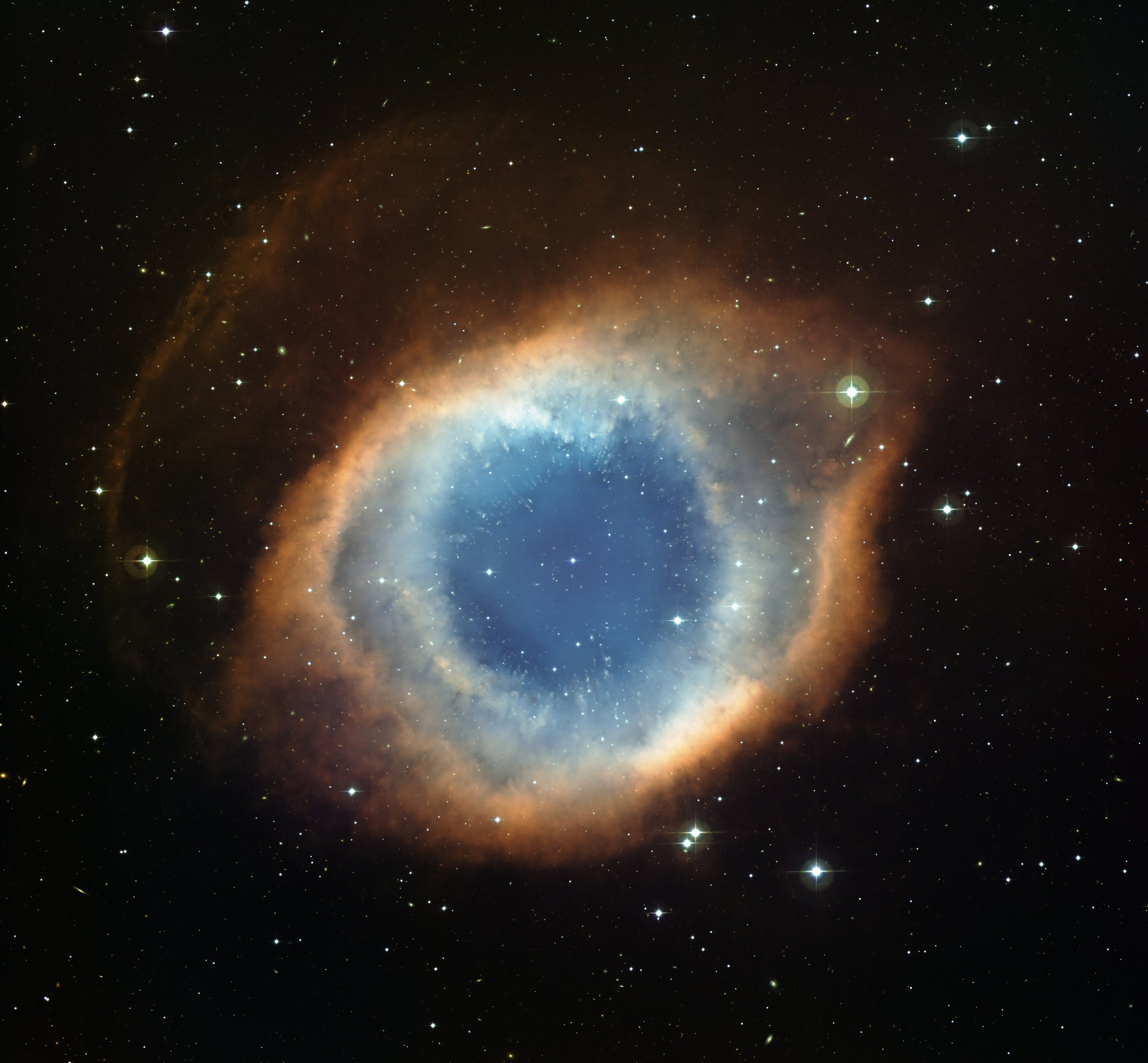
The Helix Nebula from La Silla Observatory
Credit: WFI, MPG/ESO 2.2-m Telescope, La Silla Obs., ESO

Explanation: Will our Sun look like this one day? The Helix Nebula is one of brightest and closest examples of a planetary nebula, a gas cloud created at the end of the life of a Sun-like star. The outer gasses of the star expelled into space appear from our vantage point as if we are looking down a helix. The remnant central stellar core, destined to become a white dwarf star, glows in light so energetic it causes the previously expelled gas to fluoresce. The Helix Nebula, given a technical designation of NGC 7293, lies about 700 light-years away towards the constellation of Aquarius and spans about 2.5 light-years. The above picture was taken by the Wide Field Imager on the 2.2-meter Telescope at the European Southern Observatory's La Silla Observatory. A close-up of the inner edge of the Helix Nebula shows complex gas knots of unknown origin.

Sunday, February 15, 2009

Astronomy Picture of the Day

See Explanation.  Clicking on the picture will download  the highest resolution version available.
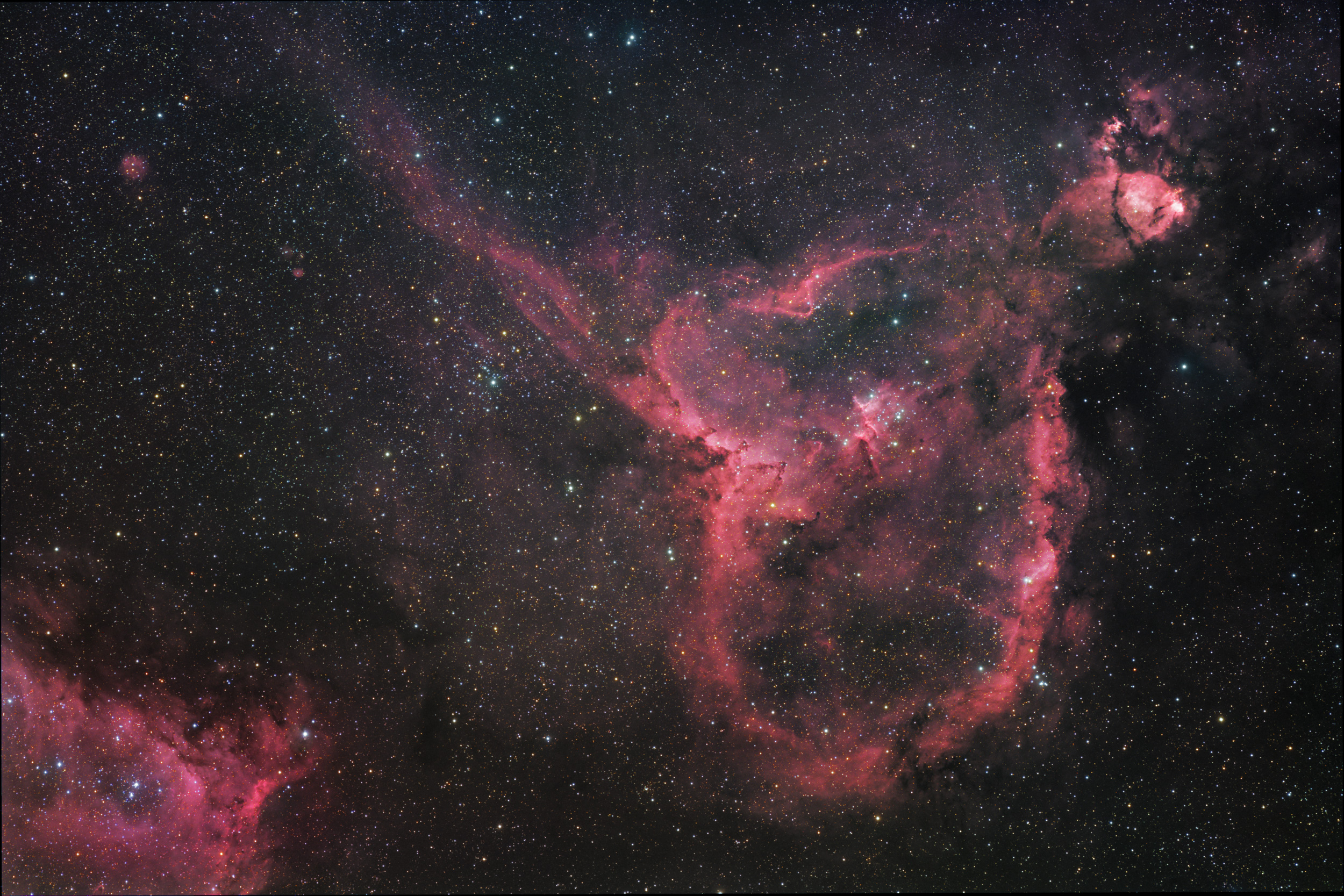
IC 1805: The Heart Nebula
Credit & Copyright: Daniel Marquardt

Explanation: Sprawling across almost 200 light-years, emission nebula IC 1805 is a mix of glowing interstellar gas and dark dust clouds. Derived from its Valentine's-Day-approved shape, its nickname is the Heart Nebula. About 7,500 light-years away in the Perseus spiral arm of our galaxy, stars were born in IC 1805. In fact, near the cosmic heart's center are the massive hot stars of a newborn star cluster also known as Melotte 15, about 1.5 million years young. A little ironically, the Heart Nebula is located in the constellation Cassiopeia. From Greek mythology, the northern constellation is named for a vain and boastful queen. This deep view of the region around the Heart Nebula, cropped from a larger mosaic, spans about 2.5 degrees on the sky or about 5 times the diameter of the Full Moon.

  • Link

Sunday, February 8, 2009

New Zealand town is in the dark — and proud of it

A stone chapel is shown on the edge of Lake Tekapo under the sparkling sky in By RAY LILLEY, Associated Press Writer Ray Lilley, Associated Press Writer Sun Feb 8, 11:03 am ET

AP – A stone chapel is shown on the edge of Lake Tekapo under the sparkling sky in New Zealand's South Island …

TEKAPO, New Zealand – This little town is in the dark and proud of it.

Where other places greet the night by lighting up their streets and tourist attractions, this one goes the other way — low-energy sodium lamps are shielded from above, and household lights must face down, not up.

The purpose: to bring out the stars.

The town of 830 people on New Zealand's South Island is on a mission to protect the sight of the night sky, even as it disappears behind light and haze in many parts of the world.

The ultimate prize would be UNESCO's approval for the first "starlight reserve," and already the "astro tourists" are coming.

A group of 25 are huddled at midnight on a bare New Zealand hilltop, their faces numbed by an icy wind as they gaze up at the Milky Way.

"It's awesome, I mean it's like beyond words," says Simon Venvoort, 46, a management consultant from Amsterdam. "You see so much you aren't aware of..."

More

Wednesday, January 14, 2009

Life on Mars

ALIEN microbes living just below the Martian soil are responsible for a haze of methane around the Red Planet, Nasa scientists believe.

The gas, belched in vast quantities in our world by cows, was detected by orbiting spacecraft and from Earth using giant telescopes.

Discovery ... gas around Mars

Discovery ... gas around Mars

Nasa are today expected to confirm its presence during a briefing at their Washington HQ.

And the find is seen as exciting new evidence that Martian microbes are still alive today.

Some scientists reckon methane is also produced by volcanic processes. But there are NO known active volcanoes on Mars.

Furthermore, Nasa has found the gas in the same regions as clouds of water vapour, the vital �drink� needed to support life.

Mission ... probe on the surface of Mars

Mission ... probe on the surface of Mars

Experts speculate that the methane is being emitted as a waste product by organisms called methanogens living in water beneath underground ice.

And they would have to be alive today because the methane would otherwise have been lost from the Martian atmosphere.

What a scoop ... Phoenix lander dug up chunks of ice last year

What a scoop ... Phoenix lander dug up chunks of ice last year

John Murray — a member of the Mars Express European space probe team — believes the mini-Martians may be in a form of suspended animation and could even be REVIVED.

He has found overwhelming evidence of a vast frozen ocean beneath the dust near the Martian equator where simple life could have thrived as microbes.

Today’s briefing will feature a star panel of Mars experts headed by Michael Meyer, chief scientist for Nasa’s Mars programme.

UK Mars expert Professor Colin Pillinger believes the methane can only point to the presence of life on the planet.

Space neighbours ... Earth and Venus rise over Mars in mock-up

Space neighbours ... Earth and Venus rise over Mars in mock-up

His ill-fated Beagle 2 probe was carrying a laboratory that would have looked directly for such signs of life when it crashed on Christmas Day 2003.

Prof Pillinger, below, told The Sun last night: �Methane is a product of biology. For methane to be in Mars’ atmosphere, there has to be a replenishable source.

�The most obvious source of methane is organisms. So if you find methane in an atmosphere, you can suspect there is life.

�It’s not proof, but it makes it worth a much closer look.�

Nasa’s findings confirm studies by Europe’s Mars Express probe, which has been orbiting the planet for five years and also reported signs of methane in 2004.

Britain’s top space expert Nick Pope last night hailed the new evidence of life as �the most important discovery of all time�.

He said: �What could be more profound than to know it’s not just us out there?

Expert ... Colin Pillinger

Expert ... Colin Pillinger

"We’ve really only scratched the surface — it’s an absolute certainty that there is life out there and we are not alone.

�If there is life on Mars then the logical conclusion is that there must be life elsewhere too.

�If it’s happened here on Earth, then why shouldn’t it happen anywhere? The implication is this is a universal law.

�Mars is very similar to Earth. It’s about the same size, it’s a rocky inner planet.

�Most scientists believe it probably has liquid water which is almost universally agreed as the pre-requisite for life. I am certain there is other life in the Universe and, most likely, intelligent life.�

The Red Planet has gripped the public imagination for more than a century as a possible home for aliens.

But life could not survive on its surface because, unlike the Earth, Mars has no magnetic shield to protect it against deadly sun radiation.

The planet resembles our own in many ways. It is made of rock, it has an atmosphere and weather systems.

Although much smaller with a diameter of around 4,222 miles, Mars’ day is just 40 minutes longer than ours and its tilted axis gives it seasons.

Water has been found in the form of buried ice and scientists believe that two billion years ago, Mars was covered with liquid oceans.

Proof that water is still on Mars came in 2007 when Mars Express used ground-piercing radar to study the region around the planet’s South Pole.

Nasa’s latest lander Phoenix dug up chunks of Martian ice last year. It swiftly evaporated into the thin atmosphere.

Nasa have controversially hit the headlines before for claiming evidence for Martians.

In 1996, they said they had discovered fossilised organisms in a meteorite from the planet.

But other scientists were sceptical.

Today’s conference will be broadcast live online by NASA TV (www.nasa.gov/ntv ) at 7pm.

Thursday, August 7, 2008

Astronomy Picture of the Day

See Explanation.  Clicking on the picture will download  the highest resolution version available.

At the Sun's Edge

Credit & Copyright: Catalin Beldea (Descopera Magazine)

Explanation: A train trip on the Trans-Siberian railway to Novosibirsk resulted in this stunning view along the edge of the Sun recorded during the August 1st total solar eclipse. The picture is a composite of two images taken at special moments in the eclipse sequence, corresponding to the very beginning and the very end of the total eclipse phase. Those times are known to eclipse chasers as 2nd and 3rd contact. Bright beads around the Moon's dark silhouette are rays of sunlight shining through lunar valleys at the edge of the lunar disk. But the composite view also captures solar prominences, looping structures of hot plasma suspended in magnetic fields, extending beyond the Sun's edge.

Friday, May 23, 2008

Dark energy 'imaged' in best detail yet

  • 19:40 23 May 2008
  • NewScientist.com news service
  • Zeeya Merali
Supervoids of empty space (blue) and superclusters of galaxies (red) were slightly cooler or warmer, respectively, than expected in maps of the cosmic microwave background because of dark energy (Illustration: Granett/Neyrinck/Szapudi/NASA/SDSS)

Some had hoped it might be just an illusion. But it looks like dark energy is real and here to stay, as astronomers "image" the mysterious entity in action.

In 1998, astronomers found that distant supernovae were dimmer, and thus farther away, than expected. This suggested that the expansion of the universe is accelerating – and "dark energy" was named as the culprit.

Since then, astronomers have struggled to explain what dark energy actually is – leading some to speculate that it may not exist at all. Some have claimed that uneven distributions of matter within the universe could distort our measurements of the distance to supernovae, fooling us into thinking that they are farther away than they are.

To find an independent check on the existence of dark energy, IstvĂĄn Szapudi at the University of Hawaii in Honolulu, US, and colleagues turned to the cosmic microwave background (CMB) – relic radiation from the big bang. Detailed maps of the CMB show hot and cold spots that reflect variations in the density of the early universe.

When dark energy was proposed, astronomers realised that it should create additional temperature bumps on the map.

This extra dark energy effect is generated because the temperature of a photon zipping across the universe can be changed depending on whether it has passed through a region of dense matter or a sparser region.

Shallow well

A photon gains energy when it enters a dense region with enhanced gravity – such as a galaxy cluster – as though it is falling into a well. When it leaves the cluster and climbs back out of the gravitational well, it loses energy.

In a universe without dark energy, the energy gained and lost during the crossing would be equal and would cancel out. But in the presence of dark energy, the universe expands quickly enough to stretch the gravitational well while the photon is still inside. This makes the well shallower and easier for the photon to climb out.

That means that a photon travelling through a cluster gains more energy than it loses, giving it a little energy kick so that it creates a hotter spot than would be expected on images of the CMB. Similarly, a photon that has passed through a void would leave a cold spot.

It's tough to detect this effect because dark energy gives only a slight nudge to the temperature, which is easily swamped by the normal temperature variations seen in the CMB, says Szapudi.

Extreme density

To get around this, his team looked at regions of extremely high and extremely low density, where you would expect to see the biggest effect.

Using data from the Sloan Digital Sky Survey, they chose over 3000 superclusters of galaxies and 500 "supervoids" of relatively empty space, and they found that the regions did indeed tally with enhanced hot and cold spots in the CMB.

Other teams have reported signs of this effect in the past, but those have been open to alternative explanations, says Szapudi. By contrast, his calculations suggest that there is less than a 1 in 200,000 chance that the match up his team saw is down to anything other than dark energy.

"We have shown the imprint on the CMB of dark energy at work," says Szapudi. "In this sense, we have imaged dark energy."

The finding should rule out any notion that dark energy is an illusion, he says. "We've really attacked the dark energy question in a different way from supernovae measurements. It's difficult to argue that an illusion could be responsible for this effect."

Warped space

Thomas Buchert at the University of Lyon in France, one of the physicists who suggested that dark energy may be an illusion, is impressed by the thoroughness of Szapudi's work. "People have discussed this effect, but this is the first really clear-cut signal," he says.

However, Buchert is not ready to abandon alternatives to dark energy just yet. He points out that a similar effect might be produced if space-time is significantly warped around the voids and clusters - something that isn't usually considered in standard calculations.

He also notes that Szapudi's team observed a temperature effect that was stronger than expected from dark energy. "This could be a hint that there may be something else happening here that's worth investigating," he says.

Tuesday, May 13, 2008

Believing in aliens not opposed to Christianity, Vatican’s top astronomer says

.- The Director of the Vatican's Observatory, Fr. José Gabriel Funes, said in an interview with the Vatican daily, L'Osservatore Romano, that believing in the possible existence of extraterrestrial life is not opposed to Catholic doctrine.

The 45-year-old Argentinean priest heads the Vatican Observatory, founded by Pope Leo XIII with offices at Castelgandolfo, near the Apostolic summer palace, and another in Tucson, Arizona. Fr. Funes has been in charge of the Observatory since August 2006.

The astronomer began the interview titled, "The Alien is my Brother," by saying that, "Astronomy has a profound human value. It is a science that opens the heart and the mind. It helps us to put our lives, our hopes, our problems in the right perspective. In this regard, and here I speak as a priest and a Jesuit, it is an apostolic instrument that can bring us closer to God", said Fr. Funes in the interview.

Regarding the beginning of the universe, Fr. Funes says that he personally believes that the "big bang" theory seems to him the most plausible, and that it does not contradict the Bible. "We cannot ask the Bible for a scientific answer here. At the same time, we don't know if in a near future the 'Big Bang' theory will be superseded by a more complete and precise explanation of the origin of the universe."

When he was asked about the possibility of extraterrestrial life, the Director of the Vatican Observatory responded that "it is possible, even if until now, we have no proof. But certainly in such a big universe this hypothesis cannot be excluded."

Asked is he sees a contradiction between the Catholic faith and believing in aliens, he said, "I think there isn't (a contradiction). Just as there is a multiplicity of creatures over the earth, so there could be other beings, even intelligent (beings), created by God. This is not in contradiction with our faith, because we cannot establish limits to God's creative freedom. To say it with St. Francis, if we can consider some earthly creatures as 'brothers' or 'sisters', why could we not speak of a 'brother alien'? He would also belong to the creation."

Fr. Funes says that taking the image of the lost sheep in the Gospel, "we could think that in this universe there can be 100 sheep, equivalent to different kinds of creatures. We, belonging to human kind could be precisely the lost sheep, the sinners that need the shepherd. God became man in Jesus to save us. In that way, assuming that there would be other intelligent beings, we could not say that they need redemption . They could have remained in full friendship with the Creator."

"But if they were sinners?" L'Osservatore's journalist asks.

"Jesus became man once and for all. The Incarnation is a single and unique event. So I am sure that also they, in some way, would have the chance to enjoy God's mercy, just as it has happened with us human beings."

Monday, May 12, 2008

Astronomy Picture of the Day

Click above to enlarge

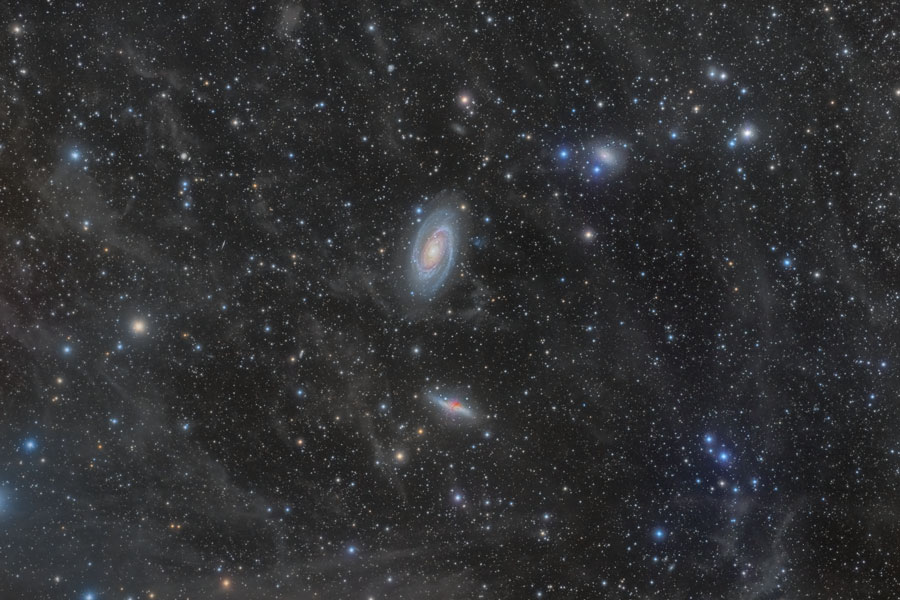
The M81 Galaxy Group Through the Integrated Flux Nebula
Credit & Copyright: Jordi Gallego

Explanation: Large galaxies and faint nebula highlight this deep image of the M81 Group of galaxies. First and foremost in the above wide-angle 12-hour exposure is the grand design spiral galaxy M81, the largest galaxy visible in the image. M81 is gravitationally interacting with M82 just below it, a big galaxy with an unusual halo of filamentary red-glowing gas. Around the image many other galaxies from the M81 Group of galaxies can be seen. Together with other galaxy congregates including our Local Group of galaxies and the Virgo Cluster of galaxies, the M81 Group is part of the expansive Virgo Supercluster of Galaxies. This whole galaxy menagerie is seen through the faint nebular glow of the Integrated Flux Nebula, a little studied complex of diffuse gas and dust clouds in our Milky Way Galaxy.

Friday, February 15, 2008

Astronomy Picture of the Day

Young Stars in the Rho Ophiuchi Cloud
Credit: NASA JPL-Caltech, Harvard-Smithsonian CfA

Explanation: Cosmic dust clouds and embedded newborn stars glow at infrared wavelengths in this tantalizing false-color view from the Spitzer Space Telescope. Pictured is of one of the closest star forming regions, part of the Rho Ophiuchi cloud complex some 400 light-years distant near the southern edge of the pronounceable constellation Ophiuchus. The view spans about 5 light-years at that estimated distance. After forming along a large cloud of cold molecular hydrogen gas, newborn stars heat the surrounding dust to produce the infrared glow. An exploration of the region in penetrating infrared light has detected some 300 emerging and newly formed stars whose average age is estimated to be a mere 300,000 years -- extremely young compared to the Sun's age of 5 billion years.

Wednesday, February 6, 2008

Astronomy Picture of the Day

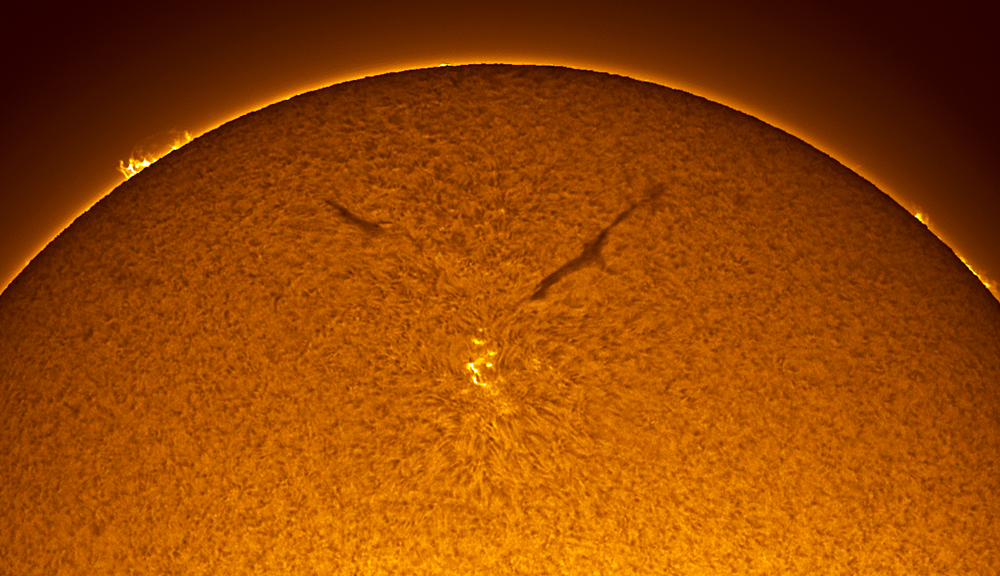
A Sunspot in the New Solar Cycle
Credit & Copyright: Greg Piepol

Explanation: A new cycle has begun on our Sun. Over the past year, the Sun's magnetic field11 year period is beginning. Pictured above in a specific color of light emitted by hydrogen is sunspot 10982, one of the first sunspots of the new solar cycle. The two dark lines visible just above and to either side of the bright sunspot are cool filaments held aloft by the Sun's magnetic field. Hot and cold regions are shown as regions of relative light and dark, respectively. A solar cycle is caused by the changing magnetic field, and varies from solar maximum, when sunspot, coronal mass ejection, and flare phenomena are most frequent, to solar minimum, when such activity is relatively infrequent. Solar minimums occurred in 1996 and 2007, while the last solar maximum occurred in 2001. Of course, tomorrow's annular solar eclipse is mostly for penguins. has reset and now a new