Showing posts with label Protestants. Show all posts

Sunday, August 28, 2016

Church of England parishes consider first step to break away over sexuality

By John Bingham, Religious Affairs Editor

(The Telegraph) A group of parishes is preparing what could be the first step towards a formal split in the Church of England over issues such as homosexuality, with the creation of a new “shadow synod” vowing to uphold traditional teaching.

Representatives of almost a dozen congregations in the Home Counties are due to gather in a church hall in Tunbridge Wells, Kent, later this week for the first session of what they say could eventually develop into an alternative Anglican church in England.

Organisers, drawn from the conservative evangelical wing of Anglicanism, say they have no immediate plans to break away - but are setting up the “embryonic” structures that could be used to do so if the established church moves further in what they see as a liberal direction.

The new alliance will be viewed as a “church within a church” but founders have not ruled out full separation if, for example, the Church of England offers blessing-style services for same-sex unions - a move expected to be considered by bishops in the next few months... (continued)

Link:


Friday, July 31, 2015

German Protestants apologise for Reformation iconoclasm


By Christa Pongratz-Lippitt

(The Tablet) The German Protestant Church (EKD) has apologised for the widespread destruction of religious images during the Reformation.

“The Protestant Church rejects the destruction of images. Images have long since become an expression of Protestant piety,” Protestant Bishop Petra Bosse-Huber underlined at a meeting of delegations from the Ecumenical Patriarchate of Constantinople and the EKD. The clerics met in Hamburg to discuss the word “image” from the Orthodox and Protestant points of view. Ecumenical Patriarch Bartholomew and EKD chairman Bishop Heinrich Bedford-Strohm sent greetings and blessings to the Hamburg meeting.

Destroying image was most common in the immediate aftermath of the Reformation. In the first half of the sixteenth century, statues of the Virgin and the saints, stained-glass windows, organs and any objects associated with miracles and the supernatural were removed from Catholic churches and wayside chapels and in many cases destroyed. Switzerland, the Netherlands, England and southern Germany suffered particularly... (continued)


Link:

Friday, April 24, 2015

Presbyterian Pastor: “I Love Planned Parenthood.” Calls Abortion Business a “Ministry”

By Carole Novielli

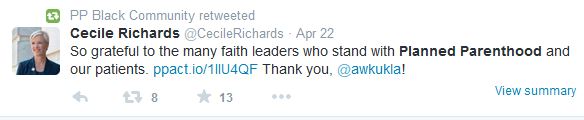
(LifeNews.com) The president of the largest chain of abortion clinics in the United States is thanking “Faith Leaders” for standing with them.

In a tweet by Planned Parenthood president, Cecile Richards, recently released she states, “So grateful to the many faith leaders who stand with Planned Parenthood and our patients. http://ppact.io/1IIU4QF Thank you, @awkukla!”

Cecile Richards Planned Parenthood Faith Leaders

@awkukla is Andrew Kukla, who describes himself as a , “Presby minister, love philosophy and Kierkegaard in particular, dad of four young kids, and I live in Boise, ID,” on his twitter page. The link takes you to a post written by the Presbyterian pastor which calls what Planned Parenthood does “a ministry“.

He titled the blog post, “I (heart) Planned Parenthood.” Hard to believe? Read for yourself:

“I heart Planned Parenthood. I love these people who do not care what others will label them or say about them or even say to them. They care too much about people and too much about life to let hate and ignorance hold them back. As a Christian I am called to grace, forgiveness, mercy… and building up of those who life has torn down. And from all I learned today, some of the greatest practitioners of that are the people working at Planned Parenthood. So I say it proudly: I love Planned Parenthood. I love the people that are Planned Parenthood. I love their ministry”.

Planned Parenthood has proudly posted about this this Pastor on a blog they entitled, “Pastor loves Planned Parenthood.”

The blog makes it clear that the Rev. Andrew Kukla loves the killer of unborn children and some women like 24 year-old Tonya Reaves who was left to bleed for 5 hours after her abortion.
And, why does the delusional Rev. Kukla “love” Planned Parenthood? For “fighting for life.”

REALLY?
“What I love is the dedicated staff of people who are doing the ministry of caring for people. Fighting for people. Fighting for life,” he writes.
He then calls Planned Parenthood “resurrection workers.”
“I walked out of a meeting this morning at a Planned Parenthood office/clinic and saw a lone protestor holding a sign that said, “They kill babies here.” I have a lot of thoughts about that sign but I will restrain myself. Here is what I thought that is most relevant: This is resurrection work. No, not the sign carrier. The people I love at Planned Parenthood. They are resurrection workers.”
Rev. Andrew Kukla is the pastor of First Presbyterian Church Boise, Idaho.

andrewkukla

Despite that the Word of God is full of scriptures against the killing of the innocent, this Pastor supports Planned Parenthood. Even more ironic, is that one of his recent blog posts was entitled, ““Cherry Picking” Scripture.” This man will have to answer to God for what he is doing.

In the words of our Lord Jesus Christ from Matthew 18, “If anyone causes one of these little ones–those who believe in me–to stumble, it would be better for them to have a large millstone hung around their neck and to be drowned in the depths of the sea.”

Unfortunately, this heretic pastor and church is not alone.

I recently blogged about a Presbyterian Church in Louisiana which opened their doors to Planned Parenthood for support- read that post here. In addition, I also exposed the Planned Parenthood clergy letters encouraging abortion – shameful. Read that here.

LifeNews Note: Carole Novielli is the author of the blog Saynsumthn, where this article originally appeared.

Link:

Monday, July 28, 2014

Pope Francis Becomes First Pope To Visit A Pentecostal Church In Outreach To Evangelicals


VATICAN CITY (AP) - Pope Francis has become the first pope to visit a Pentecostal church, pressing his outreach to evangelicals who represent Catholicism's greatest competition for Christian souls around the globe.

Francis flew by helicopter Monday to visit the under-construction Pentecostal Church of Reconciliation in the southern city of Caserta. He met privately with a Pentecostal preacher who is an old friend, Giovanni Traettino.

Speaking to some 350 Pentecostal faithful in the church, Francis apologized for Catholic persecution of Pentecostals during Italy's fascist regime and stressed that there was unity in diversity within Christianity.

He acknowledged the remarkable nature of his visit, saying: "Someone will be surprised: 'The pope went to visit the evangelicals?' But he went to see his brothers."

Francis has met unofficially with several Pentecostal and evangelical preachers recently.

Link:

Saturday, April 27, 2013

Former Nun in Kentucky Simulates Ordination to the Priesthood

Rosemarie Smead, a 70-year-old Kentucky woman, sings with the audience before being ordained a Roman Catholic priest, during a Celebration of Ordination at St. Andrew's United Church of Christ in Louisville, Kentucky April 27, 2013. Smead was ordained as part of a dissident group operating outside official Roman Catholic Church authority. REUTERS-John Sommers II

Rosemarie Smead, a 70-year-old Kentucky woman, sings with the audience before [not] being ordained a Roman Catholic priest, during a Celebration of Ordination at St. Andrew's United Church of Christ in Louisville, Kentucky April 27, 2013. Smead was [not] ordained as part of a dissident group operating outside official Roman Catholic Church authority. REUTERS/John Sommers II

By Mary Wisniewski 

LOUISVILLE, Kentucky  | Sat Apr 27, 2013 9:00pm EDT

(Reuters) - In an emotional ceremony filled with tears and applause, a 70-year-old Kentucky woman was [not] ordained a priest on Saturday as part of a dissident group operating outside of official Roman Catholic Church authority.

Rosemarie Smead is one of about 150 women around the world who have decided not to wait for the Roman Catholic Church to lift its ban on women priests, but to be ordained and start their own congregations.

Rosemarie Smead (2nd R), a 70-year-old Kentucky woman, is ordained a Roman Catholic priest during a Celebration of Ordination at St. Andrew's United Church of Christ in Louisville, Kentucky April 27, 2013. Smead was ordained as part of a dissident group operating outside official Roman Catholic Church authority. REUTERS-John Sommers II

In an interview before the ceremony, Smead said she is not worried about being excommunicated from the Church - the fate of other women ordained outside of Vatican law.

"It has no sting for me," said Smead, a petite, gray-haired former Carmelite nun with a ready hug for strangers. "It is a Medieval bullying stick the bishops used to keep control over people and to keep the voices of women silent. I am way beyond letting octogenarian men tell us how to live our lives."

Rosemarie Smead, a 70-year-old Kentucky woman, weeps openly as almost the entire congregation comes to lay their hands on her head in blessing, as she was ordained a Roman Catholic priest during a Celebration of Ordination at St. Andrew's United Church of Christ in Louisville, Kentucky April 27, 2013. Smead was ordained as part of a dissident group operating outside official Roman Catholic Church authority. REUTERS-John Sommers II

The ordination of women as priests, along with the issues of married priests and birth control, represents one of the big divides between U.S. Catholics and the Vatican hierarchy. Seventy percent of U.S. Catholics believe that women should be allowed to be priests, according to a New York Times/CBS News poll earlier this year.

The former pope, Benedict XVI, reaffirmed the Catholic Church's ban on women priests and warned that he would not tolerate disobedience by clerics on fundamental teachings. Male priests have been stripped of their holy orders for participating in ordination ceremonies for women.

Rosemarie Smead (front row, C), a 70-year-old Kentucky woman, sings with the audience before being ordained a Roman Catholic priest, during a Celebration of Ordination at St. Andrew's United Church of Christ in Louisville, Kentucky April 27, 2013. Smead was ordained as part of a dissident group operating outside official Roman Catholic Church authority. REUTERS-John Sommers II

In a statement last week, Louisville Archbishop Joseph E. Kurtz called the planned ceremony by the Association of Roman Catholic Women Priests a "simulated ordination" in opposition to Catholic teaching.
"The simulation of a sacrament carries very serious penal sanctions in Church law, and Catholics should not support or participate in Saturday's event," Kurtz said.

The Catholic Church teaches that it has no authority to allow women to be priests because Jesus Christ chose only men as his apostles. Proponents of a female priesthood said Jesus was acting only according to the customs of his time.

They also note that he chose women, like Mary Magdalene, as disciples, [wrong:] and that the early Church had women priests, deacons and bishops [/wrong].


The ceremony, held at St. Andrew United Church of Christ in Louisville, was attended by about 200 men and women. Many identified themselves to a Reuters reporter as Catholics, but some declined to give their names or their churches.

'NEW ERA OF INCLUSIVITY'

The modern woman priest movement started in Austria in 2002, when seven women were ordained by the Danube River by an independent Catholic bishop. Other women were later ordained as bishops, who went on to ordain more women priests and deacons.

The processional enters the Church sanctuary for the Celebration of Ordination of Rosemarie Smead into the priesthood during a service at St. Andrew's United Church of Christ in Louisville, Kentucky April 27, 2013. Smead was ordained as part of a dissident group operating outside official Roman Catholic Church authority. REUTERS-John Sommers II

"As a woman priest, Rosemarie is leading, not leaving the Catholic Church, into a new era of inclusivity," said Bishop Bridget Mary Meehan during her sermon Saturday. "As the Irish writer James Joyce reminded us, the word 'Catholic' means 'Here comes everybody!'"


Smead had to leave the rigorous Carmelite life due to health reasons, and earned a bachelor's degree in theology and a doctorate in counseling psychology. She taught at Indiana University for 26 years, and works as a couples and family therapist.

During the ordination ceremony, Smead wept openly as nearly everyone in the audience came up and laid their hands on her head in blessing. Some whispered, "Thanks for doing this for us."

Rosemarie Smead, a 70-year-old Kentucky woman, lies prostrate on the floor as the audience prays for the blessing of the Saints, before being ordained a Roman Catholic priest during a Celebration of Ordination at St. Andrew's United Church of Christ in Louisville, Kentucky April 27, 2013. Smead was ordained as part of a dissident group operating outside official Roman Catholic Church authority. REUTERS-John Sommers II

During the communion service, Smead and other woman priests lifted the plates and cups containing the sacramental bread and wine to bless them.

A woman in the audience murmured, "Girl, lift those plates. I've been waiting a long time for this."

One of those attending the service was Stewart Pawley, 32, of Louisville, who said he was raised Catholic and now only attends on Christmas and Easter. But he said he would attend services with Smead when she starts to offer them in Louisville.

"People like me know it's something the Catholic Church will have to do," said Pawley.

(Editing by Tim Gaynor and Mohammad Zargham)

Link:
Related:

Tuesday, June 26, 2012

Pope Benedict XVI Thumps Protestants


"Growing religious pluralism is a factor that calls for serious consideration. The ever more active presence of Pentecostal and Evangelical communities, not only in Colombia, but also in many regions of Latin America, cannot be ignored or underestimated." - Pope Benedict XVI

Sunday, June 24, 2012

Pope Gives Advice to Keep Catholics From Falling Away


Be Better Believers, More Pious, Welcoming in Our Parishes

VATICAN CITY, JUNE 22, 2012 (Zenit.org).- Benedict XVI met today with a group of bishops from Colombia in Rome for their ad limina visits, offering them some concrete advice on growing religious pluralism and the increasing presence of evangelical communities in the country.
 
The Pope cited the concluding document from the fifth general conference of the Latin American and Caribbean bishops, which observed that people often leave the Church not because of what non-Catholic groups believe, but because of what they live.

Hence, the Holy Father said, facing this challenge is "about being better believers, more pious, affable and welcoming in our parishes and communities, so that no one will feel distant or excluded."

"Catechesis must be promoted, giving special attention to young people and adults; homilies must be carefully prepared, as well as promoting the teaching of Catholic doctrine in schools and universities," he added.

All of this, the Bishop of Rome affirmed, will help to recover in the baptized "a sense of belonging to the Church and to awaken in them the aspiration to share with others the joy of following Christ and of being members of his Mystical Body."

Benedict XVI added that it is important to emphasize the Church's tradition, Marian spirituality and the rich diversity of devotion.

"To facilitate a serene and open exchange with other Christians, without losing one’s own identity, can also help to improve relations with them," he said, "and to overcome mistrust and unnecessary confrontations."

Link:

Monday, June 11, 2012

Make Sure You Bleed Out Real Good Part 1

By Ann Barnhardt @ Barnhardt.biz

So I got an email from someone last evening stating that I should totally monetize this website and make all kinds of money off of it because even if doing so is indeed sinful, I will never be punished for that or any other sin if I’m “saved”, because once a person is “saved” sin doesn’t matter anymore.

I hear variants on this all the time from neo-pagans who fancy themselves "Bible Christians." It’s the old “once saved, always saved” heresy, and man is this heresy bad, bad, bad. All heresies are bad, but this one is truly from the pit of hell.

As with all heresies, satan begins with a statement that is true, and then twists and perverts it into a hellish nightmare. The true statement that gets perverted in this case is: no person can ever merit salvation. No person can ever, through their own efforts “earn heaven.”

That is true. Christ’s Passion and Sacrifice is infinite. No person can ever come even remotely close to earning, deserving or meriting the Cross, which is nothing less than the total self-immolation of the Second Person of the Holy Trinity.

Where satan now leads people – and let me tell you, it is a massive number of people – is to the conclusion that because the Sacrifice of Calvary is infinite in the amount of grace that it makes available, and because no one can ever fully merit the total self-immolation of God Himself, that people need not even bother to try, and as corollary beyond that, that sin has become irrelevant to a person who declares themselves “saved.”
In short, do what you want, Jesus has it covered.

You people have got to snap out of this, because to embrace this mindset is to completely and totally reject Christ. Let me say that again: to embrace the “once saved, always saved” mindset is to completely and totally reject Christ. How can that be? Isn’t the “once saved, always saved” mindset simply an expression of faith in Jesus? No, it is not. It is an expression of faith in a legalistic abstraction. Jesus is not a legal contract, a juridical philosophical abstraction. Jesus Christ is a Person – a Divine Person. Saying, “If I do x, then Jesus is obligated to do y . . . If I accept Jesus Christ as my personal Lord and Savior, then Jesus HAS to forgive my sins, so if I get “saved” I can do or not do whatever I want without any further worry . . . .” is not Christianity. It is a perverse, evil form of heartless litigation, and that lawyering bullshit is not going to fly at your Particular Judgment.

For the last 2000 years, there have been many people, later declared saints, who have been given private revelations from Our Lord. There is a remarkably consistent thread that runs through these revelations, and that is the command, and dare I say even the pleading by Our Lord to pray and contemplate on His Passion and Death. It is constant. The Stations of the Cross. The Sorrowful Mysteries of the Rosary. Spontaneous prayer focused on His Passion and Death. And obviously, the Mass itself, which is Calvary Itself re-presented by the manipulation of time. Why? Because keeping focused on His Suffering forces us to acknowledge His Humanity and His Personhood. If a person stops regarding Jesus as a Person, or never regarded Him as a Person at all, but rather as an abstract philosophical or legal construct, that person is no longer Christian. They are no longer worshiping God. They are worshiping something inside their minds that does not exist. Non-existent abstractions did not die for you. Non-existent abstractions do not and cannot forgive your sins and reconcile you to the Father. Non-existent abstractions DO NOT EXIST. By staying focused and ever-mindful of the Passion, we are kept engaged and close to Christ’s Humanity and Personhood and from slipping into this apostasy of worshiping a system of contract law that we name “jesus.”

Oh, but it gets so much worse. If you are a person who believes that sin no longer matters, and that no matter what you do or don’t do, it’s cool because “Jesus has me covered – I’m free to live my life and no longer worry about whether my actions are sinful or not,” you will be one of the people who very well may be utterly rejected and turned away by Christ at the Judgment. Remember this verse?
Not every one that saith to Me, Lord, Lord, shall enter into the kingdom of heaven: but he that doth the will of My Father who is in heaven, he shall enter into the kingdom of heaven. Many will say to Me in that day: Lord, Lord, have not we prophesied in Thy name, and cast out devils in Thy name, and done many miracles in Thy name? And then will I profess unto them, I never knew you: depart from Me, you that work iniquity.
--Matthew 7:21-23
Make Sure You Bleed Out Real Good Part 2

By Ann Barnhardt

Let’s think this through, and I warn you, this is going to get brutal, because you people clearly are not thinking about this or comprehending this.

Jesus Christ is a Person, who is also God, who loves you infinitely. He has freely chosen to suffer infinitely for you – and not just physically, but spiritually. He has volunteered to allow you to kill Him and break His Heart unto complete burning immolation. You do this to Him with every sin you commit. Since He is infinitely good, infinitely innocent, and loves you infinitely, every sin you commit against Him is an infinite offense. And because His Blood is infinitely precious, it has the capacity to cover any sin, and can never be earned or merited by any person. Got it? Every sin causes Him infinite pain.

If you tell yourself that because of this dynamic of infinities canceling each other out that you can therefore mathematically sin without compunction and still be “legally covered”, and that since you can never mathematically merit salvation, you shouldn’t even bother worrying about or trying to avoid sin, you have declared that you by definition DO NOT LOVE JESUS. How? Because you are declaring that you are indifferent to His suffering. You are declaring that you do not care and are unmoved by the fact that you are causing Jesus Christ infinite pain. Not only that, but you are using His infinite capacity for pain as a satanic counterfeit currency with which you happily convince yourself you have an infinite supply of to purchase the legal right to sin and still retain your salvation. And this is what gives satan tremendous satisfaction. THIS is what he is seeking to accomplish. Satan luxuriates in a masturbatory frenzy at the agony of Christ, the God-Man.

Do you know what the opposite of love is? It isn’t hate. The opposite of love is indifference. If you are indifferent to the suffering you inflict on Christ with your sins, you do not love Him in any way shape or form. Your indifference is worse than hating Him. Satan hates Him, but satan fully acknowledges both His Divine Personhood and His Suffering on the Cross. The indifferent man denies Christ’s very personhood and thus is totally indifferent and apathetic towards His very real Suffering.

If some soulless gang-banger walked up to me on the street and started beating the crap out of me, I wouldn't take it personally. It would be a physical crime, but it wouldn't break my heart. You know what would break my heart? If I was walking along with my best friend, a soulless gang-banger started beating the crap out of me, I cried out for help, and when I turned to my best friend, instead of helping me he turned and walked in the opposite direction. THAT would break my heart. THAT would damn-near kill me, not Pookie the gang-banger. Bruises and broken bones heal. Broken hearts? The total indifference of a FRIEND? That would leave scars that would never, ever would go away. That's why Jesus still has His Wounds after the Resurrection, and always will. Look at the holes in His hands, feet and side, and see your own indifference to Him.

If your parent, spouse, best friend, or even a total stranger was hooked up to a torture device and tortured to death every time you sinned in exchange for your life . . . wouldn’t you be horrified and try to do everything you could to not sin, and thus spare them as much agony as possible? And when you did sin, wouldn’t you be wracked with sorrow and tell that person that you were sorry? Wouldn’t you want to get them removed from the torture device, or at least hook yourself up to it too so that you could bear a share of the agony – agony that you fully deserve, but they do not?

Oh, but not you “once saved, always saved” people. No. You would look at your beloved family member or friend hooked up to the torture device, feel absolutely nothing, and then with aloof indifference say, “You got me covered then? Cool. I’m out. I’ve got a life to lead, and since you’ve got me covered, I’m gonna live it up, Baby! Yeah!”

What the hell is wrong with you people? Seriously. This is all the domain of the psychopath. You have the unmitigated gall to call yourselves “true, Bible-believing Christians” and yet, from what I can tell, a terrifying number of you are totally indifferent to what you are doing to Christ by your sins, and even promote that indifference to His Passion as virtuous, and proof of your “faith.”

Well, I guess that’s what happens when you are the member of a schismatic sect and not of the Church. I guess that’s what happens when you don’t believe in the Real Presence of Jesus Christ in the Eucharist. I guess that’s what happens when you don’t go to Mass, but instead go to a pagan rock concert and worship yourself. I guess that’s what happens when there isn’t even a Crucifix, or for that matter even a Cross in your pagan meeting hall, so you don’t have even the slightest reminder of Christ’s Humanity, much less His Suffering. I guess that’s what happens when you don’t think or use your brain. I guess that’s what happens when churchin’ is merely a self-serving social and entertainment experience.

You got me covered then? Alright, I’m out. Catch You on the flip. Dude, make sure You bleed out real good ‘cause I’m planning on living it up, Baby! No worries, just doing what feels good and doin’ what a man’s gotta do to make it in the world, cause I know You got me covered, right? I’m prolly gonna need, like, a swimming pool of Blood to cover me, so just plan on that! But seriously, you can't expect me to hang around and deal with this, right? See Ya. I'll call You later.


“And then will I profess unto them, I never knew you: depart from Me, you that work iniquity.”

Link:

Friday, June 1, 2012

Serpent-handling pastor dies from rattlesnake bite

http://www.washingtonpost.com/rf/image_606w/2010-2019/WashingtonPost/2011/10/13/Magazine/Advance/Images/IMG_0144_1318535101.jpg
Mack Wolford, a flamboyant Pentecostal pastor from West Virginia whose serpent-handling talents were profiled last November in The Washington Post Magazine , hoped the outdoor service he had planned for Sunday at an isolated state park would be a “homecoming like the old days,” full of folks speaking in tongues, handling snakes and having a “great time.” But it was not the sort of homecoming he foresaw. 

Instead, Wolford, who turned 44 the previous day, was bitten by a rattlesnake he owned for years. He died late Sunday.

Mark Randall “Mack” Wolford was known all over Appalachia as a daring man of conviction. He believed that the Bible mandates that Christians handle serpents to test their faith in God — and that, if they are bitten, they trust in God alone to heal them.

He and other adherents cited Mark 16:17-18 as the reason for their practice: “And these signs will follow those who believe: in My name they will cast out demons; they will speak with new tongues; they will take up serpents; and if they drink anything deadly, it will by no means hurt them; they will lay their hands on the sick, and they will recover.”

The son of a serpent handler who himself died in 1983 after being bitten, Wolford was trying to keep the practice alive, both in West Virginia, where it is legal, and in neighboring states where it is not. He was the kind of man reporters love: articulate, friendly and appreciative of media attention. Many serpent-handling Pentecostals retreat from journalists, but Wolford didn’t. He’d take them on snake-hunting expeditions.
Last Sunday started as a festive outdoor service on a sunny afternoon at Panther Wildlife Management Area, a state park roughly 80 miles west of Bluefield, W.Va. In the preceding days, Wolford had posted several teasers on his Facebook page asking people to attend.

“I am looking for a great time this Sunday,” he wrote May 22. “It is going to be a homecoming like the old days. Good ’ole raised in the holler or mountain ridge running, Holy Ghost-filled speaking-in-tongues sign believers.”

“Praise the Lord and pass the rattlesnakes, brother” he wrote on May 23...

Sunday, April 22, 2012

Patrick Madrid's Advice to Catholic Parents: Don’t Let Your Kids Date Non-Catholics

By Patrick Madrid

I know, this is hardly revolutionary or unique advice, but I was recently asked about this issue by a young Catholic man who called my “Open Line” radio show (heard every Thursday at 3:00 p.m. ET). He had been dating a devoutly Presbyterian girl, and her father didn’t like it one bit that the guy was Catholic.

I think my response to his “what do I do now?” question may have surprised him. (It apparently surprised and even dismayed a few of my listeners, judging from some of the e-mails that came in after that show.)
My basic premise, which I advert to in this audio segment is that, more often than not, mixed marriages (i.e., when a Catholic marries a non-Catholic) are a recipe for serious problems down the road in that marriage.

My advice to Catholic parents is, teach your children well the importance of finding a devoutly Catholic spouse. Eventually, if you haven’t taught them this maxim and they, as a result, do not act on it, you will very likely see problems springing up in your extended family due to your sons and daughters being, in a certain sense, unequally yoked with non-Catholics. Word to the wise.


Link:

Sunday, November 20, 2011

Crystal Cathedral prays for miracle to stop sale

The bankrupt megachurch is to be sold to the Diocese of Orange.

http://images.onset.freedom.com/ocregister/gallery/luzf1h-b78880246z.120111120150620000g7p13l5j4.2.jpg

GARDEN GROVE – Crystal Cathedral's head pastor spoke optimistically about the future of her iconic megachurch at Sunday morning services, telling a congregation of about 400 that it was not too late to ask God to intervene and stop the church's impending sale to the Roman Catholic Diocese of Orange.

Senior Pastor Sheila Schuller Coleman, the daughter of the church's founder, offered a prayer thanking God for "intentionally delaying" a miracle, and indicated that the bankrupt church would continue to pray and wait for God to reveal His final plans.

"Is a miracle delayed, denied?" Coleman asked repeatedly during the service, as congregants shouted "No!" from the pews.

"We have many reasons to believe that God's miracle will still come to pass," Coleman said, "and His glory will still shine all that much brighter."

On Thursday, a U.S. bankruptcy judge ruled that the Diocese of Orange would be able to purchase the 40-acre Crystal Cathedral campus for $57.5 million. In his decision, Bankruptcy Judge Robert Kwan in Santa Ana rejected a higher offer of $59 million from Chapman University in Orange, which was the other top contender for the Garden Grove property.

Under the diocese's plan, the ministry will be able to lease the core buildings – including the glass-walled sanctuary and its shimmering tower – for three years, at $100,000 a month during the first year and $150,000 for years two and three. They also will be able to lease back the Crystal Cathedral school building for $10,000 a month through summer 2013...

Monday, May 2, 2011

Bishop William Morris of Toowoomba announces early retirement

http://resources1.news.com.au/images/2011/05/01/1226047/989689-bishop-william-morris.jpg

- A controversial Australian bishop said he is retiring early in a deal he negotiated with the Vatican.

Pope Benedict XVI has now decided Toowoomba “would be better served by the leadership of a new bishop,” the bishop said.

Bishop Morris, 67, has been the head of the diocese in southeastern Australia near Brisbane, since 1993. The normal retirement age for bishops is 75.

He said the Pope told him personally that Church law made clear that “the successor of Peter nominates and may remove from office” any bishop he finds unfit for the job...

The Vatican is expected to appoint an administrator until a new bishop can be named. 

Critics say the problems in Toowoomba go beyond the bishop’s public disagreement with Church doctrine on the priesthood.

They say Bishop Morris — who prefers a shirt and tie to a priestly collar and bishops’ attire — has done much to undermine Catholic identity and teaching in his 18 years here.

http://www.catholicnewsagency.com/images/ppchaput010708.jpgCritics cite a host of abuses — including “communion services” being co-celebrated by lay people and priests and widespread use of “general absolution” rites as an alternative to personal confession...

Bishop Morris did acknowledge that the investigation, known as an “apostolic visitation,” involved three major Vatican congregations — the offices that oversee bishops, doctrine, and worship and the sacraments.

He said he had “never seen” the final report filed by the lead investigator, who he identified as American Archbishop Charles J. Chaput, OFM Cap. of Denver.

He complained that he had been denied “due process” and “any possibility of appropriate defense and advocacy on my behalf.”

Contacted by CNA, Archbishop Chaput declined to comment on the matter...

Link:
Related:

Sunday, July 25, 2010

Church minister to tweet Holy Communion to the faithful

A church minister is to conduct the first communion service on Twitter, the social networking site.

By Jonathan Wynne-Jones, Religious Affairs Correspondent

Twitter ye not; The original Twitter question: What are you 
doing?; Alamy
Hundreds of people have already registered to follow the service Photo: Alamy
 
In a modern spin on Christianity's most sacred rite, worshippers are being invited to break bread and drink wine or juice in front of their computers as they follow the service online.
Churches usually require a priest to take the Eucharist, but the Rev Tim Ross, a Methodist minister, will send out a prayer in a series of Tweets – messages of up to 140 characters – to users of Twitter.

Those following the service are asked to read each tweet out loud before typing Amen as a reply at the end.

The move is likely to upset traditionalists, but the Rev Mr Ross argues that it is an important step in uniting Christians around the world and reaching those who might not normally go to church.


Hundreds of people have already registered to follow the service and Mr Ross hopes that thousands will have signed up by the time he sends out the groundbreaking tweets next month.

"Twitter offers unique possibilities for communication for the Church," he said.

"It's a community that's as real and tangible as any local neighbourhood and we should be looking to minister to it.

"The perception of church is often that it is rusting away in antiquated buildings and not in touch with the world around us, but this is a statement that we're prepared to embrace the technological revolution."

He added: "Those who are from a high [traditional] church background might be concerned about whether this is a valued form of communion, but this is for a global community."

Last year, the Most Rev Vincent Nichols, the Archbishop of Westminster, warned that social networking websites such as Facebook and MySpace could encourage teenagers to view friendship as a "commodity" and claimed the internet was "dehumanising" community life.

However, the Church of England has tried to appeal to the internet generation by setting up an online church which offers prayers and worship.

Following its launch in 2006, a number of other internet churches have been set up, creating opportunities for people to talk online.

Tuesday, July 20, 2010

Exsurge Domine


By Swissmiss

The older I get the more I understand that since I've been a Catholic all my life, not necessarily a good or practicing Catholic mind you, but raised and surrounded by Catholics and constantly confirming my belief in the Church as an adult, I realize that I cannot fully see things from any other perspective, specifically relating to my in-laws. It's hard to put my finger on it; I will never have the perspective of a non-Catholic.

To sum it up, since faith and reason are united in Truth, why don't my in-laws move in my direction? Why, quite recently, would a close relation proudly proclaim his desire to leave the Church to become a Lutheran pastor? Why would he think, telling me a Catholic from beginning and to hopeful end, I would react with anything but sadness?


Rock of ages
Cleft into innumerable bits

    Saturday, March 6, 2010

    Hologram Preachers Slated to Appear in Churches

    (Photo: Tony Morgan)
    Pastor Tony Morgan (right) stands next to a holographic figure.

    By Lillian Kwon|Christian Post Reporter

    While the dust over beaming preachers on a video screen on multi-site campuses has somewhat settled, the new 3D tool is raising more questions and concerns among some believers.

    "Since so many of us in the west are convinced that entertaining pew fodder is critical to advancing 'the gospel' and that only a very few have the necessary gifts to preachertain – this will become the 'perfect' solution," Bill Kinnon, author of A Networked Conspiracy, Social Networks, The Church & the Power of Collective Intelligence, wrote in a recent blog post.

    What has Kinnon and many other Christians talking is the holographic technology that music artist Madonna famously used at the Grammy Awards in 2006 and that one company wants to promote in churches...

    According to Morgan, pricing on the holographic technology is "coming down quickly to the point that I won’t be surprised if we see this technology implemented in churches within the next 12 months."

    Sunday, December 20, 2009

    Houston, Texas (CNN) -- Joel Osteen strides into the former Compaq Center. Some 20,000 people are standing and singing. Purple lights softly pulse across the ceiling, and mist floats around two giant screens flashing words to the songs.

    It's not a pulpit but a podium. It's not an altar but a stage. There is no cross. Instead a huge globe spins, and two massive bubbling creeks flank the stage. A lighting system softens distant corners of the massive arena and spreads colored light and smoke in strategic spots. Somehow, the space that will hold 40,000-plus on Sunday morning doesn't feel like a sports arena...

    Osteen's supporters and associates suggest mainstream Christian mistrust of his success may be as much jealousy as theology.

    "Have you been to church in America recently?" one aide said. "They put on a funeral. If you put on a funeral every week, eventually people stop coming..."

    And what of the Bible verse that it is easier for a camel to go through the eye of needle than for a rich man to enter the kingdom of heaven? Or that Jesus preached his followers to give up all their belongings and follow him?

    "Years back at least, you know you had to be poor and to show you were holy," Osteen said. "You're supposed to sacrifice everything, and I'm all for sacrifice and I believe in that, but I also believe that God wants us to be leaders. He's put gifts and talents in every person, that they're supposed to come out to the full..."

    Wednesday, November 18, 2009

    Protestant Paranoia: The American Protective Association Oath

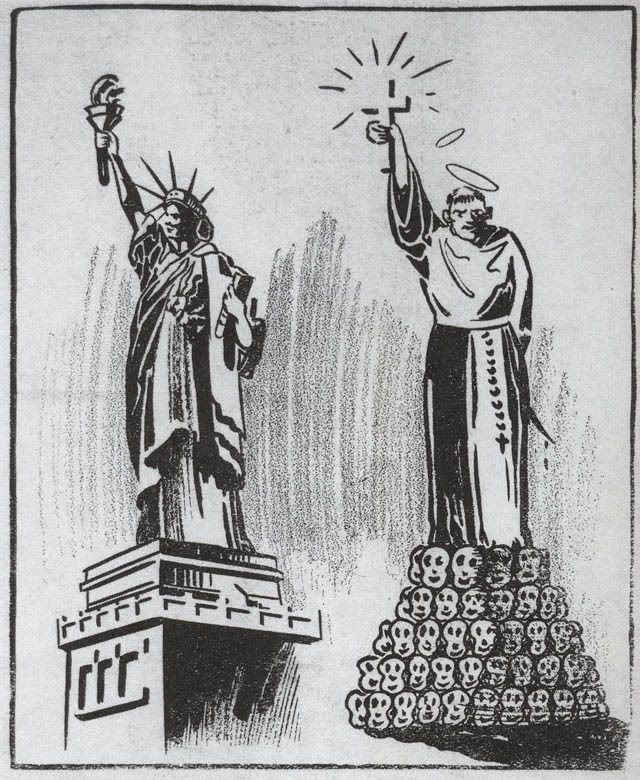
    Newspaper cartoon by APA

    In 1887, Henry F. Bowers founded the nativist American Protective Association (APA) in Clinton, Iowa. Bowers was a Mason, and he drew from its fraternal ritual—elaborate regalia, initiation ceremonies, and a secret oath—in organizing the APA. He also drew many Masons, an organization that barred Catholics. The organization quickly acquired an anti-union cast. Among other things, the APA claimed that the Catholic leader of the Knights, Terence V. Powderly, was part of a larger conspiracy against American institutions. Even so, the APA successfully recruited significant numbers of disaffected trade unionists in an era of economic hard times and the collapse of the Knights of Labor. This secret oath taken by members of the American Protective Association in the 1890s revealed the depth of Protestant distrust and fear of Catholics holding public office.


    I do most solemnly promise and swear that I will always, to the utmost of my ability, labor, plead and wage a continuous warfare against ignorance and fanaticism; that I will use my utmost power to strike the shackles and chains of blind obedience to the Roman Catholic church from the hampered and bound consciences of a priest-ridden and church-oppressed people; that I will never allow any one, a member of the Roman Catholic church, to become a member of this order, I knowing him to be such; that I will use my influence to promote the interest of all Protestants everywhere in the world that I may be; that I will not employ a Roman Catholic in any capacity if I can procure the services of a Protestant.

    I furthermore promise and swear that I will not aid in building or maintaining, by my resources, any Roman Catholic church or institution of their sect or creed whatsoever, but will do all in my power to retard and break down the power of the Pope, in this country or any other; that I will not enter into any controversy with a Roman Catholic upon the subject of this order, nor will I enter into any agreement with a Roman Catholic to strike or create a disturbance whereby the Catholic employes may undermine and substitute their Protestant co-workers; that in all grievances I will seek only Protestants and counsel with them to the exclusion of all Roman Catholics, and will not make known to them anything of any nature matured at such conferences.

    I furthermore promise and swear that I will not countenance the nomination, in any caucus or convention, of a Roman Catholic for any office in the gift of the American people, and that I will not vote for, or counsel others to vote for, any Roman Catholic, but will vote only for a Protestant, so far as may lie in my power. Should there be two Roman Catholics on opposite tickets, I will erase the name on the ticket I vote; that I will at all times endeavor to place the political positions of this government in the hands of Protestants, to the entire exclusion of the Roman Catholic church, of the members thereof, and the mandate of the Pope.

    To all of which I do most solemnly promise and swear, so help me God. Amen.

    Source: "The Secret Oath of the American Protective Association, October 31, 1893," in Michael Williams, The Shadow of the Pope (New York: McGraw-Hill Book Co., Inc., 1932), 103–104. Reprinted in John Tracy Ellis, ed., Documents of American Catholic History (Milwaukee: The Bruce Publishing Company, 1956), 500–501.

    Tuesday, November 10, 2009

    Nuts & Bolts: In the Lion's Den

    Tim Staples

    Scenario:
    You’ve been talking with Bob, a fellow worker at the office, for weeks about the faith. You can see you’ve made headway in presenting him your biblical case for Catholicism. So you decide to invite him to an apologetics Bible study you have at your parish.

    He agrees to come on one condition: You must first come to a Bible study at his “non-denominational” assembly for four weeks. Then he will come to your meeting for four weeks.
    Immediately, you jump at the chance. You’re fired up! The Lord has given you an open door for evangelism.

    Upon arrival at Bob’s assembly, “Church of the Open Door,” Bob takes you to a room filled with about forty-five congenial people with Bibles in hand. After drinking punch, eating a few cookies, and talking small talk for a few moments, the leader of the group, Robert, asks everyone to find a seat so the Bible study can begin.

    After a short prayer, Robert says the topic of study over the next four weeks will be salvation. But first, he says, “We must begin with the assumption that all present believe in the inspiration and inerrancy of Sacred Scripture. And also that Sacred Scripture is the regula fidei or sole rule of faith for all believers. In other words, the doctrine of sola scriptura.”

    You immediately raise your hand with a question. “Do you mind if I ask why you believe this seemingly foundational doctrine? I don’t believe sola scriptura to be true — in fact, I don’t believe that the Bible itself teaches such a doctrine at all.”

    You hear a few subdued gasps and feel the eyes of all turn to you, as Robert quickly responds: “The Bible very plainly teaches sola scriptura in 2 Timothy 3:16: ‘All scripture is inspired by God and profitable for teaching, for reproof, for correction, and for training in righteousness, that the man of God may be complete, equipped for every good work.’ The Bible can’t make it any more plain than that!” Robert declares.

    You respond to Robert with four reasons why his stated position, sola scriptura, is untenable: It is unreasonable, unhistorical, unbiblical, and unworkable.

    Step One: Sola Scriptura is unreasonable.
    As briefly as possible, you quickly point out that Robert’s reasoning is circular, and therefore fallacious: “You cannot prove the inspiration of a text from the text itself. The Book of Mormon, the writings of Mary Baker Eddy, the Muslim Quran, and other books claim divine inspiration. This doesn’t make them inspired. The question remains, how do we know the Scriptures are inspired and canonical using the principle of sola scriptura?”

    Robert immediately asks if you are Catholic. (He could tell by your critiques of sola scriptura). When you answer in the affirmative, Robert responds, “I believe the Holy Spirit guides us into all truth as Jesus said in John 16:13. The Holy Spirit guided the early Christians and helped them to gather the canon of Scripture and declare it to be the inspired Word of God. God would not leave us without His Word to guide us.”

    You respond, “The Scripture you quoted from John 16:13 has nothing to do with sola scriptura. While I agree with you that the Holy Spirit guided the early Christians to canonize the Scriptures, the question is whether they used sola scriptura as their guiding principle. The answer is no.

    “They needed Tradition outside of Scripture as their criterion for the canon. This criterion is not found in Scripture itself. They needed Tradition to authenticate the books in question. And they also needed the Church in council to give an authoritative decree on the whole matter.

    “All of that aside, let’s look at the text you quoted. I ask you, what if I made a similar claim to demonstrate to you any of our Catholic dogmas? Imagine that you asked me why I believe Mary to be the Mother of God, and I responded, ‘We believe the Holy Spirit guides us into all truth and guided the early Christians to declare this truth.’ Would you believe me on this basis? No!

    “But all this begs my original question. Not only is the text you used unacceptable from a perspective of sola scriptura; it’s also circular reasoning to claim the Scripture as your authority for claiming the inspiration of Scripture.”

    Robert seems to be intrigued with this dialogue, as are the rest of those gathered. Robert says, “How do you know the Scriptures are inspired? Your reasoning is just as circular: You say the Church is infallible because the inspired Scriptures say so, and then claim the Scriptures are inspired and infallible because the Church says so!”

    “That’s a very good question,” you reply. “However, the Catholic Church’s position on inspiration is not circular. We begin with the Bible as an historical document, not as an inspired one. As any reputable historian will tell you, the New Testament is the most accurate and verifiable historical document in all of ancient history. To deny the historical reliability of the New Testament would be to deny the reliability of all ancient history.

    “Nevertheless, we cannot deduce from this that they are inspired. There are many accurate historical documents that are not inspired. However, the Scriptures do give us accurate historical information whether we hold to their inspiration or not.

    “It is on this basis that we can say it is an historical fact that Jesus lived, died, and was reported to be resurrected from the dead by over five hundred eyewitnesses. This is the historical record. Many of these eyewitnesses went to their deaths testifying to the veracity of what Christ had done (see Lk 1:1-4, Jn 21:18-19, 24-25, Acts 1:1-11, 1 Cor 15:1-8). Further, this testimony of the Bible is backed up by hundreds of works by early Christians and historians, some of whom were not Christian — such as Tacitus, Pliny the Younger, and Josephus.

    “Now, what do we find when we examine the Scriptures as historical documents? The Scriptures record Jesus establishing a Church, not a book, to be the foundation of the Christian faith (see Mt 16:15-18, 18:15-18, Eph 2:20, 3:10,20-21,4:11-15, 1 Tim 3:15, Heb 13:7,17, and others). He said of His Church: “He who hears you hears me, and he who rejects you rejects me, and he who rejects me rejects Him who sent me” (Lk 10:16).

    “The many books that comprise what we call the Bible never tell us certain crucial truths: the fact that they are inspired, or who can and cannot be the human author of them, or who authored many of them, or what is the canon of Scripture, just to name a few. But what is very clear is that Jesus established a kingdom with a hierarchy and authority to speak for Him (see Lk 20:29-32, Mt 10:40, 28:18-20). It was members of this kingdom, the Church, that would write the Scripture, preserve the Scripture, and eventually canonize the Scripture.

    “The Scriptures cannot write or canonize themselves. To put it simply, reason clearly rejects sola scriptura as a self-refuting principle, because we cannot determine what the scriptura is using the principle of sola scriptura.”

    Step Two: Sola Scriptura is unhistorical.
    “If I may, I would like to concretize my point by making an argument from history. Let’s say you were living in the mid-fourth century before there was a recognized canon of Scripture. As I’m sure you know, the first time a formal canon was arranged and recognized by any council of the Church was in A.D. 382 at a synod in Rome called by Pope Damasus I.

    “Let’s say you were to read The Instructor by Saint Clement of Alexandria (written about 202). In book II, chapter 3, he quotes Baruch 3:16-19 and calls it ‘Divine Scripture.’”

    After you briefly explain, for those who may not know it, that Baruch is one of the deuterocanonical books of the Old Testament accepted by Catholics, but rejected by Protestants, you note: “Saint Clement was the head of the famous catechetical school in Alexandria and one of the greatest theologians of the second and third centuries. Now I could cite scores of examples of other early Christians referring to the deuterocanonical books of the Old Testament, but for the sake of brevity I will refer just to this one.

    “Let’s say you then read a book by the greatest historian of the fourth century, Eusebius, bishop of Caesarea. In his classic Ecclesiastical History (written around 330), book III, chapters 3 and 25, he records the canon of Scripture as understood in the mid-fourth century. He claims that James, Jude, 2 Peter and 2 and 3 John are among ‘the disputed writings.’ He notes that Hebrews and Revelation are rejected altogether by many.

    “My question is this: Many of the early Christians disagreed over which books were inspired. So where do you go to get a definitive answer about the canon of Scripture if you use the principle of sola scriptura?”

    Robert responds: “You make some very interesting points that I will have to think about. However, I have to disagree with you when you say the Scriptures do not claim to be inspired and the sole rule of faith. I’ve already quoted 2 Timothy 3:16 to you. In addition, over and over in Scripture we clearly find our Lord quoting the Old Testament authoritatively, as He does in Matthew 4:4-11. When Jesus was tempted by the Devil, his response was: ‘It is written’ — three times in a matter of seven verses. Jesus clearly uses sola scriptura as his guiding principle or regula fidei.”
    This leads you into your third point.

    Step Three: Sola Scriptura is unbiblical.
    “Let’s back up,” you say, “to the original verse Robert used to prove his case, 2 Timothy 3:16. (You now find yourself addressing the entire Bible study group, not just Robert!) The text itself does not assert what Robert claimed. It does not claim the inspiration of the New Testament. Nor does it claim to be the sole rule of faith for Christians. Let’s look at the context of the passage.

    “Robert, let’s read aloud verses 14-15, which precede 2 Timothy 3:16.” (You can’t help but notice that you are slowly taking over this Bible study!) Robert then reads aloud: “But as for you, continue in what you have learned and have firmly believed, knowing from whom you learned it and how from childhood you have been acquainted with the sacred writings which are able to instruct you for salvation through faith in Christ Jesus” (emphasis added).

    “In context, this passage does not refer to the New Testament at all. None of the New Testament books had been written when Saint Timothy was a child! Further, how does this text tell us whether or not the book of Revelation is an authentic book of the New Testament, since it had not even been written at that point?”

    Robert responds: “You keep coming back to the canon and you make an interesting point. As I said, I will have to think more about that, but you cannot escape the unique status Scripture is given in the Bible. Only Scripture is referred to as inspired by God. Therefore, only Scripture can be said to be infallible. And the text says Scripture is all we need to equip us. We certainly do not need any Catholic traditions. In fact, Jesus condemned the use of tradition in Matthew 15:1-6.”

    “With all due respect,” you reply, “I have to disagree with you. You’ve made three key mistakes I think we can clear up. First, while I agree with you that only Scripture is referred to as inspired (Greek theopneustos), that does not mean the infallible Word of God is limited to Scripture. The text does not say that!

    “Inspiration is a technical term used to describe the unique way in which God instrumentally moved the human authors of Scripture to write in such a way that we can say God is the primary author of Scripture. However, this is not the only way in which God communicates His infallible Word. For example, in Deuteronomy 18:20-22 we are told that if a prophet speaks a word that does not come to pass, he is a false prophet and is put to death.

    “Why? Because the spoken word of a true prophet is infallible. A true prophet does not hit and miss. And by the way: You don’t have to wait until it’s written down before it becomes infallible!

    “Second, we agree that Jesus quoted Scripture and condemned some traditions. But He did not refer to Scripture alone as His authority, and He did not condemn all tradition. When Jesus condemned a certain tradition of the Pharisees in Matthew 15:9, He qualified exactly what kind of tradition it was. Jesus condemned the traditions of men, not all tradition.

    “In fact, Jesus refers to an oral tradition in Matthew 23:2-3: ‘The scribes and the Pharisees sit on Moses’ seat; so practice and observe whatever they tell you, but not what they do; for they preach, but do not practice.’ Jesus both refers to this oral tradition about ‘the chair of Moses’ Himself, and commands the apostles to believe and obey it.”

    “St. Paul also mentions oral Tradition as having the same authority as written Tradition in 1 Corinthians 11:2 and in 2 Thessalonians 3:6 and 2:15. The last of these texts says: ‘So then, brethren, stand firm and hold to the traditions which you were taught by us, either by word of mouth or by letter.’ Even further, Jesus not only referred to Scripture and Tradition, but He also gave us teachings on His own authority as well when He repeatedly said, ‘You have heard it said . . . but I say unto you . . .’ (Mt 5:21-44).

    “Now for my third point: Even if we granted that 2 Timothy 3:16 was talking about all of Scripture, it never claims Scripture is the sole rule of faith. A rule of faith, but not the sole rule of faith. Let me explain what I mean.

    “In James 1:4 we read: ‘And let steadfastness have its full effect, that you may be perfect and complete, lacking in nothing.’ If we apply the same principle of exegesis to this text that you applied to 2 Timothy 3:16, we would have to say that all we need is steadfastness to be perfected. We don’t need faith, hope, charity, the Scriptures, the Church, or anything else.”

    Robert immediately says, “That is manifestly absurd!”

    “Of course it is,” you reply. “Can you see how I would say it is just as weak to claim that 2 Timothy 3:16 is saying Scripture is all we need because it says Scripture serves believers so that they may be ‘complete, equipped for every good work’?”

    Step Four: Sola Scriptura is unworkable.
    Realizing you have monopolized the time at this Bible study, and looking for a graceful exit, you conclude your remarks. “If I could leave you with one last biblical text: ‘If your brother sins against you, go and tell him his fault, between you and him alone. . . . But if he does not listen, take one or two others along with you. . . . If he refuses to listen . . . tell it to the church; and if he refuses to listen even to the church, let him be to you as a Gentile and a tax collector’ (Mt 18:15-17).

    “The Bible is very clear to me about what to do if we have a disagreement with one another over some issue pertaining to the Faith. And please remember: To lead someone into heresy is a grievous sin against your brother according to Galatians 5:19-21! The Bible tells us that the Church, not the Bible, is the final court of appeal. I believe this is made obvious in the case of the canon of Scripture as I mentioned. It was the Church that declared the truth about the Bible.

    “But isn’t it also telling that since the ‘Reformation’ just 480 years ago — a reformation claiming sola scriptura as its formal principle — there are now over 26,000 denominations that have derived from that principle? The 1982 World Christian Encyclopedia projected in that year that there would be 22,190 denominations by 1985. ‘The present net increase,” it noted, is 270 denominations each year (five new ones a week).’1 If we extend that projection to our time, we have well over 26,000 denominations by now.

    “It seems to me that for 1,500 years we only had a few enduring schisms, such as the Coptics and the Orthodox. Now in just 480 years we have this? I hardly think that when Jesus prophesied there would be ‘one shepherd and one fold’ in John 10:16, this is what He had in mind. It seems quite clear to me that not only is sola scriptura unreasonable, unhistorical, and unbiblical — it’s also unworkable.”
    Robert says that he must begin the Bible study even though there is very little time remaining for the class. He says the group would take up this subject again in the future and awkwardly begins his talk. You can tell that he’s uneasy as he continues the study, and you decide to be quiet for these last few minutes.

    Wow! you think to yourself. I can’t wait to come back again next week!

    Tim Staples is the director of evangelization for the Catholic Resource Center in West Covina, CA. He can be reached at 626-334-3549.

    1 David Barrett, ed., World Christian Encyclopedia,
    1st ed. (London: Oxford University Press, 1982), 15-18.

    Thursday, September 3, 2009

    Radio Replies First Volume - Purgatory


    951. I am interested in your dogma concerning purgatory. Must I be a Catholic before I can understand that invention of your Church?

    No. You must be a non-Catholic to suspect that the Church did invent it. The idea that there is no purgatory is the invention of Protestants. The reformers corrupted the true doctrine, and many good Protestants, realizing this, are returning to the Catholic religion of their forefathers even as I myself have done. Meantime, if I could discover, or you could show me, when and where the Church invented this doctrine, I promise to spend the rest of my life exposing the Catholic Church as a merely human institution making outrageous claims upon men.

    952. Why make people afraid of such a horrible place as purgatory, when you know that it does not exist?

    I know that it does exist. And if you deny it because to you it seems a horrible place, you must deny hell also because it is far more horrible. And if you deny hell, you deny Christianity. And is it not a more horrible thought that there would be no purgatory? In that case you would have but heaven and hell. All not quite fit for heaven could not hope to escape hell. It is a much more pleasant thought that there are people not quite good enough for heaven, yet not bad enough for hell, and that these are sent to purgatory until they are purified sufficiently for heaven.

    953. What is the nature of your doctrine on purgatory?

    It can be summed up very briefly. At death the soul of man, if quite fit, goes at once to heaven; if not quite fit, to purgatory; if quite unfit, to hell. The soul which has repented of all its sins, and has fully expiated them in this life, is quite fit for heaven at once. The soul which departs this life in a state of unrepented mortal sin can never be fitted for heaven, and goes to hell. But a soul which has sincerely repented of its sins, yet has not fully expiated them, secures immunity from hell by repentance, and goes to purgatory until it has expiated all its deficiencies.

    954. Does God want to roast you merely because you have the misfortune to be alive? He knows that you had no say in the matter.

    God does not want to roast me. It is not a misfortune to be alive, though it is blameworthy to have misused one's existence. Nor did I want a say as to whether I should receive the gift of existence. People can leave me a fortune tomorrow without consulting me. But I did have a say in my infidelities to God's grace, and for that I am responsible and do not wish to excuse myself.

    955. Have you been so atrociously wicked as to deserve purgatory?

    There is no need to be atrociously wicked in order to need purification, any more than there is need to be on your deathbed before you need medicine. But there is need to attain to a high standard of purity and holiness before one could be fit to enter the glory of God's presence.

    956. Do the souls of Protestants go to purgatory?

    All souls, whether of Protestants or of Catholics, or of any other religion, will go to purgatory if they are not good enough for heaven at the moment of death, nor bad enough for hell. Non-Catholics may deny purgatory, but that makes no difference to purgatory.

    957. Would God destine so good a man as General Booth for purgatory just because he was not a Catholic?

    Purgatory is not a final destiny. Every soul that goes there is saved, and is ultimately admitted to the very Vision of God. Good Protestants as well as good Catholics will go there if they are not quite perfect at death. There is no dispensation. And where is the man who has not his imperfections?

    958. A man has every chance to repent in this life.

    He has. And if he does not, he will not even go to purgatory if his sins be grave. Purgatory is not a place for repentance, but for purification. If two men repent on their death-beds, one of whom broke one commandment and the other, all the commandments often, both are saved by their repentance. But they are not both equal before God. They will suffer relative purifications in purgatory.

    959. This dogma of purgatory was invented by Pope Gregory in 600 A.D., and was made an article of faith by the Council of Florence in 1439.

    If not invented until 600 A.D. why did St. Monica, in the 4th century, implore her son St. Augustine, as she lay on her dying bed, that he would pray for her soul whenever he went to the Altar to offer the Mass? And how would you account for the inscriptions in the Catacombs recording prayers for the dead offered by the Christians of the first centuries? Or, if you would go back earlier, what will you do with the teaching of Scripture itself? The Council of Florence merely recalled previous definitions.

    960. What is your Romish reply to the challenge of Art. XXII in the Book of Common Prayer?

    That Article of the Church of England says that the Romish doctrine of purgatory is grounded upon no warranty of Scripture, but is rather repugnant to the Word of God. The reply is that the Article is quite erroneous, and that many Anglicans realize the fact. Thus an Anglican clergyman unsays that Article definitely in his book entitled, "The Catholic Religion — a Manual of instruction for members of the Church of England." He speaks of a place of mercy "provided in the intermediate state, in which evil will be completely purged. When this purification is accomplished, such souls enter into perfect peace," p. 193. On the following page he suggests that, at the Reformation, men were too eager and rejected much that was true — including the intermediate state. In no less than six different places he urges prayer for the dead just as Catholics pray for the dead, and, as he shows from Scripture, both the Jews and St. Paul prayed for the departed. On p. 379, he writes, "Still more desirable is the celebration of the Holy Eucharist for the repose of the soul of the departed." Thus this Anglican clergyman goes back to the Romish doctrine of purgatory. I am not quoting from a book unacceptable to the many. My copy is of the 19th edition, completing 207-thousand.

    961. How can an Anglican clergyman, who has sworn to accept the Articles of religion, teach such doctrine?

    I do not see how he can do so. Romish theologians are simple children compared with the capacity for mental gymnastics manifested by Rev. Vernon Staley, the author of the book, in his efforts to salve his conscience. He says in effect that the doctrine of purgatory is all right, but that Anglicans must not use the word purgatory. He admits the thing, but not its description. He calls it a place or process of cleansing, but he will not call it purgatory, which means the same thing. It is as if we Catholics had invented the word theatre. Then this exponent of Anglicanism would insist upon using the word playhouse, and swear that he did not agree with the Catholic Church concerning houses of entertainment. In substance he declares Article XXII to be false and unscriptural.

    962. You speak of Scripture, but the Bible mentions only heaven and hell.

    It does not. It certainly mentions an intermediate state to which the soul of Christ went after His death on the cross. 1 Pet 3:19. This state was neither heaven nor hell, but the Limbo of the Fathers of the Old Law. In addition to this, Scripture mentions the purgatorial state. In any case, it would not matter if the Bible did mention but two places. My mentioning only London and New York could not prove the non-existence of Paris. It would be a different matter if Christ had said, "There is no purgatory." But He did not.

    963. But the Bible does not mention purgatory.

    It does not mention the precise word purgatory. But the intermediate state of purification described by that word is there.

    964. How do you prove the existence of such a state?

    In Mt 5:26, Christ, in condemning sin, speaks of liberation only after expiation. "Thou shalt not go out from thence till thou repay the last farthing." In Mt 12:32, He speaks of sin which "shall not be forgiven either in this world or in the world to come." Any remission of the effects of sin in the next world can refer only to purgatory. Above all St. Paul tells us that the day of judgment will try each man's work. That day is after death, when the soul goes to meet its God. What is the result of that judgment? If a man's work will not stand the test St. Paul says that "he shall suffer loss; but he himself shall be saved, yet so as by fire." 1 Cor 3:15. This cannot refer to eternal loss in hell, for no one is saved there. Nor can it refer to heaven, for there is no suffering in heaven. Purgatory alone can explain this text As a matter of fact, all Christians believed in purgatory until the Reformation, when the reformers began their rejection of Christian doctrines at will. Prayer for the dead was ever the prevailing custom, in accordance with the recommendation of the Bible itself. "It is a holy and wholesome thought to pray for the dead, that they may be loosed from their sins." 2 Macc 12:46. Prayer for the dead supposes a soul not in heaven where it does not need the help of prayer, nor in hell where prayer cannot assist it. Some intermediate state of purification and need, where prayer can help, is necessary. And the doctrine is most reasonable. "Nothing defiled shall enter heaven." Rev 21:27. Yet not all defilement should cost man the loss of his soul. Even in this life human justice does not inflict capital punishment for every crime. Small offenses are punished by fines or by temporary imprisonment, after which the delinquent is liberated. Those who deny purgatory teach the harder and more unreasonable doctrine.

    965. God would not demand expiation after having forgiven the sin.

    What you think God would or would not do cannot avail against that which He does do. When David repented of his great sin God sent the prophet Nathan with the message to him, "The Lord hath taken away thy sin. Nevertheless, because thou hast given occasion to the enemies of the Lord to blaspheme, thy child shall surely die." 2 Sam 12:14. To forgive the guilt of sin, and purify the spiritual scar and stain, which that disease of the soul leaves, by expiatory suffering, is better than to leave the soul still unpurified and indebted to God's justice. I too could fully forgive a friend his offense should he have robbed me, yet still insist that he make good the damage he has wrought me.

    966. What is the punishment of purgatory?

    When the soul leaves the body, that which can think, remember, love, hate, be happy or miserable, has gone from that body. A corpse cannot do these things. And the soul, with these capabilities, goes into a new state of being as a separated spirit. And my true self, separated from the distractions of this world, will perceive clearly and fully its own unfitness for God's presence, a perception which will mean unspeakable suffering. The exact nature of this suffering we do not know, but it is compared in Scripture to the action of fire afflicting a sensitive body. Although it is not defined as a dogma that there is a real fire of purgatory, it is the general opinion of theologians that there is a real fire somewhat analogous to the fire of hell. However it be explained, the fact that purgatorial suffering awaits the imperfect has been revealed by God.

    967. When did God make purgatory?

    Heaven of course always existed. For where God is, there is heaven. Hell was made when the devil and his followers fell from grace. There was no purgatory for them. Purgatory, then, was made when men began to sin and die with sins repented of, but not fully expiated by the sufferings of this life. Men under the Old Law went to purgatory just as those do who live under the New Law.

    968. Where is purgatory?

    God has not deigned to satisfy our curiosity on that point, and the knowledge is not of practical importance to us. The fact that there is a purgatory has been revealed by God. And when He reveals a fact, we cannot say to Him, "Well, I for one refuse to believe it until You tell me more about it." God proves a thing by saying it, for He is truth itself. We have but to prove that He said it.

    969. How do you know that there are any souls in purgatory?

    I know that 100,000 people die daily. I refuse to believe that they all go to hell, and feel quite sure that they are not all fit for immediate entry into heaven. Moreover, you would find far more difficulty in endeavoring to show that there are no souls in purgatory.