Francis had invited Bartholomew to present his
encyclical on ecology. Zizoulas, one of the greatest Orthodox
theologians, will do it in his place. “Mary is much more important than
the apostles.” Forcing migrants back in Asia is not an attitude inherent
to a continent that “has a mystical treasure-trove”. Similarly, “the
fundamentalism found in some parts of Pakistan where Christians were
burnt alive for bearing the Gospel is not inherent”.
Rome (AsiaNews) – Pope Francis today
proposed that all Christians celebrate Easter at the same time. He did
so, noting that “The Catholic Church has been willing since Paul VI to
set a date and give up the first solstice after the full moon in March"
by which Easter is established.
He must the proposal to find an agreement during a highly ecumenical
meditation pronounced in Spanish during the third world retreat for
priests, which brought together in the Basilica of St John Lateran about
a thousand priest from 90 countries and 5 continents.
With ecumenical goals in mind, the pope said that he had invited the
Orthodox ecumenical Patriarch Bartholomew to present his encyclical on
ecology. "We are friends,” he said, “ but he had a commitment, and so
sent the Archbishop of Pergamum Zizoulas. This way, the encyclical will
be presented by one of the greatest Orthodox theologians.
“Ex oriente lux, former occidente luxsus,” said the pope in
relation to Orthodox Christians. "From the Orthodox East and its Asian
part comes the light" of spirituality, while the West exports "luxury,
hedonism, consumerism," all things that are causing "decadence," said
the pontiff. Indeed, he emphasised Asia’s “spiritual reserves,” noting
the cultural and pastoral contributions from the Churches in Japan,
Korea, Thailand, and others
Citing the fate of migrants in the Indian Ocean faced with
refoulement, he warned that forcing back migrants is a “sin”. What is
more, this “kind of attitude in a continent that has a mystical
treasure-trove is not inherent, it comes from another part. [. . .]
Likewise, the fundamentalism found in some parts of Pakistan where
Christians were burnt alive for bearing the Gospel is not inherent. [. .
.] There are problems, but Asia is a promise, a future, full of
spiritual reserves."
The long meeting gave the pope an opportunity to announce that he
would travel to Uganda and the Central African Republic in November.
Kenya could be added but it is an idea that is only a possibility. In
response to a question from an African priest, Francis said that “Africa
is generous with the world, but the world is not generous with Africa,
because it uses and treats it as a land to be exploited.”
The pope spoke again about the homily. “In homilies,” he said, "have
pity on the people of God. [. . .] People cannot bear more than eight
minutes, then they turn off. They want you to speak to the heart. An
idea, an image, a feeling is what a homily must have”. Thus, "it is not a
lecture or a lesson in catechesis;" it is "positive, not restrictive
language..." (continued)
Link:

Showing posts with label homilies. Show all posts
Showing posts with label homilies. Show all posts
Saturday, June 13, 2015


Thursday, October 16, 2014
Pope Francis revealing his take on Synod controversies in his private homilies?

By John-Henry Westen / LifeSiteNews.com
While Pope Francis has been silent about
many of the controversial matters being debated at the Synod, both in
the lead-up to the Synod and in the Synod Hall, veteran Vatican watchers
say he has been obliquely making his views known through other avenues,
including through some of his close advisors, as well his homilies at
his private morning masses.
When it comes to advisors, none have sparked more speculation than Cardinal Walter Kasper, with debate swirling for months about whether Pope Francis himself personally supports Cardinal Kasper’s controversial proposal to allow divorced and remarried Catholics to receive communion in some circumstances.
While the cardinal himself has repeatedly claimed the pope’s support, and Francis has repeatedly praised the cardinal on a personal level and his writing in general, no explicit confirmation of the pope’s position on the specific issue has been forthcoming. But in an explosive interview yesterday Kasper was arguably more explicit than ever before, bluntly telling Edward Pentin of Zenit that the pontiff “wants” the change. "Of course, the pope wants it and the world needs it," he said.
If so, it is hard to interpret a homily from Pope Francis on the morning of October 13, 2014, the day the controversial “mid-term” report was released, creating a firestorm inside and outside the Synod, as anything other than the pope strongly hinting at his views on this, and possibly other controversies at the ongoing Synod.
Indeed, even consummate Vatican journalist John Allen of the Boston Globe agreed, writing: “In his usual impromptu homily at morning Mass (Monday), Pope Francis seemed to prepare the ground for the (interim report), and the conflicting reactions it was destined to stir, by delivering a strong rebuke to rigid legalists of all stripes.”
During the homily, Pope Francis spoke of the “Doctors of the Law” who were “unable to understand the signs of the times.” They were, he said, “closed within their system, they had perfectly systemized the law, it was a masterpiece.
“Every Jew knew what they could do and what they could not do, how far they could go. It was all systemized. And they were safe there."
The pope noted that the Doctors of the Law "did not like” Jesus, he “was dangerous; doctrine was in danger, the doctrine of the law” which the theologians had formulated over the centuries. Pope Francis said that while the theologians had "done this out of love, to be faithful to God," they had become “closed", they had "simply forgotten history. They had forgotten that God is the God of the Law, but He is also the God of surprises."
Seeming to address one of the major sub themes of the Synod, that doctrine will never change, but pastoral practice should, Pope Francis said: "They did not understand that God is the God of surprises, that God is always new; He never denies himself, never says that what He said was wrong, never, but He always surprises us. They did not understand this and they closed themselves within that system that was created with the best of intentions.”
But while the pope seemed to frame the controversies of the Synod as a dispute between legalists and those who are open to God’s “surprises,” leading Synod Fathers who are concerned about attempts to change long-standing Church practice and teaching, have been arguing that the controversy is ultimately about whether or not the Church will conform “to the mentality of today’s world.”
Numerous Vatican Synod Fathers have voiced grave concerns both within and without the Synod hall over the last few days that the Synod mid-term report has indeed endangered assurance of doctrinal security, and with potentially grave consequences.
Most recently, Australian Cardinal George Pell said: "In seeking to be merciful, some want to open up Catholic teaching on marriage, divorce, civil unions, homosexuality in a radically liberalising direction, whose fruits we see in other Christian traditions.” He urged, “the task now is to reassure good practising Catholics that doctrinal changes are not possible; to urge people to take a deep breath, pause and to work to prevent deeper divisions and radicalising of factions.”
His remarks echo the even more blunt words of Cardinal Raymond Burke, who himself directly addressed Pope Francis in his criticisms of the Synod’s mid-term report, saying that a statement from the pope strongly re-affirming Church teaching is “long overdue.”
“The faithful and their good shepherds are looking to the Vicar of Christ for the confirmation of the Catholic faith and practice regarding marriage which is the first cell of the life of the Church,” he added.
The mid-term report, he said, proposes views that many Synod fathers “cannot accept,” and that they “as faithful shepherds of the flock cannot accept.”
The push to radically alter so-called “pastoral practice” without simultaneously affecting doctrine is not possible. One African bishop who was appraised of the situation at the Synod reportedly wept at the proposals on the table. “Oh my God, what are they doing? The people will soon get hold of declarations like these and they'll prefer to become evangelicals or even Muslims than remain Catholic! What are they doing in Rome? Oh my God, oh my God!,” he declared.
It’s not the first time the pope has seemed to address tensions of the Synod in his morning homilies. Before the official launch of the Synod, while various polarized positions were being laid out in the media via book releases and such, Pope Francis sounded a remarkably similar tone to Monday’s homily.
“It’s the ruling class which closes the door to God’s way of salvation,” Pope Francis said, referring to Church leaders, in the homily at his private Mass on October 4. “This attitude is quite different from that of the people of God, who understand and accept salvation brought to them through Jesus,” he added. “Their leaders, on the other hand, reduce salvation to the fulfilment of the 613 commandments they have created through their intellectual and theological fervour.”
“These leaders,” the pope said, “don’t believe in mercy and forgiveness but simply in sacrifices.” He urged asking ourselves: “How do I want to be saved? On my own? Through a spirituality which is good, but fixed and clear so that there are no risks? Or following the footsteps of Jesus who always surprises us, opening doors to that mystery of God’s mercy and pardon?”
That homily too was interpreted by veteran Vatican watchers as Pope Francis staking out a position on the matters of the Synod. “The Pope has hinted in homilies, addresses and interviews,” said the Telegraph’s Vatican correspondent Nick Squires, “that he is in favour of adopting a more ‘merciful’ approach towards remarried divorcees who want to receive the Sacrament.”
Link:
Related:
- ¡Hagan lío! Synod Bishops revolt against leadership and get their way – UPDATE!
- Document-gate
- DAILY ROME REPORT
- Statement on Cardinal Kasper Interview
- Reports of Circuli Minores now available on Vatican website
- What’s the liberals next move?
- The Robber Synod!
- ¡Hagan lío! Synod Bishops revolt against leadership and get their way – UPDATE!
- Burke Blasts Back
- Blindsided: Press received document before synod fathers
- Did no one know that when the MSM got hold of the ‘Relatio’, people were going to go bananas?
- Revolution on the Way - Synod Coverage
- “The truly bizarre document that the Vatican released Monday”
- Cardinal Burke says statement from Pope Francis defending Catholic teaching is ‘long overdue’
- Cardinal Burke: Synod's mid-term report "lacks a solid foundation in the Sacred Scriptures and the Magisterium"
- Confused, Contradictory Chaos in Rome
- Magister: Pitched Battle on a Mad Monday at the Synod, Our conclusion: Bruno Forte made up homosexuality paragraphs by himself
- Press Grill Vatican on Divorce, Remarriage, and Homosexuality
- VIDEO: Card. Burke’s clear, articulate, blunt answers about divorce, remarriage, Card. Kasper
Thursday, March 14, 2013
Pope Francis' First Homily
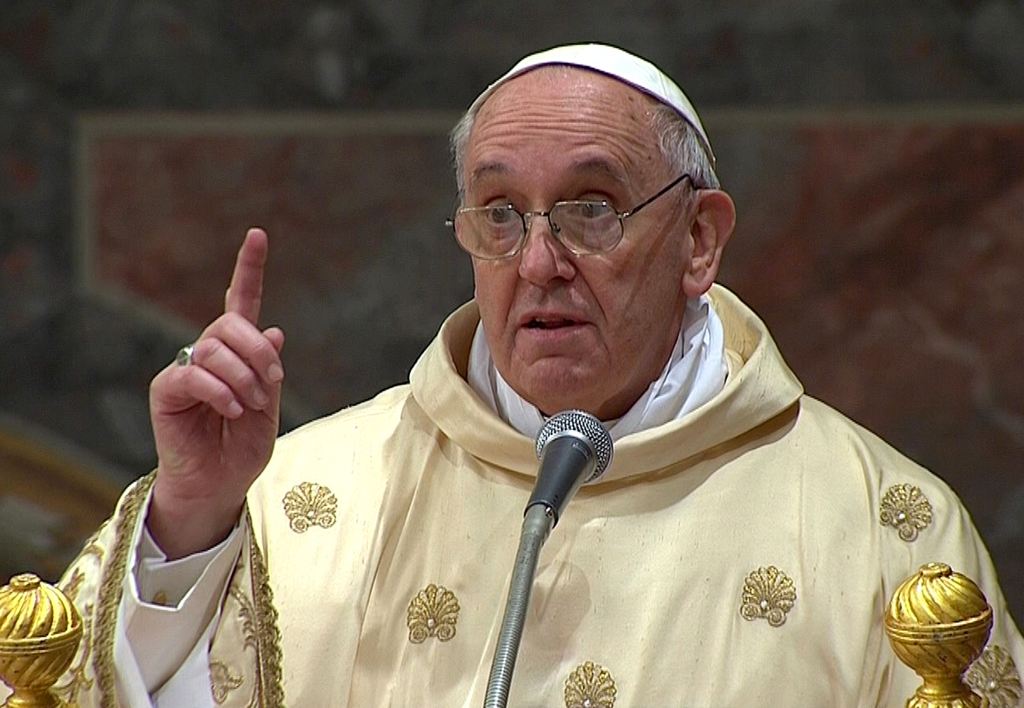
Vatican City, March 14, 2013 (Zenit.org)
Here is a translation of the homily Francis gave this morning at Mass with the cardinals in the Sistine Chapel. He spoke in Italian without a text.
There is something that I see that these three readings have in common: movement. In the first reading it is the movement of a journey; in the second reading it is the movement in building the Church; in the third, the Gospel, it is the movement of confession. Journeying, building, confessing.
Journeying. “House of Jacob, come, let us walk together in the light of the Lord” (Isaiah 2:5). This is the first thing that God said to Abraham: Walk in my presence and you will be blameless. Journey: our life is a journey and when we stop it does not go on. Journey always in the presence of the Lord, in the light of the Lord, seeking to live with that blamelessness that God asked of Abraham in his promise.
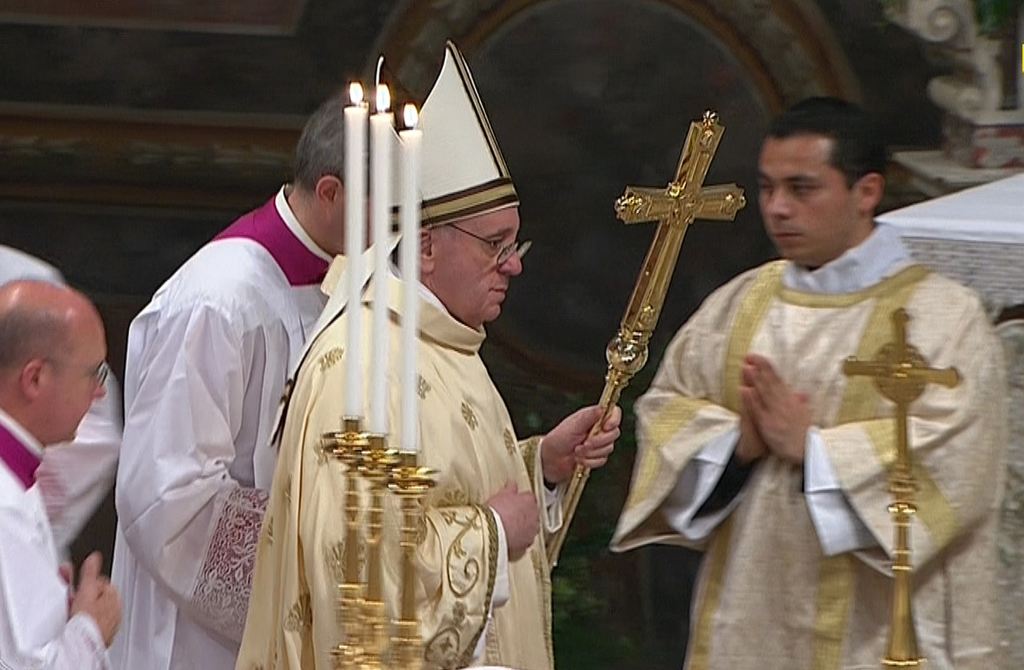
Building. Building the Church. Stones are spoken of: the stones have a consistency, but they are the living stones, stones anointed by the Spirit. Building the Church, the Bride of Christ, upon that cornerstone that is the Lord himself. Building is another form of movement in our life.
Third, confessing. We can journey as much as we want, we can build many things, but if we do not confess Jesus Christ, the thing does not work. We will become a welfare NGO but not the Church, the Bride of Christ. When we do not journey, we stop. When we do not build upon the stones, what happens?
Everything collapses, loses its consistency, like the sandcastles that children build on the beach. When we do not confess Jesus Christ, I am reminded of the words of Léon Bloy: “Whoever does not pray to the Lord, prays to the devil.” When we do not confess Jesus Christ, we confess the worldliness of the devil, the worldliness of the demon.
Journeying, building-constructing, confessing. But it is not that easy, because in journeying, in constructing, in confessing, there are problems, there are movements antithetical to the journey: they are movements that take us backward.
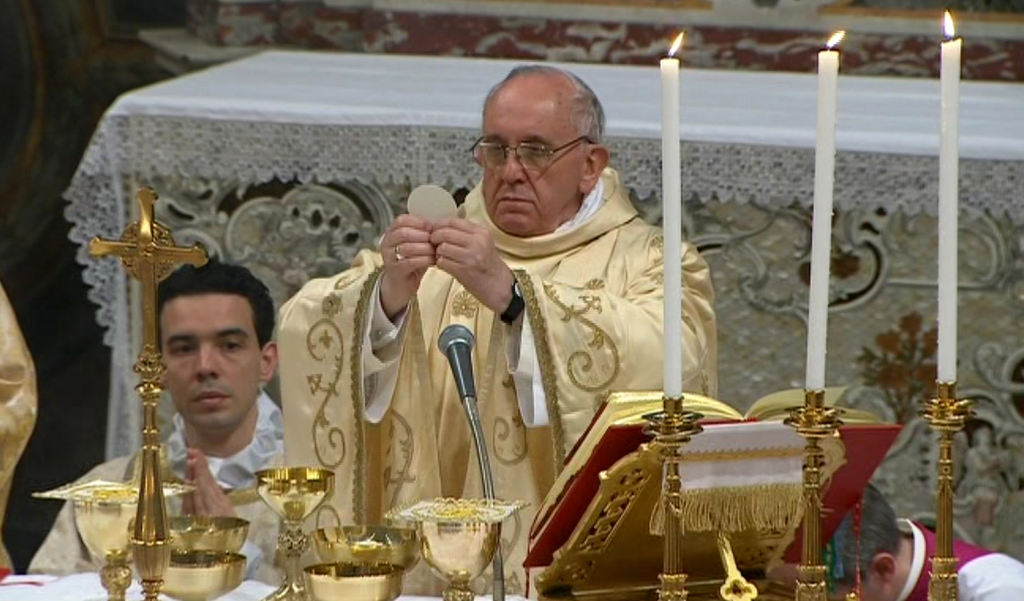
This Gospel continues with an important moment. The same Peter who had confessed Jesus Christ said to him: You are the Christ, the Son of the living God. I will follow you, but let’s not talk about the cross. This is not a part of it. I will follow you in other directions, but not to the cross. When we journey without the cross, when we build without the cross and when we confess a Christ without the cross, we are not disciples of the Lord: we are worldly, we are bishops, priests, cardinals, popes, but not disciples of the Lord.
I would like for us all, after these days of grace, to have courage, precisely the courage, to walk in the Lord’s presence, with the cross of the Lord; to build the Church upon the blood of the Lord, which was poured out on the cross; and to confess the only glory there is: Christ crucified. And in this way the Church will go forward.
It is my wish for all of us that the Holy Spirit – through the prayer of Our Lady, our Mother – bestow upon us the grace of journeying, building, confessing Jesus Christ crucified. Amen.
[Translation by Joseph G. Trabbic]
Link:
Sunday, June 24, 2012
Pope Gives Advice to Keep Catholics From Falling Away

Be Better Believers, More Pious, Welcoming in Our Parishes
VATICAN CITY, JUNE 22, 2012 (Zenit.org).- Benedict XVI met today with a group of bishops from Colombia in Rome for their ad limina visits, offering them some concrete advice on growing religious pluralism and the increasing presence of evangelical communities in the country.
The Pope cited the concluding document from the fifth general conference of the Latin American and Caribbean bishops, which observed that people often leave the Church not because of what non-Catholic groups believe, but because of what they live.
Hence, the Holy Father said, facing this challenge is "about being better believers, more pious, affable and welcoming in our parishes and communities, so that no one will feel distant or excluded."
"Catechesis must be promoted, giving special attention to young people and adults; homilies must be carefully prepared, as well as promoting the teaching of Catholic doctrine in schools and universities," he added.
All of this, the Bishop of Rome affirmed, will help to recover in the baptized "a sense of belonging to the Church and to awaken in them the aspiration to share with others the joy of following Christ and of being members of his Mystical Body."
Benedict XVI added that it is important to emphasize the Church's tradition, Marian spirituality and the rich diversity of devotion.
"To facilitate a serene and open exchange with other Christians, without losing one’s own identity, can also help to improve relations with them," he said, "and to overcome mistrust and unnecessary confrontations."
Link:
Subscribe to:
Posts (Atom)