Pat Buchanan: 'What did Christ die on the cross to save us from?'
By Pat Buchanan
(WND) “Pope Declares No Hell?”
So ran the riveting headline on the Drudge Report of Holy Thursday.
Drudge quoted this exchange, published in La Repubblica, between Pope Francis and his atheist friend, journalist Eugenio Scalfari.
Scalfari: “What about bad souls? Where are they punished?”
Bad souls “are not punished,” Pope Francis is quoted, “those who do not repent and cannot therefore be forgiven disappear. There is no hell, there is the disappearance of sinful souls.”
On the first Holy Thursday, Judas betrayed Christ. And of Judas the Lord said, “Woe to that man by whom the Son of Man shall be betrayed; it were better for him if that man had never been born.”
Did the soul of Judas, and those of the monstrous evildoers of history, “just fade away,” as Gen. Douglas MacArthur said of old soldiers? If there is no hell, is not the greatest deterrent to the worst of sins removed?
What did Christ die on the cross to save us from?
If Francis made such a statement, it would be rank heresy.
Had the pope been speaking ex cathedra, as the vicar of Christ on earth, he would be contradicting 2,000 years of Catholic doctrine, rooted in the teachings of Christ himself. He would be calling into question papal infallibility, as defined in 1870 by the Vatican Council of Pius IX.
Questions would arise as to whether Francis is a true pope.
The Vatican swiftly issued a statement saying the pope had had a private conversation, not a formal interview, with his friend, Scalfari.
The Vatican added: “The textual words pronounced by the pope are not quoted. No quotation of the aforementioned article must therefore be considered as a faithful transcription of the words of the Holy Father.”
Sorry, but this will not do. This does not answer the questions the pope raised in his chat. Does hell exist? Are souls that die in mortal sin damned to hell for all eternity? Does the pope accept this belief? Is this still the infallible teaching of the Roman Catholic Church?
However one may applaud Francis’ stance on social justice, on matters of faith and morals he has called defined doctrine into question and created confusion throughout the Church he heads.
In his letter Amoris Laetitia, “The Joy of Love,” the pope seemed to give approval to the receiving of Holy Communion by divorced and remarried Catholics, whose previous marriages had not been annulled, and whom the Church holds to be living in adultery.
Relying on the pope’s letter, German bishops have begun to authorize the distribution of Communion to divorced and remarried couples.
Cardinal Gerhard Muller, former prefect of the Vatican office for the Doctrine of the Faith, the position once held by Pope Benedict XVI, says this contradicts Catholic doctrine as enunciated by Pope John Paul II.
Said Cardinal Muller, “No power in heaven or on earth, neither an angel nor the pope, not a council, nor a law of the bishops has the faculty to change it.”
Four cardinals, including Raymond Burke of the United States, in a formal letter, asked the pope to clarify Amoris Laetitia. The pope did not, nor has he addressed the cardinals’ concerns.
Indeed, when asked early in his papacy about the immorality of homosexuality, the pope parried the question, “Who am I to judge?”
But if not thee, who? Is not the judging of right and wrong part of the job description?
Nor is it only in the realm of doctrine that the pope has sown confusion among the faithful.
To legalize the underground Catholic Church in China, the pope and the Vatican have agreed to ask Catholic bishops to stand aside for bishops approved by the Communist Party that seeks tighter control of Christian faiths.
The Vatican has also agreed to approve the consecration of a bishop named by Beijing, whom Rome previously regarded as illegitimate.
The capitulation is necessary for the Catholic Church in China to survive and prosper, argues the Vatican. But what kind of church will it become, asks retired Archbishop Joseph Zen Ze-kiun of Hong Kong.
The Vatican is “selling out” the Church in China, says the archbishop: “Some say that all the effort to reach an agreement is to avoid the ecclesial schism. How ridiculous! The schism is there, in the Independent Church!”
Archbishop Zen concedes his criticism of the Communist Party and the Vatican’s diplomatic efforts are causing problems in closing the rift between the underground Church and the Communist Party-sanctioned church, but he makes no apology: “Am I the major obstacle in the process of reaching a deal between the Vatican and China? If that is a bad deal, I would be more than happy to be the obstacle.”
There is a division inside Catholicism that is widening, between a Third World and traditional church that are growing, and a mainstream Church in Europe and here that is taking on aspects of the Anglican Church of the 20th century.
And how did that turn out, Your Holiness?
Happy Easter!
Link:
Related:

Showing posts with label Christ. Show all posts
Showing posts with label Christ. Show all posts
Thursday, March 29, 2018


Thursday, June 9, 2016
Mel Gibson Planning 'Passion of the Christ' Sequel

Courtesy of Photofest
By Paul Bond
'Braveheart' screenwriter Randall Wallace says he is writing a follow-up to the biblical blockbuster that will focus on the resurrection of Jesus.
(The Hollywood Reporter) Mel Gibson and writer Randall Wallace are working on a sequel to The Passion of the Christ that will tell the story of the resurrection of Jesus, Wallace tells The Hollywood Reporter.
Wallace, nominated for an Academy Award for scripting Gibson's 1995 best picture Oscar winner Braveheart, on Thursday (reluctantly) confirmed rumors that he has begun to write a script for a story about the resurrection, telling THR that the project is becoming too difficult to keep under wraps.
Wallace, who most recently directed and co-wrote the 2014 faith-based drama Heaven Is for Real, says he and Gibson began to get serious about a sequel to The Passion, the most successful independent film of all time, while making Hacksaw Ridge, which Gibson directed and Wallace co-wrote. Hacksaw Ridge opens in November and centers on World War II Army medic Desmond Doss, the first conscientious objector to be awarded the Congressional Medal of Honor. br>
Wallace was a religion major at Duke University and says the resurrection was a specialty of his. "I always wanted to tell this story," he says. "The Passion is the beginning and there's a lot more story to tell."
A rep for Gibson declined to comment on the filmmaker-actor's involvement in a Passion sequel.
The Passion, Gibson's story of the persecution and crucifixion of Jesus, was released in 2004 by the independent Newmarket Films and earned a whopping $612 million worldwide on a $30 million production budget. Since then, many in Hollywood have presumed a sequel would someday be made, but Gibson has moved on to other projects.
Rumors swirled anew last month when Gibson was a surprise guest at Liberty University's graduation ceremony to do an advance screening of Hacksaw Ridge and was asked about a Passion follow-up. He expressed interest in making a sequel but was not specific about his involvement. Wallace says demand in the Christian community influenced his and Gibson's willingness to do another film.
"The evangelical community considers The Passion the biggest movie ever out of Hollywood, and they kept telling us that they think a sequel will be even bigger," Wallace says.
No studio or financial backing has been lined up for the project, which is still in the early script stage. But Wallace indicates there are several financiers interested in investing. "It's too early to talk money," he adds. "This is such a huge and sacred subject."
In February, Sony released Risen, which tells the story of the resurrection, though Gibson wasn't involved. The movie made $46 million worldwide on a $20 million budget.
Link:
Friday, April 3, 2015
Good Friday: The One About BEING TORTURED AND EXECUTED BY THE PERSON YOU LOVE MOST

By Ann Barnhardt
Several emails have come in asking advice on cultivating an authentic, genuine “personal relationship” with Christ. The answer is simple, and it comes from Our Lord Himself who has told many mystic saints and doctors of the Church the same thing: THINK AND PRAY ABOUT MY PASSION AND DEATH. Why? Because thinking about Our Lord’s torture, agony and excruciating death forces us to confront Him as a Person, True God AND True Man. Legal systems don’t sob until their capillaries burst. Philosophies don’t suffer the agony of unrequited love. Imaginary friends don’t lay down their lives. Bureaucracies don’t fight asphyxiation by pushing themselves up on their impaled feet.
Only a PERSON can do these things. Only a DIVINE PERSON did. And remember, He would go through His ENTIRE PASSION just for you alone, and He would go through it REPEATEDLY for you alone, in fact as many times as you assist at the Holy Sacrifice of the Mass, and even more. That is how much He PERSONALLY loves you, PERSONALLY.
Think about that early and often, and I promise that you will develop a PERSONAL RELATIONSHIP with Him.
———————————————
The key to beginning to understand the Incarnation, God becoming Man, is Christ’s agony in the Garden of Gethsemane. If you recall, after the Last Supper in the Upper Room, Jesus and the apostles, except for Judas who was on his errand of betrayal already, went to the Garden of Gethsemane. John tells us that Jesus went there with the apostles frequently to pray, and thus it would be one of the first places Judas would have known to look for Him. The wheels of the Passion are in motion. Jesus knows exactly what is coming, and that it is coming within a matter of hours.. (continued)
Link:
Thursday, August 7, 2014
British police raid pub in search for 'Holy Grail'
By William James
LONDON (Reuters) - British police raided an English country pub this week in search of a stolen wooden relic believed by some to be the Holy Grail - a cup from which, according to the Bible, Jesus is said to have drunk at his final meal before crucifixion.
The Grail has captivated religious experts for centuries, spawning myriad theories about its location and inspiring numerous fictional accounts from the Middle Ages onwards.
The object of the police search, which was unsuccessful, was a frail wooden bowl known as the Nanteos Cup that has been attributed with healing powers since the 19th century, attracting pilgrims and others who believe it may be the Holy Grail itself.
After receiving a tip-off, a team of eight officers and a police dog arrived on Sunday morning at the Crown Inn, a village pub in the rural English county of Herefordshire.
"They turned the place upside down. They came with fibre optic cameras to look in all the corners and nooks and crannies, and under the floorboards ... they were clearly serious about it," the pub's landlady, Di Franklyn, said.
Police said the relic, a dark wooden cup kept inside a blue velvet bag, had been stolen from a house in the area about a month ago. Photographs available online show a bowl-shaped vessel with around half its side missing.
"We get a few rogues and scallywags in the pub, but no one who's quite on the level of stealing a priceless ancient artefact," Franklyn said.
The cup takes its name from Nanteos Mansion, a country house in Wales where the vessel is reported to have been stored until 1952 after 16th-century monks fleeing King Henry VIII's dissolution of England's monasteries sought refuge there.
The cup was said to have been brought to Britain after Jesus' death by Joseph of Arimathea, the biblical figure who provided Christ with a tomb and, according to legend, brought Christianity to Britain.
Scientists who have examined the cup have said it almost certainly dates from many centuries after the crucifixion, and is not made of the olive wood that might have been expected for a Middle Eastern drinking vessel.
LONDON (Reuters) - British police raided an English country pub this week in search of a stolen wooden relic believed by some to be the Holy Grail - a cup from which, according to the Bible, Jesus is said to have drunk at his final meal before crucifixion.
The Grail has captivated religious experts for centuries, spawning myriad theories about its location and inspiring numerous fictional accounts from the Middle Ages onwards.
The object of the police search, which was unsuccessful, was a frail wooden bowl known as the Nanteos Cup that has been attributed with healing powers since the 19th century, attracting pilgrims and others who believe it may be the Holy Grail itself.
After receiving a tip-off, a team of eight officers and a police dog arrived on Sunday morning at the Crown Inn, a village pub in the rural English county of Herefordshire.
"They turned the place upside down. They came with fibre optic cameras to look in all the corners and nooks and crannies, and under the floorboards ... they were clearly serious about it," the pub's landlady, Di Franklyn, said.
Police said the relic, a dark wooden cup kept inside a blue velvet bag, had been stolen from a house in the area about a month ago. Photographs available online show a bowl-shaped vessel with around half its side missing.
"We get a few rogues and scallywags in the pub, but no one who's quite on the level of stealing a priceless ancient artefact," Franklyn said.
The cup takes its name from Nanteos Mansion, a country house in Wales where the vessel is reported to have been stored until 1952 after 16th-century monks fleeing King Henry VIII's dissolution of England's monasteries sought refuge there.
The cup was said to have been brought to Britain after Jesus' death by Joseph of Arimathea, the biblical figure who provided Christ with a tomb and, according to legend, brought Christianity to Britain.
Scientists who have examined the cup have said it almost certainly dates from many centuries after the crucifixion, and is not made of the olive wood that might have been expected for a Middle Eastern drinking vessel.
Monday, April 22, 2013
Pope Calls on Youth to Heed the Lords Calling
Thousands Gather in St. Peters on Vocations Sunday
Vatican City, (Zenit.org) Junno Arocho Esteves
 Pope Francis reflected on the God’s calling to men and women
during his address prior to the recitation of the Regina Caeli
yesterday at St. Peter’s Square. The fourth Sunday of Easter, which is
also known as Good Shepherd Sunday as well as Vocations Sunday, was
marked by the ordination of 10 deacons to the priesthood earlier that
morning.
Pope Francis reflected on the God’s calling to men and women
during his address prior to the recitation of the Regina Caeli
yesterday at St. Peter’s Square. The fourth Sunday of Easter, which is
also known as Good Shepherd Sunday as well as Vocations Sunday, was
marked by the ordination of 10 deacons to the priesthood earlier that
morning.
The Holy Father reflected on the Gospel of the Good Shepherd, which he stated is the the “central nucleus” of Jesus’ Gospel in which “He Calls us to participate in His relationship with the Father.”
“Jesus wants to establish a relationship with his friends that is the reflection of the one he himself has with the Father: a relation of mutual belonging in total confidence, in intimate communion,” the Pope said.
“Jesus uses the image of the shepherd and his sheep to express this profound shared understanding, this relationship of friendship. The shepherd calls his sheep and they recognize his voice, they respond to his call and follow him. This is a beautiful parable!”
The Pope went on to say that if we learn to listen to the unique voice of Christ, then it will lead us along the path of life. A path, he continued, “that stretches even beyond death.”
Pope Francis then directed his word to the youth present in the square, exhorting them to heed God’s call.
In a moment of dialogue the Pope asked “Have you heard the Lord’s voice at some time in a desire, in upheaval, invite you to follow him more closely? Have you heard it? I can’t hear you.” The youth erupted with shouts and applause.
“Youth must be placed at the service of great ideals. Do you think so? Do you agree? Ask Jesus what he wants of you and be courageous! Be courageous! Ask him! Behind and prior to every vocation to the priesthood or the consecrated life there is always someone’s powerful and intense prayer: a grandmother’s, a grandfather’s, a mother’s, a father’s, a community’s; This is why Jesus said: “Pray to the Lord of the harvest,” that is, God the Father, “that he might send workers for the harvest!”
Before reciting the Regina Caeli, the Holy Father asked the faithful to pray in particular for the new priests ordained and called on all to follow the example of the Blessed Virgin Mary.
“She learned to recognize Jesus’ voice from the time she carried him in her womb. Mary our Mother, help us to recognize Jesus’ voice always better and to follow it to walk along the path of life! Thank you,” the Pope said.
Link:
Vatican City, (Zenit.org) Junno Arocho Esteves
Pope Francis reflected on the God’s calling to men and women
during his address prior to the recitation of the Regina Caeli
yesterday at St. Peter’s Square. The fourth Sunday of Easter, which is
also known as Good Shepherd Sunday as well as Vocations Sunday, was
marked by the ordination of 10 deacons to the priesthood earlier that
morning.The Holy Father reflected on the Gospel of the Good Shepherd, which he stated is the the “central nucleus” of Jesus’ Gospel in which “He Calls us to participate in His relationship with the Father.”
“Jesus wants to establish a relationship with his friends that is the reflection of the one he himself has with the Father: a relation of mutual belonging in total confidence, in intimate communion,” the Pope said.
“Jesus uses the image of the shepherd and his sheep to express this profound shared understanding, this relationship of friendship. The shepherd calls his sheep and they recognize his voice, they respond to his call and follow him. This is a beautiful parable!”
The Pope went on to say that if we learn to listen to the unique voice of Christ, then it will lead us along the path of life. A path, he continued, “that stretches even beyond death.”
Pope Francis then directed his word to the youth present in the square, exhorting them to heed God’s call.
In a moment of dialogue the Pope asked “Have you heard the Lord’s voice at some time in a desire, in upheaval, invite you to follow him more closely? Have you heard it? I can’t hear you.” The youth erupted with shouts and applause.
“Youth must be placed at the service of great ideals. Do you think so? Do you agree? Ask Jesus what he wants of you and be courageous! Be courageous! Ask him! Behind and prior to every vocation to the priesthood or the consecrated life there is always someone’s powerful and intense prayer: a grandmother’s, a grandfather’s, a mother’s, a father’s, a community’s; This is why Jesus said: “Pray to the Lord of the harvest,” that is, God the Father, “that he might send workers for the harvest!”
Before reciting the Regina Caeli, the Holy Father asked the faithful to pray in particular for the new priests ordained and called on all to follow the example of the Blessed Virgin Mary.
“She learned to recognize Jesus’ voice from the time she carried him in her womb. Mary our Mother, help us to recognize Jesus’ voice always better and to follow it to walk along the path of life! Thank you,” the Pope said.
Link:
Monday, December 10, 2012
Santa Claus Will Punch You in the Mouth, Fool.
By Ann Barnhardt @ Barnhardt.biz
 Today is the Feast of St. Nicholas, who died on December 6, AD 343.
Saint Nicholas is well-known by his Dutch moniker, "Santa Claus".
Don't be fooled by the crass, commercialized image. Saint Nicholas was a
stone-cold butt-kicker for Christ and His Church.
Today is the Feast of St. Nicholas, who died on December 6, AD 343.
Saint Nicholas is well-known by his Dutch moniker, "Santa Claus".
Don't be fooled by the crass, commercialized image. Saint Nicholas was a
stone-cold butt-kicker for Christ and His Church.
Early in the Fourth Century, there was a terrible heresy in the Church put forth by a very persuasive man named Arius. Arius contended that Christ was not fully divine, but a creature, created by the Father. This heresy was threatening to schism the Church. (Back then everyone understood the truth that any schism whatsoever was totally and completely evil and thus unacceptable - the Church is ONE. Christ has ONE Bride, not a harem. There is ONE Truth. Not multiple "truths". As soon as you start saying that there are "multiple truths", what you have done is denied Truth Itself, of which there is only ONE.)
So, the First Council of Nicea was called in AD 325 to hash this out and put the Arian heresy down once and for all. Arius was at the Council, of course, and was called upon to defend his position on the inferiority of Christ. Being a bishop, Nikolaos of Myra (in present-day Turkey) was naturally in attendance. Arius' nonsensical, destructive and insulting lying contentions about Our Lord became too much for Bishop Nikolaos, who stood up and proceeded to haul off and go all Manny Pacquiao on Arius with a left jab directly to Arius' piehole.
Everyone was alarmed by Bishop Nikolaos' righteous beatdown of Arius, and he was immediately summarily stripped of his bishopric. In those days, the two things that designated a man a Christian bishop were a personal copy of the Gospels and a pallium, which is like a stole. Now you may taken aback by the "personal copy of the Gospels" thing. Well, of course! How could a bishop NOT have the Gospels? But you must remember that the printing press wasn't invented until AD 1439. Before that, if you wanted a book, it had to be written out BY HAND. And what were you going to write on? Try vellum. Every piece of vellum had to be harvested from an animal and made. So you see, for a man to have a personal copy of any written text was a HUGE, and frankly EXPENSIVE, deal. So, poor Nikolaos was stripped of his Gospel and his pallium AND thrown in the hoosegow.
Now here is where it gets really good.
While Nikolaos was in the clink, he received a visit from both Our Lord and the Virgin Mary. Jesus asked Nikolaos, "Why are you here?" And Nikolaos replied, "Because I love You, my Lord and my God." At this, Jesus then presented Nikolaos with his copy of the Gospels, and Mary put his pallium back on him, thus restoring his rank as a bishop. When Nikolaos was discovered sitting calmly in his cell, still under guard, with his Gospel and his pallium, which the other bishops had locked away themselves far from Niklaos' prison cell, Nikolaos was released, welcomed back by his brother bishops, and rejoined the Council. The heresy of Arianism was struck down once and for all, and the Nicene Creed (which we still recite at the Holy Sacrifice of the Mass today) was authored.
The anti-Arian part is this:
"Why are you here?"
"Because I love You, my Lord and my God."
Go Santa.
----------------------------------------------------
(The top image I saw today over at wdtprs.com . EXCELLENT!! The bottom image is from antiquity depicting the beautiful and inspiring left jab.)

Link:
Early in the Fourth Century, there was a terrible heresy in the Church put forth by a very persuasive man named Arius. Arius contended that Christ was not fully divine, but a creature, created by the Father. This heresy was threatening to schism the Church. (Back then everyone understood the truth that any schism whatsoever was totally and completely evil and thus unacceptable - the Church is ONE. Christ has ONE Bride, not a harem. There is ONE Truth. Not multiple "truths". As soon as you start saying that there are "multiple truths", what you have done is denied Truth Itself, of which there is only ONE.)
So, the First Council of Nicea was called in AD 325 to hash this out and put the Arian heresy down once and for all. Arius was at the Council, of course, and was called upon to defend his position on the inferiority of Christ. Being a bishop, Nikolaos of Myra (in present-day Turkey) was naturally in attendance. Arius' nonsensical, destructive and insulting lying contentions about Our Lord became too much for Bishop Nikolaos, who stood up and proceeded to haul off and go all Manny Pacquiao on Arius with a left jab directly to Arius' piehole.
Everyone was alarmed by Bishop Nikolaos' righteous beatdown of Arius, and he was immediately summarily stripped of his bishopric. In those days, the two things that designated a man a Christian bishop were a personal copy of the Gospels and a pallium, which is like a stole. Now you may taken aback by the "personal copy of the Gospels" thing. Well, of course! How could a bishop NOT have the Gospels? But you must remember that the printing press wasn't invented until AD 1439. Before that, if you wanted a book, it had to be written out BY HAND. And what were you going to write on? Try vellum. Every piece of vellum had to be harvested from an animal and made. So you see, for a man to have a personal copy of any written text was a HUGE, and frankly EXPENSIVE, deal. So, poor Nikolaos was stripped of his Gospel and his pallium AND thrown in the hoosegow.
Now here is where it gets really good.
While Nikolaos was in the clink, he received a visit from both Our Lord and the Virgin Mary. Jesus asked Nikolaos, "Why are you here?" And Nikolaos replied, "Because I love You, my Lord and my God." At this, Jesus then presented Nikolaos with his copy of the Gospels, and Mary put his pallium back on him, thus restoring his rank as a bishop. When Nikolaos was discovered sitting calmly in his cell, still under guard, with his Gospel and his pallium, which the other bishops had locked away themselves far from Niklaos' prison cell, Nikolaos was released, welcomed back by his brother bishops, and rejoined the Council. The heresy of Arianism was struck down once and for all, and the Nicene Creed (which we still recite at the Holy Sacrifice of the Mass today) was authored.
The anti-Arian part is this:
". . . Et in unum Dominum Iesum Christum,I post this because it speaks directly to our question of love and defense of Truth and defense of those we love. Arius was attacking Christ and His Church with his heresy just as viciously as if he had been leading an army - and Nikolaos stepped into the breach to defend his Beloved. PHYSICALLY. The reason Nikolaos stepped in was because Arius was attacking CHRIST, and His Bride, the Church, which is made up of Niklaos' fellow human beings - whose immortal souls were being put at risk by Arius. We are in no way taught by Christ to stand by and watch as our loved ones are attacked. The miracle in Nikolaos' cell is proof of this. Nikolaos did the right thing by going all Pacquiao on Arius and dropping him on his heretical keister before God and everyone.
(And [I believe] in one Lord Jesus Christ)
Filium Dei Unigenitum,
(the only begotten Son of God)
Et ex Patre natum ante omnia saecula.
(And born of the Father, before all ages.)
Deum de Deo, lumen de lumine,
(God of God: Light of Light:)
Deum verum de Deo vero,
(true God of true God)
Genitum, non factum, consubstantialem Patri
(Begotten, not made, consubstantial with the Father)
Per quem omnia facta sunt."
(by Whom all things were made.)
"Why are you here?"
"Because I love You, my Lord and my God."
Go Santa.
----------------------------------------------------
(The top image I saw today over at wdtprs.com . EXCELLENT!! The bottom image is from antiquity depicting the beautiful and inspiring left jab.)

Link:
Sunday, December 9, 2012
Fr. George Rutler: A Wider Kind of Insanity
By Father George Rutler
 When people “rush” Christmas, they pay an oblique tribute
to the Advent mysteries, because they want something to celebrate, and
in the darkening days of the year they know that celebration has
something to do with light. If only they paid attention to what Christ
shows about those mysteries of death, judgment, heaven and hell, they’d
have a much better celebration. “These things I have spoken to you, that
my joy may be in you, and your joy may be filled” (John 15:11).
When people “rush” Christmas, they pay an oblique tribute
to the Advent mysteries, because they want something to celebrate, and
in the darkening days of the year they know that celebration has
something to do with light. If only they paid attention to what Christ
shows about those mysteries of death, judgment, heaven and hell, they’d
have a much better celebration. “These things I have spoken to you, that
my joy may be in you, and your joy may be filled” (John 15:11).
The second mystery of Advent is God’s judgment: His design for the world and how we fit into His plan. We shall be accountable to Him in the “particular judgment” when we die, for what we have done with the gift of life He has given us. This will not be like facing a judge in court. It will be like facing one’s spouse after a long separation and reaching out. There can only be an embrace if there is love. St. John Chrysostom said that in the moment of judgment, Christ will ask only: “How much did you love?” If the temporal world was created out of eternity by God’s love, we can fit into that eternity only if love is the passport.
The essence of divine justice, then, consists in how one reciprocates the love that gives life. “Evil men do not understand justice, but those who seek the Lord understand it fully” (Proverbs 28:5). That is easier said than done, for how can the Lord’s justice be understood in part, let alone “fully”? And yet, the answer is clear. The Lord’s justice, which is the way He designs the world and all its motions and our participation in it, is beautiful, true, and good, and while we may not easily define beauty, truth and goodness, we know their result: joy.
Insanity is the inability to make right judgment. There is more insanity than we realize. The local police once gave me a special code number to call if I saw anyone in our neighborhood behaving strangely, and I told them that if I obliged them, their telephone would be ringing off the hook. But there is a wider kind of insanity, and it is life lived contrary to God’s will. It is the source of sadness, and nothing is more insane than to be sad while being alive.
There are many reasons for sorrow in “this valley of tears,” but such sorrow is not despair. The cynic may say that the light at the end of the tunnel is an approaching train, but the saints know that the light is Christ Himself. As the judge who is righteous and true, He says, “These things I have spoken to you, that in me you may have peace. In the world you shall have distress: but have confidence, I have overcome the world” (John 16:33).
Link:

The second mystery of Advent is God’s judgment: His design for the world and how we fit into His plan. We shall be accountable to Him in the “particular judgment” when we die, for what we have done with the gift of life He has given us. This will not be like facing a judge in court. It will be like facing one’s spouse after a long separation and reaching out. There can only be an embrace if there is love. St. John Chrysostom said that in the moment of judgment, Christ will ask only: “How much did you love?” If the temporal world was created out of eternity by God’s love, we can fit into that eternity only if love is the passport.
The essence of divine justice, then, consists in how one reciprocates the love that gives life. “Evil men do not understand justice, but those who seek the Lord understand it fully” (Proverbs 28:5). That is easier said than done, for how can the Lord’s justice be understood in part, let alone “fully”? And yet, the answer is clear. The Lord’s justice, which is the way He designs the world and all its motions and our participation in it, is beautiful, true, and good, and while we may not easily define beauty, truth and goodness, we know their result: joy.
Insanity is the inability to make right judgment. There is more insanity than we realize. The local police once gave me a special code number to call if I saw anyone in our neighborhood behaving strangely, and I told them that if I obliged them, their telephone would be ringing off the hook. But there is a wider kind of insanity, and it is life lived contrary to God’s will. It is the source of sadness, and nothing is more insane than to be sad while being alive.
There are many reasons for sorrow in “this valley of tears,” but such sorrow is not despair. The cynic may say that the light at the end of the tunnel is an approaching train, but the saints know that the light is Christ Himself. As the judge who is righteous and true, He says, “These things I have spoken to you, that in me you may have peace. In the world you shall have distress: but have confidence, I have overcome the world” (John 16:33).
Link:
Monday, November 19, 2012
Monday, June 11, 2012
Make Sure You Bleed Out Real Good Part 1
By Ann Barnhardt @ Barnhardt.biz
 So I got an email from someone last evening
stating that I should totally monetize this website and make all kinds
of money off of it because even if doing so is indeed sinful, I will
never be punished for that or any other sin if I’m “saved”, because once
a person is “saved” sin doesn’t matter anymore.
So I got an email from someone last evening
stating that I should totally monetize this website and make all kinds
of money off of it because even if doing so is indeed sinful, I will
never be punished for that or any other sin if I’m “saved”, because once
a person is “saved” sin doesn’t matter anymore.
I hear variants on this all the time from neo-pagans who fancy themselves "Bible Christians." It’s the old “once saved, always saved” heresy, and man is this heresy bad, bad, bad. All heresies are bad, but this one is truly from the pit of hell.
As with all heresies, satan begins with a statement that is true, and then twists and perverts it into a hellish nightmare. The true statement that gets perverted in this case is: no person can ever merit salvation. No person can ever, through their own efforts “earn heaven.”
That is true. Christ’s Passion and Sacrifice is infinite. No person can ever come even remotely close to earning, deserving or meriting the Cross, which is nothing less than the total self-immolation of the Second Person of the Holy Trinity.
Where satan now leads people – and let me tell you, it is a massive number of people – is to the conclusion that because the Sacrifice of Calvary is infinite in the amount of grace that it makes available, and because no one can ever fully merit the total self-immolation of God Himself, that people need not even bother to try, and as corollary beyond that, that sin has become irrelevant to a person who declares themselves “saved.”
In short, do what you want, Jesus has it covered.
You people have got to snap out of this, because to embrace this mindset is to completely and totally reject Christ. Let me say that again: to embrace the “once saved, always saved” mindset is to completely and totally reject Christ. How can that be? Isn’t the “once saved, always saved” mindset simply an expression of faith in Jesus? No, it is not. It is an expression of faith in a legalistic abstraction. Jesus is not a legal contract, a juridical philosophical abstraction. Jesus Christ is a Person – a Divine Person. Saying, “If I do x, then Jesus is obligated to do y . . . If I accept Jesus Christ as my personal Lord and Savior, then Jesus HAS to forgive my sins, so if I get “saved” I can do or not do whatever I want without any further worry . . . .” is not Christianity. It is a perverse, evil form of heartless litigation, and that lawyering bullshit is not going to fly at your Particular Judgment.
For the last 2000 years, there have been many people, later declared saints, who have been given private revelations from Our Lord. There is a remarkably consistent thread that runs through these revelations, and that is the command, and dare I say even the pleading by Our Lord to pray and contemplate on His Passion and Death. It is constant. The Stations of the Cross. The Sorrowful Mysteries of the Rosary. Spontaneous prayer focused on His Passion and Death. And obviously, the Mass itself, which is Calvary Itself re-presented by the manipulation of time. Why? Because keeping focused on His Suffering forces us to acknowledge His Humanity and His Personhood. If a person stops regarding Jesus as a Person, or never regarded Him as a Person at all, but rather as an abstract philosophical or legal construct, that person is no longer Christian. They are no longer worshiping God. They are worshiping something inside their minds that does not exist. Non-existent abstractions did not die for you. Non-existent abstractions do not and cannot forgive your sins and reconcile you to the Father. Non-existent abstractions DO NOT EXIST. By staying focused and ever-mindful of the Passion, we are kept engaged and close to Christ’s Humanity and Personhood and from slipping into this apostasy of worshiping a system of contract law that we name “jesus.”
Oh, but it gets so much worse. If you are a person who believes that sin no longer matters, and that no matter what you do or don’t do, it’s cool because “Jesus has me covered – I’m free to live my life and no longer worry about whether my actions are sinful or not,” you will be one of the people who very well may be utterly rejected and turned away by Christ at the Judgment. Remember this verse?
By Ann Barnhardt
Let’s think this through, and I warn you, this is going to get brutal, because you people clearly are not thinking about this or comprehending this.
Jesus Christ is a Person, who is also God, who loves you infinitely. He has freely chosen to suffer infinitely for you – and not just physically, but spiritually. He has volunteered to allow you to kill Him and break His Heart unto complete burning immolation. You do this to Him with every sin you commit. Since He is infinitely good, infinitely innocent, and loves you infinitely, every sin you commit against Him is an infinite offense. And because His Blood is infinitely precious, it has the capacity to cover any sin, and can never be earned or merited by any person. Got it? Every sin causes Him infinite pain.
If you tell yourself that because of this dynamic of infinities canceling each other out that you can therefore mathematically sin without compunction and still be “legally covered”, and that since you can never mathematically merit salvation, you shouldn’t even bother worrying about or trying to avoid sin, you have declared that you by definition DO NOT LOVE JESUS. How? Because you are declaring that you are indifferent to His suffering. You are declaring that you do not care and are unmoved by the fact that you are causing Jesus Christ infinite pain. Not only that, but you are using His infinite capacity for pain as a satanic counterfeit currency with which you happily convince yourself you have an infinite supply of to purchase the legal right to sin and still retain your salvation. And this is what gives satan tremendous satisfaction. THIS is what he is seeking to accomplish. Satan luxuriates in a masturbatory frenzy at the agony of Christ, the God-Man.
Do you know what the opposite of love is? It isn’t hate. The opposite of love is indifference. If you are indifferent to the suffering you inflict on Christ with your sins, you do not love Him in any way shape or form. Your indifference is worse than hating Him. Satan hates Him, but satan fully acknowledges both His Divine Personhood and His Suffering on the Cross. The indifferent man denies Christ’s very personhood and thus is totally indifferent and apathetic towards His very real Suffering.
If some soulless gang-banger walked up to me on the street and started beating the crap out of me, I wouldn't take it personally. It would be a physical crime, but it wouldn't break my heart. You know what would break my heart? If I was walking along with my best friend, a soulless gang-banger started beating the crap out of me, I cried out for help, and when I turned to my best friend, instead of helping me he turned and walked in the opposite direction. THAT would break my heart. THAT would damn-near kill me, not Pookie the gang-banger. Bruises and broken bones heal. Broken hearts? The total indifference of a FRIEND? That would leave scars that would never, ever would go away. That's why Jesus still has His Wounds after the Resurrection, and always will. Look at the holes in His hands, feet and side, and see your own indifference to Him.
If your parent, spouse, best friend, or even a total stranger was hooked up to a torture device and tortured to death every time you sinned in exchange for your life . . . wouldn’t you be horrified and try to do everything you could to not sin, and thus spare them as much agony as possible? And when you did sin, wouldn’t you be wracked with sorrow and tell that person that you were sorry? Wouldn’t you want to get them removed from the torture device, or at least hook yourself up to it too so that you could bear a share of the agony – agony that you fully deserve, but they do not?
Oh, but not you “once saved, always saved” people. No. You would look at your beloved family member or friend hooked up to the torture device, feel absolutely nothing, and then with aloof indifference say, “You got me covered then? Cool. I’m out. I’ve got a life to lead, and since you’ve got me covered, I’m gonna live it up, Baby! Yeah!”
What the hell is wrong with you people? Seriously. This is all the domain of the psychopath. You have the unmitigated gall to call yourselves “true, Bible-believing Christians” and yet, from what I can tell, a terrifying number of you are totally indifferent to what you are doing to Christ by your sins, and even promote that indifference to His Passion as virtuous, and proof of your “faith.”
Well, I guess that’s what happens when you are the member of a schismatic sect and not of the Church. I guess that’s what happens when you don’t believe in the Real Presence of Jesus Christ in the Eucharist. I guess that’s what happens when you don’t go to Mass, but instead go to a pagan rock concert and worship yourself. I guess that’s what happens when there isn’t even a Crucifix, or for that matter even a Cross in your pagan meeting hall, so you don’t have even the slightest reminder of Christ’s Humanity, much less His Suffering. I guess that’s what happens when you don’t think or use your brain. I guess that’s what happens when churchin’ is merely a self-serving social and entertainment experience.
You got me covered then? Alright, I’m out. Catch You on the flip. Dude, make sure You bleed out real good ‘cause I’m planning on living it up, Baby! No worries, just doing what feels good and doin’ what a man’s gotta do to make it in the world, cause I know You got me covered, right? I’m prolly gonna need, like, a swimming pool of Blood to cover me, so just plan on that! But seriously, you can't expect me to hang around and deal with this, right? See Ya. I'll call You later.

Link:
I hear variants on this all the time from neo-pagans who fancy themselves "Bible Christians." It’s the old “once saved, always saved” heresy, and man is this heresy bad, bad, bad. All heresies are bad, but this one is truly from the pit of hell.
As with all heresies, satan begins with a statement that is true, and then twists and perverts it into a hellish nightmare. The true statement that gets perverted in this case is: no person can ever merit salvation. No person can ever, through their own efforts “earn heaven.”
That is true. Christ’s Passion and Sacrifice is infinite. No person can ever come even remotely close to earning, deserving or meriting the Cross, which is nothing less than the total self-immolation of the Second Person of the Holy Trinity.
Where satan now leads people – and let me tell you, it is a massive number of people – is to the conclusion that because the Sacrifice of Calvary is infinite in the amount of grace that it makes available, and because no one can ever fully merit the total self-immolation of God Himself, that people need not even bother to try, and as corollary beyond that, that sin has become irrelevant to a person who declares themselves “saved.”
In short, do what you want, Jesus has it covered.
You people have got to snap out of this, because to embrace this mindset is to completely and totally reject Christ. Let me say that again: to embrace the “once saved, always saved” mindset is to completely and totally reject Christ. How can that be? Isn’t the “once saved, always saved” mindset simply an expression of faith in Jesus? No, it is not. It is an expression of faith in a legalistic abstraction. Jesus is not a legal contract, a juridical philosophical abstraction. Jesus Christ is a Person – a Divine Person. Saying, “If I do x, then Jesus is obligated to do y . . . If I accept Jesus Christ as my personal Lord and Savior, then Jesus HAS to forgive my sins, so if I get “saved” I can do or not do whatever I want without any further worry . . . .” is not Christianity. It is a perverse, evil form of heartless litigation, and that lawyering bullshit is not going to fly at your Particular Judgment.
For the last 2000 years, there have been many people, later declared saints, who have been given private revelations from Our Lord. There is a remarkably consistent thread that runs through these revelations, and that is the command, and dare I say even the pleading by Our Lord to pray and contemplate on His Passion and Death. It is constant. The Stations of the Cross. The Sorrowful Mysteries of the Rosary. Spontaneous prayer focused on His Passion and Death. And obviously, the Mass itself, which is Calvary Itself re-presented by the manipulation of time. Why? Because keeping focused on His Suffering forces us to acknowledge His Humanity and His Personhood. If a person stops regarding Jesus as a Person, or never regarded Him as a Person at all, but rather as an abstract philosophical or legal construct, that person is no longer Christian. They are no longer worshiping God. They are worshiping something inside their minds that does not exist. Non-existent abstractions did not die for you. Non-existent abstractions do not and cannot forgive your sins and reconcile you to the Father. Non-existent abstractions DO NOT EXIST. By staying focused and ever-mindful of the Passion, we are kept engaged and close to Christ’s Humanity and Personhood and from slipping into this apostasy of worshiping a system of contract law that we name “jesus.”
Oh, but it gets so much worse. If you are a person who believes that sin no longer matters, and that no matter what you do or don’t do, it’s cool because “Jesus has me covered – I’m free to live my life and no longer worry about whether my actions are sinful or not,” you will be one of the people who very well may be utterly rejected and turned away by Christ at the Judgment. Remember this verse?
Not every one that saith to Me, Lord, Lord, shall enter into the kingdom of heaven: but he that doth the will of My Father who is in heaven, he shall enter into the kingdom of heaven. Many will say to Me in that day: Lord, Lord, have not we prophesied in Thy name, and cast out devils in Thy name, and done many miracles in Thy name? And then will I profess unto them, I never knew you: depart from Me, you that work iniquity.Make Sure You Bleed Out Real Good Part 2
--Matthew 7:21-23
By Ann Barnhardt
Let’s think this through, and I warn you, this is going to get brutal, because you people clearly are not thinking about this or comprehending this.
Jesus Christ is a Person, who is also God, who loves you infinitely. He has freely chosen to suffer infinitely for you – and not just physically, but spiritually. He has volunteered to allow you to kill Him and break His Heart unto complete burning immolation. You do this to Him with every sin you commit. Since He is infinitely good, infinitely innocent, and loves you infinitely, every sin you commit against Him is an infinite offense. And because His Blood is infinitely precious, it has the capacity to cover any sin, and can never be earned or merited by any person. Got it? Every sin causes Him infinite pain.
If you tell yourself that because of this dynamic of infinities canceling each other out that you can therefore mathematically sin without compunction and still be “legally covered”, and that since you can never mathematically merit salvation, you shouldn’t even bother worrying about or trying to avoid sin, you have declared that you by definition DO NOT LOVE JESUS. How? Because you are declaring that you are indifferent to His suffering. You are declaring that you do not care and are unmoved by the fact that you are causing Jesus Christ infinite pain. Not only that, but you are using His infinite capacity for pain as a satanic counterfeit currency with which you happily convince yourself you have an infinite supply of to purchase the legal right to sin and still retain your salvation. And this is what gives satan tremendous satisfaction. THIS is what he is seeking to accomplish. Satan luxuriates in a masturbatory frenzy at the agony of Christ, the God-Man.
Do you know what the opposite of love is? It isn’t hate. The opposite of love is indifference. If you are indifferent to the suffering you inflict on Christ with your sins, you do not love Him in any way shape or form. Your indifference is worse than hating Him. Satan hates Him, but satan fully acknowledges both His Divine Personhood and His Suffering on the Cross. The indifferent man denies Christ’s very personhood and thus is totally indifferent and apathetic towards His very real Suffering.
If some soulless gang-banger walked up to me on the street and started beating the crap out of me, I wouldn't take it personally. It would be a physical crime, but it wouldn't break my heart. You know what would break my heart? If I was walking along with my best friend, a soulless gang-banger started beating the crap out of me, I cried out for help, and when I turned to my best friend, instead of helping me he turned and walked in the opposite direction. THAT would break my heart. THAT would damn-near kill me, not Pookie the gang-banger. Bruises and broken bones heal. Broken hearts? The total indifference of a FRIEND? That would leave scars that would never, ever would go away. That's why Jesus still has His Wounds after the Resurrection, and always will. Look at the holes in His hands, feet and side, and see your own indifference to Him.
If your parent, spouse, best friend, or even a total stranger was hooked up to a torture device and tortured to death every time you sinned in exchange for your life . . . wouldn’t you be horrified and try to do everything you could to not sin, and thus spare them as much agony as possible? And when you did sin, wouldn’t you be wracked with sorrow and tell that person that you were sorry? Wouldn’t you want to get them removed from the torture device, or at least hook yourself up to it too so that you could bear a share of the agony – agony that you fully deserve, but they do not?
Oh, but not you “once saved, always saved” people. No. You would look at your beloved family member or friend hooked up to the torture device, feel absolutely nothing, and then with aloof indifference say, “You got me covered then? Cool. I’m out. I’ve got a life to lead, and since you’ve got me covered, I’m gonna live it up, Baby! Yeah!”
What the hell is wrong with you people? Seriously. This is all the domain of the psychopath. You have the unmitigated gall to call yourselves “true, Bible-believing Christians” and yet, from what I can tell, a terrifying number of you are totally indifferent to what you are doing to Christ by your sins, and even promote that indifference to His Passion as virtuous, and proof of your “faith.”
Well, I guess that’s what happens when you are the member of a schismatic sect and not of the Church. I guess that’s what happens when you don’t believe in the Real Presence of Jesus Christ in the Eucharist. I guess that’s what happens when you don’t go to Mass, but instead go to a pagan rock concert and worship yourself. I guess that’s what happens when there isn’t even a Crucifix, or for that matter even a Cross in your pagan meeting hall, so you don’t have even the slightest reminder of Christ’s Humanity, much less His Suffering. I guess that’s what happens when you don’t think or use your brain. I guess that’s what happens when churchin’ is merely a self-serving social and entertainment experience.
You got me covered then? Alright, I’m out. Catch You on the flip. Dude, make sure You bleed out real good ‘cause I’m planning on living it up, Baby! No worries, just doing what feels good and doin’ what a man’s gotta do to make it in the world, cause I know You got me covered, right? I’m prolly gonna need, like, a swimming pool of Blood to cover me, so just plan on that! But seriously, you can't expect me to hang around and deal with this, right? See Ya. I'll call You later.
“And then will I profess unto them, I never knew you: depart from Me, you that work iniquity.”
Link:
Wednesday, April 18, 2012
Why Just Execution is a Truly Merciful Act
Posted by Ann Barnhardt - April 17, AD 2012 8:20 PM MST
 Fr. Z over at WDTPRS.com (What Does the Prayer Really Say) posted this on Sunday in honor of Divine Mercy Sunday.
In a nutshell, Rudolf Hoess, the Nazi butcher, was raised Catholic but formally renounced the Church as a young man and eventually became a Nazi and then the Commandant of Auschwitz.
After the war, Hoess was captured and tried in Poland. He was hanged immediately adjacent to the Auschwitz crematory on April 16, 1947.
While in his cell in Krakow, shortly before his execution, Hoess could hear the bells of the nearby convent and he remembered the faith of his youth. He asked to see a priest. He partook of the Sacrament of Confession, was reconciled to Christ and His Church, and received the Eucharist.
Let's assume that Hoess' penitence was sincere. Debating his sincerity really isn't a worthwhile activity because we simply cannot know. Only Christ knows Hoess' heart. You can't bee-ess Our Lord.
So, here's the point. Would Hoess have been contrite and sought the Divine Mercy of Our Lord had he NOT been within days of being executed? Was it the fact and full knowledge of his forthcoming death that moved him to repent? Had he been still on the loose, had he "gotten away" would he have had the same conversion of heart? If he had lived to old age, would the passage of time have dulled his recollection of what he had done, and thus even if facing a quiet, natural death as an old man, would he have been moved to repent?
Obviously, the answer to these questions is "no". It was the fact of Hoess' execution itself that acted as the earthly conduit of God's grace. The full, swift application of justice is essential to any civilized society.
Execution can be the most profound act of mercy and charity in a society, and has the power to literally save SOULS. And yes, a man can be forgiven, but still justly executed. Execution is not mathematically opposed to the Lord's Prayer.
But, of course, you'll never hear any sort of discussion like this in today's superfun rockband church, or even in the infiltrated and desperately stupid Catholic parishes - which are trying to be superfun rockband church. And the key word there is STUPID. The Marxist infiltration of Christianity has as its prime tactic the "stupidification" of the liturgy and theology. Superfun rockband church is STUPID. It is INSIPID. It is DIM-WITTED. It is OBTUSE. It is MORONIC.
Think. Think about Hoess and the possibility of the Infinite Mercy of Christ being applied even to him. Think about true justice, and how it must be present in order for there to be true charity.
Link:
Related:

In a nutshell, Rudolf Hoess, the Nazi butcher, was raised Catholic but formally renounced the Church as a young man and eventually became a Nazi and then the Commandant of Auschwitz.
After the war, Hoess was captured and tried in Poland. He was hanged immediately adjacent to the Auschwitz crematory on April 16, 1947.
While in his cell in Krakow, shortly before his execution, Hoess could hear the bells of the nearby convent and he remembered the faith of his youth. He asked to see a priest. He partook of the Sacrament of Confession, was reconciled to Christ and His Church, and received the Eucharist.
Let's assume that Hoess' penitence was sincere. Debating his sincerity really isn't a worthwhile activity because we simply cannot know. Only Christ knows Hoess' heart. You can't bee-ess Our Lord.
So, here's the point. Would Hoess have been contrite and sought the Divine Mercy of Our Lord had he NOT been within days of being executed? Was it the fact and full knowledge of his forthcoming death that moved him to repent? Had he been still on the loose, had he "gotten away" would he have had the same conversion of heart? If he had lived to old age, would the passage of time have dulled his recollection of what he had done, and thus even if facing a quiet, natural death as an old man, would he have been moved to repent?
Obviously, the answer to these questions is "no". It was the fact of Hoess' execution itself that acted as the earthly conduit of God's grace. The full, swift application of justice is essential to any civilized society.
Execution can be the most profound act of mercy and charity in a society, and has the power to literally save SOULS. And yes, a man can be forgiven, but still justly executed. Execution is not mathematically opposed to the Lord's Prayer.
But, of course, you'll never hear any sort of discussion like this in today's superfun rockband church, or even in the infiltrated and desperately stupid Catholic parishes - which are trying to be superfun rockband church. And the key word there is STUPID. The Marxist infiltration of Christianity has as its prime tactic the "stupidification" of the liturgy and theology. Superfun rockband church is STUPID. It is INSIPID. It is DIM-WITTED. It is OBTUSE. It is MORONIC.
Think. Think about Hoess and the possibility of the Infinite Mercy of Christ being applied even to him. Think about true justice, and how it must be present in order for there to be true charity.
Link:
Related:
Saturday, January 2, 2010
Calling Mary “Mother of God” Tells Us Who Jesus Is
January 2nd, 2010 by Marcellino D'Ambrosio, Ph.D.
Link
 The mother of the messiah has been called many things in the last 2000 years — the Virgin Mary, Our Lady, the Blessed Mother. But call her “the Mother of God” and you’ll see some Christians squirm.
This is nothing new. One day in the early fifth century, a priest preached a stirring sermon in the presence of the patriarch of Constantinople. His subject was the holy mother of Jesus. The preacher continually referred to Mary as the “Theotokos” meaning “God-bearer” or mother of God. This was no innovation — Christians had invoked Mary under this title for at least two hundred years. Nevertheless, at the close of the sermon, the patriarch ascended the steps of the pulpit to correct the preacher. We should call Mary the Mother of Christ, said Patriarch Nestorius, not the Mother of God. She was the mother of his human nature, not the mother of his divinity.
His comment sparked a riot. And the dispute rocked not only the congregation, but the entire empire. Cyril, patriarch of Alexandria, Egypt, immediately recognized that Nestorius’ Marian theology was a symptom of a much deeper problem, a problem with the incarnation itself. For to deny Mary the title “Mother of God” makes of Jesus a dichotomy, a split personality. It would mean that God had not really embraced our humanity so as to become human. Rather, the humanity of Christ is hermetically sealed off from the divinity, as if Jesus were two persons, as if human nature was so distasteful that God, in Christ, had to keep it at arm’s distance. It is okay, according to Nestorius, to say that in Jesus, God raised Lazarus, or multiplied the loaves, or walked on water. But it is not okay to say that in Jesus God is born or that God died.
Cyril, aware that this was a challenge to the heart of our faith, demanded that an ecumenical council be called to settle the matter. So in 431, the Council of Ephesus met, under Cyril’s leadership, and solemnly proclaimed that Mary is indeed rightly to be honored as the Theotokos, the Mother of God. It proclaimed that from the moment of his conception, God truly became man. Of course Mary is a creature and could never be the origin of the eternal Trinity, God without beginning or end. But the second person of the blessed Trinity chose to truly become man. He did not just come and borrow a human body and drive it around for awhile, ascend back to heaven, and discard it like an old car. No, at the moment of his conception in the womb of Mary, an amazing thing happened. God the Son united himself with a human nature forever. Humanity and divinity were so closely bound together in Jesus, son of Mary, that they could never be separated again. Everything that would be done by the son of Mary would be the act both of God and of man. So indeed it would be right to say that a man raised Lazarus from the dead and commanded the wind and waves, that God was born that first Christmas day and that, on Good Friday, God died.
The Council of Ephesus, once confirmed by the Pope, became the third ecumenical council of the Catholic Church, and its teaching in this matter is dogma, truth revealed by God which all are bound to accept.
So why does the Roman liturgy celebrate the Octave of Christmas as the Feast of Mary the Mother of God? Because this paradoxical phrase strikes at the very heart of Christmas. The songs we sing and the cards we write extol the babe of Bethlehem as Emmanuel, God-with-us. He is so with us that after Gabriel’s visit to the Virgin of Nazareth, the Divine Word can never again be divided from our humanity. What God has joined, let no man separate.
Dr. D'Ambrosio studied under Avery Cardinal Dulles for his Ph.D. in historical theology and taught for many years at the University of Dallas. He now directs www.crossroadsinitiative.com, which offers Catholic resources for RCIA and adult and teen faith formation, with a special emphasis on the Eucharist, the Theology of the Body, the early Church Fathers, and the Sacrament of Confirmation.
Link
Sunday, August 23, 2009
Thursday, May 14, 2009

Sunday, April 5, 2009
Christ's Suffering

Eleison Comments XCI
Secondly, by normal human knowledge, Christ suffered in his soul from observing all the kinds of people contributing to his Passion: Jew and Gentile, man and woman (e.g. the serving-girl mocking Peter), leaders and people, friend and foe. In particular, says St. Thomas, Christ suffered in his soul from being hated by his own people, then still God's Chosen People, and - worst of all - from being abandoned and betrayed by his very own Apostles. Thirdly, like any man, Christ suffered in his soul from having to die, and the more innocent and perfect his life had been, the more keenly he suffered its loss and the injustice of its loss.
Now what other human being, or mass of human beings, have lived a perfect and innocent life: have chosen to lay it down by a death anything like as terrible as crucifixion: have been able to see all sins of all men and wish to pay for them; finally have observed abandonment all around them to the point of feeling deserted even by God ("lama, lama, sabactani")? Were there any such men, still they could not claim that their sacrifice was informed with anything like a charity such as that of Christ, with his overwhelming love for every one of us poor sinners. So their sacrifice would still not be comparable to His. Kyrie eleison.
London, England
The eve of Palm Sunday is surely a good moment to consider with St. Thomas Aquinas (IIIa, Q46, art.5,6) how Christ's suffering surpassed all other sufferings. Of course Christ could not suffer in his impassible divine nature, but he had chosen his perfect human nature, conceived by the Holy Ghost and born of the Virgin Mary, to provide him with an incomparably sensitive instrument of suffering, in body and soul, to redeem us all and to save us from Hell if we wish.
As for Christ's body, every part of it, from thorn-crowned head to nailed feet, was tormented in his Passion, culminating in the excruciating pains of death on the Cross, three hours racked between cramp from pushing up on nailed feet to breathe, and breathlessness or suffocation from slumping down on nailed hands to relieve the cramp. Crucifixion was positively designed to be excruciating -- both words derive from the Latin for "cross" (crux, crucis).
As for Christ's soul with its far greater range of perception than that of mere bodily senses, however perfect, St. Thomas names three heads of suffering. Firstly, by infused knowledge, Christ saw all sins of all men of all time, and chose to pay by his self-sacrifice for all those sins in general. In other words he used his superhuman gifts not to avoid suffering but to suffer the more. Yet at the same time he wished to suffer not just by a divine reckoning according to which a mere pin-prick of the Divine Person would have been payment infinite and more than enough, but by a human reckoning, as though he alone were to undergo umpteen executions to pay for umpteen criminals!
Secondly, by normal human knowledge, Christ suffered in his soul from observing all the kinds of people contributing to his Passion: Jew and Gentile, man and woman (e.g. the serving-girl mocking Peter), leaders and people, friend and foe. In particular, says St. Thomas, Christ suffered in his soul from being hated by his own people, then still God's Chosen People, and - worst of all - from being abandoned and betrayed by his very own Apostles. Thirdly, like any man, Christ suffered in his soul from having to die, and the more innocent and perfect his life had been, the more keenly he suffered its loss and the injustice of its loss.
Now what other human being, or mass of human beings, have lived a perfect and innocent life: have chosen to lay it down by a death anything like as terrible as crucifixion: have been able to see all sins of all men and wish to pay for them; finally have observed abandonment all around them to the point of feeling deserted even by God ("lama, lama, sabactani")? Were there any such men, still they could not claim that their sacrifice was informed with anything like a charity such as that of Christ, with his overwhelming love for every one of us poor sinners. So their sacrifice would still not be comparable to His. Kyrie eleison.
London, England
Monday, March 9, 2009

Sunday, March 1, 2009
Saturday, February 28, 2009
Meditate

"Jesus told me that I please Him best
by meditating on His sorrowful Passion,
and by such meditation
much light falls upon the soul."
by meditating on His sorrowful Passion,
and by such meditation
much light falls upon the soul."
Saint Maria Faustina
Tuesday, February 3, 2009
"(2) God uses the just consequences of our sin to aid us in coming close to Him, using our weakness to work for the mercy, using the just consequences of sin, this weakness, to work for the mercy that is so abundant in our sanctification. One has to love good irony in order to be a good Christian. Instead of weakness being so much of a danger to our spiritual lives — which is all that people concentrate on, stupidly, me included — weakness is instead used by our Lord as a teaching tool, teaching us, as we carry this cross of our weakness, that we are so weak that we might as well just give up on placing any trust in ourselves, but instead, put all our trust, all our confidence, in Christ. Humbly accepting that we are weak because of the just consequences of original sin and our own sin goes a long way in getting us to look beyond ourselves and only to Christ..."
- Père Georges David Byers, Chapelain des Sanctuaires Notre-Dame de Lourdes

- Père Georges David Byers, Chapelain des Sanctuaires Notre-Dame de Lourdes
Monday, February 2, 2009
New Blog
Check out Sanctus Belle's new blog: Stained Glass Splendor
 "Thou art Peter, upon this rock I shall build my church" ~Jesus
"Thou art Peter, upon this rock I shall build my church" ~JesusSt. Edward's Catholic Church in Drayton, ND.
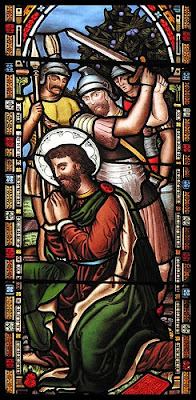
"Church Tradition teaches that St Paul suffered martyrdom in Rome and was beheaded, whence the sword is his symbol.According to Eusebius: "When the government of Nero was now firmly established, he began to plunge into unholy pursuits, and armed himself even against the religion of the God of the universe... Thus publicly announcing himself as the first among God's chief enemies, he was led on to the slaughter of the apostles. It is, therefore, recorded that Paul was beheaded in Rome itself, and that Peter likewise was crucified under Nero. This account of Peter and Paul is substantiated by the fact that their names are preserved in the cemeteries of that place even to the present day.This is one of the scenes from the window of St Paul's life in Melton Mowbray."
Here is the associated caption for this beautiful picture.
"Church Tradition teaches that St Paul suffered martyrdom in Rome and was beheaded, whence the sword is his symbol.According to Eusebius: "When the government of Nero was now firmly established, he began to plunge into unholy pursuits, and armed himself even against the religion of the God of the universe... Thus publicly announcing himself as the first among God's chief enemies, he was led on to the slaughter of the apostles. It is, therefore, recorded that Paul was beheaded in Rome itself, and that Peter likewise was crucified under Nero. This account of Peter and Paul is substantiated by the fact that their names are preserved in the cemeteries of that place even to the present day.This is one of the scenes from the window of St Paul's life in Melton Mowbray."
Wednesday, November 12, 2008
WORLD OF JUSTICE CANNOT EXIST WITHOUT CHRIST

VATICAN CITY, 12 NOV 2008 (VIS) - In his general audience, held this morning in St. Peter's Square, the Pope turned his attention to St. Paul's eschatological teaching.
In his First Letter to the Thessalonians, said the Holy Father, "St. Paul speaks of the return of Jesus, an event known as the 'parusia' or advent". The saint describes this vividly "using symbolic images that nonetheless transmit a simple and profound message: 'In the end we will be with the Lord forever'. ... Our future is 'to be with the Lord'".
Benedict XVI pointed out how in his Second Letter to the Thessalonians, the Apostle "changes perspective and speaks of the negative events that will precede the end. We must not allow ourselves to be deceived, he says, as if the Day of the Lord were truly imminent by some chronological calculation. ... The continuation of the Pauline text makes it clear that the coming of the Lord will be preceded by apostasy and by the appearance of a person identified only as 'the lawless one', the 'one destined for destruction', whom tradition came to identify as the Antichrist".
The Pope examined the fundamental attitudes a Christian must adopt in the face of the ultimate realities of death and the end of the world: "The first attitude", he said, "must be the certainty that Jesus rose and that, with the Father, He remains with us forever. ... Secondly, the certainty that Christ is with me; and since the future world has already begun in Christ, this gives us the certainty of hope. The future is not an area of darkness in which no-one can find their way. ... Without Christ, the future is dark even today. ... Christians know that the light of Christ is stronger and hence they experience a hope that is not vain, a hope that gives certainty and courage to face the future".
The third attitude, the Pope went on, "is responsibility before Christ for the world and for our fellow man and, at the same time, the certainty of His mercy. ... We have to work to ensure this world opens to Christ, that it is renewed. ...We know that God is the true Judge, we are sure He is good, we know His face, the face of the risen Christ. ... For this reason we can be sure of His goodness and live our lives courageously".
At the end of his First Letter to the Corinthians, St. Paul "repeats a prayer of the early Christian communities of Palestine, putting it into the mouths of the Corinthians themselves: 'Marana tha! Our Lord, come!' ... which is also how the Book of the Apocalypse ends. ... Can we pray like this today? In our lives, in our world, it is difficult to pray sincerely for this world to perish, for the coming of the New Jerusalem, the Final Judgement, Christ the Judge. ... Nonetheless, like the first Christian community we can say: Come Jesus! Of course we do not want the end of the world to come now. On the other hand, we do want the world of injustice to end, we do want the world to change, the civilisation of love to begin, a world of justice and peace to come, a world without violence and hunger. ... But without the presence of Christ a truly just and renewed world will never come".
"We can and must cry out urgently in the circumstances of our own time: Come, Lord! Come in Your way, in the ways that You know. Come where there is injustice and violence. Come into the refuge camps of Darfur and North Kivu, in so many parts of the world. Come where drugs dominate. Come also among the rich who have forgotten You and who live for themselves alone. Come where You are known. Come in Your way and renew today's world. Come also into our hearts ... that we too may become light of God, Your presence".
Subscribe to:
Posts (Atom)