Showing posts with label St. Peter. Show all posts

Monday, February 11, 2013

Lightning Strikes St. Peter's Basilica After Pope Benedict XVI Resigns

A sign from God? Lightning strikes the basilica of St.Peter's dome earlier this evening during a storm that struck Rome on the same day Pope Benedict XVI announced his resignation - Daily Mail

Related:

Tuesday, November 13, 2012

South Carolina Episcopal Parish Members to Convert to Catholic Church

(The Post and Courier) The breakup in the Episcopal diocese has led some members of one local parish, the Anglo-Catholic Church of the Holy Communion, to make a move of their own.

Five families will follow the Rev. Patrick Allen, curate at Holy Communion, into the arms of the Roman Catholic Church.

The Rev. Dow Sanderson, rector of Holy Communion, will remain part of the Episcopal Church, along with most of the congregation, and strive to be neutral as the drama plays out, he said.

The fracture comes as no surprise; worshippers at this historic downtown parish at 218 Ashley Ave. have long preferred to uphold Catholic traditions.

Holy Communion adheres to the Oxford Movement’s assertion that the Church of England (and other Anglican Church bodies) has been, and is now, an apostolic church, a direct descendant of St. Peter’s church, a true inheritor of the word of Christ.

Protestantism, instead, holds that there is no “one true church,” that individuals have the authority to forge a personal relationship with Christ and don’t really require the aid of an institution.

The 19th-century Oxford Movement asserts that the doctrine of apostolic succession accommodates “One True Church” with three branches: Roman Catholicism, Orthodoxy and Anglicanism. Its ideas were promoted in a series of pamphlets called “Tracts for the Times” (1833-41).

Allen said the process of becoming Catholic will take several months.


“I will continue to serve as curate at Holy Communion through the end of the year,” he said. “Of the families who are making this move, several adults are involved in ministry and leadership positions here, so they will serve out their terms.”

In January, Allen and the others will join the congregation at St. Mary Catholic Church on Hasell Street to worship. Allen said he hopes to be confirmed as a priest in the Catholic Church by late spring or early summer.

“At that point, we will begin having our own ordinariate (Catholic community of former Anglicans) and Mass,” he said. The group will share St. Mary’s.

More than a year ago, Holy Communion, as a parish, considered opting out of the Episcopal Church and joining the Catholic Diocese of Charleston, but that possibility faded, according to Allen, who addressed the matter in a Nov. 7 letter to the congregation.

 
With the split in the Episcopal diocese, Allen saw a new opportunity to pursue his goal, though the controversies were not central to his decision, he wrote.

“Mine is a move forward to the Catholic Church, and I am nothing but grateful for my own years in the Episcopal Church and the Diocese of South Carolina,” Allen wrote.

Link:
Related:

Monday, July 2, 2012

On the SSPX

By Ann Barnhardt at Barnhardt.biz:

I get lots of questions, and hate mail, about this, and in the spirit of getting things wrapped-up and saying everything I have on my little list to say while I can, here's my screed on the SSPX.

The Society of Saint Pius the Tenth (SSPX) is a group of traditionalist Catholics who broke away from Rome in 1970 after Vatican II when they were told by evil Marxist infiltrators inside the Church that they were forbidden from saying the Tridentine Latin Mass. They were led by an Archbishop named Marcel Lefebvre, hence the term "Lefebvrists" sometimes used to describe those in the SSPX.

The legalisms are EXTREMELY confusing, but as I understand it, Vatican II never actually forbade the saying of the Tridentine Mass. That was all a lie by the Marxist-homosexualist infiltrators. But, instead of hanging around and fighting the good fight, the SSPX took off on its own.

There have been steps toward reconciliation over the last 40 years, and as I understand it, SSPX Masses are indeed valid, but they are still not in full communion with the Church.

I totally sympathize with them - I can't imagine the fury and heartbreak that so many felt in 1970 as the Mass was literally eviscerated before their eyes and turned into a Protestant off-Broadway performance vehicle for homosexual priests and nuns, specifically designed to degrade the Church from the inside-out and ultimately destroy it by turning it into a neo-pagan Marxist-homosexualist cult.

But apparently ol' Annibale Bugnini and his masonic cohorts didn't take Christ Almighty seriously:

"Thou art Peter (Cephah) and upon this rock (cephah) I will build My Church, and the gates of hell shall not prevail against it."
 
You ain't gonna win, boys. And that goes for the uber-right contingent every bit as much as the Marxist-homosexualist infiltrators. The gates of hell will not prevail against the Church, and Peter is the Rock upon which Christ built, and builds, His Church.

It does not get any clearer than that. Any argument or confusion on this point is a direct result of satanic-inspired heresy aimed at destroying the Church by tearing it into utter chaos (40,000 protestant sects in the U.S. alone, all gleefully ratifying mortal sin, and counting!), ripping people away from the Eucharist, and ultimately resulting in people being lost eternally to hell. Period. You don't agree? You don't like that? You want to be your own pope? You want to "vote" on what the Truth is? Wow. I SOOOOOO don't care what you "want", "like", "feel" or "believe." I care about what the Truth is, and scripture makes it crystal, crystal clear on this point for anyone who isn't blinded by their own pride.

So, think of the SSPX as Protestants, but on the other side of the spectrum.

Today, the head of the SSPX is a bishop named Bernard Fellay, and he is working very hard to try to get the SSPX fully reconciled to Rome and thus 100% back inside the Barque of Peter. Everything I have read and listened to from Fellay seems extremely sensible, faithful and sincere. He fully comprehends that he is a shepherd and that he needs to get his flock back into the Church, and he is trying very hard to get that done before the manure hits the spinning airfoils.

The other three SSPX bishops? Not so much. The nutty wing of the SSPX is led by a bishop named Williamson. Williamson is nuts. Just stone-cold bonkers. He is a vicious anti-Semite (and there is a considerable problem with this inside the SSPX), holocaust denier, and naturally flowing from that evil and insanity, Williamson is a 9/11 truther. Like I said, the dude is nuts. Once you know that information, you know everything you need to know about Williamson and his wing.

Now you might think that all the traddy Catholics *lurv* me and that I have bunches and bunches of "friends." Oh, you'd be dead wrong. Most of the traddy Catholics hate me too, because people like me just can't win for losing. They send me lovely emails telling me how much they hate me on a fairly regular basis. They also send me Williamson propaganda. So, I have a pretty solid dossier of evidence on this point.

Would you like to hear what they tell me? Sure you would.

A. If you are 35 and unmarried, you must be a lesbian. We hate you.

(And all this time I thought it was a combination of my shrewish personality, dull wit and acrid body odor. Huh.)
 
B. You're a convert. We hate converts. We hate you.

(The Blessed Virgin Mary, the first Convert to Christianity, was unavailable for comment. Her press secretary simply referred all inquiries on this topic to the First Joyful Mystery, the Annunciation. Oh, and the Great Commission of her Son.)
 
C. You speak to Jews. We hate you.

(If your stupid asses don't even understand Catholicism, how do you expect the Jews today to understand it, much less convert to it? Maybe if you learned your faith, understood how every aspect of the Church and the Mass is a perfected fulfillment of Judaism, and could then EXPLAIN that to people, you might actually win some converts. Oh, but I forgot. You hate converts.)
 
D. You're ugly. Your hair is ugly. You have horse teeth and bug eyes. We hate you.

(Are you sure THAT isn't the reason I'm not married? Because I'm so freakishly physically repellant? Just sayin'.)
 
And, finally, my personal favorite:

E. You prophesy before men UNVEILED. We hate you.

(Okay, I can't win here. If I say to myself, "Ahem, I am going to PROPHESY now," and put on a veil to make a video or give a talk, then I'm a delusional, megalomaniacal nutcase. If I don't, some kooky dude sends me emails telling me that I'm going to hell for my failure to accessorize. Dude, throw me a bone. Seriously.)
 
That's all good for a chuckle, but let me explain with an analogy what these people's error is, and it isn't just them. It is the error of any schismatic.

Let's say your wife was diagnosed with cancer. Would you suddenly hate your wife? Would you argue that you didn't marry a body riddled with cancer, and therefore she was no longer the person you married, and then leave her in a smug huff?

Would you hate your wife's body, and thus hate your wife? No. You would love your wife and her body, perhaps even more than before, when you saw her under attack from the cancer. You would want to fight the cancer - chemotherapy, radiation, surgery - anything to get rid of the cancer and bring your wife back to full health and vigor.

This is exactly the situation in the Church today. The Church has cancer. Bad. Fully metastasized, all over-type cancer. It is called Marxist-homosexualism, and the cancer was first observed and diagnosed 45 years ago. Sadly, instead of clinging to the Bride of Christ and fighting the cancer, some people abandoned Her, claiming that the cancer WAS her body, instead of just an invading infection. Others left out of indifference. Others stayed and embraced the cancer as a "good thing" and "progress". A tiny, tiny contingent stayed, held Her hand, and have lovingly administered as much medicinal therapy to her as they possibly could.

The Williamson wing of the SSPX hates the Bride of Christ and will never rejoin her no matter what, because they are too prideful and dim to make the distinction between the Body and the cancer. They want a new wife, one of their own making, and "cancer free." And that is what they will get, but they will quickly find out that their new bride isn't really a bride at all, but just another cheap whore. A true and loving Bride with a bad case of cancer beats a whore in her prime.

So, Fellay needs to get back into the Church ASAP, and let the chips fall where they may with the SSPXers. Even if it is just Fellay and one other person coming back into the Church, it will be worth it for that ONE person, and Fellay will have done his job as a shepherd. Our Lord made clear that men will be sifted. People will have to choose. Wheat or chaff? Sheep or goats? This is one of those "siftings."

Get back in the Barque of Peter, Bishop Fellay and all SSPXers of good will, of which there are many. Because the gates of hell and its cancer WILL NOT PREVAIL. There is going to be a miraculous cure, and your Bride wants you there to share in the joy of the healing, which is explicitly guaranteed by Our Lord Himself.


Link:

Friday, September 11, 2009

The Petrine Fact, Part 3: Peter and the Twelve

By Jimmy Akin

Continued from Part 1 | Part 2


Teaching of the Twelve icon

"First Simon, who is called Peter."

With these words St. Matthew begins his enumeration of the Twelve, emphasizing the primacy of Simon Peter among the Twelve (Matt 10:2ff). A similar prominence is given to Peter in every enumeration of the Twelve, where Peter is always listed first, followed by the next most prominent disciples, John and James, with Judas Iscariot always in the last position (cf. Mark 3:16ff, Luke 6:14ff, Acts 1:13ff).

The word "first," protos, is the same word that Jesus later uses when he says, "Whoever would be great among you must be your servant, and whoever would be first (or "chief") among you must be your slave; even as the Son of man came not to be served but to serve, and to give his life as a ransom for many" (Matt 20:26-28). (It's also the same word Paul uses in the passage from 1 Corinthians 15 previously discussed, in which he called himself the "chief" [protos] of sinners.)

This saying, in response to the petition of the sons of Zebedee to sit as Jesus' right and left in positions of honor, establishes that primacy in the new order that Jesus brings is a very different thing from primacy in the world. For now, though, I am concerned with the mere fact of Peter's primacy, without losing sight of the reversal of worldly standards that Jesus brings.

A casual perusal of the Gospels and Acts is sufficient to establish Peter's prominence among the Twelve in early Christian memory. Peter is named far more often than all the rest of the Twelve combined (nearly 200 times). After Peter, the most prominent disciples are John and James, the sons of Zebedee, who with Peter formed an inner circle of Jesus' closest disciples, and whose names are listed close to Peter's (along with Peter's brother Andrew) in all the enumerations of the Twelve. (John, the most frequently mentioned disciple after Peter, is mentioned fewer than 40 times, not even 1/7th as often as Peter.)

We even encounter phrases like "Peter/Simon and those who were with him" (Mark 1:36, Luke 9:32, 8:45) and "Peter and the apostles" (Acts 5:29), subsuming other apostles under Peter, as well as "his disciples and Peter" (Mark 16:7), emphasizing Peter in particular. (St. Paul similarly makes special note of Peter in 1 Corinthians 9:5, referring to "the other apostles and the brothers of the Lord and Cephas").

Peter's prominence is not simply a matter of literary shorthand. Both in the Gospels and in Acts Peter is often seen speaking for and taking the initiative among the Twelve, for good and for ill (e.g., Matt. 18:21, Mark 8:29, Luke 12:41, John 6:68-69). Peter expresses the faith of the Twelve when he confesses Jesus as the Christ; he also expresses their ill-fated claim to be ready to die rather than fall away (e.g., "And they all said the same," Mark 14:31). Peter's denials, reported in all four Gospels, represent a low point of Peter's prominence, followed by his prominence in the resurrection accounts previously discussed.

Matthew's Gospel depicts Jewish interlocutors approaching Peter to question him about Jesus (Matt 17:24); in the same episode, Jesus associates Peter with himself by making provision for their payment of the Temple tax, without involving the rest of the Twelve. It is also in Matthew that Peter shares with Jesus the extraordinary miracle, reported in Matthew, Mark and John, of walking on water (Matt 14:22-23).

Jesus treats Peter as representative of the others. In Gethsemane, though James and John also were asleep, it is Peter that Jesus rebukes ("he came and found them sleeping, and he said to Peter, 'Simon, are you asleep? Could you not watch one hour?'" Mark 14:37). There is a hint of something similar in Jesus' rebuke to Peter following Peter's confession: "But turning and seeing his disciples, he rebuked Peter, and said, "Get behind me, Satan! For you are not on the side of God, but of men" (Mark 8:33). Just as Peter's confession articulated the faith of all, so perhaps Peter's opposition to the foretelling of Jesus' passion articulated the resistance of all.

Much of this prominence, even in Jesus' own interaction with Peter that the Twelve, can be ascribed at least in part to by Peter's impulsive, headstrong personality, which makes him a natural spokesman, if an uneven one. At the same time, Jesus repeatedly offers clear indications of a unique purpose for Peter — a purpose not defined or limited by Peter's personal strengths and weaknesses.

We have already seen how in John 21 the resurrected Christ solemnly instated Peter by triple commission as vice shepherd; and we have not yet come to the Petrine locus classicus, Matthew 16. But there is also the pivotal role that Jesus intends for Peter in relation to the Twelve and the apostolic ministry, most clearly attested in a saying in Luke's Last Supper account.

Significantly, this saying takes place in the context of a familiar motif, a dispute among the disciples about "which of them was to be regarded as the greatest" (Luke 22:24ff). In this passage, the disciples' quarrel about greatness is connected to the puzzle of which disciple would betray Jesus, and leads directly to Simon Peter's claim to be ready to go to prison and death.

Jesus' response here to this issue comes in three parts. First, as he did in response to the request of the sons of Zebedee mentioned above to sit at his right and his left, Jesus is careful to emphasize the reversal of worldly ideas of greatness implied by his own example: "The kings of the Gentiles exercise lordship over them; and those in authority over them are called benefactors. But not so with you; rather let the greatest among you become as the youngest, and the leader as one who serves. For which is the greater, one who sits at table, or one who serves? Is it not the one who sits at table? But I am among you as one who serves."

Then, very nearly reversing his reversal, Jesus affirms the greatness that indeed awaits the Twelve in the kingdom: "You are those who have continued with me in my trials; and I assign to you, as my Father assigned to me, a kingdom, that you may eat and drink at my table in my kingdom, and sit on thrones judging the twelve tribes of Israel." (This is rather more encouraging than what he told the sons of Zebedee about sharing in the cup and the baptism of his sufferings.)

Finally, he concludes with a warning and a promise: a warning and a promise simultaneously directed at all the Twelve and one in particular: "Simon, Simon, behold, Satan demanded to have ye (second person plural, i.e., "all of you"), that he might sift [ye] like wheat, but I have prayed for thee (second person singular, i.e., "you, Simon"), that thy faith may not fail; and when thou hast turned again, strengthen your brethren" (Luke 22:31-32). (This direct affirmation of the role that Peter will play makes an intriguing contrast with Jesus' demurral to the sons of Zebedee that to sit at his right and his left belongs to those for whom it has been prepared.)

In the context of the dispute as to which was the greatest, this saying to Peter offers three different layers of meaning. First, Jesus stresses that temptation stands at the gate. The disciples are unprepared for what is coming; while they quarrel over who is the greatest, they are easy pickings for the enemy; their minds are dominated by earthly notions of greatness.

Second, in singling out Peter, Jesus may well implicate Peter in particular in the sorry dispute — in part, perhaps, because of Peter's own awareness, and possibly to some extent his misapprehension, of his own primacy among the Twelve. (There is a note of remonstration in Jesus' "Simon, Simon," though it is not impossible that this alludes to Peter's promises of faithfulness rather than the dispute about which of them was the greatest. Nevertheless, the two issues seem linked here, the bridge being who would betray Jesus.)

But thirdly, Jesus implicitly affirms a particular sort of primacy to Peter: All the Twelve are in line to be sifted, but Jesus' prayer is for Peter in particular — not just because of what may be his special danger, but also because of the special role Jesus intends for him to play in strengthening his brethren.

This saying does not mean, of course, that Jesus does not pray also for the other apostles (cf. John 17:6-19). Nevertheless, Jesus' prayer for the Twelve, whom he says are all in line to be sifted, comes to a head or finds a focal point in Peter. It is Peter's faith that Jesus has prayed will not fail; it is Peter who, when all have fallen away, will turn again and strengthen his brethren.

Had Jesus wanted to affirm a completely egalitarian ideal among the Twelve, with no sort of priority or prominence of any kind, it is difficult to see why he would have expressed himself in this way. Indeed, on an egalitarian theory of apostlehood, Jesus' words seem almost perversely bound to lead to misunderstanding. It seems, that, rather than denying any sort of primacy among the apostles, he seeks to redefine how primacy will be understood among his followers, while nevertheless definitely attaching a sort of primacy — however unlike the sort of primacy the disciples, not excluding Peter, might have been grasping at — to one apostle in particular: one who, precisely because of his preeminent position among the Twelve, requires Jesus' individual attention in prayer on behalf of all.

Having reported Jesus' prayer in Luke 22, Luke goes on in Acts to demonstrate its fulfillment as Peter, following Jesus' resurrection and ascension, comes into his own in an extraordinary way. Peter's role in Acts is so prominent that the first half of the book could almost be dubbed "Peter & Friends." (The second half, of course, would be "The Paul Show," a point I'll return to later.)

In Acts 1, Peter initiates the action to select Judas's replacement and articulates the criteria for apostleship. In Acts 2, on Pentecost, Peter speaks on behalf of the Twelve to the Jewish onlookers, proclaiming the Gospel of the church for the first time and bringing thousands to baptism on the birthday of the church.

When Peter and John are arrested in Acts 4, Peter, "filled with the Holy Spirit," leads their defense (after which Luke tells us that "Peter and John" both spoke; Acts 4:8-19); when the apostles are arrested again a chapter later, we read, "Peter and the apostles answered, 'We must obey God rather than men'" (Acts 5:29). When members of the company are laying the proceeds of sold property at the apostles' feet, it is Peter who speaks for the apostles to Ananias and Sapphira, prophetically exposing the lie they tell him ("You have not lied to men, but to God"), for which their lives are forfeit (Acts 4:33-5:11).

In Acts 5 the apostles are miraculously liberated from prison by an angel; then, in Acts 12, James bar-Zebedee (another apostle of Jesus' inner circle) is seized and put to death by the sword — but Peter, arrested immediately afterward, is again liberated by an angel. (Paul and Silas are also delivered from imprisonment, though technically there is no mention of an angel, "only" an earthquake that opens the doors and unfastens everyone's fetters.)

Finally and most crucially — along with Peter's role at Pentecost — it is Peter who receives the vision that opens the door for table-fellowship between Christian Jews and Gentiles; Peter who authorizes the first administrations of baptism to Gentiles (Acts 10), and who defends the acceptance of Gentiles to the "circumcision party" (Acts 11).

On Pentecost, Peter first preached the Gospel to Jews; in Acts 10-11 Peter brings to light the fullness of the Gospel message that in Christ the barrier between Jew and Gentile has been demolished, and that circumcision is no longer a prerequisite to salvation. (These are themes we will revisit in a very different light in Galatians 1-2 and also Acts 15.)

More to come.

Continued from Part 1 | Part 2


Sunday, August 2, 2009

SAINT PETER'S CHAINS

In the year 44 King Herod Agrippa, after putting to death Saint James, son of Zebedee, was still avid for popular approval by the Jews. He had Saint Peter cast into prison, intending to put him to death publicly after the Passover; but the entire Church of Jerusalem was offering up prayers to God “without ceasing” (Acts 12:5) for the deliverance of the Chief Pastor of His flock, and God heard them favorably.

The king had taken all possible precautions to prevent the escape of his prisoner. He was guarded day and night by sixteen soldiers, four of whom kept sentry duty in turn — two in the same dungeon with him, and two at the gate. Saint Peter was fastened to the ground by two chains, and a soldier watched on either side of him. He lay fast asleep on the very night before the day fixed for his execution, when it pleased God to deliver him out of the hands of his enemies. In the middle of the night, a bright light shone in the prison, and an Angel appeared beside him. He woke him from his sleep and bade him instantly rise, fasten his cincture, put on his sandals and cloak, and follow him. The Apostle did so, for the chains had fallen off his wrists. Following his heavenly guide, he passed after him through the first and second watches, and when they arrived at the iron gate which led into the city, that gate opened before them of its own accord. The Angel conducted him through one street, then, suddenly disappearing, left him to seek refuge.

The Apostle went directly to the house of Mary, mother of John Mark, where several disciples were assembled and sending up their prayers to heaven for his deliverance. As he stood knocking, a young woman who had been sent to the door, hearing Peter’s voice, ran back in joy and informed the group that their Pastor was at the door. They paid no attention to her, saying she was beside herself, or that it was probably his Guardian Angel. But the knocking continued until they opened the door, and Saint Peter, entering, told them of his miraculous escape. Having enjoined them to notify the rest of the brethren, he departed to regions of greater security, carrying wherever he went the divine blessing and life.

Reflection: This miracle clearly confirms the divine promise, “If two of you consent upon earth about anything at all for which they ask, it shall be done for them by My Father in heaven.” (Matt. 18:19)

Sources: New Testament, Acts of the Apostles, Chapter 12; Little Pictorial Lives of the Saints, a compilation based on Butler’s Lives of the Saints and other sources by John Gilmary Shea (Benziger Brothers: New York, 1894).

Friday, July 3, 2009

'Michelangelo self-portrait' discovered in restored Vatican fresco

Crucifixion of St. Peter by Michelangelo

Crucifixion of St. Peter, 1546-50 by Buonarroti, Michelangelo

The restoration of frescoes by Michelangelo in the Vatican has revealed what is believed to be a self-portrait of the artist.

The face is in a wall mural in the Vatican’s Pauline Chapel or Cappella Paolina, according to Maurizio De Luca, the Vatican’s chief restorer. The chapel, which is used by the Pope and not open to the public, was unveiled this week after a restoration costing €3.2 million (£2.7 million).

Professor De Luca said that a figure on horseback in a blue turban in Michelangelo’s The Crucifixion of St Peter was clearly the artist. “This is an extraordinary and moving discovery,” he said. He said that the resemblance to portraits by Giuliano Bugiardini and Daniele da Volterra, as well as to a bust by Giambologna, was striking.

The frescoes were painted by Michelangelo in the chapel beginning from 1542 to 1549, when he was 75. They depict the crucifixion of St Peter and the conversion to Christianity of the apostle Paul. The restoration began in 2004 and was funded by Vatican museum arts patrons.

Michelangelo is also said to have included a self-portrait in Last Judgment in the Sistine Chapel, hidden in the robes of St Bartholomew. Michelangelo began work on the Pauline Chapel murals after he had completed the Sistine Chapel. Pope Benedict XVI will inaugurate the restored chapel with an evening prayer service on July 4.

The two murals are the last Michelangelo painted. The chapel is named not after St Paul but after Pope Paul III, who commissioned it in 1537.

Antonio Paolucci, the director of the Vatican Museums, said that the frescoes were “a kind of spiritual testament marked by vast sadness and deep pessimism. One has the impression that the mystery of grace offered to an unworthy humanity caused anguish in the soul of the artist, a Christian, who lived through and witnessed the religious crisis of his era, which was divided and lacerated by the Reformation.”

The paintings had profound importance for the Church, Professor Paolucci said, since they depicted St Peter, “to whom all popes trace their spiritual responsibility” and St Paul, “from whom they inherit the mission of preaching the Gospel to all peoples”.

Sunday, June 28, 2009

Daily Bible Readings June 29 2009 Solemnity of Sts Peter and Paul, Apostles Mass During the Day

From Bob at A Catholic Site:

June 29 2009 Monday Solemnity of Saints Peter and Paul, Apostles – Mass During the Day
Saint of the Day – Sts. Peter and Paul

About the sources used. The readings on this site are not official for the Mass of Roman Rite of the Catholic Church in the USA, but are from sources free from copyright. They are here to present the comparable readings alongside traditional Catholic commentary as published in the Haydock Bible for your own personal study. Readings vary depending on your local calendar.

Official Readings of the Liturgy at – http://www.usccb.org/nab/readings/062909.shtml

Acts 12:1-11
Haydock New Testament
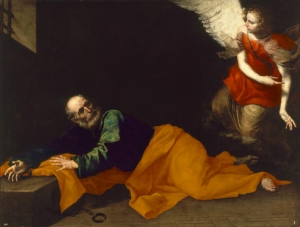
editedSt-Peter-Freed-by-an-

St Peter Freed by an Angel

AND at the same time Herod, the king, stretched forth his hands, to afflict some of the church. And he killed James, the brother of John, with the sword. And seeing that it pleased the Jews, he proceeded to apprehend Peter also. Now it was in the days of the azymes. Whom when he had apprehended, he cast into prison, delivering him to four files of soldiers, to be kept, intending after the Pasch to bring him forth to the people. Peter, therefore, was kept in prison. But prayer was made without ceasing, by the church, to God, for him. And when Herod would have brought him forth, that very night Peter was sleeping between two soldiers, bound with two chains: and the guards before the door kept the prison. And behold an Angel of the Lord stood by him: and a light shined in the room: and he striking Peter on the side, raised him up, saying:

Arise quickly.

And the chains fell off from his hands. And the Angel said to him:

Gird thyself, and put on thy sandals.

And he did so. And he said to him:

Cast thy garment about thee, and follow me.

And going out, he followed him, and knew not that what was done by the Angel was true: but thought he saw a vision. And having passed through the first and the second ward, they came to the iron gate that leadeth to the city, which of itself opened to them. And going out, they passed on through one street: and immediately the Angel departed from him. And Peter coming to himself, said:

Now I know truly, that the Lord hath sent his Angel, and hath delivered me out of the hand of Herod, and from all the expectation of the people of the Jews.

Responsorial Psalm 33:2-9
DR Challoner Text Only

I will bless the Lord at all times, his praise shall be always in my mouth.
In the Lord shall my soul be praised: let the meek hear and rejoice.
O magnify the Lord with me; and let us extol his name together.
I sought the Lord, and he heard me; and he delivered me from all my troubles.
Come ye to him and be enlightened: and your faces shall not be confounded.
This poor man cried, and the Lord heard him: and saved him out of all his troubles.
The angel of the Lord shall encamp round about them that fear him: and shall deliver them.
O taste, and see that the Lord is sweet: blessed is the man that hopeth in him.
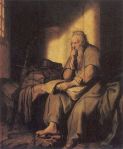
Saint Paul in Prison Rembrandt 1627AD

Saint Paul in Prison

2 Timothy 4:6-8, 17-18
Haydock NT

For I am even now ready to be sacrificed: and the time of my dissolution is at hand. I have fought the good fight, I have finished my course, I have kept the faith. For the rest, there is laid up for me a crown of justice, which the Lord, the just judge, will render to me on that day: and not to me only, but to them also who love his coming. Make haste to come to me quickly.

But the Lord stood by me and strengthened me, that by me the preaching may be accomplished, and that all the Gentiles may hear: and I was delivered from the mouth of the lion. The Lord hath delivered me from every evil work: and will preserve me unto his heavenly kingdom, to whom be glory for ever and ever. Amen.

The Holy Gospel of Jesus Christ According to Saint Matthew 16:13-19
Haydock New Testament

And Jesus came into the parts of Cæsarea Philippi: and he asked his disciples saying:

Whom do men say that the Son of man is?

But they said:

Some John the Baptist, and others Elijah, and others Jeremiah, or one of the prophets.

But Jesus saith to them:

But whom do you say that I am?

Simon Peter answering said:

Thou art Christ, the Son of the Living God.

And Jesus answering, said to him:

Blessed art thou, Simon Bar-Jona: because flesh and blood hath not revealed it to thee, but my Father, who is in heaven. And I say to thee: That thou art Peter; and upon this rock I will build my church, and the gates of hell shall not prevail against it. And I will give to thee the keys of the kingdom of heaven. And whatsoever thou shalt bind upon earth, it shall be bound also in heaven: and whatsoever thou shalt loose upon earth, it shall be loosed also in heaven.

Haydock Commentary Acts 12:1-11
Notes Copied From Haydock Commentary Site

  • Ver. 1. Herod. Agrippa, made king by the emperor Caius. See Jos. vi. 18. Antiq. c. viii. and l. xix. c. 5. put to death James the great, brother to John. Wi. This man was the same as Agrippa, by which name he is most commonly known. He was brother to the famous Herodias, who was the cause of S. John the Baptist’s decollation, (Calmet) and son-in-law of Herod the Great, by his father Aristobulus. V.
  • Ver. 2. S. James the elder, brother of S. John, the evangelist.
  • Ver. 3. The days of the azymes. By this we may know about the time when S. James was executed. Peter was to be reserved till after the Pasch, because it was not usual for the Jews to put any one to a violent death on a festival day. They would not damp the joy of the solemnity by such actions. Menoch. Nothing can be more illiberal, nothing more unfounded, and unjust, than the accusation advanced by the translators of the Bible dedicated to King James. In their preface they say, that the Catholics keep the words, azymes, holocaust, pasch, &c. in their version, purposely “to darken the sense, that since they must needs translate the Bible, yet by the language thereof, it may be kept from being understood.” See the splendid Oxford edit. an. 1770. So far from this, we open the window, to let in the light; we bread the shell, that the kernel may be eaten: we put aside the curtain, that a sight may be had into the holy place; we remove the cover of the well, that the good and humble may get to the water of life. If we retain certain words in the original tongue, it is for the same reason as our adversaries retain others, such as Amen, Sabaoth, Alleluia, Jehova, &c.
  • Ver. 4. To four files of soldiers.[1] To four times four soldiers, or to sixteen soldiers, each band or file consisting of four.
  • Ver. 6. With these two chains, according to the Roman custom, S. Peter must have been fastened to the two soldiers, that guarded him. Yet Peter slept secure, trusting in that Providence which sleepeth not.
  • Ver. 7. An Angel. This was probably his Angel guardian. It has always been the constant belief of the Church, that each individual is put under the protection of a tutelar Angel. A. S. Bernard, on these words of the psalm, he has given his Angels charge over thee, thus expresses himself: Wonderful condescension! and truly great love! He has given his Angels charge over thee, to guard thee in all thy ways. What is man, O God, that thou shouldst thus be mindful of him, or the son of man, that thou shouldst look upon him! What reverence, devotion, and confidence, should this word inspire in us! Reverence their presence, be grateful for their good will; have confidence in their protection; walk with circumspection; your Angel is present. In every abode, in every place, respect his presence. Let us love them too, destined to be in future our co-heirs; in the mean time, our guardians and patrons. What have we to fear under such guides? They cannot be overcome nor seduced; much less can they lead us astray. They are faithful, they are prudent, they are powerful. Why do we fear? Let us follow them; let us stick close to them; and we shall dwell under the protection of the God of heaven. If a grievous temptation urges; if great tribulation hangs over you; call upon your leader your helper in opportunities, in tribulations; call upon him, and say, save us, or we perish, &c. S. Bern. Serm. in Psalm. Qui habitat. A light shined in the room. To Peter only; not to the rest. Wi.
  • Ver. 11. Peter coming to himself. Being now sensible that all was true. Wi.

2 Timothy 4:6-8, 17-18

  • Ver. 6. I am even now ready to be sacrificed.[5] Lit. to be immolated. See Philip. ii. 17. The time of my dissolution (lit. resolution) is at hand. This makes many judge that this letter was written during his last imprisonment; but the sense perhaps may be, that being old and worn out with labours, he could not live long. Wi.
  • Ver. 7. I have fought a good fight, or strived a good strife.[6] The Latin and Greek may signify any kind of striving for a prize. I have kept the faith, not only the Christian faith, the been faithful in my office. Wi.
  • Ver. 8. A crown of justice, which the Lord, the just judge, will render to me. These words confirm the Catholic doctrine, that good works performed with the assistance of God’s grace, deserve and are meritorious of a reward in heaven: it is what is signified, 1. by a crown of justice, 2. from a just judge, 3. which he will render or give as a reward. Yet we own with S. Aug. that we have no merit, but what is also a gift of God from his grace and mercy, and grounded on his promises. Wi. “A crown of justice,” which the Protestant translate, of righteousness; but let us see how the learned S. Austin, 1400 years ago, expounds the apostle’s meaning: “How should he repay as a just judge, unless he had first given as a merciful Father?” De grat. et lib. arb. c. vi. See Heb. vi. 10. God is not unjust, that he should forget your works; the the Protestants change into, God is not unrighteous.
  • Ver. 17. The Lord stood, &c. All agree that Nero is here meant by the lion. S. Chrys. thinks that S. Paul was set at liberty after this first justification of his conduct, but that having afterwards converted the cupbearer of Nero, he was by him beheaded. S. Chrys. hom. x. p. 611. But the Lord assisted and fortified me on this occasion by a vision, in which he assured me that he would prolong my life for the more perfect preaching of the gospel. V. The times predicted by the apostle in this epistle, (v. 3. and 4.) are now arrived; and the warnings he gives to Timothy and to all preachers of the word, should be sedulously attended to: preach the word: be instant in season and out of season; reprove, entreat, rebuke with all patience and doctrine. There will arrive a time when men will not bear sound doctrine; eager in the extreme to hear what flatters, they will have recourse to a variety of teachers not lawfully sent or ordained, calculated to tickle their ears: Assentatores populi, multitudinis levitatem voluptate quasi titillantes. Cic. In the same sense Plutarch says: ta wta apoknaiousin. It is yours, adds S. Paul, wV kaloV stratiwthV Cristou Ihsou, as a valiant soldier of Jesus Christ, to oppose yourself as a wall to all these evils, to attend every branch of your ministerial duty, not to yield to either opponents or dangers, and to see that the gospel is both preached and practised in all its purity. Thus may the Church find in you, and in her other ministers, what she is soon to lose in me, knowing as I do that my course is nearly run. That by me the preaching may be accomplished, (or fulfilled) and that all the Gentiles may hear it. This is an argument that he wrote this letter in his first imprisonment. And I was delivered from the mouth of the lion; that is, according to the common exposition, from Nero. Wi.

Haydock Commentary Matthew 16:13-19

  • Ver. 13. Cæarea Philippi, was first called Paneades, and was afterwards embellished and greatly enlarged by Philip the tetrarch, son of Herod the great, and dedicated in honour of Augustus, hence its name. There was moreover another Cæsarea, called Straton, situated on the Mediterranean: and not in this, but in the former, did Christ interrogate his disciples. He first withdrew them from the Jews, that they might with more boldness and freedom deliver their sentiments. S. Chry. hom. lv. The Cæsarea here mentioned continued to be called by heathen writers Panea, from the adjoining spring Paneum, or Panium, which is usually taken for the source of the Jordan.
  • Ver. 14. Some say, &c. Herod thought that Christ was the Baptist, on account of his prodigies. S. Mat. xiv. 2. Others that he was Elias: 1st. because they expected he was about to return to them, according to the prophecy of Malachias; behold I will send you Elias; 2d. on account of the greatness of his miracles; 3d. on account of his invincible zeal and courage in the cause of truth and justice. Others again said he was Jeremias, either on account of his great sanctity, for he was sanctified in his mother’s womb; or, on account of his great charity and love for his brethren, as it was written of Jeremias: he is a lover of his brethren. Or, again, one of the prophets, viz. Isaias, or some other noted for eloquence; for it was the opinion of many of the Jews, as we read in S. Luke, that one of the ancient prophets had arisen again. Dion. Carth.
  • Ver. 15. Whom do you say that I am? You, who have been continually with me; you, who have seen me perform so many more miracles; you, who have yourselves worked miracles in my name? From this pointed interrogation, Jesus Christ intimates, that the opinion men had formed of him was very inadequate to the exalted dignity of his person, and that he expects they will have a juster conception of him. Chry. hom. lv.
  • Ver. 16. Simon Peter answering. As Simon Peter had been constituted the first in the college of apostles, (Matt. x. 2.) and therefore surpasseth the others in dignity as much as in zeal, without hesitation, and in the name of all, he answers: thou art the Christ, the Redeemer promised to the world, not a mere man, not a mere prophet like other prophets, but the true and natural Son of the living God. Thus SS. Chrys. Cyril, Ambrose, Austin, and Tirinus. When our Saviour inquired the opinion of him, Peter, as the mouth of the rest, and head of the whole college, steps forth, and prevents the others. Chrys. hom. lv. Tu es Christus, filius Dei vivi; or, as it is in the Greek, o cristoV, o uioV; The Christ, the Son, the Christ formerly promised by the law and the prophets, expected and desired by all the saints, the anointed and consecrated to God: o uios, the Son, not by grace only, or an adoptive filiation like prophets, to whom Christ is here opposed, but by natural filiation, and in a manner that distinguishes him from all created beings. Thou art[1] Christ, the Son of the living God, not by grace only, or by adoption, as saints are the sons of God, but by nature, and from all eternity, the true Son of the living God. Wi.
  • Ver. 17. Blessed art thou, Simon Bar-Jona. Simon is undoubtedly Sumewn, as written 2 Pet. i. 1. Bariwna is son of Jona, or John, an abridgment for Bariwanna. Bar, in Chaldaic, is son; hence S. Peter is called, in John xi, 16. and 17, Simon, son of John. It was customary with the Jews to add to a rather common name, for the sake of discrimination, a patrwnumikon, or patronymic, as appears from Matt. x. 3. and xxiii. 35. Mark ii. 14. John vi. 42. P.
  • Ver. 18. Kagw. And I say to thee, and tell thee why I before declared, (John i. 42.) that thou shouldst be called Peter, for thou art constituted the rock upon which, as a foundation, I will build my Church, and that so firmly, as not to suffer the gates (i.e. the powers) of hell to prevail against its foundation; because if they overturn its foundation, (i.e. thee and thy successors) they will overturn also the Church that rests upon it. Christ therefore here promises to Peter, that he and his successors should be to the end, as long as the Church should last, its supreme pastors and princes. T. In the Syriac tongue, which is that which Jesus Christ spoke, there is no difference of genders, as there is in Latin, between patra, a rock, and Petrus, Peter; hence, in the original language, the allusion was both more natural and more simple. V. –Thou art Peter;[2] and upon this (i.e. upon thee, according to the literal and general exposition of the ancient Fathers) I will build my church. It is true S. Augustine, in one or two places, thus expounds these words, and upon this rock, (i.e. upon myself:) or upon this rock, which Peter hath confessed: yet he owns that he had also given the other interpretation, by which Peter himself was the rock. Some Fathers have also expounded it, upon this faith, which Peter confessed; but then they take not faith, as separated from the person of Peter, but on Peter, as holding the true faith. No one questions but that Christ himself is the great foundation-stone, the chief corner-stone, as S. Paul tells the Ephesians; (C. ii, v. 20.) but it is also certain, that all the apostles may be called foundation-stones of the Church, as represented Apoc. xxi. 14. In the mean time, S. Peter (called therefore Cephas, a rock) was the first and chief foundation-stone among the apostles, on whom Christ promised to build his Church. Wi. Thou art Peter, &c. As S. Peter, by divine revelation, here made a solemn profession of his faith of the divinity of Christ, so in recompense of this faith and profession, our Lord here declares to him the dignity to which he is pleased to raise him: viz. that he, to whom he had already given the name of Peter, signifying a rock, (John i. 42.) should be a rock indeed, of invincible strength, for the support of the building of the church; in which building he should be next to Christ himself, the chief foundation-stone, in quality of chief pastor, ruler, and governor; and should have accordingly all fulness of ecclesiastical power, signified by the keys of the kingdom of heaven. Upon this rock, &c. The words of Christ to Peter, spoken in the vulgar language of the Jews, which our Lord made use of, were the same as if he had said in English, Thou art a rock, and upon this rock I will build my church. So that, by the plain course of the words, Peter is here declared to be the rock, upon which the church was to be built; Christ himself being both the principal foundation and founder of the same. Where also note, that Christ by building his house, that is, his Church, upon a rock, has thereby secured it against all storms and floods, like the wise builder. Matt. vii. 24, 25. The gates of hell, &c. That is, the powers of darkness, and whatever Satan can do, either by himself or his agents. For as the Church is here likened to a house, or fortress, the gates of which, i.e. the whole strength, and all the efforts it can make, will never be able to prevail over the city or Church of Christ. By this promise we are fully assured, that neither idolatry, heresy, nor any pernicious error whatsoever shall at any time prevail over the Church of Christ. Ch. The gates, in the Oriental style, signify the powers; thus, to this day, we designate the Ottoman or Turkish empire by the Ottoman port. The princes were wont to hold their courts at the gates of the city. V.
  • Ver. 19. And I will give to thee the keys, &c. This is another metaphor, expressing the supreme power and prerogative of the prince of the apostles. The keys of a city, or of its gates, are presented or given to the person that hath the chief power. We also own a power of the keys, given to the other apostles, but with a subordination to S. Peter and to his successor, as head of the Catholic Church. And whatsoever thou shalt bind, &c. All the apostles, and their successors, partake also of this power of binding and loosing, but with a due subordination to one head invested with the supreme power. Wi. Loose on earth. The loosing the bands of temporal punishments due to sins, is called an indulgence: the power of which is here granted. Ch. Although Peter and his successors are mortal, they are nevertheless endowed with heavenly power, says S. Chry. nor is the sentence of life and death passed by Peter to be attempted to be reversed, but what he declares is to be considered a divine answer from heaven, and what he decrees, a decree of God himself. He that heareth you, heareth me, &c. The power of binding is exercised, 1st. by refusing to absolve; 2d. by enjoining penance for sins forgiven; 3d. by excommunication, suspension or interdict; 4th. by making rules and laws for the government of the Church; 5th. by determining what is of faith by the judgments and definitions of the Church. T. The terms binding and loosing, are equivalent to opening and shutting, because formerly the Jews opened the fastenings of their doors by untying it, and they shut or secured their doors by tying or binding it. V. Dr. Whitby, a learned Protestant divine, thus expounds this and the preceding verse: “As a suitable return to thy confession, I say also to thee, that thou art by name Peter, i.e. a rock; and upon thee, who art this rock, I will build my making laws to govern my Church.” (Tom. i, p. 143.) Dr. Hammond, another Protestant divine, explains it in the same manner. And p. 92, he says: ” What is here meant by the keys, is best understand by Isaias xxii. 22, where they signified ruling the whole family or house of the king: and this being by Christ accommodated to the Church, denotes the power of governing it.”

Link

Sunday, February 22, 2009

Pontiff Requests Prayer for Fulfillment of Mission

http://d.yimg.com/img.news.yahoo.com/util/anysize/400,http%3A%2F%2Fd.yimg.com%2Fa%2Fp%2Fap%2F20090222%2Fcapt.b4b8a07efa3c4aa7b21ec44d4e956287.vatican_pope_ajm102.jpg?v=2

Says Rome's Primacy Protects Unity and Diversity in Church

VATICAN CITY, FEB. 22, 2009 (Zenit.org).- Benedict XVI is asking for prayers, on this feast of the Chair of Peter, for a successful fulfillment of his mission as the Bishop of Rome.

The Pope made this request today in an address to those gathered in St. Peter's Square for the Angelus.

He affirmed that the "chair of Peter symbolizes the authority of the Bishop of Rome, who is called to perform a special service for the whole People of God."

The Pontiff noted that the "primacy of the Church of Rome in the Catholic community was recognized" immediately after the martyrdom of St. Peter and St. Paul.

He underlined the fact that within the Church, "particular Churches hold a rightful place" and "retain their own traditions, without in any way opposing the primacy of the Chair of Peter, which presides over the whole assembly of charity."

This Chair, the Holy Father added, "protects legitimate differences, while at the same time assuring that such differences do not hinder unity but rather contribute toward it."

He asked for the prayers of the Church in order to be able to "faithfully carry out this great task, entrusted [...] by Providence, as successor to the Apostle Peter."

Spiritual healing

Benedict XVI also dedicated some words to reflect on the Gospel account of Jesus' healing of the paralytic.

He affirmed the story's proof that "Jesus has the power not only to heal the sick body but also to forgive sins."

The Pope added: "The physical healing is a sign of the spiritual healing that his forgiveness produces.

"In effect, sin is a kind of paralysis of the spirit, from which only the power of the merciful love of God can liberate us, allowing us to pick ourselves up and set out again along the path of goodness."

Monday, February 2, 2009

New Blog

Check out Sanctus Belle's new blog: Stained Glass Splendor

"Thou art Peter, upon this rock I shall build my church" ~Jesus
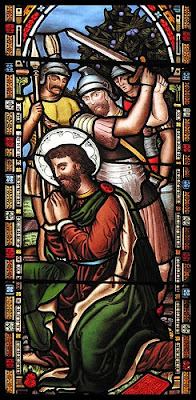
St. Edward's Catholic Church in Drayton, ND.

Here is the associated caption for this beautiful picture.

"Church Tradition teaches that St Paul suffered martyrdom in Rome and was beheaded, whence the sword is his symbol.According to Eusebius: "When the government of Nero was now firmly established, he began to plunge into unholy pursuits, and armed himself even against the religion of the God of the universe... Thus publicly announcing himself as the first among God's chief enemies, he was led on to the slaughter of the apostles. It is, therefore, recorded that Paul was beheaded in Rome itself, and that Peter likewise was crucified under Nero. This account of Peter and Paul is substantiated by the fact that their names are preserved in the cemeteries of that place even to the present day.This is one of the scenes from the window of St Paul's life in Melton Mowbray."