Thursday, April 4, 2013
In the Company of Saints and Villains: The Work of Divine Mercy
“Let the greatest sinners place their trust in My mercy. They have the right before others to trust in the abyss of My mercy . . . To such souls I grant even more graces than they ask. I cannot punish even the greatest sinner if he makes an appeal to My compassion, but on the contrary, I justify him in my unfathomable and inscrutable mercy.” (Diary of Saint Faustina, 1146)
By Fr. Gordon J. MacRae
(These Stone Walls) Exactly twenty years ago, in the first week of April 1993, my friend and spiritual director, Father Richard Drabik, M.I.C. was preparing to go to Rome to concelebrate with Pope John Paul II the Mass of Beatification of Sister Maria Faustina Kowalska, now known as Saint Faustina. Her Beatification took place on the Sunday after Easter that year, and Pope John Paul II decreed that henceforth that Sunday would be universally known in the Roman Calendar as Divine Mercy Sunday.
Father Richard Drabik was formerly Provincial Superior of the Marian Fathers of the Immaculate Conception. He wrote the Preface to the Diary of Saint Maria Faustina Kowalska that has become globally famous. Just before leaving for her Beatification in Rome twenty years ago this month, Father Drabik asked me if I would like to write a brief prayer for (then) Blessed Faustina’s intercession. I did not know what to write, so on the day of my friend’s departure I handed him a small scrap of paper to place with his intentions for the Mass. I folded it and sealed it in a small envelope that would fit easily in his pocket.
No one ever knew what I wrote. Except for a brief note sent to Felix Carroll a few weeks ago, I have never before spoken of this. The note with my petition was simple: “I ask the intercession of Blessed Faustina that I may have the courage to be the priest God calls me to be.” It was an odd petition, and today I have no idea what I was thinking about when I wrote it and handed it to Father Drabik on his way out the door... (continued)
Related:
Wednesday, April 18, 2012
Why Just Execution is a Truly Merciful Act
Fr. Z over at WDTPRS.com (What Does the Prayer Really Say) posted this on Sunday in honor of Divine Mercy Sunday.
In a nutshell, Rudolf Hoess, the Nazi butcher, was raised Catholic but formally renounced the Church as a young man and eventually became a Nazi and then the Commandant of Auschwitz.
After the war, Hoess was captured and tried in Poland. He was hanged immediately adjacent to the Auschwitz crematory on April 16, 1947.
While in his cell in Krakow, shortly before his execution, Hoess could hear the bells of the nearby convent and he remembered the faith of his youth. He asked to see a priest. He partook of the Sacrament of Confession, was reconciled to Christ and His Church, and received the Eucharist.
Let's assume that Hoess' penitence was sincere. Debating his sincerity really isn't a worthwhile activity because we simply cannot know. Only Christ knows Hoess' heart. You can't bee-ess Our Lord.
So, here's the point. Would Hoess have been contrite and sought the Divine Mercy of Our Lord had he NOT been within days of being executed? Was it the fact and full knowledge of his forthcoming death that moved him to repent? Had he been still on the loose, had he "gotten away" would he have had the same conversion of heart? If he had lived to old age, would the passage of time have dulled his recollection of what he had done, and thus even if facing a quiet, natural death as an old man, would he have been moved to repent?
Obviously, the answer to these questions is "no". It was the fact of Hoess' execution itself that acted as the earthly conduit of God's grace. The full, swift application of justice is essential to any civilized society.
Execution can be the most profound act of mercy and charity in a society, and has the power to literally save SOULS. And yes, a man can be forgiven, but still justly executed. Execution is not mathematically opposed to the Lord's Prayer.
But, of course, you'll never hear any sort of discussion like this in today's superfun rockband church, or even in the infiltrated and desperately stupid Catholic parishes - which are trying to be superfun rockband church. And the key word there is STUPID. The Marxist infiltration of Christianity has as its prime tactic the "stupidification" of the liturgy and theology. Superfun rockband church is STUPID. It is INSIPID. It is DIM-WITTED. It is OBTUSE. It is MORONIC.
Think. Think about Hoess and the possibility of the Infinite Mercy of Christ being applied even to him. Think about true justice, and how it must be present in order for there to be true charity.
Link:
Related:
Saturday, April 10, 2010
Divine Mercy Image
Why so Many Images? Which One is 'Best'? (click for article)
Thursday, April 30, 2009
The Chaplet of The Divine Mercy

2. Then on the Our Father Beads say the following:
Eternal Father, I offer You the Body and Blood, Soul and Divinity of Your dearly beloved Son, Our Lord Jesus Christ, in atonement for our sins and those of the whole world.
3. On the 10 Hail Mary Beads say the following:
For the sake of His sorrowful Passion, have mercy on us and on the whole world.
(Repeat step 2 and 3 for all five decades).
4. Conclude with (three times):
Holy God, Holy Mighty One, Holy Immortal One, have mercy on us and on the whole world.
In 1933, God gave Sister Faustina a striking vision of His Mercy,
Sister tells us:
"I saw a great light, with God the Father in the midst of it.
Between this light and the earth I saw Jesus nailed to the Cross
and in such a way that God, wanting to look upon the earth, had to
look through Our Lord's wounds and I understood that God blessed
the earth for the sake of Jesus."
Of another vision on Sept. 13, 1935, she writes:
"I saw an Angel, the executor of God's wrath... about to strike
the earth...I began to beg God earnestly for the world with words
which I heard interiorly. As I prayed in this way, I saw the
Angel's helplessness, and he could not carry out the just
punishment...."
The following day an inner voice taught her to say this prayer on
ordinary rosary beads:
"First say one 'Our Father', 'Hail Mary', and 'I believe'. Then on
the large beads say the following words:
'Eternal Father, I offer You the Body and Blood, Soul and Divinity
of Your dearly beloved Son, Our Lord Jesus Christ, in atonement
for our sins and those of the whole world.'
On the smaller beads you are to say the following words:
'For the sake of His sorrowful Passion have mercy on us and on the
whole world.'
In conclusion you are to say these words three times:
'Holy God, Holy Mighty One, Holy Immortal One, have mercy on us
and on the whole world'.
Jesus said later to Sister Faustina:
"Say unceasingly this chaplet that I have taught you. Anyone who
says it will receive great Mercy at the hour of death. Priests
will recommend it to sinners as the last hope. Even the most
hardened sinner, if he recites this Chaplet even once, will
receive grace from My Infinite Mercy. I want the whole world to
know My Infinite Mercy. I want to give unimaginable graces to
those who trust in My Mercy...."
"....When they say this Chaplet in the presence of the dying, I
will stand between My Father and the dying person not as the just
judge but as the Merciful Savior".
Wednesday, April 22, 2009
Friday, April 10, 2009
The Divine Mercy Novena

'These souls cause Me more suffering than any others; it was from such souls that My soul felt the most revulsion in the Garden of Olives. It was on their account that I said: 'My Father, if it is possible, let this cup pass Me by.' The last hope of salvation for them is to flee to My Mercy.'
In her diary, St. Faustina wrote that Jesus told her:
'On each day of the novena you will bring to My heart a different group of souls and you will immerse them in this ocean of My mercy ... On each day you will beg My Father, on the strength of My passion, for the graces for these souls.'
The different souls prayed for on each day of the novena are:
DAY 1 (Good Friday) - All mankind, especially sinners..."
Saturday, March 7, 2009
Divine Mercy
Please pray for Swissmiss and her son:"Now my son has walking pneumonia. I have no idea how he got it because with me being sick lately, he hasn't really gone anywhere.St. Monica's Kneeler
Please keep us all in your prayers...a Chaplet of Divine Mercy would be wonderful!!"
Sunday, March 30, 2008
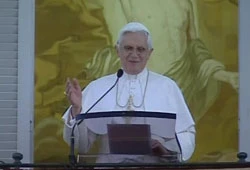
John Paul II Was an Apostle of Divine Mercy, Says Pope Benedict XVI

Before praying the Regina Caeli, the Holy Father spoke about the significance of Divine Mercy Sunday.
Pope Benedict recalled that John Paul II designated the Sunday after Easter as Divine Mercy Sunday, and did so at the same time Sister Faustina Kowalska was canonized. The Polish sister, who died in 1938, is known as the messenger of God's Mercy, since it was through her diary that the message of mercy came to be known to the world, even before it was approved by the Holy See.
Speaking to thousands of pilgrims at Castel Gondolfo and in St. Peter's Square, Pope Benedict said, "Mercy is in reality the core of the Gospel message; it is the name of God himself, the face with which he reveals himself in the Old Testament and fully in Jesus Christ, the incarnation of creative and redemptive Love.”
“This love of mercy also illuminates the face of the Church, and is manifested through the sacraments, in particular that of reconciliation, as well as in works of charity, both of community and individuals,” said the Holy Father.
“Everything that the Church says and does,” continued the Pope, “shows that God has mercy for man. When the Church must call attention to an unrecognized truth, or a good betrayed, it is always driven by merciful love that all people might have life and have it abundantly (cf. Jn 10.10). From divine mercy comes hearts that are pacified, and then comes true peace in the world, peace between peoples, cultures and religions.”
“Like Sister Faustina, Pope John Paul II was in his time an apostle of Divine Mercy,” Benedict XVI noted. “Many noticed the remarkable coincidence that when he closed his eyes to this world on the evening of Saturday, April 2, 2005, it was on the eve of the second Sunday of Easter, Divine Mercy Sunday, and also at the same time as the Marian devotion of the first Saturday of the month. In fact, this was at the core of his long and multifaceted pontificate; his entire mission in the service of God and man and peace in the world was summarized in the announcement he made in Krakow in 2002.”
Pope Benedict recalled the ceremony in Krakow where John Paul II inaugurated the great Shrine of Divine Mercy and said: “'Outside the mercy of God there is no other source of hope for human beings.' His message, like Saint Faustina's, leads back to the face of Christ, the supreme revelation of God's mercy. Constantly contemplating that face: this is the legacy that he has left us, which we welcome with joy and make our own,” the Pope said.
After reciting the Regina Caeli, Pope Benedict greeted pilgrims in Italian, German, French, Spanish and English. He also greeted in a special way Polish pilgrims from the Shrine of Divine Mercy in Krakow- Łagiewniki.
Before imparting his apostolic blessing, he reminded pilgrims that this Sunday's Gospel calls us to recognize through the gift of faith the presence of the Risen Lord in the Church, and that we receive from him the gift of the Holy Spirit.
"During this Easter season, he said, "may we strengthen our desire to bear witness to the Good News of Jesus Christ calling us to a life of peace and joy. Upon each of you present and your families, I invoke God's blessings of happiness and wisdom."