Showing posts with label sandalistas. Show all posts

Wednesday, August 20, 2014

Wisconsin priest punished for celebrating Mass with woman (priest impersonator) dies

By Mary Wisniewski

(Reuters) - A Wisconsin Jesuit who was punished by Catholic Church authorities for celebrating Mass with a woman non-priest in violation of Church rules has died at the age of 94, his nephew said on Wednesday.

Rev. Bill Brennan, a Milwaukee-area peace activist who had done missionary work in Central America, died of natural causes earlier this month, according to his nephew Timothy Brennan. A funeral was held this week.

Bill Brennan celebrated Mass in late 2012 with Janice Sevre-Duszynska of the Association of Roman Catholic Women Priests. Though Brennan remained Jesuit and could hear confessions with other Jesuits, he was no longer able to celebrate Mass or other sacraments publicly under his Church sanction.

Women are forbidden by the Church to become priests, but some have been ordained and celebrate Mass outside of the official Church. Catholic clergy who support the women can face punishment.

Timothy Brennan said his uncle didn't complain about the restrictions imposed on him.

"He wanted there to be equal rights for women, across the board ... ," Brennan said of his uncle. "He recognized them as the backbone of the Church."

When asked about the possibility of women priests, Pope Francis has said "that door is closed."

Brennan's body has been donated for scientific research.

(Reporting by Mary Wisniewski in Chicago; Editing by Eric Beech)

Link:
Related:

Saturday, April 27, 2013

Former Nun in Kentucky Simulates Ordination to the Priesthood

Rosemarie Smead, a 70-year-old Kentucky woman, sings with the audience before being ordained a Roman Catholic priest, during a Celebration of Ordination at St. Andrew's United Church of Christ in Louisville, Kentucky April 27, 2013. Smead was ordained as part of a dissident group operating outside official Roman Catholic Church authority. REUTERS-John Sommers II

Rosemarie Smead, a 70-year-old Kentucky woman, sings with the audience before [not] being ordained a Roman Catholic priest, during a Celebration of Ordination at St. Andrew's United Church of Christ in Louisville, Kentucky April 27, 2013. Smead was [not] ordained as part of a dissident group operating outside official Roman Catholic Church authority. REUTERS/John Sommers II

By Mary Wisniewski 

LOUISVILLE, Kentucky  | Sat Apr 27, 2013 9:00pm EDT

(Reuters) - In an emotional ceremony filled with tears and applause, a 70-year-old Kentucky woman was [not] ordained a priest on Saturday as part of a dissident group operating outside of official Roman Catholic Church authority.

Rosemarie Smead is one of about 150 women around the world who have decided not to wait for the Roman Catholic Church to lift its ban on women priests, but to be ordained and start their own congregations.

Rosemarie Smead (2nd R), a 70-year-old Kentucky woman, is ordained a Roman Catholic priest during a Celebration of Ordination at St. Andrew's United Church of Christ in Louisville, Kentucky April 27, 2013. Smead was ordained as part of a dissident group operating outside official Roman Catholic Church authority. REUTERS-John Sommers II

In an interview before the ceremony, Smead said she is not worried about being excommunicated from the Church - the fate of other women ordained outside of Vatican law.

"It has no sting for me," said Smead, a petite, gray-haired former Carmelite nun with a ready hug for strangers. "It is a Medieval bullying stick the bishops used to keep control over people and to keep the voices of women silent. I am way beyond letting octogenarian men tell us how to live our lives."

Rosemarie Smead, a 70-year-old Kentucky woman, weeps openly as almost the entire congregation comes to lay their hands on her head in blessing, as she was ordained a Roman Catholic priest during a Celebration of Ordination at St. Andrew's United Church of Christ in Louisville, Kentucky April 27, 2013. Smead was ordained as part of a dissident group operating outside official Roman Catholic Church authority. REUTERS-John Sommers II

The ordination of women as priests, along with the issues of married priests and birth control, represents one of the big divides between U.S. Catholics and the Vatican hierarchy. Seventy percent of U.S. Catholics believe that women should be allowed to be priests, according to a New York Times/CBS News poll earlier this year.

The former pope, Benedict XVI, reaffirmed the Catholic Church's ban on women priests and warned that he would not tolerate disobedience by clerics on fundamental teachings. Male priests have been stripped of their holy orders for participating in ordination ceremonies for women.

Rosemarie Smead (front row, C), a 70-year-old Kentucky woman, sings with the audience before being ordained a Roman Catholic priest, during a Celebration of Ordination at St. Andrew's United Church of Christ in Louisville, Kentucky April 27, 2013. Smead was ordained as part of a dissident group operating outside official Roman Catholic Church authority. REUTERS-John Sommers II

In a statement last week, Louisville Archbishop Joseph E. Kurtz called the planned ceremony by the Association of Roman Catholic Women Priests a "simulated ordination" in opposition to Catholic teaching.
"The simulation of a sacrament carries very serious penal sanctions in Church law, and Catholics should not support or participate in Saturday's event," Kurtz said.

The Catholic Church teaches that it has no authority to allow women to be priests because Jesus Christ chose only men as his apostles. Proponents of a female priesthood said Jesus was acting only according to the customs of his time.

They also note that he chose women, like Mary Magdalene, as disciples, [wrong:] and that the early Church had women priests, deacons and bishops [/wrong].


The ceremony, held at St. Andrew United Church of Christ in Louisville, was attended by about 200 men and women. Many identified themselves to a Reuters reporter as Catholics, but some declined to give their names or their churches.

'NEW ERA OF INCLUSIVITY'

The modern woman priest movement started in Austria in 2002, when seven women were ordained by the Danube River by an independent Catholic bishop. Other women were later ordained as bishops, who went on to ordain more women priests and deacons.

The processional enters the Church sanctuary for the Celebration of Ordination of Rosemarie Smead into the priesthood during a service at St. Andrew's United Church of Christ in Louisville, Kentucky April 27, 2013. Smead was ordained as part of a dissident group operating outside official Roman Catholic Church authority. REUTERS-John Sommers II

"As a woman priest, Rosemarie is leading, not leaving the Catholic Church, into a new era of inclusivity," said Bishop Bridget Mary Meehan during her sermon Saturday. "As the Irish writer James Joyce reminded us, the word 'Catholic' means 'Here comes everybody!'"


Smead had to leave the rigorous Carmelite life due to health reasons, and earned a bachelor's degree in theology and a doctorate in counseling psychology. She taught at Indiana University for 26 years, and works as a couples and family therapist.

During the ordination ceremony, Smead wept openly as nearly everyone in the audience came up and laid their hands on her head in blessing. Some whispered, "Thanks for doing this for us."

Rosemarie Smead, a 70-year-old Kentucky woman, lies prostrate on the floor as the audience prays for the blessing of the Saints, before being ordained a Roman Catholic priest during a Celebration of Ordination at St. Andrew's United Church of Christ in Louisville, Kentucky April 27, 2013. Smead was ordained as part of a dissident group operating outside official Roman Catholic Church authority. REUTERS-John Sommers II

During the communion service, Smead and other woman priests lifted the plates and cups containing the sacramental bread and wine to bless them.

A woman in the audience murmured, "Girl, lift those plates. I've been waiting a long time for this."

One of those attending the service was Stewart Pawley, 32, of Louisville, who said he was raised Catholic and now only attends on Christmas and Easter. But he said he would attend services with Smead when she starts to offer them in Louisville.

"People like me know it's something the Catholic Church will have to do," said Pawley.

(Editing by Tim Gaynor and Mohammad Zargham)

Link:
Related:

Saturday, March 9, 2013

The National Catholic Reporter draws rebuke from Bishop Robert Finn

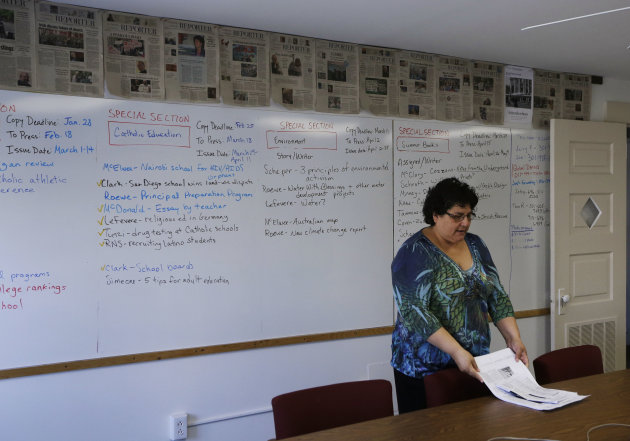
 In this Wednesday, March 6, 2013 photo, editor Toni Ortiz works in a conference room at the National Catholic Reporter in Kansas City, Mo. The National Catholic Reporter, a newspaper known for unflinching coverage of the Catholic church scandal, was rebuked by a bishop in its own backyard after calling for his ouster in a battle that illustrates tensions between U.S. bishops and groups that call themselves Catholic but aren't sanctioned by the church. (AP Photo/Orlin Wagner)
 Associated Press/Orlin Wagner - In this Wednesday, March 6, 2013 photo, editor Toni Ortiz works in a conference room at the National Catholic Reporter in Kansas City, Mo. The National Catholic Reporter, a newspaper known for unflinching coverage of the Catholic church scandal, was rebuked by a bishop in its own backyard after calling for his ouster in a battle that illustrates tensions between U.S. bishops and groups that call themselves Catholic but aren't sanctioned by the church. (AP Photo/Orlin Wagner)

By MARIA SUDEKUM

KANSAS CITY, Mo. (AP) — A newspaper known for unflinching coverage of the Catholic church scandal was rebuked by a bishop in its own backyard after calling for his ouster in a battle that illustrates tensions between U.S. bishops and groups that call themselves Catholic but aren't sanctioned by the church.

The National Catholic Reporter, an independent Kansas City, Mo.-based weekly, called for Bishop Robert Finn's removal or resignation in September, after he was convicted of failing to report suspected child abuse.

Finn, leader of the Roman Catholic Diocese of Kansas City-St. Joseph, later wrote in an editorial in his own diocesan newspaper that parishioner anger is growing over the NCR's challenges to Catholic orthodoxy on topics ranging from the ordination of women to contraception.

In the last several years, church leaders have been trying to shore up the religious identity and mission of organizations that call themselves Catholic, including trying to bar groups from saying they have ties with the church if bishops believe the organizations stray from church teaching. Conflict over the issue intensified in the 2008 presidential election, when some Catholic advocacy groups backed Barack Obama despite his support for abortion rights.

Finn, who declined to be interviewed by The Associated Press, wrote in his editorial that a local bishop first asked the paper to remove Catholic from its name in 1968 — "to no avail."

"In light of the number of recent expressions of concern, I have a responsibility as the local bishop to instruct the Faithful about the problematic nature of this media source which bears the name 'Catholic,'" Finn wrote in The Catholic Key. "While I remain open to substantive and respectful discussion with the legitimate representatives of NCR, I find that my ability to influence the National Catholic Reporter toward fidelity to the Church seems limited to the supernatural level."

Thomas Groome, professor of religious education at Boston College, said he was surprised Finn was "picking such a public fight." Finn is the highest-ranking U.S. church official convicted of a crime related to the sex abuse scandal. The misdemeanor charge stemmed from the case of an area priest who pleaded guilty in August to producing child pornography. Finn and other church officials knew about photos on the priest's computer six months before they turned him in.

Groome said the Catholic Church benefits from publications such as the National Catholic Reporter.

"There are all kinds of ways the church's position has evolved, and if that's to happen you need publications like the NCR that raises critical issues, controversial issues, and I think it does that respectfully with a sense of faithfulness to the church's core teaching," he said.

NCR, founded in Kansas City in 1964, has been widely lauded for its coverage of the church and garnered widespread recognition for its reporting on child sex abuse in the 1980s. The newspaper, which has a circulation of about 35,000 and is available online, has won several awards from the Catholic Press Association, including for general excellence for 13 straight years. The CPA, while independent, works closely with church hierarchy, according to Timothy Walter, CPA's executive director.

"We don't present official teaching, and we don't pretend to," said the newspaper's editor, Dennis Coday. "What we do is report on what's happening in the church. And part of what's happening is dissent and questioning, and that's what we report about. And that's why we remain Catholic and continue to call ourselves Catholic."

Coday said the question for the paper is: "Are we upholding the deepest values set out in the Gospel, the message Jesus preached?"

Finn is not alone in complaining about NCR, which has also called for the church to reverse its teaching on women's ordination and supported re-examining the church's approaches to contraception and sexuality.

Canon lawyer Edward Peters, the Vatican's expert witness in U.S. sex abuse lawsuits and an adviser to the Vatican's highest court, said in a recent blog post that Finn was "too kind" in his remarks about NCR and noted that other groups have stopped using "Catholic" in their names.

Peters said the newspaper has carried on "a steady tirade against ecclesiastical authority in general, and against numerous Church teachings in particular, for several decades."

"But the last few years have seen a shrillness that should discomfort even its dwindling number of friends," Peters wrote.

The tension between NCR and Finn likely won't resolve easily because it's tied to an ongoing battle over authority in the church, said the Rev. Thomas Reese, senior fellow at the Woodstock Theological Center at Georgetown University.

"The vision of the Vatican and the hierarchy is that the Catholic media should support and ... promote the positions taken by the hierarchy," said Reese, who was removed from his position as editor of the Jesuit magazine America in 2005 after it published stories on topics including gay marriage.

"But you know," Reese said, "many people in the Catholic media think that they should also criticize those positions or be a forum where there can be discussion and argument and dialogue on issues facing the church."

Link:

Friday, October 21, 2011

A Modern Seminarians’ Dictionary

H/t to Carol, from Domenico Bettinelli at Bettnet.com:

"I saw this once back when I was in college and have regretted not keeping a copy ever since. I have sought it high and low and have finally had it come across my desk again. It is both hilarious and stunningly accurate. Read them all, you’ll recognize some of them especially if you’re a frequent visitor here."

A MODERN SEMINARIANS’ DICTIONARY

Published in “Fidelity”, September 1987, pp. 23-25.

Brother seminarians!  Are you troubled by the non‑judgmental expectations of the seminary?  Are you confused by their concerns? Fear not.  Before your eyes you have the key to ordination in this person’s seminary.  Add these terms to your theological lexicon and believe me, you could well be ordained one or two years early!                   

PASTORAL:  Effeminate; an attribute lacking in a man who demonstrates overt masculine attributes of clarity, decisiveness, and orthodoxy: G.K. Chesterton was not pastoral.

RIGID: Your view is not my view; normally, the rigid person has a simplistic view of Catholic doctrine (see SIMPLISTIC); for example, a rigid person holds that the ordination of women is not possible; a flexible person holds that to fail to ordain women is an example of sexism.  Evelyn Waugh was rigid: “It is better to be narrow‑minded than to have no mind, to hold limited and rigid principles than to have none at all.  That is the danger which faces so many people today ‚ to have no considered opinions on any subject, to put up with what is wasteful and harmful with the excuse that there ‘is good in everything’ ‚ which in most cases means an inability to distinguish between good and bad.”

VISION:  The quality of agreeing with me. 
         
JUDGMENTAL: A person who judges the sin but not the sinner.  A non‑judgmental person utters not a word on the morality of the usual sexual sins, but tries to determine “where a person’s at” so that the person’s motives can be judged accordingly; a non‑judgmental person judges the sinner but not the sin. 

SIMPLISTIC:  Having to do with common sense. 
         
CATHOLIC FUNDAMENTALIST:  A simplistic person who tries to live the Faith in a docile and pious way; also a Catholic who frequently prays the Rosary.

FLEXIBLE:  You agree with me; a flexible person is open and dialogues on any issue, smiles knowingly and does precisely what he started out to do.

CHALLENGE:  To recognize that my views are better than your views.
           
GROWTH:  For you to assimilate my way of thinking into your life.

ENABLE:  An essential attribute of a priest whereby he is able to convince others to do things his way without parishioners catching on to the deception.

NETWORKING:  Allowing nuns to run parishes.

I HEAR YOU:  A clever way of telling you that I don’t agree with you but I don’t want to sound dogmatic, rigid or inflexible. 

WE HAVE NO RIGHT ANSWERS/WE DON’T HAVE MANY ANSWERS:  Except this one (cf. Archbishop Rembert Weakland on homosexuality:  “...I would like to state that I do not have all the answers on this highly complex issue…”  (The Catholic Herald, July19, 1980.) 
         
YOU’RE NOT LISTENING: The way a flexible, non‑judgmental person expresses disappointment that a rigid, dogmatic person doesn’t agree with him; example:  the Pope is “not listening” to the American Church.  

OPEN AND HONEST:  Telling religious superiors what they want to hear.           

WOUNDED HEALER:  The term used to convince a person who doesn’t “feel good about himself” to feel good about himself without Confession.           

WHERE YOU’RE AT:  Your psychological condition when you’re in the state of mortal sin calling for acceptance and a non‑judgmental attitude.
           
WHERE ARE THOSE TEARS COMING FROM?:  The standard question to ask troubled or sick persons when you have nothing else to fill up the unnerving silence.
         
COMPLEX TECHNOLOGICAL WORLD:  The reason for resisting one’s conscience when opposing the teaching of the Catholic Church; also, the standard response a flexible person uses when a rigid person seems to be winning an argument.
           
VALUING YOUR SEXUALITY:  Obsession with the usual adolescent preoccupations.           

WE ARE ALL SEXUAL BEINGS:  The reason to overlook sexual misbehavior in seminaries.

CELIBACY: Refraining from heterosexual genital activity.           

PROCESS: The spontaneous movement in the dialogue of group therapy sessions never to be disrupted by thinking.

FEELING:  The highest faculty of the human person left fully untouched by original sin.

ORIGINAL SIN:  See SEXISM.           

LOVE:  A nice feeling.
         
THINKING:  The most dangerous activity in a seminary; cause for psychological counseling; those who think “disrupt the process”; see PROCESS.

TOUCH, MINISTRY OF:  Physical contact to demonstrate that one has the capacity of intimacy; does not necessarily involve an exchange of bodily fluids.     
   
IN TOUCH WITH FEELINGS:  Using the intellect to explicitly identify what one is feeling so that speech patterns can be altered to communicate one’s sensitivity and compassion; not to be confused with “intellectualizing your feelings”.

INTELLECTUALIZING YOUR FEELINGS: Controlling one’s temper.

COMPASSION:  The warm feeling one has for oneself at any given time; one who has compassion needs to tell others he/she has compassion, otherwise compassion isn’t present; see also IN TOUCH WITH FEELINGS.

COMPASSION BURNOUT: The loss of the warm feeling one has for oneself when charitable works become wearisome or otherwise costly.

SENSITIVITY:  The ability to identify and agree with the conventional wisdom of left‑wing political issues such as feminism, gay rights, dissent,etc.  Tim Unsworth of the National Catholic Reporter describes a sensitive priest: “But Vince Connery also cries a lot.  He cries openly and unashamedly in private conversation and in public.  He doesn’t cover his face or hide it in the crook of his elbow. He simply stands there and cries, letting the tears flow and the voice break; and if someone reaches out even slightly, Connery will share an embrace while he cries some more.  It soon becomes clear that this is an emotionally healthy priest in an emotionally unhealthy church” (NCR April, 1987).         

TOTAL COMMITMENT:  The intensity of involvement in charitable works until one finds that one “doesn’t feel good” about oneself; total commitments usually last six months to a year.           

LEGALISM:  Accepting at face value and obediently implementing what a document, law, or guideline reads.

OBEDIENCE: A word which doesn’t exist.

RULES: A word that once was operative but was done away with by the Second Vatican Council.

EXPECTATIONS:  Flexible guidelines which change as frequently as the feelings of the Rector; not to be confused with RULES or LEGALISM.           

REPRESSED ANGER: If detected, a cause for dismissal from the seminary; probable cause of both world wars, the Holocaust, and the election of Ronald Reagan [and George H.W. Bush and George W. Bush]; a technique absolutely essential for an orthodox seminarian to get ordained.           

FORMATION:  Kindergarten.           
AFFIRMATION:  The flattery due to someone who is in a position of authority.           

AUTHORITY:  Cannot exist or be invoked unless vested in a sensitive, flexible, non‑judgmental and compassionate person (see SENSITIVE, FLEXIBLE, and JUDGMENTAL).           
SEXISM:  The sin associated with being male.           

MALE DOMINATION: The irritating interest men have in sports, cigars, and male‑bondingÆ’especially in the hierarchy of the Church; the only mortal personal sin.     
                                                 
FEMININITY:  A word created by a sexist, male‑dominated society to subjugate women in the maternal role;  the presence of femininity in women religious is a cause to recommend psychological counseling.

GETTING IN TOUCH WITH ONE’S FEMININE SIDE:  An essential requirement for ordination to the priesthood.

NEGATIVE:  The bad attitude having to do with the recognition of personal sin;  also, any disposition which is not happy with the policies and views of sensitive, flexible and non-judgmental people.           

CHANGE:  Mandated by the Second Vatican Council; must be open to all change unless instituted recently; see WE HAVE NO RIGHT ANSWERS.

CONCERN: The response that a sensitive, flexible, non-judgmental and compassionate people in authority have when someone doesn’t agree with them.

HUMANKIND:  The human race free of sexism (see SEXISM).           

PARENTING:  The activity of humankind in begetting children (see HUMANKIND).
SPIRIT OF VATICAN II:  Church activities and programs which have absolutely no relationship to the letter of the documents of Vatican II.

ONGOING:  The period of time between the Second Vatican Council and the implementation of the Spirit of Vatican II (see SPIRIT OF VATICAN II).             
RELEVANT: Anything to do with dissent from Church teaching.           

PAIN:  The focus of Church dissent; felt by the editors of the National Catholic Reporter and inflicted by the editors of The Wanderer.

REDEFINING THE CHURCH:  Defining the Church according to the Spirit of Vatican II (see SPIRIT OF VATICAN II).           

LIBERATION: The replacement of existing structures of constraint with new and improved structures of constraint.             

CONSCIENCE:  The final arbiter of the correctness of one’s action always to be guided by the latest in Church dissent.

PRE‑VATICAN II:  A person who accepts at face value the teaching of the Church and who reads the documents of the Second Vatican Council without reference to a commentary.

CHURCH:  Me.           

MACROCHURCH:  The male-dominated, sexist, oppressive, authoritarian hierarchical Church.

MICROCHURCH:  The pastoral, flexible, open and honest, compassionate, open-to-change, local Christian community.           

COLLEGIALITY:  The doctrine defined by the Spirit of Vatican II stating that bishops have exactly the same authority as the Bishop of Rome.           

BISHOP OF ROME:  The local ordinary of an obscure diocese in Italy.

RADICALLY CONSERVATIVE:  Reason to ignore the current discipline of the Church.           

THE FUTURE:  The last and enduring hope of Church dissenters.

WE CAN’T GO BACK:  An absolutely efficacious and disarming argument.
HUMANAE VITAE:  The biggest mistake the Church has made since the Council of Trent.
   
COUNCIL OF TRENT:  A convenient summary of medieval myths and superstitions.

ECUMENISM:  The process of transforming the liturgical rites of the mainline Christian denominations into a single rite of coffee, donuts and dialogue.           

TRADITION:  A practice established before the Middle Ages or after the Second Vatican Council.           

THE LAITY:  The future of the Church; cannot be ignored unless associated with ultra-conservative groups.

ULTRA‑CONSERVATIVE:  Anyone who disagrees with the National Catholic Reporter.

TRADITIONAL NUN: Irrelevant; an embarrassment to women religious.           
WOMEN RELIGIOUS: Feminist nun; an oxymoron.           

SOCIAL JUSTICE:  The realignment of social structures according to the platform of the Democratic Party.  

PROGRESSIVE:  Pouring the wine of old heresies into new wineskins.           

CONSCIOUSNESS RAISING:  The method of argumentation used by radical feminists moving adult males to action: “Better to live in a corner of the house‑top than have a nagging wife and a brawling household” (Prov.21:9).         


EXPERIENCE: The only valid way to substantiate one’s opinions and beliefs; there’s no such thing as a"bad experience”.

SPEAKOUT:  The activity springing from the virtue of Social Justice whereby sensitive and compassionate persons, with great emotion, promote the platform of the Democratic Party.

SHRILL:  The nasty habit rigid and judgmental people have when they dare to disagree with the demands of Social Justice (see SOCIAL JUSTICE).         


PREFERENTIAL OPTION FOR THE POOR:  Socialism.             

MINISTRY:  All human activity.           

COMFORT, COMFORTABLE: The final cause and proper object of ministry.             

PLURALISM:  The acceptance of all points of view except those with a point of view which doesn’t accept all points of view.

CLERICALISM:  The attitude of priests who knowingly and willingly practice the sacramental aspects of the priesthood with diligence, reverence and joy.

HOMOPHOBIC: The psychological condition of those who witness and report acts of homosexuality to seminary authorities.           

GAY:  Deeply sensitive person who naturally possesses the skills for effective pastoral ministry; oppressed minority; in no way connected with pederasty:  cf. Fr. James L. Arimond: “Don’t confuse homosexual orientation with other sexual minorities:  transexual; pederasty; bafoonery; etc.” from an Archdiocese of Milwaukee workshop in Gay Ministry.           

SEXUAL PREFERENCE:  Feeling good about some or all objects of desire whether animal, vegetable or mineral.

MISSION STATEMENT: A written objective or goal of a pastoral program upon which the success of the Gospel of Jesus Christ depends.

INTERFACE: A term, borrowed from computer technology, where sensitive and compassionate people dialogue among themselves; similar to the dialogue that the farmers and pigs engaged in in George Orwell’s Animal Farm.           

ORDINATION:  An archaic celebration in the Church still useful to mark the beginning of full-time ministry.

SEMINARY:  School where men and women are prepared for full-time ministry.

OUTREACH: Any program for whatever reasons; also known as reach out; usually involves fundraising.

VOCATIONS CRISIS: Refers to the Church’s failure to relax the rules on celibacy and failure to ordain women.

SHARE:  The practice of discussing the deepest intimacies of one’s life in front of complete strangers.           

WORKSHOP:  A church-sponsored meeting to ensure that the issues of optional celibacy, women’s ordination, the Sandinistas and leisure suits are still being addressed.           

SELF‑ACTUALIZATION: Salvation; no longer a mortal sin.           

DIALOGUE:  The deft use of banal clichés in conversation.

PROPHETIC/PROPHET: One who has the courage to speak out on one’s behalf; e.g., Charlie Curran.

CURRAN, CHARLIE:  Twentieth century saint; went into debt defending his faith.           

EMPOWER:  To encourage others to think for themselves; cf., Evelyn Waugh:  “Every effort was made to encourage the children at the public schools to „think for themselves.”  When they should have been whipped and taught Greek paradigms, they were set arguing about birth control and nationalization.  Their crude little opinions were treated with respect.  Preachers in the school chapel week after week entrusted the future to their hands.  It is hardly surprising that they were Bolshevik at 18 and bored at 20.”

POWERFUL:  A spontaneous exclamation from hearing one’s own views restated in a more banal fashion.    

LITURGISTS:  “A society of men among us, bred from their youth in the art of proving by words multiplied for the purpose, that white is black, and black is white, according as they are paid” (Swift, Gulliver’s Travels).

EASTER DUTY:  Annual sacrilege.           

PSYCHOLOGIST:  Infallible teaching authority in the Church.           

OFFICIAL CHURCH TEACHING:  “I don’t expect it to change anybody’s mind one way or another.  Catholics today have learned what it means to be selectively obedient to the Church’s teaching” (Father Richard McBrien, Washington Post, December16,1981).                               

CHASTITY: Safe sex.                                                     

SAFE SEX:  Taking appropriate precautions during high risk sexual activity; not to be confused with responsible love.           

RESPONSIBLE LOVE:  Sexual relations only within marriage with a spouse; an ideal impossible to sustain in a complex technological world.

HIGH RISK SEXUAL ACTIVITY:  Sodomy; the term neo‑Victorian Catholics use when referring to the kinds of sexual activity St. Paul warned against.

CLOWN MASS:  Liturgical innovation comparable to the innovation of Gregorian chant; relevant:  “A clown liturgy may sound sacrilegious but those who attended a special Mass at St. Agnes Church described it as moving, uplifting, spirited and colorful” (Catholic Herald, Milwaukee, February 16, 1984).

LITURGICAL DANCE:  Liturgical innovation comparable to the innovation of Gregorian chant:  “Today’s procession into the altar by the priest and some members of the laity was a dance in the early church”  (Sister Baraba Link); relevant: “‘For me, my body is my instrument; it’s my way of expressing myself,’ she said, gesturing frequently with hand to convey her thoughts.  ‘I feel free when I dance; it’s a natural expression.’” (Sister Barbara Linke, quoted in the Milwaukee Sentinel, August 3, 1985).

Thursday, September 1, 2011

A Clergy Rebellion in Austria's Catholic Church

From Time.com:

By Michael Frank / Süddeutsche Zeitung / Worldcrunch

This post is in partnership with Worldcrunch, a new global-news site that translates stories of note in foreign languages into English. The article below was originally published in Süddeutsche Zeitung.

VIENNA — There is open rebellion among the clergy of Austria's Catholic Church. One highly placed man of the cloth has even warned about the risk of a coming schism as significant numbers of priests are refusing obedience to the Pope and bishops for the first time in memory.

The 300-plus supporters of the so-called Priests' Initiative have had enough of what they call the church's "delaying" tactics, and they are advocating pushing ahead with policies that openly defy current practices. These include letting nonordained people lead religious services and deliver sermons; making communion available to divorced people who have remarried; allowing women to become priests and to take on important positions in the hierarchy; and letting priests carry out pastoral functions even if, in defiance of church rules, they have a wife and family. (See photos of Pope Benedict XVI in Spain.)

Cardinal Christoph Schönborn, Vienna's Archbishop and head of the Austrian Bishops' Conference, has threatened the rebels with excommunication. Incidentally, those involved in the initiative are not only low-profile members of the clergy. Indeed, it is being led by Helmut Schüller — who was for many years vicar general of the archdiocese of Vienna and director of Caritas — and the cathedral pastor in the Carinthian diocese of Gurk.

The issues that supporters of the initiative want addressed may be revolutionary, but they are by no means new: they constitute basic questions that have been around for a long time but have never been addressed by church officials.

The initiative's supporters are demanding that parishes openly expose all things forbidden by the church hierarchy, thus putting a stop to hypocrisy and allowing authenticity of belief and community life to emerge. The appeal for "more honesty" made to the world's youth by Pope Benedict XVI in Madrid last week left a sour taste in many mouths in Austria, where some say that honesty is a quality the church hierarchy has more of a tendency to punish than reward.

Open Pressure and Disobedience

Particularly affected are some 700 members of an association called Priester ohne Amt (Priests Without a Job) who wish in vain to practice their ministry because they have a wife and children and stand by them. Priests who break ties with loved ones, on the other hand, are allowed to continue working. (See photos of President Obama's meeting with Pope Benedict XVI.)

According to the initiative's founder Schüller, only openly disobedient priests and pressure from both priests and laity can force the hierarchy to budge. Although the problems have been out there for decades, he says, the church keeps putting off doing anything about them. Schönborn stated that the critics would have to "give some thought to their path in the church" or face unavoidable consequences. On the other hand, Anton Zulehner, a priest who is one of the most respected pastoral theologians in Austria, believes that this time the church is not going to get away with diversionary tactics.

Twenty years ago, Austria, nominally at least, was 85% Catholic. Today, in the city of Vienna, Catholics account for less than half the population while rural parishes are melting away. Various scandals have rocked the Catholic Church in Austria, among them child-abuse charges against former Vienna Archbishop Hans-Hermann Groër and the nomination of a series of reactionary priests to the rank of bishop.

Read the original story in German.

Monday, February 23, 2009

The Tablet Tries to Silence Father Finigan's Response

From Father Z:

"This is hilarious. His Hermeneuticalness, Fr. Tim Finigan, who was recently the object of a mean-spirited hit-piece by Elena Curti in the pages of The Tablet, writes:

CENSORED!

The Tablet have asked me to remove this post because it is a breach of copyright for me to quote their article in full. A new copyright-compliant version is available at the post: Responding to the Tablet – legally compliant version

It is hilarious to see the Tablet failing utterly to grasp the concept of publishing on the internet.
During a recent cordial phone chat about this sad affair, Fr. Finigan and I predicted that The Pill would come after him for responding in detail.
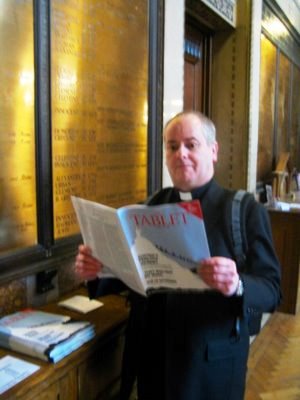
Right on schedule.

This says a great deal about The Tablet.

First, they drag him on a hurdle through the liberal parishes and chanceries willing to swallow the their message.

Then they whine when he frees an arm and bloodies their noses with his bonds.

They want him to go quietly.

Bullies are ever craven.

Second, they are stuck not only in the washed-up ecclesiology of the ‘70’s, they are stuck in the ‘70’s tools of social communication.

They think they are going to contain what they did to Fr. Finigan.

I checked Wikipedia for The Tablet and found that in 2006 it had a circulation, if the number is accurate, of 23,628. I suppose most of that involves the copies off-loaded in parish churches.

I get more readers than that every day.

And I hope everyone of them will visit Fr. Finigan’s site!

You know… if they all sent Fr. Finigan £ 1.00 ... just to, you know, offset the expense of his ultra-right wing clerical garb …. imagine what The Pill could write about next? Imagine how irritating that would be to the progressivists. "

Thursday, February 19, 2009

Fr. Tim Finigan's Response to the Tablet

From Fr. Tim Finigan of Our Lady of the Rosary, Blackfen:

"The Tablet article is up now so I thought I should get in quickly. Sorry for the length of this post but I need to get a few things on record. Following the Zuhlsdorf convention, my emphases in black and my comments in red. (Fr Z just rang me and it seems that we have been engaged in a simultaneous transatlantic fisk. (See: Exercises in intimidation: The Tablet attacks Fr. Finigan)


That was not my Mass
Elena Curti

Nearly 40 years ago, that was the comment of the keenest supporters of the Tridentine Rite as the new rite was introduced. Now the sentiment has been reversed in the suburban parish of Blackfen, where a priest’s introduction of traditionalist liturgy has split the parish

Each Sunday at around 9.45 a.m. [or earlier - youngsters get there up to an hour before Mass to help prepare] a team at Our Lady of the Rosary, Blackfen, in the south-eastern suburbs of Greater London, erects a wooden stepped platform faced in a marble-effect laminate on the altar. On this is placed a gold crucifix, six large candlesticks, vases of flowers and altar cards for the celebration of the old Latin Mass. Welcome to the parish of Fr Tim Finigan, popular blogger and leading light of the Latin Mass Society of England and Wales.

Fr Finigan is in the vanguard of priests determined to restore “tradition” to their parishes and, step by step, [gradually, with explanations, over a couple of years] he has introduced elements of the extraordinary form into the liturgy at his church. The centrepiece is the weekly Sunday Tridentine Mass at 10.30 a.m, introduced in the wake of the Pope’s motu proprio allowing wider celebration of the old rite. During his 11 years in charge he has also gradually brought in other traditionalist touches that have split the parish. [Ah yes, the "split" - thats a key point of the article - but in fact the vast majority of parishioners just come along to whichever Mass they want, and wonder what all the fuss is about. What hurts them is the bad atmosphere caused by vehement complaining and controversy. This is not helped, of course, by airing it all in the press.]

Between 30 and 40 people no longer attend the church and a similar number have taken their place. [Hmmm. In these suburban parishes, over the course of a year or so, there are at least that number coming and going for all sorts of reasons.] The row about numbers has become so heated that supporters of Fr Finigan carefully count the numbers attending the Sunday morning old-rite Mass. [We have long counted all the numbers at all the Masses. More recently, the accuracy of these counts has been made an issue. It has been important to counter the claim that the usus antiquior Mass is not well supported. 135 came last Sunday. Total at the four masses, about 550.] An auxiliary in Southwark diocese, Bishop Pat Lynch, has been called in to mediate. [Not quite. He was complained to, and generously took time to meet various people and advise on bringing peace in the situation.]

In what was once a fairly typical parish, [oh, it still is, in many ways] there are no extraordinary ministers of the Eucharist. Altar rails have been installed and the parish priest makes it clear that he prefers communicants to kneel and to receive the Host on the tongue. [I have passed on the insights of Archbishop Ranjith, Bishop Schneider and others, and mentioned the example of Pope Benedict. As with other matters, this is not about what "I prefer" but about what is best.] Communion is not usually offered under both species. At a regular Sunday evening Mass in the new rite, there are no bidding prayers and the congregation is not invited to exchange the sign of peace. [At the other new-rite Sunday Masses, these things are all available.] Fr Finigan says the Eucharistic Prayer with his back to the congregation [boo!] with the stepped platform, properly called a gradine, on the altar. Unaccompanied hymn-singing has been dropped after the priest complained it was a “torture” to continue to inflict it on the assembly. [It was.]

Old-rite Masses are also usually celebrated on major feast days including Midnight Mass, and there is a regular Mass in the extraordinary form on Saturday mornings. The ordinary form is used for the Saturday vigil Mass and the Sunday 9 a.m. children’s Mass. Weekday Masses are in the new rite.

But Fr Finigan’s critics fear that their parish is gradually becoming a flagship for the Tridentine Rite. They claim that most of those who welcome the trend are newcomers living outside the parish. [The claim is simply false.]

“Six parishioners wanted the Latin Mass here. [No idea where that number comes from.] I have no objection to them having it once a month or once a week, but it should not be the main Sunday Mass and it should not be imposed over the whole parish,” [It isn't. We have four weekend precept Masses, three of them in English, in the novus ordo.] said Les Thomas, a member of the delegation that went to see Bishop Lynch.

Mr Thomas is one of nine parishioners I met who claim that Fr Finigan’s dedication to “tradition” has hurt the parish. Most of them have served as readers and/or Eucharistic ministers. Four say they can no longer bear to attend Mass at Blackfen, the rest doing so under sufferance.

“It is a matter of principle. I won’t be driven out,” says Eddie Sweeney, a former master of ceremonies and scoutmaster who has lived in the parish for 57 years. The group describe feelings of irritation, discomfort and sadness at the changes that have been made. Those who prefer to stand for Communion and receive it in the hand say they feel selfconscious doing so at Fr Finigan’s Masses. [I never do anything to indicate disapproval of someone receiving Holy Communion correctly according to the current norms. Many people have told me of how priests have made difficulties for them receiving on the tongue. As for kneeling when everyone else is standing - well we all know how that goes down.]

Several said their adult children vowed never to go to the church again, such was their unhappiness with the liturgy. “People who have been away from church come back at Christmas and Easter and are totally put off. It is so sad,” said Jean Gray. A woman who asked not to be named said she had known Fr Finigan for many years and he had been a “rock” supporting her family through some difficult times. But she felt moved to complain after she asked him to celebrate a Mass for her daughter’s favourite aunt who had recently died. She did not realise at the time that it would be entirely in Latin. “My daughter cried through most of the Mass because she could not join in. Afterwards she said: ‘That was not my Mass.’” [I'm sorry that this happened: I would never knowingly put someone's Mass intention on at a Mass they didn't want to go to. And, I'd always be happy to celebrate the Mass again on a different occasion.]

Rules introduced include an insistence on silence in the church before and after Mass, [Rules? I periodically ask people not to hold conversations in the Church so that others are left free to pray if they want to. Some people just ignore this.] which critics said meant there was little opportunity for parishioners to mingle afterwards, losing an important point of contact especially for the elderly. [Whenever I talk about silence in Church, I always affirm the importance of social interaction outside or in the Hall.]

There were also complaints about their priest’s refusal to support Cafod, his expenditure on traditional vestments and other clerical garb, the absence of a parish council and failure to account to parishioners how money from the collection plate was being spent. [This is a really cheap shot and I'll address it below.]

Matters came to a head last October when one parishioner, Bernard Wynne, a retired management consultant, set out his grievances in an email to Fr Finigan and asked for a parish consultation. He copied his message to a number of parishioners [and the Archbishop, and the Area Bishop] and invited them to make their views known. The ensuing correspondence resulted in about a dozen people objecting to Fr Finigan’s approach and about the same number supporting him.

In her email Susan Reynolds, a parishioner for 35 years wrote: “I grew up with the Latin Mass and remember sitting watching men and women saying the Rosary, slyly reading the newspaper or making responses they didn’t really understand. The English Mass made us participants and co-celebrants in the sacrifice of the Mass. The instruction to ‘open the windows and doors’ is one of the most liberating things to happen in the Catholic Church. If you listen carefully you can hear them being shut in Blackfen.”

Fr Finigan’s response [to the above and many other emails totalling about 20,000 words] was a 35-page essay, in which he set out the thinking behind his use of the “traditional liturgy”. [See: "Sacred and Great"] But it is in a lecture to the Latin Mass Society’s training conference at Oxford last year for priests learning how to celebrate the extraordinary form that he set out his strategy. He told the priests they were the “infantry” who need to overcome “real problems and difficulties” in bringing the extraordinary form to their parishes. He said the priest had a responsibility to persevere even in parishes where there were not a large number of people requesting the old rite. [Well, what I said was that priests could not adequately prepare for the older form by catechesis alone but needed to persevere even though it might be a shock to begin with. But see the article. The reference to "infantry" was an allusion to the phrase "poor bloody infantry" who are at times attacked by both officers and civilians. This sometimes ring true for parish clergy.]

Parish reaction to the introduction of the old rite would find a few “very favourable”, a few “strongly against”, and “the substantial majority who simply wonder what Father is doing now”. It was, Fr Finigan said, “important not to neglect this majority of our parishioners in deference to a vocal minority”.

When I spoke to Fr Finigan he admitted there had not been a stable group at Blackfen who had requested Mass in the extraordinary form as set out in the motu proprio, but over a period of time he said most parishioners had accepted the liturgy and some, particularly young people, had become very enthusiastic about the old Latin Mass. [Oh there had been a stable group, all right. What I admit is that (despite temptation to the contrary) I did not get them get them to draw up a petition etc. to introduce the Mass on those grounds. I read SP as allowing the pastor to introduce the usus antiquior for pastoral reasons and felt it was more honest to do just that. (See my post 'If ... but not "only if"'). I think that Cardinal Hoyos supports this position.] He pointed out the three Masses in the ordinary form that people could attend on Sundays, adding: “I am not going to be able to please everybody. I would like people to gradually be able to settle down and accept the way things are now.”

The parish priest rejected the idea of a consultation or the setting up of a parish council on the grounds that it would be a “bear pit” and “people would be at each others’ throats”. [Having a big meeting for everyone to argue about the Liturgy would, I think, not be helpful. I'm not against the idea of a Parish Council if it will help the pastoral work of the parish but not as a quarterly debate on how we should celebrate the Liturgy.] With regard to the parish’s finances, he said he was arranging to get help so that a summary of income and expenditure could be published for parishioners.

Fr Finigan put me in touch with five parishioners who support the changes at Blackfen. One was a mother of seven-year-old twins, Wendy Kane, who lives just outside the parish boundary [In fact, in suburban parishes, lots of people cross parish boundaries.] and has been attending Our Lady’s for seven years. She felt delighted with the liturgy and said it had strengthened her faith and that of her family, adding: “The extraordinary form is not what I grew up with and I never experienced it before. I personally find it a beautiful form of worship.” [And her boys are very eager to start serving as soon as they have made their first Communion, and her husband is being received into the Church this Easter.]

Another supporter, Julia Jones, a 38- year-old teacher who moved to the parish last summer, said: “I have been very moved by the silence and palpable feeling of devotion, especially during the Eucharistic Prayer. I have gained greatly from the experience in only a few months. I really do believe that I have found ‘the pearl of great price’.”

Bishop Lynch said this week that the whole parish needs to build communion through prayer and social activities. “You need a situation where people respect diversity but can also come together,” he said. [I heartily concur - and many thanks to Bishop Lynch for his tactful interventions at every stage.]

Fr Finigan trained for the priesthood at the English College in Rome and has worked in parishes in south-east London for 23 years. Through his blog, The Hermeneutic of Continuity, which recently had its millionth hit, he has become well known. He is also a visiting tutor in Sacred Theology at St John’s Seminary, Wonersh; and there can be no doubt that he considers bringing the old rite to his parishioners central to his ministry.

Some welcome what Fr Finigan is doing. It is equally clear that some do not. If Fr Finigan is right, and the priest’s responsibility for the liturgy in his parish is absolute, [It is not absolute, it is subject to the law of the Church. Pope Benedict more than once pointed out that even the Pope is subject to the tradition of the Church.] there is nothing parishioners can do about it. And there could be many more Blackfens in the future. [I must get a parish anthem going (ouside the Liturgy, of course) - something along the lines of "There's only one Blackfen!"]
Just a note on finances. The bit about vestments and clerical garb (Boo! Hiss!) is, as I said, a cheap shot. It is a part of my responsibility to ensure that there are dignified vestments for the Liturgy. Gradually, over 11 years, I have spent judiciously in accordance with our budget to secure worthy vestments. I have also recovered a substantial quantity of vestments and other liturgical artefacts free of charge from people who did not have any use for them (i.e. might have thrown them out.) "Clerical garb" probably refers to things like my cassock and Ferraiuolo etc. These come out of my own pocket - thankfully, the parishioners as a whole are very generous at Christmas and Easter (significantly more generous this Christmas than usual).

Over the past few years, helped by many parishioners, I have also, among other works, replaced the roof, floor, heating and lighting in the Hall, put in disabled toilets and levelled the entrance, repainted the interior of the Church, replaced the roof on two areas, replaced the guttering, replaced the public address system, put in an industrial spec kitchen in the Club (for the lunch club to provide lunch every week for 40 elderly people without falling foul of health and safety law).

We also raise money regularly for the Bexley Deanery Third World Project, Aid to the Church in Need, the Manna Centre for the Homeless, the Bexley Centre for the Unemployed, the Good Counsel Network, and Cardiac Research in the Young to name but a few. In place of CAFOD, I send our Family Fast Day money to the Pontifical Council Cor Unum (which CAFOD is a partner of, I think.) That way, we support the Church's development work without contributing to glossy advertising or a questionable policy on HIV prevention.

Fr Z today quotes a famous remark of Pope Benedict when he read a negative article about him in an Italian daily:
"If I don’t read an article like that every week or so, I have to examine my conscience."
Admirable - but daunting. A man to admire and emulate not only in liturgical matters.

That's all for now - I have to go and inflict Rosary and Benediction on my oppressed parishioners."