
Showing posts with label Hermeneutic of Continuity. Show all posts
Showing posts with label Hermeneutic of Continuity. Show all posts
Monday, March 16, 2009


Thursday, February 19, 2009
Fr. Tim Finigan's Response to the Tablet
From Fr. Tim Finigan of Our Lady of the Rosary, Blackfen:

"The Tablet article is up now so I thought I should get in quickly. Sorry for the length of this post but I need to get a few things on record. Following the Zuhlsdorf convention, my emphases in black and my comments in red. (Fr Z just rang me and it seems that we have been engaged in a simultaneous transatlantic fisk. (See: Exercises in intimidation: The Tablet attacks Fr. Finigan)
Just a note on finances. The bit about vestments and clerical garb (Boo! Hiss!) is, as I said, a cheap shot. It is a part of my responsibility to ensure that there are dignified vestments for the Liturgy. Gradually, over 11 years, I have spent judiciously in accordance with our budget to secure worthy vestments. I have also recovered a substantial quantity of vestments and other liturgical artefacts free of charge from people who did not have any use for them (i.e. might have thrown them out.) "Clerical garb" probably refers to things like my cassock and Ferraiuolo etc. These come out of my own pocket - thankfully, the parishioners as a whole are very generous at Christmas and Easter (significantly more generous this Christmas than usual).
That was not my Mass
Elena Curti
Nearly 40 years ago, that was the comment of the keenest supporters of the Tridentine Rite as the new rite was introduced. Now the sentiment has been reversed in the suburban parish of Blackfen, where a priest’s introduction of traditionalist liturgy has split the parish
Each Sunday at around 9.45 a.m. [or earlier - youngsters get there up to an hour before Mass to help prepare] a team at Our Lady of the Rosary, Blackfen, in the south-eastern suburbs of Greater London, erects a wooden stepped platform faced in a marble-effect laminate on the altar. On this is placed a gold crucifix, six large candlesticks, vases of flowers and altar cards for the celebration of the old Latin Mass. Welcome to the parish of Fr Tim Finigan, popular blogger and leading light of the Latin Mass Society of England and Wales.
Fr Finigan is in the vanguard of priests determined to restore “tradition” to their parishes and, step by step, [gradually, with explanations, over a couple of years] he has introduced elements of the extraordinary form into the liturgy at his church. The centrepiece is the weekly Sunday Tridentine Mass at 10.30 a.m, introduced in the wake of the Pope’s motu proprio allowing wider celebration of the old rite. During his 11 years in charge he has also gradually brought in other traditionalist touches that have split the parish. [Ah yes, the "split" - thats a key point of the article - but in fact the vast majority of parishioners just come along to whichever Mass they want, and wonder what all the fuss is about. What hurts them is the bad atmosphere caused by vehement complaining and controversy. This is not helped, of course, by airing it all in the press.]
Between 30 and 40 people no longer attend the church and a similar number have taken their place. [Hmmm. In these suburban parishes, over the course of a year or so, there are at least that number coming and going for all sorts of reasons.] The row about numbers has become so heated that supporters of Fr Finigan carefully count the numbers attending the Sunday morning old-rite Mass. [We have long counted all the numbers at all the Masses. More recently, the accuracy of these counts has been made an issue. It has been important to counter the claim that the usus antiquior Mass is not well supported. 135 came last Sunday. Total at the four masses, about 550.] An auxiliary in Southwark diocese, Bishop Pat Lynch, has been called in to mediate. [Not quite. He was complained to, and generously took time to meet various people and advise on bringing peace in the situation.]
In what was once a fairly typical parish, [oh, it still is, in many ways] there are no extraordinary ministers of the Eucharist. Altar rails have been installed and the parish priest makes it clear that he prefers communicants to kneel and to receive the Host on the tongue. [I have passed on the insights of Archbishop Ranjith, Bishop Schneider and others, and mentioned the example of Pope Benedict. As with other matters, this is not about what "I prefer" but about what is best.] Communion is not usually offered under both species. At a regular Sunday evening Mass in the new rite, there are no bidding prayers and the congregation is not invited to exchange the sign of peace. [At the other new-rite Sunday Masses, these things are all available.] Fr Finigan says the Eucharistic Prayer with his back to the congregation [boo!] with the stepped platform, properly called a gradine, on the altar. Unaccompanied hymn-singing has been dropped after the priest complained it was a “torture” to continue to inflict it on the assembly. [It was.]
Old-rite Masses are also usually celebrated on major feast days including Midnight Mass, and there is a regular Mass in the extraordinary form on Saturday mornings. The ordinary form is used for the Saturday vigil Mass and the Sunday 9 a.m. children’s Mass. Weekday Masses are in the new rite.
But Fr Finigan’s critics fear that their parish is gradually becoming a flagship for the Tridentine Rite. They claim that most of those who welcome the trend are newcomers living outside the parish. [The claim is simply false.]
“Six parishioners wanted the Latin Mass here. [No idea where that number comes from.] I have no objection to them having it once a month or once a week, but it should not be the main Sunday Mass and it should not be imposed over the whole parish,” [It isn't. We have four weekend precept Masses, three of them in English, in the novus ordo.] said Les Thomas, a member of the delegation that went to see Bishop Lynch.
Mr Thomas is one of nine parishioners I met who claim that Fr Finigan’s dedication to “tradition” has hurt the parish. Most of them have served as readers and/or Eucharistic ministers. Four say they can no longer bear to attend Mass at Blackfen, the rest doing so under sufferance.
“It is a matter of principle. I won’t be driven out,” says Eddie Sweeney, a former master of ceremonies and scoutmaster who has lived in the parish for 57 years. The group describe feelings of irritation, discomfort and sadness at the changes that have been made. Those who prefer to stand for Communion and receive it in the hand say they feel selfconscious doing so at Fr Finigan’s Masses. [I never do anything to indicate disapproval of someone receiving Holy Communion correctly according to the current norms. Many people have told me of how priests have made difficulties for them receiving on the tongue. As for kneeling when everyone else is standing - well we all know how that goes down.]
Several said their adult children vowed never to go to the church again, such was their unhappiness with the liturgy. “People who have been away from church come back at Christmas and Easter and are totally put off. It is so sad,” said Jean Gray. A woman who asked not to be named said she had known Fr Finigan for many years and he had been a “rock” supporting her family through some difficult times. But she felt moved to complain after she asked him to celebrate a Mass for her daughter’s favourite aunt who had recently died. She did not realise at the time that it would be entirely in Latin. “My daughter cried through most of the Mass because she could not join in. Afterwards she said: ‘That was not my Mass.’” [I'm sorry that this happened: I would never knowingly put someone's Mass intention on at a Mass they didn't want to go to. And, I'd always be happy to celebrate the Mass again on a different occasion.]
Rules introduced include an insistence on silence in the church before and after Mass, [Rules? I periodically ask people not to hold conversations in the Church so that others are left free to pray if they want to. Some people just ignore this.] which critics said meant there was little opportunity for parishioners to mingle afterwards, losing an important point of contact especially for the elderly. [Whenever I talk about silence in Church, I always affirm the importance of social interaction outside or in the Hall.]
There were also complaints about their priest’s refusal to support Cafod, his expenditure on traditional vestments and other clerical garb, the absence of a parish council and failure to account to parishioners how money from the collection plate was being spent. [This is a really cheap shot and I'll address it below.]
Matters came to a head last October when one parishioner, Bernard Wynne, a retired management consultant, set out his grievances in an email to Fr Finigan and asked for a parish consultation. He copied his message to a number of parishioners [and the Archbishop, and the Area Bishop] and invited them to make their views known. The ensuing correspondence resulted in about a dozen people objecting to Fr Finigan’s approach and about the same number supporting him.
In her email Susan Reynolds, a parishioner for 35 years wrote: “I grew up with the Latin Mass and remember sitting watching men and women saying the Rosary, slyly reading the newspaper or making responses they didn’t really understand. The English Mass made us participants and co-celebrants in the sacrifice of the Mass. The instruction to ‘open the windows and doors’ is one of the most liberating things to happen in the Catholic Church. If you listen carefully you can hear them being shut in Blackfen.”
Fr Finigan’s response [to the above and many other emails totalling about 20,000 words] was a 35-page essay, in which he set out the thinking behind his use of the “traditional liturgy”. [See: "Sacred and Great"] But it is in a lecture to the Latin Mass Society’s training conference at Oxford last year for priests learning how to celebrate the extraordinary form that he set out his strategy. He told the priests they were the “infantry” who need to overcome “real problems and difficulties” in bringing the extraordinary form to their parishes. He said the priest had a responsibility to persevere even in parishes where there were not a large number of people requesting the old rite. [Well, what I said was that priests could not adequately prepare for the older form by catechesis alone but needed to persevere even though it might be a shock to begin with. But see the article. The reference to "infantry" was an allusion to the phrase "poor bloody infantry" who are at times attacked by both officers and civilians. This sometimes ring true for parish clergy.]
Parish reaction to the introduction of the old rite would find a few “very favourable”, a few “strongly against”, and “the substantial majority who simply wonder what Father is doing now”. It was, Fr Finigan said, “important not to neglect this majority of our parishioners in deference to a vocal minority”.
When I spoke to Fr Finigan he admitted there had not been a stable group at Blackfen who had requested Mass in the extraordinary form as set out in the motu proprio, but over a period of time he said most parishioners had accepted the liturgy and some, particularly young people, had become very enthusiastic about the old Latin Mass. [Oh there had been a stable group, all right. What I admit is that (despite temptation to the contrary) I did not get them get them to draw up a petition etc. to introduce the Mass on those grounds. I read SP as allowing the pastor to introduce the usus antiquior for pastoral reasons and felt it was more honest to do just that. (See my post 'If ... but not "only if"'). I think that Cardinal Hoyos supports this position.] He pointed out the three Masses in the ordinary form that people could attend on Sundays, adding: “I am not going to be able to please everybody. I would like people to gradually be able to settle down and accept the way things are now.”
The parish priest rejected the idea of a consultation or the setting up of a parish council on the grounds that it would be a “bear pit” and “people would be at each others’ throats”. [Having a big meeting for everyone to argue about the Liturgy would, I think, not be helpful. I'm not against the idea of a Parish Council if it will help the pastoral work of the parish but not as a quarterly debate on how we should celebrate the Liturgy.] With regard to the parish’s finances, he said he was arranging to get help so that a summary of income and expenditure could be published for parishioners.
Fr Finigan put me in touch with five parishioners who support the changes at Blackfen. One was a mother of seven-year-old twins, Wendy Kane, who lives just outside the parish boundary [In fact, in suburban parishes, lots of people cross parish boundaries.] and has been attending Our Lady’s for seven years. She felt delighted with the liturgy and said it had strengthened her faith and that of her family, adding: “The extraordinary form is not what I grew up with and I never experienced it before. I personally find it a beautiful form of worship.” [And her boys are very eager to start serving as soon as they have made their first Communion, and her husband is being received into the Church this Easter.]
Another supporter, Julia Jones, a 38- year-old teacher who moved to the parish last summer, said: “I have been very moved by the silence and palpable feeling of devotion, especially during the Eucharistic Prayer. I have gained greatly from the experience in only a few months. I really do believe that I have found ‘the pearl of great price’.”
Bishop Lynch said this week that the whole parish needs to build communion through prayer and social activities. “You need a situation where people respect diversity but can also come together,” he said. [I heartily concur - and many thanks to Bishop Lynch for his tactful interventions at every stage.]
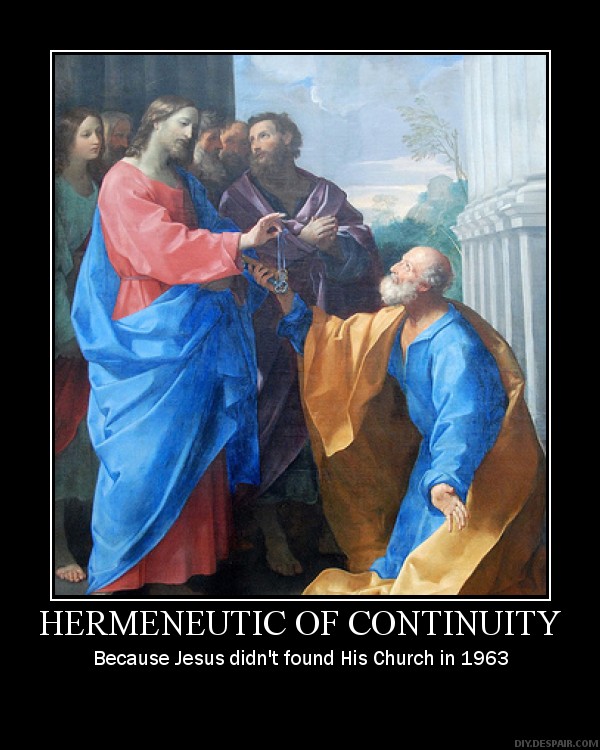
Fr Finigan trained for the priesthood at the English College in Rome and has worked in parishes in south-east London for 23 years. Through his blog, The Hermeneutic of Continuity, which recently had its millionth hit, he has become well known. He is also a visiting tutor in Sacred Theology at St John’s Seminary, Wonersh; and there can be no doubt that he considers bringing the old rite to his parishioners central to his ministry.
Some welcome what Fr Finigan is doing. It is equally clear that some do not. If Fr Finigan is right, and the priest’s responsibility for the liturgy in his parish is absolute, [It is not absolute, it is subject to the law of the Church. Pope Benedict more than once pointed out that even the Pope is subject to the tradition of the Church.] there is nothing parishioners can do about it. And there could be many more Blackfens in the future. [I must get a parish anthem going (ouside the Liturgy, of course) - something along the lines of "There's only one Blackfen!"]
Over the past few years, helped by many parishioners, I have also, among other works, replaced the roof, floor, heating and lighting in the Hall, put in disabled toilets and levelled the entrance, repainted the interior of the Church, replaced the roof on two areas, replaced the guttering, replaced the public address system, put in an industrial spec kitchen in the Club (for the lunch club to provide lunch every week for 40 elderly people without falling foul of health and safety law).
We also raise money regularly for the Bexley Deanery Third World Project, Aid to the Church in Need, the Manna Centre for the Homeless, the Bexley Centre for the Unemployed, the Good Counsel Network, and Cardiac Research in the Young to name but a few. In place of CAFOD, I send our Family Fast Day money to the Pontifical Council Cor Unum (which CAFOD is a partner of, I think.) That way, we support the Church's development work without contributing to glossy advertising or a questionable policy on HIV prevention.
Fr Z today quotes a famous remark of Pope Benedict when he read a negative article about him in an Italian daily:"If I don’t read an article like that every week or so, I have to examine my conscience."Admirable - but daunting. A man to admire and emulate not only in liturgical matters.
That's all for now - I have to go and inflict Rosary and Benediction on my oppressed parishioners."

Tuesday, August 12, 2008
Let us pray in Latin: priests take on Catholics’ magic circle
Damian Thompson sniffs the incense of a revolution among Britain’s parish priests
For a moment it looks as if a fire has broken out in the chapel. A cloud of smoke is billowing from the back and rolling down the aisle – and it is fiercely pungent. This is grade A incense, pure enough to guarantee an instantaneous spiritual high.
A young man walks through the door swinging a thurible on a gold chain. He passes it to a priest, deacon and subdeacon – all in gold vestments – who take turns wafting it at each other. Finally, the subdeacon turns round and, bowing low, shoots plumes of smoke diagonally across the choir stalls with the accuracy of a mid-fielder taking a difficult corner.
We are witnessing an unusual sight: a Roman Catholic solemn mass, celebrated according to an ancient Latin rite effectively outlawed 40 years ago. And it’s taking place in the 13th-century chapel of Merton college, Oxford, which has been Anglican for 400 years.
Just for a week, however, it has gone back to being Catholic – but this is not Catholicism as most people know it. I’m at the summer school of the Latin Mass Society which – to the delight of the conservative Pope Benedict XVI and the dismay of trendy British bishops – is teaching priests how to say the Tridentine mass.
The last time Merton chapel regularly witnessed this sort of complex liturgy was in the 1540s, before the Protestant reformers pulled out much of the stained glass and toppled the statues of saints. The organi-sers of the summer school are reformers, too, but their aim is precisely the opposite: to restore Latin services and rich furnishings to their own Catholic parish churches, many of which were stripped bare by modernisers after the Second Vatican Council in the 1960s.
What makes this summer school rather controversial is that most of the bishops of England and Wales disapprove of the return of the Latin mass, regarding its sonorous Latin prayers and intricate gestures as a relic of the Middle Ages. Until recently, the Tridentine mass could be celebrated only with a bishop’s permission, usually granted grudgingly for special occasions. Then, in July last year, Pope Benedict XVI swept away the right of bishops to ban the old services. Most of them were horrified.
So these are tense times. But the 60 priests who have gathered at Merton college – to brush up their skills or to learn the Tridentine mass from scratch – are careful to avoid talk of civil war in the church. All are aware that this autumn, Pope Benedict is expected to announce a successor to Cardinal Cormac Murphy-O’Connor, the Archbishop of Westminster, who presides over a liberal “magic circle” of bishops unsympathetic to the Pope’s reforms. Will Benedict break the circle that has run the English church for 40 years?
Whoever gets the job, however, nobody expects a sudden return to the Tridentine mass in parishes all over the country. The seminaries do not teach priests how to say it and teaching yourself is difficult. A glance at the manual explains why: “Bring the thumb of each hand over the upper front edge of the paten [communion plate], tilting it to let the host slide off onto the crease of the front-centre fold of the corporal [linen cloth]. Place your left hand on the altar and with your right hand set the paten halfway under the right edge of the corporal.” And all the while saying: “. . . pro innumerabilibus peccatis, et offensionibus, et negligentiis meis, et pro omnibus circumstantibus . . .”
Interestingly, the most traditionalist priests here are also the youngest – and I spot four in the choir stalls who are popular bloggers on the internet. Walking down the high street later, I encounter two clergy wearing the old-fashioned soup-plate hats beloved of Italian village padres. One of them has long knotted tassels dangling from the brim, “so I can tie them round my neck when I ride my horse through the parish”.
A priest who looks barely out of his teens explains what he does when unsolicited copies of The Tablet – a liberal Catholic magazine that opposes the Latin revival – arrive at his church: “I painstakingly remove the staples and feed it into the shredder. It’s time-consuming, but God’s work.”
Most of the other priests at the summer school are less extreme: they have come because they are curious about the Latin mass and they can scent change in the air. “We’re not trying to turn them into traditionalists,” says Father Andrew Wadsworth, an authority on the old rite who is conducting classes. “We want to show priests how the underlying principles of the traditional liturgy can deepen their understanding of their priesthood.”
Father John Boyle, a parish priest in Ashford, Kent, recently taught himself to say the Tridentine mass by watching a DVD. “It’s made a profound difference to the way I celebrate the new mass in English,” he says. “There’s greater reverence now. I’m more of a celebrant and less of a compere.”
I sense a huge contrast with the atmosphere at the first Merton summer school in August 2007. Then, I was allowed to poke my head round the door of a training session. Now, Wadsworth lets me watch him take a priest right through the opening sequence of a Latin mass in a student’s room, using a reversed bookcase as an altar.
The priest, Canon Michael McCreadie, is in his fifties – yet today is the first time in his life that he has acted out the ancient gestures. He removes an invisible biretta (it’s a pretend mass). “Now, father, keep your hands joined,” Wadsworth reminds him. “Go to the centre of the altar, not touching it . . . left hand flat on the page. No, you should be over here,” and he gently turns his pupil towards the window.
After half an hour, we are still only five minutes into the order of service, but McCreadie is elated: “I wasn’t looking forward to saying the old mass, but after today I most certainly am.”
It’s only now I discover that he is dean of Leeds Cathedral. A year ago there were no senior main-stream clerics at the summer school. Later in the day, even more significantly, the Rev Malcolm McMahon, the Bishop of Nottingham, celebrates old rite pontifical vespers wearing a jewelled mitre and an embroidered cope that even Cardinal Wolsey might have considered over the top.
McMahon, a Dominican, is left-wing in his politics and certainly not part of a traditionalist faction – but nor does he belong to the politically correct, back-slapping magic circle. At dinner later, he effectively breaks ranks with his fellow bishops by unambiguously endorsing Pope Benedict’s vision of a church in which the old and new rites coexist. The traditionalists give him a standing ovation and a verse of God Bless our Pope.
He also tells Father Tim Finigan, author of the Hermeneutic of Continuity, the most influential of all the conservative blogs, to keep writing. Which is interesting, given that the Bishops’ Conference would dearly like to stop that particular blog.
Afterwards, Finigan writes: “Bishop McMahon has certainly won the hearts of the priests . . . All of a sudden, there is someone that many priests loyal to Pope Benedict will be watching closely . . . ecce sacerdos magnus!”
That’s Latin for “behold the great priest”. Those words will be read carefully in the Vatican, where Pope Benedict has been informed that the magic circle is desperate to install one of its own as the next cardinal. He isn’t pleased. Watch this space.
Damian Thompson is editor-in-chief of the Catholic Herald
Subscribe to:
Posts (Atom)