Showing posts with label Gregorian Rite. Show all posts

Thursday, September 10, 2009

SSPX priest celebrates Mass in St Peter's in Rome

From Catholic Church Conservation:

The sensation is that there are finally signs that point to a return to Catholic normalcy.

The Prior of the SSPX House of Neustadt an der Weinstrasse, Father Marcus Jasny has celebrated Masses in St. Peter's in the Old Rite.
The SSPX referrto this in a report on its website about a pilgrimage to Rome of graduates of the Schöneberg High School for Girls near Bonn.

Neustadt an der Weinstrasse is a town in Rhineland-Palatinate in southwest Germany.

The students visited the Eternal City, 24 August to 2 September.

In the morning at 7 clock Fr Jasny "could" celebrate the Mass in St. Peter’s - the report on the website of the SSPX states- at "that mysterious, quiet time of daybreak in St. Peter's, before the arrival of the torrents of tourist."

The paleo- liberal Swiss news agency 'Kipa-Apic' complained about the Latin Masses in Rome.

The person responsible for arranging Masses in St. Peter's said that there was no written request from the Father for the period concerned.

But it is possible that a priest can ask in the sacristy directly for an opportunity for celebration. Whoever presenting evidence of priesthood and asking for a Missal for the traditional rite, does not get a negative response.

Even already in the Jubilee Year 2000, the SSPX was able to celebrate during their great pilgrimage to Rome - at that time even under Pope John Paul II - a prayer service in St. Peter's.

Friday, August 28, 2009

New Poll on the Traditional Latin Mass

From The Center for Applied Research in the Apostolate at Georgetown University:

Three in ten Catholics who do not “oppose” bringing back the Latin Mass say they would attend such a Latin Mass if it was readily available at convenient times and locations. This is equivalent to about one in ten adult Catholics (11 percent overall) or approximately 5.7 million individuals.

If the Latin Tridentine Mass were made readily available at convenient times and locations, and you were able to attend, would you?
Respondents who “Favor” or have “No opinion” about easing restrictions on the Latin Tridentine Mass

Yes: 29%
No: 25%
No opinion: 46%

Among those who do not oppose the return of the Latin Mass, interest in attending a Latin Mass is more likely among frequent Mass attendees. More than four in ten of these respondents, who attend Mass at least once a month, say they would attend a Latin Mass if it was available.
If the Latin Tridentine Mass were made readily available at convenient times and locations, and you were able to attend, would you?
Respondents who “Favor” or have “No opinion” about easing restrictions on the Latin Tridentine Mass

Mass Attendance

Weekly or more

Yes: 45%
No: 20%
No opinion: 35%

Less than weekly but at least once a month

Yes: 42%
No: 16%
No opinion: 42%

A few times a year or less

Yes: 18%
No: 30%
No opinion: 52%
h/t to EWTN's The World Over and Una Voce Carmel

Friday, August 21, 2009

Solemn High Mass - EWTN Saturday 8/22 8:00 AM ET

SOLEMN HIGH MASS ON THE FEAST OF THE IMMACULATE HEART OF THE BLESSED VIRGIN MARY - LIVE ( 2hrs)
From the Shrine of the Most Blessed Sacrament, the Solemn High Mass in the extraordinary form on the Feast of the Immaculate Heart of the Blessed Virgin Mary.
Sat 8/22/09 8:00 AM ET / 5 AM PT

Update - photos from NLM:

Monday, June 29, 2009

EWTN - Pontifical Tridentine High Mass of the Extraordinary Form - July 1

PONTIFICAL TRIDENTINE HIGH MASS OF THE EXTRAORDINARY FORM - LIVE (2hrs)
From the Shrine of the Most Blessed Sacrament, Hanceville, Alabama, Pontifical Tridentine High Mass of the Extraordinary Form on the Solemnity of the Most Precious Blood.
Wed 7/01/09 8:00 AM ET / 5 AM PT
Thu 7/02/09 12:00 AM ET / (Wed) 9 PM PT

Sunday, March 29, 2009

Cardinal: Liberalized use of Tridentine Mass already is bearing fruit

By Cindy Wooden
Catholic News Service

VATICAN CITY (CNS) -- Pope Benedict XVI's outreach to traditionalist Catholics by liberalizing the use of the Tridentine Mass already is bearing fruit, said Cardinal Dario Castrillon Hoyos.

The cardinal, president of the Pontifical Commission "Ecclesia Dei," which coordinates care for traditionalist Catholics, said that thanks to the pope's action "not a few have asked to return to full communion, and some already have returned."

In an interview published in the March 28 edition of L'Osservatore Romano, the Vatican newspaper, Cardinal Castrillon said the Oasis of Jesus the Priest monastery of 30 cloistered nuns in Spain "has already been recognized and regularized" by his office and "there are cases of American, German and French groups" who have begun the process.

The cardinal insisted that the only traditionalists excommunicated were the four bishops ordained by the late Archbishop Marcel Lefebvre in 1988 without Vatican permission.

The priests who have followed those bishops, he said, "are only suspended," and so the Masses they celebrate "are without a doubt valid, but not licit." The religious who have followed the schismatic bishops need to have their congregations or monasteries recognized by the Vatican, he said.

In addition, he said, "there are individual priests and many laypeople who contact us, write to us and call us for a reconciliation and, on the other side, there are many other faithful who demonstrate their gratitude to the pope" for his July letter authorizing widespread use of the liturgy according to 1962 Roman Missal.

In his letter, the pope said the Mass from the Roman Missal in use since 1970 remains the ordinary form of the Mass, while celebration of the Tridentine Mass is the extraordinary form.

Cardinal Castrillon said wider use of the pre-Second Vatican Council rite "is not a matter of returning to the past, but is a matter of progress," because it gives Catholics the richness of two liturgical forms instead of one.

Asked whether he was worried that bringing back into the church "men and women who do not recognize the Second Vatican Council" would alienate some of the faithful who see the council's teaching as a compass for the church, Cardinal Castrillon said he did not think the problem "is as serious as it could seem."

The excommunicated leaders of the Society of St. Pius X, founded by Archbishop Lefebvre, "have expressly recognized Vatican II as an ecumenical council," he said, but they disagree with the way the documents have been interpreted and put into practice.

"These are theological discussions that could take place within the church where, in fact, there exist different interpretive discussions about the council texts, discussions that could continue also with the groups who return to full communion," the cardinal said.

The eucharistic celebration is a sign and source of the unity of the church, he said, and Pope Benedict's decision to keep alive the older form of the Mass is an effort to preserve a rich tradition while promoting unity.

"We must never forget that the supreme point of reference in the liturgy, as in life, is always Christ. Therefore, we should not be afraid, including in the liturgical rite, to turn toward him, toward the crucifix, together with the faithful to celebrate the holy sacrifice," he said.

Friday, March 20, 2009

Vatican clamps down on Killala Latin Mass move

Michael Kelly

Bishop John Fleming

A high-profile Vatican office has ordered Bishop John Fleming to make provision for the traditional Latin Mass in his Killala diocese. The move, from the powerful 'Ecclesia Dei' Commission comes after the Killala Council of Priests decided that no provision should be made for the celebration of the Mass in the Extraordinary Form.

In July 2007, Pope Benedict's letter, Summorum Pontificum, eased restrictions on the pre-Vatican II Mass, the so-called Tridentine Rite and established that any Catholic priest can celebrate the traditional Latin Mass without first seeking the permission of his bishop. Prior to the coming into force of Summorum Pontificum bishops had the right to restrict access to the Latin Mass.

Initially, the Killala Council of Priests, an advisory body made up of both elected members and priests appointed by Bishop Fleming, advised that no provision should be made for the Latin Mass pending a request for clarification from the Vatican on aspects of the Pope's letter. This advice was accepted by Bishop Fleming and an announcement made that the Mass would be unavailable in the Killala diocese.

However, The Irish Catholic has learned that the matter came to the attention of the Holy See as a number of people in Killala wrote to the Vatican to express their frustration at the lack of provision. The Irish Catholic also understands that a number of diocesan priests who believed the decision countermanded papal legislation, contacted Bishop Fleming to register discontent.

The 'Ecclesia Dei' Commission, headed by Cardinal Darío Castrillón Hoyos, then wrote to Bishop Fleming insisting that the restriction was forbidden under Church law since Pope Benedict had made universal provision for the availability of the Mass in the extraordinary form. In its letter, the Commission insisted that neither Bishop Fleming, nor the Council of Priests, had the right to place a restriction on a right approved by the Pope. Bishop Fleming has now designated the Church of the Assumption, Ardagh, Crossmolina, Co Mayo as the centre for the traditional Mass in the Killala diocese and the celebrant will be Fr John Loftus, a priest of the diocese.

h/t to Ulster Taig

Tuesday, February 17, 2009

Report from Canons Regular of St. john Cantius Training Session

http://www.canons-regular.org/images/ui/canons-crest.gif
"From February 9-13, 2009, priests from diverse parts of the United States and Canada studied the Extraordinary Form of the Roman Rite (1962 Missale Romanum) under the direction of the Canons Regular of St. John Cantius. Two classes were offered, one for beginners, learning the ceremony and rubrics of Missa Lecta (Low Mass) for the first time, and an advanced class for those studying the Missa Cantata (High Mass)...

On Wednesday evening one of the students studying High Mass, Fr. John Ubel, Pastor of St. Agnes Church in St. Paul, MN, offered the Missa Cantata with incense...."

Friday, January 9, 2009

Ecclesia Dei to to be Attached to the Congregation for Divine Worship?

From Monde et Vie via RORATE CÆLI:

"The pope wishes to use the nomination of his right-hand man [Cardinal Cañizares Llovera] at the helm of the Congregation for Divine Worship [as a means] to profoundly reorganize the Ecclesia Dei Commission, where Cardinal Cañizares is already a member. According to the rumor, which seems to be just backstage gossip, Cardinal Castrillón Hoyos, who has surpassed the age limit for a long time, would cede his place to his current second, Mgr. Camille Perl, a personal friend to Pope Ratzinger, who would be consecrated a bishop for the event.

And the Commission would then be attached to the Congregation for Divine Worship, bearing responsibility, within a dicastery, for the Traditional form of the Roman rite, under the patronage of Cardinal Cañizares. [...] This means, at any rate, that the Ecclesia Dei Commission is placed within the ecclesial landscape..." - more

And NLM:

"Such an integration of the Pontifical Commission Ecclesia Dei into the Congregation for Divine Worship and the Discipline of the Sacraments would indeed be excellent for several reasons. It would clearly and unmistakably demonstrate, as the article mentions, that the usus antiquior is now a normal and regular part of the life and liturgy of the Church, attended to by a regular discastery of the Curia, and one of the most important at that, and not by a Special Commission named after a now obsolete indult. It makes sense that the curial authority charged with the Sacred Liturgy should have competence over both forms of the Roman Rite, not only because, once again, the Extraordinary Form is a living and regular part of the Sacred Liturgy, and not some isolated special interest concern, but also because, as we have seen, there are many questions which concern both forms, and where a seperate treatment of the same question can cause frictions..." - more


Sunday, December 7, 2008

NLM: Fr. George Rutler and Church of Our Saviour, NYC, add Weekly Usus Antiquior

From NLM:

[IMG_1442.JPG]

"This just in from the Church of Our Saviour in New York City:

Church of our Saviour
Park and 38th Street
New York, NY 10016

NEW MASS SCHEDULE


Following the Vatican's instructions and in response to the request of some of the faithful, the traditional Latin Mass will be offered in our parish every Sunday beginning January 4 at 9 AM. Because of canonical regulations which limits the number of Masses which a priest normally offers, the 7:30 and 9:30 will be combined. The new 9 AM celebration will be a Missa Cantata, and books will be provided to assist worshipers in following the texts, along with an explanation of the ritual. This will also provide more time for confessions before the 11AM Mass which remains the principle Mass of Sunday. The rest of the Mass schedule remains the same, with the Vigil mass at 5PM on Saturday, and other Masses at 12:30 and 5PM. Some may want to attend the 9AM in addition to the Mass they normally attend. The church will open at 8PM on Sunday for preparatory prayer and private devotion.
Posted by Shawn Tribe on 6.12.08"

Friday, December 5, 2008

Canons Regular of St. John Cantius Missa Cantata Instructional DVD

From NLM:
Latin High Mass and Benediction
1962 Missale Romanum

DVD Instruction of the Traditional Latin High Mass
for Priests, Seminarians, Altar Servers, Sacristans, Church Musicians


If your parish is wanting to start the Traditional Latin High Mass this is the DVD for you!

Full-length instructional video of the Latin High Mass with Incense

See the priest’s rubrics of the Missa Cantata (High Mass) demonstrated

Observe the rubrics of liturgical music for the Extraordinary Form

Video of Benediction of the Blessed Sacrament

Stunning choral music by the St. Cecilia Choir of St. John Cantius Church, Chicago.

Evocative rendering of the Gregorian Chant propers and ordinary by the Canons Regular of St. John Cantius

Organ music by Br. Jonathan Ryan, S.J.C., featuring the church’s 101 year-old Kilgen organ.

BONUS video of sacristy preparation and vesting.

For more information: DVD - Latin High Mass and Benediction - SanctaMissa.org

Posted by Shawn Tribe on 4.12.08 -

Tuesday, December 2, 2008

Major Development in St. Paul

Traditional Mass Returns to Historic Church of St. Agnes


Michael J. Matt
Editor, The Remnant


Father John Ubel Offers the Traditional Mass

at St. Agnes for the first time in 40 Years
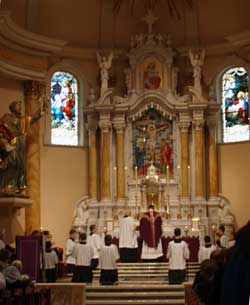
SAINT PAUL—The First Sunday in Advent (November 30, 2008) was an historic day here in the Archdiocese of St. Paul and Minneapolis. After forty years, the traditional Latin Mass returned to the altar of the grand and historic Church of St. Agnes here in Minnesota’s capital city.

After the passing of longtime pastor of St. Agnes, Monsignor Richard Schuler on April 20, 2007, the future of one of Minnesota’s most tradition-minded diocesan churches became uncertain. An inner city parish, St. Agnes now draws the majority of its parishioners from the suburbs and beyond. For decades, Catholic families have traveled from all over the state to find orthodox sermons, Latin Masses (Novus Ordo), Gregorian chant, and the traditional parish life (complete with frequent confession, Tuesday night devotions, Sunday vespers, etc.) for which St. Agnes is famous.

Over the years, the late Monsignor Schuler did significantly more than most to preserve the traditional dignity and sacrality of the Roman Rite here in Minnesota. Though he eventually came to offer the New Mass, his Church of St. Agnes was the only one in Minnesota to preserve at least one Latin Mass every Sunday. The Holy Week services at St. Agnes, for example, were (and are still) internationally recognized events, since they remained comparatively unchanged and retained much of the spirit and character of the old days.

After the Council, Monsignor Schuler eventually began offering the New Mass but in the manner he believed had been intended by the Council Fathers. There were no altar girls at St. Agnes...ever! There were (and are) no women in the sanctuary, no ‘sign of peace’, no Communion in the hand, no guitars, pianos, balloons or clowns. For this reason, thousands of Catholics (traditionalists and conservatives alike) came to appreciate Monsignor Schuler's stand against the liturgical experimentation that eventually led to wide scale loss of Faith, church closings, and empty seminaries. Not surprisingly, St. Agnes inspired more vocations to the priesthood in recent decades than any other diocesan parish in Minnesota.

Father John L. Ubel, the current pastor of St. Agnes, is doing his part to carry on the work of liturgical preservation at St. Agnes.

Church of St. Agnes
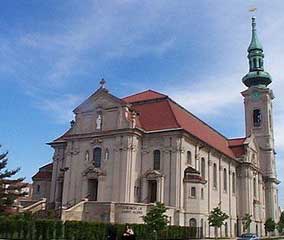
On November 30, 2008, St. Agnes took an historic step in the all important campaign to reestablish Catholic identity throughout this archdiocese and around the world. Upon request from a stable group of his parishioners, and thus in accordance with the wishes of Pope Benedict XVI, Father Ubel has restored the Traditional Mass to St. Agnes. After months of extensive training of St. Agnes’ famous altar server corps, Father Ubel used the First Sunday in Advent to inaugurate St. Agnes’ latest effort to preserve the traditional heritage of the Catholic Church here in Minnesota. The Mass was as beautiful as it was historic.

For this writer, the first Traditional Mass at St. Agnes was special on a number of fronts. My grandfather served on the building and planning committee of St. Agnes a hundred years ago. My father was baptized there and attended St. Agnes grade school. I attended St. Agnes grade school, as well, and received my first Holy Communion from Monsignor Schuler. This is a great day! The return of the Traditional Mass to this historic landmark means a great deal to us and to countless Catholic families here in Minnesota. May it bring an abundance of grace and even more vocations to the archdiocese! And may it come to pass one day soon that all the Masses in this beautiful, traditional building will be celebrated according to the liturgical tradition of the Roman Rite--the most beautiful thing this side of heaven.

To thank Father Ubel for his decision to generously respond to the Holy Father’s wishes where the Traditional Mass is concerned, send him an email at: rectory@stagnes.net

Thursday, October 30, 2008

SSPX: pilgrimage and a new Crusade of the Rosary

From Rorate via Father Z:
____________________________________________

CATEGORY: SESSIUNCULUM — Fr. John Zuhlsdorf @ 8:15 am

Our colleagues at Rorate have this stunner. Be sure to visit their site. My emphases and comments.

SSPX: pilgrimage and a new Crusade of the Rosary

Pictures of the Solemn Mass, of the public recitation of the Holy Rosary, and of the Adoration of the Most Holy Sacrament, as the Sanctuary of Lourdes once again opens its doors and buildings to the Priestly Fraternity of Saint Pius X (FSSPX / SSPX) during the weekend of Christ the King. The four bishops of the SSPX, who were consecrated by Archbishop Marcel Lefebvre in 1988, were present in the pilgrimage.

Regarding developments in the ongoing conversation between the leadership of the Fraternity and Cardinal Castrillón Hoyos, President of the Pontifical Commission "Ecclesia Dei", the SSPX will start this Saturday a "Crusade of the Rosary" to "obtain from Our Lady the removal of the Decree of Excommunication", a "crusade" which will last from November 1 to Christmas Day. [OKAY! Well… this is a good initiative. But let us not forget that grace builds on nature. Hopefully some of that prayer will be dedicated to softening hearts, not just in the Holy See, but also in the SSPX and its followers so that they will submit in concrete ways to the Roman Pontiff.]

This is a most auspicious development, considering that the last time a Crusade of the Rosary was proposed by the SSPX (in July 2006), its main intention was to "obtain from Heaven for Pope Benedict XVI the strength required to completely free up the Mass of all time, called the Tridentine Mass". [I hope they are not thinking that all the credit goes to them, though I don’t hesitate to affirm that PRAYER HELPS!] All eyes to Heaven, and to Rome, in the next few months.
I will participate in this Rosary "Crusade". It would be a joy to see the excommunications lifted.

I urge you to do the same. Add this intention to your daily recitation of the Rosary.

In the meantime… I guess you can say the old Mass at Lourdes after all!


Saturday, October 18, 2008

Card. Castrillon pontificates at Ss. Trinita in Rome

From Fr. Z:

"The FSSP is celebrating their anniversary in Rome. Our friend John Sonnen of Orbis Catholicus has posted some video of a Mass at the "personal parish" in Rome for the TLM and older forms of sacraments, the historic church where St. Philip Neri began the still extant confraternity, Santissima Trinita dei Pelegrini. Cardinal Castrillon, President of the Pontifical Commission Ecclesia Dei was the celebrant."

Wednesday, October 15, 2008

Special Ops

From Maureen in a comment at NLM:
"In a world that doesn't understand the mind of the Council Fathers...

[sad scenes of your favorite liturgical abuses]

When you need the Sacraments.
When you want the Extraordinary Form.
When no one has been trained.
When even your bishop won't help you.

Maybe you can call in --

Ecclesia Dei: Special Ops.

[quick cuts of priests on motorcycles, priests on skis in snowy barrens, priests crawling on their belly through underbrush, priests parachuting]

[Shot of priest at just opened door.]

"I'm from the Vatican, and I'm here to help you."

[quick cuts of various traditional forms of the Sacraments and other devotions, each led by a priest in full traditional array.]

Good guys wear black!

Ecclesia Dei: Special Ops."

Instruction on Summorum Pontificum in Early January 2009?

From NLM:

"The following item was today posted on the Italian "Pontifex" site of Bruno Volpe (NLM translation). While what it says about the Instruction being submitted by Ecclesia Dei to the Holy Father agrees with the public declarations of the leadership of PCED, the rest should still be regarded as a rumour, as yet unconfirmed by any of the prestigious vaticanistas. The tone of the article, which is not exactly impartial, would suggest some caution, lest some wishful thinking is mixed into the reporting, and the last paragraph, to me at least, sounds somewhat confused. Still, if this is indeed accurate, it would be quite remarkable, and certainly more than many of the more pessimistic supporters of the usus antiquior had hoped for.

Instruction on the Motu Proprio Ready. Ecclesia Dei Strengthened.

The Instruction on the Motu Proprio Summorum Pontificum of 7 July 2007 which liberalized Holy Mass according to the ancient Roman rite, has been ready for some time already and is now being examined by Pope Benedict XVI. This Pontifex has learned from authoritative sources. The text, signed by Cardinal Darío Castrillón Hoyos, President of the Pontifical Commission Ecclesia Dei, will be signed most likely by the Pope in late December and published in the first days of January 2009. In its most important parts the document, which had become indispensable after the many problems in the application of the Motu Proprio and forms of outright recalcitrance on the part of not a few bishops (incidentally appropriately denounced in September by the Vice President of the Commission Ecclesia Dei, Monsignor Camille Perl), addresses two crucial topics: the interpretation of the term "stable group of faithful" within an ordinary parish and the problem of personal parishes. It was even considered to list and to indicate a minimum number of faithful, but this solution has been discarded.

According to the document, the traditionalist faithful present in a parish will have the full protection of the law to ask for the old Mass, and if the bishop refuses (here is the news), saying that there are no priests capable of celebrating according to the ancient rite in that place, the Commission Ecclesia Dei will authoritatively ("di imperio") send a priest able to do so to that diocese. In short, the bishops will no longer be able to refuse a priori to have the old Mass celebrated, because in such cases, the Commission Ecclesia Dei will send a delegated priest of its own.

The document then analyzes the case of personal parishes in which the traditionalists want to celebrate the Christmas Mass or the Easter Triduum according to the ancient rite, also in cases of an absence of priests, or a prohibition by the bishop. The possibility of a shortage of priests could be envisaged, and also in this case, Ecclesia Dei will take care. The Holy See, therefore, wants to establish definitive clarity regarding the application of the Motu Proprio, and for this reason also the powers and prerogatives of the Pontifical Commission Ecclesia Dei will be better defined and strengthened.

Again, this should be taken for what it is, a rumour, and considered with due caution."

Sunday, October 5, 2008

Defending the readings in the Traditional Mass

From RORATE CÆLI:


As the Synod on Holy Scripture is opened by Pope Benedict XVI in the Basilica of Saint Paul Outside the Walls, a good article on the forms of the Roman Rite and the Scripture readings.

WORDS OF DOCTRINE
Two theories born of Biblicism
Fr. Nicola Bux and Fr. Salvatore Vitiello

Some say that the post-Conciliar Mass is richer in Readings and Eucharistic Prayers, while the Missal said of Pius V would be poorer and less accurate. The theory is anachronistic since it fails to consider four centuries of distance; it is as if we were to say the same about "Sacramentaries" some centuries earlier than that of Pius V. What is more, it is forgotten that the pericopes of the Pius V Missal were formed on the basis of old capitularies with epistles, such as St Jerome's Liber comitis– dated 471 - or with Gospel pericopes ; a tradition in common with the Church of the East, as the Byzantine liturgy still shows today.

Secondly, the brief readings help memorize the essential and express the sobriety of the Roman Rite. Some even go as far as to say that the Extraordinary Form of the only Latin Rite gives too little emphasis to the presence of Christ in the Word, when the latter is proclaimed in the assembly; in this cas,e the liturgy loses its very essence, the 'two tables' - in Dei Verbum, n. 21, there would appear to be only “one” - forming one act of worship!

It is said that the Missal of the Council of Trent moves in a vision far from the tradition of the Church Fathers; that the Missal was planned for the priest only, not for the participation of the assembly because the congregation is merely irrelevant. In fact, it is said that the priest celebrates on his own and so does the congregation; they say the Mass of Paul VI is quite different because it is not the priest who celebrates but the Church, sacramentally present in the assembly, of which the priest, by reason of order, is the natural president.

This position is considerably problematic because it reduces everything to Word and Assembly. However “Jesus is not just the teacher, but also the redeemer of the whole person. The Jesus who teaches is, at the same time, the One who saves ” (J.Ratzinger-Benedict XVI, Gesù di Nazaret, p. 65) and this comes about effectively only through the Eucharistic Sacrament.

Another theory, widespread due to the customary phenomenon of substitution and exchanging one thing with another, is to equal the presence of Jesus Christ in the Blessed Sacrament with the presence of the Word in the Book of the Scriptures: the latter presence takes place only “when the Holy Scriptures are read in the Church” (Sacrosanctum Concilium n. 7). It is necessary to reaffirm that Christ's presence in the Word exists on two conditions: when it is read out “in the Church assembly ”, not privately, and when Sacred Scripture is 'read'. Therefore the holy book placed on the lectern or the altar is not sufficient for this presence.

To conclude, it is more than ever urgent for preaching and catechesis to return to making the proper distinction between Revelation, Word of God and Sacred Scripture which, although closely connected, are not equivalent. At times in fact, not without surprise, we see in this regard considerable confusion and not only among the lay faithful. Some even think that the Bible is to be interpreted with the Bible and not, as the Catholic Church has always held, with Tradition and by faithful listening to the Magisterium.

_________________________
FIDES translation, adapted according to the Italian original.