

Sunday, November 22, 2009


St. Joan of Arc Catholic Church: Peace, Love & 40 Years of Church in a Gym

"The 15th annual SJA Cabaret: Peace, Love & 40 Years of Church In a Gym presented October 23 and 24 featured the hippy look of 1969 with peace signs adorning shaggy wigged performers and an impressive eight feet wide four canvas paneled peace sign painted by four SJA youth students greeted the crowd upon arrival. Performers jammed with their favorite songs from 1969 and a video created by Fred Vagle recapped pivotal events that year when Mass began in St. Joan’s gym. Underscored by the Beatles “A Day In the Life” iconic moments flashed rapidly by from Vietnam war protesting and President Nixon, television’s the Smothers Brothers and the Brady Bunch shows, the first man on the moon to finally the man who turned St. Joan’s into what it remains today— passionately peace seeking and inclusively welcoming, Father Harvey Egan." - Link


Bishop Tobin responds to Kennedy

(WPRI.com)
On February 21, 2007, I wrote to Congressman Kennedy stating: "In light of the Church's clear teaching, and your consistent actions, therefore, I believe it is inappropriate for you to be receiving Holy Communion and I now ask respectfully that you refrain from doing so." My request came in light of the new statement of the United States Conference of Catholic Bishops that said, "If a Catholic in his or her personal or professional life were knowingly and obstinately to repudiate her definite teachings on moral issues, he or she would seriously diminish his or her communion with the Church. Reception of Holy Communion in such a situation would not accord with the nature of the Eucharistic celebration, so that he or she should refrain." (Happy Are Those Who Are Called to His Supper, December, 2006)
In the same letter I wrote to Congressman Kennedy, "I am writing to you personally and confidentially as a pastor addressing a member of his flock . . . At the present time I have no need or intention to make this a public issue." I also indicated, "I am available to discuss this matter with you in person at any mutually convenient time and place. I would welcome the opportunity to do so."
On February 28, 2007, the Congressman responded to me, "I have the utmost respect for the work you do on behalf of the Catholic community in Rhode Island. . . I understand your pastoral advice was confidential in nature and given with the best intentions for my personal spiritual welfare."
I am disappointed that the Congressman would make public my pastoral and confidential request of nearly three years ago that sought to provide solely for his spiritual well-being.
I have no desire to continue the discussion of Congressman Kennedy's spiritual life in public. At the same time, I will absolutely respond publicly and strongly whenever he attacks the Catholic Church, misrepresents the teachings of the Church, or issues inaccurate statements about my pastoral ministry....
Friar Pluck

November 22-28, 2009 Issue | Posted 11/14/09 at 12:11 AM
Father Benedict Groeschel has spent a lifetime evangelizing, preaching, teaching, writing books and reforming religious life.
Recently celebrating 50 years as a priest, the Franciscan Friar of the Renewal shows little sign of slowing down, in spite of a serious car accident several years ago and a minor stroke earlier this year. He still appears live on EWTN each Sunday evening and is getting ready to release yet another book.
In a wide-ranging interview with Register correspondent Celeste Behe Oct. 25, Father Benedict, 76, discussed growing up, discovering his vocation and the highlights of his many years in religious life.
You celebrated your first Mass at your home parish of St. Aloysius in Caldwell, N.J. Today, 50 years later, you returned to St. Aloysius to celebrate Mass once again. What were your thoughts upon entering the church?
I went to live at St. Aloysius in 1933 with my family; I’m the oldest of six children. In that church, most of my brothers and sisters were baptized. We all made our confirmation there; I was ordained and said my first Mass there; my parents and my brother were buried from that church. It’s so beautiful to have one’s family united in a parish.
You and your family had strong ties to the parish.
In those days, the parish was the center of social life; it determined who you were. In Jersey City, where I grew up, if someone asked where you were from, you told him the name of your parish. Most of the time, the churches were called by their popular names, like St. Al’s or St. Pete’s or OLPH. And if you lived in Brooklyn, you weren’t from New York, you were from Sacred Heart. I was in New York working at Children’s Village, an agency for homeless and delinquent kids. There I met a fellow from Jersey City who was a Baptist. I asked him, “Where are you from?” He said, “St. Mary’s.” I said, “You, too?” That was his identity.
When did you feel that you had a vocation to the priesthood?
I knew that I was supposed to be a priest when I was 7 years old. I was somewhat disappointed because I wanted to be a fireman. Near our house in Jersey City was the firehouse with the beautiful engines and the firemen who would give the kids candy and nuts. We used to listen for an alarm so that we could watch the firemen sliding down the poles.
Then in second grade I had a wonderful teacher, Sister Theresa. She would go out every day to bring food to a poor old woman who lived in a tenement. One day I went up the fire escape and looked in the old lady’s window. Now, the only movie I had seen was Snow White and the Seven Dwarfs, which you may recall has a very awful witch in it. So I looked in the window, and there was the witch, about six inches away from me. I jumped off the milk box that I’d been standing on and ran up the street into the Church of Our Lady of Victory, praying because I had seen a witch. While I was praying, something told me to be a priest. It was an extremely clear thought that did not come from myself. It was like the “something” that clicks in the mind of an inventor and suddenly the idea is there. So I came out of the church knowing that I would be a priest, but I didn’t tell anybody.
You speak fondly of the Dominican Sisters of Caldwell who taught you in school. Did they encourage you in your vocation?
Sister Consolata, who taught me in the third grade, gave me a holy card and wrote on the back “ora pro me.” My dad said, “Why did she write it in Latin?” I asked Sister Consolata, and she said, “Because you’re going to be a priest.” So there it was: Sister blew my cover!
These very good sisters gave me a wonderful example of Christian life and faith. Sister Theresa had taken care of the poor woman, so I also wanted to take care of poor people. And what’s the most obvious thing to do but become a priest? So I started reading about being a friar. I decided to be a Capuchin friar, and for many years, I was chaplain of Children’s Village.
The Dominican Sisters were excellent teachers. I am heartbroken, just heartbroken that they are gone. Recently, I met three of my classmates. We talked about where to have dinner, and we decided to have it at the motherhouse. We had a picnic supper because no one lives at the motherhouse anymore. It’s very sad.
What did your family have to say when they learned that you were going to be a priest?
My family always knew that I would be a priest, and they had always supported me. But I still couldn’t help thinking, “Who wants to be a priest? I want to be a fireman!” And it didn’t help that the parish priest’s house looked more than a little foreboding.
You became a Capuchin in 1951, but in 1987 you and seven other Capuchins left to start the Franciscan Friars of the Renewal. What led you to make that move?
We felt that the Capuchins needed to have a reform. Right now, the Capuchins are varied in different areas; in some places, we would be quite at peace with them. Generally, they are in the area of getting life back together. You see, the whole Church is moving toward a Catholicism that is more authentic, more observant, more enthusiastic, and theologically more orthodox. I profoundly disagreed with the rather laissez-faire, casual kind of liturgy and Catholicism. There are good people on that side, and I disagree with them and they disagree with me. But I have to tell you this: They’re all getting old. I have never found one person under the age of 32 who agrees with their position. Very interesting!
So you feel that young Catholics are moving towards a more traditional practice of the faith?
Well, I was at a Catholic college recently which is sort of edging toward becoming a secular school, and the students were totally against that. When I gave my talk there, the students were behind me 100%. Groups like the Cardinal Newman Society are changing the face of higher Catholic education, which right now is largely in disaster. I wrote the introduction to their Newman Guide to Choosing a Catholic College, and I can say that there are authentically Catholic schools out there. Things are changing, and more and more colleges are finally getting themselves together.
What do you believe has been the impetus behind this renewal?
You cannot say; you can only blame the Holy Spirit. I have to tell you that the more traditional people did not win the battle; it was a standoff, but things nonetheless started to change. You find in this country that the mainstream Protestant churches are dying off; nobody goes to them. It’s the evangelical Protestant churches that are doing well. Also, many young Jews who had no actual religious training are becoming orthodox Jews. And even among young Catholics who are not particularly observant, there is at least an interest in the faith. God himself, through the Holy Spirit, is calling to souls, and I’m absolutely delighted with the changes that are taking place. The pendulum has swung.
How are these changes affecting the seminaries?
Today there are much better young men coming out of excellent seminaries: St. Joseph’s Seminary in Yonkers, N.Y., where I’ve been teaching for 45 years, St. Charles in Philadelphia, Mount St. Mary’s in Emmitsburg, Md., and a number of others. During the crazy ’70s and ’80s, there naturally were differences of opinion about the religious life and even about the observance of the Christian life. The seminaries were in a miserable state; they were awful. Some seminaries acquired such bad reputations that people would speak about those seminaries almost to the point of scandal. I’ve talked to a number of very fine priests who went to those seminaries, and they suffered all the way through. Interestingly enough, some of them came to the priesthood with a very strong faith because they fought against the seminary all along the way. But now, everywhere you go, seminaries are moving in the right direction.
How did the seminaries of 30 years ago fall into such a state?
People were naive. They thought that the Church was going to become much more casual, and that certain immoral sexual behaviors would come to be accepted. The whole situation is different now. I used to be Public Enemy No. 1 in a number of seminaries. I still have plenty of enemies, but at age 76, I don’t care, because I’m checking out of here anyway.
Do you feel that the prevalence of single-parent families has affected the number of vocations to the priesthood?
Interestingly enough, I know a number of very fine seminarians who are from families that have been divided by divorce. Many of the kids raised in broken families spend some time with each of their parents; they at least have “pieces” of the family around. But what about children without parents? Many of them have surrogate parents. In my own life, because I worked at a home for kids, every year I get Christmas cards signed “to the only father I ever had.” Some of these cards are from young men who had no idea who their fathers were. And so they would grow quite close to me. You know, years ago there was this ideal of the healthy, smiling Catholic family, which is not always what you can expect right now. I know many dedicated priests and friars who come from very difficult situations. Divine grace does things.
Can you tell me about people of other faiths who have been a part of your life?
Dr. Creighton was a very good friend of mine. He was a young Presbyterian minister of 25 when I was a kid of about 15. In the Presbyterian church, as in many other Protestant churches, they have communion once a month at the 11 a.m. service. In Dr. Creighton’s church, by the time he retired, communion was given every Sunday, both at the 9:30 and the 11 service. Dr. Creighton passed away recently, and I went to his funeral. The minister who spoke at his funeral told us that between the two services, the bread and wine that had been blessed was left on a table with two candles and covered with a white cloth. Aha! And much to my utter surprise, at the end of the service for Dr. Creighton, the minister led us in a prayer for his soul on his way to God. Now that is absolutely Catholic!
Another friend was Mr. Graff, the Jewish tailor in my old neighborhood. Right before I left for seminary, I went to visit him. I was standing there in my suit that didn’t quite fit, and Mr. Graff gave me this piece of advice: “Be a good boy.” I also remember the Baptist ladies in Harlem who would come around every Thursday to visit their “sweet Lord Jesus” in the Blessed Sacrament. And I say to myself, “We are all moving.”
What about people from your old parish?
I know two old women, both are Eucharistic ministers, and I knew them 40 years ago when their kids were in our school. It’s interesting; these women were prostitutes. That’s what happens to old prostitutes; they become Eucharistic ministers! But 40 years ago, they were doing what they could to earn a living. The poor souls knew that the Church didn’t approve of it, but they didn’t know why. Fortunately, God’s grace knows no limits. So now those two women are wearing large crosses around their necks.
Father, of the many books you’ve written, which do you think has touched the most readers?
My book Arise From Darkness, which is about suffering and chaos, sold about 100,000 copies. My recent book, Tears of God, goes beyond darkness to catastrophe. The death of an elderly person is not a catastrophe; it’s a loss; it’s a sorrow. The terminal illness of a child is a catastrophe. Even those in the medical profession call it a catastrophic illness. The stories in Tears of God are about several people who lived in my area. Members of one family were murdered during a break-in. Some other people were in terrible car accidents. Everybody has sorrow in his life, but only some people experience catastrophe. But it could happen to anybody.
I have a book coming out within the next few weeks called After This Life: What Catholics Believe About What Happens Next. It’s about what we call the “last things.” I write about death, heaven and purgatory, and very briefly on hell, because frankly, I don’t think that most of the people who read my books are on their way to hell. At least, I hope not!
How do you explain suffering to people who have experienced catastrophe?
Well, in Tears of God, I explain what catastrophe means in Christ’s life. The end of his life, humanly speaking, was a horrible catastrophe. He was tortured; he was betrayed; he was murdered. When Christ died on the cross, only one apostle was there, a boy, along with the Blessed Virgin Mary and St. Mary Magdalene. But also standing near the cross were the women who had followed Christ up from Galilee. We know nothing about these women, but they were the loyal witnesses. If I were a bishop, I’d open a church called “The Church of the Holy Women of Galilee.” You know, Italian painters depict the Last Judgment with Christ and the whole line of apostles, with the Blessed Virgin Mary in the middle, St. Mary Magdalene on one end and St. John on the other. I don’t believe we’ll see that on Judgment Day; I believe the Galilean women are going to be there in that lineup. Because they were doing what they were supposed to be doing; the apostles were out for lunch.
Have any of your friends or family experienced a loss of faith? How have you dealt with it?
I have a friend who is getting on in years and does not go to church at all. I told him, “I may live longer than you do. If you die, what should I do then?” He said that he would want to be cremated. I said, “I hope you won’t object to my offering several Masses for you.” He answered, “I would be so pleased.” I didn’t want to say “Do you have faith?” because that is a question that will get you into an argument. Instead, I asked, “Do you have hope?” He paused and said, “I don’t know,” and I said, “I will pray.”
You see, no one is going to say, “I have no hope.” Now that is something to think about.
If you have family and friends who appear to have lost faith, say to them, “Do you have any hope?” Pray for them; pray for them very much. And remember that there is always hope.
Celeste Behe writes
from Bethlehem, Pennsylvania.
Report: Patrick Kennedy barred from communion by bishop

Photo by AP (File)
Update [Bishop Tobin responds to Kennedy]: It appears that this happened in 2007, the original AP article from today didn't make that clear. The Bishop's response below:
Bishop Tobin responds to Kennedy
Dispute about receiving communion
Updated: Sunday, 22 Nov 2009, 10:57 AM EST
Published : Sunday, 22 Nov 2009, 10:41 AM EST
Stephanie Lane
I am disappointed and really surprised that Congressman Patrick Kennedy has chosen to reopen the public discussion about his practice of the faith and his reception of Holy Communion. This comes almost two weeks after the Congressman indicated to local media that he would no longer comment publicly on his faith or his relationship with the Catholic Church. The Congressman's public comments require me to reply.
On February 21, 2007, I wrote to Congressman Kennedy stating: "In light of the Church's clear teaching, and your consistent actions, therefore, I believe it is inappropriate for you to be receiving Holy Communion and I now ask respectfully that you refrain from doing so..."_________________________________________
By Associated Press
Sunday, November 22, 2009
PROVIDENCE, R.I. — Rep. Patrick Kennedy says Roman Catholic Bishop Thomas Tobin has barred him from receiving communion because of his support of abortion rights.
The Providence Journal reports on its Web site Sunday that Kennedy said in an interview that Tobin issued the order during discussions with the Democratic lawmaker, further escalating a simmering ideological dispute between the two men.
Under church rules, Tobin can prevent Kennedy from receiving communion within his diocese, which covers Rhode Island. It’s unclear whether bishops outside Rhode Island will take the same path.
The dispute between the men began when Kennedy criticized the nation’s Catholic bishops for threatening to oppose an overhaul of the health care system unless it included tighter restrictions on publicly financed abortion. Tobin asked for an apology and questioned Kennedy’s faith.
____________________________________________________Kennedy: Barred from Communion
“The vast majority of bishops don’t want people denied Communion” over the abortion issue, said Thomas J. Reese, a Jesuit scholar at the Woodstock Theological Center in Washington. “But the problem is, every time an individual bishop does it — especially if the public official has a high-profile name like Kennedy — it’s going to make headlines across the country and every bishop is going to suffer because of it,” Father Reese said....According to the National Catholic Reporter, Cardinal Sean O’Malley, the archbishop of Boston, once urged Catholic officials who support abortion rights to refrain from Communion. But the newspaper said Cardinal O’Malley did not order Boston priests to deny them the sacrament. Kerry and the late Massachusetts Sen. Edward M. Kennedy (Patrick Kennedy’s father and another supporter of abortion rights) both received Communion at Cardinal O’Malley’s installation as archbishop in 2003.
In 2004, a large majority of bishops “tried to persuade the minority not to do this — using Communion as a weapon,” Father Reese said, but the conference could not come to a consensus view on the issue...
Card McCarrick Downplays Ratzinger Letter on Denying Holy Communion
Sept 12, 2004
Washington Cardinal Theodore E. McCarrick downplayed a letter to the U.S. Catholic bishops from the Vatican's chief doctrinal watchdog on whether priests should refuse Communion to pro-choice Catholic politicians.
(The Washington Times, 7 July 2004) Cardinal Joseph Ratzinger sent his letter in early June to Cardinal McCarrick and Bishop Wilton Gregory, president of the U.S. Conference of Catholic Bishops, in the context of dealing with Democratic presidential candidate Sen. John Kerry, a Catholic whose positions on several issues, including abortion, contradict church teachings.
But its full text, which was published Saturday in the Italian newspaper L'Expresso, contains much stronger language than Cardinal McCarrick used last month at a meeting of the country's Catholic bishops near Denver.
Cardinal McCarrick's nuanced speech during the meeting from June 14 to 19 paraphrased the Ratzinger letter to say that the Vatican had left the issue of Communion in the hands of the U.S. bishops.
As the chairman of a task force on Catholic Bishops and Catholic Politicians, it was his job to convey what Vatican officials had told him during meetings in Rome.
"I would emphasize that Cardinal Ratzinger clearly leaves to us as teachers, pastors and leaders WHETHER to pursue this path" of denying Communion, Cardinal McCarrick told the bishops in his speech, the text of which is posted at the U.S. bishops' Web site, on www.usccb.org.
"The question for us is not simply whether denial of Communion is possible, but whether it is pastorally wise and prudent," the cardinal said.
As a result, bishops voted 183-6 on a compromise statement allowing each bishop to decide whether to give Communion to pro-choice politicians.
Before the meeting, 15 bishops had released statements suggesting that pro-choice politicians refrain from taking the Eucharist, and four bishops forbade such politicians from doing so.
However, the Ratzinger letter says that denial of Communion is obligatory "regarding the grave sin of abortion or euthanasia."
Cardinal Ratzinger also says a priest should warn "the person in question" of the consequences, including the denial of Communion.
If "the person in question, with obstinate persistence, still presents himself to receive the Holy Eucharist, the minister of Holy Communion must refuse to distribute it," Cardinal Ratzinger wrote.
The letter's last paragraph also takes on Catholics who vote for candidates because of their pro-choice stance.
"If he were to deliberately vote for a candidate precisely because of the candidate's permissive stand on abortion and/or euthanasia," that Catholic too "would be guilty of formal cooperation in evil and so unworthy to present himself for Holy Communion," it reads.
That statement supports Colorado Springs Bishop Michael Sheridan, who on May 1 sent out a letter to his diocese saying Catholics who vote for candidates who support abortion, stem-cell research or euthanasia also should not take Communion.
But Catholics who vote for that politician on other grounds should not be penalized, the Ratzinger letter adds.
"Ratzinger's letter was stronger and firmer than we were led to believe," said Michael Novak, a Catholic theologian and author of many books on the church, who is in Italy this week. "It's pretty dynamite stuff."
Before leaving for Italy, he had heard of "dissatisfaction" in Rome over how Cardinal McCarrick was representing the church's teachings.
"I had heard Rome was much tougher than Cardinal McCarrick was letting on," he said. "Some people in the Vatican were upset that McCarrick was putting on too kind a face on it."
Cardinal McCarrick was out of town yesterday, but a spokeswoman released a statement saying he had not read L'Expresso reporter Sandro Magister's report on the letter.
"From what I have heard, it may represent an incomplete and partial leak of a private communication from Cardinal Ratzinger, and it may not accurately reflect the full message I received," the cardinal said.
"Our task force's dialogue with the Holy See on these matters has been extensive, in person, by phone and in writing. I should note I was specifically requested by the cardinal not to publish his written materials, and I will honor that request."
Raymond Flynn, the ambassador to the Vatican from 1993 to 1997, said American prelates often downplay the Vatican's instructions.
"The American church has been reluctant to speak out forcefully on a lot of these issues, whereas Pope John Paul II has instructed the Catholic Church to be more assertive," said Mr. Flynn, a conservative Democrat and former mayor of Boston.
"A lot of these American bishops aren't willing to get involved because of the backlash, because it's not politically correct, and the criticism they will receive from the liberal media," he said.

Saturday, November 21, 2009
Medjugorje Apparition Message Generator
 The banal messages from the alleged Medjugorje apparitions look pretty much the same, with a lot of repetition. I wouldn't be surprised if the visionaries or their handlers have a bag containing strips of paper, each imprinted with random sentences from previous messages and they pluck 4 or 5 out, assembling them into a 'message.' Let's create one using this technique:
Dear children! Also today I call youFrom the Bishop of Mostar:
to personal conversion.
Be joyful carriers of peace
and love in this peaceless world.
Therefore, little children,
pray without ceasing for this turbulent
world without hope, so that you
may become witnesses
of peace for all.
I am with you for this long because you
are on the wrong path,.
Only with my help, little children,
you will open your eyes.
Convert little children, open
yourselves to God and to His plan
for each of you.
Thank you for having responded
to my call.
"If as Catholics, loyal sons and daughters of the Church, we wish to live according to Church norms and teachings, glorifying the Holy Trinity, venerating the B. V. Mary ever Virgin, the Immaculate Conception, the Mother of God who was Assumed in heaven and wish to confess all that the Church teaches us in the Creed, then we need not search for alternative “apparitions” and “messages” whose character the Church has not acknowledged as supernatural!"A commenter at another site offered some insightful commentary on the phenomena:
"In fact, the Blessed Mother of Medjugorje doesn’t have anything to say beyond a collection of sweet, vague, dippy teenager pieties. Since I refuse to believe that the real mother of Jesus is a dopey airhead, I must conclude that she’s not appearing at Medjugorje and not saying those dopey airhead things."
Medjugorje seer Vicka flinches while in "ecstasy" (Video)
Bishop Cracks Down on Medjugorje
Bishop of Mostar-Duvno explains the "Phenomenon of Medjugorje"
Verses I Never Saw
by Marcus Grodi
 One of the more commonly shared experiences of Protestant converts to the Catholic Church is the discovery of verses “we never saw.” Even after years of studying, preaching, and teaching the Bible, sometimes from cover to cover, all of a sudden a verse “we never saw” appears as if by magic and becomes an “Aha!” mind-opening, life-altering messenger of spiritual “doom”! Sometimes it’s just recognizing an alternate, clearer meaning of a familiar verse, but often, as with some of the verses mentioned below, it literally seems as if some Catholic had snuck in during the night and somehow put that verse there in the text!
One of the more commonly shared experiences of Protestant converts to the Catholic Church is the discovery of verses “we never saw.” Even after years of studying, preaching, and teaching the Bible, sometimes from cover to cover, all of a sudden a verse “we never saw” appears as if by magic and becomes an “Aha!” mind-opening, life-altering messenger of spiritual “doom”! Sometimes it’s just recognizing an alternate, clearer meaning of a familiar verse, but often, as with some of the verses mentioned below, it literally seems as if some Catholic had snuck in during the night and somehow put that verse there in the text!The list of these surprise verses is endless, depending especially on a convert’s former religious tradition, but the following are a few key verses that turned my heart toward home. This article is a reprint from the topic I covered on the July 31, 2006 broadcast of The Journey Home on EWTN.
1. Proverbs 3:5-6
Trust in the LORD with all your heart, and do not rely on your own insight. In all your ways acknowledge him, and he will make straight your paths.
Ever since my adult re-awakening (read “born-again experience”) at age 21, this Proverb has been my “life verse.” It rang true as a guide for all aspects of my life and ministry, but then during my nine years as a Presbyterian minister, I became desperately frustrated by the confusion of Protestantism. I loved Jesus and believed that the Word of God was the one trustworthy, infallible rule of faith. But so did lots of the non-Presbyterian ministers and laymen I knew: Methodists, Baptists, Lutherans, Pentecostals, Congregationalists, etc., etc., etc . . . The problem was that we all came up with different conclusions, sometimes radically different, from the same verses. How does one “trust in the Lord with all your heart”? How can you make sure your not “leaning on your own understanding”? We all had different opinions and lists of requirements. A verse I had always trusted suddenly became nebulous, immeasurable, and unreachable.
2. 1 Timothy 3: 14-15
I hope to come to you soon, but I am writing these instructions to you so that, if I am delayed, you may know how one ought to behave in the household of God, which is the church of the living God, the pillar and bulwark of the truth.
Scott Hahn pulled this one on me. “So, Marc, what is the pillar and foundation of truth?” I answered, “The Bible, of course.” “Oh yeah? But what does the Bible say?” “What do you mean?” When he told me to look up this verse, I suspected nothing. I had taught and preached through First Timothy many times. But when I read this verse, it was as if it had suddenly appeared from nowhere, and my jaw dropped. The Church!? Not the Bible? This alone sent my mind and essentially my whole life reeling; the question of which Church was one I was not ready to broach.
3. 2 Timothy 3:14-17
But as for you, continue in what you have learned and have firmly believed, knowing from whom you learned it and how from childhood you have been acquainted with the sacred writings which are able to instruct you for salvation through faith in Christ Jesus. All scripture is inspired by God and profitable for teaching, for reproof, for correction, and for training in righteousness, that the man of God may be complete, equipped for every good work.
Verses 16-17 were the texts I and others had always turned to buttress our belief in sola Scriptura, so to this I quickly turned my attention. Among many things, three important things became very clear, for the first time: (1) when Paul used the term “scripture” in this verse, he could only have meant when we call the Old Testament. The New Testament canon would not be established for another 300 years! (2) “All” scripture does not mean “only” scripture nor specifically what we have in our modern bibles. And (3), the emphasis in the context of this verse (vereses 14-15) is the trustworthiness of the oral tradition Timothy had received from his mother and others—not sola Scriptura!
4. 2 Thessalonians 2:15
So then, brethren, stand firm and hold to the traditions which you were taught by us, either by word of mouth or by letter.
This was another “too-hot-to-handle” verse Scott threw in my lap. The traditions (Dare I say, traditions) that these early Christian were to hold fast to were not just the written letters and Gospels that would eventually make up the New Testament, but the oral tradition. And even more significant, the context of Paul’s letters indicates that his normal, preferred way of passing along “what he had received” was orally; his written letters were an accidental, sometimes unplanned add-on, dealing with immediate problems—leaving unsaid so much of what they had learned through oral teaching.
5. Matthew 16:13-19
Now when Jesus came into the district of Caesare’a Philip’pi, he asked his disciples, “Who do men say that the Son of man is?” And they said, “Some say John the Baptist, others say Eli’jah, and others Jeremiah or one of the prophets.” He said to them, “But who do you say that I am?” Simon Peter replied, “You are the Christ, the Son of the living God.” And Jesus answered him, “Blessed are you, Simon Bar-Jona! For flesh and blood has not revealed this to you, but my Father who is in heaven. And I tell you, you are Peter, and on this rock I will build my church, and the powers of death shall not prevail against it. I will give you the keys of the kingdom of heaven, and whatever you bind on earth shall be bound in heaven, and whatever you loose on earth shall be loosed in heaven.”
There is so much to discuss in this verse, so much I never saw. I always knew that Catholics used this to argue Petrine authority but I wasn’t convinced. To the naively ignorant, the English words “Peter” and “rock” are so different that it’s obvious that Jesus was referring to the faith Simon Peter received as a gift from the Father. For the more informed seminary educated Bible students, like myself, I knew that behind the English was the Greek, where one discovered that Peter is the translation of petros, meaning little pebble, and rock is the translation of petra, large boulder. Again an obvious disconnect, so so for years I believed and taught specifically against Petrine authority. Then, through the reading of Karl Keating’s wonderful book, Catholicism and Fundamentalism, I realized the implications of something I knew all along: behind the Greek was the Aramaic which Jesus originally spoke, in which the word for Peter and rock are identical—kepha. Once I saw that Jesus had said essentially “You are kepha and on this kepha I will build my Church,” I knew I was in trouble.
6. Revelation 14:13
And I heard a voice from heaven saying, "Write this: Blessed are the dead who die in the Lord henceforth." "Blessed indeed," says the Spirit, "that they may rest from their labors, for their deeds follow them!"
For years, as a Calvinist preacher, I recited this verse in every funeral graveside service. I believed and taught sola fide and discounting any place for works in the process of our salvation. But then, after my last funeral service as a minister, a family member of the deceased cornered me. He asked, with a tremble in his voice, “What did you mean that Bill’s deeds follow him?” I don’t remember my response, but this was the first time I became aware of what I had been saying. This began a long study on what the New Testament and then the Early Church Fathers taught about the mysterious but necessary synergistic connection between our faith and our works.
7. Romans 10:14-15
But how are men to call upon him in whom they have not believed? And how are they to believe in him of whom they have never heard? And how are they to hear without a preacher? And how can men preach unless they are sent?
I had always used these verses to defend the central importance of preaching and why I, therefore, had given up my engineering career for seminary and the great privilege of becoming a preacher of the Gospel! And I was never bothered by the last phrase about the need of being “sent,” because I could point to my ordination where a cackle of local ministers, elders, deacons, and laymen laid their hands on my sweaty head to send me forth in the Name of Jesus. But then, first through my reading of the history and writings of the Early Church Fathers and second through my re-reading of the scriptural context of Paul’s letters, I realized that Paul emphasized the necessity of being “sent” because the occasion of his letters was to combat the negative, heretical influences of self-appointed false teachers. I had never thought of myself as a false teacher, but by what authority did those people send me forth? Who sent them? In this I realized the importance of Apostolic [those who have been sent] succession.
8. John 15:4 and 6:56
Abide in me, and I in you. As the branch cannot bear fruit by itself, unless it abides in the vine, neither can you, unless you abide in me.
He who eats my flesh and drinks my blood abides in me, and I in him.
The book of the Bible I most preached on was the Gospel of John and my most preached on section John 15, the analogy of the vine and the branches. I bombarded my congregations with the need to “abide” or “remain” in Christ. But what does this mean? I always had an answer, but when I saw “for the first time” the only verse where Jesus himself defines clearly what we must do to abide in Him, I was floored. “He who eats my flesh and drinks my blood abides in me and I in him.” This led me to study a boatload of verses in John 6 “I had never seen before,” and in the end, when it came accepting Jesus at His word on the Eucharist, I had only one answer: “Where else can we go? Only you have the words of life.”
9. Colossians 1:24
Now I rejoice in my sufferings for your sake, and in my flesh I complete what is lacking in Christ's afflictions for the sake of his body, that is, the church.
I don’t know if I purposely avoided this or just blindly missed it, but for the first 40-years of my life I never saw this verse. And to be honest, when I finally saw it, I still didn’t know what to do with it. Nothing in my Lutheran, Congregationalist, or Presbyterian backgrounds helped me understand how I or anyone could rejoice in suffering, and especially why anything was needed to complete the suffering of Christ: nothing was lacking! Christ’s suffering, death, and resurrection were sufficient and complete! To say anything less was to attack the omnipotent completeness of God’s sovereign grace. But then again, this was the apostle Paul speaking in inerrant, infallible Scripture. And we were to imitate him as he imitated Jesus. It took a reading of Pope John Paul II’s encyclical on the meaning of suffering to open my eyes to the beautiful mystery of redemptive suffering.
10. Luke 1:46-49
“And Mary said, ‘My soul magnifies the Lord, and my spirit rejoices in God my Savior, for he has regarded the low estate of his handmaiden. For behold, henceforth all generations will call me blessed; for he who is mighty has done great things for me, and holy is his name.’”
Finally the hardest hurdle for so many Protestant converts to get over: our Blessed Mother Mary. For most of my life, the only place Mary came into the picture was at Christmas—and dare I say, as a statue! But I never referred to her as “blessed.” Yet Scripture says all generations will call her blessed. Why wasn’t I? This led me to see other verses for the first time, including John 17 where from the cross Jesus giave his mother into the keeping of John, rather than any supposed siblings, and by grace I began, in imitation of my Lord and Savior and eternal brother Jesus, to recognize her, too, as my loving Mother.
The Coming Home Network International PO Box 8290, Zanesville, OH 43702 (740) 450-1175 www.chnetwork.org
I'm the champion
Category: Christendom
During the 14th century, this was the last mainland European country to officially convert to Christianity.
Answer: What is Lithuania?
Pope Benedict and Archbishop Rowan Williams - Photos

Pope Benedict XVI (R) speaks with Archbishop of Canterbury Rowan Williams during a private meeting at the Vatican November 21, 2009. Pope Benedict held talks with Archbishop Williams in their first meeting since a Vatican initiative making it easier for disaffected Anglicans to convert to Catholicism. REUTERS/Osservatore Romano (VATICAN RELIGION)

Pope Benedict XVI (5th L) and Archbishop of Canterbury Rowan Williams (4th R) pose with their own delegates during a private meeting at the Vatican November 21, 2009. Pope Benedict held talks with Archbishop Williams in their first meeting since a Vatican initiative making it easier for disaffected Anglicans to convert to Catholicism. REUTERS/Osservatore Romano (VATICAN RELIGION)

Pope Benedict XVI (C) exchanges gifts with Archbishop of Canterbury Rowan Williams (R) during a private meeting at the Vatican November 21, 2009. Pope Benedict held talks with Archbishop Williams in their first meeting since a Vatican initiative making it easier for disaffected Anglicans to convert to Catholicism. REUTERS/Osservatore Romano (VATICAN RELIGION)

Pope Benedict XVI (L) shakes hands with Archbishop of Canterbury Rowan Williams during a private meeting at the Vatican November 21, 2009. Pope Benedict held talks with Archbishop Williams in their first meeting since a Vatican initiative making it easier for disaffected Anglicans to convert to Catholicism. REUTERS/Osservatore Romano (VATICAN RELIGION)

This handout picture released by The Vatican Press office shows Pope Benedict XVI and Church of England leader Rowan Williams, Archbishop of Canterbury, at the Vatican. The pontiff and his Anglican counterpart had "cordial discussions", the Vatican said amid tensions between the two churches. (AFP/OSSERVATORE ROMANO)

Pope Benedict XVI (L) speaks with Archbishop of Canterbury Rowan Williams during a private meeting at the Vatican November 21, 2009. Pope Benedict held talks with Archbishop Williams in their first meeting since a Vatican initiative making it easier for disaffected Anglicans to convert to Catholicism. REUTERS/Osservatore Romano (VATICAN RELIGION)

In this picture made available by the Vatican newspaper Osservatore Romano, Pope Benedict XVI, right, meets with the archbishop of Canterbury Rowan Williams at the Vatican, Saturday, Nov. 21, 2009. The archbishop of Canterbury held his first talks Saturday with Pope Benedict XVI since the Roman Catholic church's unprecedented invitation to disaffected Anglicans with the Vatican saying the two sides still want to press ahead for closer relations. (AP Photo/Osservatore Romano, HO)
Bishops and Seers Square Off in Recent Flurry of Alleged Rejected Apparitions

From Spirit Daily:
"Rarely, if ever, has there been such a blatant eruption of antagonism between bishops and "seers."
At least, rarely has one followed the other so swiftly.
Most flagrant: a dispute in Ireland -- at the famed old apparition site of Knock -- between a modern-day "clairvoyant named Joe Coleman who claims to see and hear the Virgin (yet also partakes in New Age-style mysticism), and an archbishop named Mike Neary who warned that alleged new apparitions at the shrine (which was approved in the 19th century) threatened to "mislead God's people and undermine the faith."
Despite those warnings, Catholics have been responding to Coleman's call -- thousands defying the archbishop on October 31 to witness what had been promised as a manifestation..."
- Condemned "apparition" in Cleveland is going into grand mal
- "Holy Love Ministries" condemned as not supernatural by Bishop of Cleveland
- Bosnian Cardinal denies claims of Vatican commission for Medjugorje
- Medjugorje: Negative Judgment from the Church Forthcoming? Or a Positive Endorsement?
- Patrick Madrid: A Caller to My "Open Line" Radio Show Asks Me About the "Good Fruits" of Medjugorje
- News of Cardinal Schonborn's visit to Medjugorje was not intended for internet
- The Vatican to officially comment on apparitions of Medjugorje
- The Medjugorje Hoax
- Rumor: Archbishop of Vienna Cardinal Schonborn to visit Medjugorje
- Medjugorje seer Vicka flinches while in "ecstasy" (Video)
- Vatican ruling on disputed Medjugorje shrine expected soon
- Medjugorje news
- Bishop Cracks Down on Medjugorje
- Bishop of Mostar-Duvno explains the "Phenomenon of Medjugorje"
- E. Michael Jones Interview - Medjugorje
- Sadly flawed arguments against the Bishop of Medjugorje (Mostar-Duvno Diocese) on the letter to Sr. Elvira of Cenacolo


Altar Girls?
Sermon given by Rev. Peter R. Pilsner on the
Fourth Sunday of Easter, April 24, 1994
Fourth Sunday of Easter, April 24, 1994
Excerpt:
"My reason for being sad or dismayed at this change is that I am going to miss being a spiritual father to my altar boys. I will miss that joyful experience of trying to pass on to them something of myself, my love for the mass, and especially my priesthood. As I said, I have great respect for the girls. But boys and girls are different. And just as there is a special kind of relationship that a father can have only with a son, there is a special kind of spiritual fatherhood that I can exercise, not with girls, nor with a mixed group, but only with a group of boys. It seems that this will be taken away from me now, and it does make me sad.
"Oh, Father," some of you may say, "why do you say such things? You will still have altar boys. The only change is that now you will have girls too." The reason I say it is that, at the risk of making a self-fulfilling prophesy, I am afraid that if the American bishops mandate that girls must serve together with boys, we may not have many altar boys left. As I said before, girls tend to be more ready and willing than boys to step forward and participate in religious activities. I am sure that if we open serving at the altar to girls, many of them will volunteer, and they will do so with the most noble motives -- their love for God and their heartfelt desire to serve Him. However, since serving will then no longer be something for boys only, it will lose its attraction for the boys, and they simply won't want to do it anymore. This is not idle speculation on my part. In parish after parish it has happened that when the altar girls come, the altar boys go. If you have been reading the papers or listening to the radio, you may have heard about a parish in Manhattan that introduced altar girls twelve years ago. The media reported with glee that now girls outnumber boys. A week ago Friday, I spoke to a priest who was assigned to a parish with both male and female altar servers. When he arrived, there were three boys and fifteen girls. Then the parish went back to a policy of altar boys only. Now this priest has fifty altar boys. I hope that with the addition of girls we won't lose our altar boys, and I and a number of other priests have signed a petition to the Cardinal asking him to look into ways to prevent this from happening, but I am very much afraid that it will happen all the same."
Friday, November 20, 2009
Cardinal Vinko Puljic denies claims of Vatican commission for Medjugorje
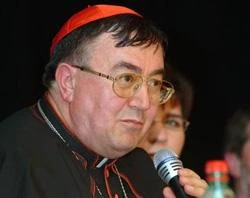 .- Cardinal Vinko Puljic, Archbishop of Sarajevo and President of the Bishops’ Conference of Bosnia and Herzegovina denied press reports yesterday which claim that the Vatican is creating a commission to investigate the alleged apparitions of Medjugorje.
 The cardinal, who is visiting Rome to attend the plenary session of the Congregation for the Evangelization of Peoples, of which he is a member, said that the Congregation for the Doctrine of the Faith is neither preparing a document nor establishing a special commission to study the Medjugorje apparitions.
Cardinal Puljic said that the official position of the bishops of Bosnia and Herzegovina is the one expressed by the then Bishops’ Conference of Yugoslavia in April 1991.
That statement not only expressed the episcopate’s support to then-Bishop Pavao Zanic of Mostar – where the town of Medjugorje is located - but explicitly said that, “based on previous research, it cannot be affirmed that these events concerning apparitions and revelations are of supernatural nature.”
“The doctrinal issue of the Medjugorje phenomenon is resolved, but its pastoral significance must still be taken into account,” the cardinal continued.
“The Medjugorje phenomenon is not only gathering faithful from Bosnia, but from all over the world, and in places where people gather to pray, God gives his blessing. Therefore, we should carefully examine all sides of this phenomenon,” he added.
Nevertheless, he reiterated, “for the moment, everything is under the jurisdiction of the local bishops.”
“Still, at any given moment, the Congregation for the Doctrine of the Faith could establish an International Commission in order to study the case of Medjugorje,” the cardinal remarked.
Speaking at the 2004 assembly of the Synod of Bishops, Cardinal Puljic complained that the reported apparitions of Medjugorje were “becoming a source of division in the Church.” In 2006, the cardinal was involved in setting up a commission concluding that the alleged Marian apparitions were not supernatural.
Bosnian Cardinal denies claims of Vatican commission for Medjugorje
- Medjugorje: Negative Judgment from the Church Forthcoming? Or a Positive Endorsement?
- Patrick Madrid: A Caller to My "Open Line" Radio Show Asks Me About the "Good Fruits" of Medjugorje
- News of Cardinal Schonborn's visit to Medjugorje was not intended for internet
- The Vatican to officially comment on apparitions of Medjugorje
- The Medjugorje Hoax
- Rumor: Archbishop of Vienna Cardinal Schonborn to visit Medjugorje
- Medjugorje seer Vicka flinches while in "ecstasy" (Video)
- Vatican ruling on disputed Medjugorje shrine expected soon
- Medjugorje news
- Bishop Cracks Down on Medjugorje
- Bishop of Mostar-Duvno explains the "Phenomenon of Medjugorje"
- E. Michael Jones Interview - Medjugorje
- Sadly flawed arguments against the Bishop of Medjugorje (Mostar-Duvno Diocese) on the letter to Sr. Elvira of Cenacolo
Hacker Releases Data Implicating CRU in Global Warming Fraud (Updated)
BBC confirms that a hack did indeed occur. Is this smoking-gun evidence of global warming data being fabricated?
So, has much of the climate change debate of the last ten years been a purposeful fraud? If the files that became available in the last few hours prove to be legitimate, it would appear so....
So, has much of the climate change debate of the last ten years been a purposeful fraud? If the files that became available in the last few hours prove to be legitimate, it would appear so....
Researcher says she found text on Shroud of Turin
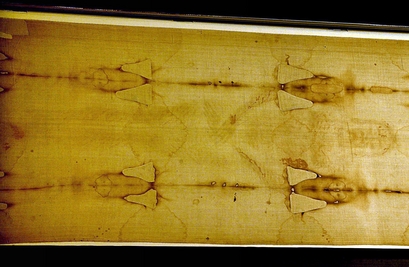
ROME — A Vatican researcher claims she has found a nearly invisible text on the Shroud of Turin and says the discovery proves the authenticity of the artifact revered as Jesus' burial cloth.
The claim made in a new book by historian Barbara Frale drew immediate skepticism from some scientists, who maintain the shroud is a medieval forgery.
Frale, a researcher at the Vatican archives, says the faint writing emerged through computer analysis of photos of the shroud, which is not normally accessible for study.
Frale says the jumble of Greek, Latin and Aramaic includes the words "Jesus Nazarene" and mentions he was sentenced to death. She believes the text was written on a document by a clerk to identify the body and the ink then seeped into the clothThursday, November 19, 2009

Pope Benedict XVI speaks with Bangladesh's Prime Minister Sheikh Hasina Wajed (L) during their meeting at the Vatican November 18, 2009.
REUTERS/Osservatore Romano (VATICAN POLITICS RELIGION)

Pope Benedict XVI leads his Wednesday general audience in the Paul VI hall at the Vatican November 18, 2009.
REUTERS/Tony Gentile (VATICAN RELIGION)
Pope Benedict XVI stands with his secretary Monsignor Georg Ganswein (R) after a meeting with Burundi's President Pierre Nkurunziza at the Vatican November 17, 2009.
REUTERS/Christophe Simon/Pool (VATICAN POLITICS RELIGION)
Pope Benedict XVI (L) is greeted by an unidentified delegate while arriving at a U.N. Food and Agriculture Organisation (FAO) food security summit in Rome November 16, 2009.
REUTERS/Osservatore Romano (ITALY POLITICS RELIGION)

Pope Benedict XVI (L) blesses to faithful during the Angelus prayer from a window of his private apartment at the Vatican November 15, 2009.
REUTERS/Alessandro Bianchi (VATICAN RELIGION)
A gust of wind lifts the drape with the Vatican's symbol as Pope Benedict XVI delivers his blessing during his weekly Angelus prayer from his window overlooking St. Peter's Square, at the Vatican, Sunday, Nov. 15, 2009.
(AP Photo/Pier Paolo Cito)Wednesday, November 18, 2009
AT THE END OF THE DAY, DIVERSITY HAS JUMPED THE SHARK, HORRIFICALLY
By Ann Coulter
November 18, 2009
It cannot be said often enough that the chief of staff of the United States Army, Gen. George Casey, responded to a massacre of 13 Americans in which the suspect is a Muslim by saying: "Our diversity ... is a strength."
As long as the general has brought it up: Never in recorded history has diversity been anything but a problem. Look at Ireland with its Protestant and Catholic populations, Canada with its French and English populations, Israel with its Jewish and Palestinian populations.
Or consider the warring factions in India, Sri Lanka, China, Iraq, Czechoslovakia (until it happily split up), the Balkans and Chechnya. Also look at the festering hotbeds of tribal warfare -- I mean the beautiful mosaics -- in Third World hellholes like Afghanistan, Rwanda and South Central, L.A.
"Diversity" is a difficulty to be overcome, not an advantage to be sought. True, America does a better job than most at accommodating a diverse population. We also do a better job at curing cancer and containing pollution. But no one goes around mindlessly exclaiming: "Cancer is a strength!" "Pollution is our greatest asset!"
By contrast, the canard "diversity is a strength" has now replaced "at the end of the day," "skin in the game," "blood and treasure," "jumped the shark," "boots on the ground," "horrific" (whatever happened to the perfectly good word "horrible"?), "not so much," "I am shocked, shocked to find that gambling is going on here," and "that went well," as America's most irritating cliche.
We should start making up other nonsense mantras along the lines of "diversity is a strength" and mindlessly repeating them until they catch on, too.
Next time you're at a cocktail party, just start saying, "Chocolate pudding is dramatic irony" from time to time. Eventually other people will start saying it, without anyone bothering to consider whether it makes sense. Then we'll do another one: "Nicolas Cage is a two-cycle engine."
Before you know it, liberals will react to news of a mass murder by muttering, "Well, you know what they say: Nicolas Cage is a two-cycle engine," while everyone nods in agreement.
Except mere nonsense makes more sense than "diversity is a strength."
If Gen. Casey's wildly inappropriate use of this lunatic cliche in the aftermath of the Fort Hood massacre doesn't kill it, nothing will.
Among the worst aspects of America's "diversity" is that liberals' reaction to a heterogeneous population is to create a pecking order based on alleged victimhood -- as described in electrifying detail in my book, "Guilty: Liberal 'Victims' and Their Assault on America."
In modern America, the guilty are sanctified, while the innocent never stop paying -- including with their lives, as they did at Fort Hood last week. Points are awarded to aspiring victims for angry self-righteousness, acts of violence and general unpleasantness.
But liberals celebrate diversity only in the case of superficial characteristics like race, gender, sexual preference and country of origin. They reject diversity when we need it, such as in "diversity" of legal forums.
After conferring with everyone at Zabar's, Obama decided that if a standard civilian trial is good enough for Martha Stewart, then it's good enough for the mastermind of the 9/11 attacks. So Khalid Sheikh Mohammed is coming to New York!
Mohammed's military tribunal was already under way when Obama came into office, stopped the proceedings and, eight months later, announced that Mohammed would be tried in a federal court in New York.
In a liberal's reckoning, diversity is good when we have both Muslim jihadists and patriotic Americans serving in the U.S. military. But diversity is bad when Martha Stewart and Khalid Sheikh Mohammed are subjected to different legal tribunals to adjudicate their transgressions.
Terrorists tried in civilian courts will be entitled to the whole panoply of legal protections accorded Stewart or any American charged with a crime, such as the presumption of innocence, the right to a fair trial, the right to exclude evidence obtained in violation of Miranda rights, the right to a speedy trial, the right to confront one's accusers, the right to a change of venue, the right to examine the evidence against you, and the right to subpoena witnesses and evidence in one's defense.
Members of Congress have it in their power to put an end to this lunacy right now. If they don't, they are as complicit in Mohammed's civilian trial as the president. Article I, Section 8, and Article III, Section 1 of the Constitution give Congress the power to establish the jurisdiction of the lower federal courts and to create exceptions to that jurisdiction.
Congress could pass a statute limiting federal court jurisdiction to individuals not subject to trial before a military tribunal. Any legislator who votes "nay" on a such a bill will be voting to give foreign terrorists the same legal rights as U.S. citizens -- and more legal rights than members of the U.S. military are entitled to.
In the case of legal proceedings, diversity actually is a strength.
November 18, 2009
It cannot be said often enough that the chief of staff of the United States Army, Gen. George Casey, responded to a massacre of 13 Americans in which the suspect is a Muslim by saying: "Our diversity ... is a strength."
As long as the general has brought it up: Never in recorded history has diversity been anything but a problem. Look at Ireland with its Protestant and Catholic populations, Canada with its French and English populations, Israel with its Jewish and Palestinian populations.
Or consider the warring factions in India, Sri Lanka, China, Iraq, Czechoslovakia (until it happily split up), the Balkans and Chechnya. Also look at the festering hotbeds of tribal warfare -- I mean the beautiful mosaics -- in Third World hellholes like Afghanistan, Rwanda and South Central, L.A.
"Diversity" is a difficulty to be overcome, not an advantage to be sought. True, America does a better job than most at accommodating a diverse population. We also do a better job at curing cancer and containing pollution. But no one goes around mindlessly exclaiming: "Cancer is a strength!" "Pollution is our greatest asset!"
By contrast, the canard "diversity is a strength" has now replaced "at the end of the day," "skin in the game," "blood and treasure," "jumped the shark," "boots on the ground," "horrific" (whatever happened to the perfectly good word "horrible"?), "not so much," "I am shocked, shocked to find that gambling is going on here," and "that went well," as America's most irritating cliche.
We should start making up other nonsense mantras along the lines of "diversity is a strength" and mindlessly repeating them until they catch on, too.
Next time you're at a cocktail party, just start saying, "Chocolate pudding is dramatic irony" from time to time. Eventually other people will start saying it, without anyone bothering to consider whether it makes sense. Then we'll do another one: "Nicolas Cage is a two-cycle engine."
Before you know it, liberals will react to news of a mass murder by muttering, "Well, you know what they say: Nicolas Cage is a two-cycle engine," while everyone nods in agreement.
Except mere nonsense makes more sense than "diversity is a strength."
If Gen. Casey's wildly inappropriate use of this lunatic cliche in the aftermath of the Fort Hood massacre doesn't kill it, nothing will.
Among the worst aspects of America's "diversity" is that liberals' reaction to a heterogeneous population is to create a pecking order based on alleged victimhood -- as described in electrifying detail in my book, "Guilty: Liberal 'Victims' and Their Assault on America."
In modern America, the guilty are sanctified, while the innocent never stop paying -- including with their lives, as they did at Fort Hood last week. Points are awarded to aspiring victims for angry self-righteousness, acts of violence and general unpleasantness.
But liberals celebrate diversity only in the case of superficial characteristics like race, gender, sexual preference and country of origin. They reject diversity when we need it, such as in "diversity" of legal forums.
After conferring with everyone at Zabar's, Obama decided that if a standard civilian trial is good enough for Martha Stewart, then it's good enough for the mastermind of the 9/11 attacks. So Khalid Sheikh Mohammed is coming to New York!
Mohammed's military tribunal was already under way when Obama came into office, stopped the proceedings and, eight months later, announced that Mohammed would be tried in a federal court in New York.
In a liberal's reckoning, diversity is good when we have both Muslim jihadists and patriotic Americans serving in the U.S. military. But diversity is bad when Martha Stewart and Khalid Sheikh Mohammed are subjected to different legal tribunals to adjudicate their transgressions.
Terrorists tried in civilian courts will be entitled to the whole panoply of legal protections accorded Stewart or any American charged with a crime, such as the presumption of innocence, the right to a fair trial, the right to exclude evidence obtained in violation of Miranda rights, the right to a speedy trial, the right to confront one's accusers, the right to a change of venue, the right to examine the evidence against you, and the right to subpoena witnesses and evidence in one's defense.
Members of Congress have it in their power to put an end to this lunacy right now. If they don't, they are as complicit in Mohammed's civilian trial as the president. Article I, Section 8, and Article III, Section 1 of the Constitution give Congress the power to establish the jurisdiction of the lower federal courts and to create exceptions to that jurisdiction.
Congress could pass a statute limiting federal court jurisdiction to individuals not subject to trial before a military tribunal. Any legislator who votes "nay" on a such a bill will be voting to give foreign terrorists the same legal rights as U.S. citizens -- and more legal rights than members of the U.S. military are entitled to.
In the case of legal proceedings, diversity actually is a strength.
Cardinal George: "I feel as if we're doing guerilla warfare here."

Wednesday, November 18, 2009
Bishop Donald Trautman of Erie lost his 10-year battle to prevent the Catholic bishops from approving a new Mass translation that he believes is awkward and ungrammatical. But his finale on the floor had the bishops tied up in knots over whether their president, Cardinal Francis George, broke church law when he gave a Vatican office permission to finish one set of English translations without the U.S. bishops' approval...
As Bishop Trautman persisted in his arguments, Cardinal George sighed, "I feel as if we're doing guerilla warfare here."
But he promised to look into a possible solution, drawing laughter when he said, "The United States Conference of Catholic Bishops could sue the Congregation [for Divine Worship] in the Apostolic Signatura" -- the Vatican's highest court. But during a coffee break, Bishop Trautman was mulling the possibility of doing that himself...
Batting Around the Great Apostasy
Having a ball with some Mormon elders.
Tim Staples
Tim Staples
Scenario:
It's a scorching hot Saturday afternoon in early September. Your wife has taken the little ones to the pool. It's just you and your oldest, ten-year-old Matthew, staying in to watch the big game. Mark McGuire has now hit 59 home runs! And the way he's been connecting, he could catch Roger Maris' thirty-seven year old record of 61 homers in today's game. Your son is decked out in his "McGuire" jersey and you've just poured ice-cold drinks for the start of the game when the doorbell rings. You hurry to the door, thinking of ways to get rid of whoever it is as quickly as possible. Opening it, however, you discover two sweat-drenched young men wearing white shirts and ties. With beaming smiles, they introduce themselves as Elders Joseph McCarthy and Leonard Smith. "We're from the Church of Jesus Christ of Latter-day Saints. We'd like to offer you some free literature and talk to you about the Lord and Savior Jesus Christ."
Your Response:
For a moment you freeze, thinking to yourself, "Why now, Lord? What about the game?" Quickly, you come to your senses. "Which is more important, Maris' record being broken or the salvation of two immortal souls?" So you invite them in. As you ask them to be seated in the living room where your son is engrossed in the game, you wonder if he'll see things the way you do.
Matthew winces a bit when you tell him you must turn the game off while you talk with these young Mormons. You're delighted, however, when his disappointment changes to excitement. (All that home schooling is paying off.) Matthew wants to talk about the Faith!
Step One:
Rather than wait for their scripted presentation, you decide to cut to the chase and begin the dialogue. You start by complimenting the Mormon Church on its belief in an authoritative, hierarchical church. You comment that of all the sects that have begun in the last 480 years, only theirs even claims to have apostolic authority. According to Ephesians 4:11-15, St. Paul tells us the true Church of Jesus Christ must have "apostles, some prophets, some evangelists, some pastors and teachers. . ." This leads you to the big question. "Why would I ever leave the Catholic Church which was founded by Jesus Christ and received apostolic authority directly from Him and the Apostles? This is so clearly attested to by both Scripture and many early Christian writers like St. Clement of Rome (A.D. 90), St. Ignatius of Antioch (A.D. 107), St. Irenaeus of Lyons (A.D. 180), St. Hippolytus (A.D. 200), St. Cyprian (A.D. 250), Eusebius of Caesarea (A.D. 330), St. Ambrose (A.D. 390), St. Augustine (A.D. 410), St. Jerome (A.D. 410), etc. The bishops in the Catholic Church are the successors of the Apostles and have true apostolic authority."
Elder Smith responds, "We believe the Church Jesus established fell into apostasy after the death of the last Apostle, as was foretold in the Bible in both Amos 8:11-14 and 2 Thessalonians 2:1-4. It has been re-established through another Testament given to Joseph Smith and the Church of Jesus Christ of Latter-day Saints."
Step Two:
You respond with a challenge. "Let's get out a Bible and look at those two texts you just mentioned. We'll begin with Amos. Amos prophesied around 780 B.C. Among other things, he warned of the coming destruction of Israel that would, in fact, occur in 721 B.C. (because of her idolatry — cf. chapters six and seven)." The passage Elder Smith cited reads: "'Behold, the days are coming,' says the Lord God, 'when I will send a famine on the land; not a famine of bread, nor a thirst for water, but of hearing the words of the Lord. They shall wander from sea to sea, and from north to east; they shall run to and fro, to seek the word of the Lord, but they shall not find it. . .'"
"This text speaks of an apostasy in ancient Israel, not after the death of the last apostle in New Testament times. But even this apostasy was not total. In the very next chapter (9:8-10), Amos makes this very clear: "'Behold, the eyes of the Lord God are upon the sinful kingdom, and I will destroy it from the surface of the ground; except that I will not utterly destroy the house of Jacob,' says the Lord. 'For lo, I will command, and shake the house of Israel among all the nations as one shakes with a sieve, but no pebble shall fall to the ground. All the sinners of my people shall die by the sword, who say, 'Evil shall not overtake or meet us.'
"There were many incidents in Old Testament salvation history when priests and prophets were corrupt (Lam. 4:13, Ezek. 22:22-26, Zeph. 1:4, Mic. 3:5), prophets had no vision from the Lord, prophesied falsely (Lam. 2:14, Jer. 23:26-31), or at times, there were no prophets at all (Psalm 74:9). Apostasies were frequent in the Old Testament, but never total. There was always a faithful remnant."
Step Three:
Now you move to a crucial point concerning Old Testament hierarchy. In the midst of good times and bad, there was one constant in all of Old Covenant salvation history: the existence of the High Priesthood and the Levitical Priesthood as they are detailed in Exodus 28 and Deuteronomy 17. God established and gave authority to them to guide the children of Israel. The High Priest, or those to whom the High Priest delegated authority, had the power to deliver the oracle of God to His people.
Deuteronomy 17:8-12 is an example of this historical fact: "If any case arises requiring decision between one kind of homicide and another, one kind of legal right and another, or one kind of assault and another any case. . . which is too difficult for you, then you shall. . . go up to. . . the Levitical priests, and to the judge who is in office in those days, you shall consult them, and they shall declare to you the decision. Then you shall do according to what they declare. . . you shall be careful to do according to all that they direct you. . . The man who acts presumptuously, by not obeying the priest who stands to minister there before the Lord your God, or the judge. . . shall die."
According to Exodus 28:30, the High Priest had what was called the "Urim and the Thummim" on the breastplate of his vestments whereby he would bear the sins of the people of Israel when he went before the Lord in the temple. Through this gift of God, the High Priest would also hear the Word of God and proclaim divine oracles from God.
Even during such a corrupt time as the time of the Judges, we see this gift in operation in Israel. This was a time when "every man did what was right in his own eyes" (Judges 17:6). Yet, even then, this gift of "the Urim and the Thummim" was alive and well. And when the Israelites consulted God through "Phineas the son of Eleazar the son of Aaron," who was High Priest at the time (cf. Judges 20:18-28), they received the oracle of God through him. They may not have always consulted the Lord or obeyed Him, but He was always there for them.
In fact, our Lord Jesus Christ Himself acknowledges the existence of this hierarchy and its authority in His time. In Matthew 23:2-3, Jesus says to his disciples, "The scribes and Pharisees sit on Moses' seat; so practice and observe whatever they tell you, but not what they do; for they preach, but do not practice." Even the Apostles must obey the scribes and Pharisees who speak in an official capacity with delegated authority from the High Priest. Note: they must do so even if the legitimate authority may be personally corrupt (see also John 11:47-52).
Elder Smith responds, "Even if the Old Testament people of God never completely apostatized, St. Paul prophesied the New Covenant people of God would in 2 Thessalonians 2:1-4. He even used the word apostasia in verse 3 to describe it. He declared this apostasy must occur before Jesus would come again. And after all, didn't the Jews themselves reject the Messiah and apostatize? Doesn't this at least demonstrate that an apostasy is possible?"
Step Four:
You respond, "First of all, not all of Israel apostatized. The Apostles, Mary and the earliest disciples were mostly Jews! And remember, the Church is 'the Israel of God' (Gal. 6:16). And 'he is not a real Jew who is one outwardly, nor is true circumcision something external and physical. He is a Jew who is one inwardly, and real circumcision is a matter of the heart. . .' (Rom. 2:28). St. Paul describes the relationship between Jews and Christians in Romans 11:18-29, but once again, I emphasize the fact that a total apostasy simply did not occur. There isn't one shred of biblical evidence that says otherwise. And to put it frankly, a total apostasy, as you describe it, is impossible in the New Testament. There are three reasons for this:
"First, the Old Testament prophecies concerning the New Covenant describe it as perpetual and indefectible. For example, Daniel 7:13-14:
'I saw in the night visions, and behold, with the clouds of heaven there came one like a son of man [Jesus], and he came to the Ancient of Days and was presented before him. And to him was given dominion and glory and kingdom, that all peoples, nations, and languages should serve him; his dominion is an everlasting dominion, which shall not pass away, and his kingdom one that shall not be destroyed.' (See also Isaiah 9:6-7 and Daniel 2:44.)
"Second, the New Testament also describes the Church as indefectible. Yes, there will be apostasies. That is what St. Paul is referring to in 2 Thessalonians. In fact, there will be a major apostasy before the Second Coming according to 2 Thessalonians 2, but never does it say a total apostasy. According to the New Testament, this is impossible! Matt. 28:19-20 says, 'And Jesus came and said to them, 'All authority in heaven and on earth has been given to me. Go therefore and make disciples of all nations, baptizing them in the name of the Father and of the Son and of the Holy Spirit, teaching them to observe all that I have commanded you; and lo, I am with you always, to the close of the age.' A similar thought can be found in Luke 1:33, where the Angel Gabriel says of Jesus, 'And of his kingdom there will be no end.'"
Just as you finish quoting this last verse, your son says, "Daddy, what about when Jesus gave the keys of the kingdom to St. Peter? Didn't Jesus say the gates of hell would never overcome the Church?" (Cf. Matt. 16:15-19) You feel so proud, you want to jump through the roof. "Yes, son, that's an excellent point!"
Elder Joseph then responds, "Those verses merely speak of the ultimate triumph of the Church. We agree with that. But that doesn't mean there would not be an apostasy in the centuries between the time of the Apostles and now."
"I'm glad you bring that up, because that leads me to the third reason why a total apostasy is impossible," you retort. "Matthew 28:20 says the Lord will be with us, pasas tas hemaras, or 'all the days'! So there's no room for total apostasy. Christ will be teaching via his apostles and their successors all days even until the end of time!
"In Ephesians, St. Paul explicitly tells us the Church will be with us until the end of time. Ephesians 1:22 describes the Church as '[Christ's] body, the fullness of him who fills all in all.' This Church is 'built upon the apostles and prophets, Christ Jesus himself being the chief cornerstone' (2:20). She is described as being so awesome, St. Paul can say 'through the Church the manifold wisdom of God might now be made known to the principalities and powers in heavenly places' (3:10). The Church teaches angels!
As we saw before, this true Church must have apostles, prophets, pastors, evangelists and teachers (cf. 4:11). And why, you ask? 'For the equipment of the saints. . . for building up the body of Christ. . . so that we may no longer be children, tossed to and fro and carried about with every wind of doctrine. . .' (4:12,14).
"So, God gave us the Church that we may know with certainty the truths of the Faith. That's not the only reason, but it is a central reason. But maybe the most important passage for us in Ephesians is 3:20-21:
'Now to him who by the power at work within us is able to do far more abundantly than all that we ask or think, to him be glory in the Church and in Christ Jesus to all generations, forever and ever. Amen.'
"This Church that St. Paul is describing in Ephesians will be here to all generations (pasas tas geneas, 'all the generations') forever and ever. This eliminates the possibility of a total apostasy for even one generation!"
At this point, Elder Smith says it's time for them to get going, but that they'd like to come back with someone who would be better able to respond to what you're saying. You realize you may well be making progress, so you agree and you give them one last thing to think about. As you all say your good-byes, you ask them this question:
"According to Matthew 18:15-18, Jesus gives us a commandment. He says if we have a difficulty with a brother, we try and settle the difficulty with him personally. If we can't settle it, we take two or three with us and try to work it out then. Let's say the difficulty we have with our brother is over the nature of God. The question is whether or not God is a Trinity. If we still cannot settle the difficulty, we 'tell it to the Church.' If he fails to listen to the Church, he is to be excommunicated. The question is, what Church is being referred to here?"
Elder Smith responds without pause, "Jesus is talking about the true Church, which I testify to you is the Church of Jesus Christ of Latter-day Saints."
You answer, "But what if you're living in 1785, and you have this same difficulty? In obedience to Jesus, where do you go then? Your church doesn't exist yet."
There is silence. After an awkward moment, you calmly say, "Fellas, Jesus is the way, the truth and the life. He would never lead us astray or command us to follow error. If the true Church didn't exist on this earth for 1,700 years, then Jesus misguided millions into obeying error-filled churches with no apostolic authority. And that's ridiculous."
As you shake hands, you invite them to return anytime. Then, as they turn to leave, little Matthew says, "I hope you guys become Catholic — that would be really cool." Matthew closes the door. Looking at him with pride you say, "Yeah, that would be really cool. Now, let's go see what McGuire did!"
Tim Staples is the director of evangelization for the Catholic Resource Center in West Covina, CA.
Subscribe to:
Posts (Atom)