 Colorado Springs, Colo., Oct 6, 2009 / 09:27 pm (CNA)
.- An Italian scientist is claiming to have re-created the burial cloth believed to have covered the crucified body of Jesus, called the Shroud of Turin. However, CNA spoke with experts who maintain that there are still several major differences between the new shroud and the ancient one.
According to Reuters, Luigi Garlaschelli, an organic chemistry professor at the University of Pavia announced that he and his team “have shown it is possible to reproduce something which has the same characteristics as the Shroud.” The scientist plans to present his findings at a conference on the paranormal this weekend in Italy.
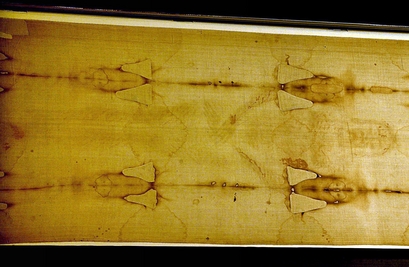
The Shroud of Turin is considered by many to bear an image of the face of Jesus Christ. Made of herring bone linen, the shroud is nearly four feet by 14 feet and bears faint brown discolorations forming the negative image of a crucified man.
The shroud’s positive image, revealed by modern photography, shows the outline of a bearded man. While skeptics contend that the shroud is a medieval forgery, scientists have been unable to explain how the image appeared on the cloth.
Garlaschelli and his team, who were funded by an Italian association of atheists and agnostics, created their image by placing the linen over a volunteer before rubbing it with a pigment called ochre with traces of acid.
The linen was then “aged” by heating it in an oven and washing it with water. Reuters reports that the team then added blood stains, burn holes and water stains to finalize their product.
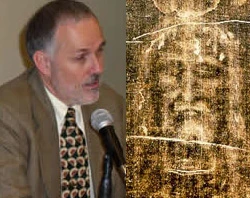
CNA spoke with Dr. John Jackson who runs the Turin Shroud Center of Colorado and is a physics lecturer at the University of Colorado at Colorado Springs. Jackson led a team of 30 researchers in 1978 who determined that the shroud was not painted, dyed or stained. He explained to CNA that that based off the Reuters report as well as photos of Garlaschelli’s shroud on the internet, it appeared that it doesn’t exactly match the Shroud of Turin.
Dr. Jackson first questioned the technique used by Garlaschelli’s team, taking issue with the method of adding blood after aging the cloth. Jackson explained that he has conducted “two independent observations that argue that the blood features on the shroud” show “that the blood was on it first, then the body image came second.”
Dr. Keith Propp, a physicist who is also a colleague of Jackson's, told CNA that while Garlaschelli’s shroud “does create an image that could’ve been done in medieval times,” there are a many things that “are not consistent with what the actual shroud shows us.”
For example, he continued, we know that the blood contacted the shroud before the body “because there’s no image beneath the shroud.” He added that this image pattern would be difficult to duplicate “because it would ruin the blood stains.”
Another area concern for the scientists is the three dimensionality of the shroud.
Propp explained that while Garlaschelli’s cloth does have some aspects of light and dark to create a three-dimensional perspective, “it’s nowhere near as sophisticated as the shroud” and that “it misses out on the accuracy and subtleties that are in the actual image.”
Dr. Jackson from the Turin Shroud Center also touched on the same point, saying, “The shroud’s image intensity varies with” the distances in between the cloth and the body. While he admitted that the images of Garlaschelli’s shroud on the internet look authentic, when taken from a 3-D perspective, “it’s really rather grotesque.”
“The hands are embedded into the body and the legs have unnatural looking lumps and bumps,” he explained.
Jackson noted that he or his colleagues would be open to testing the Garlaschelli shroud or any other “idea about the shroud relative to the scientific characteristics that have been documented in respect to the shroud,” however to do so they would need “more detailed information about what was specifically done.”
Garlachelli’s technique has also received criticism from other experts. One scientist from the Shroud Science Group, a private forum of about 100 scientists, historians and researchers provided CNA with some of the critiques made in the forum.
One English-speaking expert explained that the blood used on the Shroud of Turin is not whole blood. “They didn't just go out and kill a goat and paint the blood on the cloth. The blood chemistry is very specific,” he said explaining that the blood is from “actual wounds.”
He added that most of the blood on the shroud flowed after death. “The side wound and the blood that puddles across the small of the back are post-mortem blood flows,” he said, adding that blood flowing after death “shows a clear separation of blood and serum.”
Propp added, “In some ways, it comes out better than most others I’ve seen before. Still there are too many things – the shroud is more than just the image.”
Jackson also pointed out that Garlaschelli’s findings have yet to be peer reviewed. What scientists need “to do is present their work for publication before their peers.”
He explained that any person can conduct his or her own research, but it doesn’t matter whether or not the author believes his or her hypothesis was proven. In the end, what the scientific community decides “upon seeing and reviewing the work” is what counts, he said.
Pope Benedict has announced that the Shroud will be open for public viewing in 2010 and that he is planning to visit the image at some point during its exposition.
The Catholic Church has not taken an official position on the authenticity of the Shroud of Turin.