LONDON, MARCH 12, 2009 (Zenit.org).- Modern liberalism has strong totalitarian tendencies, according to the archbishop of Sydney.
Cardinal George Pell affirmed this at a conference last week in Oxford on "Varieties of Intolerance: Religious and Secular."
The Australian prelate began his address considering two examples of intolerance. The first was the little-publicized reaction to California's vote in November to define marriage as between one man and one woman.
The cardinal said that religious groups, businesses and individuals that worked toward the amendment have been the victims of pro-homosexual retaliation, ranging from death threats to boycotts to forced resignation from jobs.
He went on to consider as a second example the opposite reaction of human rights groups to what is considered intolerance of Islam.
The prelate said these cases show there is "onesidedness about discrimination and vilification."
"Some secularists seem to like one way streets," he added. "Their intolerance of Christianity seeks to drive it not only from the public square, but even from the provision of education, health care and welfare services to the wider community. Tolerance has come to mean different things for different groups."
The cardinal noted how particularly in the United States, members of Church organizations are facing more and more legal obstacles when it comes to following their consciences.
And in Australia, he said, the abortion law enacted last year in the state of Victoria "made a mockery of conscientious objection."
"Pro-abortion commentators attacked the concept of conscientious objection as nothing more than a way for doctors and nurses to impose their morality on their patients," Cardinal Pell recalled. "Victoria’s statutory charter of rights, which purports to protect freedom of religion, conscience and belief, was shown to be a dead letter when it comes to abortion. […] The human rights industry ran dead on the freedom of conscience issues which the legislation raised. Amnesty International seems to have been completely missing in action. […] As we know, abortion corrupts everything it touches; law, medicine and the whole concept of human rights."
Christian response
The cardinal contended that "there is an urgent need to deepen public understanding of the importance and nature of religious freedom."
"Believers should not be treated by government and the courts as a tolerated and divisive minority whose rights must always yield to the minority secular agenda, especially when religious people are overwhelmingly in the majority," he said. "The opportunity to contribute to community and public good is a right of all individuals and groups, including religious ones. The application of laws within democracies should facilitate the broadening of these opportunities, not their increasing constraint."
Affirming that "modern liberalism has strong totalitarian tendencies," the cardinal went on to explain how it is different than "traditional liberalism, which sees the individual and the family and the association as prior to the state, with the latter existing only to fulfill functions that the former require but which are beyond their means to provide."
He said the Universal Declaration of Human Rights and the International Covenant on Economic and Social and Cultural Rights understand and articulate this proper relationship.
Cardinal Pell stated that new trends in using anti-discrimination law and human rights claims to advance the "autonomy project" is not new but that there is a new and "dangerous" trend: the withholding or retrenchment of exemptions for church agencies and conscience provisions for individuals.
The broad effect of this, he said "is to enforce conformity."
The key to the solution, Cardinal Pell affirmed, is that "Christians have to recover their genius for showing that there are better ways to live and to build a good society; ways which respect freedom, empower individuals and transform communities. They also have to recover their self-confidence and courage.
"The secular and religious intolerance of our day needs to be confronted regularly and publicly. Believers need to call the bluff of what is, even in most parts of Europe, a small minority with disproportionate influence in the media. This is one of the crucial tasks for Christians in the 21st century."
--- --- ---
On the Net:
Full text of address: http://documents.scribd.com/docs/1aqyamje35bx7w1omesl.pdf
Thursday, March 19, 2009
Wednesday, March 18, 2009
The Story of a Modern-Day Exorcist

When he first heard about a Vatican-sponsored course on exorcism for priests, journalist Matt Baglio was intrigued by the idea of this ancient ritual taking place in the modern world. In his new book, The Rite, Baglio follows American priest Father Gary — sent to Rome to train as an exorcist — and his apprenticeship with Father Carmine. Baglio talked to TIME about belief, skeptical priests and the particulars of the exorcism ritual.
TIME: The thing that inspired this book was a class on exorcism. Tell me about it.
BAGLIO: I was a freelance journalist living in Rome and had heard about this course called Exorcism and the Prayer of Liberation. It was organized by the Legion of Christ and their school, the Regina Apostolorum, which is Vatican-affiliated. Not knowing anything about exorcism or if the Church even still believed in it, I was intrigued by the idea of a university-level course teaching priests about exorcism.
What were your first thoughts about the class? Did you think, Wait a minute, this is the 21st century. Why are we even still talking about exorcism?
Absolutely. My first thought was, Why is the church doing this class? Is it just a p.r. stunt? But then I saw that a lot of the course work itself was very theologically and historically based. None of it was practical, which is why Father Gary had to eventually go out and apprentice with a veteran exorcist, Father Carmine. The course would bring in experts — experts in satanic cults, experts in criminology, they even had a psychiatrist come in to talk to the priests about the differences between the various mental illnesses that could be confused for demonic possession vs. what the church says is actually demonic possession. (See photos of Pope Benedict XVI.)
As we understand more and more about multiple personalities, epilepsy, schizophrenia and other mental illnesses, doesn't demonic possession get explained away?
There's a definite degree to which that's true. You can't deny the fact that many illnesses in the past were misunderstood. The church has to be very careful about confusing mental illness with demonic possession.
When you started the book, did you lean one way or another in terms of whether or not you believed in the possibility of exorcism?
I came at this topic very journalistically, not having an opinion for or against it. I wanted to really understand what it is and why the church still believes in it. But even exorcists themselves admit that 90% of the people that come to see them don't need an exorcism. There still remains a small percentage of cases, however, involving levitation, mind-reading and other paranormal phenomena that can't be explained through science. Maybe one day.
You write about how most priests don't even like to talk about exorcism, that they find the idea distasteful. Why is that?
There's a lot of taboo when it comes to the devil and evil itself. Parishioners don't want to hear about Satan and evil and sin. Father Gary, he's in his 50s, and he was ordained in the late '70s. During that period, you had a lot of turmoil in conjunction with Vatican II shaking up the church and getting rid of many very old traditions, the Latin mass and those sorts of things. But you have to look at priests themselves as being creatures of their environment. Coupled with that were all this these new psychoanalytical approaches that were uncovering a lot of things that in the past were considered to be in the realm of the spiritual. I think a lot of priests saw that and said, Let's just keep becoming more modern and more open and don't worry about all these "medieval things."
And as a result, many exorcists are marginalized within the church.
I had priests tell me that their superiors belittled the fact that they were exorcists. Interestingly, though, the newer generation of priests are more responsive to the reality of the devil, and a lot of that has to do with the fact that John Paul II was and Pope Benedict XVI is a little more conservative, so the younger seminarians are a little less apt to ridicule. The older priests of Father Gary's generation didn't want to talk about it.
So how is a priest supposed to figure out that an exorcism is warranted? How do they judge who is and who isn't a worthy candidate?
The ritual stipulates that there are three signs that the priest has to look for: abnormal strength, the ability to understand unknown languages and the knowledge of hidden things. But they're very arbitrary, even those things. So they have to be in concert with something else. And typically what priests look for is what they call the aversion to the sacred, which is a person's inability to pray, to say the name of Jesus or Mary, to even look at the priest. Typically, when the person comes to see them, it's the last thing they want to do. They tend to have gone to see many doctors in search of a medical cure for whatever is afflicting them. They don't believe that the problem is demonic. They don't come in and say, "Father, I'm being attacked by demons. You need to pray over me." When someone says that to them, the priests immediately discounts that the problem is demonic.
So what happens during the exorcism rite?
The ritual, as its written, has several different stages to it. You say the litany of saints, you read the Gospel, you say a homily. The priest is allowed to bring in other elements if he wants to — the renewal of the baptismal vows, for example. But at the core of it are the exorcism prayers themselves, which are composed of the imperative and the depreciatory. The depreciatory involves the exorcist entreating God — "God, come down and bless this person." The imperative is the command, "I command you to leave this person." If you were to do the whole thing from start to finish, it would take out about an hour. But none of the priests that I followed in Rome do it like that. Almost all of them get rid of everything except the exorcism prayers. And the reason they do that is because they don't have time. They have a waiting room of 20 people. That's one day. The next day they have another 20 people.
Most of the exorcisms that Father Gary witnesses are fairly low-key. What happens during the dramatic ones?
If an exorcist sees 100 people, there are only going to be 2 or 3 that are dramatic. And I would characterize those as being when the person actually speaks to the exorcist. Quite often they'll be burping or belching or coughing or yawning. There's moaning and screaming too. But in the stronger cases, in almost every instance, you'll have the voice. The person will speak in a demonic voice, and they'll say things like, "This person belongs to us," "You have no power over us," "You can't defeat us." They are usually very dramatic in the sense that the person will be screaming at the top of their lungs. There can also be shaking. Picture a person sitting in a chair with their arms sticking straight out, their legs sticking straight out, convulsing. That's common.
But usually, the more dramatic cases deal with people who are screaming, using their voice, shoving and punching, getting up, smacking their head against the wall — just very violent. And that voice is beyond a simple mimic of a strange voice. It's very uncanny, very unnatural. And then, of course, there's vomiting, which is common. Father Carmine saw a case where a woman vomited up a small black toad that was still alive. He went to catch it, and it dissolved into saliva. I had another priest who I talked to who dealt with a woman who vomited up seven little black nails, six of which dissolved into this black liquid. Father Carmine saw a woman vomiting up buckets of human sperm.
Don't you think that regardless of your book or the testimonials by these priests, there are many people who aren't going to believe that exorcism is valid?
For people to just outright discount it is a little premature. I think that there's clearly something going on here. Even if you don't believe in the devil, how do you explain the paranormal? I would dearly love if science could really explain some of these things, but until then, the question is just too big to ignore.
Israeli ambassador confirms Pope Benedict may wear cross at Western Wall

Rome, Italy, Mar 18, 2009 / 02:13 am (CNA).- Contrary to comments attributed to an Israeli rabbi, Pope Benedict XVI will not be barred from entering the holy area of Jerusalem’s Western Wall while wearing a cross.
On Tuesday the Jerusalem Post quoted Rabbi Shmuel Rabinovitch, who oversees worship matters at the Western Wall, as saying that the Pope should not wear a cross during his visit to the area.
“It is not fitting to enter the Western Wall area with religious symbols, including a cross,” the rabbi reportedly said, according to SIR.
Mordechay Lewy, Israel’s Ambassador to the Holy See, issued a clarifying statement saying that the Jerusalem Post’s quotation was “misleading.”
Ambassador Lewy said that Israel will “respect, as a matter of course, the religious symbols of the Holy Father and of his entourage, as expected in accordance with rules of hospitality and dignity,” following the same procedure applied in Pope John Paul II’s papal visit to Israel in 2000.
“This was confirmed to a high Official of the Ministry of Foreign Affairs of Jerusalem personally by Rabbi Shmuel Rabinovitch,” the ambassador’s statement continued.
Pope Benedict is scheduled to visit the Western Wall on May 12 as part of his journey to the Holy Land.
- Israeli ambassador confirms Pope Benedict may wear cross at Western Wall
- Western Wall rabbi says pope should not wear cross at site
Tuesday, March 17, 2009
Depart From Me! I Never Knew You, Eaters of Bacon

By Katharine Shilcutt in Spaced City
Monday, Feb. 23 2009 @ 2:14PM
Did you know that Joel Osteen is kicking it old school now? And by old school, I mean Old Testament. Straight outta Hebron!
The new-agey

He further explained his newfound nutritional path to salvation with deeply theological phrases like "back in the Bible days" and "this is kinda gross" before launching into a detailed diatribe about the inherent filth and evil associated with porcine digestive tracts...
Monday, March 16, 2009
The Protestant Meltdown
By David Mills
March 22-28, 2009 Issue | Posted 3/13/09 at 10:25 AM
"Many cradle Catholics I know look at the moral conflicts tearing apart the mainline denominations with sadness, but as a convert from one of them (the Episcopal Church, the most notoriously divided one of them all), I think this is not quite the right response.
We will feel sad at the sight of beloved Christian friends suffering as their churches divide, but we might be heartened to see that because these conflicts express flaws in the original design, they will encourage some to greater friendship, if not full reconciliation, with the Catholic Church..."
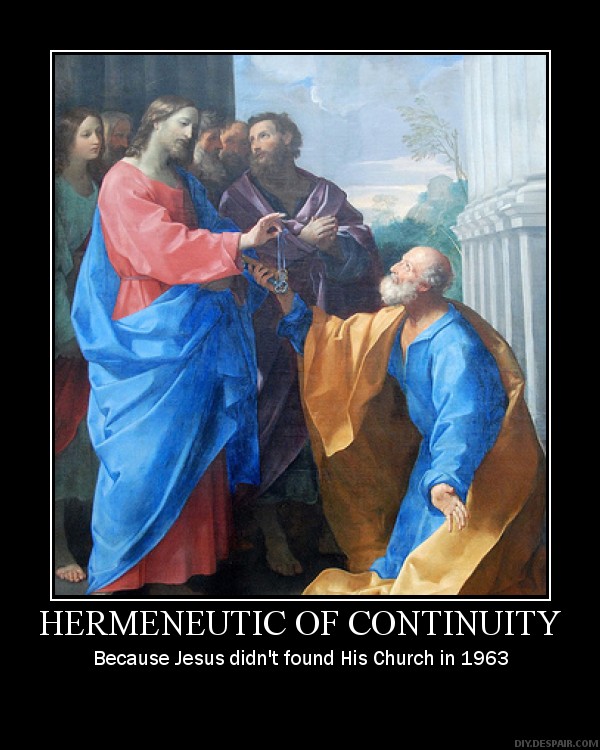
Continuity, Not Rupture

Sunday, March 15, 2009
Pope Benedict XVI's Book on Saint Paul
In this book, Pope Benedict XVI, a profound spiritual leader in his own right and a first-rate theologian and Bible commentator, explores the legacy of Paul. Pope Benedict follows the course of the Apostle’s life, including his missionary journeys and his relationship with the other apostles of Jesus such as St. Peter and St. James, and Paul’s martyrdom in Rome. Benedict also examines such questions as: Did Paul know Jesus during his earthly life and how much of Jesus’ teaching and ministry did he know of? Did Paul distort the teachings of Jesus? What role did Jesus’ death and resurrection play in Paul’s teaching? What are we to make of Paul’s teaching about the end of the world? What does Paul’s teaching say about the differences between Catholic and Protestant Christians over salvation and the roles of faith and works in the Christian life? How have modern Catholic and Protestant scholars come together in their understanding of Paul? What does Paul have to teach us today about living a spiritual life?
These and other important issues are addressed in this masterful, inspirational, and highly-readable presentation of St. Paul and his writings by one of today’s great spiritual teachers, Pope Benedict XVI.
“The Apostle Paul, an outstanding and almost inimitable yet stimulating figure, stands before us as an example of total dedication to the Lord and to his Church, as well as of great openness to humanity and its cultures.”
—Pope Benedict XVI

Why Sebelius should refrain from communion
By ARCHBISHOP JOSEPH f. NAUMANN
As a Catholic priest, my life is dedicated to attempting to bring people to Jesus Christ. In our Catholic faith, we believe that Jesus makes himself uniquely present to us through our reception of the Eucharist.
Catholics, in receiving the Eucharist, profess their faith in the real presence of Jesus as well as their communion with His Church.
Catholics have a personal responsibility not to receive Holy Communion if they have with knowledge and intention committed a grave evil.
While I realize that most readers of The Star do not share my faith in the Eucharist, I share this brief description of Catholic belief to provide the context for my request that Kansas Gov. Kathleen Sebelius not receive Holy Communion.
As a bishop, it is my responsibility to protect the integrity of the sacraments as well as the teaching of the Church.
Many public policy issues have ethical and moral dimensions. Our Catholic faith offers us principles that guide our understanding of such important societal issues as immigration, war, health-care reform, etc.
While the principles are consistent for every Catholic, the determination of how to apply them varies.
However, there are some actions that, because they involve the destruction of innocent human life, can never be justified. A Catholic in good conscience can never support policies permitting abortion, experimentation on human embryos or euthanasia.
Catholics in public life who consistently support policies that permit these intrinsic evils not only damage themselves spiritually but also create scandal by leading others into error.
For more than 25 years, Gov. Sebelius has advocated and supported legalized abortion. She has opposed such modest protections as parental notification for minors, waiting periods, informed consent and improved regulation of abortion clinics.
In the hope to awaken her to the grave spiritual consequences of her own actions and in an effort to prevent her from leading others into error, it was my responsibility to request that the governor refrain from receiving the Eucharist.
Unlike the Church’s understanding of the Eucharist that depends on faith in a revealed truth, the Church’s defense of the sanctity of human life is based on human reason.
The Church has a moral obligation to stand with many other Americans of different religious persuasions in the defense of the most fundamental of human rights.
Obviously, the governor has the freedom to continue her past support for legalized abortion that has served her well politically. But she does not have the right, by her public actions, to attempt to redefine Catholic teaching regarding abortion as well as our understanding of the Eucharist.
Archbishop Joseph F. Naumann is the archbishop of the Archdiocese of Kansas City in Kansas, which covers 21 counties, 111 parishes and 203,741 Catholics.
Armenian rite ordinations in Rome...
"If you've been blessed with the grace of a liturgical interest then a visit to Rome's (Catholic) Armenican rite parish is a must. This parish is located in the fashionable Via Veneto neighborhood (the Church of San Nicola da Tolentino). Armenican Catholics have had this Rome parish as their own since the 1880s when PopeLeo XIII gave them the property. Armenian seminarians live in the attached collegio. In the photos is a diaconal ordination from Sunday. The ordaining prelate was His Beatitude Nerses Bedros XIX, the Catholic Patriarch of Armenians.Needless to say, the rite was breathtaking. "
Saturday, March 14, 2009
Pope to make historic visit to Britain
By Jonathan Wynne-Jones, Religious Affairs Correspondent
Last Updated: 10:18PM GMT 14 Mar 2009

The German pontiff will make the first Papal visit to this country in nearly three decades.
It is understood that the historic event is being timed to coincide with the beatification of Cardinal John Henry Newman, who is on the path to becoming the first British saint for 40 years.
Details of the visit, which will attract crowds of hundreds of thousands of people, are still under discussion, but cities being considered include London, Birmingham, Oxford, Edinburgh, Armagh and Dublin.
A senior cardinal is due to make a private trip to Britain in the summer to make preparations for the Pope's visit, which could be announced by the end of this year.
The Catholic Church in England and Wales will hope that such an event will capture the imagination of the country's four million Catholics, of whom only a quarter now regularly attend Mass...
Friday, March 13, 2009

The Institution of the Eucharist
POUSSIN, Nicolas

The Adoration of the Kings
GOSSAERT, Jan (Mabuse)

Madonna and Child with an Angel
BOTTICELLI, Sandro

The Institution of the Eucharist
BAROCCI, Federico Fiori
Cardinal Pell Says Secularism Is Getting Totalitarian

Considers Cases of Religious Intolerance
Thursday, March 12, 2009

Albrecht Dürer

Albrecht Durer


