By Ian Graham
BELFAST (Reuters) - A Northern Ireland bakery owned by devout Christians who refused to bake a cake with a pro-gay marriage slogan was found guilty of discrimination in Belfast on Tuesday and fined.
The case has become heavily politicized in Northern Ireland with members of the province's largest political party, the Democratic Unionist Party, proposing the introduction of a Conscience Clause Bill to allow the withholding of services on grounds of religious belief.
Northern Ireland's Deputy First Minister Martin McGuinness, a member of the Irish nationalist party Sinn Fein, welcomed the judgment as "a good result for equality".
Gay rights activist Gareth Lee took Ashers Baking Company in Belfast to court in a civil action after it canceled his order for a cake with the slogan "Support Gay Marriage" on it. The case was funded by the British province's Equality Commission.
The firm initially accepted the order but later contacted Lee to cancel it and refund his money. Lee told a court hearing over three days in March that the bakery's refusal made him feel "unworthy" and "a lesser person".
Speaking outside the court just before the judgment on Tuesday, bakery owner Daniel McArthur said: "We happily serve everyone but we cannot promote a cause that goes against what the Bible says about marriage."
In her judgment, District Judge Isobel Brownlie said that while the defendants had a right to religious beliefs "they are limited as to how they manifest them".
For it to be otherwise "would be to allow religious belief to dictate what the law is," she added.
The court found that Ashers had discriminated against Lee on the grounds of his sexual orientation as well as his political beliefs and ordered the bakery to pay £500 ($776).
Link:

Showing posts with label Ireland. Show all posts
Showing posts with label Ireland. Show all posts
Tuesday, May 19, 2015


Tuesday, April 22, 2014
"Maria Divine Mercy" - Statement of Archdiocese of Dublin on the Alleged Visionary

Archbishop Diarmuid Martin
STATEMENT OF ARCHDIOCESE OF DUBLIN
ON THE ALLEGED VISIONARY “MARIA DIVINE MERCY”
Requests for clarification have been coming to the Archdiocese of Dublin concerning the authenticity of alleged visions and messages received by a person who calls herself “Maria Divine Mercy” and who may live in the Archdiocese of Dublin.
Archbishop Diarmuid Martin wishes to state that these messages and alleged visions have no ecclesiastical approval and many of the texts are in contradiction with Catholic theology.
These messages should not be promoted or made use of within Catholic Church associations.
Link:
Friday, October 5, 2012
Morocco denies entry to Dutch "abortion ship"
The Women on Waves ship, which already has visited traditionally Roman Catholic countries Spain, Portugal and Ireland at the invitation of local women's groups, had planned to arrive at Smir, northern Morocco, but was denied entry.
"The harbor is totally blocked by warships so no one can get in, and there are a lot of police here," said Marlies Schellekens, a doctor from Women on Waves who had gone on shore.
"We're now working on an emergency plan but we have opened up our hotline so women can call for information about the abortion pill."
The group, which was invited to Morocco by rights group Alternative Movement for Individual Freedoms (MALI), wants to spread awareness on land about the use of pills for a medical abortion and said it would carry out abortions aboard the ship in international waters.
Like in other Muslim countries, abortion is illegal and punishable by up to 20 years in prison under Moroccan law, but hundreds of illegal abortions are carried out daily in clinics or using herbal medicines, sometimes resulting in death or injury.
"In Morocco, between 600 and 800 abortions are done every day, but only about 250 are done by doctors, so they are safer, while the rest are taking risks," Schellekens said.
There was no immediate comment from officials on Thursday, but on Wednesday Interior Minister Mohand Laenser, a secular member of the government led since December by moderate Islamists, said the ship would not be allowed to reach Morocco.
"The organizers have never contacted us to seek permission to visit Morocco," Laenser told Reuters. "Plus, we are not going to let them in."
Each year hundreds of single mothers are forced to abandon or give up their babies for adoption because of the stigma linked to abortion and pre-marital pregnancy.
The Moroccan Association Against Clandestine Abortion said in June that the legislation on abortion was disconnected from the social realities of the country and the number of unsafe abortion required a political commitment for a change.
Organisers of an all-gay cruise in June blamed Moroccan officials for the cancellation of what would have been the first visit of its kind to a Muslim country.
Link:
Thursday, June 14, 2012
No special case for seal of confessional - Minister for Justice Shatter
(Irish Times) SEANAD: DAVID CULLINANE (SF) said he was glad the Minister for
Justice had made it clear that there would be absolutely no exemptions
in terms of legislative requirements on the reporting of the abuse of
children or vulnerable adults.
Mr Cullinane had earlier noted that the Association of Catholic Priests had stated that there would be no breaking of the confessional seal. It had to be made clear to everyone, including the main church in this State, that the rights of children and the laws of the land came first, Mr Cullinane stressed. Priests should know that they could not use the confessional seal as a reason for not coming forward with information on abuse.
Minister for Justice Alan Shatter (FG) said it was possible that if a priest or a bishop was prosecuted under withholding of information legislation they might claim entitlement to some form of privilege. However, the legal basis for such a claim no longer held, as the special position of the Catholic church had been removed from the Constitution. If such a claim was based on freedom of religion, the courts might be called on to decide the issue.
He did not believe that, where a child or a vulnerable adult had been a victim of abuse, the Irish courts would hold that it was of benefit to the State that those who knew of the abuse concealed it.
Link:
Mr Cullinane had earlier noted that the Association of Catholic Priests had stated that there would be no breaking of the confessional seal. It had to be made clear to everyone, including the main church in this State, that the rights of children and the laws of the land came first, Mr Cullinane stressed. Priests should know that they could not use the confessional seal as a reason for not coming forward with information on abuse.
Minister for Justice Alan Shatter (FG) said it was possible that if a priest or a bishop was prosecuted under withholding of information legislation they might claim entitlement to some form of privilege. However, the legal basis for such a claim no longer held, as the special position of the Catholic church had been removed from the Constitution. If such a claim was based on freedom of religion, the courts might be called on to decide the issue.
He did not believe that, where a child or a vulnerable adult had been a victim of abuse, the Irish courts would hold that it was of benefit to the State that those who knew of the abuse concealed it.
Link:
Thursday, April 12, 2012
Austria, Ireland... His Holiness is moving.
From New Catholic at RORATE CÆLI:
Following the Holy Father's strong words during Chrism Mass against the rebel priests of the Pfarrer-Initiative in Austria (words that have been accompanied by strong secret letters ordering the Austrian episcopate and its leader, the incredible Cardinal of Vienna, to take real charge of the matter), now the most outspoken and influential rebel-priest in Ireland is also on the receiving end of Roman orders. Not only is he under investigation, as we first reported on April 7, he has in effect been silenced during this same investigation:
We wish Fr. Flannery weeks, months, and years of silent contemplation - very contemplative and, especially, very silent!
Link:
Following the Holy Father's strong words during Chrism Mass against the rebel priests of the Pfarrer-Initiative in Austria (words that have been accompanied by strong secret letters ordering the Austrian episcopate and its leader, the incredible Cardinal of Vienna, to take real charge of the matter), now the most outspoken and influential rebel-priest in Ireland is also on the receiving end of Roman orders. Not only is he under investigation, as we first reported on April 7, he has in effect been silenced during this same investigation:
[From the Daily Beast, and several secular sources.]
Just days before Easter, Flannery, a prolific and longtime columnist for the Redemptorist Order’s monthly magazine, Reality, was told he can no longer write on any of the church-doctrine issues. ... Reality editor Gerard Moloney has also been reprimanded for allowing Flannery’s prose to make it into print. Future editions of the magazine will now have to be reviewed by a Vatican-approved theologian. In the meantime, Flannery has reportedly been sent to a monastery for six weeks of prayer and contemplation.

We wish Fr. Flannery weeks, months, and years of silent contemplation - very contemplative and, especially, very silent!
Link:
Monday, March 5, 2012
Saint Laurence O'Toole's Heart Stolen From Dublin Cathedral
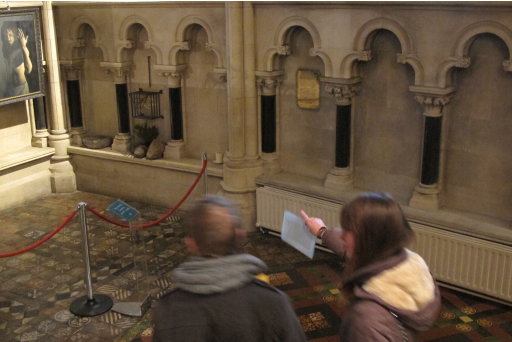
DUBLIN (AP) — Somewhere in Ireland, a burglar has the heart of a saint.
Officials at Christ Church Cathedral in Dublin said Sunday they're distraught and perplexed over the theft of the church's most precious relic: the preserved heart of St. Laurence O'Toole, patron saint of Dublin.
O'Toole's heart had been displayed in the cathedral since the 13th century. It was stored in a heart-shaped wooden box and secured in a small, square iron cage on the wall of a chapel dedicated to his memory. On Saturday someone cut through two bars, pried the cage loose, and made off with the relic.
"I am devastated that one of the treasured artifacts of the cathedral is stolen," said the Most Rev. Dermot Dunne, the cathedral's dean. "It has no economic value but it is a priceless treasure that links our present foundation with its founding father."
Ireland's national police force, the Garda Siochana, said detectives were studying hours of closed-circuit TV footage to try to identify the approximately 40 people who walked out the cathedral's front doors Saturday morning.
The force said the thief may have hidden overnight in the cathedral and fled with the heart when its doors opened Saturday. Worshippers didn't spot that the relic was missing until Saturday afternoon. Nobody was arrested.
Nuala Kavanagh, the cathedral's director of operations, said whoever stole it appeared to have no interest in financial gain, since several nearby objects made of gold and other precious materials were not touched.
"It's completely bizarre," she said. "They didn't touch anything else. They wanted the heart of St. Laurence O'Toole."
Church services went ahead as normal Sunday. The trickle of tourists visiting the Viking-era cathedral weren't told of the theft. Many approached the O'Toole chapel and spent much time looking, confusedly, between their guide books and the pried-open box.
Ireland's churches have suffered a spate of such robberies of irreplaceable, but also hard to sell, religious artifacts.
Last year three relics believed to be fragments of the cross used to crucify Jesus were stolen from Holy Cross Abbey in County Tipperary. Police safely recovered those relics in January but arrested nobody.
Also in January, a thief stole the ornate container housing the jawbone of St. Brigid in a northside Dublin church. The container, called a reliquary, was bolted down to the altar. However, it had just been cleaned and so the jawbone of St. Brigid, one of Ireland's earliest and most venerated saints, wasn't inside.
O'Toole was Dublin's archbishop from 1162 to 1180 and gained a reputation as a skillful mediator between rival Gaelic and Norman factions then fighting for power in Ireland. He died aged 58 while traveling in Normandy on another peace mission. On his death bed he was said to have declined to make a will, claiming not to have a penny to his name.
Pope Honorius III canonized O'Toole in 1225 on the weight of many claims of miracles at his original grave site.
O'Toole's heart had been the last surviving part of his remains. His bones were re-interred in an English church yard in 1442 but were dug up and disappeared during the Protestant Reformation of the 16th century.
Although O'Toole is mainly revered by Roman Catholics, Christ Church Cathedral has been a center of worship for the Anglican-affiliated Church of Ireland since the Reformation.
___
Online:
Christ Church Cathedral, http://bit.ly/wy4d83
O'Toole's story for Irish schools, http://bit.ly/x2xScP
Thursday, July 14, 2011
Government proposal to break the seal of confession is without precedent
From David Quinn at the Irish Catholic:
 The Taoiseach, the Minister for Justice and the Minister for Children are all indicating that a proposed new law will require priests to break the seal of confession if someone confesses to them the crime of paedophilia.
This would make us the one and only country in the Western world to have such a law. Even Revolutionary France in the days of its worst violence against the Church did not pass a law requiring the breaking of the seal of confession.
The justification for the law is that the crime of paedophilia is so heinous that no one who hears about it, under whatever circumstances, can be allowed to keep it to themselves.
But our Government is clearing missing something that every other Government can see, which is that at a minimum such a law is very unlikely to lead to a single conviction and at a maximum will be counter-productive and will make society less safe, rather than more safe.
It could equally be argued that a priest who hears a confession of murder must report it to the police. But if the murderer knew that priests were under such a legal requirement, the murderer would not make such a confession unless he was going to the police anyway.
On the other hand, a murderer who wishes to confess a crime to a priest, under the absolute seal of the confessional, is on the road to repentance and attending confession gives a priest the chance to encourage the murderer to turn himself over to the authorities or at the very least to cease his criminal activities.
The logic is the same with child abusers. No child abuser will go to a priest in confession knowing the priest is required to inform the police. But cutting off the avenue of confession to a child abuser makes it less likely that he will talk to someone who can persuade him to take the next step.
Various relationships in society are considered privileged and confidential. One is between a person and his or her confessor. Another is between a doctor and patient, and another is between a lawyer and client.
In creating a legal requirement that priests break the seal of confession under certain circumstances, the Irish State is going down a road very few other states in history have gone down. We need to seriously reconsider this extremely unwise and unprecedented proposal.
It says a lot about the present mood here that it can even be entertained.

This would make us the one and only country in the Western world to have such a law. Even Revolutionary France in the days of its worst violence against the Church did not pass a law requiring the breaking of the seal of confession.
The justification for the law is that the crime of paedophilia is so heinous that no one who hears about it, under whatever circumstances, can be allowed to keep it to themselves.
But our Government is clearing missing something that every other Government can see, which is that at a minimum such a law is very unlikely to lead to a single conviction and at a maximum will be counter-productive and will make society less safe, rather than more safe.
It could equally be argued that a priest who hears a confession of murder must report it to the police. But if the murderer knew that priests were under such a legal requirement, the murderer would not make such a confession unless he was going to the police anyway.
On the other hand, a murderer who wishes to confess a crime to a priest, under the absolute seal of the confessional, is on the road to repentance and attending confession gives a priest the chance to encourage the murderer to turn himself over to the authorities or at the very least to cease his criminal activities.
The logic is the same with child abusers. No child abuser will go to a priest in confession knowing the priest is required to inform the police. But cutting off the avenue of confession to a child abuser makes it less likely that he will talk to someone who can persuade him to take the next step.
Various relationships in society are considered privileged and confidential. One is between a person and his or her confessor. Another is between a doctor and patient, and another is between a lawyer and client.
In creating a legal requirement that priests break the seal of confession under certain circumstances, the Irish State is going down a road very few other states in history have gone down. We need to seriously reconsider this extremely unwise and unprecedented proposal.
It says a lot about the present mood here that it can even be entertained.
Wednesday, May 27, 2009
N.Ireland soccer mob beats Catholic man to death
DUBLIN -- Militant Protestant supporters of a Scottish soccer team beat to death a Roman Catholic man in the latest sign of how sports rivalries inspire sectarian bloodshed in Northern Ireland, police and politicians said Monday.
Witnesses said more than 20 Protestant supporters of Glasgow Rangers, many of them wearing the team's blue-and-white jerseys and scarves, drove into a Catholic district of the town of Coleraine after Rangers clinched the Scottish Premier League championship Sunday.
Billy Leonard, a former policeman and politician from the Irish nationalist party Sinn Fein, said several carloads of anti-Catholic extremists came armed with clubs "and literally attacked the first person they came across."
Kevin McDaid, 49, was fatally bludgeoned while his wife, Evelyn, and a 46-year-old Catholic neighbor, Damien Fleming, were both injured. Fleming was reported in critical condition...
Friday, March 20, 2009
Vatican clamps down on Killala Latin Mass move
Michael Kelly

A high-profile Vatican office has ordered Bishop John Fleming to make provision for the traditional Latin Mass in his Killala diocese. The move, from the powerful 'Ecclesia Dei' Commission comes after the Killala Council of Priests decided that no provision should be made for the celebration of the Mass in the Extraordinary Form.
In July 2007, Pope Benedict's letter, Summorum Pontificum, eased restrictions on the pre-Vatican II Mass, the so-called Tridentine Rite and established that any Catholic priest can celebrate the traditional Latin Mass without first seeking the permission of his bishop. Prior to the coming into force of Summorum Pontificum bishops had the right to restrict access to the Latin Mass.
Initially, the Killala Council of Priests, an advisory body made up of both elected members and priests appointed by Bishop Fleming, advised that no provision should be made for the Latin Mass pending a request for clarification from the Vatican on aspects of the Pope's letter. This advice was accepted by Bishop Fleming and an announcement made that the Mass would be unavailable in the Killala diocese.
However, The Irish Catholic has learned that the matter came to the attention of the Holy See as a number of people in Killala wrote to the Vatican to express their frustration at the lack of provision. The Irish Catholic also understands that a number of diocesan priests who believed the decision countermanded papal legislation, contacted Bishop Fleming to register discontent.
The 'Ecclesia Dei' Commission, headed by Cardinal Darío Castrillón Hoyos, then wrote to Bishop Fleming insisting that the restriction was forbidden under Church law since Pope Benedict had made universal provision for the availability of the Mass in the extraordinary form. In its letter, the Commission insisted that neither Bishop Fleming, nor the Council of Priests, had the right to place a restriction on a right approved by the Pope. Bishop Fleming has now designated the Church of the Assumption, Ardagh, Crossmolina, Co Mayo as the centre for the traditional Mass in the Killala diocese and the celebrant will be Fr John Loftus, a priest of the diocese.
h/t to Ulster Taig
Saturday, March 14, 2009
Pope to make historic visit to Britain
Pope Benedict XVI will visit Britain next year, according to senior Vatican sources.
By Jonathan Wynne-Jones, Religious Affairs Correspondent
Last Updated: 10:18PM GMT 14 Mar 2009

The German pontiff will make the first Papal visit to this country in nearly three decades.
It is understood that the historic event is being timed to coincide with the beatification of Cardinal John Henry Newman, who is on the path to becoming the first British saint for 40 years.
Details of the visit, which will attract crowds of hundreds of thousands of people, are still under discussion, but cities being considered include London, Birmingham, Oxford, Edinburgh, Armagh and Dublin.
A senior cardinal is due to make a private trip to Britain in the summer to make preparations for the Pope's visit, which could be announced by the end of this year.
The Catholic Church in England and Wales will hope that such an event will capture the imagination of the country's four million Catholics, of whom only a quarter now regularly attend Mass...
By Jonathan Wynne-Jones, Religious Affairs Correspondent
Last Updated: 10:18PM GMT 14 Mar 2009
The German pontiff will make the first Papal visit to this country in nearly three decades.
It is understood that the historic event is being timed to coincide with the beatification of Cardinal John Henry Newman, who is on the path to becoming the first British saint for 40 years.
Details of the visit, which will attract crowds of hundreds of thousands of people, are still under discussion, but cities being considered include London, Birmingham, Oxford, Edinburgh, Armagh and Dublin.
A senior cardinal is due to make a private trip to Britain in the summer to make preparations for the Pope's visit, which could be announced by the end of this year.
The Catholic Church in England and Wales will hope that such an event will capture the imagination of the country's four million Catholics, of whom only a quarter now regularly attend Mass...
Monday, February 9, 2009
‘Abortion reduction strategies’ ignore half of the problem, Archbishop Chaput warns
.- During a trip to Ireland this past weekend, Archbishop Charles Chaput of Denver delivered a talk to the Irish chapter of Human Life International that outlined the “dos and don’ts” for the pro-life movement. Those who claim pro-lifers should avoid the “divisive” issue of ending legalized abortion and focus on providing better support for pregnant mothers are creating a false division, the archbishop insisted.
Following the theme “An American view on how to build a culture of life,” Archbishop Chaput explained that his goal was “to offer some lessons from the American experience that Irish Christians might find useful.”
More than three decades after the legalization of abortion in the U.S., Archbishop Chaput diagnosed Americans’ beliefs on abortion as schizophrenic as he gave an overview of the current situation. “Most believe abortion is wrong. But most also want it legal under some limited circumstances,” he said.
The consequences of holding two such divergent views are that the U.S. has “a large and well-funded abortion industry” and that a “very vigorous prolife movement” has grown up “right alongside the abortion industry,” Chaput observed.
“American pro-lifers have had many setbacks. They never have enough money. They don't get treated fairly by the media. Too many of their leaders argue with each other too much of the time. But they just won't give up or die. And so they've won quite a few modest but important legal victories. Meanwhile they continue to work toward the strategic goal of overturning the 1973 Supreme Court decision.”
With all of this in mind, Archbishop Chaput offered what he sees as six “don’ts” and five “dos” that pro-lifers around the world should learn from their American counterparts.
“First,” he recommended, “don't let yourselves be tricked into an inferiority complex.” Drawing on a point made in his book “Render Unto Caesar,” he told his Irish audience:
“Critics like to say that religion is divisive, or intellectually backward, or that it has no proper place in the public square. … But this is nonsense. Democracy depends on people of conviction carrying their beliefs into public debate -- respectfully, legally and non-violently, but vigorously and without apology. If we are uncomfortable being Christians in a public debate, then we've already lost the war. In America the word "pluralism" is often conjured up like a kind of voodoo shield to get religious people to stop talking about right and wrong. In reality, our moral beliefs always shape social policy. Real pluralism actually demands that people with different beliefs should pursue their beliefs energetically in the public square. This is the only way a public debate can be honest and fruitful. We should never apologize for being Catholics.”
The next two “don’ts” cited by the Archbishop of Denver were, “Don't let divisions take root” and “Don’t get trapped by politics -- especially partisan politics.”
He related how as a bishop he has been “baffled” by how much energy is wasted on internal pro-life bickering and that pro-lifers should “never allow our differences to become personal” since infighting within the movement is “a gift to the other side.”
Sticking to one political party is also dangerous, Archbishop Chaput argued. “The more pro-lifers tie themselves to a single political party, the less they can speak to society at large. In the United States, Catholics -- both on the right and the left -- have too often made the mistake of becoming cheerleaders for a specific candidate,” he said.
“Don't create or accept false oppositions,” the archbishop cautioned as he waded into a topic that has caused great debate in the American pro-life community.
“During the last U.S. election,” Chaput recalled, “we saw the emergence of so-called pro-life organizations that argued we should stop fighting the legal struggle over abortion. Instead we should join with ‘pro-choice’ supporters to seek ‘common ground’.”
“Their argument was simple: Why fight a losing battle on the legal, cultural and moral front since - according to them -- we haven't yet made serious progress in ending legalized abortion? Let's drop the ‘divisive’ political battle, they said, and instead let's all work together to tackle the economic and health issues that might eventually reduce abortions,” he explained.
But this argument doesn’t sync with history, Archbishop Chaput stressed.
“Did Americans take a gradual, social-improvement road to ‘reducing’ racism? No. We passed the Civil Rights Act of 1964,” he pointed out.
Taking the logic a step further, the Denver prelate said, “Nor have I ever heard anyone suggest that the best way to deal with murder, rape or domestic abuse is to improve the availability of health care and job training. We make rape illegal -- even though we know it will still sometimes tragically occur -- because rape is gravely evil. It's an act of violence, and the law should proscribe it.
“Of course, we also have a duty to improve the social conditions that can breed domestic and sexual violence. But that doesn't change the need for the law.”
“Likewise,” Chaput reasoned, “if we really believe that abortion is an intimate act of violence, then we can't aim at anything less than ending abortion.
“It doesn't matter that some abortions have always occurred, and some will always occur. If we really believe that abortion kills a developing unborn life, then we can never be satisfied with mere ‘reductions’ in the body count.”
The new groups that materialized during the last election seem to operate from an “either/or” mentality, that argued that pro-lifers needed to choose between abortion “reduction” programs and outlawing abortion, the archbishop said. But protecting the unborn child “is not an ‘either/or’ choice. It's ‘both/and’,” he countered.
“We need to help women facing problem pregnancies with good health care and economic support; and we need to pass laws that will end legal abortion. We need to do both.”
Despite this disagreement, the archbishop’s fifth “don’t” cautioned pro-lifers against hating their adversaries. “Our adversary is an opponent, but never our "enemy." Our enemy is the Evil One,” he said.
Playing off his previous “don’t,” the Denver archbishop focused on adversaries again, saying, “Don't let your adversaries set the agenda.”
President Barack Obama’s recent reversal of the Mexico City policy in office served to illustrate this point for the archbishop. “His reason for signing the executive order was that it was time to put this ‘divisive issue behind us,’ once and for all,” Chaput reminded.
“There's something a little odd about rhetoric that tells that we're the ‘divisive’ ones, and lectures adult citizens about what we should challenge, and when we should stop. In a democracy, we get to decide that for ourselves.
“An issue that involves the life and death of unborn children and the subversion of entire traditional societies can't be ‘put behind us’ with an executive signature.”
Switching gears, the archbishop moved on to give his Irish audience his list of “dos.”
“Do become martyrs,” he challenged as he quipped, “I said it was simple. I didn't say it was easy. Be ready to pay the ultimate price.”
In modern society, you may not have to give your life for the unborn, but you may sacrifice your reputation or have lies told about you, the prelate counseled.
With the annual March for Life fresh in his mind, Archbishop Chaput called on pro-lifers to his second do—“keep hope alive.” “Many of the marchers are young, joyful people who radiate a strong hope in the future - and not the shallow hope of political sloganeering, but the real Christian hope that emerges from self-sacrifice and the struggle to do God's will.”
“I've never in my life seen a joy-filled pro-abortion event. And I've always found that instructive,” he added.
The third “do” offered by Chaput was to “be strategic.” Likening pro-life advocates to “sheep in the midst of wolves,” he told his audience that this “doesn’t mean we can also be dumb as rocks.”
“Being strategic means planning ahead, setting the agenda, working together and outsmarting our adversaries. To achieve these goals, we need a big dose of realism. We should never dream or whine about all the things we could do with the million Euros we don't have. We need to focus on the ten Euros we do have,” the archbishop said.
Next on the “do” list was a message that echoed Pope Benedict’s recent message for the World Day of Communications—use new technologies to spread your message.
Archbishop Chaput closed out his “dos” by stepping back for a look at the big picture. “Remember that renewing the culture, not gaining power, is our ultimate goal,” he counseled.
Culture is everything, the archbishop stated as he encouraged pro-lifers to make evangelizing it their ultimate goal. “Our real task, and our much longer-term and more important goal, is to carry out what John Paul II called the ‘evangelization of culture’," he explained.
Exhorting pro-lifers to continue fighting for this goal, Archbishop Chaput said “cultural trends can be changed. And I'll prove it.”
“Mainline media have been telling us for a decade that the American public is evenly divided between those who consider themselves prolife and those who describe themselves as ‘pro-choice’.”
“This is broadly true. But the devil - or in this case, God -- is in the details.”
Archbishop Chaput went on to cite a national poll by Harris Interactive that came out in December 2008, which found among other things that “fewer than ten per cent of Americans support legalized abortion on demand as it stands today.”
The findings of the poll show that “prolife efforts have made real progress in improving people's awareness of the sanctity of unborn life,” he asserted.
“We need to work to change the culture. And that demands a lifelong commitment to education, Christian formation and, ultimately, conversion. Only saints really change the world. And there lies our ultimate victory: If we change one heart at a time, while we save one unborn life at a time, the day will come when we won't need to worry about saving babies, because they'll be surrounded by a loving, welcoming culture.”
Friday, June 13, 2008
Lisbon Treaty looks set to be rejected
The Lisbon Treaty referendum looks set to be rejected by the Irish people, according to the first official results and tallies taken as votes are counted around the country.
With seven of 43 constituencies having declared results, the No vote is leading by 57 per cent to 43 per cent...
Thursday, June 12, 2008
Pope hails Irish role in Europe

 Pope Benedict praised St Columbanus in his weekly audience |
The pope has timed a speech about the role of Ireland in European history to coincide with the eve of the Lisbon Referendum.
Pope Benedict has used his weekly audience to praise the central role of Irish missionaries in European history, a day before voters go to the polls to decide the future of the Lisbon Treaty.
Speaking to tens of thousands of pilgrims in St Peter's Square, the Pope gave a sermon about the life of St Columbanus, an Irish monk born in 543 who travelled to Europe to spread Christianity.
In his speech charting the saint's life, Pope Benedict said that Columbanus could be called a "European saint".
The Pope explained that Columbanus, who was born in Leinster, entered monastic life in Bangor aged 20, before leaving "with 12 companions to begin missionary work on the European continent, where the migration of peoples from the north and the east had caused entire Christian regions to lapse back into paganism".
He established three monasteries, including one built in Luxeuil which "became the centre for the expansion of monastic and missionary life of the Irish tradition on mainland Europe".
Columbanus and his Irish monks were expelled in 610 and "condemned to definitive exile" after a row with King Theodric over the monarch's "adulterous relationships," the Pope explained.
Unable to return to Ireland, they moved to Switzerland where they continued their work.
'Founding father of Europe'
The saint was an early advocate of European unity, at least in religious terms.
The church was split with schisms in northern Italy, prompting Columbanus to write "a letter to Pope Boniface IV to convince him to make certain decisive steps towards re-establishing unity".
Pope Benedict described Columbanus as one of the founding "Fathers of Europe".
"(Columbanus) spent all his energies to nourish the Christian roots of the nascent Europe.
"With his spiritual strength, with his faith, with his love of God and neighbour, he became one of the Fathers of Europe, showing us today the way to those roots from which our continent may be reborn," he said.
While the Pope did not urge a "yes" vote in Ireland, church sources said that the timing of his speech would not have been accidental.
He has frequently spoken about the need for European unity and for a Europe as a "community" which he has said must acknowledge its Christian heritage.
He also chose the name Benedict, as the last Pope Benedict was a vigorous advocate of European unity, striving to avoid the outbreak of World War.
While the Irish Catholic hierarchy has not taken a stance for or against the Lisbon Treaty, or directed its congregation on how to vote, a statement by Irish bishops last month was widely seen as supportive of the treaty.
It urged voters not to register a protest vote and condemned groups spreading "false information", a regular jibe by the "yes" campaign used against their opponents in the "no" camp.
"Those who seek to influence the outcome of the referendum either by offering misleading or patently incorrect advice or by introducing extraneous factors into the debate, ought to be condemned," the bishops said in their statement.
The bishops also said they believed the treaty would not change Ireland's constitutional prohibition on abortion, an argument put forward by some, including a number of clergy, against the treaty.
The Pope is close to the Catholic Archbishop of Dublin Diarmaid Martin, who was a senior figure and diplomat in the Vatican when Pope Benedict was cardinal.
Archbishop Martin presented the Irish Catholic bishops' statement on the Irish media, and is likely to have briefed the Vatican on the referendum.
Whether this inspired a speech by the Pope about Irish missionaries' historic role in Europe - just as the country's people determine the future shape of Europe in the referendum - is probably a Vatican decision likely to remain behind closed doors.
Subscribe to:
Posts (Atom)