Now
http://ewtn.com/audiovideo/index.asp

Sunday, April 26, 2009


Cross, Sign Of
| Father Arthur Tonne |
| Copyright 1950 Didde Printing Company Emporia, Kansas "God forbid that I should glory save in the cross of our Lord Jesus Christ." Galatians, 6:14 In April of 1945 American artillery in the town of Siegburg, Germany, was shelling a nearby village, in which there were about 20 German soldiers. The natives were in constant danger of being hit by bullets from either side. Toward evening of April 12 the people persuaded the German soldiers to cease fire. Next morning the village priest carried a white flag to the American outpost to inform the commander that the German soldiers had gone and the civilian population had no desire to resist further. Instructions were given to fly white flags from all the houses. The question uppermost in the minds of the towns-people was: How will the Americans treat us? They had heard terrible tales of cruelty on the part of the Russians. How would these conquerors act? The Americans began a thorough search for weapons and German soldiers. Two soldiers armed with pistols came to a certain three-room home. They stopped short in the living room before a hand-carved family altar. Into the bedroom they went, to find there a beautiful crucifix. The soldiers noticed the cross. They stopped, took off their steel helmets, changed their automatics from right hand to left, and respectfully made the sign of the cross. As a member of the family related, the members of that household feared no longer. Yes, the sign of the cross is the salute of the true follower of Christ whether he is conqueror or conquered, whether he is German, Chinese, American or Australian. It is the countersign of the Christian. In particular, it is the special salute of the Catholic. The sign of the cross is one of the most important and one of the most frequently used of the sacramentals. It is the sacred sign first taught to the feeble fingers of the child at its mother's knee; it is the sacred sign traced by the faltering fingers of the dying Catholic. From birth to death it is the holy sign, the holy ceremony that continually reminds the Catholic of the source from which all spiritual blessings come—the cross. The two most common forms of this sacramental are the large sign of the cross made by touching the forehead, the breast, and the left and right shoulders. The cross thus covers the body—at least the most important members—the head and heart. The smaller sign of the cross is traced upon the forehead, lips, and breast. 1 Why do we make the sign of the cross?
2. The uses of this sacred sign in the Catholic Church are practically without limit:
Let me quote the instructive words of St. Gaudentius: "Let the sign of the cross be continually made on the heart, on the mouth, on the forehead, at table, at the bath, in bed, coming in and going out, in joy and sadness, sitting, standing, speaking, walking—in short, in all our actions. Let us make it on our breasts and all our members, that we may be entirely covered with this invincible armor of Christians." An indulgence of 100 days is granted for making the sign of the cross and saying the words. An indulgence of 300 days for making the sign of the cross, with holy water. A love and devotion toward this sacred sign is the mark of a true follower of Christ. Just as it identified those two American soldiers as genuine Catholics, so the sign of the cross will identify you. Use it frequently, use it thoughtfully, use it lovingly. It will bring you countless blessings. Amen. Sacred Music Volume 117, Number 4, Winter 1990 SIGNS AND SYMBOLS: A REFLECTION (This is reprinted from "Faith," a bi-monthly published in London, England. It was originally given as an address to a youth group at John Fisher School, Purley, Surrey, England.) The Sign Of The Cross A logical place to start, since it is a very ancient Christian habit, is to begin and end prayers with the sign of the cross. Yet the only recognizable biblical reference is in Matthew 28:19 when Our Lord tells His apostles, "Go, therefore, and make disciples of all nations, baptizing them in the name of the Father and of the Son and of the Holy Spirit." The practice of making the sign of the cross dates back to at least the second century. It was said to recall the blood of the lambs marked on Jewish doorposts in Egypt on the night of the Passover (Ex. 12:7) and to foreshadow the seal set on the foreheads of the saints in heaven. One of the earliest references to the sign of the cross is found at the end of the second century in these words of Tertullian: "at every forward step and movement, at every going in and out, when we put on our clothes and shoes...in all the ordinary actions of everyday life, we trace the sign" (of the cross). Whether such diligent self-crossing was generally observed is impossible to tell, but it does illustrate the importance that the early Church attached to the cross. Another important thread is drawn out by Saint Thomas Aquinas who said: "by making use of bodily signs of humility, our desire to submit ourselves to God is aroused." So, how does the above apply to us in the present day and age? When we make the sign of the cross, it is a reminder of our baptism. It also brings to mind the general vocation that we as Catholics are called to, as illustrated in the rite for adult baptism when the priest signs the recipient with the cross saying: "Receive the cross of Christ on your forehead. Christ Himself will guard you by this sign of love. Learn to know and follow that cross...Receive the cross on your breast, that by your faith Christ may find a dwelling place in your heart. Receive the sign of the cross on your shoulders so that you take on the sweet yoke of Christ. I sign you in your whole being 'in the name of the Father and of the Son and of the Holy Spirit' that you may have life in eternity." Let us not underestimate this "sign of love," for when we reverently make the sign of the cross, it is not only a confession of faith. It is also a reminder of the price that Christ paid for our healing and redemption so that we can call God "Abba! Father!" and eventually come into His presence in the glory of the kingdom of heaven. A HANDBOOK OF CATHOLIC SACRAMENTALS Ann Ball Published by Our Sunday Visitor Press The making of the sign of the cross, professing faith both in the redemption of Christ and in the Trinity, was practiced from the earliest centuries. St. Augustine (d. 430) mentioned and described it many times in his sermons and letters. In those days, Christians made the sign of the cross (Redemption) with three fingers (Trinity) on their foreheads. The words "In the name of the Father and the Son and the Holy Ghost" were added later. In the third century, Tertullian had already reported this touching and beautiful early Christian practice: "In all our undertakings—when we enter a place or leave it; before we dress; before we bathe; when we take our meals; when we light the lamps in the evening; before we retire at night; when we sit down to read; before each new task—we trace the sign of the cross on our foreheads" (Weiser, p. 256). |
| Provided Courtesy of: |
"Keep me in your prayers; I'm going through a bad time in my life"
"Mel Gibson made a private and unexpected visit to St. Louis this week. He came to pray and talk to bishops from the Eastern Catholic Church Bishop Conference.
I was more than surprised; I was flabbergasted," said Bishop Robert Shaheen of the Maronite Church. Shaheen had little warning about Gibson's visit. The mega star decided to pay a visit after learning the Maronite tradition within the Catholic Church uses a dialect of the historic language of Jesus , Aramaic, during the Mass.
Gibson's compelling movie, "The Passion of the Christ," used the Aramaic language and English subtitles to tell the story of the last days of Jesus.
"A dozen Eastern Rite bishops from various traditions shared dinner with Gibson Wednesday night at Bartolino's Osteria in west St. Louis City. "He was very kind, very gracious, really no business," said Bishop Shaheen. Gibson asked the clergy about the differences among their traditions and the languages they use to celebrate liturgy.
The group shared traditional St. Louis style toasted ravioli and other Italian dishes. Gibson signed a menu for owner Bart Saracino and then one of his assistants paid the entire bill.
Gibson has led a controversial and very public life. He was accused of being anti-semitic and criticized for his personal life. He is currently facing divorce proceedings. "He didn't ask us of anything. He didn't ask us to endorse him," said the Bishop adding," He never said anything about his personal life except 'keep me in your prayers; I'm going through a bad time in my life.'"
Thursday morning Gibson arrived at the Maronite Church Pastoral Center near downtown to attend Mass with the bishops. He shared breakfast with them and then left to ride home on his private plane."
- Link
Saturday, April 25, 2009

Our Lady of Akita
Akita-Shi, Japan
1973
A few pious women known as the Institute of the Handmaids of the Holy Eucharist were leading a quiet, hidden life of prayer in Yuzawadai just outside of Akita when they welcomed into their novitiate Sister Agnes Katsuko Sasagawa, who was then 42 years old and a convert from Buddhism. When she entered on May 12, 1973, Agnes was totally and incurably deaf, however she was blessed with various mystical favors; soon this convent would become so well known that their little chapel would attract pilgrims from around the world.
The first miraculous event at Akita occurred on June 12, 1973, only a month after the entrance of Sr. Agnes:A brilliant light shone forth from the Tabernacle. This happened several times and was often accompanied by something resembling smoke which hung around the altar. During one of these illuminations Sr. Agnes saw ". . . a multitude of beings similar to Angels who surrounded the altar in adoration before the Host." Bishop Ito was staying at the convent to conduct a week of devotions. Sr. Agnes confided to him the circumstances of this vision, as well as all the events and apparitions that followed. Bishop Ito and the convent's spiritual director, Rev. Teiji Yasuda, were witnesses to many of the events.
Sr. Agnes was also favored with visitations of her guardian Angel. Asked to describe the Angel, Sr. Agnes replied: "a round face, an expression of sweetness . . . a person covered with a shining whiteness like snow . . ." The guardian Angel confided various messages to the sister and often prayed with her, in addition to guiding and advising her.
On the evening of June 28, 1973, Sr. Agnes discovered on the palm of her left hand a cross-shaped wound that was exceedingly painful. On July 5, 1973, a small opening appeared in the center from which blood began to flow. Later, the pain would ease during most of the week except for Thursday nights and all day Friday, when the pain became almost unbearable.
Then on July 6 the guardian Angel appeared, telling Sr. Agnes: ". . . The wounds of Mary are much deeper and more sorrowful than yours. Let us go to pray together in the chapel." After entering the chapel the Angel disappeared. Sr. Agnes then turned to the statue of Mary situated on the right side of the altar.
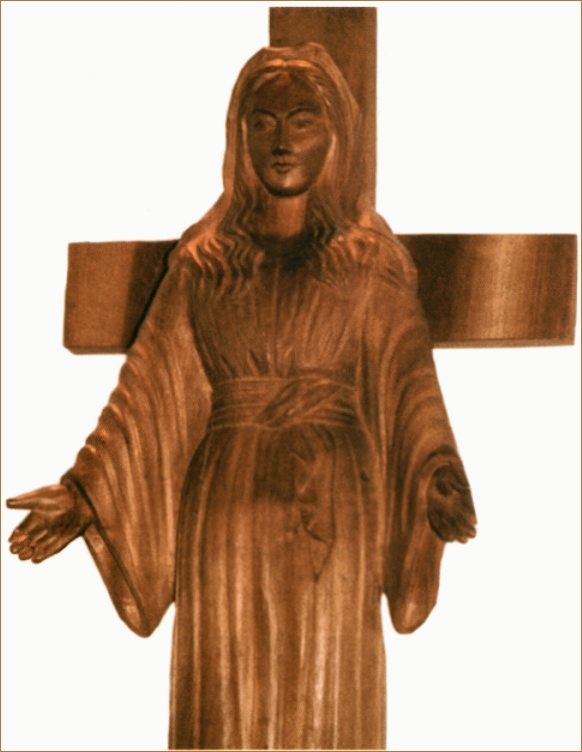
The statue, which is approximately three feet tall had been carved from the hard wood of the Judea tree: it is a figure of Our Lady standing before a cross, her arms at her side with the palms of her hands facing forward. Beneath her feet is a globe representing the world.
When Sr. Agnes approached the statue, she said, "I suddenly felt that the wooden statue came to life and was about to speak to me . . . She was bathed in a brilliant light . . . and at the same moment a voice of indescribable beauty struck my totally deaf ears." Our Lady told her: ". . . Your deafness will be healed . . ." She then recited with Sr. Agnes the community prayer that had been composed by Bishop Ito. At the words "Jesus present in the Eucharist," Mary instructed, "From now on, you will add TRULY." Together with the Angel who again appeared, the three voices recited a consecration to the Most Sacred Heart of Jesus, TRULY present in the Holy Eucharist. Before disappearing, Our Lady asked that Sr. Agnes "pray very much for the Pope, bishops and priests . . ."
The next morning, when the sisters assembled for the recitation of Lauds, they found blood on the right hand of the statue and two lines which crossed, in the middle of which was an opening from which the blood flowed. The wound matched that on the hand of Sr. Agnes except that, since the statue's hand was smaller, its wound was smaller. It bled on the Fridays of July during the year 1973, as did the wound on the hand of Sr. Agnes.
One of the sisters wrote: "It seemed to be truly cut into flesh. The edge of the cross had the aspect of human flesh and one even saw the grain of the skin like a fingerprint. I said to myself at that moment that the wound was real . . ."
Of special noteworthiness, the drops of blood ran the length of the statue's hand, which was open and pointing downward, yet the drops never fell from the hand.
The wound on the hand of Sr. Agnes appeared on Thursday, June 28. As predicted by the guardian Angel, the wound disappeared on Friday, July 27 without leaving a trace.
The second message of Our Lady came on August 3, 1973, a First Friday, when the heavenly voice from the statue warned:
". . . Many men in this world afflict the Lord . . . In order that the world might know His anger, the Heavenly Father is preparing to inflict a great chastisement on all mankind . . . I have prevented the coming of calamities by offering Him the sufferings of the Son on the Cross, His Precious Blood and beloved souls who console Him forming a cohort of victim souls. Prayer, penance and courageous sacrifices can soften the Father's anger . . . know that you must be fastened to the Cross with three nails. These three nails are poverty, chastity and obedience. Of the three, obedience is the foundation . . .
When Sr. Agnes was professed, she pronounced these three vows. Although the wound on the hand of Sr. Agnes disappeared on July 27, the wound on the hand of the statue remained until its disappearance on September 29. At that time the statue emitted a bright light. The wound had remained for three months.
While wounds in the hands of the statue bled, Bishop Ito advises that, contrary to some reports, ". ..the statue did not sweat blood or weep blood at any time."
On the evening office of September 29, 1973, the whole community saw a brilliant light coming from the statue. Almost immediately the entire body of the statue became covered with a moisture resembling perspiration. Sr. Agnes' guardian Angel told her, "Mary is even sadder than when she shed blood. Dry the perspiration."
The sisters used cotton balls to collect the moisture. Following Our Lady's message, the dazzling light that had surrounded the statue gradually disappeared.
Toward the end of May, 1974, another phenomenon occurred. While the statue's garment and the hair retained the look of natural wood, the face, hands and feet became distinguished by a dark, reddish-brown tint. Eight years later, when the sculptor came to see the statue, he could not hide his surprise that only the visible parts of Our Lady's body had changed color, and that the face itself had changed expression.
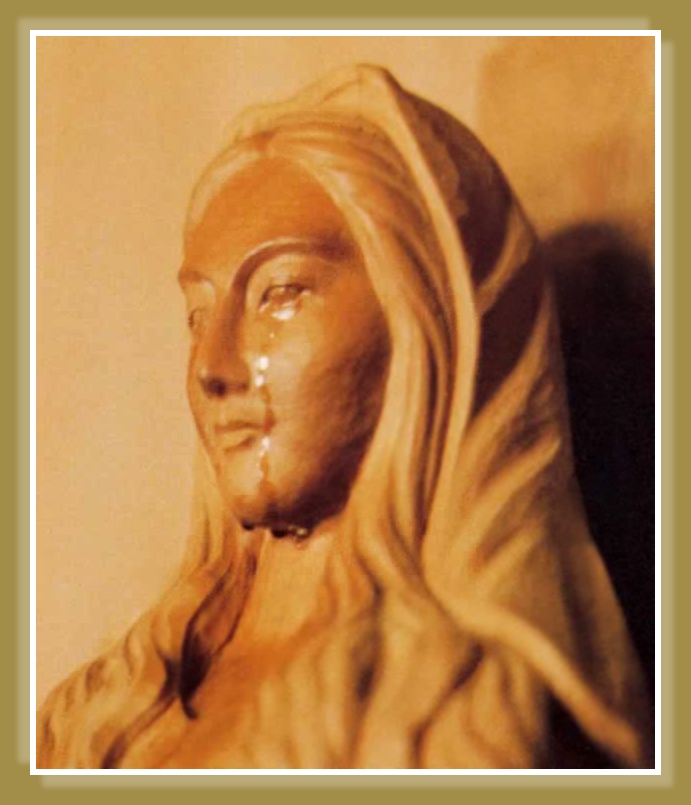
Then on January 4, 1975, to the amazement of the community and Fr. Yasuda, the statue of the Virgin began to weep and did so three times that day. Also witnessing these tears, in addition to the sisters, were Bishop Ito and a number of people who had joined the nuns for a New Year's retreat. In the 10 years following, scientific studies excluded any explanation other than the supernatural.
the tears collected on the inside edge of the eyes flowed down the cheeks, collected at the edge of the garment near the throat, rolled down the folds of the garment and fell upon the globe under Our Lady's feet.
Fr. Yasuda recorded in his book, The Tears and Message of Mary, that the statue:
. . . had completely dried out during the years since it was made and little cracks had begun to appear. It is already miraculous if water would flow from such material, but it is still more prodigious that a liquid sightly salty, of the nature of true human tears, should have flowed precisely from the eyes."
Eventually, Bishop Ito arranged for Professor Sagisaka, M.D., a non-Christian specialist in forensic medicine, to make a rigorous scientific examination of the three fluids, although the Bishop did not reveal their source. The results were: "The matter adhering on the gauze is human blood. The sweat and the tears absorbed in the two pieces of cotton are of human origin." The blood was found to belong to group B and the sweat and tears to group AB. Sr. Agnes belongs to group B.
Bishop Ito was advised by the Apostolic Nuncio to seek the assistance of the Archbishop of Tokyo in creating a commission of canonical inquiry. Unfortunately, the Inquisitor who was not Catholic was named president of this group. Without any of the members visiting the convent to conduct a personal inquiry, the commission rendered an unfavorable verdict.
Unwilling to accept a negative verdict to the events he himself had witnessed, Bishop Ito asked the advice in Rome of the Congregation for the Doctrine of the Faith, as well as the Congregation for the Propagation of the Faith. He was then advised to form another commission to study the events from the beginning. This commission rendered a favorable verdict regarding the supernatural aspects of the events.
The tears of December 8, 1979 were filmed by a televiion crew at 11 o'clock in the evening, the Feast of the Immaculate Conception, and was shown on television to 12 million people throughout Japan. It is now shown by the nuns at the convent and was shown during news broadcasts throughout the world.
The sculptor of the statue, Saburo Wakasa, a non-Catholic and a citizen of Akita, was asked his reaction to the occurrences relating to the statue. He answered:
The statue of Mary was my first work connected with Christianity. Of my various statues, it is only with the statue of Mary at Yuzawadai that mysterious events occurred . . . I sculptured the whole statue of Mary, globe, and the Cross from the same piece of wood, so there are no joints . . . The wood from which I carved the statue of Mary was very dry and rather hard . . .
When questioned as to whether he regards as a "miracle" the reported shedding of tears from the statue of Mary, he replied, "It is a mystery."
Another examination of the fluids was conducted by Dr. Sagisaka of the Department of Forensic Medicine, School of Medicine, University of Akita. The results were given on November 30, 1981 and revealed that:
"The object examined has adhering to it human liquids which belong to the blood group O." Since the first analysis revealed that the blood belonged to group B and the sweat and tears to group AB, it has been established that the fluids belong to three different blood groups.
It is a medical fact that the blood, tears and sweat of an individual all belong to the same blood group. One fluid cannot differ in type from the other fluids of the same body. Since Sr. Agnes belonged to group B she could not have "ejected and transferred" blood or fluids belonging to group AB or O. The theory of the Inquisitor that Sr. Agnes exercised had ectoplasmic power wass thereby refuted. On the Feast of Our Lady of Sorrows [September 15], the statue cried for the last time. Two weeks later, Sr. Agnes' guardian Angel presented a large Bible surrounded with a brilliant light. The open Bible revealed the reference, Genesis 3:15. The Angel explained that the passage had a relationship with the tears of Mary and then continued.
. . . sin came into the world by a woman and it is also by a woman that salvation came to the world . . .
The lachrymations number 101, and they took place at irregular intervals from January 4, 1975 until September 15, 1981. The first 1 is Eve, the second, Our Lady and the 0 represents the eternal Holy Trinity.
According to the records kept by the sisters, the number of persons witnessing the tears went unrecorded on five occasions. However, all the other times they were witnessed by no fewer than ten persons, and other lachrymations were witnessed by various numbers of people, sometimes as many as 46, 55 and, for the last lachrymation, 65 people. Some of the witnesses were non-Christians and some were prominent Buddhists, including the mayor of the city.
On October 13, the anniversary of the Miracle of the Sun at Fatima, 1973, Sr. Agnes heard the beautiful voice speaking from the statue once more: "The work of the devil will infiltrate even into the Church in such a way that one will see cardinals opposing cardinals, bishops against other bishops. The priests who venerate me will be scorned and opposed by their confreres, churches and altars will be sacked. The Church will be full of those who accept compromises and the devil will press many priests and consecrated souls to leave the service of the Lord. The demon would be especially implacable against souls consecrated to God. The thought of the loss of so many souls is the cause of my sadness. If sins increase in number and gravity, there will be no longer any pardon for them."
She continued, "As I told you, if people do not repent and better themselves, the Father will inflict a terrible punishment on all humanity. It will be a punishment greater than the Flood, such as one will never have seen before. Fire will fall from the sky and will wipe out a great part of humanity, the good as well as the bad, sparing neither priests nor faithful. The survivors will find themselves so desolate that they will envy the dead. The only arms which will remain for you will be the Rosary and the Sign left by my Son. Each day recite the prayers of the Rosary. With the Rosary pray for the Pope, the bishops and the priests."
The statue wept for the last time on September 15, Feast of Our Lady of Sorrows.
Sr. Agnes was totally and incurably deaf when she entered the community, having lost her hearing on March 16, 1973. Sister was able to speak, and understood spoken messages by lip reading. As predicted by her guardian Angel, she temporarily regained her hearing on October 13, 1974. Deafness returned on March 7, 1975. Her hearing was permanently restored on May 30, 1982, as predicted by Our Lady during the first message of July 6, 1973. Both healings occurred instantaneously during Benediction of the Blessed Sacrament. Sr. Agnes is today in sound health, except for the rheumatism that has affected her hands.
A canonical law regarding the judgment of a Marian apparition was issued in 1978. According to a Vatican official: ". . . the authority to hand down a conclusion regarding the authenticity of any Marian apparition is given canonically to the ordinary (the bishop) of the local diocese where the apparition took place . . ."
In his pastoral letter dated April 22, 1984, Bishop John Ito, the Ordinary of the Diocese of Niigata, wrote that having been given directives in this regard, "I authorize throughout the entire diocese of which I am charged, the veneration of the Holy Mother of Akita." The Bishop noted that the events are only a matter of private revelation, and are not points of doctrine. The Bishop also mentioned in his pastoral letter that he had known Sr. Agnes Sasagawa for 10 years. "She is a woman sound in spirit, frank and without problems; she has always impressed me as a balanced person. Consequently the messages she says that she has received did not appear to me to be in any way the result of imagination or hallucination."
Four years later, on June 20, 1988, during Bishop lto's visit to Rome, the Sacred Congregation for the Doctrine of the Faith approved the contents of the pastoral letter.
Plan B decision treats pregnancy as disease, U.S. bishops' official says
 .- The U.S. Food and Drug Administration (FDA) has made the “Plan B” contraceptive available to 17 year-old women without a prescription. One pro-life leader has warned the decision treats pregnancy as a “disease” and could put young women and newly-conceived human beings at risk.
 The move follows a March 23 federal court order requiring the drug Levonorgestrel—also known as the “morning after pill”--be made available to girls 17 and older without a prescription. The U.S. government said it would not appeal the decision.
The drug aims to prevent pregnancy when used within 24 hours of sexual intercourse.
Deirdre McQuade, Assistant Director for Policy and Communications at the U.S. Conference of Catholic Bishops’ Secretariat of Pro-Life Activities, criticized the action in an April 23 statement.
Characterizing the decision as “court-driven,” McQuade said it “flies in the face of common sense.
“Levonorgestrel is a powerful drug, taken in two doses over a 12-hour period. It is 40 times more potent than comparable progestin-only birth control pills (Ovrette) for which a prescription is required.
“Wider access to Plan B could endanger the lives of newly-conceived children, and will put minors at risk for unnecessary side effects, undermine parental rights, and contribute to higher STD rates,” warned McQuade.
“Pregnancy is not a disease and fertility is not a pathological condition, so Plan B has no authentic therapeutic purpose, and can actually cause harm to women and their newly-conceived children,” she said...
Reclaiming Sacred Art
Interview With Creators of "Catholic Canvas"
ROME, APRIL 23, 2009 (Zenit.org.- A new Rome-produced series airing this spring on EWTN is doing its part to reassert the original evangelizing purpose of the greatest Catholic works of art.
"Catholic Canvas," which was filmed entirely in the Vatican Museums, recounts the history of man's salvation through the Church's rich and varied collection of art. The creators of the project call it a unique event in the history of art documentaries.
ZENIT interviewed the three people most involved with the project.
* * *
Mary Shovlain is the producer, director and creator of the program.
Q: What inspired you to develop this project? Out of all the many books, films and TV specials produced about art in the Vatican what makes this unique?
Shovlain: I have covered the Vatican for over a decade, I have advanced degrees in theology and for the past seven years I have been making television shows about the faith. I got tired of the ever-increasing programs on Vatican art, especially the Sistine Chapel, offering erroneous, secularized interpretations of the images of sacred events in Salvation History. Many of these shows often twisted or ignored the Christian message to promote individual agendas or even used the art as a loudspeaker to broadcast criticisms about the Catholic Church or the Popes, etc.
We wanted to reclaim the original intent and function of these world-famous works. Using their creative genius, Michelangelo, Raphael and others were evangelizing through art, trying to "incarnate" eternal mysteries.
Today, more than ever, we need beauty, and although some of the works we filmed are over 1,000 years old, they still proclaim objective truths clearly and powerfully to a frantic world lost in relativism...
ROME, APRIL 23, 2009 (Zenit.org.- A new Rome-produced series airing this spring on EWTN is doing its part to reassert the original evangelizing purpose of the greatest Catholic works of art.
"Catholic Canvas," which was filmed entirely in the Vatican Museums, recounts the history of man's salvation through the Church's rich and varied collection of art. The creators of the project call it a unique event in the history of art documentaries.
ZENIT interviewed the three people most involved with the project.
* * *
Mary Shovlain is the producer, director and creator of the program.
Q: What inspired you to develop this project? Out of all the many books, films and TV specials produced about art in the Vatican what makes this unique?
Shovlain: I have covered the Vatican for over a decade, I have advanced degrees in theology and for the past seven years I have been making television shows about the faith. I got tired of the ever-increasing programs on Vatican art, especially the Sistine Chapel, offering erroneous, secularized interpretations of the images of sacred events in Salvation History. Many of these shows often twisted or ignored the Christian message to promote individual agendas or even used the art as a loudspeaker to broadcast criticisms about the Catholic Church or the Popes, etc.
We wanted to reclaim the original intent and function of these world-famous works. Using their creative genius, Michelangelo, Raphael and others were evangelizing through art, trying to "incarnate" eternal mysteries.
Today, more than ever, we need beauty, and although some of the works we filmed are over 1,000 years old, they still proclaim objective truths clearly and powerfully to a frantic world lost in relativism...

Friday, April 24, 2009
Archbishop Sheen's cause for beatification 'on track'
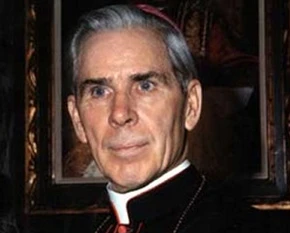 .- The famous Catholic evangelist Archbishop Fulton Sheen's reputation for holiness and his impact on Catholics and non-Catholics alike has led to his cause for beatification being opened. Bill Engelbrecht, a member of the Archbishop Sheen Foundation’s board of directors, told CNA recently that the cause is progressing “quite well.”
 The foundation, Engelbrecht explained, is kept informed of the beatification cause’s progress in Rome, and it is “on track.”
“The process is lengthy and it is undetermined. It can take from a few years to a few hundred years. It’s very difficult to actually assess one’s progress,” he said.
Engelbrecht related that several “significant” events had taken place in New Jersey, Texas, and other states. Upcoming events are planned for Georgia, Oklahoma City, and in Peoria, Illinois, Sheen’s birthplace.
“Everything has been moving in the right direction,” he said, adding that the foundation is promoting ways to make Archbishop Sheen better known to clergy and to younger generations, such as mp3 audio files, Facebook, the micro-blogging site Twitter and other new media.
“If you read Archbishop Sheen, he was able to strike a chord with almost every generation from the very young to the very old,” Engelbrecht said. “He was eminently accessible, he was charismatic, people liked him, people listened to him.”
One of his great lessons was about “how to live your life.”
“Obviously that was captured in his program “Life is Worth Living.” That’s a perfect title for what he had to say to us.”
He said that people touched by Archbishop Sheen exist everywhere.
“Go anywhere a large group of Catholics are assembled and bring up Archbishop Sheen. You’ll have somebody say how he affected them, or somebody close to them. He just touched so many people that it’s just amazing. It just repeats itself everywhere you go.”
He noted how one man, a recovering addict and alcoholic, drove nine hours to an Archbishop Sheen Foundation event to tell how one of the archbishop’s books affected him.
“He never met him. Someone by accident asked him to read a book of [Sheen’s]. He believes this man changed his life.”
Asked how Catholics might participate in advancing Archbishop Sheen’s cause, Engelbrecht said there would be a significant event at St. Patrick’s Cathedral in New York City in December.
He encouraged people to expose themselves to Archbishop Sheen’s books and to his writings.
“Simply go to the Archbishop Sheen Foundation website,” he said, explaining that there were opportunities to receive prayer cards, relic cards, information about the beatification process and information about how to support his cause.
The Archbishop Fulton J. Sheen Foundation’s web site is located at http://www.archbishopsheencause.org/
- Link
Thursday, April 23, 2009
Pope Affirms Love is the Key to Knowledge of God

Urges Spiritual Battle Against Greed to Solve Economic Crisis
VATICAN CITY, APRIL 22, 2009 (Zenit.org).- Benedict XVI is affirming the words of a eighth century writer, who noted that although intellectual study can help, only when we love God can we truly know him.
The Pope said this today at the general audience in St. Peter's Square, in which he continued a catechesis series about great writers of the Church in the Middle Ages, speaking today about the monk and abbot, Ambrose Autpert.
He explained, "The Church lives in people and whoever wants to get to know the Church, to understand its mystery, must consider the people who have lived and who continue to live its message, its mystery."
The Pontiff noted that Autpert lived in an age when "strong political tensions" influenced life inside the monasteries, motivating him to write with the intention of helping his monks live virtuously. The abbot "intended to train the monks specifically on how to address the spiritual battle on a daily basis."
In a treatise on the conflict between vice and virtue, the Holy Father said, "He presents 24 pairs of combatants in a kind of juxtaposition: each vice tries to persuade the soul with subtle reasoning, while the respective virtues refute such insinuations preferably using the words of Scripture."
Benedict XVI pointed out in particular the monk's description of greed and the corresponding virtue of contempt of the world. He explained: "This contempt of the world is not a contempt of creation, beauty and goodness of creation and the Creator, but a contempt of the false vision of the world presented and insinuated to us by our own greed.
"This greed affirms that the value of 'having' is the supreme value of our being, of our living in the world and our image of ourselves as important. And so greed falsifies the creation of the world and destroys the world."
He observed that like St. Paul, Autpert sees greed as the root of all evil. The monk notes that this vice influences the rich and powerful as well as the souls of his monks.
The Pope added: "I offer this reflection, which, in light of this global economic crisis, is revealed in all its relevance. We see that from this very root of greed this crisis is born.
"Ambrose foresaw the objection that the rich and powerful would raise, saying: but we are not monks, these ascetic standards don't apply to us. And he answers: 'It is true what you say, but also for you, in your own way and to the best of your ability, the hard and narrow way applies to you, because the Lord has proposed only two doors and two ways -- the narrow gate and the wide, the hard and comfortable; he did not indicate a third door or a third way.'"
The Pontiff affirmed that even rich people must "fight against greed, against the desire to possess, to appear, against the false notion of freedom as the right to dispose of everything according to one's own will," and they must also "find the authentic path of truth, of love and in this way the path of moral rectitude."
The abbot wrote that the piety that frees the "soul from attachment to earthly and transient pleasures" should be "united with the deep study of the sacred sciences, especially the meditation of Sacred Scripture."
The Holy Father noted the example of Autpert, who emphasized that "every theological search for truth relies on love," and prayed to God, "When you are scrutinized intellectually by us, you're not discovered as you truly are; it's only when you are loved that we reach you."
Benedict XVI continued: "Autpert understood that with mere theological research God can not be known as he really is. Only love can reach him. Let us listen to this message and ask the Lord to help us live the mystery of the Church today, in this our time."
Wednesday, April 22, 2009
NELL HUSBANDS MARTIN COULTER
April 22, 2009
By Ann Coulter
A lot of people claim to be my No. 1 fan -- God bless them -- but my true No. 1 fan left this world last week. My mother quietly stopped breathing last Tuesday, as she slept peacefully, holding my hand.
She was the biggest fan of all of us -- Father, me and my brothers John and Jim.
After reading the eulogy column I wrote for Father last year -- not to excess, probably only about 4,637 times -- Mother realized to her chagrin that she wouldn't be able to read the eulogy column I'd be writing for her, and started hinting that maybe I could rustle up a draft so she could take a peek.
But I couldn't do it, until I had to.
The only thing Mother wanted to be sure my brothers and I included in her remembrances were her contributions to the Republican Party, the New Canaan Republican Town Committee and the Daughters of the American Revolution.
She was a direct descendant of at least a dozen patriots who served the cause of the American Revolution and traced her lineage on both sides of her family to Puritan nonconformists who came to America in 1633 seeking religious freedom on a ship led by Pastor Thomas Hooker. Or, as Homeland Security chief Janet Napolitano would call them, "A dangerous right-wing extremist hate group."
Even back in the Puritan days, Mother's female ancestors were brought up on charges for their heretical dressing styles (and then sassed the judge). During the Revolution, one female ancestor, Effie Ten Eyck Van Varick, contributed to the rebel cause by donating lead for bullets from the curtain weights in her home in what was, even then, traitorous, loyalist Manhattan.
Mother's deep-seated political activism saved me on more than one occasion.
At the 2004 Republican National Convention, I was taking my parents to a lot of the parties in New York and, at one of them, Herman Cain walked up to me and told me he was a big fan even though I probably didn't know who he was.
Cain was the former president and CEO of Godfather's Pizza who was then running for the U.S. Senate from Georgia. I had seen him on Fox News' "Cavuto" -- but I couldn't remember his name for the life of me.
Luckily for me, Mother was standing next to me and she piped in, "I know who you are -- I donated to your campaign." Thank you, Mommy!
Mother probably contributed hundreds of thousands of dollars to various conservative outfits over the years -- all in her little $20 checks -- especially to any organization that claimed it was going to stop Hillary. In fact, if they mentioned Hillary in their letter, Mother sometimes made it $25.
My brothers and I always figured we'd have no inheritance, but there would be a lovely memorial to Oliver North somewhere.
Mother may have thought her most notable characteristic was her Republican activism, but, for the rest of us, it was her constant, unconditional love. She was a little love machine, spreading warmth and joy wherever she went.
Every time she'd see me, even after just a few days' absence, she'd hug me as if I had been lost in the Himalayan Mountains for the past 20 years.
On Mother's birthday last year, I had a dinner party for her with Rush Limbaugh, Conrad Black and my friends Peter and Angie.
Mother was always delighted to be with people talking about politics -- actually she told me that, lately, she was delighted to be around any conversations that didn't involve who had a doctor's appointment or who had died that day.
So I let her stay up until 3 a.m. that night, well past her bedtime. Mother was so happy that after I had her all tucked in and the lights out, I heard her singing herself to sleep.
Even on the rare occasions when I'd be cross with her, she'd completely forget about it, and within 10 seconds would be telling me what a wonderful, precious daughter I was. My brother Jimmy found out recently that she'd even forgotten that he had caused her to miss Reagan's first inauguration by getting in a car accident the night before we were leaving -- and she never should have forgotten that.
Everyone wanted my mother to be his mother. (The "his" in that sentence is grammatically correct and Mother would never let us forget it.) I'm sure everyone thinks he has the perfect mother, but we really did.
Since I was a little girl, friends, relatives and neighbors would bring their problems to Mother. She had a rare combination of being completely moral and completely nonjudgmental at the same time -- the exact opposite of liberals who have absolutely no morals and yet are ferociously judgmental.
You could tell Mother anything, get good counsel and not end up feeling worse about yourself.
Several of Mother's New Canaan friends sent us notes last week, calling her a "gentle lady" and remarking that she never had an unkind word for anyone.
As a family member, I can assure you that -- much to our annoyance -- she really did never have an unkind word for anyone. I mean, except Democrats, but not anyone she knew.
Whenever the rest of us would be making fun of someone -- trust me, always for good and sound reasons -- Mother would somehow manage to muster up a defense of the miscreant. Father would always smile and say, "Your mother defends everyone."
She was, in fact, such a "gentle lady" that I had to go to her doctors' appointments and hospital visits with her and be her Mother Lion. If officious hospital administrators had told Mother to get off a gurney, go outside in the pouring rain and stand on one foot for three hours before the doctor would see her, she'd thank them profusely and apologize for being such a bother.
She viewed her doctors' appointments as social visits, which is the other reason I'd have to go with her, to make sure we eventually got around to the business end of the appointment.
When she began her final decline last fall, she had to go to her Connecticut doctor without me to find out what was wrong. This was the first time she didn't seem to be getting better after a chemo treatment.
So I had been worrying about her appointment all day, but when I called her that night, she immediately turned the subject to me and asked me how my book was going.
I insisted on knowing if she had seen the doctor and she perked up and brightly told me that, oh yes, she had seen him, he had all my books in his office, he was worried about Obama, too, and he has such beautiful children!
Before she launched into a spirited discussion of his children's extracurricular activities and triumphs on the athletic field, I had to ask her, "Mommy, did the doctor happen to say anything about why you're feeling lousy?"
It turned out, of course, that it was the ovarian cancer -- as well as the massive amounts of poison she had been receiving to kill the cancer over the past five years. That was the beginning of the end.
Now I'll never be able to introduce my Mother to friends and surprise them with her charming Southern accent.
And I'll never see my mother's beautiful face again, at least not for the next several decades here on Earth. I've been looking at her across the room in doctors' offices over the past few years, thinking to myself: There will come a point when you won't see that face again.
Her angelic face always looked like home to me. My whole life, as soon as I'd see my mother's face I'd know I was safe, whether I was a little girl lost in a department store or a big girl with a problem, who needed her mother.
Thanks to the doctors at Memorial Sloan-Kettering and mother's fighting Kentucky spirit, we got to see that face much longer than anyone ever expected.
So now she's with Daddy and Jesus. Every single day since Daddy died last year, Mother would say how much she missed him and gaze at his photo, telling us what an amazing man he was and repeating his little expressions and jokes. Even though I miss her, I'm glad they're together again.
I don't know about Jesus, but I think Daddy was getting impatient. But Mommy was always running a little bit late.
By Ann Coulter
A lot of people claim to be my No. 1 fan -- God bless them -- but my true No. 1 fan left this world last week. My mother quietly stopped breathing last Tuesday, as she slept peacefully, holding my hand.
She was the biggest fan of all of us -- Father, me and my brothers John and Jim.
After reading the eulogy column I wrote for Father last year -- not to excess, probably only about 4,637 times -- Mother realized to her chagrin that she wouldn't be able to read the eulogy column I'd be writing for her, and started hinting that maybe I could rustle up a draft so she could take a peek.
But I couldn't do it, until I had to.
The only thing Mother wanted to be sure my brothers and I included in her remembrances were her contributions to the Republican Party, the New Canaan Republican Town Committee and the Daughters of the American Revolution.
She was a direct descendant of at least a dozen patriots who served the cause of the American Revolution and traced her lineage on both sides of her family to Puritan nonconformists who came to America in 1633 seeking religious freedom on a ship led by Pastor Thomas Hooker. Or, as Homeland Security chief Janet Napolitano would call them, "A dangerous right-wing extremist hate group."
Even back in the Puritan days, Mother's female ancestors were brought up on charges for their heretical dressing styles (and then sassed the judge). During the Revolution, one female ancestor, Effie Ten Eyck Van Varick, contributed to the rebel cause by donating lead for bullets from the curtain weights in her home in what was, even then, traitorous, loyalist Manhattan.
Mother's deep-seated political activism saved me on more than one occasion.
At the 2004 Republican National Convention, I was taking my parents to a lot of the parties in New York and, at one of them, Herman Cain walked up to me and told me he was a big fan even though I probably didn't know who he was.
Cain was the former president and CEO of Godfather's Pizza who was then running for the U.S. Senate from Georgia. I had seen him on Fox News' "Cavuto" -- but I couldn't remember his name for the life of me.
Luckily for me, Mother was standing next to me and she piped in, "I know who you are -- I donated to your campaign." Thank you, Mommy!
Mother probably contributed hundreds of thousands of dollars to various conservative outfits over the years -- all in her little $20 checks -- especially to any organization that claimed it was going to stop Hillary. In fact, if they mentioned Hillary in their letter, Mother sometimes made it $25.
My brothers and I always figured we'd have no inheritance, but there would be a lovely memorial to Oliver North somewhere.
Mother may have thought her most notable characteristic was her Republican activism, but, for the rest of us, it was her constant, unconditional love. She was a little love machine, spreading warmth and joy wherever she went.
Every time she'd see me, even after just a few days' absence, she'd hug me as if I had been lost in the Himalayan Mountains for the past 20 years.
On Mother's birthday last year, I had a dinner party for her with Rush Limbaugh, Conrad Black and my friends Peter and Angie.
Mother was always delighted to be with people talking about politics -- actually she told me that, lately, she was delighted to be around any conversations that didn't involve who had a doctor's appointment or who had died that day.
So I let her stay up until 3 a.m. that night, well past her bedtime. Mother was so happy that after I had her all tucked in and the lights out, I heard her singing herself to sleep.
Even on the rare occasions when I'd be cross with her, she'd completely forget about it, and within 10 seconds would be telling me what a wonderful, precious daughter I was. My brother Jimmy found out recently that she'd even forgotten that he had caused her to miss Reagan's first inauguration by getting in a car accident the night before we were leaving -- and she never should have forgotten that.
Everyone wanted my mother to be his mother. (The "his" in that sentence is grammatically correct and Mother would never let us forget it.) I'm sure everyone thinks he has the perfect mother, but we really did.
Since I was a little girl, friends, relatives and neighbors would bring their problems to Mother. She had a rare combination of being completely moral and completely nonjudgmental at the same time -- the exact opposite of liberals who have absolutely no morals and yet are ferociously judgmental.
You could tell Mother anything, get good counsel and not end up feeling worse about yourself.
Several of Mother's New Canaan friends sent us notes last week, calling her a "gentle lady" and remarking that she never had an unkind word for anyone.
As a family member, I can assure you that -- much to our annoyance -- she really did never have an unkind word for anyone. I mean, except Democrats, but not anyone she knew.
Whenever the rest of us would be making fun of someone -- trust me, always for good and sound reasons -- Mother would somehow manage to muster up a defense of the miscreant. Father would always smile and say, "Your mother defends everyone."
She was, in fact, such a "gentle lady" that I had to go to her doctors' appointments and hospital visits with her and be her Mother Lion. If officious hospital administrators had told Mother to get off a gurney, go outside in the pouring rain and stand on one foot for three hours before the doctor would see her, she'd thank them profusely and apologize for being such a bother.
She viewed her doctors' appointments as social visits, which is the other reason I'd have to go with her, to make sure we eventually got around to the business end of the appointment.
When she began her final decline last fall, she had to go to her Connecticut doctor without me to find out what was wrong. This was the first time she didn't seem to be getting better after a chemo treatment.
So I had been worrying about her appointment all day, but when I called her that night, she immediately turned the subject to me and asked me how my book was going.
I insisted on knowing if she had seen the doctor and she perked up and brightly told me that, oh yes, she had seen him, he had all my books in his office, he was worried about Obama, too, and he has such beautiful children!
Before she launched into a spirited discussion of his children's extracurricular activities and triumphs on the athletic field, I had to ask her, "Mommy, did the doctor happen to say anything about why you're feeling lousy?"
It turned out, of course, that it was the ovarian cancer -- as well as the massive amounts of poison she had been receiving to kill the cancer over the past five years. That was the beginning of the end.
Now I'll never be able to introduce my Mother to friends and surprise them with her charming Southern accent.
And I'll never see my mother's beautiful face again, at least not for the next several decades here on Earth. I've been looking at her across the room in doctors' offices over the past few years, thinking to myself: There will come a point when you won't see that face again.
Her angelic face always looked like home to me. My whole life, as soon as I'd see my mother's face I'd know I was safe, whether I was a little girl lost in a department store or a big girl with a problem, who needed her mother.
Thanks to the doctors at Memorial Sloan-Kettering and mother's fighting Kentucky spirit, we got to see that face much longer than anyone ever expected.
So now she's with Daddy and Jesus. Every single day since Daddy died last year, Mother would say how much she missed him and gaze at his photo, telling us what an amazing man he was and repeating his little expressions and jokes. Even though I miss her, I'm glad they're together again.
I don't know about Jesus, but I think Daddy was getting impatient. But Mommy was always running a little bit late.
Study: Nearly half of new priests were discouraged against seminary

By Daniel Burke, Religion News Service
Conversations around the kitchen table may be more responsible for the shortage of Roman Catholic priests in the U.S. than influences from American culture, a new study suggests.
Almost 45% of Catholic priests planning to be ordained this year said they were discouraged from considering the priesthood, according to a survey produced by the Center for Applied Research in the Apostolate (CARA) at Georgetown University for the U.S. bishops.
Of those, nearly 6 in 10 said a parent or family member was the source of the discouragement. Fifty-one percent said a friend or classmate had counseled them against the priesthood, and 15% said a priest or other clergy had. The percentages add up to more than 100 because respondents could select more than one category.
The number of Catholic priests in the U.S. has dropped steadily since the 1970s, a worrisome trend for church leaders. In 2000, there were 45,700 priests, compared to 40,600 in 2008. The U.S. church will ordain 465 priests in 2009; 310 responded to the CARA survey.



Vatican planned to move to Portugal if Nazis captured wartime Pope
Secret plans were drawn up by the Vatican to elect a new Pope and flee to a friendly country should Hitler have carried out his threat to kidnap the wartime Pontiff, it was claimed yesterday.
Pope Pius XII told senior bishops that should he be arrested by the Nazis, his resignation would become effective immediately, paving the way for a successor, according to documents in the Vatican's Secret Archives.
The bishops would then be expected to flee to a safe country – probably neutral Portugal – where they would re-establish the leadership of the Roman Catholic Church and appoint a new Pontiff.
That Hitler considered kidnapping the Pope has been documented before, but this is the first time that details have emerged of the Vatican's strategy should the Nazis carry out the plan.
"Pius said 'if they want to arrest me they will have to drag me from the Vatican'," said Peter Gumpel, the German Jesuit priest who is in charge of researching whether Pius should be made a saint, and therefore has access to secret Vatican archives.
Pius, who was Pope throughout the war, told his advisers "the person who would leave the under these conditions would not be Pius XII but Eugenio Pacelli" – his name before he was elected Pontiff – thus giving permission for a new Pope to be elected.
"It would have been disastrous if the Church had been left without an authoritative leader," said Father Gumpel.
"Pius wouldn't leave voluntarily. He had been invited repeatedly to go to Portugal or Spain or the United States but he felt he could not leave his diocese under these severe and tragic circumstances." Vatican documents, which still remain secret, are believed to show that Pius was aware of a plan formulated by Hitler in July 1943 to occupy the Vatican and arrest him and his senior cardinals...
Monday, April 20, 2009
"Catholic blogs are vital in countermanding the sneering attitude towards Catholicism perpetuated by the mainstream media, particularly in the West. It's easy to feel as if you are a freak, or in a freakish minority, because you believe what the Church teaches. You may not be as faithful as you'd like in following those teachings, but you know the teaching is there and it is true. Occasionally, when on a pilgrimage to a place like Lourdes, you get to see thousands of other Catholics who are facing the same struggles... but this is only an occasional thing. However, blogs allow you to connect with Catholics who are striving to be faithful all over the world. This really brings home the idea that the Church is Catholic, universal." - Mac
Ninth Circuit Rules 2nd Amendment Incorporated to States
BELLEVUE, Wash.--(BUSINESS WIRE)--The Second Amendment Foundation today applauded the U.S. Ninth Circuit Court of Appeals in San Francisco for ruling that the Second Amendment is incorporated against the states and local governments.
The majority opinion was written by Judge Diarmuid F. O'Scannlain, with a concurring opinion from Judge Ronald M. Gould, who wrote, “The right to bear arms is a bulwark against external invasion…That we have a lawfully armed populace adds a measure of security for all of us and makes it less likely that a band of terrorists could make headway in an attack on any community before more professional forces arrived.”
Although the court found against the plaintiffs in the case of Nordyke v. King – Russell and Sallie Nordyke, operators of a gun show in Alameda County, CA – the court acknowledged that its earlier position that the Second Amendment protected only a collective right of states has been overruled by the Supreme Court’s 2008 historic ruling in District of Columbia v. Dick Anthony Heller. That was the case in which the high court ruled that the Second Amendment protects an individual civil right to keep and bear arms.
“This is a great victory for advancement of the fundamental individual right of American citizens to own firearms,” said SAF founder Alan Gottlieb. “The Ninth Circuit panel has acknowledged that the Heller ruling abrogated its earlier position on the Second Amendment, and it further clarified that the Second Amendment is incorporated to the states through the Fourteenth Amendment through the due process clause.”
SAF attorney Alan Gura, who successfully argued the Heller case before the Supreme Court in March 2008, filed an amicus brief in the Nordyke case. The Nordykes sued when Alameda County banned gun shows at the county fairgrounds by making it illegal to bring or possess firearms or ammunition on county property.
“The Heller ruling in 2008 was the first critical step toward full restoration of the individual citizen’s right to keep and bear arms to its rightful position as a cornerstone of the Bill of Rights,” Gottlieb observed. “This victory in the Ninth Circuit not only reinforces the Heller ruling, it expands upon it.”
The Second Amendment Foundation (www.saf.org) is the nation’s oldest and largest tax-exempt education, research, publishing and legal action group focusing on the Constitutional right and heritage to privately own and possess firearms. Founded in 1974, The Foundation has grown to more than 600,000 members and supporters and conducts many programs designed to better inform the public about the consequences of gun control.
Bishop D'Arcy May Join Prayerful Notre Dame Protests against Obama Invite
By Kathleen Gilbert
NOTRE DAME, Indiana, April 17, 2009 (LifeSiteNews.com) - Notre Dame's own Bishop John D'Arcy has expressed a desire to attend "prayerful and dignified" demonstrations led by Notre Dame students against the school's honoring of President Obama on May 17, according to reports.
Bishop D'Arcy's latest statement on his support for peaceful demonstrations clarifies once again an April 10 statement in which the bishop urged protesters "to stay away from unseemly and unhelpful demonstrations against our nation's president or Notre Dame or Father John I. Jenkins..."
'The Passion': A 'deeply moving spiritual experience'
By Cardinal Roger M. Mahony
While in Rome last week, I had the opportunity to view the film, "The Passion of the Christ."
Having read so many conflicting reviews about the film, I --- like so many others --- did not know how this portrayal of the last 12 hours of Jesus' life would affect me. When the film began, the various movie reviews were lurking in the back of my mind: Would the film be too violent? Was there too much emphasis on Jesus' sufferings? Did hints of anti-Semitism creep in?
Amazingly, all of the film reviews and questions quickly receded into the background. In their place, I found myself somehow absorbed into that band of disciples who were with Jesus that dreadful night and the next day. The person of Jesus seemed so real --- so close to all of those images which prayer and meditation created over the years. I felt transported into the scenes, not as a viewer, but as a friend of Jesus, one who was terrified and mystified by each tragic event that blended into the next.
"The Passion of the Christ" became for me a deeply moving spiritual experience, a time of prayer. Immersed into the sacrifice of Jesus for the redemption of us all, one refrain echoed in my soul: "Whoever wishes to come after me must deny himself, take up his cross, and follow me" (Mark 8:34). That call to authentic discipleship was never so real to me.
Scene by scene, I was struck by the meekness, the humility and the generous love of Jesus for us all. His emphasis on the love of neighbor, especially of enemies and those who persecute us, became so genuine when you beheld the badly beaten Son of God never waver. Mary, His mother, John the disciple and Mary Magdalene seemed to reach out and draw me into their small circle of disciples. Together, we recoiled in fright at what was happening to Jesus, we tried desperately to get near Him, to let Him know that we were now with Him --- as He is with us when we carry our crosses.
For me, "The Passion" had a deep, spiritual impact that will long endure. The total surrender of Jesus into His Father's hands, His gestures of forgiveness spoken from the heart in the midst of excruciating suffering, and His modeling of the redemptive power of suffering --- absorbed me powerfully. As I reflected back on the crosses I have had to embrace over the years --- practically none carried with the generosity of Jesus --- I discovered a new strength, even a zeal, to accept my own present crosses.
The film connects well the Last Supper with the sacrifice of Jesus upon the Cross. While I had always understood that the celebration of the Eucharist was the celebration of the sufferings, death and resurrection of Jesus Christ, the film has given me a deeper appreciation of that truth. Each time I celebrate the Eucharist, I will be immersed into the mystery of our redemption and salvation in a fuller way than before.
As "The Passion of the Christ" concluded with a simple scene of the Resurrection of the Lord Jesus, I did not feel sadness nor remorse; the brutal scenes did not linger. Rather, I felt the power of Jesus' words: "No one has greater love than this, to lay down one's life for one's friends" (John 15:13).
My Friend had laid down His life for me, and I had been there. I walked out into the cold Rome night a renewed disciple of Jesus, and I was not alone --- my Friend was walking alongside me, reassuring me that He would always be there for me and with me. Somehow my own crosses seemed so much lighter now.
While in Rome last week, I had the opportunity to view the film, "The Passion of the Christ."
Having read so many conflicting reviews about the film, I --- like so many others --- did not know how this portrayal of the last 12 hours of Jesus' life would affect me. When the film began, the various movie reviews were lurking in the back of my mind: Would the film be too violent? Was there too much emphasis on Jesus' sufferings? Did hints of anti-Semitism creep in?
Amazingly, all of the film reviews and questions quickly receded into the background. In their place, I found myself somehow absorbed into that band of disciples who were with Jesus that dreadful night and the next day. The person of Jesus seemed so real --- so close to all of those images which prayer and meditation created over the years. I felt transported into the scenes, not as a viewer, but as a friend of Jesus, one who was terrified and mystified by each tragic event that blended into the next.
"The Passion of the Christ" became for me a deeply moving spiritual experience, a time of prayer. Immersed into the sacrifice of Jesus for the redemption of us all, one refrain echoed in my soul: "Whoever wishes to come after me must deny himself, take up his cross, and follow me" (Mark 8:34). That call to authentic discipleship was never so real to me.
Scene by scene, I was struck by the meekness, the humility and the generous love of Jesus for us all. His emphasis on the love of neighbor, especially of enemies and those who persecute us, became so genuine when you beheld the badly beaten Son of God never waver. Mary, His mother, John the disciple and Mary Magdalene seemed to reach out and draw me into their small circle of disciples. Together, we recoiled in fright at what was happening to Jesus, we tried desperately to get near Him, to let Him know that we were now with Him --- as He is with us when we carry our crosses.
For me, "The Passion" had a deep, spiritual impact that will long endure. The total surrender of Jesus into His Father's hands, His gestures of forgiveness spoken from the heart in the midst of excruciating suffering, and His modeling of the redemptive power of suffering --- absorbed me powerfully. As I reflected back on the crosses I have had to embrace over the years --- practically none carried with the generosity of Jesus --- I discovered a new strength, even a zeal, to accept my own present crosses.
The film connects well the Last Supper with the sacrifice of Jesus upon the Cross. While I had always understood that the celebration of the Eucharist was the celebration of the sufferings, death and resurrection of Jesus Christ, the film has given me a deeper appreciation of that truth. Each time I celebrate the Eucharist, I will be immersed into the mystery of our redemption and salvation in a fuller way than before.
As "The Passion of the Christ" concluded with a simple scene of the Resurrection of the Lord Jesus, I did not feel sadness nor remorse; the brutal scenes did not linger. Rather, I felt the power of Jesus' words: "No one has greater love than this, to lay down one's life for one's friends" (John 15:13).
My Friend had laid down His life for me, and I had been there. I walked out into the cold Rome night a renewed disciple of Jesus, and I was not alone --- my Friend was walking alongside me, reassuring me that He would always be there for me and with me. Somehow my own crosses seemed so much lighter now.
L.A. Diocesan Spokesman: Mel Gibson is "not a Roman Catholic"

"(Los Angeles Cardinal Roger Mahony's) diocesan spokesman Tod Tamberg declared: “Mel Gibson is not a Roman Catholic and is not subject to the canons of Catholic law.”
And he added tersely: “Repeat – he’s not a Roman Catholic and is not subject to our process regarding marriage and annulment.”
Devout Gibson, 53, has adopted a traditional or “Old -Roman” form of the faith.
This includes the celebration of the Tridentine Mass in its original Latin format.
Followers are not recognised by the modern church. Gibson’s friends are furious over Cardinal Mahony’s public attack.
One said yesterday: “It’s like taking a sledgehammer to crack a nut or, in this case, pointing the finger of God at a famous guy who is an easy target.”
Mel’s wife Robyn, 52, filed for divorce last week.
Pope Says Christ Leads Us to a New Future

Underlines Historical Reality of the Resurrection
CASTEL GANDOLFO, Italy, APRIL 19, 2009 (Zenit.org).- Benedict XVI is affirming the new life that all Christians share by participating in Jesus' resurrection, a cause for joy that no pain or difficulty can destroy.
The Pope said this Wednesday at the general audience in the pontifical residence at Castel Gandolfo.
These days, he said, are "pervaded by a spiritual joy, that joy that no suffering or pain can destroy, because it is the joy that flows from the certainty that Christ, with his death and resurrection, has definitively triumphed over evil and death."
"Seen from the perspective of the resurrection," the Pontiff noted, "we can say that this whole way of suffering is the road of light and spiritual rebirth, of interior peace and solid hope."
He affirmed, "The unsettling novelty of the resurrection is so important that the Church does not cease to proclaim it, prolonging the recollection especially every Sunday."
Real event
The Holy Father explained that "it is fundamental to our Christian faith and witness to proclaim the resurrection of Jesus of Nazareth as a real historical event testified to by many authoritative witnesses."
He added: "We strongly affirm this because, even in our times, there is no lack of those who deny its historicity, reducing the Gospel account to a myth, to a 'vision' of the Apostles, taking up again and presenting old worn-out theories as new and scientific.
"Certainly for Jesus the resurrection was not a mere return to the former life. In this case, in fact, it would be a thing of the past: 2,000 years ago someone rose from the dead, returned to his old life, just as Lazarus did, for example.
"The resurrection is oriented in another direction; it is the passage to a dimension of life that is profoundly new, that also implicates us, that involves the whole of the human family, of history and of the universe."
Benedict XVI stated, "This year too, at Easter there resounds unchanged and always new, in every corner of the earth, this good news: Jesus, who has died on the cross and been resurrected, lives in glory because he has defeated the power of death, he has brought human beings into a new communion of life with and in God."
He continued, "Jesus' resurrection founds our certain hope and illuminates the whole of our earthly pilgrimage, including the human enigma of pain and death."
"God reveals himself and the power of the trinitarian love that annihilates the destructive forces of evil and death in the events of Easter," he said.
The Pope urged his listeners, "Let us allow ourselves to be enlightened by the splendor of the risen Lord."
He added: "We cannot just hold onto the proclamation of this truth -- which changes the life of everyone -- only for ourselves. And with humble confidence let us pray: 'Jesus, who, rising from the dead, anticipated our resurrection, we believe in you!'"
Fla. to test air in homes with Chinese drywall
Officials in Florida will soon begin air quality tests in homes to determine whether fumes emitted from Chinese-made drywall can make people sick, the state Health Department said Friday.
Agency spokesman Doc Kokol said the tests, which he hopes will begin in several weeks, are complex and have never been done before.
"This is new science, nobody has tested drywall like this," he said.
An Associated Press review of shipping records found more than 540 million pounds of plasterboard was imported from China between 2004 and 2008 to meet U.S. demand during the national housing boom. Hundreds of people nationwide are now complaining that the material emits fumes that make them sick. They claim it also corrodes copper pipes, blackens jewelry and silverware and ruins air conditioners.
Estimates indicate the drywall may be in more than 100,000 homes, more than 35,000 in Florida alone...
Agency spokesman Doc Kokol said the tests, which he hopes will begin in several weeks, are complex and have never been done before.
"This is new science, nobody has tested drywall like this," he said.
An Associated Press review of shipping records found more than 540 million pounds of plasterboard was imported from China between 2004 and 2008 to meet U.S. demand during the national housing boom. Hundreds of people nationwide are now complaining that the material emits fumes that make them sick. They claim it also corrodes copper pipes, blackens jewelry and silverware and ruins air conditioners.
Estimates indicate the drywall may be in more than 100,000 homes, more than 35,000 in Florida alone...
Sunday, April 19, 2009
Banquet displayed Palin hold on conservatives

By Thomas B. Langhorne (Contact)
Sunday, April 19, 2009
It wasn't supposed to be a political event, but try telling that to a man who has seen 2,200 people react when he walks into a banquet hall.
Sgt. Robert Goedde, a sheriff's officer who was at Alaska Gov. Sarah Palin's side throughout her 17-hour stay in Evansville, says Palin was besieged at Thursday's Vanderburgh County Right to Life banquet by people urging her to run for president in 2012.
Centre pays to set tables for visit
The annual Vanderburgh County Right to Life spring banquet, which organizers call the largest such event in the nation, already had sold 175 tables before Alaska Gov. Sarah Palin's appearance there was announced.
After it was announced, organizers squeezed in enough additional tables to up the banquet capacity from 2,050 to 2,180 and sold almost 800 additional tickets for a satellite feed in The Centre's auditorium. The Evansville-Vanderburgh County Building Authority, which owns The Centre, bought an extra $10,000 worth of plates, silverware and table cloths.
On Thursday, Evansville police closed down Ninth Street between Locust and Walnut streets to make room for a crush of vehicles representing media organizations.
Mary Ellen Van Dyke, executive director of Vanderburgh County Right to Life, said receipts from the banquet have not been tallied. Van Dyke said Right to Life officials hope they top the banquet's previous record $300,000 fundraising take by $100,000.
The exhortations, which Goedde called a constant refrain, began as soon as he and Palin and other officers began making their way to the banquet's head table through surging crowds in The Centre's assembly hall. The journey, during which Palin was mobbed by people seeking autographs and pictures, took 20 minutes.
"Some people would shout it out, and you'd see others just asking her," Goedde said. "I heard it two or three times a minute, the entire time. She'd just smile and wave. She was very gracious."
Palin's appearance at the sold-out Right to Life banquet was her first major public event outside of Alaska since the 2008 presidential campaign, when she and Sen. John McCain, R-Ariz., were defeated.
Campaign opener?
Dr. W.R. Mack, a political scientist at the University of Southern Indiana, called it the first major event of the 2012 presidential campaign. Mack cited Palin's criticism of Democratic President Barack Obama in Evansville on the abortion issue.
Mack said the key to understanding Palin's appeal to social conservatives — a potent constituency in Republican presidential primaries — is her perceived sincerity and strength of conviction about their issues...
Subscribe to:
Posts (Atom)