Saturday, February 21, 2009

Fr. Z: "In the meantime, I hear Fr. Kennedy has some strong support from an interesting quarter. The site Perth Now tells us that the UFO crowds thinks Fr. Kennedy is their sort of guy!

A small party of Raelians, who believe that alien beings have intervened in earthly affairs, were outside St Mary’s with signs supporting Fr Kennedy.
And in case you were thinking that this all sounds familiar, Fr. Kennedy clears it up:

"But we can take heart from the words of Jesus himself, who was judged harshly for his unorthodox behaviour – ‘By their fruits you will know them’."
Indeed. The fruits are standing outside with signs."

http://www.news.com.au/common/imagedata/0,,6487281,00.jpg

Spanish bishop: Social acceptance of abortion 'one of the greatest tragedies of our age'

.- The secretary general of the Bishops’ Conference of Spain, Bishop Juan Antonio Martinez Camino, said Thursday that the social acceptance of abortion “is one of the greatest tragedies of the 20th century” and reiterated that “taking an innocent life is an absolute evil.”

During a press conference at the conclusion of the bishops’ plenary meeting, Bishop Martinez asked, “How is it possible that the right to life is not recognized” for the unborn while other rights for them are? “The less this right is protected by law, the more unjust and illegitimate will the law be,” he warned.

Likewise, he called abortion “an intrinsically evil act” that “gravely violates the dignity of an innocent human being, taking his or her life.” “A society that does not ensure the lives of the unborn is a society that is experiencing serious internal violence,” he said.

Bishop Martinez called for the rejection of “propaganda that deceptively presents abortion as a just another surgical or medical intervention that is hygienic and safe.” Abortion “gravely wounds the dignity of those who commit it, leaving profound psychological and moral trauma.”

“The Church,” he continued, “sounds the alarm against the gravity of abortion by determining excommunication for all those who collaborate as necessary accomplices in its completion.”

On the other hand, Bishop Martinez reiterated that providing personal, economic and moral help to women “is a duty of strict justice,” as maternity is a valuable contribution to the common good.

“Unfortunately, pregnant women, left to fend for themselves or even pressured to eliminate their own child, turn to abortion as the both the authors and victims of this violence,” he said.

Pretenders - Back on the Chain Gang

Edge Of Seventeen - Stevie Nicks 1983

Friday, February 20, 2009

Pope: enough with false controversies!

From RORATE CÆLI:
"Let us not consider ourselves to be above the others, but let us enter in the obedience of the faith, and thus the great space of truth and freedom are opened. ... 'You keep biting and devouring one another' [Galatians v, 15] like beasts: arguments arise, and one bites the other. We see well that even today similar things take place, when instead of entering the Body of Christ, it is thought, with intellectual arrogance, that one is better than the other, and destructive controversies are created."
Benedict XVI
Lectio Divina on the Epistle of Saint Paul to the Galatians
in the Seminario Romano Maggiore
February 20, 2009

CNBC's Rick Santelli: Bailout Backlash

Papal trip to Holy Land takes shape

By John Thavis
Catholic News Service

VATICAN CITY (CNS) -- Pope Benedict XVI's planned trip to the Holy Land was slowly taking shape in February, and the tentative schedule included a number of important pastoral and interreligious events.

The proposed itinerary would take the pope to Jordan May 8-11, for a visit to the new King Hussein Mosque in Amman, meetings with Jordanian officials, a Mass for Catholics in a soccer stadium, a stop at Jesus' baptism site at the Jordan River and a pilgrimage to Mount Nebo, where Moses once looked out at the Promised Land.

The pope would travel from Jordan to Israel May 11 and visit the Yad Vashem Holocaust memorial in Jerusalem the same day. Over the next three and a half days, he would visit the Western Wall, sacred to Jews; meet with Jewish and Muslim leaders; hold talks with Israeli and Palestinian leaders; visit a Palestinian refugee camp; and celebrate Mass in Bethlehem, Nazareth and Jerusalem.

Before returning to Rome May 15, the tentative schedule calls for the pope to hold a brief ecumenical encounter and visit the Church of the Holy Sepulcher. There was talk of a papal stop in war-devastated Gaza, but Vatican sources said there were no firm plans for such an event; instead, a delegation of Gaza residents was expected to attend one of the papal Masses.

The Vatican's chief papal trip planner was expected to meet with local organizers in late February to work out a definitive schedule for the visit.

Meanwhile, Archbishop Antonio Franco, the Vatican nuncio to Israel and Palestinian territories, said the importance of the papal visit to the small Catholic community in the Holy Land should not be overlooked.

"The visit of the pope is that of the spiritual head of the Catholic community, and so he is coming to visit his children who are here, in Jordan and the Holy Land," Archbishop Franco told the Italian news agency SIR.

"One hopes that everyone who wants to come will be able to breathe the atmosphere of peace that will surely be created during the visit, and to listen to a message of peace and reconciliation that can stimulate people to build a better world," he said.

Icons gain greater presence in Catholic Alaska

By Joel Davidson

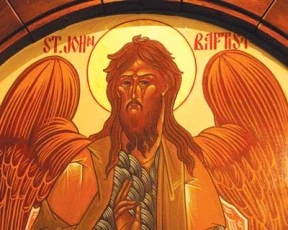
.- Wide-eyed figures, often viewed as “windows to the eternal,” have long peered from rustic churches and chapels inside of Alaska’s Russian Orthodox churches. More recently, however, a growing number are appearing in local Catholic parishes as well.

These haloed, somber-looking forms are sacred icons, believed to be capable of reflecting the holiness of heaven into the earth, explains the Catholic Anchor.

A gift from the East

Dating back to the first centuries of Christianity, icons gained increased prominence in Alaska after Russian Orthodox missionaries landed on Kodiak Island in 1794. The images spread to churches and missions across the state and then on into the Western United States.

While long familiar to Orthodox and Byzantine Catholic traditions of the East, the increased presence of icons within Western Christianity, both Roman Catholic and Protestant, is part of what Deacon Charles Rohrbacher sees as a renewed interest in sacred art.

An internationally respected Catholic iconographer who now lives in the Diocese of Juneau, Deacon Rohrbacher has observed a growing fascination with icons in Western Christianity over the past quarter century.

“I often ask theologians and church leaders why there has been a resurgence in icons,” he said in a telephone interview with the Anchor. “They most commonly tell me that it is due to a deep hunger for transcendence.”

It is a hunger that Deacon Rohrbacher has seen cut across denominational lines as modern Christians seek deeper spiritual realities in an increasingly secular world. “The icon is a healing image,” he said. “So many modern images we see do not heal — they wound us. They are of terror and abuse. In the icon, Christ, Mary and the saints look on us in love and invite us to contemplation.”

Expanded use of icons

In Alaska, Deacon Rohrbacher’s icons hang from Catholic parishes in the Anchorage and Juneau dioceses, as well as in several Orthodox churches farther north.

One of his most prominent works, completed in 2003, is an icon screen, which includes 38 interlocking images that span the entire width of the sanctuary at St. Nicholas Byzantine Catholic Church in Anchorage. In traditional form, the screen depicts the salvation story through icon imagery.

Two of the largest Roman Catholic parishes in the Anchorage Archdiocese also have made recent moves to expand the place of icons within their communities. Most notably, a large four-by-six-foot icon of the Holy Family is under construction for prominent display in the sanctuary at Holy Family Cathedral in Anchorage.

Dominican Father Francis Hung Le, pastor of the cathedral, said he hopes the icon will bridge the wide cultural and linguistic diversity within the church and point the faithful to the transcendent truth reflected in the sacred image.

“We have so many languages at the cathedral but icons can speak a universal language,” he told the Anchor.

Rediscovering a Catholic tradition

Anchorage Archbishop Roger Schwietz sees the turn to icons as a positive development and one which might reconnect Catholics to part of their tradition which is often overlooked in the Western church.

“Icons are not new to us as Catholics,” he told the Anchor. “Icons were part of our church history in the first thousand years of Christianity before the split between Orthodox and Catholics.”

Several icons hang in Archbishop Schwietz’s private residence and prayer chapel in Anchorage. They are images which he said can “feed the spiritual life of prayer.”

“You don’t just look at icons, you pray with them, and we need to relearn that as Roman Catholics,” he said. “People find that sitting with an icon can help them focus and help them set aside the noise of this world.”

The Christian belief that heavenly realities can be experienced through physical forms and images dates back to the first centuries of the church. Theologically, icons are rooted in the understanding that God took on physical form through the incarnation of Christ. And while icons are not considered holy in their own right, they are believed to be sacred because of the spiritual realities which they reflect.

The icon is also linked closely to traditional Christian beliefs about the sacramental nature of the world, a world where bread and wine become the Body and Blood of Christ and where water becomes holy and spiritually transformative through baptism.

Beyond Catholic and Orthodox

Outside Catholic and Orthodox circles, icons are rarely seen in Christian churches. More commonly, though, they are found in private devotional practices.

Orthodox priest Father Mikel Bock sees this in his work as manager of the Russian Orthodox Museum in downtown Anchorage. There, he sells icons to Christians from various church backgrounds.

“It’s a combination,” he told the Anchor. “It is probably mostly Orthodox and Catholic, but an icon will sometimes strike someone and they will buy it because it affects them — it touches their heart.”

For those unfamiliar with icons, they serve as conversation starters, Father Bock added.

“People want to know the significance of them, who they are, what they mean,” he said.

Incarnate environments

In the years following the Second Vatican Council, Deacon Rohrbacher saw a number of Catholic parishes remove sacred art and statues from their sanctuaries in the 1970s and 80s.

“There was a tendency toward a kind of bare, stripped down minimalist church environment,” he said. “Many statues and pictures were shown the door but with nothing really to replace them.”

Deacon Rohrbacher remembers a moment in the 1970s, which inspired him to learn iconography. Walking into the new cathedral in San Francisco he was taken aback.

“It was very stark, very white and very, very bare,” he recalled. “Instinctively, it seemed that a Catholic Church without images of Christ and Mary and the saints was not fully proclaiming the Gospel,” he said. “It was a disincarnate environment.”

In more recent years, however, Deacon Rohrbacher thinks Vatican II has contributed to the reemergence of icons in some Catholic circles.

“Part of Vatican II was a return to original sources,” he explained. “That has been a part of the rediscovery of the role of the icon in the life of the church.”

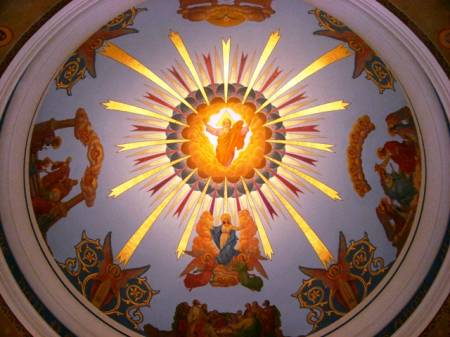
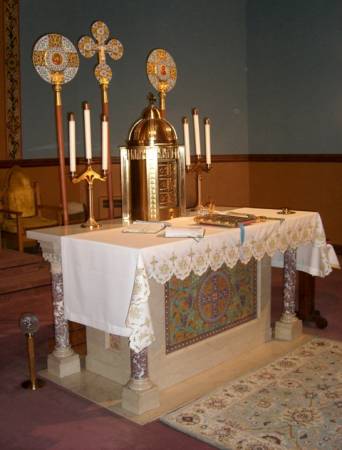
St. Mary's (Dormition) Byzantine Catholic Church, Hazleton, PA

The_recently_restored_iconostasis._Of_course,_it_is_even_more_impressive_in_person..jpg
"The recently restored iconostasis. Of course, it is even more impressive in person."

The_recently_restored_iconostasis._Of_course,_it_is_even_more_impressive_in_person..jpg
"The dome has also been restored. This picture does not do justice to the sacred artwork."

The_recently_restored_iconostasis._Of_course,_it_is_even_more_impressive_in_person..jpg
"The mosaic built into the front of the altar is impressive."

The_recently_restored_iconostasis._Of_course,_it_is_even_more_impressive_in_person..jpg
"These are brand new doors. The gold-leafing on the leaves really stand out, and shine when the lights of the church are turned out."

The_recently_restored_iconostasis._Of_course,_it_is_even_more_impressive_in_person..jpg
"The facade is cathedral-like. Beautiful!"

Catholics Decry Anti-Christianity in Israel

Protest "Horrible Offenses" on TV

JERUSALEM, FEB. 19, 2009 (Zenit.org).- Leaders of the Catholic Church in the Holy Land are condemning the "revolting attacks" against Jesus Christ and the Virgin Mary, broadcast by Israel's Channel 10 television.

A joint communiqué issued Wednesday explains, "In these days, during a night show on Channel 10, a series of horrible offenses were launched against our faith and consequently against us, Christians."

The communiqué was signed by the Latin patriarch of Jerusalem and the Franciscan custos of the Holy Land, among others.

"The show directed its attacks to the holiest figures of our Christian belief in an attempt, as the director of the show himself specifically declared, to destroy Christianism," the communiqué stated.

"Channel 10 was used to desecrate the holiest figures of Christianism offending hundreds of thousands of Christian Israeli citizens and of many millions of Christians all over the world as well," the Catholic leaders lamented.

Channel 10 began its activities in 2002.

The Catholic leaders contended that the program was "a symptom of greater problems disturbing the society, such as intolerance, refusal to accept and respect the other and inherent hatred."

And they said that the program comes in a series of attacks on Christians in Israel over the years. They cited an occurrence from a few months ago, when "copies of the New Testament were publicly burned in the yard of a synagogue in Or Yehuda."

The statement expressed appreciation for the many Christians, Muslims and Jews who "were themselves shocked and appalled, and expressed their dismay and protest at this fact."

The leaders contended that "such programs have nothing to do with freedom of expression, art and entertainment. They can only work against national integration and harmony in our society."

Mass at Lourdes

2/20/09 - 10 AM


Brady Bunch - Weird Al

Hey Ricky - Weird Al Yankovich

Laurel & Hardy vs. ABBA

Thursday, February 19, 2009

Archbishop Chaput responds to Pelosi-Pope meeting

.- Archbishop Charles Chaput of Denver is in complete agreement with the message that Pope Benedict XVI delivered to Nancy Pelosi on Wednesday. The archbishop also went so far as to say that since she disagrees with the Church on the "black and white issue" of abortion, she should not present herself for Communion.

The comments by Archbishop Chaput were made following Nancy Pelosi’s meeting with Pope Benedict, at which the Pope reminded the Speaker of the House that all legislators, but especially Catholics, are bound to protect human life from conception to natural death.

FOX News’ Neil Cavuto invited Archbishop Chaput to give his reaction to the Pope-Pelosi meeting on Wednesday afternoon.

Cavuto began by pointing out the disparity between Pelosi’s statement about the meeting and the Pope’s.

"I got very different reads from both the Pope’s message of that meeting and the speaker’s, but the gist of the Pope’s is that, she has a duty to respect life, what did you make of that?" said Cavuto.


"Well it’s true," replied the archbishop. "Every Catholic, whether you’re famous or anonymous, whether you’re a public official or a private citizen, has a responsibility to be faithful to what the Church believes about human life, and we believe that human life is sacred and precious from the moment of conception. So that applies to the Speaker as well as it does to me and to you and to anyone who’s Catholic."

Referring to a previous interview regarding Pelosi’s comment that when life begins is not agreed upon by Catholic teaching, Cavuto asked, "isn’t it a fairly black and white issue?"

Chaput responded, "Well it’s not a fairly black and white issue, it’s a clearly black and white issue.

"The Church without a doubt believes that human life begins at the moment of conception," he said.

Cavuto also asked Archbishop Chaput if he would deny Holy Communion to Pelosi.

To which, the archbishop responded:

"Well, I’d like to talk to her if she’s coming to church in the Archdiocese of Denver and I’d say to her what I’d say to anyone, if you don’t accept what the Church teaches, you shouldn’t present yourself for Communion, because Communion means you’re in agreement with what the Church teaches, and, as I said to you earlier, that applies to all of us..."

Isn’t she boxed in by Catholic beliefs on the one hand and by a society that is pro-choice? Cavuto queried.

"Well I don’t think it’s a box to defend the truth and to stand up for what you know to be right, even if others in the community disagree with you, and being honest about our moral principles is a sign of maturity, is a sign of being a statesman.

"And I think that politicians are required to be both good Americans and good Catholics at the same time and to be convincing when they present the position of the community on basic human rights," the archbishop replied.

Referring to the issue of abortion, Archbishop Chaput said, "This is a human rights issue, from the point of view of the Church, and not a theological or religious perspective. Our religious perspective supports that, but that’s not the source of our belief about the sacredness of human life."

Fr. Tim Finigan's Response to the Tablet

From Fr. Tim Finigan of Our Lady of the Rosary, Blackfen:

"The Tablet article is up now so I thought I should get in quickly. Sorry for the length of this post but I need to get a few things on record. Following the Zuhlsdorf convention, my emphases in black and my comments in red. (Fr Z just rang me and it seems that we have been engaged in a simultaneous transatlantic fisk. (See: Exercises in intimidation: The Tablet attacks Fr. Finigan)


That was not my Mass
Elena Curti

Nearly 40 years ago, that was the comment of the keenest supporters of the Tridentine Rite as the new rite was introduced. Now the sentiment has been reversed in the suburban parish of Blackfen, where a priest’s introduction of traditionalist liturgy has split the parish

Each Sunday at around 9.45 a.m. [or earlier - youngsters get there up to an hour before Mass to help prepare] a team at Our Lady of the Rosary, Blackfen, in the south-eastern suburbs of Greater London, erects a wooden stepped platform faced in a marble-effect laminate on the altar. On this is placed a gold crucifix, six large candlesticks, vases of flowers and altar cards for the celebration of the old Latin Mass. Welcome to the parish of Fr Tim Finigan, popular blogger and leading light of the Latin Mass Society of England and Wales.

Fr Finigan is in the vanguard of priests determined to restore “tradition” to their parishes and, step by step, [gradually, with explanations, over a couple of years] he has introduced elements of the extraordinary form into the liturgy at his church. The centrepiece is the weekly Sunday Tridentine Mass at 10.30 a.m, introduced in the wake of the Pope’s motu proprio allowing wider celebration of the old rite. During his 11 years in charge he has also gradually brought in other traditionalist touches that have split the parish. [Ah yes, the "split" - thats a key point of the article - but in fact the vast majority of parishioners just come along to whichever Mass they want, and wonder what all the fuss is about. What hurts them is the bad atmosphere caused by vehement complaining and controversy. This is not helped, of course, by airing it all in the press.]

Between 30 and 40 people no longer attend the church and a similar number have taken their place. [Hmmm. In these suburban parishes, over the course of a year or so, there are at least that number coming and going for all sorts of reasons.] The row about numbers has become so heated that supporters of Fr Finigan carefully count the numbers attending the Sunday morning old-rite Mass. [We have long counted all the numbers at all the Masses. More recently, the accuracy of these counts has been made an issue. It has been important to counter the claim that the usus antiquior Mass is not well supported. 135 came last Sunday. Total at the four masses, about 550.] An auxiliary in Southwark diocese, Bishop Pat Lynch, has been called in to mediate. [Not quite. He was complained to, and generously took time to meet various people and advise on bringing peace in the situation.]

In what was once a fairly typical parish, [oh, it still is, in many ways] there are no extraordinary ministers of the Eucharist. Altar rails have been installed and the parish priest makes it clear that he prefers communicants to kneel and to receive the Host on the tongue. [I have passed on the insights of Archbishop Ranjith, Bishop Schneider and others, and mentioned the example of Pope Benedict. As with other matters, this is not about what "I prefer" but about what is best.] Communion is not usually offered under both species. At a regular Sunday evening Mass in the new rite, there are no bidding prayers and the congregation is not invited to exchange the sign of peace. [At the other new-rite Sunday Masses, these things are all available.] Fr Finigan says the Eucharistic Prayer with his back to the congregation [boo!] with the stepped platform, properly called a gradine, on the altar. Unaccompanied hymn-singing has been dropped after the priest complained it was a “torture” to continue to inflict it on the assembly. [It was.]

Old-rite Masses are also usually celebrated on major feast days including Midnight Mass, and there is a regular Mass in the extraordinary form on Saturday mornings. The ordinary form is used for the Saturday vigil Mass and the Sunday 9 a.m. children’s Mass. Weekday Masses are in the new rite.

But Fr Finigan’s critics fear that their parish is gradually becoming a flagship for the Tridentine Rite. They claim that most of those who welcome the trend are newcomers living outside the parish. [The claim is simply false.]

“Six parishioners wanted the Latin Mass here. [No idea where that number comes from.] I have no objection to them having it once a month or once a week, but it should not be the main Sunday Mass and it should not be imposed over the whole parish,” [It isn't. We have four weekend precept Masses, three of them in English, in the novus ordo.] said Les Thomas, a member of the delegation that went to see Bishop Lynch.

Mr Thomas is one of nine parishioners I met who claim that Fr Finigan’s dedication to “tradition” has hurt the parish. Most of them have served as readers and/or Eucharistic ministers. Four say they can no longer bear to attend Mass at Blackfen, the rest doing so under sufferance.

“It is a matter of principle. I won’t be driven out,” says Eddie Sweeney, a former master of ceremonies and scoutmaster who has lived in the parish for 57 years. The group describe feelings of irritation, discomfort and sadness at the changes that have been made. Those who prefer to stand for Communion and receive it in the hand say they feel selfconscious doing so at Fr Finigan’s Masses. [I never do anything to indicate disapproval of someone receiving Holy Communion correctly according to the current norms. Many people have told me of how priests have made difficulties for them receiving on the tongue. As for kneeling when everyone else is standing - well we all know how that goes down.]

Several said their adult children vowed never to go to the church again, such was their unhappiness with the liturgy. “People who have been away from church come back at Christmas and Easter and are totally put off. It is so sad,” said Jean Gray. A woman who asked not to be named said she had known Fr Finigan for many years and he had been a “rock” supporting her family through some difficult times. But she felt moved to complain after she asked him to celebrate a Mass for her daughter’s favourite aunt who had recently died. She did not realise at the time that it would be entirely in Latin. “My daughter cried through most of the Mass because she could not join in. Afterwards she said: ‘That was not my Mass.’” [I'm sorry that this happened: I would never knowingly put someone's Mass intention on at a Mass they didn't want to go to. And, I'd always be happy to celebrate the Mass again on a different occasion.]

Rules introduced include an insistence on silence in the church before and after Mass, [Rules? I periodically ask people not to hold conversations in the Church so that others are left free to pray if they want to. Some people just ignore this.] which critics said meant there was little opportunity for parishioners to mingle afterwards, losing an important point of contact especially for the elderly. [Whenever I talk about silence in Church, I always affirm the importance of social interaction outside or in the Hall.]

There were also complaints about their priest’s refusal to support Cafod, his expenditure on traditional vestments and other clerical garb, the absence of a parish council and failure to account to parishioners how money from the collection plate was being spent. [This is a really cheap shot and I'll address it below.]

Matters came to a head last October when one parishioner, Bernard Wynne, a retired management consultant, set out his grievances in an email to Fr Finigan and asked for a parish consultation. He copied his message to a number of parishioners [and the Archbishop, and the Area Bishop] and invited them to make their views known. The ensuing correspondence resulted in about a dozen people objecting to Fr Finigan’s approach and about the same number supporting him.

In her email Susan Reynolds, a parishioner for 35 years wrote: “I grew up with the Latin Mass and remember sitting watching men and women saying the Rosary, slyly reading the newspaper or making responses they didn’t really understand. The English Mass made us participants and co-celebrants in the sacrifice of the Mass. The instruction to ‘open the windows and doors’ is one of the most liberating things to happen in the Catholic Church. If you listen carefully you can hear them being shut in Blackfen.”

Fr Finigan’s response [to the above and many other emails totalling about 20,000 words] was a 35-page essay, in which he set out the thinking behind his use of the “traditional liturgy”. [See: "Sacred and Great"] But it is in a lecture to the Latin Mass Society’s training conference at Oxford last year for priests learning how to celebrate the extraordinary form that he set out his strategy. He told the priests they were the “infantry” who need to overcome “real problems and difficulties” in bringing the extraordinary form to their parishes. He said the priest had a responsibility to persevere even in parishes where there were not a large number of people requesting the old rite. [Well, what I said was that priests could not adequately prepare for the older form by catechesis alone but needed to persevere even though it might be a shock to begin with. But see the article. The reference to "infantry" was an allusion to the phrase "poor bloody infantry" who are at times attacked by both officers and civilians. This sometimes ring true for parish clergy.]

Parish reaction to the introduction of the old rite would find a few “very favourable”, a few “strongly against”, and “the substantial majority who simply wonder what Father is doing now”. It was, Fr Finigan said, “important not to neglect this majority of our parishioners in deference to a vocal minority”.

When I spoke to Fr Finigan he admitted there had not been a stable group at Blackfen who had requested Mass in the extraordinary form as set out in the motu proprio, but over a period of time he said most parishioners had accepted the liturgy and some, particularly young people, had become very enthusiastic about the old Latin Mass. [Oh there had been a stable group, all right. What I admit is that (despite temptation to the contrary) I did not get them get them to draw up a petition etc. to introduce the Mass on those grounds. I read SP as allowing the pastor to introduce the usus antiquior for pastoral reasons and felt it was more honest to do just that. (See my post 'If ... but not "only if"'). I think that Cardinal Hoyos supports this position.] He pointed out the three Masses in the ordinary form that people could attend on Sundays, adding: “I am not going to be able to please everybody. I would like people to gradually be able to settle down and accept the way things are now.”

The parish priest rejected the idea of a consultation or the setting up of a parish council on the grounds that it would be a “bear pit” and “people would be at each others’ throats”. [Having a big meeting for everyone to argue about the Liturgy would, I think, not be helpful. I'm not against the idea of a Parish Council if it will help the pastoral work of the parish but not as a quarterly debate on how we should celebrate the Liturgy.] With regard to the parish’s finances, he said he was arranging to get help so that a summary of income and expenditure could be published for parishioners.

Fr Finigan put me in touch with five parishioners who support the changes at Blackfen. One was a mother of seven-year-old twins, Wendy Kane, who lives just outside the parish boundary [In fact, in suburban parishes, lots of people cross parish boundaries.] and has been attending Our Lady’s for seven years. She felt delighted with the liturgy and said it had strengthened her faith and that of her family, adding: “The extraordinary form is not what I grew up with and I never experienced it before. I personally find it a beautiful form of worship.” [And her boys are very eager to start serving as soon as they have made their first Communion, and her husband is being received into the Church this Easter.]

Another supporter, Julia Jones, a 38- year-old teacher who moved to the parish last summer, said: “I have been very moved by the silence and palpable feeling of devotion, especially during the Eucharistic Prayer. I have gained greatly from the experience in only a few months. I really do believe that I have found ‘the pearl of great price’.”

Bishop Lynch said this week that the whole parish needs to build communion through prayer and social activities. “You need a situation where people respect diversity but can also come together,” he said. [I heartily concur - and many thanks to Bishop Lynch for his tactful interventions at every stage.]

Fr Finigan trained for the priesthood at the English College in Rome and has worked in parishes in south-east London for 23 years. Through his blog, The Hermeneutic of Continuity, which recently had its millionth hit, he has become well known. He is also a visiting tutor in Sacred Theology at St John’s Seminary, Wonersh; and there can be no doubt that he considers bringing the old rite to his parishioners central to his ministry.

Some welcome what Fr Finigan is doing. It is equally clear that some do not. If Fr Finigan is right, and the priest’s responsibility for the liturgy in his parish is absolute, [It is not absolute, it is subject to the law of the Church. Pope Benedict more than once pointed out that even the Pope is subject to the tradition of the Church.] there is nothing parishioners can do about it. And there could be many more Blackfens in the future. [I must get a parish anthem going (ouside the Liturgy, of course) - something along the lines of "There's only one Blackfen!"]
Just a note on finances. The bit about vestments and clerical garb (Boo! Hiss!) is, as I said, a cheap shot. It is a part of my responsibility to ensure that there are dignified vestments for the Liturgy. Gradually, over 11 years, I have spent judiciously in accordance with our budget to secure worthy vestments. I have also recovered a substantial quantity of vestments and other liturgical artefacts free of charge from people who did not have any use for them (i.e. might have thrown them out.) "Clerical garb" probably refers to things like my cassock and Ferraiuolo etc. These come out of my own pocket - thankfully, the parishioners as a whole are very generous at Christmas and Easter (significantly more generous this Christmas than usual).

Over the past few years, helped by many parishioners, I have also, among other works, replaced the roof, floor, heating and lighting in the Hall, put in disabled toilets and levelled the entrance, repainted the interior of the Church, replaced the roof on two areas, replaced the guttering, replaced the public address system, put in an industrial spec kitchen in the Club (for the lunch club to provide lunch every week for 40 elderly people without falling foul of health and safety law).

We also raise money regularly for the Bexley Deanery Third World Project, Aid to the Church in Need, the Manna Centre for the Homeless, the Bexley Centre for the Unemployed, the Good Counsel Network, and Cardiac Research in the Young to name but a few. In place of CAFOD, I send our Family Fast Day money to the Pontifical Council Cor Unum (which CAFOD is a partner of, I think.) That way, we support the Church's development work without contributing to glossy advertising or a questionable policy on HIV prevention.

Fr Z today quotes a famous remark of Pope Benedict when he read a negative article about him in an Italian daily:
"If I don’t read an article like that every week or so, I have to examine my conscience."
Admirable - but daunting. A man to admire and emulate not only in liturgical matters.

That's all for now - I have to go and inflict Rosary and Benediction on my oppressed parishioners."

Wednesday, February 18, 2009

Pope lectures Pelosi on abortion stance

Emphases and comments by Fr. Z:
Pope lectures Pelosi on abortion stance
By Mike Soraghan
Posted: 02/18/09 10:32 AM [ET]

Pope Benedict XVI made clear to House Speaker Nancy Pelosi Wednesday that she cannot advocate for abortion rights and still be a good Catholic.

After meeting with Pelosi (D-Calif.) at the Vatican, the pontiff stressed that Catholic politicians are required to work to outlaw abortion, and stressed that church teachings are “consistent” on the matter.

Both seem aimed directly at Pelosi’s public positions. Though she considers herself an “ardent” Catholic, she is also a vocal supporter of abortion rights. She tangled with church officials last year about whether church teachings on abortion have been consistent.

After their meeting the Vatican issued a statement that read:

"His Holiness took the opportunity to speak of the requirements of the natural moral law and the Church’s consistent teaching on the dignity of human life from conception to natural death which enjoin all Catholics, and especially legislators, jurists and those responsible for the common good of society, to work in cooperation with all men and women of good will in creating a just system of laws capable of protecting human life at all stages of its development."

The statement emphasizes that the church considers life to begin at conception and that legislators such as Pelosi are "enjoined" to work to create laws that "protect life at all stages of development."

In her own statement, Pelosi did not raise the issue of abortion, focusing instead on the social and economic issues where she is squarely in line with church teaching.

"I had the opportunity to praise the Church’s leadership in fighting poverty, hunger, and global warming, as well as the Holy Father’s dedication to religious freedom and his upcoming trip and message to Israel," Pelosi said.

The Pope’s brief statement mentioned none of those issues. [Right!]

Pope watchers found the Pope’s criticism rather mild.

“I think there was something for both sides,” said Dave Gibson, author of The Rule of Benedict: Pope Benedict XVI and His Battle with the Modern World. “When he talked about ‘a system of laws capable of protecting life,’ Pelosi can say ‘We Democrats do a better job of protecting children and mothers.’”

Gibson noted that Benedict has met with and given communion to pro-abortion rights Catholic politicians from Italy without controversy in the past.

Jon O’Brien, president of Catholics for Choice, said he was heartened by what he considers a civil disagreement. He praised Pelosi for emphasizing social justice issues. [A "civil disagreement"? This guy, O’Brien, praises her for emphasizing social issues to the Pope when the Pope is instructing her…]

“These are the issues that are important to a majority of American Catholics,” O’Brien said. “The next time a bishop is talking wildly about excommunication, he should look at this exchange.” [I am beginning serious to dislike this fellow.]

...

Pope Urges Catholic US Legislators to Defend Life

Receives Speaker of the House Pelosi in Audience

VATICAN CITY, FEB. 18, 2009 (Zenit.org).- Benedict XVI is urging legislators to uphold the sanctity of human life according to Church teaching, he affirmed in an meeting with U.S. Speaker of the House of Representatives.

The Pope received Nancy Pelosi and her entourage briefly today after the general audience, reported a Vatican communiqué.

He "took the opportunity to speak of the requirements of the natural moral law and the Church's consistent teaching on the dignity of human life from conception to natural death," the Vatican reported afterward.

The Pontiff added that these teachings "enjoin all Catholics, and especially legislators, jurists and those responsible for the common good of society, to work in cooperation with all men and women of good will in creating a just system of laws capable of protecting human life at all stages of its development."

In a statement today from Pelosi's office, she said that in the meeting she lauded "the Church's leadership in fighting poverty, hunger and global warming, as well as the Holy Father's dedication to religious freedom and his upcoming trip and message to Israel."

Abortion controversy

The meeting comes after Pelosi's erroneous remarks on a television interview last August. When asked to comment on when human life begins, she responded that as a Catholic, she had studied the issue "for a long time" and that "the doctors of the Church have not been able to make that definition."

The next day, Cardinal Justin Rigali, chairman of the U.S. bishops' Committee on Pro-Life Activities, and Bishop William Lori, chairman of the Committee on Doctrine, said her answer "misrepresented the history and nature of the authentic teaching of the Catholic Church against abortion."

They, and other bishops, issued public statements clarifying the Church's position. They cited the teaching of the Catechism of the Catholic Church: "Since the first century the Church has affirmed the moral evil of every procured abortion. This teaching has not changed and remains unchangeable. Direct abortion, that is to say, abortion willed either as an end or a means, is gravely contrary to the moral law."

Archbishop George Niederauer of San Francisco, which is Pelosi's home diocese, invited her for a private meeting in September.

Catholic congressmen

Meanwhile, two other Catholic congressmen, John Boehner and Thaddeus McCotter, wrote a letter Tuesday to Cardinal Rigali. They thanked him for his Feb. 5 letter to all members of Congress in which he urged legislators to uphold existing pro-life laws and refrain from forcing taxpayers to fund abortions.

The legislators' letter, released to the public, read "We stand with you in the defense of all human life and look forward to working with you."

It continued: "We are committed to working with our pro-life colleagues on both sides of the aisle to proactively defeat efforts to enact the so-called Freedom of Choice Act (FOCA) or any similar measure. We are similarly committed to working to retain, and not weaken, laws that prohibit using federal funds for the purpose of promoting or funding promotion of abortion. […]

"We will, as Pope Benedict XVI exhorted during his apostolic visit to the United States last year, 'proclaim the gift of life, to serve life, and promote a culture of life.'"

Pope: Catholic politicians must protect life

Feb 18 08:43 AM US/Eastern
By VICTOR L. SIMPSON
Associated Press Writer


VATICAN CITY (AP) - Pope Benedict XVI on Wednesday told U.S. Speaker of the House Nancy Pelosi, a Catholic who supports abortion rights, that Catholic politicians have a duty to protect life "at all stages of its development," the Vatican said.
Pelosi is the first top Democrat to meet with Benedict since the election of Barack Obama, who won a majority of the Catholic vote despite differences with the Vatican on abortion.

The Vatican released remarks by the pope to Pelosi, saying Benedict spoke of the church's teaching "on the dignity of human life from conception to natural death." That is an expression often used by the pope when expressing opposition to abortion.

Benedict said all Catholics—especially legislators, jurists and political leaders—should work to create "a just system of laws capable of protecting human life at all stages of its development."

Pelosi could not immediately be reached after the 15-minute meeting, which was closed to reporters and photographers. The two met in a small room of a Vatican auditorium after the pope's weekly public audience.

A number of the bishops in the United States have questioned Pelosi's stance on abortion, particularly her theological defense of her support for abortion rights.

Benedict has cautiously welcomed the new Democratic administration, although several American cardinals have sharply criticized its support of abortion rights in a break from former President George W. Bush.

Tuesday, February 17, 2009

Report from Canons Regular of St. john Cantius Training Session

http://www.canons-regular.org/images/ui/canons-crest.gif
"From February 9-13, 2009, priests from diverse parts of the United States and Canada studied the Extraordinary Form of the Roman Rite (1962 Missale Romanum) under the direction of the Canons Regular of St. John Cantius. Two classes were offered, one for beginners, learning the ceremony and rubrics of Missa Lecta (Low Mass) for the first time, and an advanced class for those studying the Missa Cantata (High Mass)...

On Wednesday evening one of the students studying High Mass, Fr. John Ubel, Pastor of St. Agnes Church in St. Paul, MN, offered the Missa Cantata with incense...."

Letter From a Survivor

From this site via The Sensible Bond:
One of the seminarians who was involved in the avalanche near Econe on Wednesday has written an account of what happened. The text was published here. This is a rough translation. The original text is colloquial in style and repetitive.

Ecône, 12 February 2009, 10am.

Dear family and friends,

Some of you might already have heard about this, but if only to correct partial accounts, I want to tell you about a difficult trial that hit the seminary of Econe yesterday. Three third year seminarians died in the mountains because of an avalanche (for those who know them, Jean-Baptiste Després (22), Raymond Guérin (22) et Michaël Sabak (20 ans)).

After the end-of-semester exams, we had a break of four days when we could make whatever outings we wanted. This Wednesday 11 February, seven of us seminarians (all 3rd years and French) decided to go out for a day in the mountains. We planned to treck on snow shoes towards a mountain refuge, cook our picnic and return in the evening so as to be back at the seminary for 6.30pm. We left the seminary by car about 9am, and parked up about 10.30am. From there we went off onto the fresh snow in snowshoes, along a path that leads to a hydroelectric dam way up in the mountains.

When we reached the summit about 12.45pm, a sign indicated that from that point it would ordinarily take one hour twenty minutes to reach the mountain refuge. But the path was covered with a metre and a half of snow on which nobody had walked, so much so that we had to cut the path again with our snow shoes. This path passed 50 metres above the lake (Cleuson). Two of us, being tired and hungry, didn't want to go on. So we were walking behind the others at a distance of 50 metres. Then, as the path went around an outcrop of rock above the lake, they disappeared from view. One of them, however, wanted to see what had become of us, and came again into view around the outcrop. We exchanged a few words and then caught up with him. But then, looking for the group up ahead, we could see only their footprints, which petered out about 40 metres ahead of us, and the trail of an avalanche. The ice on the lake was broken where the avalanche had come to a halt, but we could make nothing else out because of the brightness of the snow and the visibility (100 metres).

We understood straightaway what had just happened. Seeing that in any case we could not help them, we went back to the dam. It was 1pm. After a few minutes of difficult walking, we reached the 'dam keepers' lodge'. The door was open, the lodge was empty, and near to the door was a phone. I then called 112 and the mountain rescue centre answered straightaway. Four people were in the avalanche and perhaps in the lake itself. In record time (15 mins), 2 'allouettes III' (helicopters) arrived at the spot and after half an hour, they brought back one of my best friends Eric Peron. He had not lost consciousness, and, though completely submerged in the snow, had managed to keep a pocket of air in front of his mouth with his arms, which saved him. Soon, he realised that the snow was whiter above him. Guessing that he was near the surface (his feet were in the lake and he was stuck from the waist up), he opened up a gap with his free arm, and actually reached the surface of the snow and he had the presence of mind to pull off his scarf and shove it through the opening. The rescuers saw it and with their dogs they got him out. He pointed out to them his fellow seminarian Raymond whose feet he could see, but Raymond was already dead. Eric was able to walk and seemed okay but Raymond was on the ground and we were not told until later that he was dead.

About 3pm they took us by helicopter (my first time in one ...) to the rescuers' base at Sion where the police took charge of us. Eric was already at hospital and he was well and had no broken bones. They held us a long time at the police station to make their inquiries into what had happened. As the eldest of the witnesses they made me make a long statement which the two others confirmed. Meanwhile we learnt that Raymond had died and that Jean-Baptiste and Michaël had not been found. There was no hope of getting them out alive. That evening at 7pm, they took us to the funeral home where we found Eric who was with Raymond's body. At 8.30pm, we were all taken back to the seminary. The searches stopped for the night and began again this morning.

That is the story of what happened. Everyone here is in shock. Three young, beautiful souls have gone to meet the Eternal Father. Four miracles - for if we had not lagged behind, we would have all been caught in the avalanche and, with nobody to raise the alarm, the searches would not have started until 7pm, which would have been too late for the seven of us, the ways of God are impenetrable - give thanks to the Lord for the life which he has given them, and mourn the death of their friends. I ask you now to pray for the dead, and for their families who are enduring a terrible trial, and to join us in thanking the mercy of heaven for sparing our lives.

With my love,
Benoît.

Requiescant in Pace

"Lepers' Apostle" to Be Declared a Saint

Father Damián Ministered in Hawaii

VATICAN CITY, FEB. 16, 2009 (Zenit.org).- The miraculous healing of a Hawaiian woman with cancer is leading to the canonization of a priest known for his ministry on the island with lepers relegated to a sequestered community.

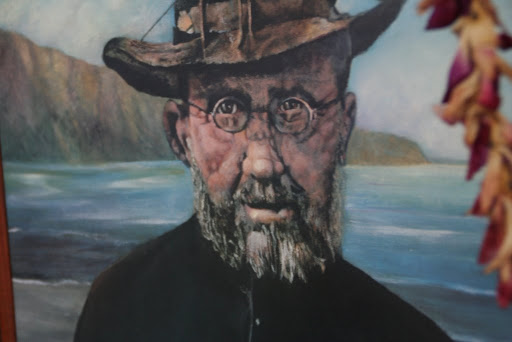
Belgian Father Damián de Veuster (1840-1889) is known as the apostle to the lepers, for his ministry on the island of Molokai. The Holy See reported today that on Saturday, there will be a consistory to decide the date for his canonization, and that of nine other blesseds.

Pope John Paul II beatified Father Damián in 1995.

http://lh3.ggpht.com/_UNc08M5H-aM/R8JhwK7wYKI/AAAAAAAAAZY/fuvIhXQzQoc/early+2008+207.jpg

The priest requested to work with the lepers, providing them with religious and practical support since they were denied necessary medical treatment and provided only with food and basic supplies. Father Damián managed to establish for them a parish, schools and a society. He himself died of leprosy.

The miracle that paved the way for his canonization was the healing of Audrey Toguchi of Honolulu. Her cancer was considered incurable, but she spent nearly a year asking God to heal her through the intercession of Father Damián.

She said that during that period, her prayer was directed to God "exclusively through Blessed Damián. I am convinced that this miraculous disappearance of the cancer is due to the intercession of Blessed Damián."

The Schering-plough Research Institute visits bloggingLOURDES