Showing posts with label the Bitter Pill. Show all posts

Friday, September 7, 2012

Time To Put Our House In Order (The Bitter Pill)

From Mac McLernon at Mulier Fortis:
"Before the Catholic blogosphere took off, the only sources of information for ordinary Catholics were papers such as The Pill. Unfortunately, The Pill has, for quite some time, been giving rather a lot of publishing space to individuals who are actually opposed to Church teaching. One such individual is Prof. Tina Beattie, who, as director of the Digby Stuart Research Centre for Catholic Studies at the University of Roehampton, certainly should not be writing against the Church's position on subjects such as abortion and same-sex "marriage."

If The Pill wishes to campaign against the teachings of the Church, then it should not be sold as a Catholic publication, and definitely not be made available for sale in Catholic parishes and cathedrals."
Link:

Monday, August 2, 2010

Fr. Doyle and the ecclesiology of despair

From the blog of Edward N. Peters, Canon Laywer:
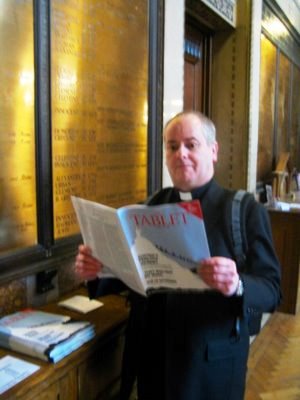
https://blogger.googleusercontent.com/img/b/R29vZ2xl/AVvXsEjDtOhM7J9RMUjxLcgo-OfoSguyRTJNYsePWR_dTbgusRN31sAYdg3arCdRLUj2r6H9CQ_fkNYpJWizjyt_EL0QGhX6Bf-q5CdAa8Qp0aV5hj-1PRQwHPtyDrx-Inn_Dlhg9Gp0EHDSscZ5/s400/tabletcover21022009b.gif"Fr. Thomas Doyle, op., has an essay in The Tablet (24 July 2010) wherein he comments, mostly negatively, on some canonical procedural norms recently revised and published by Rome. My concern here, though, is with what I will call an “ecclesiology of despair” to which I think Fr. Doyle’s essay gives voice.

Concluding his criticisms of the new norms, Fr. Doyle asserts that: “They are tragic evidence that the hierarchical governing body of the Church is no longer capable of leading the People of God.” Now, for Catholics called to maintain communion with the Church in all things (c. 209), such an assertion, no matter what context occasioned it, is disturbing.

The “hierarchical governing body of the Church” is the pope and bishops in union with him (cc. 331, 336), usually operating dispersed throughout the world (cc. 375, 381), sometimes operating in an ecumenical council (c. 337). But let's be clear: the “hierarchical governing body of the Church” is not the ecclesiastical equivalent of, say, the Democratic or Republican Party (groups that can and do lose their mandate to govern in any number of ways), nor is the Church's hierarchy even the equivalent of the federal-state governmental system we know in America (a structure that need not have been adopted and that many nations do not follow). Not at all.

Rather, the “hierarchical governing body of the Church” is the divinely-mandated governing structure that Christ left to his Church. See Lumen gentium 8, 18-29. It is the way that Christ wants his Church to shepherd the People of God. To assert, then, that “the hierarchical governing body of the Church is no longer capable of leading the People of God” is to assert that Christ’s plan and his promise of abiding protection were insufficient to preserve (not so much individuals from sin, for they still have free will, etc., but rather, to preserve) the Petrine-Apostolic foundations of his Church from eventual collapse and, at least from then on, to save her very reason for existence from radical frustration. In short, one sighs in despair, So much for Christ and his divine promises.

Of course Fr. Doyle, blessed with free will, can urge this viewpoint, and others are, I trust, free to contradict him. But we should make no mistake about what his assertion implies for ecclesiology:..."


Thursday, February 11, 2010

The Tablet: Catholic Church Needs to Change on Homosexuality

Smeaton said, "For a parish priest to take the Tablet in bulk for sale to his parishioners is like a psychiatrist ordering cyanide capsules in bulk for sale to his depressed patients.

LONDON, February 11, 2010 (LifeSiteNews.com) – Britain’s left-leaning Catholic magazine, the Tablet, has called for the Catholic Church to “if not doctrinally, at least pastorally” change its teaching on homosexuality. The Catholic Church, said an unsigned editorial titled, “The Deepest Human Desire,” should “move on with confidence,” to facilitate greater acceptance of the homosexual lifestyle, or risk losing public approval.

Referring to the media uproar following comments made to the English bishops by Pope Benedict XVI opposing the Labour government’s proposed Equality Bill, the Tablet said, “The Church must take seriously, and ponder deeply, the underlying reasons for this week’s furore.”

The problem, the editorial said, is the “Catholic attitude to homosexuality.”

“What gay Catholics say is that it is not so much the Church’s disapproval of their sexual activity that hurts and damages them, as its inability to comprehend and value their emotional lives, their relationships. The deepest human desire of all is to love and be loved.” The Tablet asserts that many have found this love in same-sex relationships.

But this rosy view of the homosexual lifestyle is distinctly at odds with the findings of many studies, as well as abundant anecdotal evidence, that show homosexual activities to be mentally and physically damaging.

In a hard-hitting television documentary in 2008, homosexual activist and journalist Simon Fanshawe described the “gay scene” in London and elsewhere in Britain as a “sewer” of casual, degrading sex, drug abuse and misery.

Fanshawe pulled no punches in his investigation of bath houses, gay clubs and gay “beauty pageants” where sex, obsession with looking young and “chasing the ultimate sexual high” form the centre of life for many homosexuals.

Gay men, he said, are so "hardwired" towards finding casual sexual encounters, some going as far as plastic implants to enhance their appearance, that finding genuine intimacy is "practically impossible.” Gay men, he said, have “organise[d] our identity around sex. And that is corrosive. And to make things worse, promiscuity has become the norm.”

While Fanshawe ended his documentary with a plug for homosexual “marriage” as a solution to the shallowness and unfulfilling promiscuity of the gay lifestyle, a soon-to-be released study has, according to the New York Times, found that gay “marriages” themselves are highly polygamous, with frequent extra-‘marital’ liasons being the norm for these unions.

Available evidence of the harms of the gay lifestyle notwithstanding, the Tablet insists that the Catholic Church needs to change. In the face of growing public “tolerance” for homosexuals, the Church should "move beyond a sterile state of disapproval," lest it "lose the sympathy of wide sections of the public."

"Is the Church able to move beyond a sterile state of dis­approval that is in danger of becoming part of its public profile?" the Tablet asks, blasting the Church for its "inability to comprehend and value [homosexual persons'] emotional lives [and] their relationships."

The Tablet implied the support of none other than Pope Benedict XVI for this position, saying that his encyclical Deus Caritas Est supplies a "context" for understanding that homosexual relationships should be "treasured and respected."

John Smeaton, the head of the U.K.'s Society for the Protection of Unborn Children said the editorial, "goes beyond mere opinion, and is in fact a manifesto for homosexual equality."

Smeaton wrote, "It is part of a softening-up and consciousness-raising exercise within the Church. It is clear that The Tablet intends to use the months leading up to the Pope's visit as part of a media campaign to entrench an anti-life and anti-family agenda within official Catholic circles."

Catholics in the U.K. who adhere to and wish to promote the Church's teaching on sexuality have complained for years that the Tablet is one of their greatest foes. Sold in most U.K. Catholic parishes, taken by most of its religious orders, and quoted freely as an authoritative voice for the Catholic Church by the secular media, the Tablet has come to represent the Catholic Church in Britain.

Smeaton said, "For a parish priest to take the Tablet in bulk for sale to his parishioners is like a psychiatrist ordering cyanide capsules in bulk for sale to his depressed patients.

"The Tablet isn't known as 'The Bitter Pill' for nothing."

In August last year, the Tablet was blasted by Denver bishop Charles Chaput for an editorial in which the magazine urged the U.S. Bishops to support Barack Obama's healthcare reforms. The U.S. bishops, the magazine said, "have so far concentrated on a specifically Catholic issue - making sure state-funded health care does not include abortion - rather than the more general principle of the common good."

Bishop Chaput, in a letter published on the Denver diocese website, said that the editorial was the result of "ignorance and cynicism."

"It proves once again that people don't need to actually live in the United States to have unhelpful and badly informed opinions about our domestic issues," the bishop wrote.

"Abortion is not, and has never been, a 'specifically Catholic issue,' and the editors know it."

Founded in 1840, the Tablet was sold to a group of laity by Cardinal Hinsley in 1935, and taken on by "The Tablet Trust" in 1976. It made its first public break with Catholic sexual teaching in August 1968 over the issuance of Pope Paul VI's encyclical on contraception, Humanae Vitae.

Thursday, January 21, 2010

The Bitter Pill's Bizarre Report on Medjugorje & Cardinal Schonborn & The Pope


From WDTPRS:

CATEGORY: SESSIUNCULAFr. John Zuhlsdorf @ 5:19 pm

And now for one of the most absurd interpretations of news you will ever read.

This is either pure ignorance or deliberate misdirection.

Either way it is from RU-486 (aka The Bitter Pill aka The Tablet).

[schonborn_balloon_mass.jpg]

Church in the World
Schönborn says Pope might visit Medjugorje [And I might become the next Archbishop of Southwark.]
Christa Pongratz-Lippitt9 January 2010

A cardinal close to Benedict XVI has signalled his support for the controversial Marian shrine of Medjugorje. [Does that sound even slightly plausible?]
Cardinal Christoph Schönborn of Vienna indicated that Pope Benedict himself might one day [might.one.day] visit the spot where the Virgin Mary is believed [by fewer and fewer] to have appeared to a group of local children. Speaking on his return from a three-day visit to the shrine in Bosnia at the turn of the year, he told journalists in Vienna that the time had come to integrate the “Medjugorje phenomenon” into the Church’s ordinary pastoral work.

Asked in an interview with the Bologna-based daily Il Resto di Carlino what he would tell Pope Benedict XVI about the trip, he said: “The Pope does not need my advice. [Therefore….?] He knows very well how important the Virgin Mary is for the Catholic Church and he is a fervent devotee. [My heavens… did Card. Schonborn really say that? Was he addressing elementary schoolchildren at the time?]
He has visited many Marian shrines and I think one day he might even come here.” [And I might one day visit Kinshasa.] He added that Medjugorje could “become something very important and profound”.


The cardinal’s support comes as a surprise to many who have observed the wrangling over the shrine. The local Franciscan community believes the visions are genuine while the local bishop of Mostar, Ratko Peric, has been highly critical....

Monday, February 23, 2009

The Tablet Tries to Silence Father Finigan's Response

From Father Z:

"This is hilarious. His Hermeneuticalness, Fr. Tim Finigan, who was recently the object of a mean-spirited hit-piece by Elena Curti in the pages of The Tablet, writes:

CENSORED!

The Tablet have asked me to remove this post because it is a breach of copyright for me to quote their article in full. A new copyright-compliant version is available at the post: Responding to the Tablet – legally compliant version

It is hilarious to see the Tablet failing utterly to grasp the concept of publishing on the internet.
During a recent cordial phone chat about this sad affair, Fr. Finigan and I predicted that The Pill would come after him for responding in detail.

Right on schedule.

This says a great deal about The Tablet.

First, they drag him on a hurdle through the liberal parishes and chanceries willing to swallow the their message.

Then they whine when he frees an arm and bloodies their noses with his bonds.

They want him to go quietly.

Bullies are ever craven.

Second, they are stuck not only in the washed-up ecclesiology of the ‘70’s, they are stuck in the ‘70’s tools of social communication.

They think they are going to contain what they did to Fr. Finigan.

I checked Wikipedia for The Tablet and found that in 2006 it had a circulation, if the number is accurate, of 23,628. I suppose most of that involves the copies off-loaded in parish churches.

I get more readers than that every day.

And I hope everyone of them will visit Fr. Finigan’s site!

You know… if they all sent Fr. Finigan £ 1.00 ... just to, you know, offset the expense of his ultra-right wing clerical garb …. imagine what The Pill could write about next? Imagine how irritating that would be to the progressivists. "

Sunday, February 22, 2009

James MacMillan: Tablet attack on Fr Tim Finigan is a 'disgrace'

From Damian Thompson :

"James MacMillan, Britain's foremost Catholic composer and a long-time contributor to The Tablet, has written to the magazine's deputy editor Elena Curti describing her article about Fr Tim Finigan and Our Lady of the Rosary, Bleckfen, as a "disgrace" that may be actionable.

"I hope the good parishioners of Our Lady of the Rosary can find it in their hearts to forgive you and pray for you," he tells her.

This week's Bitter Pill contains a hatchet job by Curti on Fr Tim - one of this country's finest priests - for offering Mass in the Extraordinary Form alongside the new rite. In one place, Curti implies that Fr Tim is less than open about parish expenditure on vestments – a disgraceful imputation that he is able to refute easily.

Over the last few days, I've sensed that The Tablet has seriously blundered by allowing its most biased writer to stir up trouble in one of the few parishes which is putting Summorum Pontificum into practice. Fr Finigan is a formidable and holy priest – and a nice bloke with friends across the Catholic world. In a properly run Church he would be a bishop.

Now Dr MacMillan - whose masterpiece, the St John Passion, has just been recorded by Sir Colin Davies and the LSO - has written to Ms Curti to express his fury at the trashing of Fr Finigan. He writes;

Dear Ms Curti,

I am a Scottish Catholic composer who has on many occasions contributed articles to your magazine, The Tablet. I have always seen the journal as an important and sensible Catholic voice in the media. Nevertheless, I have been alarmed at the drift of the paper in recent months, especially relating to matters to do with the liturgy, which is a special interest of mine. Your latest article on Fr Tim Finigan has unfortunately plumbed new depths that I thought I would never see in a Christian publication. The whole tone was disrespectful, mischief-making and opportunistic, lacking no palpable sense of Christian charity. The Tablet has a special responsibility not to allow these issues to develop into a "civil war" between Catholics. Our liturgy is in a deplorable state and, in the spirit of Vatican II, it is imperative that steps are taken to reform the reform for the good of the faithful. There is no attempt by the Pope, or Fr Finigan for that matter, to turn back the clock. The limited reappearance of the Extraordinary Rite will contribute to a renewal and blossoming in our wider liturgical education and awareness, and in the process advance the faith of Catholics starved of good practice in this regard.

The implied assaults on the character of Fr Finigan were a disgrace, and at one point, when you suggest financial impropriety, may be actionable. I hope the good parishioners of Our Lady of the Rosary can find it in their hearts to forgive you and pray for you.

Yours sincerely,

James MacMillan CBE

I agree with every word of that; and I've also suggested that Holy Smokers might want to contribute to the expenses of Our Lady of the Rosary in staging a dignified liturgy: the details are here."

"Enough is Enough!"

From Fr. Ray Blake of Saint Mary Magdalen, Brighton, U.K.:

"I know he is the chairman and not the delivery boy but I wrote to Sir Michael Quinlan at the Tablet telling him I could not in good conscience continue to be seen giving my support or that of my parishioners to the Tablet, therefore after selling it for a century at the back of the Church we would no longer do so. I asked to ensure it was no longer sent to us.

The reasons I cited were Robert Mickens' disrespectful treatment of the Holy Father, about which I have previously exchanged correspondence with the editor. I agreed then to give The Tablet a second chance, I must confess I enjoy their arts pages.

However with the shoddiness of Elena Curti's piece on Fr Tim and Blackfen, enough is enough.

I know of two other priests who have made the same decision today from my own diocese.
I think The Tablet might well begin to look at itself a little more critically after this weekend, especially if half the people who have commented on the blogosphere actually write to the Tablet.
We actually do need a good journal like The Tablet but it needs to be Catholic and have mainstreams orthodox Catholics on its editorial board and as contributors, the days of reactionary hippies are coming to their end and so must The Tablet in its present form. Its contributors are aging, as are its readers, if it is to survive it has to attract new readers, it will not without a clear Catholic identity."

Thursday, February 19, 2009

Fr. Tim Finigan's Response to the Tablet

From Fr. Tim Finigan of Our Lady of the Rosary, Blackfen:

"The Tablet article is up now so I thought I should get in quickly. Sorry for the length of this post but I need to get a few things on record. Following the Zuhlsdorf convention, my emphases in black and my comments in red. (Fr Z just rang me and it seems that we have been engaged in a simultaneous transatlantic fisk. (See: Exercises in intimidation: The Tablet attacks Fr. Finigan)


That was not my Mass
Elena Curti

Nearly 40 years ago, that was the comment of the keenest supporters of the Tridentine Rite as the new rite was introduced. Now the sentiment has been reversed in the suburban parish of Blackfen, where a priest’s introduction of traditionalist liturgy has split the parish

Each Sunday at around 9.45 a.m. [or earlier - youngsters get there up to an hour before Mass to help prepare] a team at Our Lady of the Rosary, Blackfen, in the south-eastern suburbs of Greater London, erects a wooden stepped platform faced in a marble-effect laminate on the altar. On this is placed a gold crucifix, six large candlesticks, vases of flowers and altar cards for the celebration of the old Latin Mass. Welcome to the parish of Fr Tim Finigan, popular blogger and leading light of the Latin Mass Society of England and Wales.

Fr Finigan is in the vanguard of priests determined to restore “tradition” to their parishes and, step by step, [gradually, with explanations, over a couple of years] he has introduced elements of the extraordinary form into the liturgy at his church. The centrepiece is the weekly Sunday Tridentine Mass at 10.30 a.m, introduced in the wake of the Pope’s motu proprio allowing wider celebration of the old rite. During his 11 years in charge he has also gradually brought in other traditionalist touches that have split the parish. [Ah yes, the "split" - thats a key point of the article - but in fact the vast majority of parishioners just come along to whichever Mass they want, and wonder what all the fuss is about. What hurts them is the bad atmosphere caused by vehement complaining and controversy. This is not helped, of course, by airing it all in the press.]

Between 30 and 40 people no longer attend the church and a similar number have taken their place. [Hmmm. In these suburban parishes, over the course of a year or so, there are at least that number coming and going for all sorts of reasons.] The row about numbers has become so heated that supporters of Fr Finigan carefully count the numbers attending the Sunday morning old-rite Mass. [We have long counted all the numbers at all the Masses. More recently, the accuracy of these counts has been made an issue. It has been important to counter the claim that the usus antiquior Mass is not well supported. 135 came last Sunday. Total at the four masses, about 550.] An auxiliary in Southwark diocese, Bishop Pat Lynch, has been called in to mediate. [Not quite. He was complained to, and generously took time to meet various people and advise on bringing peace in the situation.]

In what was once a fairly typical parish, [oh, it still is, in many ways] there are no extraordinary ministers of the Eucharist. Altar rails have been installed and the parish priest makes it clear that he prefers communicants to kneel and to receive the Host on the tongue. [I have passed on the insights of Archbishop Ranjith, Bishop Schneider and others, and mentioned the example of Pope Benedict. As with other matters, this is not about what "I prefer" but about what is best.] Communion is not usually offered under both species. At a regular Sunday evening Mass in the new rite, there are no bidding prayers and the congregation is not invited to exchange the sign of peace. [At the other new-rite Sunday Masses, these things are all available.] Fr Finigan says the Eucharistic Prayer with his back to the congregation [boo!] with the stepped platform, properly called a gradine, on the altar. Unaccompanied hymn-singing has been dropped after the priest complained it was a “torture” to continue to inflict it on the assembly. [It was.]

Old-rite Masses are also usually celebrated on major feast days including Midnight Mass, and there is a regular Mass in the extraordinary form on Saturday mornings. The ordinary form is used for the Saturday vigil Mass and the Sunday 9 a.m. children’s Mass. Weekday Masses are in the new rite.

But Fr Finigan’s critics fear that their parish is gradually becoming a flagship for the Tridentine Rite. They claim that most of those who welcome the trend are newcomers living outside the parish. [The claim is simply false.]

“Six parishioners wanted the Latin Mass here. [No idea where that number comes from.] I have no objection to them having it once a month or once a week, but it should not be the main Sunday Mass and it should not be imposed over the whole parish,” [It isn't. We have four weekend precept Masses, three of them in English, in the novus ordo.] said Les Thomas, a member of the delegation that went to see Bishop Lynch.

Mr Thomas is one of nine parishioners I met who claim that Fr Finigan’s dedication to “tradition” has hurt the parish. Most of them have served as readers and/or Eucharistic ministers. Four say they can no longer bear to attend Mass at Blackfen, the rest doing so under sufferance.

“It is a matter of principle. I won’t be driven out,” says Eddie Sweeney, a former master of ceremonies and scoutmaster who has lived in the parish for 57 years. The group describe feelings of irritation, discomfort and sadness at the changes that have been made. Those who prefer to stand for Communion and receive it in the hand say they feel selfconscious doing so at Fr Finigan’s Masses. [I never do anything to indicate disapproval of someone receiving Holy Communion correctly according to the current norms. Many people have told me of how priests have made difficulties for them receiving on the tongue. As for kneeling when everyone else is standing - well we all know how that goes down.]

Several said their adult children vowed never to go to the church again, such was their unhappiness with the liturgy. “People who have been away from church come back at Christmas and Easter and are totally put off. It is so sad,” said Jean Gray. A woman who asked not to be named said she had known Fr Finigan for many years and he had been a “rock” supporting her family through some difficult times. But she felt moved to complain after she asked him to celebrate a Mass for her daughter’s favourite aunt who had recently died. She did not realise at the time that it would be entirely in Latin. “My daughter cried through most of the Mass because she could not join in. Afterwards she said: ‘That was not my Mass.’” [I'm sorry that this happened: I would never knowingly put someone's Mass intention on at a Mass they didn't want to go to. And, I'd always be happy to celebrate the Mass again on a different occasion.]

Rules introduced include an insistence on silence in the church before and after Mass, [Rules? I periodically ask people not to hold conversations in the Church so that others are left free to pray if they want to. Some people just ignore this.] which critics said meant there was little opportunity for parishioners to mingle afterwards, losing an important point of contact especially for the elderly. [Whenever I talk about silence in Church, I always affirm the importance of social interaction outside or in the Hall.]

There were also complaints about their priest’s refusal to support Cafod, his expenditure on traditional vestments and other clerical garb, the absence of a parish council and failure to account to parishioners how money from the collection plate was being spent. [This is a really cheap shot and I'll address it below.]

Matters came to a head last October when one parishioner, Bernard Wynne, a retired management consultant, set out his grievances in an email to Fr Finigan and asked for a parish consultation. He copied his message to a number of parishioners [and the Archbishop, and the Area Bishop] and invited them to make their views known. The ensuing correspondence resulted in about a dozen people objecting to Fr Finigan’s approach and about the same number supporting him.

In her email Susan Reynolds, a parishioner for 35 years wrote: “I grew up with the Latin Mass and remember sitting watching men and women saying the Rosary, slyly reading the newspaper or making responses they didn’t really understand. The English Mass made us participants and co-celebrants in the sacrifice of the Mass. The instruction to ‘open the windows and doors’ is one of the most liberating things to happen in the Catholic Church. If you listen carefully you can hear them being shut in Blackfen.”

Fr Finigan’s response [to the above and many other emails totalling about 20,000 words] was a 35-page essay, in which he set out the thinking behind his use of the “traditional liturgy”. [See: "Sacred and Great"] But it is in a lecture to the Latin Mass Society’s training conference at Oxford last year for priests learning how to celebrate the extraordinary form that he set out his strategy. He told the priests they were the “infantry” who need to overcome “real problems and difficulties” in bringing the extraordinary form to their parishes. He said the priest had a responsibility to persevere even in parishes where there were not a large number of people requesting the old rite. [Well, what I said was that priests could not adequately prepare for the older form by catechesis alone but needed to persevere even though it might be a shock to begin with. But see the article. The reference to "infantry" was an allusion to the phrase "poor bloody infantry" who are at times attacked by both officers and civilians. This sometimes ring true for parish clergy.]

Parish reaction to the introduction of the old rite would find a few “very favourable”, a few “strongly against”, and “the substantial majority who simply wonder what Father is doing now”. It was, Fr Finigan said, “important not to neglect this majority of our parishioners in deference to a vocal minority”.

When I spoke to Fr Finigan he admitted there had not been a stable group at Blackfen who had requested Mass in the extraordinary form as set out in the motu proprio, but over a period of time he said most parishioners had accepted the liturgy and some, particularly young people, had become very enthusiastic about the old Latin Mass. [Oh there had been a stable group, all right. What I admit is that (despite temptation to the contrary) I did not get them get them to draw up a petition etc. to introduce the Mass on those grounds. I read SP as allowing the pastor to introduce the usus antiquior for pastoral reasons and felt it was more honest to do just that. (See my post 'If ... but not "only if"'). I think that Cardinal Hoyos supports this position.] He pointed out the three Masses in the ordinary form that people could attend on Sundays, adding: “I am not going to be able to please everybody. I would like people to gradually be able to settle down and accept the way things are now.”

The parish priest rejected the idea of a consultation or the setting up of a parish council on the grounds that it would be a “bear pit” and “people would be at each others’ throats”. [Having a big meeting for everyone to argue about the Liturgy would, I think, not be helpful. I'm not against the idea of a Parish Council if it will help the pastoral work of the parish but not as a quarterly debate on how we should celebrate the Liturgy.] With regard to the parish’s finances, he said he was arranging to get help so that a summary of income and expenditure could be published for parishioners.

Fr Finigan put me in touch with five parishioners who support the changes at Blackfen. One was a mother of seven-year-old twins, Wendy Kane, who lives just outside the parish boundary [In fact, in suburban parishes, lots of people cross parish boundaries.] and has been attending Our Lady’s for seven years. She felt delighted with the liturgy and said it had strengthened her faith and that of her family, adding: “The extraordinary form is not what I grew up with and I never experienced it before. I personally find it a beautiful form of worship.” [And her boys are very eager to start serving as soon as they have made their first Communion, and her husband is being received into the Church this Easter.]

Another supporter, Julia Jones, a 38- year-old teacher who moved to the parish last summer, said: “I have been very moved by the silence and palpable feeling of devotion, especially during the Eucharistic Prayer. I have gained greatly from the experience in only a few months. I really do believe that I have found ‘the pearl of great price’.”

Bishop Lynch said this week that the whole parish needs to build communion through prayer and social activities. “You need a situation where people respect diversity but can also come together,” he said. [I heartily concur - and many thanks to Bishop Lynch for his tactful interventions at every stage.]

Fr Finigan trained for the priesthood at the English College in Rome and has worked in parishes in south-east London for 23 years. Through his blog, The Hermeneutic of Continuity, which recently had its millionth hit, he has become well known. He is also a visiting tutor in Sacred Theology at St John’s Seminary, Wonersh; and there can be no doubt that he considers bringing the old rite to his parishioners central to his ministry.

Some welcome what Fr Finigan is doing. It is equally clear that some do not. If Fr Finigan is right, and the priest’s responsibility for the liturgy in his parish is absolute, [It is not absolute, it is subject to the law of the Church. Pope Benedict more than once pointed out that even the Pope is subject to the tradition of the Church.] there is nothing parishioners can do about it. And there could be many more Blackfens in the future. [I must get a parish anthem going (ouside the Liturgy, of course) - something along the lines of "There's only one Blackfen!"]
Just a note on finances. The bit about vestments and clerical garb (Boo! Hiss!) is, as I said, a cheap shot. It is a part of my responsibility to ensure that there are dignified vestments for the Liturgy. Gradually, over 11 years, I have spent judiciously in accordance with our budget to secure worthy vestments. I have also recovered a substantial quantity of vestments and other liturgical artefacts free of charge from people who did not have any use for them (i.e. might have thrown them out.) "Clerical garb" probably refers to things like my cassock and Ferraiuolo etc. These come out of my own pocket - thankfully, the parishioners as a whole are very generous at Christmas and Easter (significantly more generous this Christmas than usual).

Over the past few years, helped by many parishioners, I have also, among other works, replaced the roof, floor, heating and lighting in the Hall, put in disabled toilets and levelled the entrance, repainted the interior of the Church, replaced the roof on two areas, replaced the guttering, replaced the public address system, put in an industrial spec kitchen in the Club (for the lunch club to provide lunch every week for 40 elderly people without falling foul of health and safety law).

We also raise money regularly for the Bexley Deanery Third World Project, Aid to the Church in Need, the Manna Centre for the Homeless, the Bexley Centre for the Unemployed, the Good Counsel Network, and Cardiac Research in the Young to name but a few. In place of CAFOD, I send our Family Fast Day money to the Pontifical Council Cor Unum (which CAFOD is a partner of, I think.) That way, we support the Church's development work without contributing to glossy advertising or a questionable policy on HIV prevention.

Fr Z today quotes a famous remark of Pope Benedict when he read a negative article about him in an Italian daily:
"If I don’t read an article like that every week or so, I have to examine my conscience."
Admirable - but daunting. A man to admire and emulate not only in liturgical matters.

That's all for now - I have to go and inflict Rosary and Benediction on my oppressed parishioners."

Saturday, October 11, 2008

The fight against Futurechurch: seminarians

From WDTPRS:

"I found a very engaging post at Damian Thompson’s place Holy Smoke:

Let’s have a glance with my emphases and comments.

The fight against Futurechurch: seminarians
Posted By: Damian Thompson at Oct 10, 2008 at 14:38:45

Do you know what makes liberal Catholic clergy wake up in a cold sweat in the middle of the night? It’s not the return of the Tridentine Mass. It’s not the fact that Ratzinger is Pope. It’s not their rapidly dwindling congregations.

Gallery Photo
Seminarians are taking over the world

What terrifies the old trendies is a new generation of conservative seminarians, who are gradually turning into a new generation of conservative priests - just as the supply of liberals is drying up. [This is certainly the case in the USA as well. The seminary I was in the US was a hell-hole of heresy and sheer dopiness. But then the student body began to shift. The faculty simply couldn’t throw that many guys out, and word was getting back to bishops about how bad things were there. Slowly but surely the student body changed the seminary, and eventually the bishop made some changes as well, good ones. Now that seminary is for the most part sound. The aging hippies now openly lament the loss of their 60’s dreams and mutter gloomy warnings about how "conserrrrrvativvvve" the seminarians now are.]

Until very recently, seminaries managed to screen out the more orthodox candidates. "Psychologically immature" was the code for "obedient to the Magisterium", and so effective was the process that dozens of vocations were successfully squashed. In the 1980s and 90s, English seminaries were run by a grey-shirted Magic Circle politburo, assisted (not to say bullied) by frightful middle-aged women whose liturgical preferences were only just the right side of Wicca. [LOL! Well put. But I must say that they weren’t to the right of Wicca where I was. At our place there were invocations of the "earth mother goddess", "Sophia", and the "Bringer of Light" – all blended with tacky silliness.]

One or two conservatives slipped through the net, by hiding copies of Fortescue under their beds and slipping each other photographs of fiddleback chasubles that they could admire in private. In public, however, they were careful to wear the seminary uniform of jeans and CND T-shirt, and even to swallow the Bitter Pill without gagging. [The "Bitter Pill" is the lefty UK weekly "The Tablet".]

But times are changing. Dreary Leftist seminary rectors have retired or became Magic Circle bishops, the Wiccan "pastoral advisers" have fallen out of favour, and conservative candidates for the seminary have started presenting themselves faster than they can be turned down. "It’s a bit like the Somme - no sooner have you wiped out one wave of infantry than another appears," says my source. [LOL!]

Futurechurch is losing this battle. Some Magic Circle rectors are ready to run up the white flag. I could mention a couple of English seminaries where orthodox doctrine is taught pretty rigorously. That’s in sharp contrast to the situation 20 years ago. (As one London priest told me this week, "I came away from seminary knowing only two things - that St Augustine of Hippo and St Augustine of Canterbury were different people, and that Julian of Norwich was a woman.")

The other day, I saw a photograph of seminarians and staff at Allen Hall, Westminster. I reckon you could tell just by looking at them that the students were more conservative than their teachers. [YES] The same is true of the Venerable English College in Rome, where – perhaps because it is a breeding ground for bishops – the Magic Circle is clinging on to power. "Students still have to don a false beard if they slip out to attend a Tridentine Mass," I’m told. [I think rubber nose and glasses might work better.]

Some of the really Left-wing dioceses have adopted a disgraceful tactic: rather than put forward conservative candidates for ordination, they’ve stopped looking for future priests completely. Hence all this guff about "lay empowerment": the lay people being empowered are all "made men" (if I can use such a sexist term) in the mafia of the mediocre.

But don’t despair. Conservative seminarians are getting ordained, and in a few years’ time the dioceses will run out of goody-goody Tabletistas on whom to bestow plum parishes. And then, who knows? A conservative bishop? Stranger things have happened.

Just what are the odds these days on His Hermenuticalness being named the next Archbishop of Westminster? Are odds still being offered?"