
Monday, November 16, 2009


Pray the Rosary With Father John Corapi: Virtual Rosary

Virtual Rosary
Pray the Rosary with Father!
An interactive Rosary where Father prays along with you. Complete with descriptions of each meditation and pictures
Click here
Radio Replies First Volume - Genuflection/Sign of the Cross

Genuflection
1341. Why do Catholics genuflect before entering the seats?They do so to Christ personally present in the Holy Eucharist. When Christ allowed St. Thomas the Apostle to touch the wounds in His hands and feet, St. Thomas said, "My Lord and my God." The same Christ left Himself present in the Eucharist when He said, "This is My Body," and when Catholics come into His presence they offer Him the tribute of their deep reverence and worship by genuflection. You, too, would kneel before Christ, if you believed as Catholics do.
Sign of the Cross
1342. I was rather amused by noticing how Catholics superstitiously cross themselves before beginning their prayers.A professing Christian laughing at fellow Christians for making the sign of the cross is an anomaly! It shows how far Protestantism has drifted from the spirit of true Christianity. Catholics at least say with St. Paul, "God forbid that I should glory save in the cross of our Lord Jesus Christ." Gal 6:14. The early Christians made very much of the sign of the cross, even as Catholics do today. Tertullian, who died about 240 A.D., wrote, "In all our travels, in our coming in and going out, in putting on our clothes and our shoes, at table, in going to rest, whatever employment occupies us, we mark our forehead with the sign of the cross." St. Ephrem, who died in 373 A.D., wrote, "My son, mark all your actions with the sign of the life-giving cross. Do not go out from the door of your house till you have signed yourself with the cross. Do not neglect that sign whether in eating or drinking or going to sleep, or in the home or going on a journey. There is no habit to be compared with it. Let it be a protecting wall round all your conduct, and teach it to your children that they may earnestly learn the custom." An early Christian would certainly be at home amongst Catholics, but like a fish out of water amongst Protestants.
Father Corapi's Personal Testimony - FREE!
 Fr. John Corapi's life experiences prior to ordination are simply astounding and truly show the great work of God through our Blessed Mother. Filled with the desire to "be somebody" he embraced the promises of the world. from athletics to soldiering to millionaire businessman, his life became a string of successes that always left him flat and empty. God was molding him. Through the Blessed Virgin Mary, Father Corapi began to see the light where before there was only darkness, After a series of trials, he soon felt the unmistakable call to be a priest. Father preaches the "Good News" of our Lord Jesus across the country at conferences and parishes. He gives his powerful witness of hope and Mercy to all. We encourage you to share links to this page and share Father Corapi's message of hope!
From the only authorized distributor or Father Corapi materials, Click here to receive this complete and uncut free audio "rental"

Length: Approx. 1 Hour
Amazing conversion story. This audio rental requires you to go through the order process, no charge associated with it, and then prior to playing you'll need to download Microsoft Silverlight (M.S.'s version of Flash) if you don't already have it. - V.
Sunday, November 15, 2009
Man drives million-dollar Bugatti into pond

Gilbert Harrison of MCH Towing attaches a cable to a Bugatti Veyron that was driven into the water near Omega Bay in La Marque, Texas.
Story Updated: Nov 13, 2009 at 9:57 AM PST
LA MARQUE, Texas (AP) - Police say a low-flying pelican distracted a driver in Texas, causing him to veer off a road and drive his million-dollar sports car into a salt marsh.
La Marque police Lt. Greg Gilchrist says the man claimed he lost concentration while driving his French-built Bugatti Veyron on Wednesday because the bird swooped into sight.
Gilchrist says the driver dropped his phone, reached down to pick it up and strayed into the brackish water in La Marque, about 35 miles southeast of Houston.
Gilchrist does not know if the car can be salvaged but conceded that "salt water isn't good for anything."
He says the man, whose identity has not been released, was not injured in the accident.
Erie's Catholic bishop speaks his mind on church issues
dana.massing@timesnews.com
 Erie Catholic Bishop Donald W. Trautman enunciated each word he spoke about the blood of Christ.
- Erie's Catholic bishop speaks his mind on church issues
- Bp. Donald “Ineffable” Trautman’s jihad against the new translation [Fr. Z POLL]
- Quotes from your e-mail about Bp. Trautman’s war on the translation 1, 2, 3
Saturday, November 14, 2009
Radio Replies First Volume - Holy Water

1335. On entering a Catholic Church I noticed people taking holy water Why is this?
Holy water is placed at the doors of Catholic Churches to remind us of the waters of Baptism which once flowed over our foreheads, to signify that we are not worthy to enter into the Presence of Christ without purification, and to forgive us those venial sins for which we are sorry, as well as remitting the temporal punishment due to our sins according to the measure of our regret and contrition. I do not know how you feel, but I know that I am not worthy to enter into the Presence of God in a Catholic Church. When Moses approached the burning bush, God said to him, "Come not hither. Put off the shoes from thy feet, for the place whereon thou standest is holy ground." To Catholics it is a joy to be able to make straight for the holy water font on entering into the Presence of God in the Blessed Sacrament, and to make use of those waters of purification, asking God to make them a little more fit to appear before Him.

Photo by LEXEY SWALL
Bishop Frank Dewane blesses the people with a sprinkling of holy water during the consecration of the Oratory on Monday, March 31, 2008 in the town of Ave Maria.
1336. What is holy water, and how does it differ from ordinary water?
Holy water is ordinary water sanctified by the blessing of the Church. It differs from ordinary water in so far as some salt has been added to it to signify preservation from corruption, and in so far as it conveys the blessing of the Church and of God where ordinary water does not do so.
1337. What can adulterated rain water do?
Adulteration supposes corruption. Salt preserves from corruption. Meantime, holy water confers a blessing upon those who use it with sincere dispositions.

Photo: Joao Silva for The New York Times
1338. No Priest can make water holy.
God knows differently. In Num 5:17, we read God's command, "The Priest shall take holy water." In Num 8:7, God ordered Moses to purify the Levites as follows, "Take the Levites out of the midst of the children of Israel, and thou shalt purify them according to this rite; let them be sprinkled with the water of purification." God does nothing uselessly, and if you ridicule the practice, you ridicule God.
1339. How could water convey a blessing?
In the Gospel of St. John, Jn 5:2-4, you will find that God used the waters of the pool of Probatica or Bethsaida at Jerusalem to heal the diseased. And as He gave temporal blessings to some through these waters, so He can certainly give spiritual blessings through holy water. In any case, if you are a Christian, you must admit that the waters of Baptism certainly convey spiritual graces to the soul.

Bishop Frank Dewane blessing the new statue of St. John Neumann with holy water at St John Neumann High School. The statue was a gift from the graduated senior class of 2009. this is the second year Bishop Frank lead the blessing. Photographed on September 1, 2009. Kelli Stanko/ Special to the Daily News
1340. When did the Catholic Church invent holy water?
The Catholic Church did not invent it. Holy water is in accordance with God's ways in the Old Testament, and the Catholic Church has merely kept the Christian practice which has existed from the very beginning of Christianity, and which the Protestant reformers rejected as usual in the 16th century. St. Justin Martyr, who died in the year 163 A.D., tells us that the faithful at Mass were sprinkled with these cleansing waters. A document called the Apostolic Constitutions, which dates from the very earliest ages of the Church, gives us in Bk. VIII., sect. XXIX., the following significant prayer, "Let the Bishop bless the water, and if he be not there, the Priest. And let him say: O God, Creator of the waters, sanctify this water through Thy Christ, and grant it power to banish demons, and to disperse all snares through Christ our Hope, through whom be to Thee and to the Holy Ghost, glory forever. Amen."
The Medjugorje Hoax

From: CatholicApologetics.info
To demonstrate briefly by means of events and quotes that the apparitions at Medjugorje, because of their banality or lack of dignity, the containing of heresy in the messages, and their undermining of Church authority, are certainly false, and cannot have come from Our Lady and Heaven.
1) Banality or Lack of Dignity.
According to the "Treatise on Mystical Theology," by Fr. Farges (1923), "Whereas the divine vision always conforms to the gravity and majesty of heavenly things, diabolical figures will infallibly have something unworthy of God, something ridiculous, extravagant, disorderly, or unreasonable about them."
A) Thursday, June 25, 1981: "(The seer) Mirjana asked Our Lady to leave us a sign...and the hands of Mirjana's watch turned." (book of Fr. Yanko Bubalo, p.22-25)
B) Saturday, June 27, 1981: The seers stated that the Virgin had disappeared several times because people had trod on her veil. (Bubalo, p.29-32)
C) Aug. 2, 1981: That evening during the apparition, those present followed one another in order to touch "the veil, the head, the hand, the dress" of the apparition. "At the end the Virgin seemed dirty, full of stains." (Bubalo, p.73-74)
D) Sept. 4, 1981: Seer Vicka in her diary writes: "We questioned her (the Virgin) about the man who saw Jesus in the street, when he was driving in his car. He met a man who was all bloodstained - this man was Jesus - who gave him a bloodstained handkerchief, telling him (the driver) to throw it in the river. Going on his way, he met a lady - it was the Blessed Virgin Mary; she asked the driver for the bloodstained handkerchief. The man gave a handerchief belonging to himself, but the Virgin asked for the bloodstained one. 'If he had not given it to me, it would have been the last judgment for all.' The Virgin said that that (event) was true. (report of Bishop Zanic, 1990, in whose diocese of Mostar, the apparition took place.)
E) Autumn, 1981: Jakov asked the Virgin whether Dynamo, the soccer team from Zagreb, would win the title. This gave rise, during the apparition (in the supposed presence of Our Lady) to mad laughter on the part of the other seers. (Bubalo, p.154-157)
F) Sept. 8, 1981: Jakov shook hands with the Virgin. "Dear Holy Virgin, I wish you a happy birthday." ("The Virgin Mary is Appearing in Yugoslavia," by Fr. Marian Ljubic, p. 42)
G) August 5, 1985: Mirjana says that she has received from Heaven a white sheet on which the secrets will become legible in due time. But she won't show the sheet. (Report of Fr. Rene Laurentin)
H) "One day, as she (Mirjana) was waiting for the Virgin, she saw the light, and out of the light came the devil, disguised in the features and clothes of Mary, but he had a dark, hideous face...After a while, the Holy Virgin came and said to her: 'I am sorry about that...'" ("Yugoslavia and the BVM" by Tequi)
(...who is really appearing there?)
2) An Apparition Teaching Error and Heresy
A) Fr. Tomislav Vlasic: "Do you feel the Virgin as she who gives graces (which is the traditional Catholic doctrine of Mary, the Mediatrix of All Graces) or as she who prays to God? (true also, but in conformity with some Protestant theology and not the fulness of Catholic teaching.) Vicka: "As she who prays to God." ("Is the Virgin Mary Appearing at Medjugorje? by Fr. Rene Laurentin, 1984, p.135-136, 154)
B) The Virgin was accustomed to reciting the Our father with the seers. (But how could Our Lady say: "Forgive us our trespasses," since she has none? At Lourdes, Our Lady was careful to keep her lips closed during all the Paters and Aves, reciting only the Gloria Patris.)
C) Mirjana: "I recently asked the Virgin this question (whether many souls are damned), and she told me that nowadays most souls go to Purgatory." (book by Fr. Faricy, p. 64)
(...a comforting thought, perhaps, but opposite to the teaching of Fatima, St. Louis de Montfort, Pope Gregory the Great, St. Alphonsus, St. Anthony Claret, St. Augustine, etc., etc.)
D) Oct. 1, 1981: "All religions are equal before God," says the Virgin. (Chronological Corpus of Medjugorje, p. 317)
E) The Virgin: "I do not dispose of all graces...Jesus prefers that you address your petitions directly to him, rather than through an intermediary." (Chron. Corp. p.181, 277-278)
F) "In God there are no divisions or religions; it is you in the world who have created divisions." (Faricy, p.51)
G) "God directs all denominations as a king directs his subjects, through the medium of his ministers" ("The Apparitions at Medjugorje," by Fr. Svat Kraljevic, 1984, p.58)
H) "Each one's religion must be respected, and you must preserve yours for yourselves and for your children." (Kraljevic, p.68)
I) "The Virgin added: 'It is you who are divided on this earth. The Muslims and the Orthodox, like the Catholics, are equal before my Son and before me, for you are all my children." (Fr. Ljubic, p.71)
(...unbaptized Muslims equal to the baptized, who by this fact are the adopted children of God?)
3) The Undermining of Church Authority
A) June 21, 1983: The Virgin states: "Tell the Father Bishop (Zanic) that I request his urgent conversion to the events of the Medjugorje parish...I am sending him the penultimate warning. If he is not converted, or will not be converted, my judgment as well as that of my Son Jesus will strike him." (Seer Ivanka writing to Bishop Zanic)
B) Dec. 26, 1983: ...But the Virgin takes the side of the chief propagandist for Medjugorje: "Our Lady prays for this work (i.e., the writings of Fr. Rene Laurentin.) May he who undertakes it do so in prayer, which is where he will find his inspiration." (Laurentin, p.105-111)
C) August 1, 1984: The Virgin says: "Make the priests read the Abbe Laurentin's book and spread it." (A Franciscan from Belgrade received this reply, when he had the seers bring up the matter to the Virgin.)
D) From August, 1984, to April, 1985, the apparitions continued to take place in the parish church despite the Bishop of Mostar's former prohibition. (A certain sign of a false apparition, when Church authority is disobeyed by the apparition itself.)
E) Jan. 1982: The Virgin states that two Franciscan priests, removed from their order and under suspension by the bishop, one of whom later fathered a child by a nun, may continue to say Mass and hear Confessions. Vicka the seer is asked "If the Lady said this, and the Pope says that they cannot..." Vicka answers: "The Pope can say what he wants. I'm telling it as it is." (from Bishop Zanic's document, 1990)
(...obedience to an apparition greater than obedience to the Pope?)
Miscellaneous:
Medjugorje ignores the great hope of Fatima: the consecration of Russia and its conversion, followed by peace, with the triumph of the Immaculate Heart.
Dec. 8, 1984: Fr. Gobbi, founder of the Marian Movement of Priests, receives a locution from "Mary," informing him that she has been appearing at Medjugorje.
Therefore, if Medjugorje is a fraud, so are Fr. Gobbi and his locutions.
Finally, Medjugorje has heavy overtones of Charismaticism, a movement which infiltrated the Church from Protestantism in the late 1960's; Medjugorje is still in progress, as of this writing (1999), its length resembling the nonsense apparitions of Bayside, NY, and Necedah, Wisc. rather than the succinctness of Fatima or Lourdes.
A reminder to all:
The official Church teaching concerning private revelation is explained by Pope Benedict XIV (18th century.):
"[The Church] simply permits them [private revelations] to be published for the instruction and the edification of the faithful. The assent to be given to them is not therefore an act of Catholic Faith but of human faith, based upon the fact that these revelations are probable and worthy of credence.
"St. John of the Cross asserts that the desire for revelations deprives faith of its purity, develops a dangerous curiosity that becomes a source of illusions, fills the mind with vain fancies, and often proves the want of humility, and of submission to Our Lord, Who, through His public revelation, has given all that is needed for salvation.
"We must suspect those apparitions that lack dignity or proper reserve, and above all, those that are ridiculous. This last charcteristic is a mark of human or diabolical machination."
- Rumor: Archbishop of Vienna Cardinal Schonborn to visit Medjugorje
- Medjugorje seer Vicka flinches while in "ecstasy" (Video)
- Vatican ruling on disputed Medjugorje shrine expected soon
- Medjugorje news
- Bishop Cracks Down on Medjugorje
- Bishop of Mostar-Duvno explains the "Phenomenon of Medjugorje"
- E. Michael Jones Interview - Medjugorje
- Sadly flawed arguments against the Bishop of Medjugorje (Mostar-Duvno Diocese) on the letter to Sr. Elvira of Cenacolo
Former clinic director: Episcopal Church chilly to my pro-life turn
Now feels unwelcome among Episcopalians

Abby Johnson, the former Planned Parenthood clinic director whose about-face on abortion prompted her to resign her job, says she's gotten flack for her decision from an unexpected quarter: her own church.
Her Oct. 6 decision to leave Planned Parenthood in Bryan, Texas - after viewing an ultrasound-guided abortion of a 13-week-old fetus two weeks earlier - made headlines, especially when she ended up volunteering at the Coalition for Life center a few doors away. Her former employer filed a restraining order to silence Mrs. Johnson, but a judge threw out the case on Tuesday.
Now she is facing a different kind of music at her parish, St. Francis Episcopal in nearby College Station, the home of Texas A&M University.
Whereas clergy and parishioners welcomed her as a Planned Parenthood employee, now they are buttonholing her after Sunday services.
"Now that I have taken this stand, some of the people there are not accepting of that," she told The Washington Times. "People have told me they disagree with my choice. One of the things I've been told is that as Episcopalians, we embrace our differences and disagreements. While I agree with that, I am not sure I can go to a place where I don't feel I am welcome."
The rector at St. Francis refused to comment on the charge of nonacceptance.
"I do not intend to be dismissive," the Rev. John Williams wrote in an e-mail, "but my pastoral responsibilities to this faith community preclude making public comments. I am sure you understand how important it is for me to foster healthy communication around this emotional issue - that is only possible, as I said, in the context of my pastoral ministry to all."
Mrs. Johnson, 29, spent much of her 20s searching for the right church.
"I was raised Southern Baptist but didn't find the Southern Baptist community was very accepting of my work at Planned Parenthood," she said. "It felt there was a spiritual conflict in what I was doing, but you just begin to rationalize it. I didn't want to leave these women without options, so you begin to think you are doing the right thing, although it doesn't feel right."
As a result, she and her husband, Doug, "had been told by a couple of churches," one being Baptist and the other nondenominational, "that because I worked at Planned Parenthood, we could not be members."
She and her husband, who grew up Lutheran, dropped out of church until two years ago, when they began attending St. Francis, a 25-year-old church that achieved parish status in February.
"I thought that because this church was so accepting, maybe I was doing the right thing," she said of her former employment of eight years. "A lot of people would consider the Anglican faith a pro-choice faith."
The U.S. Episcopal Church has one of the most liberal stances on abortion of any mainline Protestant denomination and is a member of the Religious Coalition for Reproductive Choice (RCRC), which supports legalized abortion.
A former longtime RCRC board member, the Rev. Katherine H. Ragsdale, is the newly installed dean of the Episcopal Divinity School, a seminary in Cambridge, Mass. She is famous for making a 2007 sermon in which she termed abortion as a "blessing."
Mr. Williams "made it clear we were welcome" at St. Francis, Mrs. Johnson said.
"I have gone to some churches in the past where they have said, 'You can't go here because you work at Planned Parenthood,' " she added. "That's not right. What kind of ministry is that? It's been very difficult for us."
The couple made St. Francis their home. They were confirmed Episcopalians, and their daughter, now 3, was baptized there. A photo on the front page of the church's Web site, stfrancisonline.org, shows her seated at the right end of the front row, holding a girl dressed in pink. Her husband, dressed in an orange shirt, is to her right.
"Chief among our values," says a statement below the photo, "are service, tolerance and understanding of the people and events that God has put into our lives."
Now the Johnsons are "reconsidering" their membership. Another Planned Parenthood staffer who was a member of St. Francis has not attended since Mrs. Johnson made her new views public a month ago.
"I know Planned Parenthood told her to not have any contact with me nor attend the same church," she said.
Rochelle Tafolla, spokeswoman for Planned Parenthood of Southeast Texas, said the employee had chosen freely not to attend St. Francis because she was concerned about encountering Mrs. Johnson.
Forbidding any employee to attend a certain church "would never happen," she said.
"Many things Abby has said about Planned Parenthood are false," she added.
Churches have long debated how to handle the abortion clinic worker who wishes to join. When Dr. George Tiller first began performing late-term abortions, his Wichita, Kan., church, Holy Cross Lutheran, privately gave him "admonitions" to stop his clinic work.
Instead, Dr. Tiller left the congregation, which was part of the Lutheran Church-Missouri Synod, and moved across town to Reformation Lutheran Church, which is part of the Evangelical Lutheran Church in America, a more liberal body.
He was ushering there when he was killed May 31 by a lone gunman.
Mrs. Johnson, who was in Nashville, Tenn., on Thursday making arrangements with a public relations firm to handle her growing speaking engagements, says she's found a new job near her home: managing an obstetrician-gynecologist clinic.
But her attendance at St. Francis remains up in the air.
"We really, really love that church," she said. "We don't want to leave."
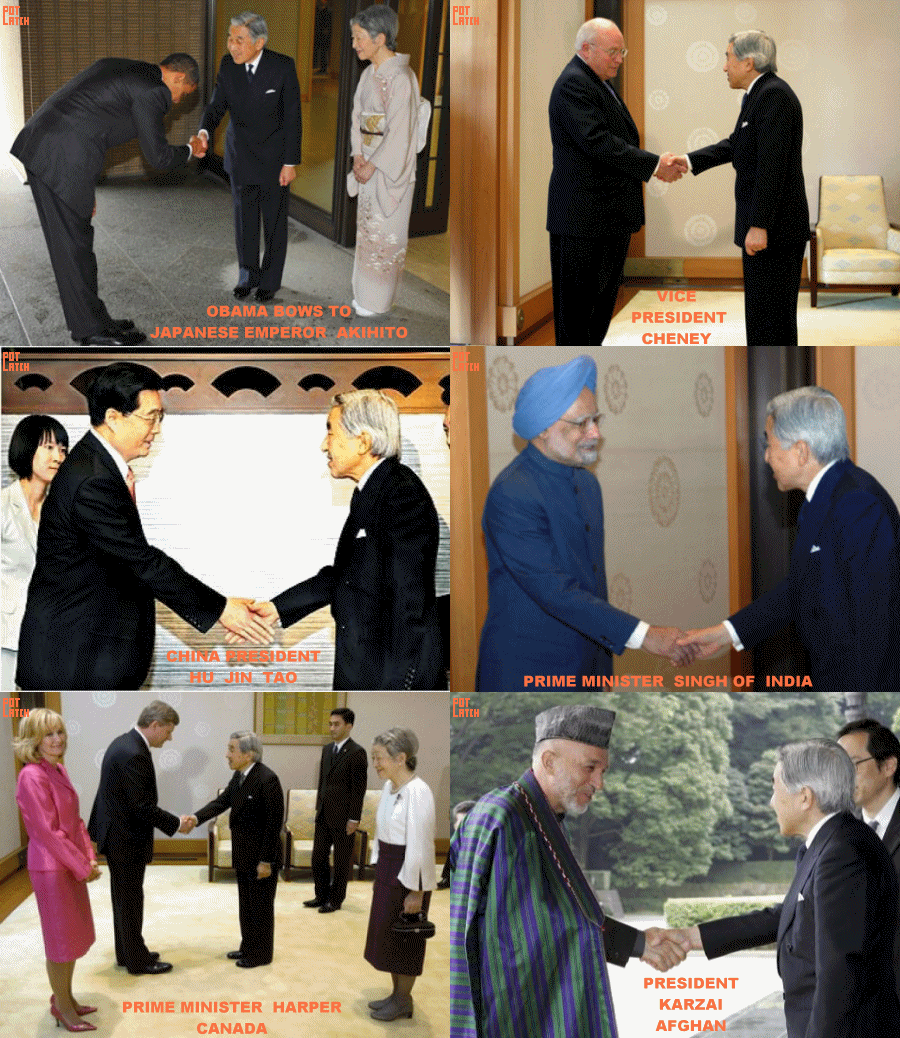
President Obama bowing to the Emperor of Japan, Akihito

U.S. President Barack Obama bows to Emperor Akihito upon arriving at the Imperial Palace in Tokyo on Saturday. Obama had lunch with the emperor and Empress Michiko, with only an interpreter attending, according to the Imperial Household Agency.
Friday, November 13, 2009
Rep. Patrick Kennedy declines to respond to bishop on abortion issue
 PROVIDENCE — U.S. Rep. Patrick Kennedy said he was “not going to dignify with an answer” Roman Catholic Bishop Thomas J. Tobin’s public comments that Kennedy could not be a good Catholic and still support abortion rights. Kennedy called those comments “unfortunate,” and said, “I’m not going to engage [in] this anymore...”
Kennedy said he also finds it “very disconcerting” that Bishop Tobin will not agree to keep private the discussion of Kennedy’s faith, and that is why his scheduled meeting with the bishop Thursday has been postponed.
 In his letter, Bishop Tobin said he was not sure whether Kennedy fulfills “the basic requirements of being a Catholic,” and said that Catholicism involves much more than being baptized into the faith, family ties or cultural heritage. He called Kennedy’s “rejection of the Church’s teaching on abortion … a deliberate and obstinate act of the will: a conscious decision that you’ve reaffirmed on many occasions,” and a position that is “unacceptable to the Church, and scandalous to many of our members. It absolutely diminishes your communion with the Church.”
Bishop Tobin requested that Kennedy “enter into a sincere process of discernment, conversion and repentance,” and offered to help Kennedy as he “travels the road of faith.”
Kennedy said yesterday that he has a pastor, and “I have my sacraments through that pastor. I have sought the sacraments of reconciliation and Communion and all the rest.” He said he preferred to keep his pastor’s name private...
Michael Guilfoyle, spokesman for the diocese, said the meeting was postponed “by mutual agreement,” but noted, “The bishop’s schedule is still free on Thursday if the congressman would like to have that personal and pastoral meeting. The contents between any personal conversation between the bishop and the congressman could certainly remain private. However, the congressman has made this a very public debate, and the bishop is responding to his public comments...”
Thursday, November 12, 2009
Rumor: Archbishop of Vienna Cardinal Schonborn to visit Medjugorje

From Fr. Neil Buchlein:
"I just received an e-mail this morning from one of my friends who lives in Medjugorje and helps with the coordination of the music for the English speaking masses wrote that Cardinal Schonborn will be visiting Medjugorje from December 8th through January 4th. No doubt this is very good news and the Cardinal has been a very strong supporter of Medjugorje since the late 1980s."
- A Mass in Wolfsthal in the Archd. of Vienna
- Medjugorje seer Vicka flinches while in "ecstasy" (Video)
- Vatican ruling on disputed Medjugorje shrine expected soon
- Medjugorje news
- Bishop Cracks Down on Medjugorje
- Bishop of Mostar-Duvno explains the "Phenomenon of Medjugorje"
- E. Michael Jones Interview - Medjugorje
- Sadly flawed arguments against the Bishop of Medjugorje (Mostar-Duvno Diocese) on the letter to Sr. Elvira of Cenacolo
Are our bishops all Republicans?!
By Phil Lawler | November 12, 2009 1:14 PM
On the Commentary blog, Eduardo Peñlaver reports that he is uncomfortable with Bishop Tobin's public denunciation of Patrick Kennedy.
Bishop Tobin’s attitude towards being Catholic — accept teachings X, Y, and Z, or go to another institution that does not affirm them — strikes me as nothing if not supremely un-Catholic in its ethos.
Peñlaver's argument is profoundly confused, I think. But it is not an unusual one; you'll find roughly the same reasoning put forward by many other liberal Catholics. And Peñlaver is not an unintelligent observer of political affairs. So the following line caught me broadside:
We on the Catholic left need to face the fact that the Church’s hierarchy simply feels much more comfortable with the political agenda of the Republican Party than it does with that of the Democrats.
Doesn't that sound familiar? Readers on the Catholic Culture site frequently complain-- with very good reason-- that the US bishops seem to be wedded to the Democratic Party agenda. How can intelligent people have such widely divergent perceptions?
Apart from dignity-of-life issues, the American bishops do not side with Republicans on a single major political issue. Whether the issue is capital-gains taxation, welfare spending, foreign aid, climate change, immigration, gun control, or (lest we forget) health-care reform, most bishops seem clearly to disagree with most Republicans. It's only on the life issues: abortion, embryo research, marriage, and homosexuality, that Catholic bishops and Republic loyalists find common ground. Since Republicans (especially those of the "big tent" persuasion) regularly downplay those issues, it's downright absurd to think that the bishops are reflexively supporting the Republicans.
So why does any intelligent commentator feel that way? Because the quest for legal abortion on demand has become so tightly woven into the Democratic Party agenda that anyone who opposes abortion becomes a threat to the Democrats. A threat to Democratic hegemony is presumed to be a Republican, and someone who threatens the Democrats at every turn-- that is, whenever they promote the culture of death, which is nearly every day-- is perceived as a stalwart Republican.
The fundamental point is not that the US bishops have adopted a partisan approach, but that the Democratic Party has become institutionally committed to policies that are irreconcilable with the Catholic faith. In fact for years the bishops have done their utmost to retain their friendly ties with the Democrats, who have traditionally held the sympathies of Catholic constituencies. It's become nearly impossible.
Radio Replies First Volume: Mixed Marriages
For many reasons. Marriage is a Sacrament, and those who desire to receive that Sacrament should be duly and validly baptized Christians. The Church, however, has no certainty that any non-Catholic has ever been validly baptized at all. Again, it is a sacrilege to receive a Sacrament while one is in a state of grave sin. The Catholic party prepares by a good confession, while the non-Catholic more often than not gives no thought whatever to the matter. Then, too, any children of the marriage have the bad example of one of the parents who never fulfills Catholic duties, even if the poor children be brought up as Catholics at all. The Catholic party is constantly subject to discouragement in the practice of his or her religion, and is even exposed to the danger of a complete loss of faith and of salvation in the end. Nor are mixed marriages, as a rule, in the interests of the parties themselves from the point of view of mutual happiness. Marriage is difficult enough in any case when the first glow of love begins to settle down to the realities of life. It is vastly more difficult when the Protestant does not understand Catholic ways, has no sympathy at all with the Catholic party on the most vital of all matters — religion, and even resents the claims of the Catholic Church. Mutual misunderstandings result, and the Protestant, not making the Catholic as happy as he expected, does not make himself as happy as he dreamed.
1267. I have heard that the Church openly forbids mixed marriages, but secretly fosters them to secure the control of the children.
That is not true. The Catholic Church has never fostered mixed marriages, and barely tolerates them when she can do nothing else.
1268. Why should religion come before marriage?
Because marriage is not the most important thing in life, whereas religion is.
1269. Where does the Bible forbid mixed marriages?
It would not matter if the Bible did not forbid them. Not every detail of Christian practice is there. Christ gave the Church the power to make such legislation as she might think necessary at various times. However that God does not approve mixed marriages between people with the true religion and people without it is clear from Scripture. In the Old Testament He strictly forbade the Jews to marry outside the true religion. "If you embrace the errors of these nations that dwell among you, and make marriages with them, and join friendships . . . they shall be a pit and a snare in your way, and a stumbling block in your side .. . till He take you and destroy you from this land which He hath given you." Josh 23:13-14. St. Paul, writing to Christians, says that a widow is free to marry, "but," he adds, "let her marry in the Lord." 1 Cor 7:39. In dealing with marriage in general, he writes to the Ephesians, "But I speak in Christ and in the Church." Eph 5:32. He gives the solemn warning as regards marriage with unbelievers, "How knowest thou, 0 wife, whether thou shalt save thy husband? Or how knowest thou, O man, whether thou shalt save thy wife?" 1 Cor 7:16.
1270. Catholic men know that Protestant wives are best. Why prevent them from having the best wives?
Good Catholic men who desire to marry Protestant women never think of them as Protestants except to wish that they had been Catholics. They do all in their power to persuade them to become Catholics. They love them at times for their character, or because they have happened to meet them at the psychological moment when they were romantically inclined. Or even at times they only think they love. There are many explanations, but never yet has a Catholic man loved and wanted a girl precisely because she is a Protestant. He may love her. He has never loved her Protestantism.
1271. Why do Catholic women make such bad wives for Protestant husbands? They seem so proud and selfish.
Good Catholic women often make bad wives for Protestant husbands. But it is not because they are proud and selfish. Their religion teaches them humility and self-denial. But the same religion teaches that a Catholic may not give way one jot or tittle in matters of Catholic obligations. The deepest thing in man is his religious conviction. If two people marry and have no religious sympathy, are alien to each other on that point, then each will say and do a dozen things daily that will disgust and further alienate the other. The Protestant party has not the same principles nor the same rigid conviction as the Catholic. He makes concessions and expects the Catholic to do the same. Very often the Catholic cannot and is accused of pride and selfishness. Peace goes and the Protestant is sorry he ever married a Catholic. It all comes from the difference in religion. I would advise every Protestant man who is determined never to become a Catholic to choose a wife from among his fellow Protestants. A Catholic wife is suitable for a Catholic but often makes a bad wife for a Protestant.
1272. If a Protestant marries a Catholic will the Catholic Church recognise that marriage at all?
Yes, provided it takes place according to Catholic rites.
1273. Marriage is a contract between the parties themselves. Why should they have to be married in the Catholic Church?
Marriage is a public as well as a private contract, and society rightly insists upon public conditions for validity. And since marriage is also a Christian Sacrament committed to the care of the Church, the Church reasonably and properly lays down the conditions for the lawful and valid reception of that Sacrament.
1274. Catholics cannot attend a Protestant Church. How can the Protestant marry in the Catholic Church?
To be married by a Priest is not against the principles of a Protestant who says that one religion is as good as another; but it is against the principles of a Catholic to be married by a Protestant minister. If it were against the principles of some given Protestant, he should stick to his principles and refuse to be married in a Catholic Church. But in this case both parties would refuse, and the marriage would be cancelled.
1275. What would the Catholic Church do to a Catholic who marries in the Protestant Church?
The Catholic Church regards her as a lapsed Catholic. While still obliged to attend Mass, she is not allowed to receive the Sacraments. Individual Catholics would be obliged to treat her kindly and with charity. She would not therefore be treated badly personally or insulted. It is a matter for her own soul. She cuts herself off from the grace of God, and forfeits her right to the spiritual privileges of her religion.
1276. I have known Priests to worry Catholics who have married outside the Catholic Church.
A Priest has the obligation to try to save souls, and he has to inspire Catholics to observe the laws of their Church. If a Catholic is living as the Catholic conscience forbids, a Priest would be little like Christ if he simply left that soul to perish. And after all, the Priest would find it much more pleasant to sit at home enjoying a quiet book and allowing his flock to go its own way. But what sort of a shepherd would he be? You should admire the Priest who is a man of duty.
1277. Would the Catholic Church recognize a marriage between a Catholic and a Protestant in a Registry Office?
From the aspect of civil law the parties would contract certain civil obligations. But before God and in conscience the marriage would not be valid, and the Catholic party would be living in a sinful alliance, violating her conscience. She would be deprived of the Sacraments of the Church until she repented and had her marriage rectified according to the laws of the Church.
1278. You dare to say that no marriage outside the Church is a true marriage, that the Catholic party is living in sin, and that the children are not acceptable in decent society?
You make one mistake. The Catholic Church does not say that the children are not acceptable in decent society. Civil society is regulated by civil law, and a marriage legal in civil law obtains legal effects. Children of such a marriage are legitimate and acceptable in civil society. But while the marriage is regarded as legal by society, it is not valid in conscience for a Catholic, and such a person lives in sin. A marriage which civil law regards as valid need not necessarily be valid in God's sight. No state on earth could force me to say that a definite civil law is infallibly the law of God, and no state could possibly prove such a claim to infallibility.
1279. By a recent law, made by men in 1908, your Church makes it a sin for a Catholic to marry in a Protestant Church.
It has always been a sin for a Catholic to marry in a Protestant Church. But in Australia, prior to April 19th, 1908, such marriages, though sinful, were regarded as valid by the Catholic Church. Since 1908 such marriages are invalid. If a Catholic wishes to contract a valid marriage now, he must do so in the Catholic Church. This law is not a new law. Wherever the Church was solidly established, the Church applied this law. And the law was applied to Australia on April 19th, 1908, by what is known as the Ne Temere Decree. As for its being a man-made law, you forget that Christ commissioned His Church to legislate for the well-being of the Sacraments, and of those who would receive them. If the state can say, "Unless you come before my Registrar, your marriage will be regarded as null and void," so the Catholic Church can say, "Unless your marriage comes before my official minister, as far as I am concerned, I shall consider it no marriage." And God sanctions the view of the Church in this matter rather than any legislation of the state. Christ elevated the natural contract of matrimony to the dignity of a Sacrament, and it is as much a Sacrament as Baptism, Confirmation, Ordination, or any other. And as such it belongs to the Church.
1280. Why come between two lovers? God says love one another as I have loved you.
That we must love as God has loved us shows at once that not any kind of love is lawfully indulged. Christ never loved us so as to break God's laws because of us. Such love would be unlawful. God and conscience come first always. No human love can come before one's love for God, and he who loves God observes the laws of His religion.
1281. Civil law says that the marriage of a Catholic and a Protestant in a Protestant Church is valid. Why don't you acknowledge the law of the land?
The state holds the marriage to be valid in state law. And all Catholics hold the marriage to be civilly legal. But the state says nothing whatever about God's view of the matter, and the Catholic Church declares the marriage null and void before God, and therefore in conscience. Even after that declaration, if the parties do not get a civil divorce, they cannot marry other people without bigamy in civil law. So you see that civil law is not affected as such.
1282. I mean, why don't you acknowledge civil law as binding before God and in conscience.
We acknowledge that in the case of each and every law which does not conflict with the law of Christ. In the matter of marriage there are laws which conflict with the law of Christ, and these state laws are not valid before God. As I have said, if every state law is necessarily the law of God, then you claim infallibility for the state, an infallibility you deny to the Catholic Church with scorn on the principle that there is no infallible body of men on earth.
1283. Render to Caesar the things that are Caesar's!
A state law opposed to the law of God is not rightly the thing of Caesar, and in so far as it is thus opposed to the law of God, it is to be ignored. Obedience must be rendered to God rather than to the State.
1284. How can the Catholic Church hope to win the confidence and respect of non-Catholics?
She does not hope to do so if it means watering down Christian obligations. Christ could have kept many of His Jewish followers by saying that He did not mean His words, "The bread which I shall give is My flesh." The Jews said, "This is a hard saying. Who can accept it?" But Christ let them go rather than keep them by mitigating His doctrine. The Catholic Church does likewise. If men say, "This is a hard saying," the Church will never mitigate Christian obligations in order to win them. She is here to accommodate men to Christian teaching, not to accommodate Christian ideals to the moods of men.
1285. If two married Protestants both become Catholics, have they to be married again in the Catholic Church?
No. They were both Protestants at the time of their marriage, and the Catholic Church declares such marriages to be binding before God. The law of the Church in this matter extends to marriages in which at least one of the parties is a Catholic.
1286. If two Protestants, married in a Protestant Church, get a divorce, could one of the parties marry a Catholic in the Catholic Church provided he or she becomes a Catholic?
No. The marriage of two Protestants in a Protestant Church is valid before God, and nothing can dissolve that marriage except the death of one of the parties. Divorce does not give even such Protestants the right to marry again while both parties are still living. And becoming a Catholic has no effect upon the validity of such a marriage.
1287. If a Catholic did marry outside the Catholic Church, would Christ cast a stain upon little children held up by Him to he the essence of goodness and innocence?
Christ would cast no stain upon them. Nor does the Catholic Church. Their goodness and innocence are not affected. But note this. The state says, "Unless you observe my laws your marriage will not be lawful wedlock, and your children will be illegitimate." On your principle, the state has no right to cast such a slur on innocent little children, and has no right to lay down any conditions of marriage, but must sanction promiscuous cohabitation as being quite all right.
1288. Tell me plainly. Are the children of a mixed marriage outside the Catholic Church illegitimate?
This means that, while the civil legitimacy of such children remains unaffected, the refusal of the Catholic party to comply with the marriage laws of the Catholic Church deprives the children of religious recognition and privileges. Such recognition and privileges are reserved by Canon Law for those children only who are born of the marriages of Catholics celebrated according to Catholic requirements. No one can reasonably object to that.
1289. Can the child of a mixed marriage outside the Church go to heaven?
If the child is brought up as a Protestant it has the same chance as any Protestant in similar circumstances from other points of view. If brought up as a Catholic, it has the additional helps of the Catholic religion just as any other Catholic child, except that it has the bad example of a non-Catholic parent ignoring obligations which the child is taught to be essential, and the weak faith in many cases of a Catholic who thinks so little of her religion as to marry outside the Church.
1290. Why sanction a mixed marriage at all in the Catholic Church? Is the Church afraid of losing the Catholic? Or the money?
It is not a question of the money. If the conditions demanded by the Church are not fulfilled, $100,000 would not secure the marriage according to Catholic rites. Nor is the Church afraid of losing one of her members. She is afraid that one of her members will lose the advantages of the Catholic faith and perhaps her soul. The loss of one person out of 400 millions does not affect the Church very much from the point of view of numbers. But the loss to such a soul will not bear description. The Church sanctions such a marriage when there are reasons grave enough to warrant risking the dangers attached to mixed marriages. But she takes every precaution by exacting promises that the Catholic will be free to practice her religion, that all children will be Catholics, and that the Catholic party will set a good example and do her best to convert the non-Catholic party.
1291. Could the Pope, besides giving a dispensation for a mixed marriage, dispense from the obligation of bringing up the children as Catholics?
No. It is divine law that no Catholic may hand over any child to what he or she knows to be a false religion.
1292. Why must the Protestant promise that all children will be Catholics?
You must try to see this through Catholic eyes. A non-Catholic does not, as a rule, believe that his is the only true religion, and on the principle that one religion is as good as another, his conscience does not forbid that his children should be brought up in the Catholic religion. But a Catholic is in a very different position. He believes that his is the only true religion, and does not believe that one religion is as good as another. Now how can a Catholic in conscience hand over his children to what he knows to be a wrong religion? How say, "I shall have all the benefits of the true religion, but my children won't!" Or, "God will be worshipped by me in the way He commands, but not by my children!" Even God could not authorize a Catholic to cling to the true faith himself, yet deny that faith to his children. Without securing the promises no Catholic could conscientiously enter upon such a marriage.
1293. Should not the children be of the mother's faith?
No. The children must be brought up in the Catholic faith, whether it be the faith of the husband or of the wife. A religion is not true because it is the religion of the wife. If so, then when the wife is Anglican, Anglicanism would be true; when a Christian Scientist, Christian Science would be true; when Catholic, Catholicism would be true! Again, if a man married a Catholic and had three children of the marriage, they would have to be Catholics, and would have the true religion because their mother was a Catholic. If she died, and the man married a Seventh Day Adventist, further children would have to be Seventh Day Adventists, and would have the true religion because their mother was an Adventist. So three children would call the Pope the Vicar of Christ, and the others would call him the Beast and Anti-Christ, and all would be right!
1294. That all must be Catholics is very one-sided in favor of the Catholic Church!
It must seem like that to you, but in reality it is not. Parents co-operate with God in giving existence to children. But why is any man at all created? That he may save his soul and attain heaven. Marriage therefore has as its chief purpose the creating and training of children for their eternal destiny. And religion is therefore all important. Now the Catholic believes that there is but one true religion. It does not matter whether others agree or not. And he believes that all other religions are wrong. Again it does not matter whether others agree or not. That is the Catholic conscience. It follows that no Catholic can in conscience consent to hand over his children to what he believes to be a false religion. Nor can a Catholic say, "Give me the girls and you take the boys." The soul of a boy is just as dear to God as the soul of a girl. There can be no compromise. As for the one-sidedness, look at things this way. The Protestant who believes that one religion is as good as another need not mind if the children are brought up as Catholics. He does not violate his conscience and does not ask the Catholic to violate hers. They are square. The fact that the Catholic Church feels bound in conscience to demand all the children shows that she is conscious of having the truth and being the true Church. The fact that Protestants do not demand the children shows that they are not really conscious of possessing the truth.
1295. If a Catholic cannot sign away the children, how can a Protestant do so?
If a Protestant wants to marry a Catholic, and his conscience does not protest against it, he may sign the promise in regard to the children. But if the Protestant really believed the Catholic faith to be evil, and that his personal religion was the only true religion, then he has no right to promise that any of his children will be Catholics. He should abandon the marriage rather than thus violate his conscience. He should demand that the children be brought up in his faith. But then of course a dead-lock would result. He would have to refuse compromise, and as the Catholic is also obliged to refuse marriage unless the written promise is given, the marriage would be cancelled. It is better to part with a human being than to part with loyalty to conscience in so grave a matter.
1296. Why must the promise be made in writing? Surely you can take a man's word for it!
In many cases, yes. But sad experience has shown that some were not in good faith, and even granting good faith at the time there is no guarantee that such dispositions will persevere. Human nature is mutable. Why does the law of the land demand both signatures for the marriage itself in writing? Surely at the moment of marriage both are in good faith? The promise concerning the children is just as important as the marriage itself. On that promise the eternal welfare of the children may depend, surely a great responsibility. All serious contracts demand permanent signed records, and as no one resents them in other matters, so no one should resent them in this. Death could carry off the Catholic partner, and it may be very necessary to have written records of the promise. And if a man really intends to grant such a condition he should not mind putting his signature to it.
1297. Why are not mixed marriages celebrated before the Altar?
Marriage is a Sacrament and a very holy rite. The normal subject is a Catholic only. When non-Catholics present themselves as partners in the marriage ceremony, the Church does not grant the full privileges which are the right of Catholics only. The marriage is valid, of course, even though celebrated elsewhere than before the altar.
1298. If this restriction were abolished there would be fewer marriages outside the Church.
The number of marriages outside the Church might be diminished, but the number of mixed marriages might greatly increase. By this law the mind of the Church is kept constantly before Catholics, and they do not think lightly of entering upon such alliances. If a Catholic would marry outside the Church because of such a law, she has little love for her religion, and would not be much of a Catholic whatever concessions were made in her favor.
1299. The law will not prevent mixed marriages. They will always be.
That may be so. But the law diminishes their number. The Church cannot accept mixed marriages as the normal thing, and she would not be wise to treat them as normal.
1300. Is it fair to mar the happiness of a young couple?
Is it fair to ask the Church to admit to her Sacraments those of any religion or of no religion? People who are complete strangers to her cannot expect her to make as much of them as of those who are her own children. The parties do not resent their exclusion from the Altar nearly so much as the Church resents mixed marriages.
1301. Why such lack of respect for the non-Catholic and the guests?
The law is not prompted by lack of respect for the non-Catholic party or for the guests. It is prompted by respect for religious rites and for the worship of God. The non-Catholic has no more right to intimate Catholic religious practices than an unnaturalized citizen to all the civic rights of true subjects. The non-Catholic party may be as good as gold. But that is not the point. The point is that she is not a Catholic, and the Church is quite within her rights in saying how far she will admit non-Catholics to a participation in her privileges, even as a club is within its rights in saying how far non-members may participate in its privileges. But such restrictions as regards non-members cannot be construed as an insult. The Catholic Church is not bound to manifest equal approval of Catholic marriages and of mixed marriages alike.
1302. Would Christ be so intolerant?
He would sanction all prudent measures for the good of souls. In the Old Law God gave drastic laws and penalties affecting those of the true religion who tried to contract mixed marriages, and the Catholic Church is but similarly zealous for the true religion of Christ.
- Link
Huffington Post: Catholic Church 'Inexplicably Evil Organization'
Allison Kilkenny, a self-styled “political humorist,” ripped the Catholic Church on the Huffington Post on Thursday for threatening to pull the plug in its social services in Washington, DC if same-sex “marriage” is legalized there. Kilkenny labeled the Church the “Inexplicably Evil Organization Most Disconnected From Real People,” and bashed Pope Benedict XVI as a “decrepit former Nazi youth.”
The “humorist” (pictured at right, courtesy of Wikimedia) began her screed, titled “Catholic Church Threatens to Stop Feeding Homeless Over Gay Marriage,” by comparing the Church to Goldman Sachs, and used her “evil” label only after three sentences (perhaps showing a bit of restraint on her part): “A few days ago, I wrote about Goldman Sachs’s transition from a bank holding company into a public relations disaster machine. I argued that Goldman’s CEO, Lloyd Blankfein, has been behaving like he wants to be attacked by a ferocious mob. Now, it appears the Catholic church is determined to unseat Blankfein in the ‘Inexplicably Evil Organization Most Disconnected From Real People’ category...”
(language warning)
Supreme Court asked to boot Hillary

Case alleges her appointment violated Constitution
By Bob Unruh
© 2009 WorldNetDaily
Judges on the U.S. Supreme Court are being asked to boot Hillary Clinton from her position as U.S. secretary of state in a lawsuit that charges her appointment violated the U.S. Constitution.
Judicial Watch, the public interest group that monitors and investigates government corruption, confirmed it has filed a notice of appeal of its case to the nation's highest court.
The lawsuit asserts Clinton is ineligible for the post because the Constitution, Article I, Section 6, states: "No Senator or Representative shall, during the Time for which he was elected, be appointed to any civil Office under the Authority of the United States, which shall have been created, or the Emoluments whereof shall have been encreased during such time..."
As WND has reported, James Madison's notes on the debates that formed the Constitution explain the reason for the clause. Madison himself argued against "the evils" of corrupt governments in which legislators created salaried positions – or increased salary – and then secured appointments to the comfortable jobs they just created. Others agreed that such tactics were evident in the colonial and British governments, and they wrote Article 1, Section 6 to prevent the practice...


Catholic Church gives D.C. ultimatum
Same-sex marriage bill, as written, called a threat to social service contracts
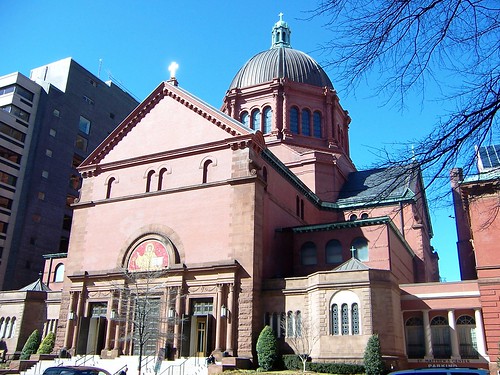

The Catholic Archdiocese of Washington said Wednesday that it will be unable to continue the social service programs it runs for the District if the city doesn't change a proposed same-sex marriage law, a threat that could affect tens of thousands of people the church helps with adoption, homelessness and health care.
Under the bill, headed for a D.C. Council vote next month, religious organizations would not be required to perform or make space available for same-sex weddings. But they would have to obey city laws prohibiting discrimination against gay men and lesbians.
Fearful that they could be forced, among other things, to extend employee benefits to same-sex married couples, church officials said they would have no choice but to abandon their contracts with the city.
"If the city requires this, we can't do it," Susan Gibbs, spokeswoman for the archdiocese, said Wednesday. "The city is saying in order to provide social services, you need to be secular. For us, that's really a problem."
Several D.C. Council members said the Catholic Church is trying to erode the city's long-standing laws protecting gay men and lesbians from discrimination.
The clash escalates the dispute over the same-sex marriage proposal between the council and the archdiocese, which has generally stayed out of city politics.
Catholic Charities, the church's social services arm, is one of dozens of nonprofit organizations that partner with the District. It serves 68,000 people in the city, including the one-third of Washington's homeless people who go to city-owned shelters managed by the church. City leaders said the church is not the dominant provider of any particular social service, but the church pointed out that it supplements funding for city programs with $10 million from its own coffers.
"All of those services will be adversely impacted if the exemption language remains so narrow," Jane G. Belford, chancellor of the Washington Archdiocese, wrote to the council this week.
The church's influence seems limited. In separate interviews Wednesday, council member Mary M. Cheh (D-Ward 3) referred to the church as "somewhat childish." Another council member, David A. Catania (I-At Large), said he would rather end the city's relationship with the church than give in to its demands.
"They don't represent, in my mind, an indispensable component of our social services infrastructure," said Catania, the sponsor of the same-sex marriage bill and the chairman of the Health Committee.
The standoff appears to be among the harshest between a government and a faith-based group over the rights of same-sex couples. Advocates for same-sex couples said they could not immediately think of other places where a same-sex marriage law had set off a break with a major faith-based provider of social services.
The council is expected to pass the same-sex marriage bill next month, but the measure continues to face strong opposition from a number of groups that are pushing for a referendum on the issue.
The archdiocese's statement follows a vote Tuesday by the council's Committee on Public Safety and the Judiciary to reject an amendment that would have allowed individuals, based on their religious beliefs, to decline to provide services for same-sex weddings.
"Lets say an individual caterer is a staunch Christian and someone wants him to do a cake with two grooms on top," said council member Yvette M. Alexander (D-Ward 6), the sponsor of the amendment. "Why can't they say, based on their religious beliefs, 'I can't do something like that'?"
After the vote, the archdiocese sent out a statement accusing the council of ignoring the right of religious freedom. Gibbs said Wednesday that without Alexander's amendment and other proposed changes, the measure has too narrow an exemption. She said religious groups that receive city funds would be required to give same-sex couples medical benefits, open adoptions to same-sex couples and rent a church hall to a support group for lesbian couples.
Peter Rosenstein of the Campaign for All D.C. Families accused the church of trying to "blackmail the city."
"The issue here is they are using public funds, and to allow people to discriminate with public money is unacceptable," Rosenstein said.
Rosenstein and other gay rights activists have strong support on the council. Council member Phil Mendelson (D-At Large), chairman of the judiciary committee, said the council "will not legislate based on threats."
"The problem with the individual exemption is anybody could discriminate based on their assertion of religious principle," Mendelson said. "There were many people back in the 1950s and '60s, during the civil rights era, that said separation of the races was ordained by God."
Catania, who said he has been the biggest supporter of Catholic Charities on the council, said he is baffled by the church's stance. From 2006 through 2008, Catania said, Catholic Charities received about $8.2 million in city contracts, as well as several hundred thousand dollars' worth this year through his committee.
"If they find living under our laws so oppressive that they can no longer take city resources, the city will have to find an alternative partner to step in to fill the shoes," Catania said. He also said Catholic Charities was involved in only six of the 102 city-sponsored adoptions last year.
Terry Lynch, head of the Downtown Cluster of Congregations, said he did not know of any other group in the city that was making such a threat.
"I've not seen any spillover into programming. That doesn't mean it couldn't happen if [the bill] passes," he said.
Cheh said she hopes the Catholic Church will reconsider its stance.
"Are they really going to harm people because they have a philosophical disagreement with us on one issue?" Cheh asked. "I hope, in the silver light of day, when this passes, because it will pass, they will not really act on this threat."
Wednesday, November 11, 2009
Signs warn Christmas carol singers away
They bring a message of “peace on Earth and goodwill to all men” but carol singers are to be warned away from doorsteps this Christmas in case they appear threatening.
By John BinghamPublished: 2:02PM GMT 11 Nov 2009

Signs are to warn christmas carol singers away from doorsteps in case people feel threatened. Photo: Paul Grover
Police and neighbourhood watch organisers in one area of Lancashire have produced official notices for nervous residents to place in their windows telling the festive singers not to call.
The yellow postcard-sized signs, which are also being handed out at libraries and GPs’ surgeries, read: “Sorry no carol singers, I won't open my door to you.”
Produced by the Safer Chorley and South Ribble Partnership, an umbrella body for police, local councils and neighbourhood watch groups, they have already been distributed in Penwortham, a middle class suburb of Preston and there are plans to hand them out more widely.
It represents an extension of a tactic widely used at Hallowe’en to deter unwanted trick-or-treaters. A similar message on the reverse of the cards warns unwanted trick-or-treaters not to call.
Some church leaders said that the suggestion that people are now afraid of carol singers represented an alarming reflection on modern Britain.
“It is a terrible state of affairs that people are terrified of answering their doors, so this is what they have to do," said Father Timothy Lipscomb, the Vicar of Preston, the parish priest for the city's Minster.
The Rev Christopher Nelson, vicar of Penwortham, said it could be seen as “insensitive” to group Christmas and Hallowe’en together but said that the organisers had good intentions to protect vulnerable people.
Cllr Mary Robinson, a Conservative member of Penwortham Town Council, said: “Are they saying that they have replaced hoodies with Father Christmas hats?"
She went on: “It isn’t a concern that has been brought to me, I would say that in the current economic climate a little bit of festive cheer might be welcomed by a lot of people.”
Organisers said that the cards were produced in response to demand from vulnerable residents who said that large groups of people left them feeling nervous.
There have been a handful of cases elsewhere in the country in which burglars have posed as carol singers.
Chief Inspector Richard Robertshaw of Lancashire Police rejected accusations of a “bah-humbug” approach.
“Singing Christmas carols is a wonderful tradition which we encourage, as long as children are considerate,” he said.
“But while carol singers bring festive cheer to many, we must bear in mind there are residents who for a variety of genuine reasons, are not comfortable with having groups of people at their doors.”