Wednesday, November 11, 2009

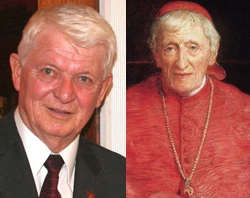
Deacon cured through intervention of Cardinal Newman preaches at Westminster Cathedral

.- Deacon Jack Sullivan, whose cure from crippling back pain advanced the beatification of Servant of God John Henry Cardinal Newman, preached from the pulpit of Westminster Cathedral on the Feast of St. John Lateran. He talked about his miraculous cure and praised Cardinal Newman’s spiritual insights and “extraordinary” foresight.

Deacon Sullivan, a permanent deacon from the Archdiocese of Boston, discussed the Basilica of St. John Lateran’s history and described it as “a magnificent sign of victory” for the countless Christian martyrs in the early centuries of the Church.

“The basilica now stands as a stately and enduring sign of hope and light that the Church world-wide might continue to endure and prosper.”

He discussed the Gospel reading for the day about Jesus expelling the money changers from the temple before turning to Cardinal Newman.

Describing the nineteenth-century theologian and convert from Anglicanism as one of those called by Christ to “inspire and revitalize” the Church, Deacon Sullivan said the cardinal’s thoughts reflect the “enduring truth” about mankind and his quest for the Creator.

“When gazing upon the din and clamor of this world, Cardinal Newman was gifted with a most extraordinary sense of foresight, a supernatural vision enabling him to see far beyond the rather limited and worldly sight of his contemporaries,” the deacon declared. “As a sign of Christ's presence in the world, he could see clearly that which was beyond the horizon. He could see clearly far above the clouds, to that shining cross in the sky, to that heavenly dimension. And he brilliantly preached and wrote about what he saw.”

He cited Cardinal Newman’s discussion of the virtue of faith as a “practical perception” of the unseen world that understands that “this world is not enough for our happiness.”

John Henry Newman encouraged Christians to “cross over the threshold of worldliness” through “inner conversion.”

“And so he surrendered his will to follow the ‘kindly light of truth’, most often at great cost to himself,” Deacon Sullivan explained.

Noting that Cardinal Newman’s works often came in response to personal attacks or attacks against the Church, the deacon said these challenges enabled Newman to achieve his “remarkable” spiritual insights.

A Miraculous Cure

Discussing how severe pain and suffering can be a source of spiritual growth if patiently endured, Deacon Sullivan explained his own affliction.

In 2001 a serious spinal condition caused him what he described as “intolerable pain with utterly no prospect of relief.” He was on the verge of complete paralysis and in jeopardy of losing his job and failing to complete his preparation to become a deacon.

“Had God called me this far only to slam the door in my face?” Deacon Sullivan asked, saying he was “completely helpless.”

“But it was this state of mind that lead me to prayer. I called upon my very special intercessor and faithful friend: ‘Please Cardinal Newman, help me to walk, so that I can return to my classes and be ordained.

“Suddenly I felt a tremendous sensation of intense heat all over, and a strong tingling feeling throughout my body, both of which lasted for a long time! I also felt an overwhelming sense of joy and peace, as well as a strong sense of confidence and determination that finally I could walk!”

“Totally invigorated, I sprinted out of my room and then up and down all the corridors on my floor, with the nurse tagging behind shouting ‘slow down - slow down!’” he added.

The same day of his ordination, Sept. 14, 2002, was the day that the Fathers at Cardinal Newman’s Birmingham Oratory had voted to formally initiate the beatification process for their founder.

The deacon said this was a “wonderful sign” affirming Cardinal Newman’s intercession.

“In this Mass, as in every Mass, I thank God for this marvelous gift, with all my heart, and praise His Holy Name!” the deacon’s homily concluded.

The principle celebrant of the Mass was Archbishop of Westminster Vincent Nichols, President of the Bishops’ Conference of England and Wales.

Cardinal Newman will be beatified in 2010, the bishops' conference reports.

Tuesday, November 10, 2009

Pope Benedict XVI views the font where Pope Paul VI was baptised ...

Pope Benedict XVI views the font where Pope Paul VI was baptised as an infant at a museum in Concesio, near Brescia November 8, 2009. Pope Paul VI was born as Giovanni Battista Enrico Antonio Maria Montini in 1897 and served as pontiff from 1963 to 1978. Picture taken November 8, 2009.

REUTERS/Osservatore Romano (ITALY RELIGION) QUALITY FROM SOURCE

http://d.yimg.com/a/p/rids/20091109/i/r232134227.jpg?x=400&y=266&q=85&sig=uKrV.FDxaJaM9K.h.0ADlQ--

Pope Benedict XVI walks near a statue of Pope Paul VI to enter a museum in Concesio, near Brescia November 8, 2009.

REUTERS/Osservatore Romano

Pope Benedict XVI views a room in the house where Pope Paul ...

Pope Benedict XVI views a room in the house where Pope Paul VI was born in Concesio, near Brescia November 8, 2009. Pope Paul VI was born as Giovanni Battista Enrico Antonio Maria Montini in 1897 and served as pontiff from 1963 to 1978. Picture taken November 8, 2009.

REUTERS/Osservatore Romano (ITALY RELIGION)

http://d.yimg.com/a/p/rids/20091109/i/r166570455.jpg?x=400&y=265&q=85&sig=V34qTEHDWm3iDBMu.Ypmcg--

http://d.yimg.com/a/p/rids/20091109/i/r1941646260.jpg?x=400&y=265&q=85&sig=6nB.u5WWeatKm7_3GoMLMQ--

http://d.yimg.com/a/p/ap/20091108/capt.d0027311a1ae43479ac066d3c3640a5e.italy_pope_visit_xlb123.jpg?x=400&y=290&q=85&sig=1uIZdimnyVM1x3vwydB_XA--

http://d.yimg.com/a/p/ap/20091108/capt.678c572ecd8f445b8572699c54260dfa.italy_pope_visit_xlb119.jpg?x=400&y=284&q=85&sig=0gKD1e9f6BWePdRcxN0X5A--

http://d.yimg.com/a/p/ap/20091108/capt.6115fb51a7c14ffa9039ef7490671aad.italy_pope_xfc109.jpg?x=400&y=278&q=85&sig=sFRVwBYRpQs9zze.dbXWPA--

http://d.yimg.com/a/p/ap/20091108/capt.df97e35279554b29b46c62858ed2a856.italy_pope_visit_xlb104.jpg?x=400&y=278&q=85&sig=E3.MaZADSh_Fi99R6hFPig--

http://d.yimg.com/a/p/ap/20091108/capt.50e41e0f7a5c4df9a386da99efd1b246.italy_pope_visit_xlb114.jpg?x=400&y=266&q=85&sig=j8CWezx_q2uAPGtSOxdaTw--

http://d.yimg.com/a/p/ap/20091108/capt.c8d905c4ff374220a0028a643d7f0182.italy_pope_visit_xlb102.jpg?x=400&y=315&q=85&sig=Gdyrn2H3sP3GS0HuwwTHNg--

Pope Benedict XVI waves at the end of a mass in Paul VI square ...

http://d.yimg.com/a/p/ap/20091108/capt.96214ba9bb8d40df8451c32e7d60d7a7.italy_pope_visit_xlb115.jpg?x=400&y=266&q=85&sig=vpdrsH7_W8j.HXYDWiva9Q--

http://d.yimg.com/a/p/rids/20091108/i/r2594386509.jpg?x=400&y=324&q=85&sig=GGGYEzJwP1vKqWKpGYzk8g--


Catholic blogosphere: Council looks at promoting charity, truth online

Sand Crawler CathedralBy Cindy Wooden
Catholic News Service


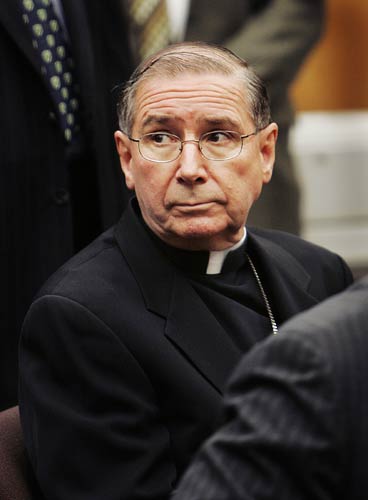
...Talking about the Catholic blogosphere, Los Angeles Cardinal Roger M. Mahony said, "I have been appalled by some of the things I've seen; of course, I've been the object of some of them."

Being Christian, he said, means treating others like Jesus treated people: reaching out to all and exercising extreme caution when making judgments.

"One of the side effects of the new technology that frightens me a bit is that people can hide behind a fake facade and then start shooting cannons at other people," the cardinal said.

One of the pontifical council's consultants, Basilian Father Thomas Rosica, the head of Canada's Salt and Light Catholic Media Foundation, said the Internet and blogs have brought about a "radicalization of rhetoric," even among Catholics.

The Web site of Salt and Light Television, he said, sometimes receives hundreds of comments on a story.

"Many we don't publish because of the filth and some we've turned over to the police" because of the threats they contain, he said.

Asked to address the council about Catholic media in North America, Father Rosica said, "On the Internet there is no accountability, no code of ethics and no responsibility for one's words and actions."

So many Web sites and bloggers who call themselves Catholics focus so much on negative stories and messages that increasingly "Christians are known as the people who are against everything," he said.

Cardinal Mahony said the sharp and often uncharitable divisions among Catholics seen on the Internet was particularly pronounced during the 2008 U.S. presidential election campaign.

And, he said, the campaign was not exactly a high point for unity among the U.S. bishops either.

During the campaign, Cardinal Mahony said, "I sensed a dangerous shift away from unity in faith and faith practice to differing opinions on this party or the other party, which I think is a very, very dangerous path to go down."

Some people could get "the impression that some bishops are very much in favor of one political party over the other, which should not be," he said. He added that when it comes to applying the Gospel to social questions bishops should be models for the Catholic faithful on how to hold a civil discussion, online or offline.

"You don't have dialogue when people anonymously throw out their hatreds, their prejudices, their biases and always -- in every case -- end up attacking people," the cardinal said.

Nuts & Bolts: In the Lion's Den

Tim Staples

Scenario:
You’ve been talking with Bob, a fellow worker at the office, for weeks about the faith. You can see you’ve made headway in presenting him your biblical case for Catholicism. So you decide to invite him to an apologetics Bible study you have at your parish.

He agrees to come on one condition: You must first come to a Bible study at his “non-denominational” assembly for four weeks. Then he will come to your meeting for four weeks.
Immediately, you jump at the chance. You’re fired up! The Lord has given you an open door for evangelism.

Upon arrival at Bob’s assembly, “Church of the Open Door,” Bob takes you to a room filled with about forty-five congenial people with Bibles in hand. After drinking punch, eating a few cookies, and talking small talk for a few moments, the leader of the group, Robert, asks everyone to find a seat so the Bible study can begin.

After a short prayer, Robert says the topic of study over the next four weeks will be salvation. But first, he says, “We must begin with the assumption that all present believe in the inspiration and inerrancy of Sacred Scripture. And also that Sacred Scripture is the regula fidei or sole rule of faith for all believers. In other words, the doctrine of sola scriptura.”

You immediately raise your hand with a question. “Do you mind if I ask why you believe this seemingly foundational doctrine? I don’t believe sola scriptura to be true — in fact, I don’t believe that the Bible itself teaches such a doctrine at all.”

You hear a few subdued gasps and feel the eyes of all turn to you, as Robert quickly responds: “The Bible very plainly teaches sola scriptura in 2 Timothy 3:16: ‘All scripture is inspired by God and profitable for teaching, for reproof, for correction, and for training in righteousness, that the man of God may be complete, equipped for every good work.’ The Bible can’t make it any more plain than that!” Robert declares.

You respond to Robert with four reasons why his stated position, sola scriptura, is untenable: It is unreasonable, unhistorical, unbiblical, and unworkable.

Step One: Sola Scriptura is unreasonable.
As briefly as possible, you quickly point out that Robert’s reasoning is circular, and therefore fallacious: “You cannot prove the inspiration of a text from the text itself. The Book of Mormon, the writings of Mary Baker Eddy, the Muslim Quran, and other books claim divine inspiration. This doesn’t make them inspired. The question remains, how do we know the Scriptures are inspired and canonical using the principle of sola scriptura?”

Robert immediately asks if you are Catholic. (He could tell by your critiques of sola scriptura). When you answer in the affirmative, Robert responds, “I believe the Holy Spirit guides us into all truth as Jesus said in John 16:13. The Holy Spirit guided the early Christians and helped them to gather the canon of Scripture and declare it to be the inspired Word of God. God would not leave us without His Word to guide us.”

You respond, “The Scripture you quoted from John 16:13 has nothing to do with sola scriptura. While I agree with you that the Holy Spirit guided the early Christians to canonize the Scriptures, the question is whether they used sola scriptura as their guiding principle. The answer is no.

“They needed Tradition outside of Scripture as their criterion for the canon. This criterion is not found in Scripture itself. They needed Tradition to authenticate the books in question. And they also needed the Church in council to give an authoritative decree on the whole matter.

“All of that aside, let’s look at the text you quoted. I ask you, what if I made a similar claim to demonstrate to you any of our Catholic dogmas? Imagine that you asked me why I believe Mary to be the Mother of God, and I responded, ‘We believe the Holy Spirit guides us into all truth and guided the early Christians to declare this truth.’ Would you believe me on this basis? No!

“But all this begs my original question. Not only is the text you used unacceptable from a perspective of sola scriptura; it’s also circular reasoning to claim the Scripture as your authority for claiming the inspiration of Scripture.”

Robert seems to be intrigued with this dialogue, as are the rest of those gathered. Robert says, “How do you know the Scriptures are inspired? Your reasoning is just as circular: You say the Church is infallible because the inspired Scriptures say so, and then claim the Scriptures are inspired and infallible because the Church says so!”

“That’s a very good question,” you reply. “However, the Catholic Church’s position on inspiration is not circular. We begin with the Bible as an historical document, not as an inspired one. As any reputable historian will tell you, the New Testament is the most accurate and verifiable historical document in all of ancient history. To deny the historical reliability of the New Testament would be to deny the reliability of all ancient history.

“Nevertheless, we cannot deduce from this that they are inspired. There are many accurate historical documents that are not inspired. However, the Scriptures do give us accurate historical information whether we hold to their inspiration or not.

“It is on this basis that we can say it is an historical fact that Jesus lived, died, and was reported to be resurrected from the dead by over five hundred eyewitnesses. This is the historical record. Many of these eyewitnesses went to their deaths testifying to the veracity of what Christ had done (see Lk 1:1-4, Jn 21:18-19, 24-25, Acts 1:1-11, 1 Cor 15:1-8). Further, this testimony of the Bible is backed up by hundreds of works by early Christians and historians, some of whom were not Christian — such as Tacitus, Pliny the Younger, and Josephus.

“Now, what do we find when we examine the Scriptures as historical documents? The Scriptures record Jesus establishing a Church, not a book, to be the foundation of the Christian faith (see Mt 16:15-18, 18:15-18, Eph 2:20, 3:10,20-21,4:11-15, 1 Tim 3:15, Heb 13:7,17, and others). He said of His Church: “He who hears you hears me, and he who rejects you rejects me, and he who rejects me rejects Him who sent me” (Lk 10:16).

“The many books that comprise what we call the Bible never tell us certain crucial truths: the fact that they are inspired, or who can and cannot be the human author of them, or who authored many of them, or what is the canon of Scripture, just to name a few. But what is very clear is that Jesus established a kingdom with a hierarchy and authority to speak for Him (see Lk 20:29-32, Mt 10:40, 28:18-20). It was members of this kingdom, the Church, that would write the Scripture, preserve the Scripture, and eventually canonize the Scripture.

“The Scriptures cannot write or canonize themselves. To put it simply, reason clearly rejects sola scriptura as a self-refuting principle, because we cannot determine what the scriptura is using the principle of sola scriptura.”

Step Two: Sola Scriptura is unhistorical.
“If I may, I would like to concretize my point by making an argument from history. Let’s say you were living in the mid-fourth century before there was a recognized canon of Scripture. As I’m sure you know, the first time a formal canon was arranged and recognized by any council of the Church was in A.D. 382 at a synod in Rome called by Pope Damasus I.

“Let’s say you were to read The Instructor by Saint Clement of Alexandria (written about 202). In book II, chapter 3, he quotes Baruch 3:16-19 and calls it ‘Divine Scripture.’”

After you briefly explain, for those who may not know it, that Baruch is one of the deuterocanonical books of the Old Testament accepted by Catholics, but rejected by Protestants, you note: “Saint Clement was the head of the famous catechetical school in Alexandria and one of the greatest theologians of the second and third centuries. Now I could cite scores of examples of other early Christians referring to the deuterocanonical books of the Old Testament, but for the sake of brevity I will refer just to this one.

“Let’s say you then read a book by the greatest historian of the fourth century, Eusebius, bishop of Caesarea. In his classic Ecclesiastical History (written around 330), book III, chapters 3 and 25, he records the canon of Scripture as understood in the mid-fourth century. He claims that James, Jude, 2 Peter and 2 and 3 John are among ‘the disputed writings.’ He notes that Hebrews and Revelation are rejected altogether by many.

“My question is this: Many of the early Christians disagreed over which books were inspired. So where do you go to get a definitive answer about the canon of Scripture if you use the principle of sola scriptura?”

Robert responds: “You make some very interesting points that I will have to think about. However, I have to disagree with you when you say the Scriptures do not claim to be inspired and the sole rule of faith. I’ve already quoted 2 Timothy 3:16 to you. In addition, over and over in Scripture we clearly find our Lord quoting the Old Testament authoritatively, as He does in Matthew 4:4-11. When Jesus was tempted by the Devil, his response was: ‘It is written’ — three times in a matter of seven verses. Jesus clearly uses sola scriptura as his guiding principle or regula fidei.”
This leads you into your third point.

Step Three: Sola Scriptura is unbiblical.
“Let’s back up,” you say, “to the original verse Robert used to prove his case, 2 Timothy 3:16. (You now find yourself addressing the entire Bible study group, not just Robert!) The text itself does not assert what Robert claimed. It does not claim the inspiration of the New Testament. Nor does it claim to be the sole rule of faith for Christians. Let’s look at the context of the passage.

“Robert, let’s read aloud verses 14-15, which precede 2 Timothy 3:16.” (You can’t help but notice that you are slowly taking over this Bible study!) Robert then reads aloud: “But as for you, continue in what you have learned and have firmly believed, knowing from whom you learned it and how from childhood you have been acquainted with the sacred writings which are able to instruct you for salvation through faith in Christ Jesus” (emphasis added).

“In context, this passage does not refer to the New Testament at all. None of the New Testament books had been written when Saint Timothy was a child! Further, how does this text tell us whether or not the book of Revelation is an authentic book of the New Testament, since it had not even been written at that point?”

Robert responds: “You keep coming back to the canon and you make an interesting point. As I said, I will have to think more about that, but you cannot escape the unique status Scripture is given in the Bible. Only Scripture is referred to as inspired by God. Therefore, only Scripture can be said to be infallible. And the text says Scripture is all we need to equip us. We certainly do not need any Catholic traditions. In fact, Jesus condemned the use of tradition in Matthew 15:1-6.”

“With all due respect,” you reply, “I have to disagree with you. You’ve made three key mistakes I think we can clear up. First, while I agree with you that only Scripture is referred to as inspired (Greek theopneustos), that does not mean the infallible Word of God is limited to Scripture. The text does not say that!

“Inspiration is a technical term used to describe the unique way in which God instrumentally moved the human authors of Scripture to write in such a way that we can say God is the primary author of Scripture. However, this is not the only way in which God communicates His infallible Word. For example, in Deuteronomy 18:20-22 we are told that if a prophet speaks a word that does not come to pass, he is a false prophet and is put to death.

“Why? Because the spoken word of a true prophet is infallible. A true prophet does not hit and miss. And by the way: You don’t have to wait until it’s written down before it becomes infallible!

“Second, we agree that Jesus quoted Scripture and condemned some traditions. But He did not refer to Scripture alone as His authority, and He did not condemn all tradition. When Jesus condemned a certain tradition of the Pharisees in Matthew 15:9, He qualified exactly what kind of tradition it was. Jesus condemned the traditions of men, not all tradition.

“In fact, Jesus refers to an oral tradition in Matthew 23:2-3: ‘The scribes and the Pharisees sit on Moses’ seat; so practice and observe whatever they tell you, but not what they do; for they preach, but do not practice.’ Jesus both refers to this oral tradition about ‘the chair of Moses’ Himself, and commands the apostles to believe and obey it.”

“St. Paul also mentions oral Tradition as having the same authority as written Tradition in 1 Corinthians 11:2 and in 2 Thessalonians 3:6 and 2:15. The last of these texts says: ‘So then, brethren, stand firm and hold to the traditions which you were taught by us, either by word of mouth or by letter.’ Even further, Jesus not only referred to Scripture and Tradition, but He also gave us teachings on His own authority as well when He repeatedly said, ‘You have heard it said . . . but I say unto you . . .’ (Mt 5:21-44).

“Now for my third point: Even if we granted that 2 Timothy 3:16 was talking about all of Scripture, it never claims Scripture is the sole rule of faith. A rule of faith, but not the sole rule of faith. Let me explain what I mean.

“In James 1:4 we read: ‘And let steadfastness have its full effect, that you may be perfect and complete, lacking in nothing.’ If we apply the same principle of exegesis to this text that you applied to 2 Timothy 3:16, we would have to say that all we need is steadfastness to be perfected. We don’t need faith, hope, charity, the Scriptures, the Church, or anything else.”

Robert immediately says, “That is manifestly absurd!”

“Of course it is,” you reply. “Can you see how I would say it is just as weak to claim that 2 Timothy 3:16 is saying Scripture is all we need because it says Scripture serves believers so that they may be ‘complete, equipped for every good work’?”

Step Four: Sola Scriptura is unworkable.
Realizing you have monopolized the time at this Bible study, and looking for a graceful exit, you conclude your remarks. “If I could leave you with one last biblical text: ‘If your brother sins against you, go and tell him his fault, between you and him alone. . . . But if he does not listen, take one or two others along with you. . . . If he refuses to listen . . . tell it to the church; and if he refuses to listen even to the church, let him be to you as a Gentile and a tax collector’ (Mt 18:15-17).

“The Bible is very clear to me about what to do if we have a disagreement with one another over some issue pertaining to the Faith. And please remember: To lead someone into heresy is a grievous sin against your brother according to Galatians 5:19-21! The Bible tells us that the Church, not the Bible, is the final court of appeal. I believe this is made obvious in the case of the canon of Scripture as I mentioned. It was the Church that declared the truth about the Bible.

“But isn’t it also telling that since the ‘Reformation’ just 480 years ago — a reformation claiming sola scriptura as its formal principle — there are now over 26,000 denominations that have derived from that principle? The 1982 World Christian Encyclopedia projected in that year that there would be 22,190 denominations by 1985. ‘The present net increase,” it noted, is 270 denominations each year (five new ones a week).’1 If we extend that projection to our time, we have well over 26,000 denominations by now.

“It seems to me that for 1,500 years we only had a few enduring schisms, such as the Coptics and the Orthodox. Now in just 480 years we have this? I hardly think that when Jesus prophesied there would be ‘one shepherd and one fold’ in John 10:16, this is what He had in mind. It seems quite clear to me that not only is sola scriptura unreasonable, unhistorical, and unbiblical — it’s also unworkable.”
Robert says that he must begin the Bible study even though there is very little time remaining for the class. He says the group would take up this subject again in the future and awkwardly begins his talk. You can tell that he’s uneasy as he continues the study, and you decide to be quiet for these last few minutes.

Wow! you think to yourself. I can’t wait to come back again next week!

Tim Staples is the director of evangelization for the Catholic Resource Center in West Covina, CA. He can be reached at 626-334-3549.

1 David Barrett, ed., World Christian Encyclopedia,
1st ed. (London: Oxford University Press, 1982), 15-18.

Rep. Lynn Woolsey: IRS should look at bishops

http://www.wdtprs.com/images/SourGrapesAward.jpg
By: Rep. Lynn Woolsey
November 9, 2009 05:38 PM EST

I expect political hardball on any legislation as important as the health care bill.

I just didn’t expect it from the United States Council of Catholic Bishops (USCCB).

Who elected them to Congress?

The role the bishops played in the pushing the Stupak amendment, which unfairly restricts access for low-income women to insurance coverage for abortions, was more than mere advocacy.

They seemed to dictate the finer points of the amendment, and managed to bully members of Congress to vote for added restrictions on a perfectly legal surgical procedure.

And this political effort was subsidized by taxpayers, since the Council enjoys tax-exempt status.
When I visit churches in my district, we are very careful to keep everything “non-political” to protect their tax-exempt status.

The IRS is less restrictive about church involvement in efforts to influence legislation than it is about involvement in campaigns and elections.

Given the political behavior of USCCB in this case, maybe it shouldn’t be.

Rep. Lynn Woolsey (D-Calif.) is co-chair of the Congressional Progressive Caucus.


Egyptian Cleric Mahmoud Al-Masri Recommends Tricking Jews into Becoming Muslims

Following are excerpts from a sermon delivered by Egyptian cleric Mahmoud Al-Masri, which aired on Al-Nas TV on August 10, 2009:

...I'd like to tell you a very nice story. Once there was a Muslim who lived next to a Jew. The Muslim saw in the Jew a measure of goodheartedness - however small - and he wanted to find any way to make him convert to Islam. So he went to him and asked: "Don't you feel the need for Islam? Why don't you become a Muslim?" The Jew said: "The only thing preventing me from becoming a Muslim is that I love drinking alcohol. I would have become a Muslim ages ago, but the only thing stopping me is that I am an alcoholic."

The Muslim devised a plan. He said: "No problem - become a Muslim, and continue to drink." The Muslim didn't meant this, of course, but he said to him: "Become a Muslim, and continue to drink." The Jews said: "Fine." He said: "I proclaim that there is no god but Allah, and Muhammad is the Messenger of Allah." The Muslim said to him: "Now you have become a Muslim. If you drink alcohol, we will carry out the punishment for drinking alcohol on you, and if you renounce Islam, we will kill you." So the man remained a Muslim and never drank alcohol again. This was a nice trick by this good Muslim...

Villagers confine rare turtle, say it is God

BHUBANESWAR, India (Reuters) - Hundreds of poor Hindu villagers in eastern India have refused to hand over a rare turtle to authorities, saying it is an incarnation of God, officials said on Tuesday.

Villagers chanting hymns and carrying garlands, bowls of rice and fruits are pouring in from remote villages to a temple in Kendrapara, a coastal district in eastern Orissa state.

Policemen have struggled to control the gathering and have failed to persuade the villagers to give up the sea turtle.

"We have asked the villagers to hand it over as it is illegal to confine a turtle, but they are refusing," said P.K. Behera, a senior government wildlife official.

The turtle is protected in India and anyone found keeping one without permission can be jailed for a year or more and fined.

But adamant villagers have refused to give up the reptile, saying the turtle bears holy symbols on its back and is an incarnation of Lord Jagannath, a popular Hindu deity.

"Lord Jagannath has visited our village in the form of a turtle. We will not allow anybody to take the turtle away," said Ramesh Mishra, a priest of the temple.

(Reporting by Jatindra Dash; Writing by Bappa Majumdar; Editing by Ron Popeski)

Dear Congressman Kennedy

Congressman Kennedy, I write these words not to embarrass you or to judge the state of your conscience or soul. That’s ultimately between you and God. But your description of your relationship with the Church is now a matter of public record, and it needs to be challenged. I invite you, as your bishop and brother in Christ, to enter into a sincere process of discernment, conversion and repentance. It’s not too late for you to repair your relationship with the Church, redeem your public image, and emerge as an authentic “profile in courage,” especially by defending the sanctity of human life for all people, including unborn children. And if I can ever be of assistance as you travel the road of faith, I would be honored and happy to do so.

Sincerely yours,

Thomas J. Tobin

Bishop of Providence

Full Article

http://d.yimg.com/a/p/rids/20091106/i/r2332651296.jpg?x=400&y=261&q=85&sig=k7gf5GxiEBEkIo5D58k6IA--
An 8-year-old male macaque Tasik drinks Cahors wine in the Royev Ruchey zoo in Russia's Siberian city of Krasnoyarsk, November 6, 2009. A zoo keeper gave red wine to the monkeys because he believes it is a preventative measure against the H1N1 flu disease. REUTERS/Ilya Naymushin (RUSSIA ENVIRONMENT HEALTH IMAGES OF THE DAY)
An 8-year-old male macaque Tasik licks spilt Cahors wine near ...

Twenty years later: Why the Berlin Wall fell

S A Aiyar Sunday October 25, 2009

We are approaching the 20th anniversary of the fall of Communism. This comprehensively refuted the Communist claim to represent the people. Yet, the claim continues, sometimes dazzling a new generation of youngsters with no inkling of why the Berlin Wall fell on November 9, 1989.

In democratic Capitalism, said Karl Marx, the rich became richer and the poor poorer. Marxism inspired young idealists for over a century. Lenin’s revolution in Russia in 1917 was hailed as a new dawn. Stalin’s invasions brought Communism to Eastern Europe. Communist governments there pledged to create a paradise for workers, who would be freed from exploitative Capitalists and instead work for the state, which would give them full employment and welfare.

Czech author Milan Kundera says of the Communists, ‘‘They had a grandiose plan, a plan for a brand new world in which everyone would find his place: the creation of an idyll of justice for all. People have always aspired to an idyll, a garden where nightingales sing, a realm of harmony where the world does not rise up as a stranger against man, nor man against other men.’’


Problem: this supposed paradise was imposed at gun-point. Nevertheless leftists cheered, dismissing objectors as Capitalist elitists. These elitists would deservedly be decimated, but the masses would get equality and fabulous benefits in paradise.

Alas, this equality was a sham: equality is not possible between those imposing the rules and those imposed upon. Eastern Europeans found that the supposed paradise was actually a cage in which they were fed and watered, but denied basic freedoms to speak, act or move. Masses of youngsters began emigrating from the Communist paradises to the supposed hell-holes of the West.

Migration was easiest from East Germany to West Germany. Official migration touched 197,000 in 1950, 165,000 in 1951, 182,000 in 1952 and 331,000 in 1953. It was impossible to pretend that all these youngsters were just greedy Capitalist reactionaries.

So, Communist countries closed their borders and jailed those seeking to escape. Kundera says the Communist paradise was supposed to be a place ‘‘where every man is a note in a magnificent Bach fugue; but anyone who refuses his note is a mere black dot, useless and meaningless, easily caught and squashed between the fingers like a fly. Since by (Communist) definition an idyll is one world for all, the people who wished to emigrate were implicitly denying its validity. So, instead of going abroad they were put behind bars.’’ Escape from paradise was forbidden: it might lead to the unthinkable notion that Communism was not paradise after all.

The Communist dilemma was worst in Berlin city, divided between a Communist east and democratic west. Escape was easiest and most massive here. So, in 1961 the Communists built the Berlin Wall through the entire Berlin border. Unlike most security walls, this did not aim to keep outsiders out: it aimed to keep citizens caged within. Nevertheless, thousands of East Berliners sought to cross, and hundreds were gunned down.

The Brezhnev Doctrine of the Soviet Union held that once a country became Communist, Soviet arms would keep it Communist. Soviet tanks crushed uprisings in Hungary in 1956 and Czechoslovakia in 1968. The same doctrine took Soviet tanks into Afghanistan in 1979. But they suffered a humiliating debacle.
When Gorbachev became Soviet president, he withdrew from Afghanistan, ending the Brezhnev Doctrine. In 1989, he told Communist rulers in Eastern Europe that they could no longer depend on Soviet tanks to thwart popular uprisings. Within three months, popular uprisings ousted Communist regimes right through Eastern Europe.

In August 1989, Hungary dismantled border barriers with Austria. Within days, hordes of Eastern Europeans, including 13,000 East Germans, escaped into Austria. Mass demonstrations against Communist rule erupted across Eastern Europe. To soothe public anger, the Communists opened the gates of the Berlin Wall on November 9. Within days, Berliners had chipped away and broken the Wall, amidst delirious cheering. Soon after, the Communist government fell.

Communists and socialists everywhere, including in India, were dismayed. They could not understand why East Germans blessed with income equality, free social welfare and full employment should flee to the highly unequal West, which bristled with unemployment and social perils. An answer came in a letter to a newspaper editor.

‘‘My daughter’s hamster (a pet white mouse) has food, water, shelter and even medical care, and a cage full of fun curly tubes. The hamster responds by constantly trying to chew his way to freedom. I think we all understand what freedom is, and it is not a gilded cage.’’

Monday, November 9, 2009

Federal Chancellor Merkel for a new global order


BERLIN (AFP)--Federal Chancellor Angela Merkel (CDU) expressed herself for a new global order, in which the nation states deliver authority to multilateral organizations...

Compared with the European the Americans more problems would have to deliver authority. This is however necessary for a peaceful future. “One of the most exciting questions, in order to overcome walls, becomes its: The nation states are ready and able to deliver authority to multilateral organizations...”

“One of the most exciting questions, in order to overcome walls, becomes its: The nation states are ready and able to deliver authority to multilateral organizations...”


Saturday, November 7, 2009

I win!

"This US state boasts the largest number of Catholics per capita. (I'm not saying they vote in line with the Church!)" - Swissmiss

Update: What is Rhode Island?
What is Connecticut?
*

And it only took 4 guesses + 4 guesses by others, and Swissmiss narrowing it down to a region of the U.S. - lol..

*Just saw that some net sources indicate Rhode Island has the highest percentage but that was my previous guess so I still win. ;)

Friday, November 6, 2009

Unexpected Joy Icon of the Mother of God


Unexpected Joy

Temple of the Holy Trinity in Listy


Unexpected Joy Icon of the Mother of God

The icon is written in commemoration of the following event: one sinner, as he was on his way to commit a sin, said a prayer for his success to the Mother of God. In response she, in anger, pointed at the immediately opened wounds on the hands and feet of the Divine Child sitting on her lap, and explained to the sinner that every time when someone falls into sin, the wounds begin to torment Christ. Fearful of the divine ire, the sinner prayed for forgiveness and began to lead righteous life. In the icon, the display structure where the image of the "Unexpected Joy" is hanging, and the repentant sinner in front of it.

Troparion to the icon of the Mother of God "Unexpected Joy", voice 4

Today the faithful people trumph in spirit as we give glory the zealous Defender of the Christian race, and as we run to her all-holy image we plead: o most-merciful Ruler Mother of God, give us the unexpected joy as we are burdened with many a sin and many a sorrow, and deliver us from all evil as we pray to Your Son Christ our God to save our souls.

[Translation: Annalex]

Belmont Abbey College Faces Persecution for Resisting Culture of Death

By TFP Student Action
November 05, 2009

You can help Belmont Abbey resist the culture of death by signing your instant e-card today: "I'm proud of you!"

Belmont Abbey College may be forced to close its doors rather than provide contraceptive drugs, abortion services, and immoral procedures.

When officials of the small Catholic liberal arts college realized its employee health benefits plan accidentally included coverage for procedures which violate Catholic moral teaching, they swiftly cut the coverage.

Belmont Abbey president
Dr. William Thierfelder, president of Belmont Abbey

"As a Roman Catholic institution, Belmont Abbey College is not able to and will not offer nor subsidize medical services that contradict the clear teaching of the Catholic Church," said college president Dr. William Thierfelder.

Reacting against the decision, a handful of faculty members filed a complaint with the federal Equal Employment Opportunity Commission (EEOC) and the North Carolina Department of Insurance. Although the EEOC of Charlotte dismissed the claims brought against the college in March, the federal EEOC bureau stepped in and reversed the decision in July, stating that Belmont Abbey College is guilty of discrimination, "because only females take oral prescription contraceptives."

The college has hired the Washington-based law firm, The Becket Fund for Religious Liberty to defend itself, according to a recent press release.

According to The Becket Fund president and founder Kevin "Seamus" Hasson, Belmont Abbey’s appeal is a "very important part of a much larger battle" to protect "the good name of conscientious objection in America."

The Becket Fund and Belmont Abbey intend to vigorously resist "the EEOC’s action [as] a direct assault on the principle of conscientious objection itself." Dr. Thierfelder has said the school is "so resolute in our commitment to the teachings of the Catholic Church that there is no possible way we would ever deviate from it, and if it came down to it... we would close the school rather than give in..."

Encourage Belmont Abbey to stand strong:


Belmont Abbey College
Dr. William Thierfelder, president
100 Belmont - Mt. Holly Rd.
Belmont, NC 28012

Email:
billthierfelder@bac.edu This e-mail address is being protected from spambots. You need JavaScript enabled to view it.
Assistant to the president:
Ritalewis@bac.edu This e-mail address is being protected from spambots. You need JavaScript enabled to view it.
Office of the president:
704-461-6726
General phone:
1-888-222-0110

Ft. Hood suspect reportedly shouted `Allahu Akbar'

FORT HOOD, Texas – The base commander at Fort Hood says soldiers who witnessed a shooting rampage that left 13 people dead reported that the gunman shouted "Allahu Akbar!" before opening fire at the Texas post.

Lt. Gen. Robert Cone told NBC's "Today" show on Friday that suspected shooter, Maj. Nidal Malik Hasan, made the comment, which is Arabic for "God is great!" before the rampage Thursday that also left 30 people wounded....

Priest’s new book challenges men to learn ‘true manhood’ by following Christ

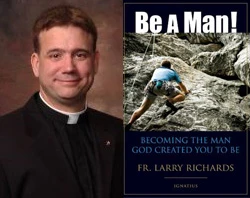
.- Pennsylvania Catholic priest Fr. Larry Richards, aiming to clear up “gender confusion” and to challenge men to pursue holiness, has released a new book titled “Be A Man: Become the Man God Created You to Be.”

In the book, Fr. Richards recounts his own efforts to learn “true manhood” and shares inspiring stories from men he has counseled and served in his decades as a priest, a press release from Ignatius Press says.

He encourages men to appreciate the differences between men and women, to set the right goals in life, to acknowledge personal faults and limitations, and to be masculine without being “macho.”

“Would you take a bullet if someone was raping your wife?” is one of his provocative questions to men.

Be A Man looks at King David, St. Paul, and Jesus as role models for men.

“Jesus Christ Himself reveals to us what it is to be a man,” Fr. Richards said. “It is about taking the one life that God has given us and give it away. When men are invited to die for others, they put others’ needs above their own. To be like Christ, and like all great men, will cost men their very lives.”

“There is a difference in the way men and women were created,” he remarked. “Men are not called to be women and vice versa. We are different – not better, but different – and men are called to be fully men. This needs to be dealt with up front because it’s a problem – in the Catholic Church and in the world itself.”

Fr. Richards said he encourages men to become men of “true love and wisdom” and to pursue holiness and find strength in faith and love. Each chapter of his book ends with a list of tasks that must be accomplished and questions for discussion and reflection.

“Read the book. Accomplish the tasks at the end of each chapter, no matter how hard or how “hokey” you may think them to be,” Fr. Richards urged. “I guarantee that if a man commits himself to each task and challenge, in the end his life will be changed forever!”

Be A Man is published by the San Francisco-based Ignatius Press.

Thursday, November 5, 2009

One Catholic Priest, and Eleven Other Pro-lifers Were Arrested for Tearing Up Nancy Pelosi's 'Health Care' Bill

Contact: Missy Smith, 904-687-9804

WASHINGTON, Nov. 5 /Christian Newswire/ -- On Thursday Afternoon, November 5, 2009, 12 pro-lifers were arrested inside or outside in the hall at Nancy Pelosi's office at #235 Cannon office building.

They entered, with two complete copies of the bill - all 2,000 pages (4,000) - and proceeded to rip it up, page by page, and strew it on the floor.

Approximately 150 supporters were in the hall, chanting: "Kill the bill!" About 10 supporters of the bill chanted, "Health care for all!" Aprox 30 police were on site, arresting pro-lifers, one at a time. No supporters of the bill were arrested.

Among those arrested was pro-life legend, Father Norman Weslin, age 78.

See raw footage of the protest, and some of the arrests at the following link.

Complete list of names of those arrested will be released shortly.

Monday, November 2, 2009

Father Z's Review of The 13th Day Fatima Film


"There is a new film about the apparitions of Our Lady at Fatima, Portugal. I was sent a copy for review and I watched it.

Before anything else, this film is going to be a source of lots of discussion. I think it will help to spur interest in the message of Our Lady and to consider it in our time..."

Higher Criticism of the Koran Resisted

From Vivificat:

Folks, Sandro Magister, the world-renowned vaticanista, hosted in his website an exchange between Muslim theologian Aref Ali Nayed and the Catholic Islamologist Michel Cuypers which I think you should read. The subject of the exchange is one that I’ve covered repeatedly in these humble folios, having to do with the need for a higher criticism of the Koran in order to know, expose, and study its literary genres, its historical context, the oral traditions that converged in its formation, and the phases in its redaction that gave us the text as we read it today. Of course, such an study has proven to very disquieting because Muslims hold a position nearly identical to that embraced by our own Protestant Fundamentalists of the KJV-Only, Independent Baptist kind regarding the Bible: that the Koran is the infallible, inerrant, exclusive Word of God, perfect in every detail, mechanically dictated by God and passively received by the sacred writer.

Magister tells us that Michel Cuypers, 67, is a Belgian member of the Little Brothers of Jesus, the religious community founded in the 20th century by René Voillaume. He spent twelve years in Iran, first in a leper colony in Tabriz and then studying Persian language and literature in Tehran. He received a doctorate in Persian literature from the University of Tehran in 1983. He then studied Arabic in Syria and Egypt, and in 1989 he moved to Cairo, where he now resides. Cuypers is a researcher at the Dominican Institute for Oriental Studies, founded in Cairo half a century ago by the Dominican Islamologists Georges Anawati, Jacques Jomier, and Serge Beaurecueil. Since 1994, he has completely focused his studies on the composition of the text of the Koran, adopting the method of rhetorical analysis. His articles and essays are increasingly appreciated by Muslim scholars as well. Two years ago in France, Lethielleux published a fascinating book by Cuypers, dedicated to the analysis of one of the chapters of the Koran: "Le festin: une lecture de la sourate al-Mâ’ida [The Banquet: A Reading of the Fifth sura of the Koran]," with a preface by the prominent Muslim scholar Mohamed-Ali Amir-Moezzi. At the recent meeting of Oasis, Cuypers gave an address precisely on the role of tradition in the Muslim world of yesterday and today. His address is reproduced further below. At the conclusion, Cuypers shows how important it is that the Muslim world open itself to a critical interpretation of the Koran. In particular, it clearly emerges from this interpretation that the most warlike verses of the sacred text do not in any way "abrogate" the more tolerant and peaceful ones, as the proponents of holy war claim. Oasis was created in Venice in 2004, through the initiative of Cardinal Angelo Scola. It publishes a semiannual magazine by the same name, in four editions and in five languages: Italian, English, French, Arabic, and Urdu. It publishes books and manages a multilingual website, with a newsletter. Read his entire address here.

Cuyper’s address earned the reaction of Aref Ali Nayed, a prominent figure in the dialogue between the Catholic Church and Islam. Born in Libya, he has studied the philosophy of science and hermeneutics in the United States and in Canada, has taken courses at the Pontifical Gregorian University in Rome, amd has given lectures at the Pontifical Instititue for Arab and Islamic Studies. He is a consultant for the Interfaith Program at the University of Cambridge. He has directed the Royal Islamic Strategic Studies Center in Amman, Jordan. This year he founded an Islamic studies center, called Kalam Reseasrch & Media, in Dubai, according to Magister. In replying to Cuypers, Nayed also adopts a combative tone. He completely ignores his extensive and elaborate arguments, to zero in on a single phrase. And he uses this as an opportunity to level against the Catholic Church, in the matter of biblical exegesis, the same accusations of obscurantism that are typical of secularist polemics. And, vice versa, to claim for Islam precedence in those methods of historical criticism and literary analysis that later became the prerogative of Jewish exegesis, then Protestant, Enlightenment, and finally Catholic. Nayed makes these core allegations:

Aref Ali Nayed - Chiesa PhotoMuslim scholars have always based their interpretations and exegeses of the Qur’an on the bases of several sciences, including the science of the ‘circumstances of revelation’ (asbabulnuzul), on the science of the history of the Qur’an (tarkhulqur’an), and on the careful study of the linguistic modes familiar to the Arabs around the time of revelation (ulumulugha). Muslim scholars developed a comprehensive apparatus of historical-critical-linguistic methodologies for understanding the Qur’an (ulumulqur’an). (For more on this, see "Al-Itqan" of Imam Jalaloddin Al-Suyuti (c. 1445-1505 CE).
Muslim scholars were always aware of the fact that interpretation, understanding, and exegesis of God’s eternal discourse are forms of human strenuous striving (ijtihad) that must be dutifully renewed in every believing generation. Solemn belief in the eternity and divine authorship of the Qur’an never prevented Muslim scholars from dealing with it historically and linguistically. On the contrary, belief in the revelatory truth of the Qur’an was the very motivation for spending life-times in close scholarly study of God’s discourse. (For more on this see "Kitab Al-Ilm" of Imam Ibn Abd Al-Barr)

Read Nayed’s entire argument here.

More recently, Cuyper again used Magister’s website as an outlet to reply to Nayed. This is his core retort:

Brother Michel Cuypers - Chiesa PhotoOn the other hand, I notice that Prof. Nayed repeatedly uses the expression "historical criticism" or "historical-critical method" both to affirm that Muslim scholars have always practiced it, and to ask Westerners to stop wanting to apply this method to the Qur'an (in the sense in which they mean it, obviously). Now, neither Magister nor my article uses this term even once. I did this intentionally, preferring to speak of "criticism," of the "critical" or "scientific" method, in a broader sense. The historical-critical method (which I personally respect, although I do not use it) is not, in fact, the only "critical" or "scientific" method for approaching the texts. Magister makes reference to the fact that the method that I personally use for analysis of the Qur'anic text is that of "rhetorical analysis." Contrary to the historical-critical method, which deconstructs (rightly or wrongly) the texts into fragments from different time periods, rhetorical analysis allows one to demonstrate the coherence of the text, its "composition": a method that, by virtue of its rigorous rules, equally deserves the description "critical." In various studies, I have shown the continuity of this method with the observations of many classical Muslim scholars: Abd al-Qahir al-Jurjânî, Zarkashî, Suyûtî, Al-Biqâ’î, and many others.

A more delicate aspect of the question is evoked by Prof. Nayed in these terms: "What is even more ironic is the fact that some Catholics, not only imagine such Muslim closure, but go on to attribute it to the Muslim belief in the divine authorship of the Qur’an (i.e. that the Qur’an is the very speech of God). This is very strange indeed, and comes down to thinking that one who believes in the divine authorship of the sacred text can not possibly be a dialogue partner on theological matters!"

It goes without saying that faith in the sacred text as the Word of God is the very foundation of every religion that considers itself "revealed." The difficulty comes, instead, from a theological question that concerns the manner of transmitting this divine Word. At the end of my talk, I explained that an excessively narrow conception of this manner of transmission, as pure and simple dictation directly from God, makes it more difficult to admit that the Qur'anic text, while still being considered the Word of God, also includes the vast cultural and scriptural Tradition that came before it. An eminent Iranian theologian, Professor Muhammad Mujtahed-e Shabestari, was recently banned from teaching at the University of Tehran, for having dared to say that Qur'anic revelation, although it is of divine origin, inevitably includes a human element due to the transmitter of this Word, meaning the Prophet of Islam.

Now, if I, a dwarf, may be permitted to walk among these giants, let me say this: Brother Cuyper is truly a son of God – a peacemaker – who in his demeanor and expression has “bent over backwards” to accommodate Nayed and Islam. He has extended every courtesy to Nayed’s understanding of revelation which is quite representative of the Muslim worldview on these matters. But Cuyper is not blind to a fact that even I can see: despite Nayed’s protestations, no serious, consistent, coherent, or sustained higher-critical study of the Koran has ever been engaged systematically in Islamic centers of higher learning, ever. Those who attempt that kind of study are persecuted, and their lives and limbs threatened. They lose their jobs, their tenure, and their dignity. For what little I have seen, Islamic scholarly efforts at “asbabulnuzul, ulumulugha” and “ulumulqur’an” are superficial at best, circular, assume what they seek to prove, and are anything but multidisciplinary in the modern sense.

I’ve discussed this three years ago in Textual criticism and the Koran's New Testament antecedents: Implications for a Christian apologetics against Islam and reached this conclusion: that textual and linguistic analysis shows that the Koran borrows from ancient Christian lectionaries. Therefore, Islamic claims for the Koran's unique and unitary origin are questionable. The finding reinforces the Christian polemic against Muslim claims of a unique and superior prophetic authority vis-à-vis Christianity. The scholar who researched these similarities had to publish his work anonymously for fear of death.

Finally, today I happily stumbled upon a very interesting article published in The Atlantic back in January 1999, entitled, What Is the Koran? The date is significant, 2 years before 9/11, and the article itself would chronicle a milestone whose significance we have now come to appreciate:

In 1972, during the restoration of the Great Mosque of Sana'a, in Yemen, laborers working in a loft between the structure's inner and outer roofs stumbled across a remarkable gravesite, although they did not realize it at the time. Their ignorance was excusable: mosques do not normally house graves, and this site contained no tombstones, no human remains, no funereal jewelry. It contained nothing more, in fact, than an unappealing mash of old parchment and paper documents—damaged books and individual pages of Arabic text, fused together by centuries of rain and dampness, gnawed into over the years by rats and insects. Intent on completing the task at hand, the laborers gathered up the manuscripts, pressed them into some twenty potato sacks, and set them aside on the staircase of one of the mosque's minarets, where they were locked away—and where they would probably have been forgotten once again, were it not for Qadhi Isma'il al-Akwa', then the president of the Yemeni Antiquities Authority, who realized the potential importance of the find.

Al-Akwa' sought international assistance in examining and preserving the fragments, and in 1979 managed to interest a visiting German scholar, who in turn persuaded the German government to organize and fund a restoration project. Soon after the project began, it became clear that the hoard was a fabulous example of what is sometimes referred to as a "paper grave"—in this case the resting place for, among other things, tens of thousands of fragments from close to a thousand different parchment codices of the Koran, the Muslim holy scripture. In some pious Muslim circles it is held that worn-out or damaged copies of the Koran must be removed from circulation; hence the idea of a grave, which both preserves the sanctity of the texts being laid to rest and ensures that only complete and unblemished editions of the scripture will be read.

Some of the parchment pages in the Yemeni hoard seemed to date back to the seventh and eighth centuries A.D., or Islam's first two centuries—they were fragments, in other words, of perhaps the oldest Korans in existence. What's more, some of these fragments revealed small but intriguing aberrations from the standard Koranic text. Such aberrations, though not surprising to textual historians, are troublingly at odds with the orthodox Muslim belief that the Koran as it has reached us today is quite simply the perfect, timeless, and unchanging Word of God.

Read it all here. It’s a great piece.

This goes way back and transcends any “compare and contrast” Islam vs. Christianity table I can formulate. Textual, linguistic, and higher-critical studiesof the Koran are still in their infancy, carried on by a few courageous Muslim and Christian scholars. The work is far from done and will continue to meet stiff resistance from Muslim scholars across the board. Yet, it is a necessary endeavor, perhaps the great necessary scholarly endeavor of the 21st century.

Yousef the monkey checks out of zoo – and swings by hotel

By CLAIRE GARDNER

PERHAPS he had been hoping his final destination would be a land flowing with nuts and bananas.

So being tranquillised on the rooftop of an Edinburgh hotel was probably not the ending this escapee monkey was hoping for when he made his break for freedom...

Not content with scaling an electric fence and exploring the zoo grounds, the four-year-old male decided to indulge in a bit of monkey business.

Leaping from lamppost to lamppost, the monkey, whose breed experts say poses no threat to the public, also negotiated Saturday morning traffic along busy Corstorphine Road...

Japanese fishing trawler sunk by giant jellyfish

Image and video hosting by TinyPic

A 10-ton fishing boat has been sunk by gigantic jellyfish off eastern Japan.

By Julian Ryall in Tokyo
Published: 7:00AM GMT 02 Nov 2009

"The crew of the fishing boat was thrown into the sea when the vessel capsized, but the three men were rescued by another trawler, according to the Mainichi newspaper. The local Coast Guard office reported that the weather was clear and the sea was calm at the time of the accident..."

Planned Parenthood Leader Resigns After Watching Ultrasound of Abortion Procedure