Sunday, July 5, 2009

Palin v. Pundits

http://s.wsj.net/public/resources/images/OB-CE712_palin__NS_20080829115851.jpg

By
C. Edmund Wright

The accomplished Alaskan governor can gaze into the face of tiny Trig and inherently know that she still has much to learn, even from her little guy. Meanwhile, her less accomplished critics gaze mostly into TV cameras (and mirrors) and have convinced themselves that they already know it all.

Well gosh darn. Who is right?

Palin v. the pundits demonstrates a profound disconnect that explains not only how and why the pundit class remains so incapable of understanding her (and much of America), it is a decent microcosm of the bigger political debate going on in this country.

To the Beltway-Big Apple pundit elites, the idea that anyone would (or could, or should) live a life not centered on the government-Ivy League-media capital corridor is simply an idea that is not on their radar. That Palin did not have such a life, and was not interested in such a life, was by definition a disqualification in their minds. That she was not willing to do anything to curry their favor was simply not forgiveable. The only possible reason was that she must be too stupid to realize that all wisdom worth having is contained within this rather closed circle of geographies, people and philosophies.

After all, what good is being able to hunt and prepare your own food when any decent speed dial will get you the Maitre'D at the Four Seasons? Why learn to run a business and turn a profit when real wisdom is running a deficit and taxing those who turn a profit to make up the difference? I mean, there is widsom and then there is wisdom. There is Washington -- and then there is the real world.

Thus, just as they were last August, the D.C.-focused pundits remain totally incapable of properly analyzing what she is all about. They continue to filter her decision through purely beltway parameters. It is clear that they were not listening to her words.

Beltway pundits view the world through the template that everything in life is a calculated PR stunt with an eye on the next election because politics and government are everything. They also have a template that no one from a state university in Idaho could possibly play in a world dominated by Ivy League insiders.

Well, just for the hell of it, let's examine both templates.

Take Ivy League-educated and connected Jamie Gorelick. Harvard B.A., magna cum laude, Harvard Law School, cu laude. Now this is the resume the pundits have immense respect for.

She managed to make tens of millions of dollars while a Vice President at Fannie Mae. Never mind that she had no background in real estate or mortgages. She was an Ivy Leaguer with connections. Policies enacted by her and Franklin Raines (another Ivy Leaguer with connections and no experience) greatly contributed to the crash of not only Fannie Mae but the entire housing segment. Meanwhile, she and Raines got filthy stinking rich for their efforts.

And after that adventure, Ms. Gorelick moved to the position of Assistant Attorney General under Bill Clinton (not literally). From that perch, another one for which she had no qualifications, she authored the infamous "wall" that kept the CIA and FBI from comparing notes on some young Middle Eastern men who ended up driving jet planes into buidlings on 9-11.

Come to think of it, maybe the pundits are right. No one from the University of Idaho could possibly screw up that much in one lifetime. Score one for the outsiders.

And then there are the brilliant and respected Republicans like Christopher Buckley and Colin Powell. While these two wizards were among many swooning at the elegant and brilliant Obama and chafing at the plain spoken Palin, they failed to notice that the elegant one was a socialist who was mentored by American hating radicals.

Dumb ole hick Governor Palin was never fooled of course. Now Buckley and Powell have chimed in publicly with various degrees of buyer's remorse. Maybe living within sight of the Soviet Union does sharpen ones sensitivty to certain vibes. Point to Palin and the outsiders again.

And let's not forget that brilliant strategists like Dick Morris and Frank Luntz were preaching that Republicans must embrace the moderate platform of the McCains of the party to have any chance of winning. You know, global warming and government nanny state programs for every phase of life and so on.

Uh oh. That backwoods Annie Oakley would talk about limited government and drilling for our own oil whenever she could break free from McCain's handlers. She even had the audacity -- as someone who has actually been to ANWR -- to differ with the beltway elites on what ANWR looked like. What nerve.

Of course we know now that global temperatures have not risen in nearly ten years and Americans do not want to pay a cent more for gas due to climate concerns. And there are surveys indicating that their number one concern is government spending, too. Oh, and now Morris is writing a book a week about Obama the socialist. Score a couple more for the Killa from Wasilla and other assorted Neanderthals.

What Palin has -- along with folks known as the conservative base -- is a lot of common sense. The kind of common sense that is so easy to get while studying at the University of Idaho, hunting moose in sub zero temperatures or managing a little league hockey team.

It seems out of reach for folks who all went to the same pretentious schools K thru Ivy and who spend their entire adult life in the D.C. to Manhattan corridor giving each other jobs for which they are not qualified and worryng incessently about what the press is saying about them.

That is not how Sarah Palin thinks or lives. It is not how the people who made this country great think or live. And folks who are trapped in that mentality are simply not able to figure out someone like Palin or the millions of voters who were energized by her addition to the McCain ticket.

So while it would be folly for me to feign insight into her heart and mind now, not to mention any kind of prediction into the future, I think it is safe to say that her calculations were not those of the pundit class so busily analyzing this resignation.

Maybe it was just some practical common sense. With her star power now, she can surely make more money in a month on the rubber chicken circuit than she makes in a year as governor. A book deal could easily be done also. And she needs the cash, with the politically motivated grievances leaving her a half mil in the red in legal bills.

Such a strategy would open up all kinds of possibilities outside of politics (gasp!) while stabilizing her finances. Meanwhile, the increased exposure and rolodex stuffers she would pick up would always be a plus if she ever does think about office again.

In other words, I think it might be wise to consider this as a "business decision" and not a political one. I would never say political future considerations never entered her mind. But I do not think it is her obsession every waking moment.

Some folks just don't get this kind of thinking. If you can get Tony Rezko to buy the yard of your house, you don't have to think this way. If you inherited the Kennedy liquor zillions, you don't have to think this way. If you married a widow sitting on top of a business fortune of a Republican senator, you don't have to think this way. If you can simply call up some Ivy League connection and get a cushy government job with seven figure bonuses regardless of performance, you don't have to think this way.

The Palins have to think this way. My family has to think this way. Yours probably does too. That's why the the beltway pundits and other Washingtonians will never understand the Palins or most of us.

And the battle is this. Our way of thinking made the country what it is. Their way of thinking will destroy it. The Palin V. Pundit contest is but one battle on a huge stage in a vital war.

Friday, July 3, 2009

Schoolhouse Rock - The Shot Heard 'Round the World

Schoolhouse Rock - No More Kings

The Ugliest Church Art Contest


'Michelangelo self-portrait' discovered in restored Vatican fresco

Crucifixion of St. Peter by Michelangelo

Crucifixion of St. Peter, 1546-50 by Buonarroti, Michelangelo

The restoration of frescoes by Michelangelo in the Vatican has revealed what is believed to be a self-portrait of the artist.

The face is in a wall mural in the Vatican’s Pauline Chapel or Cappella Paolina, according to Maurizio De Luca, the Vatican’s chief restorer. The chapel, which is used by the Pope and not open to the public, was unveiled this week after a restoration costing €3.2 million (£2.7 million).

Professor De Luca said that a figure on horseback in a blue turban in Michelangelo’s The Crucifixion of St Peter was clearly the artist. “This is an extraordinary and moving discovery,” he said. He said that the resemblance to portraits by Giuliano Bugiardini and Daniele da Volterra, as well as to a bust by Giambologna, was striking.

The frescoes were painted by Michelangelo in the chapel beginning from 1542 to 1549, when he was 75. They depict the crucifixion of St Peter and the conversion to Christianity of the apostle Paul. The restoration began in 2004 and was funded by Vatican museum arts patrons.

Michelangelo is also said to have included a self-portrait in Last Judgment in the Sistine Chapel, hidden in the robes of St Bartholomew. Michelangelo began work on the Pauline Chapel murals after he had completed the Sistine Chapel. Pope Benedict XVI will inaugurate the restored chapel with an evening prayer service on July 4.

The two murals are the last Michelangelo painted. The chapel is named not after St Paul but after Pope Paul III, who commissioned it in 1537.

Antonio Paolucci, the director of the Vatican Museums, said that the frescoes were “a kind of spiritual testament marked by vast sadness and deep pessimism. One has the impression that the mystery of grace offered to an unworthy humanity caused anguish in the soul of the artist, a Christian, who lived through and witnessed the religious crisis of his era, which was divided and lacerated by the Reformation.”

The paintings had profound importance for the Church, Professor Paolucci said, since they depicted St Peter, “to whom all popes trace their spiritual responsibility” and St Paul, “from whom they inherit the mission of preaching the Gospel to all peoples”.

The Early Church: How Christians elevated culture

ANTHONY ESOLEN

What did the Christians cherish from the pagan traditions, and what did they change?

How Christians elevated culture

What did the Christians cherish from the pagan traditions, and what did they change?

They raised the status of women.

It's dogma in our public schools today that women in ancient times were oppressed, because women had no voting rights, women had not the same opportunities as men, and so forth. You will be mocked if you deny that this spells oppression. If you're a college professor and you deny it, get ready for the stake.

But the charges are anachronistic and chauvinist. People who make them never imagine what it was like for people of another culture to put food on the table, a roof over their heads, and clothes on their backs, never mind bearing enough children to keep the population stable. The Romans in general treated their wives with esteem. The matron of the house had better be consulted along with the important males if the paterfamilias was going to make a decision. Still, the Christians preached that there was no separate baptism for men and women. All were one in Christ. If Christ was Himself the Holy of Holies, then that inner sanctum was thrown open for all. Jesus had been seen on Easter first by women, then by his apostles. The Gnostic heretics, who disdained the body, have Jesus saying that one could not be blessed unless one were made male; Christians condemned that nonsense. They did not expose baby girls (or boys, either). They did not divorce their wives. They shunned sexual practices that put them and their spouses at risk. They honored women who defied emperors, centurions and soldiers to witness to the faith. In his Confessions, Saint Augustine wrote the first tribute in history to an ordinary woman, his mother Monica, without whose love and faithful prayer he would never have known the love of God. (9.8–13)

Even so, early Christians were sexist because they, like everybody else who has walked the earth until now, did not treat women as indistinguishable from men. That indifference is our politically correct ideal, though it's hard to name a time and place wherein women would not have decried such treatment as insulting.

They palliated pagan cruelties.

Christians did not take part in the blood sports of the arena. That does not mean that all of them kept away from the stands; but the Christian attitude toward the gladiatorial combats is well captured by, again, the irrepressible Tertullian:

And are we to wait now for a scriptural condemnation of the amphitheatre? If we can plead that cruelty is allowed us, if impiety, if brute savagery, by all means let us go to the amphitheatre. (De Spectaculis)

Those games were as popular then as football in America is now, or soccer in Europe; but Christ's injunction to love one's enemy would eventually put to death the sport of death.

Christians were forbidden to help riddle the whores with diseases. We can't attribute moral degeneracy to the whole Roman empire; but the most populous cities really were sinkholes of depravity, if we can trust pagan and Christian testimony. Here's Clement of Alexandria again, describing how low the debauchery descended:

Such are the trophies of your social licentiousness which are exhibited: the evidence of these deeds are the prostitutes. Alas for such wickedness!...For fathers, unmindful of children of theirs that have been exposed, often without their knowledge, have intercourse with a son that has debauched himself, and daughters that are prostitutes. (Paedogogus,3.3)

Again, we should not expect that Christians all lived up to their ideals, any more than we live up to ours. But it's one thing to violate a law, and another to deny that the law exists.

Christians softened the institution of slavery, as common then as the service industry is now. The teachings of Jesus made it clear that it was the position of the master, not that of the slave, that placed one's salvation in jeopardy. Some Christians sold themselves into slavery to ransom a Christian brother. As the years went on, under the influence first of Stoicism and then of Christianity, laws condemning the maltreatment of slaves become common.

Contrary to what our Bible-despisers say, the Scriptures do not support slavery. They take it for granted as a social institution. How else might a poor man without land keep himself and his family alive? If a man had nothing, he at least had his back and his hands. It is not as if he could work for a day, or would even want to work for a day, and then go home, when most often there was no home to return to, or when he could have a better meal and something like a bed in the master's house. But the whole thrust of the Scriptures is towards freedom and away from bondage -- unless it is the "bondage" of love. Jesus warns his followers that if they would be great in the Kingdom of Heaven they must be slaves to everyone else.

They thrust a dagger into the heart of the State-worship.

Their failure to worship the Emperor angered a Roman like Diocletian not because he thought he was a god. Diocletian knew it was all nonsense. It angered him because they struck against the sanctity of the State he was struggling to hold together. Hence his notorious persecutions, perpetrated, as persecutions usually are, for reasons of State. But in a few decades, Constantine legalized the religion, and then Theodosius made it the official religion of the empire. That was not the same as Statist idolatry.

One example will show why not. The emperor Theodosius, a valiant soldier and a defender of the orthodox faith, attacked Arian Goths in Thessalonika and massacred them. For his pains, his bishop, Ambrose of Milan (the man who later baptized Augustine) threatened to excommunicate him unless he did immediate penance for his great evil.10 Diocletian, for political purposes, had demanded to be called Dominus et Deus, "Lord and God." But Theodosius had to suffer the rebuke of a mere bishop. More than a rebuke: he had placed his immortal soul in danger. For the Emperor, though he is the legitimate ruler, is but one Christian like another, and all are servants of the one and only Lord and God.

They took up the burden of civic responsibility.

People trained on Hollywood epics may think that everyone in the Roman Empire wore flowing white tunics and relaxed at the baths and ate figs from silver platters. But as we have seen, the population of the Empire stalled in the third century, and the economy stalled with it. That brought de-urbanization, as did the shortsighted increase in taxes. Meanwhile, the Empire had spread its legions as thinly as possible along the thousands of miles of borderland to protect its citizens from barbarian invasions. Rarely were emperors to be found in Rome. The great city became a backwater. Constantinople was the thriving capital in the East. Milan, closer to the vulnerable passes over the Alps, became more important in the West, as did the Adriatic port of Ravenna. But with food supplies dwindling, more and more people abandoned the cities generally, nor was it lucrative for the remaining magistrates to do the work.

Here's where Christian deacons, priests, and bishops came in. The Christians had developed networks of care for their sick, their widows, and their orphans. Moreover, a priest or a bishop did not have a family to support (celibacy among the clergy had become the norm in the East, and almost universal in the West), so they became natural choices to assume the places vacated by the old senatorial families. It was the persecutor Diocletian, and no Christian bishop, who first called sectors of the Empire "dioceses," but it wasn't long before bishops were in charge of those dioceses, for practical reasons -- as, for instance, to see that grain shipments came in to feed the poor. When Augustine traveled to Milan, then the hub of government in Italy, the man in charge was not the Emperor, who had to be on the move with his army, but the bishop, Ambrose. He was the primary man responsible for preserving law and order and promoting the common good. Two centuries later, after Rome had shrunk from a city of nearly two million to a town of forty thousand, in ruins, the people chose as their bishop a humble monk who had long served their practical needs as an able administrator. His name was Gregory, and when he first heard they might choose him, he fled -- for how could such as he be a worthy successor of Saint Peter?

Yet the people persuaded him to return. History knows him as Pope Gregory I, one of the wisest and holiest men to assume the chair -- and, after all, a true Roman.

They ennobled manual labor.

Unlike us, now. It is one of the purposes of the college degree, to safeguard the holder from a sore back and calluses. But the Christians could not look down upon the kind of labor that their Savior did, for Jesus was a carpenter. And Peter was a fisherman, and Paul a tent-maker.

We should not underestimate this acceptance of hard physical labor. It may be that Christianity is truly healthy only where this principle is affirmed, and that its denial is a symptom of a sickly faith, as among the French aristocrats in the eighteenth century, or the overschooled in ours. The principle long predates the Protestant Reformation. The craftsmen who built the medieval cathedrals often memorialized their trades in wood or glass or stone upon the very walls. But the Church was reviving a Roman ideal that had fallen into the yellow leaf. The Romans were fond of looking back upon the modest-living gentlemen farmers who had been the backbone of the Republic. By the second century of the Empire, many city people found themselves yearning for the peace and health of a farm. But it had been a long time since men with any money stooped their shoulders. A rich man might own a farm, but slaves dragged the plow.

Now, as I've said, a slave economy is a stagnant economy. The Romans were terrific engineers, as we see from their aqueducts and sewers and basilicas and roads. Were it not for slavery, they might have had an industrial revolution. By the time the Germans and the Huns had invaded, political and economic conditions made that impossible. But the Christian re-valuation of work would eventually build the continent anew.

They "baptized" the paterfamilias.

One of the great unheralded events in history occurred in the early sixth century, when a monk named Benedict of Nursia was asked to write a rule governing life in the monastery at Monte Cassino. Benedict aimed to provide a Roman orderliness and moderation, unlke the spiritual athleticism of the East, with its daring flights of physical deprivation and marathon prayer. In the East, you might find a Saint Daniel the Stylite, sitting atop a pillar for years in swelter and storm, praying for the people and doing penance.11 But Saint Benedict's genius was Roman; his instincts favored the stable and conservative.

He gave the West a blueprint for orderly life under hard conditions. Imagine twenty or thirty men in their prime, sworn to remain in one place, to observe an orderly round of prayer, reflection, labor, and rest, and to obey their paterfamilias, the abbot (from Hebrew abba, "father") who stands for them in the place of Christ. Imagine that they see their work as a form of praise and prayer. What can such men not do? They cleared the waterlogged land of Germany, all swamp and dark forest, and brought forth grain for bread and beer, and grapes for wine. They brought their learning to far Ireland and England and Scandinavia. They copied manuscripts (work more laborious than that of the plowman, without the benefit of muscles stretching in the open air) and embellished them with decorations fanciful and bright. Their monasteries became a network of economic hot spots, sharing their learning and their technological improvements.

They elevated the "barbarian" cultures from which they came.

The monks were not colonizers in any sane sense of the word. They entered a land, found what was good in it, attempted to preserve it and bring it into harmony with the faith, and gave to the people their inherited gifts of Roman and Christian civilization. So the monks gave the Irish their first alphabet. English, Gothic, and Icelandic are all first written by monks. Did they then eradicate the native oral poetry? Far from it. The genius who composed Beowulf was almost certainly a Christian monk, writing for his beloved Saxons soon after the dawn of the faith in England, cherishing the memories of the old sagas, but seeing in them a heroism that without Christ was incomplete.

Let me illustrate the point with a famous account from the Venerable Bede's Ecclesiastical History of the English People.12 Bede, writing from the Irish-founded monastery at Jarrow, recalls an incident one or two generations before, when one night the cattlemen, laymen working at the monastery, were sitting round a table drinking beer. As was the custom, they passed a harp from man to man as they drank. When it came to you, you were supposed to sing one of the old pagan heroic songs, the grand deeds of a Sigemund or a Beowulf. But one fellow at the beer feast was embarrassed and used an excuse to leave, going to the cattle shed to tend the stock for the night. When he fell asleep, an angel of the Lord appeared to him in a dream and called to him, "Caedmon! Sing me something!"

"I don't know anything to sing," replied the herdsman. "That's why I left the feast, because I can't sing."

"Nevertheless, you can sing."

"What shall I sing?" said Caedmon.

"Sing me the First-Making," said the angel. At which point Caedmon burst into a hymn glorifying God the Father who established the heavens and the earth:

Now let us laud . . . the Lord of heaven's realm,
the Measurer's might . . . and his mind-plan,
work of the Glory-Father . . . as every wondrous thing,
Chieftain eternal, . . . he established from of old.
He first shaped, . . . for the sons of earth,
the high roof of heaven, . . . holy Creator;
the middle-yard . . . mankind's Lord,
Chieftain eternal, . . . adorned after that,
made the earth for men, . . . the Master almighty.

This charming hymn he composed was in the heroic meter of the old sagas, using the same heroic language. When Caedmon awoke, he told his bailiff about it, who brought him to the abbess, and she, wise woman, instructed the monks who could read to tell him a story out of the Scriptures, to see what he would do with it. He returned the next day with a heroic narrative poem. "It is a gift from God," she concluded. So Caedmon was brought into the monastery, not to learn Latin, but to compose song after song in Anglo-Saxon. It is an astonishing instance of the fusion of two cultures, and because of it we have the glories of Old English poetry.

"What does Ingeld have to do with Christ?" asked the learned Alcuin at the court of Charlemagne, one of the bright spots in the centuries of social confusion after the breakup of the Western empire.13 Alcuin was annoyed that his monks were entertaining themselves with tales, passed down by song over centuries, of the feats of the pagan Germanic heroes. He was, of course, echoing Tertullian's rhetorical question from long before. But the answer would come from the experience of missionaries, and from the artists who saw in the old ways a foreshadowing of the Christian revelation. What did Ingeld have to do with Christ? According to the author of Beowulf,a great deal indeed.

The truth about heretics

If you study the heresies condemned by the early Church, you'll find excellent ammunition against the accusations of the smug atheist. First, many anti-Christians believe that their opponents actually accept some of the harsher, world-loathing heresies. Alternatively, they condemn Christians for being closed-minded, authoritarian, and, yes, intolerant; while they have the privilege of condemning all to themselves. It does not occur to them, or they don't care, that a faith without definition is like a body without skin. A cursory study of heresies will reveal the folly of these positions.

True, the Church fathers spent much time debating, not always coolly, who Jesus was, what was the nature of his relationship with the Father, what was to be understood by the Holy Spirit, what was the true Church, which books were inspired by God, and how man is to be saved.

But before the reader shakes his head with a superior air (easy to do, when the debate is far away and he is ignorant of what is at stake), let's enumerate a few of the heresies.14 Some people believed that a true Christian must be a martyr of blood, so they sought violent death, sometimes by provoking their oppressors. Some, tainted by the body-hatred of certain Eastern cults and religions, believed that Jesus did not have a genuine body (because matter is intrinsically evil), and that to be saved we must cleanse away this corporal scurf, by fasting and abstaining from sex. Or, as a more convenient alternative, one might gleefully indulge in orgies, since, after all, only the soul counts for anything.

Some believed that the God worshipped by the Jews was evil, superseded by the God of love whom Jesus called Father. Some believed that Jesus was not the Son of God, but a creature, "adopted" by the Father for his obedience. Some believed that Jesus never died, and that it was only a specter that the Romans nailed to the Cross. Some believed that one could earn one's way into paradise by energetic good works, as if man needed no savior at all.

Set aside the question of whether Christian orthodoxy presents the truth about God and Christ and man's destiny. The controversies, which lasted several centuries, were no waste of time. Their resolution redounded to the cultural benefit of the West. Why?

Again, the pagan religions had nowhere to go. No educated man really believed in the Homeric gods, and as for neoplatonic mysticism, with its melange of obscure terms, airy abstractions, and magic, even the educated would find it nearly impossible to understand, let alone be guided by it from day to day. It was the superstitious and fidgety who sought out the mystery cults, with their secret knowledge and their orgies of initiation. That was a cultural dead end, and several of the heresies would have sent Christian worship along the same short unproductive road.

Most notorious was the body-reviling Gnostic heresy which, to listen to the ill-informed critics of Christianity in our schools, you would think was Christian dogma. Had the Gnostics won the day, Christians would have retreated from the world. Why bother plowing fields and copying books and repairing the aqueducts, when this world is all an illusion, and the only real knowledge is whispered from one secret master to another?

The danger (speaking culturally, not theologically) of other heresies was more subtle. The most popular heresy, Arianism, maintained that Christ was a creature, though exactly what kind of creature the Arians did not make clear. Here is Saint Jerome, discussing the verbal sleight-of-hand used by Arian-leaning bishops of the fourth century:

Eminent Christian bishops of course, began to wave their palms, and to say they had not denied that He was a creature, but that He was like other creatures. At that moment the term Ousia [meaning "being" or "substance," as in the creedal statement that Christ is consubstantial with the Father] was abolished: the Nicene Faith stood condemned by acclamation. The whole world groaned, and was astonished to find itself Arian. (Dialogue against the Luciferians)

Had the Arian heresy triumphed, I would not now be writing a Politically Incorrect GuideTM to Western Civilization, because the Christian faith would have fizzled out, along with the Greco-Roman world it in part preserved. The reason is hard for us to see, because we do not appreciate the cultural revolution ready to explode from the declaration, God is Love.

If Arius was correct, then Jesus was only a creature, albeit the highest. Then God can be said to love, but He cannot said to be Love. He is not in his own right a relationship of love among three Persons. He retreats into transcendence: he does not really enter the world to dwell among us. In that case he either becomes the inscrutable and irrational Allah of the Muslims, a universal sultan, or he vanishes into an abstraction, a Neoplatonic Being, impersonal and unapproachable. Christian worship either way loses its bridge between earth and heaven. Its commandments harden into the dictates of a despot, or decay into a moral philosophy, like Stoicism, benevolent enough, but in most men too weak to withstand the furies of the heart. It is the path Unitarianism took in nineteenth century America, from a dilute Christianity at the Harvard of John Quincy Adams, to a vague theism with an overlay of Christian moral teaching at the Harvard of his grandson Henry Adams, to the cultural nonentity it is now, a hobby for atheists or pantheists who like hymns and incense.

In one fashion or another, the heresies flatten Jesus, mostly to deny his humanity, as unworthy of him, and sometimes to deny his divinity. Here I am not arguing theologically but culturally. Christianity survives -- nay, it exists -- only where Jesus is affirmed as both God and Man.

That matters. Recall that the Jews and the Greeks had much to say about the natural law, what C. S. Lewis called "The Tao," a set of principles that are not the result of moral inquiry, but its foundation, self-evident to all men who are not corrupted.15 You do not steal. You love your family. You sacrifice for your country. You take care of the infirm. But, as well-attested as these principles are everywhere, they are also violated everywhere, and their connection with man's destiny and his being is not clear. With the Jews that connection is clear, since the laws are given by God himself. But the Jews are in part constricted by culture. The prophets do preach that the law will be given to all nations, and, as I've written, the Jews were chosen to carry that law. Yet Rome and Greece and Germany and Ireland could only become Jewish, so to speak, by becoming Christian. And then men saw not only that Christ came into the world, but that the very meaning of this world is stamped with Him, redeemer and creator both. For the world too is loved, and made new.

The Good News brings charity

To the ends of the earth, then, came the word, brought by saints, marauders, plowmen, tyrants, ordinary people, that each human being possesses a measureless dignity, by virtue of his having been created and redeemed by a God of love; not by a philosophical idea, and not by a god bound to a mountainside or river. The Greeks had the wisdom to end slavery, but why lose the temporary economic advantage? The Jews understood why, but lacked the power. The Jews who are called Christians, after a long struggle, did put an end to it; too long a struggle, but triumphant at last. If we believe that it befits a man to enter a burning building to save someone else's child, it is because we hear the words ringing in our ears still, "Inasmuch as ye have done it unto one of the least of these my brethren, ye have done it unto me" (Matt. 25:40).

It may offend secularists and those prudes who think that religion ought to be kept behind closed doors, but charity and concern for the poor are integral to our culture today because of Christianity. If we build hospitals for the destitute beyond our own lands, with no desire for personal or national profit, and risking life and limb to do it, it is because we retain a trace, a cultural memory of the voyages of Saint Paul, of Boniface martyred by the Germans, of Cyril and Methodius trekking north among the Slavs, of Patrick driving the snakes from Ireland, of Gregory the Great seeing blond slaves in the marketplace and, hearing that they were called "Angli," replying, "Non Angli sed angeli," "not Angles but angels," and sending missionaries among them, to give them the best he had to give.16

That is only one benefit, and not the most important, which the priests and bishops at those early councils conferred upon us, ensuring that Christianity would survive.

Though it is not polite to say so, still it cries out for notice. Hindus do not send holy men into foreign lands to feed the hungry and house the naked; they will not do so for the pariahs in their own land. Buddhists, practicing benevolent detachment from the world, do not do so. Muslims, who conquer by force, and who reject natural law on the grounds that it "fetters" Allah, are required to take care of their own, but they ignore everyone else.17 All cults of ancestor worship, like Shinto, are too firmly fixed upon the local and the familial to care for people far away. The Jews and Christians would care, because of the God they worship: and they did. If the world speaks of human rights now, and the dignity of the poor, it is because the world has heard of Moses and the prophets -- and, summing them up in himself, Christ. Men have come at last neither to love the world nor to despise it simply, but to love its goodness, not as a final end, but as a manifestation of the goodness that is eternal.

Thursday, July 2, 2009

Fr. Farrow’s Rebellion, Action against Knights of Columbus

By Deacon Keith Fournier
7/3/2009

Catholic Online (www.catholic.org)

Father Farrow has chosen to engage in open rebellion and anti-Catholic activism. He is also trying to destroy the Knights of Columbus.


CHESAPEAKE, Va. (Catholic Online) - In a June 27, 2009 article entitled “Expose and Engage the ‘Fifth Column’ in the Catholic Church” I wrote about Catholics who use their position within the Church to undermine the Church. I explained:

“I use the phrase “fifth column” in reference to people within our Church, fellow Catholics. These folks have rejected the teaching of the Church in an area of moral truth and, rather than honestly admit it and seek to change themselves so that they can properly inform their conscience and give a religious submission of intellect and will,(which is our obligation as faithful Catholics), they now attempt to confuse the faithful. However, they go even further. They engage in a covert operation intended to undermine the Church.

“This is done in several ways. Sometimes it is through a kind of slow drip of dissent. Other times through a concerted campaign which overtly opposes the ‘Magisterium’ , the teaching office of the Catholic Church, though still containing its rebellion and opposition within the family of the Church. Still other times it goes beyond all propriety by overtly rejecting the clear teaching of the Church. Then, using a public forum, they intentionally try to hurt the Church and cause a scandal. It is to the last group that I now address this article.”

Today I write to expose a suspended priest who is acting in just this way. I begin by asking all of our readers to pray for Fr. Geoffrey Farrow. He was the pastor of the St. Paul Newman Center at California State University at Fresno until he was suspended by his Bishop and removed from his position. This strong action was required and intended to be remedial, as are all canonical sanctions.

Fr. Farrow openly defies the teaching of the Catholic Church concerning marriage and human sexuality. He also openly condemns the Catholic Church in public for her defense of marriage. Let me be clear, Fr. Farrow needs our prayer. We ask the Lord to help him return to fidelity. However, Father Farrow has chosen to engage in anti-Catholic activism. He has decided that he will try to change the Church in an area where her teaching cannot and will not chenge, rather than change his behavior and be changed through her loving care.

On June 4, 2009 Fr. Farrow published a recommendation on his weblog (http://fathergeofffarrow.blogspot.com) which is an ongoing act of rebellion. He has turned his anger against the Knights of Columbus because of their support for the Magisterium of the Church and their work to defend marriage. He is calling others to rally to his heretical positions (Scandal CCC #2284) and asking them to engage in fraudulent actions intended to cause economic harm to the Knights of Columbus. I fully disclose that I am a fourth degree Knight and I am completely supportive of their apostolate.

However, there is more involved in Father Farrow’s actions than his disagreement with the Knights. He is inciting people to engage in fraudulent acts with the express intention of injuring the Knights of Columbus economically. As a Lawyer, I see potential civil liability issues everywhere in the scheme which he proposes. In addition, I encourage any priest who may be sympathetic to his errant moral and theological positions to be very careful in following his encouragement to not allow the Knights freedom in their parish; Pay close attention to Canon Law as well.

Here is a portion of the posting from Fr. Farrow’s blog entitled “Boycott the Knights of Columbus” which shows his rebellion and exposes his scheme:

From Fr. Farrow's Blog

“Father Donald Cozzens, PhD is a psychologist and the former president-rector of St. Mary’s Seminary in Cleveland, Ohio. In his books “The Changing Face of the Priesthood” and “Freeing Celibacy.” He unveils the fact that a very large percentage of Catholic priests are gay. In his book “Freeing Celibacy” in chapter six, which is entitled “Celibacy and Homosexuality,” he states bluntly “the growing awareness that the priesthood is or is becoming a gay profession” [page 65].

“Many priests have E-mailed me and expressed their rage and anger over the hypocrisy of the Catholic hierarchy in supporting anti-marriage equality legislation. They have often referred to the bishops as “old queens” who blithely support anti-gay efforts, because of their own self-loathing. One of the organizations, which the bishops have effectively employed to do their dirty work, has been the Knights of Columbus.

“Specifically in California, the K of C donated large amounts of monies to the “yes on Prop 8” campaign. Priests feel impotent to fight back because they are kept in positions of economic servitude by their bishops. Cozzens explains why priests are paid in such a Byzantine fashion in his book “The Changing Face of the Priesthood.” Most people express surprise when I tell them that priests are "self-employed" and also receive a "W-2 Form" from the Diocese for their taxes. Self employed persons are not protect(ed) like employees by labor laws.

“Beyond the issue of salary, priests traditionally receive a BA in Philosophy and then, another four-year degree which is a Masters in Divinity. Neither of these two degrees is very easily translatable into secular employment. This effectively makes it very difficult for a priest to transition out of active ministry. A young priest from the Mid-west recently told me “they gave us all the training we needed to be effective counselors, teachers, administrators, etc BUT they made damn sure we never got any of the credentials necessary to get secular employment in any of those fields.” This is no mere coincidence.

“So, what can priests do to fight the anti-gay agenda of the bishops and the K of C? Here is a short list: “1) Divest the full amount of your Knights of Columbus life insurance policy immediately. Take the check and invest the funds with an LGBT friendly fund. If every priest and K of C insurance policy holder were to do this, it would create a considerable capital drain on K of C and cripple their ability to write large checks to thwart LGBT legislation and ballot initiatives. “2) If you are a layperson, write them at tell them why you have done this. If you are a priest, simply inform them that you have decided to use the funds to promote social justice. “3) Pastors have the power to decide what is published in the Sunday bulletin and what is announced at Mass on Sundays. Do not let the K of C publish or announce. 4) Pastors may grant or withhold permission for organizations to use church facilities for their meetings. Most parishes have very tight facility scheduling. Create a program and tell the K of C they need to meet elsewhere.”

End of Blog Quote

In addition to praying for Fr. Farrow and exposing his errors so as to protect the faithful, I propose that our readers demonstrate their fidelity to the Magisterium of the Church and solidarity with the Knights of Columbus by engaging in a concerted action which is the opposite of what Father Farrow suggests: Those who have not yet obtained insurance through the Knights of Columbus should do so. Their products are excellent and their profits further the wonderful work of the Order which, unlike Father Farrow, is fully and completely faithful to the Magisterium of the Catholic Church.

Yad Vashem Honor Sought for Pius XII

Foundation Announces Plan to Initiate Process

NEW YORK, JULY 2, 2009 (Zenit.org).- A foundation announced plans to nominate Pope Pius XII for the "Righteous Among the Nations" honor, traditionally given to non-Jews who risked their lives to save Jews during the Holocaust.

Gary Krupp, president of the New York-based Pave the Way Foundation, an organization that promotes interreligious dialogue, affirmed this Wednesday in a statement to ZENIT.

He reported that the foundation has the nomination guidelines from the Righteous Among the Nations Department of the Holocaust Museum Yad Vashem in Jerusalem, and will open the case soon.

Krupp stated that the foundation has "devoted years to gathering original documentation and video testimony on this controversial papacy and we believe we have uncovered enough pertinent material to now begin to seek the notarized written testimonies to officially begin this judicial procedure [with] Yad Vashem."

The president, himself a Jew, explained, "In most cases of those who have been honored as Righteous Among the Nations, the honoree has directly acted to save individual lives all while risking his or her own life to do so."

He continued: "The actions of Eugenio Pacelli [Pope Pius XII] do not fit this general description. However, we can establish the direct intercession of the Pope to act resulting in saving hundreds of thousands of Jewish lives.

"But obviously because of the nature of the high office he held, Pacelli would almost never have been in direct contact with those he saved."

Krupp reported one exception, when the Pontiff personally interceded "on behalf of his best friend Dr. Guido Mendes, an Orthodox Jewish boyhood friend," sending the family to Palestine in 1938.

The president added, "We can also establish that the life-saving actions of Pacelli were carried out under the threat of death."

He reported: "In an emergency meeting called by Pope Pius XII with the cardinals on Sept. 6, 1943, he informed [them] that he signed a letter of resignation placed in his desk and that he expected to be kidnapped at any time.

"The cardinals were to be packed and ready to instantly leave the Vatican for a neutral government where they were to elect a new Pope.

"This emergency meeting was a month before the Jews of Rome were rounded up and the Pope interceded immediately to save them. This actual document is not yet available, but we know it exists."

Krupp added that the foundation recently obtained from Germany "the affidavit from General Karl Wolff, deputy to Himmler and Commandant in Italy, that he was ordered by Hitler to plan the seizure of the Vatican and to kidnap the Pope."

Seeking truth

The statement expressed the hope that by initiating the case for honoring the Pontiff, Yad Vashem will begin its own investigation, "which is an internationally respected judicial process and will help to bring the historical truth to light."

The president noted that the foundation will be seeking "notarized original testimonies of individuals who, in many cases, were never aware that it was Pacelli who acted to save their lives."

He explained: "An example of this is the acceptance and transport of Jews into the Dominican Republic.

"We have the video testimony of 97-year-old Monsignor Giovanni Ferrofino, secretary to the nuncio in Port Au Prince, Haiti, during the war who, together with the nuncio, personally acted on the direct orders of Pius XII twice a year to obtain visas for Jews arriving from Portugal to the Dominican Republic.

"Monsignor Ferrofino traveled with the nuncio, [Archbishop Maurilio] Silvani, to get 800 visas per boat load twice a year from 1939-1945 and appealed directly to General Rafael Trujillo in the name of Pius XII."

"This action," Krupp noted, "saved over 10,000 Jews who were then routed into America with the help of Monsignor Ferrofino through Cuba, Mexico and Canada."

He expressed the hope that Yad Vashem "will act to verify the information we will be sending."

"The job is now locating many of these survivors or their relatives to get signed notarized statements," Krupp affirmed.

He stated that "we have located thousands of documents and could not locate one negative document in our search."

This "private investigative project" has been carried out in accordance with the foundation's mission, the president affirmed, with the hope of breaking "the 46-year-old academic log jam" and of eliminating "this obstacle which impacts over one billion people."

Over 22,000 men and women from 45 countries have been awarded this title by the State of Israel, representing over 10,000 confirmed rescue stories.

Only a Jewish party can initiate a nomination, and must prove that the nominee gave assistance that was repeated or substantial, and without any expectation of compensation.

--- --- ---

On the Net:

Pave the Way Foundation: www.ptwf.org

The Milky Road

See Explanation.  Clicking on the picture will download  the highest resolution version available.

Credit & Copyright: Larry Landolfi

Explanation: Inspired by the night skies of planet Earth in the International Year of Astronomy, photographer Larry Landolfi created this tantalizing fantasy view. The composited image suggests a luminous Milky Way is the heavenly extension of a country road. Of course, the name for our galaxy, the Milky Way (in Latin, Via Lactea), does refer to its appearance as a milky band or path in the sky. In fact, the word galaxy itself derives from the Greek for milk. Visible on moonless nights from dark sky areas, though not so bright or colorful as in this image, the glowing celestial band is due to the collective light of myriad stars along the plane of our galaxy, too faint to be distinguished individually. The diffuse starlight is cut by dark swaths of obscuring galactic dust clouds. Four hundred years ago, Galileo turned his telescope on the Milky Way and announced it to be "... a congeries of innumerable stars ..."

Ant mega-colony takes over world

Matt Walker
Editor, Earth News

Queen and worker Argentine ant (Linepithema humile)
A queen and worker Argentine ant have many, many relatives

A single mega-colony of ants has colonised much of the world, scientists have discovered.

(BBC) Argentine ants living in vast numbers across Europe, the US and Japan belong to the same inter-related colony, and will refuse to fight one another.

The colony may be the largest of its type ever known for any insect species, and could rival humans in the scale of its world domination.

What's more, people are unwittingly helping the mega-colony stick together...

More

President Obama's Analysis of the "Divide" in Catholicism

(Official White House Photo by Lawrence Jackson)
President Barack Obama holds a round table briefing July 2 in the Roosevelt Room with Catholic press, including Register publisher Father Owen Kearns (left foreground).

"..In addition, Father Kearns noted the president’s analysis of the divide in Catholicism.

'The president said he had fond memories of Cardinal Bernardin and that when he started his neighborhood project, they were funded by the Catholic Campaign for Human Development,' he said. “After the first question, from the National Catholic Reporter‘s Joe Feuerherd, the president jokingly asked, ‘Was there really [a controversy at Notre Dame]?’”

'The president spoke about how during Cardinal Bernardin’s time the U.S. bishops spoke about the nuclear freeze, the sanctuary movement, immigration and the poor, but that later a decided change took place,” added Father Kearns. “He said that the responses to his administration mirror the tensions in the Church overall, but that Cardinal Bernardin was pro-life and never hesitated to make his views known, but he had a consistent ‘seamless garment’ approach that emphasized the other issues, as well. The president said that that part of the Catholic tradition continues to inspire him. Those issues, he said, seemed to have gotten buried by the abortion debate."

Wednesday, July 1, 2009

"Totally Alone"

From Inside the Vatican:
"It's a little romantic. There are certain parts of the island where you can stand and look out to sea and you are totally alone, just you and God. It's a perfect atmosphere to pray." —Brother Magdala Maria, member of a traditionalist congregation which lives on Golgotha Monastery Island in the Orkney Islands off the northern coast of Scotland (photo)

This afternoon, I received an email from a friend in America who said two of his friends were in Rome, and that he thought we should get together. So, after an exchange of phone numbers, we arranged for dinner this evening at La Vittoria on via delle Fornaci.

Father Michael Maria (photo), 55, born in New Zealand, and Brother Magdala Maria, 29, born in Sydney, Australia, but descended from one of the kings of Samoa, were for many years members of the Society of St. Pius X.
However, two years ago, after Pope Benedict published his motu proprio on the liturgy, Summorum Pontificum (July 7, 2007), the two, and several of their friends, decided to leave the Society and try to return to full communion with Rome.
They have hoped for many months that their "assimilation" into the Church might take place quickly, but it has not yet occurred.
"We are still in no man's land," Father Michael told me. "We're not incardinated anywhere, though we have received faculties to hear confessions from our local bishop in Scotland."
Father Michael, the oldest of six children, was ordained a priest of the Congregation of the Most Holy Redeemer (Redemptorist) in 1978, and it was not until eight years later, after something that happened during Pope John Paul II's trip to New Zealand in 1986, that he felt moved to draw close to Archbishop Marcel Lefebvre.
"I still remember clearly a large outdoor Mass in New Zeland," Father Michael said. "I was one of the concelebrants. As I was distributing communion, a young man came up, took the host in his hand, then closed his hand on it, breaking it, and tossed it into the air. When it fell, I knelt to pick up the pieces. I saw that the man was going up to other priests and doing the same thing, so I went to the security guards and told them about the desecration that was occurring. But that wasn't the only thing that happened. I saw many young people sitting in the back, eating potato chips and drinking soft drinks, then getting up to go to communion. No fast at all. I felt the lack of reverence for the Eucharist at this papal Mass was so great that I had to find a different home in the Church."
Father Michael started reading about the liturgy, including the works of Michael Davies, and he slowly made his way toward the Society of St. Pius X, traveling to the Society's seminary in Econe, Switzerland, where he came to know Archbishop Lefebvre well.
"What kind of man was Lefebvre?" I asked.
"He was a very humble man," Father Michael replied. "He was always very thoughtful. Whenever I came to see him, he always had some gift for me, a book, or some other small item. I felt he was a kind and good man, a holy man."
Father Michael was present when Lefebvre, together with Bishop Antonio de Castro Mayer, conducted the four episcopal consecrations on June 30 which led to the first and only public schism in the Church since the Second Vatican Council.

And Father Michael remained in the society of St. Pius X for another 19 years, serving in a St. Pius X parish in southern England.

But two years ago, Father Michael decided that Pope Benedict's gesture in permitting wider use of the old liturgy compelled him to respond. He decided to seek a way to return to full union with Rome.
"We have drawn up a contitution for an order called Sons of the Most Holy Redeemer, and we have presented it to the Ecclesia Dei Commission for approval," Father Michael said. "We have been hoping against hope that it would be accepted quickly, perhaps before Cardinal (Dario) Castrillon-Hoyos retires on July 4..."
"But that is only three days away..." I said.
"I know," Father Michael said. "We are losing hope. But we haven't given up."
Father Michael said he and two other priests and some 15 brothers lives a common life together on an island off the coast of northern Scotland.
"I am of Scottish descent," Father Michael said. "When we left southern England two years ago, we visited Scotland, and came to a place where we found this isolated, barren island, completely uninhabited. It was for sale for 200,000 pounds. We had no money, but we decided to pray a novena in the hope that a way would be opened for us to make that our home. Within a couple of days, a house that had been donated to us was suddenly sold, giving us a considerable portion of the money needed. Then other gifts came unexpectedly, and by the 9th day, 236,000 pounds had arrived. We were able to buy the island."
The 18 men have built a chapel and a series of small hermitages in a row, about 15 feet apart, and live a common life on the island.
"What is the island like for you, who are from the South Pacific?" I asked Brother Magdala.
"There are no trees," he said. "And the water is very cold. You can't swim it it, except perhaps for one day in the summer. The air is all salt-laden; it burns the trees.
"It's a little romantic. There are certain parts of the island where you can stand and look out to sea and you are totally alone, just you and God. It's a perfect atmosphere to pray."
"What is your daily life like on the island?" I asked.
"We rise at 4:55 a.m.," Father Michael said. "We wash and dress and at 5:25 a.m there is a bell to go to the chapel. There we spend 30 minutes in mental prayer, and then we celebrate Mass at 6 a.m. according to the old rite, in Latin. After Mass we have a quarter hour of Thanksgiving. At 7 a.m. we have breakfast..."
"Is it a good breakfast?" I asked.
"Yeah, it's great," Father Michael replied. "We have our own milk from 10 Jersey cows, tea, bread, jam, coffee, and sometimes porridge... At 7:30, we pray a rosary in the chapel. At 8 a.m., we pray the hours, Prime and Terce, according to the 1962 Breviary. From 8:30 to 12:30, we work. We have a farm, and we are still doing lots of construction. At 12:30 a bell rings, and we gather in the chapel for Sext and None, as well as a particular examen of conscience, and a litany to Our Lady. At 1 we eat lunch in silence while an inspirational reading is read. At 1:30 we have an hour of recreation, starting with washing the dishes, then talking in the common room. From 2:30 to 5:30 we have a little silence in honor of Our Lord's three hours on the cross. We include in this time a half hour of mental prayer, a half hour of spiritual reading, and 15 minutes of Eucharistic adoration before the Blessed Sacrament. At 5:30 we say Vespers and Compline and spend time in mental prayer meditating on the Passion of Our Lord. At 6 p.m. we have supper followed by 1 hour of recreation. From 7:30 to 8 p.m. we have night prayer, and from 8 to 9 we have free time. At 9 p.m. we have lights out."
I asked Brother Magdala (photo below), who is a strapping young man about 6 foot 2 inches in height with broad shoulders, what had prompted his vocation to this life.
"I always wanted to be a priest from the time I was a young lad," he said. "My father is Luamanuvae, chief of the village of Sala'loga in Samoa. When I was a teenager, I thought of making a career as a professional rugby player. I was being considered for a $250,000 per year contract with a professional team in Australia. But then I attended a mission which Father Michael and Father Anthony preached, in Sydney, at the St. Pius X church there. They spoke about the four last things: death, judgment, hell and heaven. I knew then that I had to give my life entirely to God, though in what form I did not know. If you had been there to hear those sermons, you would have felt the same way!
"I prayed a lot in those next weeks, and after six months, I knew I had a religious vocation. I didn't believe I was leading a good life. I realized that if I stayed in the world, I might not be able to save my soul. The spirituality of the Redemptorists is to save one's own soul and the souls of others.
"I came to realize that the most important thing to do is to live in union with God. And this means something different from what most people think. Because if you are praying, and God wants you to be doing something else, you have to stop praying and do what God wants you to do. For St. Alphonsus Liquori, the definition of sanctity is when our will and the will of God are perfectly united."
"Do you think many people today are not living in union with the will of God?" I asked.
"Clearly!" Father Michael replied. "Consider just the demographic situation of Italy and Europe. There are very few children today, less than 1.2 per family. This is below replacement level. That means people are not having the families they should be having. God wishes people to be fruitful, to have the joy of children and grandchildren. And then there are the statistics about confession and communion. They are completely out of balance. Confession is vitally important."
"How would you explain that importance?" I asked.
"Confession brings about the reconciliation of the soul with God through the forgiveness of sin and the infusion of grace," Father Michael said. "It is actually an astonishing thing — to be able to have true contrition for every sin one has committed in one's whole life. This brings a spiritual freedom nothing else can bring. It breaks the shackles of sin which bind us so tightly. But it requires the humility of the penitent. The basis of all the virtues is humility. Your charity can only be as high as your humility is deep."
The three of us walked into St. Peter's Square. High above us, there were extra lights on next to the Pope's rooms in the Apostolic Palace. Usually only the two windows to the right are lit. Tonight there were five windows lit.
"I guess something special is happening tonight," I said. "I've never seen the palace lit up like this before."
"I have been attacked harshly by many in the Society since I left," Father Michael said. "But I have no regrets. I want nothing more than to be in union with the Holy Father, and to serve him, as the Vicar of Christ."

Orthodox in Australia Acquiring Abandoned Catholic, Protestant and Anglican Churches

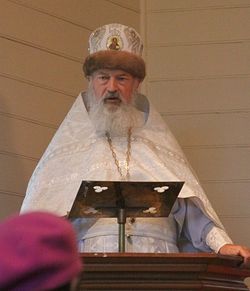
Protopriest Michael Protopopov gives an interview to www.pravoslavie.ru to discuss the reasons why Catholics, Protestants and Anglicans are deserting their churches...

Загрузить увеличенное изображение. 600 x 900 px. Размер файла 137166 b.  Mitred Protopriest Michael Protopopov"The sale of church property on a gargantuan scale is an indication of the fact the Australian populace is living in a post-Christian age. More and more people are becoming secular as opposed to being religious and spiritual. Fifty years ago, the Australian populace was much more religious; the Catholic Church has begun to recede dramatically since the Second Vatican Council
of 1963. Likewise the Anglican Church has seen plummeting parishioner numbers since the introduction of homosexuality as not a ban to clergy, same sex marriages, female clergy and even female bishops.

The closure of Anglican, Protestant and Catholic churches in rural and populated areas is also due to the fact that they lack priests, nuns and seminarians. People have lost commitment.

Especially Catholics aren’t committed as they were before the Second Vatican Council of 1963. Those people that were once committed, those people who founded these churches, have wandered away from the Catholic Church, and their children have perhaps grown up not knowing Christianity at all. Thus, out of the youth there are hardly any candidates for seminary or monasticism. Without a solid seminary and monastic program, the Catholic Church can hardly expect a positive future.

http://www.pravoslavie.ru/sas/image/100226/22612.p.jpg

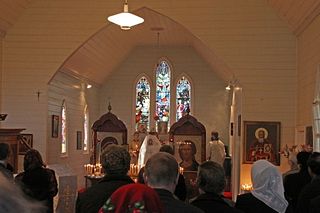
It is quite sad that Catholic and Anglican churches are being abandoned and sold. For example, at the Russian Orthodox parish in Warrnambool, there are beautiful, old stained glass windows which have inscriptions in memory of the founders of the church, brass candle sticks which have engraved in them names of parishioners who are now forgotten by their own people. Those parishioners and founders of the church are remembered in our prayers during every liturgy—as is standard practice in the Orthodox Church to pray for the “founders of this holy temple.”

Nuns in the U.S. Are Facing Scrutiny by the Vatican


Mother Mary Clare Millea has been appointed by the Vatican to study the activities of some orders of nuns in the United States.

The New York Times
Published: July 1, 2009

The Vatican is quietly conducting two sweeping investigations of American nuns, a development that has startled and dismayed nuns who fear they are the targets of a doctrinal inquisition.

Sister Sandra M. Schneiders has urged fellow nuns not to participate in the study that is being conducted by the Vatican.

Nuns were the often-unsung workers who helped build the Roman Catholic Church in this country, planting schools and hospitals and keeping parishes humming. But for the last three decades, their numbers have been declining — to 60,000 today from 180,000 in 1965.

While some nuns say they are grateful that the Vatican is finally paying attention to their dwindling communities, many fear that the real motivation is to reel in American nuns who have reinterpreted their calling for the modern world.

In the last four decades since the reforms of the Second Vatican Council, many American nuns stopped wearing religious habits, left convents to live independently and went into new lines of work: academia and other professions, social and political advocacy and grass-roots organizations that serve the poor or promote spirituality. A few nuns have also been active in organizations that advocate changes in the church like ordaining women and married men as priests.

Some sisters surmise that the Vatican and even some American bishops are trying to shift them back into living in convents, wearing habits or at least identifiable religious garb, ordering their schedules around daily prayers and working primarily in Roman Catholic institutions, like schools and hospitals.

“They think of us as an ecclesiastical work force,” said Sister Sandra M. Schneiders, professor emerita of New Testament and spirituality at the Jesuit School of Theology at Berkeley, in California. “Whereas we are religious, we’re living the life of total dedication to Christ, and out of that flows a profound concern for the good of all humanity. So our vision of our lives, and their vision of us as a work force, are just not on the same planet.”

The more extensive of the two investigations is called an Apostolic Visitation, and the Vatican has provided only a vague rationale for it: to “look into the quality of the life” of women’s religious institutes. The visitation is being conducted by Mother Mary Clare Millea, an apple-cheeked American with a black habit and smiling eyes, who is the superior general of her order, the Apostles of the Sacred Heart of Jesus, and lives in Rome.

In an interview in a formal sitting room at her order’s United States headquarters in Hamden, Conn., Mother Clare said she had already met one-on-one with 127 superiors general of women’s orders, many in that room but also in Chicago, Los Angeles, Rome and St. Louis. She is preparing questionnaires to send to each congregation of women and recruiting teams of investigators, mostly nuns and some priests, who will make visits to congregations that she selects. The visitation focuses only on nuns actively engaged in working in society and the church, not cloistered, contemplative nuns.

Mother Clare’s task is to prepare a confidential report to the Vatican on the state of each of about 340 qualified congregations of nuns in the United States, as well as a summary with her recommendations, all of which she hopes to complete by mid-2011.

The investigation was ordered by Cardinal Franc Rodé, head of the Vatican office that deals with religious orders. In a speech in Massachusetts last year, Cardinal Rodé offered barbed criticism of some American nuns “who have opted for ways that take them outside” the church.

Given this backdrop, Sister Schneiders, the professor in Berkeley, urged her fellow sisters not to cooperate with the visitation, saying the investigators should be treated as “uninvited guests who should be received in the parlor, not given the run of the house.” She wrote this in a private e-mail message to a few friends, but it became public and was widely circulated.

Mother Clare said she was aware that some women’s institutes “weren’t happy” to hear of the visitation, but that so far about 55 percent had responded in person or in writing.

“It’s an opportunity for us to re-evaluate ourselves, to make our reality known and also to be challenged to live authentically who we say we are,” she said.

Each congregation of nuns will be evaluated based on how well they are “living in fidelity” both to their congregation’s own internal norms and constitution, and to the church’s guidelines for religious life, Mother Clare said. For instance, if a congregation’s stated mission is to serve youth, are the nuns doing that? If they do not live in a convent, are they attending Mass and keeping the sacraments? Are their superiors exercising adequate supervision?

“There’s no intention to make us all identical,” she said.

Church historians said that the Vatican usually ordered an apostolic visitation when a particular institution had gone seriously astray. In the wake of the priest sexual-abuse scandal, the Vatican ordered a visitation of American seminaries. It is now conducting a visitation of the Legionaries of Christ, a men’s order whose founder, the Rev. Marcial Maciel Degollado, sexually abused young seminarians, fathered a child and was accused of financial improprieties. He died in 2008.

But the investigation of American nuns surprised many because there was no obvious precipitating cause.

Sister Janice Farnham, a part-time professor of church history at the Boston College School of Theology and Ministry, said, “Why are the U.S. sisters being singled out, when women religious in other countries are struggling with many issues about the quality of their lives, in the Church and in their societies?”

The visitation could result in some communities of nuns’ being ordered to make changes, but judging from how the Vatican handled previous visitations, those consequences may never become public.

The second investigation of nuns is a doctrinal assessment of the Leadership Conference of Women Religious, an umbrella organization that claims 1,500 members from about 95 percent of women’s religious orders. This investigation was ordered by the Vatican’s Congregation for the Doctrine of the Faith, which is headed by an American, Cardinal William Levada.

Cardinal Levada sent a letter to the Leadership Conference saying an investigation was warranted because it appeared that the organization had done little since it was warned eight years ago that it had failed to “promote” the church’s teachings on three issues: the male-only priesthood, homosexuality and the primacy of the Roman Catholic Church as the means to salvation.

The letter goes on to say that, “Given both the tenor and the doctrinal content of various addresses” at assemblies the Leadership Conference has held in recent years, the problem has not been fixed.

The Leadership Conference drew the Vatican’s wrath decades ago when its president welcomed Pope John Paul II to the United States with a plea for the ordination of women. But several nuns who have attended the group’s meetings in recent years said they had not heard anything that would provoke the Vatican’s ire.

Officers of the Leadership Conference refused interview requests, but said in an e-mail message that they had one meeting in late May with the investigators, Bishop Leonard P. Blair, of the Diocese of Toledo, and Msgr. Charles Brown from the Congregation of the Doctrine of the Faith in the Vatican, who voiced the Vatican’s concerns. (Bishop Blair declined to comment). In the fall, they said, they will meet again to respond to the concerns.

“We are looking forward to clarifying some misperceptions,” Sister J. Lora Dambroski, president of the Leadership Conference, said in the e-mail message.

Besides these two investigations, another decree that affected some nuns was issued in March by the Committee on Doctrine of the United States Conference of Catholic Bishops. The bishops said that Catholics should stop practicing Reiki, a healing therapy that is used in some Catholic hospitals and retreat centers, and which was enthusiastically adopted by many nuns. The bishops said Reiki is both unscientific and non-Christian.

Nuns practicing reiki and running church reform groups may have finally proved too much for the church’s male hierarchy, said Kenneth Briggs, the author of “Double Crossed: Uncovering the Catholic Church’s Betrayal of American Nuns,” (Doubleday Religion, 2006).

Mr. Briggs said of the various investigations: “For some in the leadership circles in Rome and elsewhere, it’s a piece of unfinished business. It’s an effort to bring about a re-establishment of a very traditional, very conservative set of standards for what convent life is supposed to be.”
_________________________________________________

U.S. nuns face "inquisition"

By Rod Dreher
Belief.net

Well, I certainly hope so. About time the Vatican looked into that mess. From the NYT story:

"They think of us as an ecclesiastical work force," said Sister Sandra M. Schneiders, professor emerita of New Testament and spirituality at the Jesuit School of Theology at Berkeley, in California. "Whereas we are religious, we're living the life of total dedication to Christ, and out of that flows a profound concern for the good of all humanity. So our vision of our lives, and their vision of us as a work force, are just not on the same planet."

The impression you get from this story is that the Vatican is sending in investigators for no good reason. How hard would it have been to have contacted well-informed orthodox Catholic sources to explain what many heterodox nuns have been up to for decades, without eliciting so much as a peep from Rome? Why was there no mention of Sr. Laurie Brink's 2007 keynote address at the Leadership Conference for Women Religious confab? Excerpt from the address:

The dynamic option for Religious Life, which I am calling, Sojourning, is much more difficult to discuss, since it involves moving beyond the Church, even beyond Jesus. A sojourning congregation is no longer ecclesiastical. It has grown beyond the bounds of institutional religion. Its search for the Holy may have begun rooted in Jesus as the Christ, but deep reflection, study and prayer have opened it up to the spirit of the Holy in all of creation. Religious titles, institutional limitations, ecclesiastical authorities no longer fit this congregation, which in most respects is Post-Christian.

Sr. Brink praises Catholic nuns' orders that have made this "courageous" choice. Gee, you think that this sort of thing being said as the keynote speech at the convention of the major US nuns' organization might cause the Vatican to wonder what in the hell was going on with American nuns?

Anyway, the Anchoress highlights a snotty-tot letter Sr. Schneiders sent to her pals, telling them to treat the Vatican investigators in a hostile, unwelcoming manner. Anchoress points out quite rightly that Sr. Schneiders and her heterodox nuns are on their last legs, and will shortly expire from old age and complete lack of relevance. As Sr. Brink observed in her keynote:

There are approximately 67,000 women religious in the United States. The average age is 69. Candidates and novices entering cannot possible offset the number of sisters who are dying. Around the country, the aging population of religious and the few numbers of entrants are having an impact on the cottage industries that grew up around the post-Vatican II Religious Life. Retreat houses are having to close due to the lack of retreatants or are busy trying to refashion and market themselves for a different generation. Summer institutes for religious are floundering. Mother houses are facing serious financial straights, requiring the down-sizing and even selling of property.

But not every women's religious order is withering on the vine. Again, Sr. Brink:

Not every congregation is giving up the ghost sort to speak. Some have attended to their reality and are making choices that a generation ago would have been anathema to their members. These groups are recognizing the changing atmosphere in the institutional Church, the reneging on the promises of Vatican II, and the seemingly conservative young adults interested in pursing a life of holiness through the profession of the evangelical counsels. They are taking seriously Pope John Paul II's call to pursue holiness first above all else. They are putting on the habit, or continuing to wear the habit with zest. They are renewing pious practices such as adoration and the Rosary. They are returning to the classroom.

Some would critique that they are the nostalgic portrait of a time now passed. But
they are flourishing. Young adults are finding in these communities a living image of
their romantic view of Religious Life. They are entering. And they are staying.

Imagine that. Imagine the Nashville Dominicans. Fidelity and orthodoxy are beautiful things.

President Obama Meets With Catholic Press Tomorrow

Posted by Tim Drake

Wednesday, July 01, 2009 3:39 PM

Tomorrow morning at 10:45 Eastern time, the president is hosting a round table at the White House for members of the Catholic press.

The National Catholic Register’s publisher, Father Owen Kearns, will be among eight religion reporters and editors in attendance at that gathering.

The purpose of the gathering, according to Chris Hensman, press secretary with the National Security Council, is a “preview of the president’s upcoming visit with Pope Benedict XVI.” The president is meeting with the Pope on July 10.

Father Kearns just received the invitation to the meeting yesterday via e-mail. At this point, there isn’t a complete list of the media who will be in attendance, but our understanding is that it’s strictly Catholic print media, not radio or television.

According to Father Kearns, the meeting is unprecedented. He has not previously met a sitting U.S. president, nor has he been previously invited by the president to a White House gathering for members of the Catholic press.

When Father Kearns asked the purpose of the round table, he was told, “It’s for the president to inform us, to listen to concerns, and to answer questions.”

The meeting is not a press conference.

“It sounds like what we would call a listening session,” said Father Kearns.

We’ll have an update about the meeting on the blog tomorrow.