

Wednesday, February 25, 2009


Fat Tuesday
 "To heck with fat Tuesday! Today is Pyro-Tuesday; the day I burn the palms for ashes. Great fun..." - Fr. Richtsteig
Tuesday, February 24, 2009
Hands of a priest
 "Priests who dwell upon earth and make their abode therein have been commissioned nonetheless to dispense things which are in heaven, and have received an authority such as God has not given either to angels or archangels. For it has not been said to them: All that you bind on earth shall be bound in heaven (Matthew 18:18). Those who rule upon earth, indeed, have authority to bind, but bodies only, whereas the binding done by priests takes hold of the soul itself and reaches to heaven. What priests execute below, God ratifies above, and the Master confirms the judgment of His servants."
~ St. John Chrysostom
Vatican liturgical official makes new plea for 'reform of the reform'
 Feb. 23, 2009 (CWNews.com) -
 A key Vatican official has called for "bold and courageous" decisions to address liturgical abuses that have arisen since the reforms of Vatican II.
Archbishop Malcolm Ranjith, the secretary of the Congregation for Divine Worship, cites a flawed understanding of Vatican II teachings and the influence of secular ideologies are reasons to conclude that-- as then-Cardinal Joseph Ratzinger said in 1985-- "the true time of Vatican II has not yet come." Particularly in the realm of the liturgy, Archbishop Ranjith says, "The reform has to go on."
Archbishop Ranjith, who was called to the Vatican personally by Pope Benedict to serve as a papal ally in the quest to restore a sense of reverence in the liturgy, makes his comments in the Foreword to a new book based on the diaries and notes of Cardinal Fernando Antonelli, who was a key figure in the liturgical-reform movement both before and after Vatican II.
The writings of Cardinal Antonelli, Archbishop Ranjith says, help the reader "to understand the complex inner workings of the liturgical reform prior to an immediately following the Council." The Vatican official concludes that implementation of the Council's suggested reforms often veered away from the actual intent of the Council fathers. As a result, Archbishop Ranjith concludes, the liturgy today is not a true realization of the vision put forward in the key liturgical document of Vatican II, Sacrosanctum Concilium (doc).
Specifically, Archbishop Ranjith writes:
Some practices which Sacrosanctum Concilium had never even contemplated were allowed into the Liturgy, like Mass versus populum, Holy Communion in the hand, altogether giving up on the Latin and Gregorian Chant in favor of the vernacular and songs and hymns without much space for God, and extension beyond any reasonable limits of the faculty to concelebrate at Holy Mass. There was also the gross misinterpretation of the principle of "active participation."
The Sri Lankan prelate argues that it in order to carry out a "reform of the reform," it is essential to recognize how the liturgical vision of Vatican lI became distorted. He praises the book on Cardinal Antonelli for allowing the reader to gain a better understanding of "which figures or attitudes caused the present situation." This, the archbishop says, is an inquiry "which, in the name of truth, we cannot abandon."
While acknowledging "the turbulent mood of the years that immediately followed the Council," Archbishop Ranjith reminds readers that in summoning the world's bishops to an ecumenical council, Blessed John XXIII intended "a fortification of the faith." The Council, in the eyes of Pope John, was "certainly not a call to go along with the spirit of the times."
However, he continues, the Council took place at a time of great worldwide intellectual turmoil, and in its aftermath especially, many would-be interpreters saw the event as a break from the prior traditions of the Church. As Archbishop Ranjith puts it:
Basic concepts and themes like Sacrifice and Redemption, Mission, Proclamation and Conversion, Adoration as an integral element of Communion, and the need of the Church for salvation--all were sidelined, while Dialogue, Inculturation, Ecumenism, Eucharist-as-Banquet, Evangelization-as-Witness, etc., became more important. Absolute values were disdained.
Even in the work of the Consilium, the Vatican agency assigned to implement liturgical changes, these influences were clearly felt, the archbishop notes:
An exaggerated sense of antiquarianism, anthopologism, confusion of roles between the ordained and the non-ordained, a limitless provision of space for experimentation-- and indeed, the tendency to look down upon some aspects of the development of the Liturgy in the second millennium-- were increasingly visible among certain liturgical schools.
Today, Archbishop Ranjith writes, the Church can look back and recognize the influences that distorted the original intent of the Council. That recognition, he says, should "help us to be courageous in improving or changing that which was erroneously introduced and which appears to be incompatible with the true dignity of the Liturgy." A much-needed "reform of the reform," he argues, should be inspired by "not merely a desire to correct past mistakes but much more the need to be true to what the Liturgy in fact is and means to us and what the Council itself defined it to be."
Archbishop Ranjith's 10-page Foreword appears in the English-language edition of a book entitled True Development of the Liturgy is written by Msgr. Nicola Giampietro, who serves on the staff of the Congregation for Divine Worship. It will be available in September from Roman Catholic Books.
h/t to the New Liturgical Movement
Pope's "Lectio Divina" on Paul's Letter to Galatians

"Only a Shared Freedom Is Human Freedom"
VATICAN CITY, FEB. 23, 2009 (Zenit.org).- Here is a translation of the "lectio divina" Benedict XVI delivered Friday during a visit to Rome's Major Seminary on the eve of the feast of the seminary's patroness, Our Lady of Confidence. The "lectio divina" is a reflection on St. Paul's Letter to the Galatians.* * *
Lord Cardinal,
Dear Friends,
For me it is always a great joy to be in my seminary, to see the future priests of my diocese, to be with you under the sign of Our Lady of Confidence. We go forward with her, who helps and accompanies us, and who really gives us the certainty of always being helped by divine grace.
Let us now see what St. Paul says to us with this text: "You were called to freedom." At all times, freedom has been humanity's great dream, since the beginning, but particularly in modern times. We know that Luther was inspired by this text of the Letter to the Galatians, and his conclusion was that the monastic Rule, the hierarchy, the magisterium seemed a yoke of slavery from which he had to free himself. Subsequently, the age of the Enlightenment was totally guided, penetrated by this desire for freedom, which it was thought had already been attained. However, Marxism also presented itself as the path to freedom.
Tonight we ask: What is freedom? How can we be free? St. Paul helps us to understand the complicated reality which freedom is by inserting this concept in a context of fundamental anthropological and theological divisions. He says: "Do not use your freedom as an opportunity for the flesh, but through love be servants of one another." The rector has already told us that "flesh" is not the body, but, in St. Paul's language, it is the absolutizing of the I, of the I that wants to be all and have everything for itself. In short, the absolute I, which does not depend on anything or anyone, seems really to possess freedom. I am free if I do not depend on anyone, if I can do everything I wish. However, precisely this absolutizing of the I is "flesh," namely, the degradation of man, it is not the victory of freedom: libertinism is not freedom, instead, it is the failure of freedom.
And Paul dares to propose a strong paradox: "Through charity, be of service " (in Greek "douleuete"); in other words, paradoxically, freedom is realized in service: We are free if we become one another's servants. And so Paul puts the whole problem of freedom in the light of the truth of man. To reduce oneself to the flesh, apparently raising oneself to the rank of divinity -- "I, man alone" -- introduces a lie. Because in fact, it is not like this: Man is not an absolute, being able to isolate himself and behave according to his own will. This goes against the truth of our being. Our truth is, above all, that we are creatures, creatures of God and we live in relationship with the Creator. We are rational beings, and only by accepting this relationship do we enter into truth, otherwise we fall into falsehood and, in the end, are destroyed by it.
We are creatures, hence dependents of the Creator. In the age of the Enlightenment, especially for atheism, this dependency seemed like something from which it was necessary to free oneself. In reality, however, it would be a fatal dependency only if this Creator God was a tyrant, not a good Being, only if he was as human tyrants are. If, however, this Creator loves us and our dependence implies being in the realm of his love, in this case, in fact, dependency is freedom. Thus, we are, indeed, in the love of the Creator, we are united to him, to the whole of his reality, to all his power. This, therefore, is the first point: To be a creature means to be loved by the Creator, to be in this relationship of love that he gives us, with which he provides for us. From this derives above all the truth about ourselves, which at the same time is a call to love.
And because of this to see God, to orient oneself to God, to know God, to know the will of God, to insert oneself in his will, that is, in the love of God is to enter increasingly into the realm of truth. And this path of knowledge of God, of the relationship of love with God, is the extraordinary adventure of our Christian life: Because in Christ we know the face of God, the face of God who loves us even to the cross, to the gift of himself.
However, the creaturely relationship also implies a second type of relationship: We are in relationship with God but, at the same time, as human family, we are also in relationship with one another. In other words, human freedom is, on one hand, to be in the joy and great realm of the love of God, but it also implies being only one thing with the other and for the other. There is no freedom in being against the other. If I absolutize myself, I become the other's enemy, we can no longer coexist on earth and the whole of life becomes cruelty and failure. Only a shared freedom is human freedom; in being together we can enter the symphony of freedom.
Hence, this is another point of great importance: Only by accepting the other, by accepting also the apparent limitation that respect for the other implies for my freedom, only by inserting myself in the network of dependencies that makes us, finally, only one human family, will I be on the way to common liberation.
A very important element appears here. What is the measure of this sharing of freedom? We see that man needs order and law, to be able to realize his freedom, which is a freedom lived in common. And how can we find this just order, in which no one is oppressed, but each one can make his own contribution to form this sort of concert of freedom? If there is no common truth of man as it appears in the vision of God, only positivism remains and one has the impression of something imposed even in a violent manner. Hence the rebellion against order and law as if it was a question of slavery.
However, if we can find the order of the Creator in our nature, the order of truth that gives each one his place, order and law can be in fact instruments of freedom against the slavery of egoism. To serve one another becomes an instrument of freedom, and here we can include a whole philosophy of politics according to the social doctrine of the Church, which helps us to find this common order that gives each one his place in the common life of humanity. The first reality that must be respected, therefore, is truth: Freedom against truth is not freedom. To serve one another creates the common realm of freedom.
And then Paul continues, saying: "For the whole law is fulfilled in one word, 'You shall love your neighbor as yourself.'" After this affirmation the mystery of the Incarnate God appears, the mystery of Christ appears who in his life, Death and Resurrection becomes the living law.
Immediately, the first words of our reading -- "You were called to freedom" -- point to this mystery. We have been called by the Gospel, we have really been called in baptism, to participate in the death and resurrection of Christ, and in this way we have passed from the "flesh," from egoism, to communion with Christ. And so we are in the fullness of the law.
You probably all know St. Augustine's beautiful words: "Dilige et fac quod vis -- Love and do what you will." What Augustine says is the truth, if we have truly understood the word "love." "Love, and do what you will," but we must really be penetrated by communion with Christ, having identified ourselves with his death and resurrection, being united to him in the communion of his body. By participation in the sacraments, by listening to the Word of God, the Divine Will, the divine law really enters our will, our will identifies with his, they become only one will and thus we are really free, we can really do what we will, because we love with Christ, we love in truth and with truth.
Therefore, let us pray to the Lord that he will help us on this path that began with baptism, a path of identification with Christ that is always realized again in the Eucharist. In the third Eucharistic Prayer we say: "To be one body and one spirit in Christ." It is a moment in which, through the Eucharist and through our true participation in the mystery of the death and resurrection of Christ, we become one spirit with Him, we identify with his will, and thus we truly attain freedom.
After this word -- the law has been fulfilled -- after this unique word that becomes reality in communion with Christ, all the figures of the saints who have entered into this communion with Christ appear behind the Lord, in this unity of being, in this unity with his will. Above all, the Virgin appears, in her humility, her goodness, her love. The Virgin gives us this confidence, she takes us by the hand, guides us and helps us on the path of uniting ourselves with the will of God, as she was from the first moment, expressing this union in her "Fiat."
And, finally, after these beautiful things, the letter points out once more the rather sad situation of the community of the Galatians, when Paul says: "But if you bite and devour one another take heed that you are not consumed by one another ... walk by the Spirit." It seems to me that in this community -- which was no longer on the path of communion with Christ, but in the external law of the "flesh" -- naturally controversies also emerged and Paul says: "You become wild beasts, one bites the other." He refers thus to the controversies that arise when faith degenerates into intellectualism and humility is substituted by the arrogance of being better than the other.
We see clearly that also today there are similar things when, instead of being inserted in communion with Christ, in the Body of Christ which is the Church, each one wants to be better than the other and with intellectual arrogance wants to be regarded as the best. And thus controversies arise which are destructive, born is a caricature of the Church, which should be one soul and one heart.
In St. Paul's warning we should find today a reason to examine our conscience: not to think of being better than the other, but to meet one another in the humility of Christ, in the humility of the Virgin, to enter into the obedience of the faith. Precisely in this way the great realm of truth and freedom in love is really opened also for us.
Finally, we want to thank God because He has shown us his face in Christ, because he has given us the Virgin, the saints, because He has called us to be only one body, one spirit with him. And let us pray that He will help us to insert ourselves ever more in this communion with his will, so as to find love and joy in freedom.
[At the end of the dinner with the community of the Roman Seminary, the Holy Father said]
I am told that yet another word is expected from me. I have already spoken perhaps too much, but I would like to express my gratitude, my joy at being with you. In my conversation now at table I have learned something more about the history of the Lateran, begun by Constantine, Sixtus V, Benedict XIV, Pope Lambertini.
So I have seen all the problems of the history and ever-new rebirth of the Church in Rome. And I have understood that in the discontinuity of external historical events lies the great continuity of the unity of the Church at all times. And also in regard to the composition of the seminary, I have understood that it is an expression of the catholicity of our Church. From all the continents we are one Church and we have the future in common. Let us only hope that vocations will grow because, as the rector said, there is a need for laborers in the Lord's vineyard. Thank you all!
Monday, February 23, 2009
Archbishop Dolan prays for future ‘full of hope’ in New York City
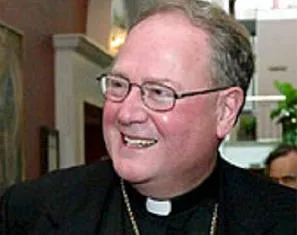
“...The obedience I freely and enthusiastically promised to Jesus Christ, His Church, and His vicar on earth, our Holy Father, is a very liberating act. So, I place my future in the hands of the Lord, whose grace and mercy endure forever, and I go.”
The Tablet Tries to Silence Father Finigan's Response
 From Father Z:
"This is hilarious. His Hermeneuticalness, Fr. Tim Finigan, who was recently the object of a mean-spirited hit-piece by Elena Curti in the pages of The Tablet, writes:
CENSORED!
The Tablet have asked me to remove this post because it is a breach of copyright for me to quote their article in full. A new copyright-compliant version is available at the post: Responding to the Tablet – legally compliant version
It is hilarious to see the Tablet failing utterly to grasp the concept of publishing on the internet.
 During a recent cordial phone chat about this sad affair, Fr. Finigan and I predicted that The Pill would come after him for responding in detail.
Right on schedule.
This says a great deal about The Tablet.
First, they drag him on a hurdle through the liberal parishes and chanceries willing to swallow the their message.
Then they whine when he frees an arm and bloodies their noses with his bonds.
They want him to go quietly.
Bullies are ever craven.
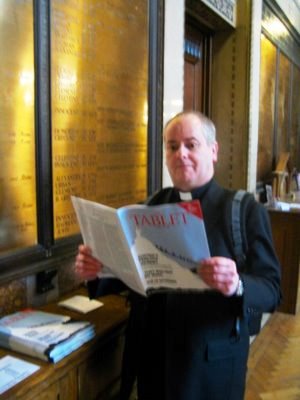 Second, they are stuck not only in the washed-up ecclesiology of the ‘70’s, they are stuck in the ‘70’s tools of social communication.
They think they are going to contain what they did to Fr. Finigan.
I checked Wikipedia for The Tablet and found that in 2006 it had a circulation, if the number is accurate, of 23,628. I suppose most of that involves the copies off-loaded in parish churches.
I get more readers than that every day.
And I hope everyone of them will visit Fr. Finigan’s site!
You know… if they all sent Fr. Finigan £ 1.00 ... just to, you know, offset the expense of his ultra-right wing clerical garb …. imagine what The Pill could write about next? Imagine how irritating that would be to the progressivists. "
"We shall go with thee!"
From The Sons of the Most Holy Redeemer, (F.SS.R.):
 Ecce ascendimus Ierosolyman, et consumabuntur omnia...
 Last May,
  Today, seven months later,
sub + Petro
Quinquagesima Sunday
Feast of the Chair of Saint Peter
 Ecce ascendimus Ierosolyman, et consumabuntur omnia...
Behold we go up to Jerusalem; and all things shall be accomplished...
 Last May,
 Brother Maximilian,
born near the Redemptorist monastery of Tuchow, Poland,
who had been a member of the Society of St. Pius X since 1999,
had his religious vows formally dispensed by his Parish Priest
in order to live in full communion with the Chair of Peter.

Following his dispensation,
in a certain hermenutic of continuity,
Brother Maximilian has been living on Papa Stronsay
as a postulant.
 Today, seven months later,
 on the feast of the Chair of St. Peter,
he was clothed in the habit
of
the Sons of the Most Holy Redeemer.

Priest: Receive, my Son, the image of the crucifix,
image of Thy Master and Redeemer,
who suffered for thee and offered Himself for thee.
Place it as a standard upon thy heart,
as a seal upon thy arm.
Novice: I will die O Lord for the love of Thy love
who has deigned to die for the love of my love.

He took the religious name:
Brother Bernard
In honour of
The Servant of God,
Father Bernard Lubienski, C.SS.R.(1846 – 1933)
 Dum esset Summus Pontifex,
Terrena non metuit,
Sed ad caelestia regna
Gloriosus migravit.
While he was Supreme Pontiff
He feared no earthly powers,
But went his way in glory
To the heavenly kingdom.
Oremus pro beatissimo Papa nostro Benedicto
Dominus conservet eum,
Et vivificet eum,
Et beatum faciat eum in terra,
Et non tradat eum in animam inimicorum eius.
Let us pray for our Holy Father Pope Benedict.
May the Lord preserve him
and give him life
and make him blessed upon earth.
And deliver him not up
to the will of his enemies.


Conservative Episcopal bishop resigned to become Roman Catholic priest
By Olivier Uyttebrouck
The Albuquerque Journal - As bishop of the Episcopal Diocese of the Rio Grande, the Rev. Jeffrey Steenson came down on the conservative side of many issues.
He opposed the election of the first openly gay bishop, and he did not allow the blessing of same-sex unions in his diocese.
Steenson said those conflicts made it impossible for him to pursue his ultimate goal of helping the Anglican Communion unite with the Roman Catholic Church.
On Saturday, both Catholics and Episcopalians celebrated Steenson's ordination as a Roman Catholic priest. Steenson, a married father of three, said he is the first sitting Episcopal bishop since 1852 to resign to become a Roman Catholic.
"Jeffrey and I have been in conversation for a number of years," Archbishop Michael Sheehan told several hundred who attended the ordination ceremony at St. Thomas Aquinas Catholic Church in Rio Rancho.
"Of course, I have to say, that he has the greatest respect for his Episcopal and theological roots."
Steenson served as bishop of the Rio Grande diocese from 2004 to 2007 at a divisive time for Episcopalians, both in New Mexico and nationally.
~~snip~~
Steenson said his decision to choose Catholicism while serving as a sitting Episcopal bishop was "extremely difficult."
"I would say it was an agonizing decision, because of the pastoral responsibilities I think I had," he said.
But the "democratic" nature of the Episcopal Church led him to sever ties with the protestant denomination, he said.
"The Episcopal Church is purely a democratic organization," Steenson said. "It governs itself democratically, and it doesn't have to answer to anyone for the decisions it makes. I just felt that I didn't believe in that view of the church."
The Albuquerque Journal - As bishop of the Episcopal Diocese of the Rio Grande, the Rev. Jeffrey Steenson came down on the conservative side of many issues.
He opposed the election of the first openly gay bishop, and he did not allow the blessing of same-sex unions in his diocese.
Steenson said those conflicts made it impossible for him to pursue his ultimate goal of helping the Anglican Communion unite with the Roman Catholic Church.
On Saturday, both Catholics and Episcopalians celebrated Steenson's ordination as a Roman Catholic priest. Steenson, a married father of three, said he is the first sitting Episcopal bishop since 1852 to resign to become a Roman Catholic.
"Jeffrey and I have been in conversation for a number of years," Archbishop Michael Sheehan told several hundred who attended the ordination ceremony at St. Thomas Aquinas Catholic Church in Rio Rancho.
"Of course, I have to say, that he has the greatest respect for his Episcopal and theological roots."
Steenson served as bishop of the Rio Grande diocese from 2004 to 2007 at a divisive time for Episcopalians, both in New Mexico and nationally.
~~snip~~
Steenson said his decision to choose Catholicism while serving as a sitting Episcopal bishop was "extremely difficult."
"I would say it was an agonizing decision, because of the pastoral responsibilities I think I had," he said.
But the "democratic" nature of the Episcopal Church led him to sever ties with the protestant denomination, he said.
"The Episcopal Church is purely a democratic organization," Steenson said. "It governs itself democratically, and it doesn't have to answer to anyone for the decisions it makes. I just felt that I didn't believe in that view of the church."
From Infused Knowledge:
"I'm the only Catholic in my family, but I'm proud to say I've taught my relatives to have proper reverence for the holy Faith. They demonstrated their abiding respect just last Christmas when one of them gave me this dignified calendar:"

"And as if we needed more proof that they're in awe of my religion, here's another Christmas gift they gave me:"

"I'm the only Catholic in my family, but I'm proud to say I've taught my relatives to have proper reverence for the holy Faith. They demonstrated their abiding respect just last Christmas when one of them gave me this dignified calendar:"

"And as if we needed more proof that they're in awe of my religion, here's another Christmas gift they gave me:"

Sunday, February 22, 2009
Pontiff Requests Prayer for Fulfillment of Mission

Says Rome's Primacy Protects Unity and Diversity in Church
VATICAN CITY, FEB. 22, 2009 (Zenit.org).- Benedict XVI is asking for prayers, on this feast of the Chair of Peter, for a successful fulfillment of his mission as the Bishop of Rome.
The Pope made this request today in an address to those gathered in St. Peter's Square for the Angelus.
He affirmed that the "chair of Peter symbolizes the authority of the Bishop of Rome, who is called to perform a special service for the whole People of God."
The Pontiff noted that the "primacy of the Church of Rome in the Catholic community was recognized" immediately after the martyrdom of St. Peter and St. Paul.
He underlined the fact that within the Church, "particular Churches hold a rightful place" and "retain their own traditions, without in any way opposing the primacy of the Chair of Peter, which presides over the whole assembly of charity."
This Chair, the Holy Father added, "protects legitimate differences, while at the same time assuring that such differences do not hinder unity but rather contribute toward it."
He asked for the prayers of the Church in order to be able to "faithfully carry out this great task, entrusted [...] by Providence, as successor to the Apostle Peter."
Spiritual healing
Benedict XVI also dedicated some words to reflect on the Gospel account of Jesus' healing of the paralytic.
He affirmed the story's proof that "Jesus has the power not only to heal the sick body but also to forgive sins."
The Pope added: "The physical healing is a sign of the spiritual healing that his forgiveness produces.
"In effect, sin is a kind of paralysis of the spirit, from which only the power of the merciful love of God can liberate us, allowing us to pick ourselves up and set out again along the path of goodness."
James MacMillan: Tablet attack on Fr Tim Finigan is a 'disgrace'
From Damian Thompson :

"James MacMillan, Britain's foremost Catholic composer and a long-time contributor to The Tablet, has written to the magazine's deputy editor Elena Curti describing her article about Fr Tim Finigan and Our Lady of the Rosary, Bleckfen, as a "disgrace" that may be actionable.
"I hope the good parishioners of Our Lady of the Rosary can find it in their hearts to forgive you and pray for you," he tells her.
This week's Bitter Pill contains a hatchet job by Curti on Fr Tim - one of this country's finest priests - for offering Mass in the Extraordinary Form alongside the new rite. In one place, Curti implies that Fr Tim is less than open about parish expenditure on vestments – a disgraceful imputation that he is able to refute easily.
Over the last few days, I've sensed that The Tablet has seriously blundered by allowing its most biased writer to stir up trouble in one of the few parishes which is putting Summorum Pontificum into practice. Fr Finigan is a formidable and holy priest – and a nice bloke with friends across the Catholic world. In a properly run Church he would be a bishop.
Now Dr MacMillan - whose masterpiece, the St John Passion, has just been recorded by Sir Colin Davies and the LSO - has written to Ms Curti to express his fury at the trashing of Fr Finigan. He writes;
Dear Ms Curti,
I am a Scottish Catholic composer who has on many occasions contributed articles to your magazine, The Tablet. I have always seen the journal as an important and sensible Catholic voice in the media. Nevertheless, I have been alarmed at the drift of the paper in recent months, especially relating to matters to do with the liturgy, which is a special interest of mine. Your latest article on Fr Tim Finigan has unfortunately plumbed new depths that I thought I would never see in a Christian publication. The whole tone was disrespectful, mischief-making and opportunistic, lacking no palpable sense of Christian charity. The Tablet has a special responsibility not to allow these issues to develop into a "civil war" between Catholics. Our liturgy is in a deplorable state and, in the spirit of Vatican II, it is imperative that steps are taken to reform the reform for the good of the faithful. There is no attempt by the Pope, or Fr Finigan for that matter, to turn back the clock. The limited reappearance of the Extraordinary Rite will contribute to a renewal and blossoming in our wider liturgical education and awareness, and in the process advance the faith of Catholics starved of good practice in this regard.
The implied assaults on the character of Fr Finigan were a disgrace, and at one point, when you suggest financial impropriety, may be actionable. I hope the good parishioners of Our Lady of the Rosary can find it in their hearts to forgive you and pray for you.
Yours sincerely,
James MacMillan CBE
I agree with every word of that; and I've also suggested that Holy Smokers might want to contribute to the expenses of Our Lady of the Rosary in staging a dignified liturgy: the details are here."


Rebel Australia priest defies sacking: reports
SYDNEY (AFP) – A rebel Catholic priest in Australia, who was sacked for blessing gay couples and allowing women to preach, defied his archbishop and led mass on Sunday, media reports said.
Father Peter Kennedy preached in front of hundreds of parishioners gathered to show support after his dismissal last week, national news agency AAP reported.
The Catholic church said Kennedy's nominated replacement did not attend Sunday service in Brisbane on police advice following a bomb threat against Archbishop John Bathersby, who sacked the 71-year-old Kennedy.
Kennedy does not dispute breaching church rules but argues his actions are in line with the Vatican's call for people to take full and active participation in the liturgy.
"It's sad the archbishop is not here because if he was, he could not turn away from this community," Kennedy told the congregation, denying that any of his followers were behind the bomb threat.
He told AFP last week he had blessed about 10 gay and lesbian unions during his time at St Mary's parish and welcomed women preachers, describing the Catholic Church as "the biggest boy's club in the world."
The congregation reportedly chanted "we shall not be moved" at the end of the service, with parishioner Allaway Allan telling the Australian Broadcasting Corporation he was not surprised by the show of support.
"This just demonstrates what a damn good job Father Peter Kennedy is doing," Allan said.
Archbishop Bathersby said an independent mediator would most likely be called to solve the impasse.
"The Church is fully entitled to have this decree obeyed and to have its ownership of the St Mary's church respected," he said Saturday.
Father Peter Kennedy preached in front of hundreds of parishioners gathered to show support after his dismissal last week, national news agency AAP reported.
The Catholic church said Kennedy's nominated replacement did not attend Sunday service in Brisbane on police advice following a bomb threat against Archbishop John Bathersby, who sacked the 71-year-old Kennedy.
Kennedy does not dispute breaching church rules but argues his actions are in line with the Vatican's call for people to take full and active participation in the liturgy.
"It's sad the archbishop is not here because if he was, he could not turn away from this community," Kennedy told the congregation, denying that any of his followers were behind the bomb threat.
He told AFP last week he had blessed about 10 gay and lesbian unions during his time at St Mary's parish and welcomed women preachers, describing the Catholic Church as "the biggest boy's club in the world."
The congregation reportedly chanted "we shall not be moved" at the end of the service, with parishioner Allaway Allan telling the Australian Broadcasting Corporation he was not surprised by the show of support.
"This just demonstrates what a damn good job Father Peter Kennedy is doing," Allan said.
Archbishop Bathersby said an independent mediator would most likely be called to solve the impasse.
"The Church is fully entitled to have this decree obeyed and to have its ownership of the St Mary's church respected," he said Saturday.
"Enough is Enough!"
From Fr. Ray Blake of Saint Mary Magdalen, Brighton, U.K.:
"I know he is the chairman and not the delivery boy but I wrote to Sir Michael Quinlan at the Tablet telling him I could not in good conscience continue to be seen giving my support or that of my parishioners to the Tablet, therefore after selling it for a century at the back of the Church we would no longer do so. I asked to ensure it was no longer sent to us.The reasons I cited were Robert Mickens' disrespectful treatment of the Holy Father, about which I have previously exchanged correspondence with the editor. I agreed then to give The Tablet a second chance, I must confess I enjoy their arts pages.However with the shoddiness of Elena Curti's piece on Fr Tim and Blackfen, enough is enough.I know of two other priests who have made the same decision today from my own diocese.I think The Tablet might well begin to look at itself a little more critically after this weekend, especially if half the people who have commented on the blogosphere actually write to the Tablet.We actually do need a good journal like The Tablet but it needs to be Catholic and have mainstreams orthodox Catholics on its editorial board and as contributors, the days of reactionary hippies are coming to their end and so must The Tablet in its present form. Its contributors are aging, as are its readers, if it is to survive it has to attract new readers, it will not without a clear Catholic identity."

Saturday, February 21, 2009
Oscars
"One new idea thought up by the producers that will be seen Sunday? Trophy boys. The result is that very handsome young men will now join very beautiful young women on stage carrying out the Oscar statuettes. If that's not an acknowledgement that the viewership for the Academy Awards these days is limited to only females and gays, I don't know what is." - Nikki Finke
Blessed Noel Pinot
From Fr. Tim Finigan of Our Lady of the Rosary, Blackfen:
"Jane Teresa of the blog My heart was restless passed on to me the story of a martyr priest from the time of the French Revolution who went to his death on this day in 1794. He refused to take the oath of allegiance to the "Civil Constitution of the Clergy", a law passed by the Constituent Assembly of the Revolution which subjected the Church to the civil government.
Many priests and religious understandably fled the country and did great work elsewhere - including the USA. A brave few actually stayed on to minister to their flock - among them Blessed Noel Pinot. After refusing to take the oath he had to go into hiding but he came back publicly after the initial success of the rising in the Vendée.
During the brutal suppression of the rising (with atrocities amounting to genocide) Fr Pinot was captured while fully vested for Mass. He was dragged through the streets to the jeers of hostile spectators and soldiers and thrown into prison. After twelve days, he was sentenced to death for refusing to take the oath.
He went to the guillotine still vested for Mass and repeatedly praying the words that begin the Mass: "Introibo ad altare Dei, ad Deum qui laetificat iuventutem meam.
Whenever we suffer, we should always remember that our trials are puny compared to those of the heroic martyrs of the faith."

Pope gives Pelosi pre-excommunication warning
By Michael Gaynor
By visiting Pope Benedict and then issuing the public statement she issued after the meeting, Pelosi has made it imperative for her bishop to begin excommunication proceedings against her and distributors of Holy communion to refuse her under canon law, to avoid sin themselves.
The title of that Catholic News Service (CNA) article on their meeting is "Pope Benedict strongly rebukes Pelosi over abortion," but it may as well have been "Pope Prepares for Pelosi Ex-communication, if She Won't Repent."
Speaker of the House Nancy Pelosi regularly claims to be an ardent Catholic while ardently supporting abortion. She has supported even taxpayer funded abortions and opposed a partial-birth abortion ban.
CNA highlighted that Pelosi was rebuked for her abortion advocacy and denied a photo-op by his Holiness, Pope Benedict XVI:
"House speaker Nancy Pelosi's photo-op with Pope Benedict XVI turned sour when the Pontiff used the 15-minute meeting to reaffirm the teachings of the Catholic Church on the right to life and the duty to protect the unborn.
"No photo of Nancy Pelosi and the Pope will be forthcoming, since the meeting was closed to reporters and photographers. The two met in a small room in the Vatican just after the Pope's weekly public audience."
Immediately after the meeting, the Vatican press office released this statement:
"Following the general audience the Holy Father briefly greeted Nancy Pelosi, Speaker of the United States House of Representatives, together with her entourage."His Holiness took the opportunity to speak of the requirements of the natural moral law and the Church's consistent teaching on the dignity of human life from conception to natural death which enjoin all Catholics, and especially legislators, jurists and those responsible for the common good of society, to work in co-operation with all men and women of good will in creating a just system of laws capable of protecting human life at all stages of its development."
Pelosi should humbly heed the words of Pope Benedict that she heard and repent.
If not, Pope Benedict paved the way for her excommunication.
Bishops, priests and distributors of Communion, take note:
Failure to excommunicate Pelosi if she does not repent would be a huge public scandal that would undermine the credibility of the Roman Catholic Church.
Giving Pelosi Holy Communion if she does not repent would be a sacrilege as well as a public scandal that would undermine the credibility of the Roman Catholic Church.
The day before the Speaker met the Pope, Jon O'Brien, president of "Catholics for Choice," told The Hill that their meeting would be an opportunity to highlight that one can be pro-choice and Catholic, and that there are much bigger issues out there to discuss, such as the fate of the poor in the global economic downturn.
That is patent nonsense and the fact that the Pope spent his time talking with Pelosi on the right to life and the need to defend the unborn demonstrates it.
Last year Pelosi said on "Meet The Press": "I would say that as an ardent, practicing Catholic, [when life begins] is an issue that I have studied for a long time. And what I know is over the centuries, the doctors of the church have not been able to make that definition ... St. Augustine said at three months. We don't know. The point is, is that it shouldn't have an impact on the woman's right to choose."
Pope Benedict personally explained to Pelosi that life begins at conception.
Previously the United States Conference of Catholic Bishops had issued a public statement correcting Speaker Pelosi and stating: "Since the first century the church has affirmed the moral evil of every procured abortion. This teaching has not changed and remains unchangeable. Direct abortion, that is to say, abortion willed either as an end or a means, is gravely contrary to the moral law."
Pelosi's office eventually released a statement on her papal visit that completely ignored life issues.
Pelosi said in her statement:
"It is with great joy that my husband, Paul, and I met with his Holiness, today. In our conversation, I had the opportunity to praise the Church's leadership in fighting poverty, hunger, and global warming, as well as the Holy Father's' dedication to religious freedom and his upcoming trip and message to Israel.
"I was proud to show his Holiness a photograph of my family's Papal visit in the 1950s, as well as a recent picture of our children and grandchildren."
George Weigel, a distinguished senior fellow of Washington's Ethics and Public Policy Center, cleverly titled his article on the meeting "Were They at the Same Meeting?" and deemed Pelosi both shameless and confused.
Mr. Weigel:
"Charity requires that one concede the possibility that genuine piety was a part of Pelosi's (rather boorish, and certainly irregular) insistence on being given a private moment with the pope during her current taxpayer-funded junket to Rome. But her office's statement on today's meeting makes it clear something else was afoot: that Pelosi, who shamelessly trumpets her 'ardent' Catholicism while leading congressional Democrats in a continuing assault on what the Catholic Church regards as the inalienable human rights of the unborn, was trying to recruit Benedict XVI ('Joseph Ratzinger, D., Bavaria'?) to Team Nancy.
"His Holiness wasn't buying it.
"He told Pelosi, politely but unmistakably, that her relentlessly pro-abortion politics put her in serious difficulties as a Catholic, which was his obligation as a pastor. He also underscored — for Pelosi, Joe Biden, Ted Kennedy, John Kerry, Barbara Mikulski, Rose DeLauro, Kathleen Sebelius, and everyone else — that the Church's opposition to the taking of innocent human life, at any stage of the human journey, is not some weird Catholic hocus-pocus; it's a first principle of justice than can be known by reason. It is a 'requirement of the natural moral law' — that is, the moral truths we can know by thinking about what is right and what is wrong — to defend the inviolability of innocent human life. You don't have to believe in papal primacy to know that; you don't have do believe in seven sacraments, or the episcopal structure of the Church, or the divinity of Christ, to know that. You don't even have to believe in God to know that. You only have to be a morally serious human being, willing to work through a moral argument — which, of course, means being the kind of person who understands that moral truth cannot be reduced to questions of feminist political correctness or partisan political advantage."
Amen!
Mr. Weigel opined that "Pelosi is deeply confused about what her church teaches on the morality of abortion, and why" and speculated that Pelosi "may have come to her bizarre views on her own." but "it's far more likely that she has been un-catechized, so to speak, by Catholic intellectuals and clerics who find Catholic teaching on life issues an embarrassment among their high-minded friends and colleagues of the progressive persuasion."
Mr. Weigel certainly was charitable, and may be right, that Pelosi actually is "deeply confused." But history shows that Democrat politicians with national aspirations like former 1980 Democrat presidential hopeful and still Senator Ted Kennedy, former Senator now Vice President Joe Biden, 2004 Democrat presidential candidate and Senator John Kerry and Pelosi adopted a pro-abortion view that has served their political interests instead of being faithful to fundamental Catholic teaching, confusion is the most charitable explanation and rank political opportunism seems to be a more plausible explanation in at least some cases.
Be that as it may, it is wonderful that Pelosi met with Pope Benedict, because now there is absolutely no question that she has been admonished by the Roman Catholic Church's highest authority that she has separated herself from what she still claims to be her Roman Catholic faith.
Mr. Weigel:
"Whatever the source of her confusion, Pelosi has now been informed, and by a world-class intellectual who happens to be the universal pastor of the Catholic Church, that she is, in fact, confused, and that both her spiritual life and her public service are in jeopardy because of that.
"Moreover, it is reasonable to assume that Pope Benedict did not have only Pelosi in mind when he said what he had to say about the obligations of moral reason and the duties of statesmanship. President Obama is not a Catholic, but he should understand that he will get the same message if, as expected, he meets with His Holiness later this year."
It is noteworthy that contrary to normal protocols for such meetings with dignitaries, no photos of Pelosi with the Pope have been released and that, diplomatic language notwithstanding, Pope Benedict firmly rebuked Pelosi.
Vatican correspondent John Allen, who writes for National Catholic Reporter, noted that "routine Vatican declarations after diplomatic meetings also generally sum up the range of issues discussed rather than concentrating on a particular point. In that sense, the statement can only be read as a rejection of Pelosi's statements last summer, and, in general, of her argument that it's acceptable for Catholics in public life to take a pro-choice position."
Exactly!
By visiting Pope Benedict and then issuing the public statement she issued after the meeting, Pelosi has made it imperative for her bishop to begin excommunication proceedings against her and distributors of Holy communion to refuse her under canon law, to avoid sin themselves.
Finally, given the widespread misreporting and confusion in the American media on Mrs. Pelosi's audience with the Holy Father, here are some helpful facts from a learned priest:
1) The Holy Father receives in formal audience — apart from hierarchs and member of the diplomatic corps — only heads of state and heads of government. (E.g. Queen Elizabeth II is received as head of state, and wears black with court jewels — Catholic queens regnant or consort wear white with Papal decorations; male monarchs and royal consorts wear court dress and decorations. Mr. Brown as PM would be received less formally as head of government.) These audiences are in the Apostolic Palace. The Pope wears a red mantaletta trimmed with fur in audience with a head of state — red satin in summer, red velvet in winter trimmed with ermine, and white silk trimme with ermine in Paschal tide, on top of a rochet, and wering the Papal stole embroidered with figures of SS. Peter and Paul — and meets the visting head of state (who has been greeted at in the Damacen court by the Master of the Papal Household and other domestic prelates and chamberlains) at the lintel of his private apartments.
(As Prince of Princes, the Pontiff receives no one, except a Patriarch, at the front entrance to his residence as heads of state normally greet each other; notable exceptions to this have been Constantine in 800 and President Bush last year, when the Pope met him at the door to the Tower of the Winds. This was an historic gesture and one which stunned Europeans although our media in its ignorance had no grasp of its significance. But President Bush was informed ahead of time by the Vatican that the Pope would do this and he thanked the Pope for this "historic honor." In Bush's instance, the Pope was clearly making a sign of his special regard for him.)
Often, as a courtesy, the Pontiff will receive in the Apostolic Palace the spouse of a head of state or government without the above protocols. In every instance, the Pope does not appear until the visitor has arrived, since no one may be late for a Papal audience. Pope Pius XII once received Eva Peron as a gesture to the Argentinian people (the Argentinian government had given a large donation for the new main building of the Gregorian University.) She was 20 minutes late, so the Papal chamberlains kept her waiting 21 minutes before the Pope received her, and she was given a minor decoration instead of a customary higher order.
Mrs. Pelosi has no protocol rank equivalent to the above. In all papal ceremonies, monarchs take precedence over elected heads of state (eg. the President of the United States would sit behind the king of Tonga or the Archduke of Luxembourg).
2) Mrs. Pelosi was given the lowest ranking audience possible: a "baciamano" — which is granted to thousands of people, usually after they have been standing behind a barrier. It lasts only a few minutes and was not in the state reception rooms. She and her small group were lined up with various civil figures and representatives of lay groups and pilgrimage party and had to wait her turn after the general audience (attended by thousands of people in the Paul VI Audience Hall).
3) The Pope made the unusual gesture of giving a brief talk to her and her entourage on the right to life, which by its exceptional nature was an instruction and admonition.
4) This Pope rarely invites anyone to his private Mass. Mrs. Pelosi was not invited and she certainly did not receive communion from the Pope.
5) Contrary to some hysterical reports, she was given no award. She was not even given a papal decoration or gift, which is interpreted as a sign of disapproval. She may have been given a rosary, but everyone who speaks to a Pope is given one (children, the infirm, etc.).
6) The Vatican issued a statement making clear that Mrs. Pelosi was given an admonition. Rarely does this happen at a baciamano.
By visiting Pope Benedict and then issuing the public statement she issued after the meeting, Pelosi has made it imperative for her bishop to begin excommunication proceedings against her and distributors of Holy communion to refuse her under canon law, to avoid sin themselves.
The title of that Catholic News Service (CNA) article on their meeting is "Pope Benedict strongly rebukes Pelosi over abortion," but it may as well have been "Pope Prepares for Pelosi Ex-communication, if She Won't Repent."
Speaker of the House Nancy Pelosi regularly claims to be an ardent Catholic while ardently supporting abortion. She has supported even taxpayer funded abortions and opposed a partial-birth abortion ban.
CNA highlighted that Pelosi was rebuked for her abortion advocacy and denied a photo-op by his Holiness, Pope Benedict XVI:
"House speaker Nancy Pelosi's photo-op with Pope Benedict XVI turned sour when the Pontiff used the 15-minute meeting to reaffirm the teachings of the Catholic Church on the right to life and the duty to protect the unborn.
"No photo of Nancy Pelosi and the Pope will be forthcoming, since the meeting was closed to reporters and photographers. The two met in a small room in the Vatican just after the Pope's weekly public audience."
Immediately after the meeting, the Vatican press office released this statement:
"Following the general audience the Holy Father briefly greeted Nancy Pelosi, Speaker of the United States House of Representatives, together with her entourage."His Holiness took the opportunity to speak of the requirements of the natural moral law and the Church's consistent teaching on the dignity of human life from conception to natural death which enjoin all Catholics, and especially legislators, jurists and those responsible for the common good of society, to work in co-operation with all men and women of good will in creating a just system of laws capable of protecting human life at all stages of its development."
Pelosi should humbly heed the words of Pope Benedict that she heard and repent.
If not, Pope Benedict paved the way for her excommunication.
Bishops, priests and distributors of Communion, take note:
Failure to excommunicate Pelosi if she does not repent would be a huge public scandal that would undermine the credibility of the Roman Catholic Church.
Giving Pelosi Holy Communion if she does not repent would be a sacrilege as well as a public scandal that would undermine the credibility of the Roman Catholic Church.
The day before the Speaker met the Pope, Jon O'Brien, president of "Catholics for Choice," told The Hill that their meeting would be an opportunity to highlight that one can be pro-choice and Catholic, and that there are much bigger issues out there to discuss, such as the fate of the poor in the global economic downturn.
That is patent nonsense and the fact that the Pope spent his time talking with Pelosi on the right to life and the need to defend the unborn demonstrates it.
Last year Pelosi said on "Meet The Press": "I would say that as an ardent, practicing Catholic, [when life begins] is an issue that I have studied for a long time. And what I know is over the centuries, the doctors of the church have not been able to make that definition ... St. Augustine said at three months. We don't know. The point is, is that it shouldn't have an impact on the woman's right to choose."
Pope Benedict personally explained to Pelosi that life begins at conception.
Previously the United States Conference of Catholic Bishops had issued a public statement correcting Speaker Pelosi and stating: "Since the first century the church has affirmed the moral evil of every procured abortion. This teaching has not changed and remains unchangeable. Direct abortion, that is to say, abortion willed either as an end or a means, is gravely contrary to the moral law."
Pelosi's office eventually released a statement on her papal visit that completely ignored life issues.
Pelosi said in her statement:
"It is with great joy that my husband, Paul, and I met with his Holiness, today. In our conversation, I had the opportunity to praise the Church's leadership in fighting poverty, hunger, and global warming, as well as the Holy Father's' dedication to religious freedom and his upcoming trip and message to Israel.
"I was proud to show his Holiness a photograph of my family's Papal visit in the 1950s, as well as a recent picture of our children and grandchildren."
George Weigel, a distinguished senior fellow of Washington's Ethics and Public Policy Center, cleverly titled his article on the meeting "Were They at the Same Meeting?" and deemed Pelosi both shameless and confused.
Mr. Weigel:
"Charity requires that one concede the possibility that genuine piety was a part of Pelosi's (rather boorish, and certainly irregular) insistence on being given a private moment with the pope during her current taxpayer-funded junket to Rome. But her office's statement on today's meeting makes it clear something else was afoot: that Pelosi, who shamelessly trumpets her 'ardent' Catholicism while leading congressional Democrats in a continuing assault on what the Catholic Church regards as the inalienable human rights of the unborn, was trying to recruit Benedict XVI ('Joseph Ratzinger, D., Bavaria'?) to Team Nancy.
"His Holiness wasn't buying it.
"He told Pelosi, politely but unmistakably, that her relentlessly pro-abortion politics put her in serious difficulties as a Catholic, which was his obligation as a pastor. He also underscored — for Pelosi, Joe Biden, Ted Kennedy, John Kerry, Barbara Mikulski, Rose DeLauro, Kathleen Sebelius, and everyone else — that the Church's opposition to the taking of innocent human life, at any stage of the human journey, is not some weird Catholic hocus-pocus; it's a first principle of justice than can be known by reason. It is a 'requirement of the natural moral law' — that is, the moral truths we can know by thinking about what is right and what is wrong — to defend the inviolability of innocent human life. You don't have to believe in papal primacy to know that; you don't have do believe in seven sacraments, or the episcopal structure of the Church, or the divinity of Christ, to know that. You don't even have to believe in God to know that. You only have to be a morally serious human being, willing to work through a moral argument — which, of course, means being the kind of person who understands that moral truth cannot be reduced to questions of feminist political correctness or partisan political advantage."
Amen!
Mr. Weigel opined that "Pelosi is deeply confused about what her church teaches on the morality of abortion, and why" and speculated that Pelosi "may have come to her bizarre views on her own." but "it's far more likely that she has been un-catechized, so to speak, by Catholic intellectuals and clerics who find Catholic teaching on life issues an embarrassment among their high-minded friends and colleagues of the progressive persuasion."
Mr. Weigel certainly was charitable, and may be right, that Pelosi actually is "deeply confused." But history shows that Democrat politicians with national aspirations like former 1980 Democrat presidential hopeful and still Senator Ted Kennedy, former Senator now Vice President Joe Biden, 2004 Democrat presidential candidate and Senator John Kerry and Pelosi adopted a pro-abortion view that has served their political interests instead of being faithful to fundamental Catholic teaching, confusion is the most charitable explanation and rank political opportunism seems to be a more plausible explanation in at least some cases.
Be that as it may, it is wonderful that Pelosi met with Pope Benedict, because now there is absolutely no question that she has been admonished by the Roman Catholic Church's highest authority that she has separated herself from what she still claims to be her Roman Catholic faith.
Mr. Weigel:
"Whatever the source of her confusion, Pelosi has now been informed, and by a world-class intellectual who happens to be the universal pastor of the Catholic Church, that she is, in fact, confused, and that both her spiritual life and her public service are in jeopardy because of that.
"Moreover, it is reasonable to assume that Pope Benedict did not have only Pelosi in mind when he said what he had to say about the obligations of moral reason and the duties of statesmanship. President Obama is not a Catholic, but he should understand that he will get the same message if, as expected, he meets with His Holiness later this year."
It is noteworthy that contrary to normal protocols for such meetings with dignitaries, no photos of Pelosi with the Pope have been released and that, diplomatic language notwithstanding, Pope Benedict firmly rebuked Pelosi.
Vatican correspondent John Allen, who writes for National Catholic Reporter, noted that "routine Vatican declarations after diplomatic meetings also generally sum up the range of issues discussed rather than concentrating on a particular point. In that sense, the statement can only be read as a rejection of Pelosi's statements last summer, and, in general, of her argument that it's acceptable for Catholics in public life to take a pro-choice position."
Exactly!
By visiting Pope Benedict and then issuing the public statement she issued after the meeting, Pelosi has made it imperative for her bishop to begin excommunication proceedings against her and distributors of Holy communion to refuse her under canon law, to avoid sin themselves.
Finally, given the widespread misreporting and confusion in the American media on Mrs. Pelosi's audience with the Holy Father, here are some helpful facts from a learned priest:
1) The Holy Father receives in formal audience — apart from hierarchs and member of the diplomatic corps — only heads of state and heads of government. (E.g. Queen Elizabeth II is received as head of state, and wears black with court jewels — Catholic queens regnant or consort wear white with Papal decorations; male monarchs and royal consorts wear court dress and decorations. Mr. Brown as PM would be received less formally as head of government.) These audiences are in the Apostolic Palace. The Pope wears a red mantaletta trimmed with fur in audience with a head of state — red satin in summer, red velvet in winter trimmed with ermine, and white silk trimme with ermine in Paschal tide, on top of a rochet, and wering the Papal stole embroidered with figures of SS. Peter and Paul — and meets the visting head of state (who has been greeted at in the Damacen court by the Master of the Papal Household and other domestic prelates and chamberlains) at the lintel of his private apartments.
(As Prince of Princes, the Pontiff receives no one, except a Patriarch, at the front entrance to his residence as heads of state normally greet each other; notable exceptions to this have been Constantine in 800 and President Bush last year, when the Pope met him at the door to the Tower of the Winds. This was an historic gesture and one which stunned Europeans although our media in its ignorance had no grasp of its significance. But President Bush was informed ahead of time by the Vatican that the Pope would do this and he thanked the Pope for this "historic honor." In Bush's instance, the Pope was clearly making a sign of his special regard for him.)
Often, as a courtesy, the Pontiff will receive in the Apostolic Palace the spouse of a head of state or government without the above protocols. In every instance, the Pope does not appear until the visitor has arrived, since no one may be late for a Papal audience. Pope Pius XII once received Eva Peron as a gesture to the Argentinian people (the Argentinian government had given a large donation for the new main building of the Gregorian University.) She was 20 minutes late, so the Papal chamberlains kept her waiting 21 minutes before the Pope received her, and she was given a minor decoration instead of a customary higher order.
Mrs. Pelosi has no protocol rank equivalent to the above. In all papal ceremonies, monarchs take precedence over elected heads of state (eg. the President of the United States would sit behind the king of Tonga or the Archduke of Luxembourg).
2) Mrs. Pelosi was given the lowest ranking audience possible: a "baciamano" — which is granted to thousands of people, usually after they have been standing behind a barrier. It lasts only a few minutes and was not in the state reception rooms. She and her small group were lined up with various civil figures and representatives of lay groups and pilgrimage party and had to wait her turn after the general audience (attended by thousands of people in the Paul VI Audience Hall).
3) The Pope made the unusual gesture of giving a brief talk to her and her entourage on the right to life, which by its exceptional nature was an instruction and admonition.
4) This Pope rarely invites anyone to his private Mass. Mrs. Pelosi was not invited and she certainly did not receive communion from the Pope.
5) Contrary to some hysterical reports, she was given no award. She was not even given a papal decoration or gift, which is interpreted as a sign of disapproval. She may have been given a rosary, but everyone who speaks to a Pope is given one (children, the infirm, etc.).
6) The Vatican issued a statement making clear that Mrs. Pelosi was given an admonition. Rarely does this happen at a baciamano.
Subscribe to:
Posts (Atom)