By Father Erik Richtsteig
And that relationship is particularly dear to priests. That relationship is also supposed to exist between priests and their bishop. However, like so many parents, all too often bishops are friends or brothers to their priests. Worse they are business managers who play favorites and are only heard from when there are problems. But during my priesthood I have always had the feeling that the Pope was there covering our backs. That we were his priest sons even when we needed to be challenged and corrected. Now, not so much.
There is this commentary over at the register about anxiety over Pope Francis. Here is the relevant section on priests. (continued)

Saturday, October 26, 2013


Sunday, October 20, 2013
For Fr. Gordon MacRae’s Appeal to Move Forward, Help Is Needed

By Ryan A. MacDonald
New Hampshire courts have declined to hear the habeas corpus appeal of Fr Gordon MacRae, and now an appeal to federal court begins, but the help of many is needed.
(These Stone Walls) Editor’s Note: This is a guest post by Ryan A. MacDonald, author of A Ram in the Thicket. I hope every visitor to These Stone Walls has read and shared with others, “The Trials of Father MacRae,” an account of egregious injustice penned last May by Pulitzer Prize-winning Wall Street Journal columnist, Dorothy Rabinowitz. Ms. Rabinowitz was also interviewed in a compelling video on this case which I urge readers not to miss. One phrase in her WSJ article provides a conscience-stirring summation:
“Those aware of the facts of this case find it hard to imagine that any court today would ignore the perversion of justice it represents.’Three months after the above article was published, a superior court judge in New Hampshire dismissed this appeal without hearing any testimony on its merits or evidence. More recently, an expensive but necessary appeal to the New Hampshire Supreme Court met, in late September, with yet another refusal by state courts to hear this case.
I am one of those aware of the facts of this case, one who, as Dorothy Rabinowitz put forth, finds it hard to imagine that any court today would ignore the perversion of justice it represents. And “perversion of justice” is the most apt description of the 1994 trial that convicted Gordon MacRae and sent him to prison. So I have asked for some space on These Stone Walls this week to update readers on the status of an appeal effort on behalf of this wrongfully imprisoned priest.
This is also an appeal of my own, an appeal to readers to assist with a fund raising effort to continue this hope for justice. Any gift, large or small, will greatly aid this just cause to bring hope and justice to an innocent man, a man who has just begun his 20th year of wrongful imprisonment. I have written below a description of why I am convinced this case is a just and worthy cause, and then I want to describe how you can help.

A VIEW OF THE “CRIME” SCENE YOU HAVEN’T SEEN
Like so many who have looked at this case, I was aghast when I first became familiar with the details of the trial of Father MacRae. I wrote of this trial in an article entitled “Judge Arthur Brennan Sentenced Fr Gordon MacRae to Die in Prison.” Once I became aware of this trial, I also wanted to see for myself exactly where this was all claimed to have taken place. What I saw was a compelling visual to accompany something Attorney Robert Rosenthal included in his appellate brief to the NH Supreme Court:
“In what the petitioner asserts has been revealed as a scam to obtain a cash settlement from the Catholic church, Tom Grover, a drug addict, alcoholic and criminal, accused Father Gordon MacRae of molesting him years before. Grover’s civil suit – featuring MacRae’s conviction -earned him nearly $200,000. No witnesses to the alleged acts could be found, despite that they were to have occurred in busy places. Grover’s claims were contradicted by objective facts (e.g. inoperable locks that he claimed worked, acts in an office to which MacRae did not have access, claims about a chess set that had not [yet] been purchased).”Just how busy was the place in which Thomas Grover claimed to have been repeatedly assaulted at age 15 by Father MacRae in the summer of 1983? To answer this question for myself, I became quite familiar with the scene above during a short trip this past summer to Keene, New Hampshire and its much-touted downtown Main Street.
A small city with a population of about 23,500 (not counting the 5,000+ students enrolled in Keene State College) Keene is the social and economic hub of southwestern New Hampshire. It boasts the widest Main Street in the United States, and its vibrant downtown area – the envy of many cities its size – is a bustling collection of quaint and busy shops, restaurants, a theatre, offices, and a concert area on the Keene Commons.
This bustling downtown area begins at the doors of Saint Bernard Church and Rectory, the scene depicted above. The building in the background is Saint Joseph Regional Catholic School (grades K to 8). The entire complex is bordered on the left by the 5,000 student campus of Keene State College, and on the right by busy downtown Keene. Just across the wide, heavily traveled Main Street from the rectory door is the region’s largest and busiest U.S. Post Office, a pizza restaurant heavily patronized by KSC students, and a convenience store conducting a brisk college town business 24/7.

Around 1980 or so, a closed circuit television camera was installed just above that door because the rectory had been the scene of a number of urban burglaries and an armed robbery or two. In the late 1970s, two priests and the pastor’s elderly mother were tied up at gunpoint in the rectory basement while the house was robbed. Just inside that door in the 1980s was the desk of a receptionist and secretary staffed in two shifts from 9:00 AM until 9:00 PM. Also just inside the door was a waiting area for parishioners wanting to see one of the four priests assigned there in early 1980s, and for daily clients of the region’s busy St. Vincent DePaul Society seeking assistance with food, clothing, and emergency shelter. This doorway was the busiest place in or around Saint Bernard Parish in the 1980s. The photo above was taken very early in the morning. At virtually any other time, it is a hubbub of activity.
Just to the left of that door is a large window. It was just behind this highly visible office window – in full view of the daily hustle and bustle of Main Street traffic and a steady stream of visitors into and out of St. Bernard Church and Rectory – that 27-year-old Thomas Grover claimed at trial in 1994 that he was four times overpowered and sexually assaulted by Father Gordon MacRae in the summer of 1983.
It was here behind this window where Grover claimed that in the months just prior to his 16th birthday he sought MacRae out for counseling for his drug addiction, but instead was threatened, berated, made to cry, and then raped. It was here behind this window that 220-pound Thomas Grover claimed to have returned four times from week to week unable to remember the sexual assaults alleged to have occurred in previous weeks. It was behind this window that he claimed to have the PTSD induced “out-of-body experiences” that caused him not to remember.
Thomas Grover claimed that these assaults occurred in this office commencing in April 1983 and ending just as he turned 16 years old in mid-November 1983. It has been determined that Father MacRae did not arrive at St. Bernard Church until mid-June 1983, and did not have access to this particular office, or any office on the first floor, because they were occupied by other priests until the end of July 1983. Grover then vaguely claimed other assaults in other nearby places, moving at least one claim to an adjacent busy office to which MacRae also had no access that summer.

The prosecution produced not a single witness to these acts. No one ever saw Thomas Grover there. No one ever opened the door to admit him, or saw him leave. No one ever claimed to have heard anything. An ornate marble chess set that Grover claimed was inside that office during the 1983 assaults was not purchased by the priest until three years later in 1986. According to Thomas Grover’s ex-wife, Thomas Grover perjured himself about the chess set claiming that it was what he was told to say. A lock Grover claimed that MacRae used to secure the office door had been dismantled and painted over years before the priest arrived.
The one person who could have helped in this appellate defense – a prominent priest of the Diocese of Manchester – refused to help. The above scene was his office for several years before MacRae arrived, and for several years after MacRae left St. Bernard’s. That priest could have spoken to the improbability of all that had been claimed. He could have described the locks that didn’t work, the shade on the office window that wasn’t there in 1983, the absence of air conditioning requiring that this office window remain wide open to the front door main entrance throughout summer months.
That priest could have attested to the traffic; to the noise of people coming and going, noise that easily penetrated that office door in both directions. He could have attested to the waiting area just outside that office door, and its steady stream of people. But he refused. In his answer to Father MacRae’s plea as the investigation for this appeal began, that priest wrote, “I can’t be of any help to you, and don’t see the necessity to entertain any further correspondence from you.”
And this as the Bishop of Manchester, who promised assistance and then reneged, informed Vatican officials and others that he and the Diocese of Manchester fully support Father MacRae’s right of defense.
We of good conscience and justice in our hearts cannot allow this to stand. Let’s make this an effort of the Church Pope Francis speaks of, the Church of the people addressing an egregious injustice with the small gifts of the many instead of the efforts of a few. Please help... (continued)
Link:
Related:
- Fr. Gordon MacRae: Federal Court to Hear Oral Arguments in Habeas Corpus Appeal
- The Trials of Father MacRae
Friday, October 18, 2013
Monday, October 7, 2013
Guess the Saint
By Ann Barnhardt
 Our Father, Who art in heaven, hallowed be Thy Name. Thy kingdom
come. Thy will be done, on earth as it is in heaven. Give us this day
our daily bread. And forgive us our trespasses, as we forgive those who
trespass against us. And lead us not into temptation, but deliver us
from evil.
Our Father, Who art in heaven, hallowed be Thy Name. Thy kingdom
come. Thy will be done, on earth as it is in heaven. Give us this day
our daily bread. And forgive us our trespasses, as we forgive those who
trespass against us. And lead us not into temptation, but deliver us
from evil.
Guess the saint:
This saint joined a Crusade to Egypt in the hopes of PROSELYTIZING as many musloids as he could before being killed. This saint was not killed, but was instead received into the court of a sultan. Our saint then offered to engage in a trial by fire – literal fire – with the sultan’s musloid “scholars”. Our saint offered to enter into a fire pit and if he emerged unscathed, the musloid scholars would then have to concede that the CATHOLIC GOD (the word “catholic” means “universal”, so of course God is Catholic, and of course His Church is Catholic) and not the phoney musloid god (our saint, like any intelligent person, knows that the thing called “allah” is a non-existent pagan-Bedouin moon deity concocted by the inventors of the musloid political system, inspired by satan himself) is the One, True God. Naturally, knowing that their non-existent deity could not duplicate such a miracle, and not wanting to be burned to a crisp, the musloids declined the challenge – BUT the sultan granted our saint permission to PROSELYTIZE and win souls for Christ in his territory WHILE THIS VERY SULTAN WAS FIGHTING CRUSADERS.
Who was this saint who knew that not only was PROSELYTIZING not “solemn nonsense”, but was utterly essential and demanded by Our Lord – a direct corollary to the two Great Commandments, to love God and to love our neighbor?
Yep. It was St. Francis of Assisi.
 Giotto’s fresco depicting St. Francis’ Trial by Fire. The musloids are
on the left, slinking away. Apparently this was all a terrible mistake
on St. Francis’ part. He should have merely “encountered” the musloids
in a spirit of “dialogue” and listened to their lies and then declared
that they should all engage in good works and “meet each other there”.
Because, you know, there isn’t a “Catholic God”, and the god the
musloids believe in is the same as the Triune Godhead, or something. And
God Himself being Goodness Itself, and good and evil being whatever the
individual “conceives” them as being, “God” is whoever or whatever the
individual says He, She or It is. Thank “god” we have Smart Francis
today to correct all of the errors of Stupid Francis of Assisi.
Giotto’s fresco depicting St. Francis’ Trial by Fire. The musloids are
on the left, slinking away. Apparently this was all a terrible mistake
on St. Francis’ part. He should have merely “encountered” the musloids
in a spirit of “dialogue” and listened to their lies and then declared
that they should all engage in good works and “meet each other there”.
Because, you know, there isn’t a “Catholic God”, and the god the
musloids believe in is the same as the Triune Godhead, or something. And
God Himself being Goodness Itself, and good and evil being whatever the
individual “conceives” them as being, “God” is whoever or whatever the
individual says He, She or It is. Thank “god” we have Smart Francis
today to correct all of the errors of Stupid Francis of Assisi.
Link:
Related:
Guess the saint:
This saint joined a Crusade to Egypt in the hopes of PROSELYTIZING as many musloids as he could before being killed. This saint was not killed, but was instead received into the court of a sultan. Our saint then offered to engage in a trial by fire – literal fire – with the sultan’s musloid “scholars”. Our saint offered to enter into a fire pit and if he emerged unscathed, the musloid scholars would then have to concede that the CATHOLIC GOD (the word “catholic” means “universal”, so of course God is Catholic, and of course His Church is Catholic) and not the phoney musloid god (our saint, like any intelligent person, knows that the thing called “allah” is a non-existent pagan-Bedouin moon deity concocted by the inventors of the musloid political system, inspired by satan himself) is the One, True God. Naturally, knowing that their non-existent deity could not duplicate such a miracle, and not wanting to be burned to a crisp, the musloids declined the challenge – BUT the sultan granted our saint permission to PROSELYTIZE and win souls for Christ in his territory WHILE THIS VERY SULTAN WAS FIGHTING CRUSADERS.
Who was this saint who knew that not only was PROSELYTIZING not “solemn nonsense”, but was utterly essential and demanded by Our Lord – a direct corollary to the two Great Commandments, to love God and to love our neighbor?
Yep. It was St. Francis of Assisi.

Link:
Related:
Sunday, October 6, 2013
Assent and Papal Magisterium

By Father Tim Finigan
(The Hermeneutic of Continuity) Various questions have arisen recently concerning the assent that we ought to give to the words of the Holy Father. I thought it might be helpful to give a few notes concerning the papal magisterium from classical Catholic theology. I have referred to the excellent Jesuit manual Sacrae Theologiae Summa published by BAC.
When the Pope defines ex cathedra a doctrine concerning faith or morals, he enjoys that infallibility with which Our Lord willed the Church to be endowed. To these definitions, we must give the assent of faith. Obvious examples are the definition of the Immaculate Conception by Blessed Pius IX in 1854 and the definition of the Assumption by Pope Pius XII in 1950.
The Pope also teaches with an authentic magisterium (teaching authority) that is not infallible. Examples of such teaching are the encyclical letters of the Pope, and decrees issued by the Holy See in forma specifica.
Decrees of the Holy See may be issued merely in forma communi. This approval means that they are legitimate, authentic and to be promulgated. But this approval does not make such statements to be formal decrees of the Supreme Pontiff. To such statements or decrees, we must give obedience, though we may internally disagree with them.
Decrees of the Holy See that are issued in forma specifica are those that are expressly published as the Supreme Pontiff’s own decrees. They are inferior to ex cathedra statements but, as part of the authentic magisterium of the Supreme Pontiff, they do not require the assent of faith but they do demand our religious submission of mind and will. Lumen Gentium n.25 affirms this.
Popes may also teach privately. Such teaching would be expressed, for example, in sermons, interviews or books. When Pope Benedict published his book Jesus of Nazareth, he said:
It goes without saying that this book is in no way an exercise of the magisterium, but is solely an expression of my personal search "for the face of the Lord" (cf. Ps 27:8). Everyone is free, then, to contradict me. I would only ask my readers for that initial goodwill without which there can be no understanding.I mentioned this in a post three years ago and, I think reasonably, said that the same would apply to papal interviews with journalists... (continued)
Link:
h/t to Fr. Z
Tuesday, October 1, 2013
Mark Shea vs. Michael Voris
One Night. One Fight. Who's Got It Right?
(Argument of the Month) In a world so militantly secularized that even the Catholic Church cannot escape the dictatorship of relativism, every man must ask himself: What does Christ expect of me? Do I speak out? Do I publicly resist? Do I pray and fast? What does it mean to be a soldier of Christ in a Christophobic day and age?
Come to the AOTM and watch two heavyweights go toe-to-toe on the issue that matters most: How do we defend the Catholic Church in Crisis?
After the dust settles, who will be left standing: The Investigative Catholic reporter, or the Catholic Apologist?
The AOTM is proud to present THE debate of the year...
MENU
From the AOTM CORONARY KITCHEN!
Appetizer
Beer cheese bread dip with lots of bacon
A great German-style cheese dip flavored with bacon, onion, herbs and of course beer.
Dinner
Beer Brats
These brats are grilled and then slow cooked in onions, peppers, in Bavarian style sauerkraut and of course lots and lots of beer! Served with German roasted potatoes covered in dill.
Dessert
Apple Crisp
Apple crisp served with REAL whip cream
Where
St. Augustine's Catholic Church
In the basement of St. Augustine's Catholic Church.
408 3rd St N.
South St Paul, MN 55075
Link:
Pope, in new interview, vows to change Vatican mentality
By Philip Pullella
VATICAN CITY (Reuters) - Pope Francis has promised to do everything in his power to change the Vatican's mentality, saying in an interview published on Tuesday that it was too focused on its own interests.
He also revealed that he had briefly considered not accepting his election as the first non-European pope in 1,300 years when his fellow cardinals chose him in March.
In the long interview with the atheist editor of the left-leaning La Repubblica newspaper, he said too many previous popes in the Church's long history had been "narcissists" who let themselves been flattered by their "courtier" aides.
"The (papal) court is the leprosy of the papacy," said Francis, who has brought a new style of openness, consultation and simplicity to the papacy.
The interview, conducted last week in the pope's spartan residence in a Vatican guest house, appeared as he began a three-day, closed-door meeting with eight cardinals from around the world to help him reform the Vatican's troubled administration, known as the Curia.
There are some "courtiers" among the Curia's administrators, he said, but its main defect is that it is too inward-looking.
"It looks after the interests of the Vatican, which are still, in large part temporal interests. This Vatican-centric vision neglects the world around it and I will do everything to change it," he said.
Francis said the eight cardinals he had chosen to make up his advisory board did not have selfish motives.
"They are not courtiers but wise people who are inspired by my same feelings. This is the start of a Church with an organisation that is not only vertical but also horizontal," he said.
Speaking of his personal faith, Francis said: "A Catholic God does not exist...
"I believe in Jesus Christ, his incarnation. Jesus is my master and my pastor, but God, the father ... is the light and the creator. This is my being."
In the interview, the Argentine pope said that on the night fellow cardinals elected him in the Sistine Chapel on March 13, before formally accepting, he had asked to go to an adjoining room to be alone.
"My head was completely empty and a great anxiety came over me. To make it go away and relax I closed my eyes and every thought went away, even that of not accepting, which the liturgical procedures permitted," he said.
On September 19, Jesuit journals published a landmark interview with Francis in which he said the Catholic Church must shake off an obsession with teachings on abortion, contraception and homosexuality and become more merciful.
Francis did not discuss themes of sexual morality in the La Repubblica interview.
Link:
Related:
Monday, September 30, 2013
Pope convenes cardinals for church reform talks
By Nicole Winfield
VATICAN CITY (AP) — Pope Francis convenes his parallel cabinet on Tuesday for a first round of talks on reforming the Catholic Church, bringing eight cardinals from around the globe together in a novel initiative to get local church leaders involved in helping make decisions for the 1.2-billion strong universal Catholic Church.
While the aim is for Francis to get advice, the Argentine Jesuit has already started making a mark on his own, with important Vatican appointments already made and clear-cut indications of the direction he wants to take the church that have elated liberals and alarmed many conservatives.
Francis' recent interview with a Jesuit journal, in which he called for more balance between the church's rules on issues like abortion, homosexuality and contraception and the need for it to be a more welcoming, merciful place for all, has become the must-read mission statement of his papacy.
It's unclear which of those issues feature in the 80-odd documents that will be considered by the pope and his so-called "Group of Eight" cardinals meeting behind closed doors this week. One core agenda item is certain: overhauling the Vatican bureaucracy, an antiquated administration that is universally disparaged as unhelpful to both the pope and the bishops it's designed to serve.
The scandal over leaked documents last year showed the Vatican bureaucracy to be a dysfunctional warren of political infighting and turf battles, fueling calls for reform from the cardinals who elected Francis pope.
Beyond the scandal, local church leaders have long bemoaned that Vatican courts take years to process requests for annulments and that Vatican offices are simply unresponsive to requests from them and lay faithful. Francis himself is a critic, frequently telling Vatican officials to be more pastors than bureaucrats. Just this weekend he told the Vatican police force that it was their job to stop the "devil" from creating internal wars through Vatican employees spreading gossip.
"It's a war that you don't fight with weapons, but with your tongue," he said.
How the pope's chosen cardinal cabinet will interact, if at all, with the existing Vatican cabinet is a topic for much speculation among Vatican watchers.
The Curia is organized according to a 1988 document "Pastor Bonus," which metes out the work and jurisdictions of the congregations, councils, courts and other offices that make up the governance of the church.
Honduran Cardinal Oscar Andres Rodriguez Maradiaga, who heads the pope's advisory commission, said the planned reform won't just make a few changes to the document.
"No, that constitution is over," he told the Catholic channel Salt and Light Television. "Now it's something different. We need to write something different. But it's not going to take one month or two months."
Indeed, no decisions are expected this week from the talks, and the pope has said reform takes time.
That hasn't stopped reform groups from pinning their hopes for a more progressive church on Francis and his council of cardinals, who hail from North and South America, Africa, Asia, Europe and Australia.
The worldwide church reform group We Are Church has written Francis asking for greater say among lay Catholics about the selection of bishops and for church officials to be removed from office if they mishandled cases of sexually abusive priests.
"Our fondest hope is that Pope Francis will accept a delegation of our leaders at the Vatican," organizer Rene Reid said in a statement. "He has been reaching out to atheists, gays and others. He wants dialogue. We want that too."
Conservatives and traditionalists, however, have reacted with dismay and downright alarm at the direction Francis has taken, particularly in the interview with the Jesuit-run La Civilta Cattolica, in which he bemoaned the church's obsession with "small-minded rules."
American canon lawyer Edward Peters suggested that Francis wasn't referring to abortion in rejecting such rules, but rather more superfluous ones like the one dictating who can march under the flag of certain religious societies on feast days.
Conservative commentator George Neumayr went further, writing in The American Spectator that Francis was in sore need of "correcting." Francis' "culturally conditioned liberalism threatens to undermine the unity and orthodoxy of the faith," he wrote.
Link:
Sunday, September 22, 2013
Why Catholicism? A Former Episcopalian Priest’s Story
By Jürgen Liias
(Catholic Exchange) Since announcing my decision to become a Catholic and to seek ordination through the Personal Ordinariate of the Chair of Saint Peter, I have had many an inquiry from folk wondering, “Why?” Some of these were authentic expressions of inquisitiveness; others came with perplexity; not a few came with consternation and dismay.
 My first reason is this decision is an act of obedience to the guidance of the Holy Spirit. As my Spiritual Autobiography details,
this has been a long personal journey, of twenty-five years or more.
However, I would add that, as personal as it is, it is not just a
private or uniquely individual call. It is not simply a private denominational predilection.
My first reason is this decision is an act of obedience to the guidance of the Holy Spirit. As my Spiritual Autobiography details,
this has been a long personal journey, of twenty-five years or more.
However, I would add that, as personal as it is, it is not just a
private or uniquely individual call. It is not simply a private denominational predilection.
There is in the Christian life a force of gravity which draws the believer ever deeper into union with Christ. That union is not only a private mystical union—though it is that–but a deepening union with the mystical body of Christ, the Church. It is a dogmatic principle of the Catholic Church that “this Church, constituted and organized as a society in the present world, subsists in the Catholic Church.” (Lumen Gentium). If this is true, then this gravitational pull of Christ’s Spirit is universally active, drawing all humanity to Christ the Head and to the fullness of his saving grace which he mediates through His Body the Church. John Henry Newman, an Anglican convert to Rome, insightfully quipped there was no steady state between Atheism and Catholicism! There is always in the human soul that spiritual battle—the psychomachia—between the centrifugal forces of the world, the flesh, and the devil drawing us away from the Love of God, and the centripetal dynamic of the Holy Spirit pulling us ever deeper into the love of God. There is a gravitas to the Catholic Church, to the See of Peter, that is, I believe, a true and objective charism intended by Christ to draw his followers into union with him in the fellowship of the Catholic Church. Whatever the individual contours of my own movement into the Catholic church have been, I believe they are part of this larger, universal gravitational grace that emanates from the Heart of Jesus which is in his Body.
That, of course, already displays the second reason for my decision: theology. The great divide between the churches of the Reformation and the Catholic church is in the domain of Ecclesiology—What is the church? In the protestant world Anglicanism has sought to maintain a catholic ecclesiology; that is to say an ordering of the body that is organic, universal, and apostolic. Bishops; creeds; sacraments; and conciliarism have been maintained as integral pieces of Anglican ecclesiology – Papal Primacy alone being set aside. Within that catholic structure, Anglicanism has also asserted a principle of theological freedom and diversity: one may believe in spiritual regeneration in baptism, but one may not; one may believe in the Real Presence in the eucharist, but one may not; one may believe in the authority of scripture, but one may not; one may believe in the sanctity of marriage but one may not. For much of my life as an Anglican, that freedom was a pleasant gift; but increasingly it had become a source of distress and a profound impediment to my priestly work as a pastor and preacher. How could I proclaim from the pulpit, “the Bible teaches…” or “Christianity asserts…” when my Bishop says quite the opposite? How could I advise a person in the confessional, when the priest in the neighboring parish would advise the opposite?; and I speak here of matters essential and primary. My authority as a teacher and confessor needed to be based on something other than my own best opinion (of course, this quandary becomes even more confusing, on almost any given point of doctrine or morality, in the vast panoply of protestant denominational theologies)... (continued)
Link:
(Catholic Exchange) Since announcing my decision to become a Catholic and to seek ordination through the Personal Ordinariate of the Chair of Saint Peter, I have had many an inquiry from folk wondering, “Why?” Some of these were authentic expressions of inquisitiveness; others came with perplexity; not a few came with consternation and dismay.
My first reason is this decision is an act of obedience to the guidance of the Holy Spirit. As my Spiritual Autobiography details,
this has been a long personal journey, of twenty-five years or more.
However, I would add that, as personal as it is, it is not just a
private or uniquely individual call. It is not simply a private denominational predilection.There is in the Christian life a force of gravity which draws the believer ever deeper into union with Christ. That union is not only a private mystical union—though it is that–but a deepening union with the mystical body of Christ, the Church. It is a dogmatic principle of the Catholic Church that “this Church, constituted and organized as a society in the present world, subsists in the Catholic Church.” (Lumen Gentium). If this is true, then this gravitational pull of Christ’s Spirit is universally active, drawing all humanity to Christ the Head and to the fullness of his saving grace which he mediates through His Body the Church. John Henry Newman, an Anglican convert to Rome, insightfully quipped there was no steady state between Atheism and Catholicism! There is always in the human soul that spiritual battle—the psychomachia—between the centrifugal forces of the world, the flesh, and the devil drawing us away from the Love of God, and the centripetal dynamic of the Holy Spirit pulling us ever deeper into the love of God. There is a gravitas to the Catholic Church, to the See of Peter, that is, I believe, a true and objective charism intended by Christ to draw his followers into union with him in the fellowship of the Catholic Church. Whatever the individual contours of my own movement into the Catholic church have been, I believe they are part of this larger, universal gravitational grace that emanates from the Heart of Jesus which is in his Body.
That, of course, already displays the second reason for my decision: theology. The great divide between the churches of the Reformation and the Catholic church is in the domain of Ecclesiology—What is the church? In the protestant world Anglicanism has sought to maintain a catholic ecclesiology; that is to say an ordering of the body that is organic, universal, and apostolic. Bishops; creeds; sacraments; and conciliarism have been maintained as integral pieces of Anglican ecclesiology – Papal Primacy alone being set aside. Within that catholic structure, Anglicanism has also asserted a principle of theological freedom and diversity: one may believe in spiritual regeneration in baptism, but one may not; one may believe in the Real Presence in the eucharist, but one may not; one may believe in the authority of scripture, but one may not; one may believe in the sanctity of marriage but one may not. For much of my life as an Anglican, that freedom was a pleasant gift; but increasingly it had become a source of distress and a profound impediment to my priestly work as a pastor and preacher. How could I proclaim from the pulpit, “the Bible teaches…” or “Christianity asserts…” when my Bishop says quite the opposite? How could I advise a person in the confessional, when the priest in the neighboring parish would advise the opposite?; and I speak here of matters essential and primary. My authority as a teacher and confessor needed to be based on something other than my own best opinion (of course, this quandary becomes even more confusing, on almost any given point of doctrine or morality, in the vast panoply of protestant denominational theologies)... (continued)
Link:
Saturday, September 21, 2013
What Happens If You're Struck By Lightning?
"The chances of you being hit by lightning are small by comparison, but it does happen! Hank will go through what ultimately happens when you are struck by lightning because chances are you will survive to tell it to your friends."

Lightning strikes the basilica of St.Peter's dome during a storm that struck Rome on the same day Pope Benedict XVI announced his resignation - Daily Mail
Friday, September 20, 2013
Why are SSPX Masses valid, but not marriages or absolutions?

By Father John Zuhlsdorf
(WDTPRS) ....The priests of the SSPX are validly ordained. They celebrate Mass illicitly but validly. In normal situations they do not validly absolve, because they lack faculties to absolve (because faculties are necessary – in addition to valid ordination – to absolve validly). They cannot act as proper witnesses to marriages, because they are not recognized as such by the Church. A proper witness is require by the Church for the form of marriage.
How to sort this out? Let’s try it this way.
Not all sacraments are juridic acts, and not all juridic acts are sacraments but, as in the classic Venn Diagram, some sacraments are juridic acts.

For example, baptism is both a juridic act, and a sacrament. A juridic effect is intended (incorporation into the Church). Formalities are observed. The person, capable in law, manifests his intention to baptize (he uses the proper matter and form). The Church, in her clemency and her desire that no one be denied baptism, extends jurisdiction to confer baptism to “any person who has the requisite intention” (can. 861§2). So, while bishops, priests, and deacons are the ordinary ministers of baptism, anyone – even an unbaptized person – is capable in law of baptizing validly.
Confirmation, Marriage, Penance, and Holy Orders are the other sacraments which are simultaneously juridic acts. Reception of these sacraments changes a person’s juridic status in the Church. The Church is more restrictive about who can administer these four sacraments. Anointing of the Sick and Holy Communion/Eucharist are not juridic acts. Reception of these sacraments does not change a person’s juridic status in the Church.
Absolution of sins after Confession is a juridic act. The priest, the confessor, acts in persona Christi and judges the penitent. Remember that the confessional has the aspect of a tribunal. The confessor/judge absolves and lifts the sin from the penitent. Confessors also at times lift censures. As a juridic act, it can only be done by someone capable in law. The Church has restricted this, not because the Church wants to make penance less available to people, but rather in order to ensure that the faithful are getting the best possible pastoral care and that they remain within the fold of the Church. Thus, the Church gives faculties, permission, jurisdiction, to act in this way, to use his priestly abilities in a performing a sacramental act which is also a juridical act.
With marriage, there’s an added wrinkle. The ministers of the sacrament of marriage are the parties who get married. The spouses are the ministers of the sacrament of matrimony. Therefore, for a valid marriage to be effected, they are required to be “capable in law”. For example, a couple of thirteen year-olds are not capable of marriage. Someone already married is not capable of marriage. Other capabilities are more relational. For example, Sempronius may be capable of marriage, but he is not capable of marrying his sister, Caia. Neither is Sempronius capable of marrying Titus). For Catholics, an additional burden must be met. For a Catholic to marry validly, he or she must marry before an authorized witness, usually a bishop, priest, or deacon.
The priest or deacon or bishop who officiates at a Catholic wedding is there, necessarily, as the Church’s official witness to ensure that the proper form is followed, etc. The Church tightly restricts the ability of clergy to officiate at weddings. Priests who have the ordinary faculty, the jurisdiction, the permission from the Church, to witness marriages, are limited to doing so within the territory of the parish where they are the pastor, the parish priest. If they go outside their territory, they need the express permission of the pastor in whose territory they are witnessing a marriage. If they don’t have that permission, the marriage would be invalid because it would lack one of the essential requirements for marriage. The pastor of the parish (or the bishop, the vicar general, or an episcopal vicar with jurisdiction in the area) can delegate to another priest the jurisdiction, the faculty, to witness the marriage. He should do so in writing. If the delegation cannot be proven, the marriage might well be invalid!... (continued)
Link:
Related:
Thursday, September 19, 2013
Catholics Should Note British Petroleum’s Ads Exposing Fraud and False Claims

By Father Gordon J. MacRae
(These Stone Walls) In the three years since, British Petroleum has spent more than $14 billion on the response and clean-up of Gulf waters and seashore, and more than $11 billion to settle over 300,000 claims for damages brought by individuals and businesses, most of whom suffered real losses and devastating hardships.
But not all. Among those claims, investigators have found an alarming amount of fraud, so much fraud that the company was forced to look more carefully at every claim. BP’s recent full-page ads have described these fraud attempts in terms that should sound familiar to Catholics who have been paying attention to some of the published reports at the Catholic League for Religious and Civil Rights, The Media Report, and These Stone Walls. A recent BP ad in The Wall Street Journal (September 5, 2013) quoted Thomas J. Donohue, President and CEO of the U.S. Chamber of Commerce describing the settlement process at BP:
“Enter a parade of trial lawyers, a who’s who of some of the nation’s wealthiest lawyers. They smell big bucks and want a piece of the action . . . . The result is that thousands of claimants that suffered no losses are coming forward, obtaining outrageous windfalls, and making a mockery of what was intended to be a fair and honest settlement process.” (Thomas J. Donohue, The Weekly Standard, July 8, 2013)Jay Timmons, President of the National Association of Manufacturers, added another point that should sound familiar to informed Catholics:
“BP’s settlement has spawned a cottage industry. Trial lawyers are actively recruiting businesses to make claims against BP . . . . What’s happening on the Gulf isn’t isolated to BP. All manufacturers have a stake, because next time it may be one of us in trial lawyers’ cross hairs . . . . “ (Jay Timmons, The Washington Times, July 8, 2013)More recently, former FBI Director Louis Freeh was commissioned to conduct an independent investigation of fraud and misconduct in the Gulf settlement claims process. Among other things, he found that lawyers engaged in pervasive improper and unethical conduct, and corrupted the claims process to enrich themselves. British Petroleum has made the Louis Freeh Report available to the public at www.FreehGulfReport.org.
Back in April, I wrote a post for TSW entitled, “Why the Catholic Abuse Narrative Needs a Fraud Task Force.” It described some of the fraud attempts British Petroleum has uncovered and exposed. On the same day BP ran one of its full-page ads, The Wall Street Journal, (August 29), also published a news brief about a new round of claims and settlements in the Archdiocese of Dubuque, Iowa. $5.2 million was just paid to 26 people claiming abuse by 10 priests – almost all of the priests are deceased – alleged to have occurred 30 to 50 years ago. This was the fourth round of settlements in Dubuque since 2006 for a total of $17.2 million.
Remember my recent post, “News on Sale”? It was about the diminishment of much of the mainstream news media, and especially the erosion of the media’s ability to act as a watchdog for society. I quoted a noted career newspaperman who wrote that the role of responsible bloggers is to hold the rest of the media accountable to the truth.
So let’s do that. It’s a symptom of the news media’s erosion that it reports on stories such as that settlement in the Archdiocese of Dubuque without ever asking any of the necessary questions that would arise in any thinking person. Where were these 26 accusers – mostly men now in their 50s and 60s – during all the previous settlements? Where were they when the national story broke in 2002? Does anyone really believe that every two years since 2006 another 26 middle-aged men in Iowa suddenly recall being sexually abused by priests forty to fifty years earlier?
Iowa isn’t the only field of dreams for tort lawyers who usually glean up to forty percent or more of such settlements – sometimes for doing little more than writing a few letters demanding money. The math tells the story best. Out of that $17.2 million in settlements from the Archdiocese of Dubuque, about $7 million has gone to the tort lawyers. One such lawyer – now serving time in prison with me – described the mediated settlement process in my own diocese, the Diocese of Manchester: “We provide the train. Anyone who wants to make money need only get aboard.”
At his A Ram in the Thicket blog, writer Ryan MacDonald recently posted an article entitled, “In Fr Gordon MacRae Case, Whack-A-Mole Justice Holds Court.” He analyzed the Bishop-Accountability website that has published a diocese-by-diocese, priest-by-priest description of every claim of abuse – proven or not, corroborated or not – that has resulted in a settlement for alleged abuse. The site is set up and maintained for the stated purpose of serving as a clearinghouse for the news media. The Media Report has examined that claim, and found it scurrilous.
WHERE’S LOUIS FREEH WHEN WE NEED HIM?
I want to tell you a story that gets lost in the shuffle as we focus on the claims for which I am in prison. One day in 2004, after Bishop-Accountability published the files of scores of accused priests handed over by my diocese, I was awaiting a medical appointment in the prison infirmary. In the crowded waiting room, I sat next to another priest of my diocese in prison for accusations in the mid-1990s. He told me that he received a letter the previous day from a church lawyer asking him to cooperate in a settlement of two new claims brought by two men the priest said he had never met or even heard of. In the end, however, he remained silent about the settlement, believing our diocese was acting in his best interest... (continued)
Related:
Saturday, September 14, 2013
Gene Simmons Defends Tim Tebow - "He’s Proud to be a Christian, What’s Wrong with That?"

(AFP/Getty Images)
(CBS/Radio.com) Has polarizing football player Tim Tebow gotten a raw deal in the press because of his religious beliefs? And would he be treated more respectfully if he were not Christian, and specifically, Muslim? Gene Simmons thinks so.
“He’s got a religious passion, as well he should, we’re in America,” the KISS frontman told Radio.com earlier this week. ”He’s proud to be a Christian, what’s wrong with that? And yet, with sports media and pop culture media, they make fun of his religion. Really? In America? If he was wearing a burqa, they wouldn’t dare say anything [editor's note: only Muslim women wear burqas].
But if you’re a Christian, you get to be picked on? What the hell? The guy’s got family values. I never saw the media picking on Michael Vick for torturing dogs. Or this other football player, who’s alleged to have killed, committed murder. That’s ‘cool.’ But a guy who’s religious and has got family values isn’t ‘cool?’ He’s cool to me...” (continued)
Link:
Friday, September 6, 2013
Father Ray Blake: Bill Gardner is "an Unscrupulous Journalist"
By Father Ray Blake
(Fr Ray Blake's Blog) Have a look at this article by a 'journalist' called Bill Gardner, in our local paper, it is his take on this piece I wrote on the poor.
I was saying that the poor, the really poor, turn our lives upside down. I know the local paper pays peanuts and expects its journalists to create stories in order to get onto the news networks but this is just a malicious and deliberate misrepresentation.
It is very interesting to see what a disreputable journalist can do with a few carefully chosen adjectives. I didn't 'condemn', 'complain', 'blast' etc, and I am pretty certain that some of his other quotes are not my words, especially not, 'test my holiness', I don't speak like that, 'only God is Holy'. Though I admit in an informal moment I might question the marriage of the parents of someone who disrupts the worship of an entire congregation, especially if they consistently steal from the church or other poor people.
It is interesting to see how an unscrupulous journalist can so easily put an entirely different slant on a simple theological reflection, presumably even basic Christian concepts are beyond the comprehension of some.
Well, journalists are obviously as messy as the poor; except unscrupulous journalists can do more damage. Perhaps Mr Gardner might like to help on our soup run, it doesn't have to be 365 day a year, once a week would be fine, providing he treats our clients with respect, or maybe he could take Jason or Daryl or Pawel or Dawn out for a cup of coffee or a meal, or just come a clear up the next time someone comes in and vomits or bleeds all over my kitchen because he is drug or has been beaten up... (continued)
Link:
Related:
(Fr Ray Blake's Blog) Have a look at this article by a 'journalist' called Bill Gardner, in our local paper, it is his take on this piece I wrote on the poor.
I was saying that the poor, the really poor, turn our lives upside down. I know the local paper pays peanuts and expects its journalists to create stories in order to get onto the news networks but this is just a malicious and deliberate misrepresentation.
It is very interesting to see what a disreputable journalist can do with a few carefully chosen adjectives. I didn't 'condemn', 'complain', 'blast' etc, and I am pretty certain that some of his other quotes are not my words, especially not, 'test my holiness', I don't speak like that, 'only God is Holy'. Though I admit in an informal moment I might question the marriage of the parents of someone who disrupts the worship of an entire congregation, especially if they consistently steal from the church or other poor people.
It is interesting to see how an unscrupulous journalist can so easily put an entirely different slant on a simple theological reflection, presumably even basic Christian concepts are beyond the comprehension of some.
Well, journalists are obviously as messy as the poor; except unscrupulous journalists can do more damage. Perhaps Mr Gardner might like to help on our soup run, it doesn't have to be 365 day a year, once a week would be fine, providing he treats our clients with respect, or maybe he could take Jason or Daryl or Pawel or Dawn out for a cup of coffee or a meal, or just come a clear up the next time someone comes in and vomits or bleeds all over my kitchen because he is drug or has been beaten up... (continued)
Link:
Related:
Russia calls for protection of Christian holy places in Maalula
Moscow, September 6, Interfax - The Russian Foreign Ministry has
expressed concern over the attempts made by the armed opposition in
Syria to take over the city of Maalula, a symbol of the Christian
presence in Syria.
"Moscow is deeply concerned over the fact that terrorist attacks in Syria have affected Maalula, a symbol of the Christian presence in this country. Its residents speak the Aramaic language, which is almost extinct and is the language in which Jesus Christ preached, and the churches located in this city are among the oldest and most honored churches of Christians," the Russian Foreign Ministry's information and press department said in a commentary released on Friday.
The Russian Foreign Ministry called "on everyone who cares about the fate of the people of Maalula to do everything possible to prevent their killing and the destruction of Christian holy places."
"Terrorist attacks need to be stopped immediately. Special responsibility for them rests with those forces in the region and outside of it that encourage terrorists, intentionally or not," the document says.
Link:
"Moscow is deeply concerned over the fact that terrorist attacks in Syria have affected Maalula, a symbol of the Christian presence in this country. Its residents speak the Aramaic language, which is almost extinct and is the language in which Jesus Christ preached, and the churches located in this city are among the oldest and most honored churches of Christians," the Russian Foreign Ministry's information and press department said in a commentary released on Friday.
The Russian Foreign Ministry called "on everyone who cares about the fate of the people of Maalula to do everything possible to prevent their killing and the destruction of Christian holy places."
"Terrorist attacks need to be stopped immediately. Special responsibility for them rests with those forces in the region and outside of it that encourage terrorists, intentionally or not," the document says.
Link:
Thursday, September 5, 2013
Doctors Tell Mom to Abort “Brain Dead” Baby, Mom Sues After Delivering Healthy Child
By Steven Ertelt
 (LifeNews.com) A mother in England is filing suit against a hospital where doctors told
her she should have an abortion of her supposedly “brain dead” unborn
baby. Sarah Hagan is now suing City Hospitals Sunderland after giving
birth to a healthy child.
(LifeNews.com) A mother in England is filing suit against a hospital where doctors told
her she should have an abortion of her supposedly “brain dead” unborn
baby. Sarah Hagan is now suing City Hospitals Sunderland after giving
birth to a healthy child.
Hagan says that, after a 24-week ultrasound scan of her unborn baby, doctors told her that her son Aaron was “brain dead,” had just one eye and no chance of survival.
The mother of two says physicians adviser her to take an abortion drug, even though the mifepristone abortion pill is only authorized to be used to destroy the life of an unborn baby much earlier in pregnancy.
When the abortion drug didn’t work, another doctor informed Hagan her baby needed to be delivered immediately and she gave birth to Aaron, who was born at 1lb 7oz with both eyes and healthy other than the fact that he was born prematurely — which has left him with chronic lung problems he wouldn’t have had otherwise. Now Aaron is 15 months old and Hagan is taking legal action.
Link:
(LifeNews.com) A mother in England is filing suit against a hospital where doctors told
her she should have an abortion of her supposedly “brain dead” unborn
baby. Sarah Hagan is now suing City Hospitals Sunderland after giving
birth to a healthy child.Hagan says that, after a 24-week ultrasound scan of her unborn baby, doctors told her that her son Aaron was “brain dead,” had just one eye and no chance of survival.
The mother of two says physicians adviser her to take an abortion drug, even though the mifepristone abortion pill is only authorized to be used to destroy the life of an unborn baby much earlier in pregnancy.
When the abortion drug didn’t work, another doctor informed Hagan her baby needed to be delivered immediately and she gave birth to Aaron, who was born at 1lb 7oz with both eyes and healthy other than the fact that he was born prematurely — which has left him with chronic lung problems he wouldn’t have had otherwise. Now Aaron is 15 months old and Hagan is taking legal action.
Link:
Can Demons Cause Disasters and Accidents?
From Roman Catholic Spiritual Direction:
By Fr. Fortea
Q. Father Fortea, can demons cause disasters and accidents?
A. If demons had the freedom to cause natural disasters, the whole world would fall into chaos. So the short answer is no – demons cannot cause disasters and accidents at will. Why? Simply because God prevents them from doing so.
Storms, hurricanes, earthquakes, and other disasters ordinarily happen as a result of natural causes. Nonetheless, the book of Revelation does teach us that God, at the end of time, will allow a freer manifestation of the power of demons (see Rev 13:13-14), even to the point of affecting the physical world. But meanwhile we should not think that disasters or accidents have their cause in demonic action without strong objective evidence. Cases of poltergeist (the presence of a demon in a place evidenced by noises and the movement of objects) are proof that a demon can suspend something in the air or move an object. Since demons hate human beings and want them to suffer, it seems likely that if they were not restrained by God from causing continuous accidents, they would do so.
Once, I was praying for a lady who suffered from a demonic influence. Soon it began to rain, then hail, and the hail became gradually more intense. Then a strong storm wind began to buffet the church. The wind was so loud that I had to stop praying; no one could hear the prayers over the noise. We needed to shout to be heard. The entire church creaked like a wooden boat in the ocean. Suddenly, the roof of the church gave out and lifted off in one of the corners. We prayed that the whole roof would not come off. It was an unforgettable scene: the wind furiously shaking the altar cloths (which did not blow away), the bricks falling on the presbytery from the highest part of the roof, and the thunder roaring without interruption.
Here we have an episode in which it is reasonable to think that there was a relation between the prayer upon that person and what happened afterward. A curious aspect of this event is that the nearest weather station did not detect any abnormal winds, so the insurance company at first refused to pay to repair the damage!
Link:
By Fr. Fortea
Q. Father Fortea, can demons cause disasters and accidents?
A. If demons had the freedom to cause natural disasters, the whole world would fall into chaos. So the short answer is no – demons cannot cause disasters and accidents at will. Why? Simply because God prevents them from doing so.
Storms, hurricanes, earthquakes, and other disasters ordinarily happen as a result of natural causes. Nonetheless, the book of Revelation does teach us that God, at the end of time, will allow a freer manifestation of the power of demons (see Rev 13:13-14), even to the point of affecting the physical world. But meanwhile we should not think that disasters or accidents have their cause in demonic action without strong objective evidence. Cases of poltergeist (the presence of a demon in a place evidenced by noises and the movement of objects) are proof that a demon can suspend something in the air or move an object. Since demons hate human beings and want them to suffer, it seems likely that if they were not restrained by God from causing continuous accidents, they would do so.
Once, I was praying for a lady who suffered from a demonic influence. Soon it began to rain, then hail, and the hail became gradually more intense. Then a strong storm wind began to buffet the church. The wind was so loud that I had to stop praying; no one could hear the prayers over the noise. We needed to shout to be heard. The entire church creaked like a wooden boat in the ocean. Suddenly, the roof of the church gave out and lifted off in one of the corners. We prayed that the whole roof would not come off. It was an unforgettable scene: the wind furiously shaking the altar cloths (which did not blow away), the bricks falling on the presbytery from the highest part of the roof, and the thunder roaring without interruption.
Here we have an episode in which it is reasonable to think that there was a relation between the prayer upon that person and what happened afterward. A curious aspect of this event is that the nearest weather station did not detect any abnormal winds, so the insurance company at first refused to pay to repair the damage!
Link:
Wednesday, August 21, 2013
Pope Emeritus Benedict says "God told me" to resign
VATICAN CITY (Reuters) - Former Pope Benedict has said he resigned after "God told me to" during what he called a "mystical experience", a Catholic news agency reported.
Benedict, whose formal title is now Pope Emeritus, announced his shock resignation on February 11 and on February 28 became the first pontiff to step down in 600 years.
"God told me to do it," the Zenith agency quoted Benedict as saying to a visitor to the convent in the Vatican gardens where he is living out his retirement in near isolation.
According to the agency, Benedict told his visitor, who asked to remain anonymous, that God did not speak to him in a vision but in what the former pope called "a mystical experience".
According to Italian media, Benedict's decision to step down was influenced by the various scandals that blighted his eight-year papacy, including the arrest of his personal butler for leaking private documents alleging corruption in the Vatican.
He was succeeded by Pope Francis, the former Cardinal Jorge Mario Bergoglio of Argentina, who was elected as the first non-European pontiff in 1,300 years.
According to the Rome-based Zenith, Benedict told his visitor that the more he observes the way Francis carries out his papal duties, the more he realized the choice was "wanted by God".
Last Sunday, Benedict spent a day at the papal summer retreat at Castel Gandolfo, south of Rome, to escape the heat of the capital.
The visit indicated that the 86-year-old ex pope's health was good enough for him to travel. There had been media reports that since his resignation, Benedict's health had deteriorated dramatically.
Link:
Benedict, whose formal title is now Pope Emeritus, announced his shock resignation on February 11 and on February 28 became the first pontiff to step down in 600 years.
"God told me to do it," the Zenith agency quoted Benedict as saying to a visitor to the convent in the Vatican gardens where he is living out his retirement in near isolation.
According to the agency, Benedict told his visitor, who asked to remain anonymous, that God did not speak to him in a vision but in what the former pope called "a mystical experience".
According to Italian media, Benedict's decision to step down was influenced by the various scandals that blighted his eight-year papacy, including the arrest of his personal butler for leaking private documents alleging corruption in the Vatican.
He was succeeded by Pope Francis, the former Cardinal Jorge Mario Bergoglio of Argentina, who was elected as the first non-European pontiff in 1,300 years.
According to the Rome-based Zenith, Benedict told his visitor that the more he observes the way Francis carries out his papal duties, the more he realized the choice was "wanted by God".
Last Sunday, Benedict spent a day at the papal summer retreat at Castel Gandolfo, south of Rome, to escape the heat of the capital.
The visit indicated that the 86-year-old ex pope's health was good enough for him to travel. There had been media reports that since his resignation, Benedict's health had deteriorated dramatically.
Link:
News on Sale: The New York Times Unloads The Boston Globe

In 1983, The New York Times acquired The Boston Globe for $1.1 billion. This month, the Times sold the Globe to Boston Red Sox owner, John Henry for $70 million.
By Father Gordon J. MacRae
(These Stone Walls) My friend, Michael, is 21 years old and will soon begin his third year in prison. Michael’s father is in prison in some other state, and he long ago lost all contact with his mother. He’s been helping me out with translating some of the social network lingo for which I’ve been pretty much clueless. “If you’re writing for the on-line world,” he says, “you’ll sound like a total dork if you don’t know the language.” Well, thanks Mike! I think!
Anyway, I just learned from Michael the meaning of “LOL,” and I’ve been looking for an excuse to use it in a sentence. Father John Zuhlsdorf made me LOL last month when he published a brief commentary about my post, “The International Criminal Court Has Dismissed SNAP’s Last Gasp.” Father Zuhlsdorf twice referred to it as a “somewhat longish post.” Clearly, he hasn’t been reading These Stone Walls.
I had to LOL because that post was actually about half the length of my usual TSW post. Because of where and how I must write, I can only manage one post per week compared with Father Z’s daily or even multiple daily posts. Since I get only one weekly shot at being heard and read, I try to provide something of substance (not that Father Z doesn’t). Like most “somewhat longish” magazine articles, I try to separate sections of my posts using subheadings so readers can get back to them over multiple days, if necessary. One reader wrote in a comment awhile back, “When I open a TSW post for the first time, I sometimes groan at its length, but then when I get to the end I don’t want to be at the end.” That is probably the nicest thing any writer could ever hear!... (continued)
Link:
Wednesday, August 14, 2013
The Sign of the Cross: Saint Maximilian Kolbe’s Gift of Life

By Father Gordon J. MacRae
Editor’s Note: This is Part Two of a two-part post. Part One was entitled “Suffering and St Maximilian Kolbe Behind These Stone Walls.”
(These Stone Walls) Writing from England in a recent posting at the venerable Homiletic and Pastoral Review, Psychologist Brent Withers has an intriguing article entitled, “The Science of Divine Love” (July 18, 2013). It is about the means for our sanctification and it describes how our actions, sacrifices and sufferings “build up the mystical body of Christ.” It’s a concept at the very heart of St. Maximilian’s sacrifice of his life at Auschwitz, a sacrifice that gave life to another as described last week in Part One of this post. It is a concept central to the Gospel:
“This is my commandment, that you love one another as I have loved you. Greater love has no man than this, that a man lay down his life for his friends.” (John 15: 13)Among his many examples of how suffering can become sacrifice, Brent Withers wrote of the “practice of non-resistance” in the spiritual life of St. Therese of Lisieux who invites us “to receive hardships warmly.” Those who survived the horrors of Auschwitz to tell of the demeanor of St. Maximilian describe a man who in life and in death lived that tenet of the Gospel. The Jewish psychiatrist, Viktor Frankl, described the power of such sacrifice in his masterful work about physical, mental, and spiritual survival of Auschwitz, Man’s Search for Meaning (Beacon Press, 1992):
“We who lived in concentration camps can remember the men who walked through the huts comforting others, giving away their last piece of bread. They may have been few in number, but they offer sufficient proof that everything can be taken from a man but one thing: the last of the human freedoms – to choose one’s attitude in any given set of circumstances, to choose one’s way.” (p. 75)These very words opened my eyes and my soul to a better path than the usual bitterness and resentment that consumes prisoners and transforms prison from Purgatory to hell. Not to be bitter, not to swallow the toxic pill of resentment, not to wear hurt and anger like a shield are a personal choice. Viktor Frankl himself used the example of Maximilian Kolbe at Auschwitz as a model for the inspiration to survive that he found in prison. It was the conclusion of Man’s Search for Meaning and the heart of TSW’s “The Paradox of Suffering: An Invitation from Saint Maximilian Kolbe.”
“Sigmund Freud once asserted, ‘Let one attempt to expose a number of the most diverse people uniformly to hunger. With the increase of the imperative urge of hunger all individual differences will blur, and in their stead will appear the uniform expression of the one unstilled urge.’ Thank heaven Sigmund Freud was spared knowing the concentration camps from the inside… Think of Father Maximilian Kolbe who was starved and finally murdered by an injection of carbolic acid at Auschwitz and who in 1983 was canonized.” (p. 153-154).. (continued)
Link:
Related:
Friday, August 9, 2013
Mystery priest appears at Missouri accident scene, is being called an angel
By Melanie Eversley, USA TODAY
Emergency workers and community members in eastern Missouri are not sure what to make of a mystery priest who showed up at a critical accident scene Sunday morning and whose prayer seemed to change life-threatening events for the positive.
Even odder, the black-garbed priest does not appear in any of the nearly 70 photos of the scene of the accident in which a 19-year-old girl almost died. No one knows the priest and he vanished without a word, said Raymond Reed, fire chief of New London, Mo.
"I think it's a miracle," Reed said. "I would say whether it was an angel that was sent to us in the form of a priest or a priest that became our angel, I don't know. Either way, I'm good with it."
Carla Churchill Lentz, mother of the teen who was critically injured, said emergency workers have told her there is no way her daughter should have lived inside such a mangled car. Of the priest, she said, "I do believe he certainly could have been an angel dressed in priest's attire because the Bible tells us there are angels among us."
The scene unfolded Sunday morning. Katie Lentz, a sophomore at Tulane University, was driving from her parents' home in Quincy, Ill., to Jefferson City, Mo., where she has a summer internship and planned to attend church with friends. The Mercedes she was driving collided with another vehicle on a highway near Center, Mo. The accident crushed Lentz's vehicle into a ball of sheet metal that lay on the driver's side, Reed said.
Reed's team and emergency workers from several other jurisdictions tried for at least 45 minutes to remove the twisted metal from around Lentz. Various pieces of equipment broke and the team was running out of choices. A helicopter waited to carry Lentz to the nearest trauma center. Though Lentz appeared calm, talking about her church and her studies toward a dentistry degree, her vital signs were beginning to fail, Reed said.
"I was pulled off to the side by one of the members of the" helicopter evacuation team, Reed said. "He expressed to me that we were out of time. Her condition looked grim for her coming out of that vehicle alive. She was facing major problems."
At that point, Reed's team agreed to take the life-threatening chance of sitting the vehicle upright so that Lentz could be removed from it. This is dangerous because a sudden change in pressure to the body can be critical, he said.
That's when Lentz asked if someone would pray with her and a voice said, "I will."
The silver-haired priest in his 50s or 60s in black pants, black shirt and black collar with visible white insert stepped forward from nowhere. It struck Reed as odd because the street was blocked off 2 miles from the scene and no one from the nearby communities recognized him.
"We're all local people from four different towns," Reed said. "We've only got one Catholic church out of three towns and it wasn't their priest."
Reed and the other emergency workers were on their knees. The priest of about medium build, maybe 6-feet-tall, stood above them.
"This priest approached Katie and began to pray openly with her," Reed said. "He had a bottle of anointing oil with him and he used that."
Another firefighter who had been watching said it appeared as if the priest also sprinkled Reed and two other emergency workers nearby with oil.
Everything happened quickly after that. Twenty emergency workers pulled together and sat the car upright, Churchill Lentz said. Katie Lentz's vital signs improved and a rescue team from a neighboring community suddenly appeared with fresh equipment and tools. Lentz was removed and rushed to the hospital.
With Lentz gone, the rescue team prepared to clean up, Reed said.
"We all go back to thank this priest and he's gone," he said.
Initially, they assumed he had to get to his home church to lead Sunday services. But then they looked at their photos of the scene.
"I have 69 photographs that were taken from minutes after that accident happened - bystanders, the extrication, our final cleanup - and he's not in them," Reed said. "All we want to do is thank him."
Meantime, the Missouri State Highway Patrol reports a 26-year-old male was arrested Sunday on charges of DWI, failure to drive on the right half of the roadway and second-degree felony assault. He was treated and released from a local hospital, according to the report.
The Facebook page of Lentz's mother, Carla Church Lentz, indicates Lentz is on the mend despite suffering two broken femurs, a broken tibia and fibia, broken left wrist, nine broken ribs, a lacerated liver, ruptured spleen and bruised lung.
Churchill Lentz said her daughter has undergone two surgeries at Blessing Hospital in Quincy, Ill., and will undergo two more, but has been upgraded from critical to serious and is doing well.
"She sustained a lot of injuries, however, her face is beautiful, her teeth are perfect, she is sunshine, and everyone who's contacted us - those emergency personnel, the Missouri State Patrol, the deputies, the firemen - they are all saying the same thing, she never cried, she never screamed, she would just say, 'pray for me and pray out loud.' "
Link:
Emergency workers and community members in eastern Missouri are not sure what to make of a mystery priest who showed up at a critical accident scene Sunday morning and whose prayer seemed to change life-threatening events for the positive.
Even odder, the black-garbed priest does not appear in any of the nearly 70 photos of the scene of the accident in which a 19-year-old girl almost died. No one knows the priest and he vanished without a word, said Raymond Reed, fire chief of New London, Mo.
"I think it's a miracle," Reed said. "I would say whether it was an angel that was sent to us in the form of a priest or a priest that became our angel, I don't know. Either way, I'm good with it."
Carla Churchill Lentz, mother of the teen who was critically injured, said emergency workers have told her there is no way her daughter should have lived inside such a mangled car. Of the priest, she said, "I do believe he certainly could have been an angel dressed in priest's attire because the Bible tells us there are angels among us."
The scene unfolded Sunday morning. Katie Lentz, a sophomore at Tulane University, was driving from her parents' home in Quincy, Ill., to Jefferson City, Mo., where she has a summer internship and planned to attend church with friends. The Mercedes she was driving collided with another vehicle on a highway near Center, Mo. The accident crushed Lentz's vehicle into a ball of sheet metal that lay on the driver's side, Reed said.
Reed's team and emergency workers from several other jurisdictions tried for at least 45 minutes to remove the twisted metal from around Lentz. Various pieces of equipment broke and the team was running out of choices. A helicopter waited to carry Lentz to the nearest trauma center. Though Lentz appeared calm, talking about her church and her studies toward a dentistry degree, her vital signs were beginning to fail, Reed said.
"I was pulled off to the side by one of the members of the" helicopter evacuation team, Reed said. "He expressed to me that we were out of time. Her condition looked grim for her coming out of that vehicle alive. She was facing major problems."
At that point, Reed's team agreed to take the life-threatening chance of sitting the vehicle upright so that Lentz could be removed from it. This is dangerous because a sudden change in pressure to the body can be critical, he said.
That's when Lentz asked if someone would pray with her and a voice said, "I will."
The silver-haired priest in his 50s or 60s in black pants, black shirt and black collar with visible white insert stepped forward from nowhere. It struck Reed as odd because the street was blocked off 2 miles from the scene and no one from the nearby communities recognized him.
"We're all local people from four different towns," Reed said. "We've only got one Catholic church out of three towns and it wasn't their priest."
Reed and the other emergency workers were on their knees. The priest of about medium build, maybe 6-feet-tall, stood above them.
"This priest approached Katie and began to pray openly with her," Reed said. "He had a bottle of anointing oil with him and he used that."
Another firefighter who had been watching said it appeared as if the priest also sprinkled Reed and two other emergency workers nearby with oil.
Everything happened quickly after that. Twenty emergency workers pulled together and sat the car upright, Churchill Lentz said. Katie Lentz's vital signs improved and a rescue team from a neighboring community suddenly appeared with fresh equipment and tools. Lentz was removed and rushed to the hospital.
With Lentz gone, the rescue team prepared to clean up, Reed said.
"We all go back to thank this priest and he's gone," he said.
Initially, they assumed he had to get to his home church to lead Sunday services. But then they looked at their photos of the scene.
"I have 69 photographs that were taken from minutes after that accident happened - bystanders, the extrication, our final cleanup - and he's not in them," Reed said. "All we want to do is thank him."
Meantime, the Missouri State Highway Patrol reports a 26-year-old male was arrested Sunday on charges of DWI, failure to drive on the right half of the roadway and second-degree felony assault. He was treated and released from a local hospital, according to the report.
The Facebook page of Lentz's mother, Carla Church Lentz, indicates Lentz is on the mend despite suffering two broken femurs, a broken tibia and fibia, broken left wrist, nine broken ribs, a lacerated liver, ruptured spleen and bruised lung.
Churchill Lentz said her daughter has undergone two surgeries at Blessing Hospital in Quincy, Ill., and will undergo two more, but has been upgraded from critical to serious and is doing well.
"She sustained a lot of injuries, however, her face is beautiful, her teeth are perfect, she is sunshine, and everyone who's contacted us - those emergency personnel, the Missouri State Patrol, the deputies, the firemen - they are all saying the same thing, she never cried, she never screamed, she would just say, 'pray for me and pray out loud.' "
Link:
Tuesday, August 6, 2013
Pope Offers Beach Ball to Our Lady at Santa Maria Maggiore Before WYD
From the Eponymous Flower:

Here's the Report from News.va:
Link:
Here's the Report from News.va:
After his arrival at Ciampino airport, the Holy Father chose to stop at the Basilica of Saint Mary Major to offer a brief prayer to the Blessed Virgin for World Youth Day.
Seeing the Pope as he entered the Basilica, a group of young people approached him and offered him a T-shirt and a ball. Pope Francis later offered the gifts to the Madonna.This is one of the great churches of Christendom, and recalls a time when it snowed in the summer as a sign of Our Lady's favor. It was commemorated by the command of St. Pius V in connection with Trent... (continued)
Link:
Saturday, July 27, 2013
Lumen Fidei: The Science of Creation and a Tale of Two Priests

By Father Gordon J. MacRae @ These Stone Walls
FATHER GEORGES LEMAITRE
Perhaps the best example in modern science is one I tackled in my first “science post” on These Stone Walls three years ago, and used again as an encore post last week. It was about the Belgian priest, mathematician and physicist, Father Georges Lemaitre, originator of the Big Bang theory and the man who changed the mind of Albert Einstein on the true origin of the created Universe. In a brief disclaimer at the beginning of that post, I asked TSW readers to “indulge me in this few minutes of science and history.” Well, please do so again, for it’s a necessary prelude to this post. What follows will make much more sense if you’ve had another look at “A Day Without Yesterday: Father Georges Lemaitre and The Big Bang.”
At the very end of that post, there is a photograph of Father Lemaitre with Albert Einstein who once told Father Lemaitre in response to his theory about the Big Bang, “Your math is perfect, but your physics is abominable.” Six years later, in 1933, Einstein declared that his own “Cosmological Constant” – his theory that the Universe always existed – was his greatest error, and he called Father Lemaitre’s work “the most beautiful and satisfactory explanation of creation I have ever heard.” For Einstein to use the “C” word – Creation – was a pivotal moment in modern science.
The story of Fr. Lemaitre’s role in modern cosmology was often stifled by science because he was a Catholic priest. Today, it is told well in How It Began: A Time Traveler’s Guide to the Universe by Chris Impey (Norton 2012), a professor of astronomy at the University of Arizona in Tucson.
Something astonishing happened after I wrote “A Day Without Yesterday.”
I first mentioned my friend, Pierre Matthews, a TSW reader from Belgium who has visited me several times in prison, in my post, “Saints Alive! Padre Pio and the Stigmata.” It described Pierre’s encounter with Padre Pio when he visited San Giovanni Rotondo as a teenager in 1954. It was like a bolt of lightning to know that there are but two degrees of separation between me and Saint Pio of Pietrelcina, one of the patrons of These Stone Walls. Pierre is also Pornchai Moontri’s Godfather... (continued)
Link:
Related:
Saturday, July 20, 2013
Pope prays at Rome basilica for World Youth Day
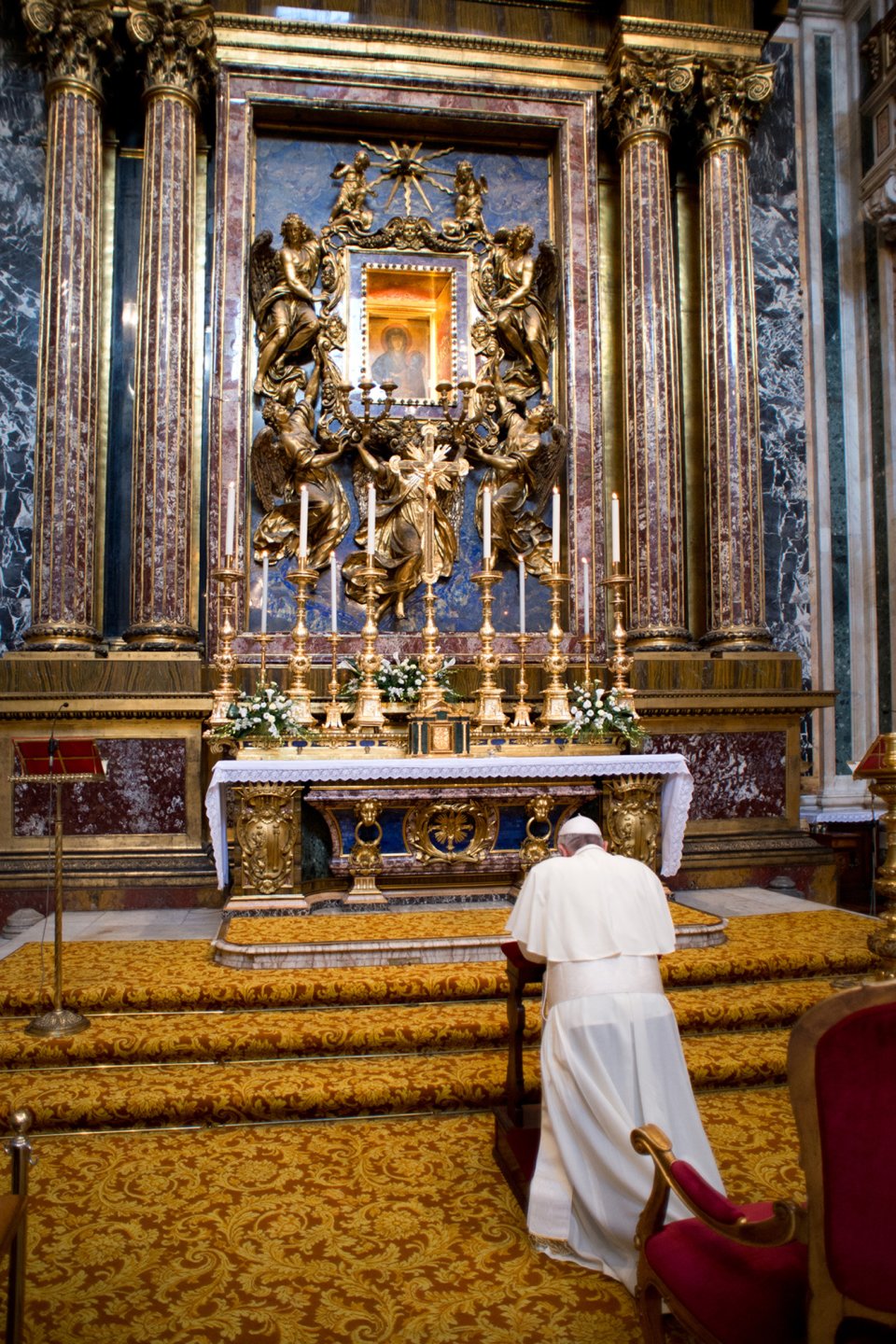
(AP Photo/L'Osservatore Romano)
VATICAN CITY (AP) — Some lucky faithful got a surprise when Pope Francis made an unannounced visit to St. Mary Major basilica Saturday to pray for followers who will gather next week in Rio de Janeiro for World Youth Day.
The pope was ushered into the basilica through a side door and brought to a chapel where he prayed for more than half an hour in front of an icon of the Madonna, the Vatican said in a statement.
"Since the basilica was open to the public, and numerous faithful were present, the pope, before leaving, stopped in front of the central altar" where he asked the faithful to follow his journey "with prayer, faith and penance," the Vatican said. The entire visit lasted a little more than an hour.
St. Mary Major is the same basilica where the pope went for an early morning prayer the day after being elected pontiff.
Earlier, the pope reached out over social media to young followers gearing up for World Youth Day, wishing young Catholics en route to Rio a safe journey.
Francis departs Monday for Brazil, where more than a million young Catholics are expected to celebrate their new pope.
The 76-year-old Argentine became the church's first pontiff from the Americas in March, and the trip to Brazil is his first international journey since becoming pope.
Catholic youth festivals are meant to reinvigorate the faithful, and Francis is expected to inspire young people with his humble ways.
Link:
Friday, July 19, 2013
Vatican prelate in 'gay romance' with Swiss guard?

AFP - The Vatican's "gay lobby" was back in the headlines on Friday after the alleged exposure of a homosexual prelate appointed by Pope Francis to a key position at the Vatican bank.
The Italian weekly L'Espresso said prelate Battista Ricca had gay relationships during his time at the Vatican embassy of Montevideo in Uruguay as well as an affair with a Swiss guard which ultimately saw him sent back to Rome in disgrace.
Vatican expert for L'Espresso Sandro Magister said Ricca provided lodgings and a pay check for captain Patrick Haari in 1999 and was once left badly beaten after trawling notorious gay hangouts before his behaviour saw him transferred out of Montevideo in 2000.
An internal bid to protect him and cover up the scandal meant Francis apparently had no idea about Ricca's past before he appointed him as his personal representative at the scandal-hit bank this year.
Ricca went on to hold several prestigious positions in Rome, including the director of the Santa Martha residence where the pope lives.
Magister said the wiping of Ricca's records was an example of a "gay lobby" at work in the Vatican.
Vatican spokesman Frederico Lombardi brushed off the story as "not credible" but the magazine insisted the allegations were confirmed by primary sources. It said "numerous bishops, priests, religious and laity" in Uruguay had testified against Ricca.
Religious watchers said the leaks about Ricca's past may be an internal attempt to block the prelate from carrying out reforms.
In June, Francis admitted the existence of a "gay lobby" inside the Vatican's secretive administration, the Roman Curia.
"In the Curia, there are truly some saints, but there is also a current of corruption... There is talk of a 'gay lobby' and it's true, it exists," he was quoted as having said during an audience with CLAR (the Latin American and Caribbean Confederation of Religious Men and Women).
The admission followed Italian media reports in February which claimed that a secret report by cardinals investigating leaks from within the Vatican included allegations of corruption and blackmail attempts against gay clergymen, and on the other hand, favouritism based on gay relationships.
If the allegations are proven to be true, it would be a blow to Francis's attempts to clean up the scandal-hit Vatican.
Link:
Subscribe to:
Posts (Atom)