Wednesday, March 21, 2012

Facebook's 'dark side': study finds link to socially aggressive narcissism

Facebook mark zuckerberg
Too many 'friends'? A psychology paper has found a link between Facebook and other social media and socially disruptive narcissism. Photograph: Justin Sullivan/Getty Images

By

(The Guardian) Researchers have established a direct link between the number of friends you have on Facebook and the degree to which you are a "socially disruptive" narcissist, confirming the conclusions of many social media sceptics.

People who score highly on the Narcissistic Personality Inventory questionnaire had more friends on Facebook, tagged themselves more often and updated their newsfeeds more regularly.

The research comes amid increasing evidence that young people are becoming increasingly narcissistic, and obsessed with self-image and shallow friendships.

The latest study, published in the journal Personality and Individual Differences, also found that narcissists responded more aggressively to derogatory comments made about them on the social networking site's public walls and changed their profile pictures more often.

A number of previous studies have linked narcissism with Facebook use, but this is some of the first evidence of a direct relationship between Facebook friends and the most "toxic" elements of narcissistic personality disorder.

Researchers at Western Illinois University studied the Facebook habits of 294 students, aged between 18 and 65, and measured two "socially disruptive" elements of narcissism – grandiose exhibitionism (GE) and entitlement/exploitativeness (EE).

GE includes ''self-absorption, vanity, superiority, and exhibitionistic tendencies" and people who score high on this aspect of narcissism need to be constantly at the centre of attention. They often say shocking things and inappropriately self-disclose because they cannot stand to be ignored or waste a chance of self-promotion.
The EE aspect includes "a sense of deserving respect and a willingness to manipulate and take advantage of others".

The research revealed that the higher someone scored on aspects of GE, the greater the number of friends they had on Facebook, with some amassing more than 800.

Those scoring highly on EE and GG were also more likely to accept friend requests from strangers and seek social support, but less likely to provide it, according to the research...

Monster titanoboa snake invades New York


By Claudine Zap | The Upshot

http://l.yimg.com/bt/api/res/1.2/i0YlyQ0cAjSlhrtjszhDVg--/YXBwaWQ9eW5ld3M7cT04NTt3PTMxMA--/http://l.yimg.com/os/152/2012/03/21/Bourque-painting-small-jpg_230830.jpg
New York commuters arriving at Grand Central Station were greeted by a monstrous sight: a 48-foot-long, 2,500-pound titanoboa snake.

The good news: It's not alive. Anymore. But the full-scale replica of the reptile -- which made its first appearance at the commuter hub -- is intended, as Smithsonian spokesperson Randall Kremer happily admitted, to "scare the daylights out of people" -- actually has a higher calling: to "communicate science to a lot of people." The scientifically scary-accurate model will go a long way toward that: If this snake slithered by you, it would be waist-high and measure the length of a school bus. Think of it as the T-rex of snakes.

This newly discovered species, known as titanoboa (yes, the words "titan" and "boa" are in there), which lived 65 million years ago, is about to have its close-up. The New York City appearance is promoting an exhibit at the Smithsonian Institute's National Museum of Natural History in D.C. opening on March 30, which ties in to a TV special on the Smithsonian Channel called, what else, "Titanoboa: Monster Snake." The two-hour program airs April 1.

Remains of the titanoboa were first discovered in a Colombian coal mine in 2005. One of the researchers specializing in the Paleocene era, the time after the death of the dinosaurs, was Jonathan Bloch. A vertebrate paleontologist from University of Florida's Museum of Natural History, the scientist led multiple expeditions, along with Carlos Jaramillo of the Smithsonian Tropical Research Institute. The team collected remains from the mine, which resulted in the find. Together with ancient-snake expert Jason Head of the University of Nebraska, they named the world's largest snake Titanoboa.

Speaking on the phone to Yahoo! News, Bloch admitted that when the team was first collecting the skeletons of Titanoboa, he didn't immediately understand what he had found until he returned to the lab. With the help of his students, he was able to identify the fossils as snakes, just much, much bigger than the ones of today. He described the enormous vertebrae as "sort of like if you saw a mouse skull the size of rhino skull."

The predator, which is related to a boa constrictor but actually behaved like an anaconda, lived in water and fed on fish, other titanoboas, and crocodiles (very, very large crocodiles).

If this sounds like Hollywood's next blockbuster, Bloch noted that this time around, truth is actually bigger than fiction: The predator from the movie "Anaconda," for one, is not as big as titanoboa. "This is really an example where reality and the past have exceeded the imaginations of Hollywood."

Jimmy Carter Releases Bible, Supports Same Sex Marriage


by Ben Johnson

ATLANTA, GEORGIA, March 20, 2012, (LifeSiteNews.com) – Former president Jimmy Carter has been strongly identified as a “Born Again” Christian and as a liberal Democrat for nearly five decades. He is once more blending those roles as he promotes “his” latest book, his own study Bible.

The NIV Lessons from Life Bible: Personal Reflections with Jimmy Carter contains the full text of the New International Version of the Bible and the former president’s prayers, reflections, and asides.
During his book tour to promote a study of the Scriptures, Carter mentioned he supports same-sex “marriage...”

“Fundamentalists,” he wrote in his 2005 book Our Endangered Values, tend “to demagogue emotional issues” and “are often angry and sometimes resort to verbal or even physical abuse against those who interfere with the implementation of their agenda.” Carter applied this term to figures as divergent as the Ayatollah Khomeini and Pope John Paul II, to atheist neoconservatives and his fellow Baptists.

Carter wrote that he exchanged harsh words with the late Pope John Paul II during a state visit over what Carter classified as the Pope’s “perpetuation of the subservience of women.” He added, “there was more harshness when we turned to the subject of ‘liberation theology’...”

In addition to nuptial vows, Carter encouraged the military to end the “Don’t Ask, Don’t Tell” policy in 2007, and in 2010, he told the website Big Think it was time to elect “a gay person” as president...

Link:
Related:

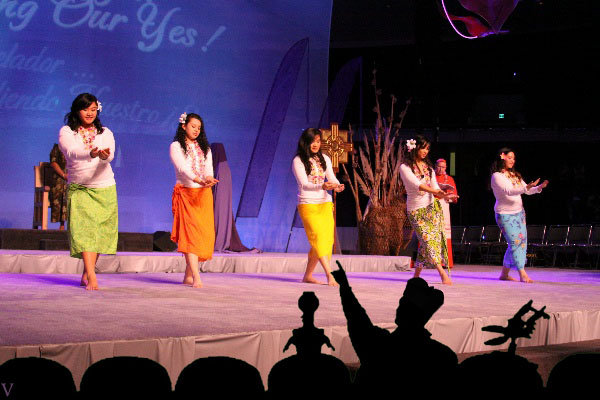
    Catholic group plans protest at Los Angeles Religious Education Congress

    https://blogger.googleusercontent.com/img/b/R29vZ2xl/AVvXsEhxSEp5iKy7hv1XZVAYVwlhTCBIxsSCpUWTDtjcXIuQR3uoC-bi-qVY5gSgldi6vXQ5Tpie9YRp6U9_fjRmYp36Y4AewTN72d-87OV8FjA0zLLtdOH1p5jaIMNh50cKvKgn7PmPP33aLyo/s1600/liturgy-science-theater-3000-2.jpg

    “Dissent-Fest”

     California Catholic Daily

    ANAHEIM, March 17, 2012 /Christian Newswire/ -- "We call on faithful Catholics to come join us in protesting the Los Angeles Archdiocese's upcoming dissent-fest, the Religious Education Congress (REC)," said Kenneth M. Fisher, chairman of Concerned Roman Catholics of America (CRCOA). "We need to warn thousands of Catholics that they'll hear speakers who spread doubts about Church teachings on abortion, homosexuality, contraception, women's ordination and the pope's authority." 

    "Why," Fisher asked, "does L.A.'s new, reputedly orthodox Archbishop José Gomez bring back the same dangerous speakers whom his predecessor Cardinal Roger Mahony brought in year after year? Jesus commanded us not to doubt but to have faith (Mt 14:31, 21:21). The Bible warns against people who sow doubts in Christians' minds (I Tim 4:1; II Tim 4:3, 4)."

    Fisher announced that on Saturday, March 24, from 9 a.m. to 6 p.m., his group will protest the annual REC, the world's largest training event for Catholic schoolteachers. (The REC is slated for the Anaheim Convention Center, March 22-25. The Saturday leafleting will take place outside the Center's main exhibit hall.)

    "The REC will have speakers with long track records of dissent," Fisher noted. "They'll tell Catholic educators what to teach. Then the teachers will infect countless innocent Catholic children with their errors."

    Fisher said CRCOA members will hand out flyers that expose speakers who dissent from the Church's teachings.

    The 185 REC speakers include:

    A priest who's said he's "not anti-choice," has publicly discussed his genitals, and has criticized the idea that truth is superior to dissent.

    A priest who says the Church needs "public models" of "healthy gay priests for Catholics to reflect on," to counter "the stereotype of the gay priest as child abuser."

    A professor who subtly undermines Church teachings on papal authority, sodomy, contraception and women's ordination.

    A nun who's taught that "ordinary genital self-touch can be very important" for children.

    A laicized priest who wants not only women priests but also women bishops.

    Fisher invited faithful Catholics to join CRCOA's leafleting by calling him at 714-491-2284 or e-mailing him at crcoa@dslextreme.com.

    Tuesday, March 20, 2012

    Cardinal Wuerl's Dereliction of Duty

    http://spectator.org/assets/db/13320931588267.jpg


    Since he won't control the sacraments, the Church's enemies will.

    http://spectator.org/assets/db/1313431165154.jpgThe road to hell is paved with the skulls of bad bishops. That's a slight paraphrase of a line from St. John Chrysostom.

    The saints of old warned bishops to choose holiness and orthodoxy over the blandishments of the "world."

    Many bishops today in America choose the good opinion of worldly elites over orthodoxy. These cufflinked cardinals worry not about punishment in the next world but slights in this one. They desperately crave the approval of America's movers and shakers and live in dread fear of losing it.

    What will the Pretty People think if I withhold Communion from powerful pro-abortion Catholic pols? Will the Washington Post editorialize against me? Will I lose my place of honor at posh parties? Will my dissenting priests think ill of me? Will I be scorned at the next USCCB meeting?

    These are some of the thoughts that race through the minds of modern prelates. Out of these anxieties comes fiascoes like Cardinal Donald Wuerl's recent one. Wuerl and his surrogates have rebuked a visiting priest from the archdiocese of Moscow for denying Communion to a self-described practicing lesbian at a funeral mass. That's not our "policy," gasped Wuerl's horrified surrogates.

    But it is the policy of the Roman Catholic Church. If a person is not in communion with the teachings of the Church, said person should not receive Communion. Period. Canon law makes this explicitly clear. If you don't believe me, ask the head of the Vatican Supreme Court, Cardinal Raymond Burke. Though most of his colleagues seem to ignore his stance, he has said for years that canon law places a grave burden on priests to protect the sacraments from defiant sinners. According to Burke, canon law is not a whimsical option for hardline eccentric priests but a moral duty which "obliges the minister of Holy Communion to refuse the Sacrament" to those in "manifest grave sin. "

    Wuerl rejects this authoritative interpretation of canon law. A while back he was asked if he would withhold Communion from the pro-abortion Nancy Pelosi. He said no. That style of "confrontation" makes him uncomfortable, he told a persistent reporter.

    I've heard Church insiders call the cardinal "Wuerl the girl," a reference to his precious personality. He has many fine qualities. He seems a little less common to me than some of his hackish colleagues. But cufflinks, starched shirts, learning, and reasonably civilized manners do not a good bishop make. Jesus Christ never required that his disciples place roses in his room or mints on his pillow. He walked straight at the decadent elites of his time, denounced them as a "brood of vipers," and then called it a day. It didn't take long for these vipers to kill him.

    Wuerl can only earn the red of his rich robes through a willingness to endure the blood of Jesus Christ's martyrdom. And the truth is that protecting the sacraments would cost him far less than death. Maybe Joe Biden wouldn't clap him on the back so heartily after that. Maybe he would get an angry letter or two from moneyed donors in the tank for the Dems. But who cares?

    This latest episode isn't even a close call. If Cardinal Wuerl doesn't have the guts to deny Communion to an agitprop lesbian Buddhist, he should just close up shop and hand the keys to his chancery over to Obama.
    This ludicrous controversy reminds me of another fiasco, one from 2008. Remember when San Francisco Archbishop George Niederauer, while distributing Communion at a parish in the gay Castro district, handed out the sacred species to two garishly painted and costumed members of the homosexual activist group "Sisters of Perpetual Indulgence."

    News of this sparked furor across the Catholic world, and even the liberal archbishop had to admit he blew it, saying dimly: 
    Toward the end of the Communion line two strangely dressed persons came to receive Communion. I did not see any mock religious garb. As I recall, one of them wore a large flowered hat or garland. Afterward it was made clear to me that these two people were members of the organization "Sisters of Perpetual Indulgence," who have long made a practice of mocking the Catholic Church in general and religious women in particular. My predecessors, Cardinal William Levada and Archbishop John Quinn, have both denounced this group's abuse of sacred things many times in the past. Only last year, I instructed the Administrator of Most Holy Redeemer Parish to cancel the group's use of the hall on the parish grounds, once I became aware of it…
    Although I had often seen photographs of members of the Sisters of Perpetual Indulgence, I had never encountered them in person until October 7th. I did not recognize who these people were when they approached me.
    After the event, I realized that they were members of this particular organization and that giving them Holy Communion had been a mistake. I apologize to the Catholics of the Archdiocese of San Francisco and to Catholics at large for doing so…
    Of course, the bishop's passive understanding of his duties and his fear of the liberal elite -- like Wuerl, Niederauer won't deny Communion to Nancy Pelosi either -- invited this outrage. After all, if a bishop announces that he is not a "gatekeeper," who can't come up to receive it? Such passivity was an invitation to abuse and the "Sisters of Perpetual Indulgence" took it. Similarly, the lesbian Buddhist to which Wuerl cravenly apologized seized her chance to stick it to the Church.

    The choice that the Wuerls face is clear: either they take seriously the duty enshrined in canon law to protect the sacraments from sacrilege and scandal, or these Communion controversies will multiply without end.
    The notion that bishops aren't gatekeepers would come as a surprise to the Church's first ones. The apostles were told by Jesus Christ that the good shepherd watches the gate, lest his flock be eaten. "Do not give what is holy to dogs," Jesus warned them.

    The Church's position on whether a bishop should stop sacrilege and scandal is not determined by his "comfort" level, Cardinal Wuerl. It is determined by the clear requirements of canon law. Cardinal Burke has spoken; the case is closed. Either the bishops take control over their own sacraments or the Church's enemies will.

    Updates:
      Links:
      Related:

      Monsignor Nicola Bux's letter to Bishop Fellay and the Priests of the SSPX

      From RORATE CÆLI:

      https://blogger.googleusercontent.com/img/b/R29vZ2xl/AVvXsEjbU8PHeLiB4SB2Yc8coyTLdlSLklWbGbJUmBHGPdVBzA69r_02wPXQjBQ6eofX7yU7Qq3KIW29UxKEwjajU9JpVvbfVGkQidss1773fTucCffHMtDcuwt5sbCCq5eWKmly1nu_a06vH_4/s1600/bux.jpgTo His Excellency, Bishop Bernard Fellay, and to the Priests of the Society of Saint Pius X

      Your Excellency,
      Most dear Brothers,

      Christian brotherhood is stronger than flesh and blood because it offers us, thanks to the divine Eucharist, a foretaste of heaven.

      Christ invited us to experience communion, this is what our "I" is made of. Communion means loving one's neighbor a priori, because we have the one Savior in common with him. Based on this fact, communion is ready for every sacrifice in the name of unity; and this unity must be visible, as the last petition addressed by Our Lord to his Father teaches us - "ut unum sint, ut credat mundus" -, because this is the decisive testimony of Christ's friends.

      It is undeniable that numerous facts of Vatican II and of the period that followed it, related to the human dimension of this event, have represented true calamities and have caused intense pain to many great Churchmen. But God does not allow His Holy Church to reach self-destruction... (continued)


      Links:
      Related:

      Apostolic visitation calls for overhaul of Church in Ireland

      (Catholic News Agency / EWTN News) ...The report says that the Church needs to show “greater concern for the intellectual formation of seminarians” to ensure that their education is “in full conformity with the Church’s Magisterium.”

      It suggests that the pastoral training of seminarians be re-evaluated to ensure “it is sacramental, priestly and apostolic” and concerned with “preparing candidates to celebrate the sacraments and to preach.”

      It also states that the seminary buildings should be “exclusively for seminarians of the local Church and those preparing them for the priesthood” to “ensure a well-founded priestly identity.” There had been concern in recent years that there was insufficient separation between the seminarians at St. Patrick’s College and the secular students of the National University of Ireland, which are both situated in Maynooth in County Kildare.

      The major superiors of religious orders also have to design new programs to focus on “living their vows in a contemporary context,” in accordance with “the Apostolic Tradition of the Church’s teaching” and the “charism of the founder of the Institute.” This should be done with a view to “revitalizing communities of prayer, community life and mission...”

      Joad Cressbeckler Denies He Incited Mob To Drag Congressman Through Briar Patch

      Sunday, March 18, 2012

      Pope Benedict XVI: I ask prayers for my upcoming voyage


      "I ask prayers for my forthcoming apostolic trip to Mexico and Cuba, where I will have the joy of traveling in a few days to confirm the faith of the Christians of these beloved nations and of all Latin America. I invite everyone to join me with spiritual closeness, so that this pastoral visit will reap abundant fruits of Christian life and Church renewal, contributing to the real progress of these peoples. I commend this pilgrimage to the Blessed Virgin Mary, who in those blessed lands receives the endearing names of Guadalupe and Charity."

      Williams quits as Anglican head, says successor needs "rhino skin"

      http://cache.daylife.com/imageserve/0dqT4O6bCY57e/610x.jpg

      Pope Benedict XVI (L) meets with Archbishop of Canterbury Rowan Williams during a private audience at Vatican March 10, 2012 (Reuters Pictures)

      By Avril Ormsby

      (Reuters) - Archbishop of Canterbury Rowan Williams, who has agonized about schisms in the Anglican Communion over women and gay bishops and same-sex unions, announced unexpectedly on Friday that he would step down at the end of the year.

       He said it was time to move on after a decade as archbishop and his new post as master of Magdelene College at Cambridge University would give him the time "which I have longed for" to think and write about the Church.

      "I would hope that my successor has the constitution of an ox and the skin of a rhinoceros," he said.

      Williams, 61, a white-bearded and bushy-browed theologian, will leave behind a church split between progressives ready to allow women bishops and bless same-sex unions, and conservatives opposed to such modern reforms.

      His resignation also appeared to spell the end for his faltering project to forge more unity in the Anglican Communion, an 80-million strong worldwide federation of 38 national and regional churches that see him as their spiritual leader.

      He acknowledged these strains in an interview with Britain's Press Association, saying that crisis management was "never a favorite activity" and had actually been "major nuisance" during his tenure.

      "There are some conflicts that won't go away, however long you struggle with them," he said. "Not everybody in the Anglican Communion or even in the Church of England is eager to avoid schism or separation."

      UGANDA-BORN ARCHBISHOP TIPPED AS SUCCESSOR

      http://www.archbishopofyork.org/img.php?f=/york/data/images/ABY_Official_/250_Archbishop_speaking_at_Oscar_Romero_Commemorative_Service.jpg&p=toWidth&o=jpg&a[width]=260Frontrunner to replace him is the Church of England's second highest cleric, Archbishop of York John Sentamu. Born in Uganda, he fled to Britain in 1974 to escape from dictator Idi Amin.

      Sentamu praised Williams as "God's apostle for our time", a courageous and holy man who had been "much maligned by people who should have known better".

      Elizabeth Hunter, director of the London-based religious think tank Theos, described Sentamu as more conservative than Williams. But she did not see him making a sharp break in the Church or the Communion.

      "Anyone who gets this post will not take a radical diversion from the path that Archbishop Rowan has been treading simply because there really isn't any other choice.

      "They'll just continue with these slightly awkward compromises and uncomfortable conversations, where you sometimes get to wondering really is it one church at all, or two or three," she said... (continued)


      Saturday, March 17, 2012

      Pope Shenouda III, head of Egypt’s Coptic Christian church, dies at 88

      By Associated Press, Updated: Saturday, March 17, 6:10 PM

      CAIRO, Egypt — Pope Shenouda III, the patriarch of the Coptic Orthodox Church who led Egypt’s Christian minority for 40 years during a time of increasing tensions with Muslims, died Saturday. He was 88.

      His death comes as the country’s estimated 10 million Christians are feeling more vulnerable than ever amid the rise of Islamic movements to political power after the toppling a year ago of President Hosni Mubarak. The months since have seen a string of attacks on the community, heightened anti-Christian rhetoric by ultraconservatives known as Salafis and fears that coming governments will try to impose strict versions of Islamic law... (continued)

      Lesbian with kids in Catholic school demands removal of Catechism quote on homosexuality


      BOWMANVILLE, Ontario, March 16, 2012 (LifeSiteNews.com) – A self-proclaimed ‘lesbian’ whose two children attend a Catholic school near Peterborough is demanding that the Peterborough Catholic school board remove a Catechism quote dealing with homosexuality from a school pamphlet. Ann Michelle Tesluk has started an online petition to pressure the board to action and describes her activities as gearing to make the Catholic Church into an “openly gay friendly church.”

      The pamphlet in question, however, is controversial from more than one perspective.  While quoting the Catechism that the homosexual inclination is “objectively disordered”, the pamphlet also misrepresents Catholic teaching in numerous ways. The pamphlet calls on schools to highlight homosexual role models and familiarize students with terms like “LGBTQQ” and “two-spirited.” It indicates that Canada legalized same-sex “marriage” in 2005 without mentioning that the Church opposes such unions.

      Greg Reeves, director of education for the Peterborough Victoria Northumberland Clarington Catholic District School Board (PVNCCDSB), told LifeSiteNews that they have had enough complaints about the pamphlet, called The Colour of Equity, to give the wording a “relook” to see if they can explain the Church’s teaching better.

      The trustees voted 6 to 8 last Tuesday against a request to remove the passage, but Nancy Sharpe, the board’s head of communications, said that the pamphlet has been sent for review to the Equity and Inclusive Education committee.

      Reeves says the school board felt they needed to include the Catechism passage because they are “under the Magisterium of the Church, the teaching and the authority of the Church.”

      “When we were going into the section on orientation, we felt it important that people understand what the Catholic Catechism would say,” he explained.

      In her online petition, which has garnered 86 signatures thus far, Tesluk says the Catholic Church’s teachings on homosexuality are “outdated and harmful” and suggests the teachings have exacerbated the problem of teen suicides.

      “As it is right now, it is derogatory, patronizing and discriminatory, not to mention lacking in scientific evidence,” she says. “Any child who reads this will be faced, at minimum, with a negative attitude towards homosexuality,” she continues. “Isn’t this what we are trying to prevent? How can we allow any school in Ontario to teach this to our children?”

      Reeves said the complaints are largely a result of confusion over the Church’s teaching, saying that the Catechism’s “phraseology is old.”

      According to Reeves, by calling the homosexual inclination “objectively disordered,” the Church means that homosexual relationships are disordered.  According to Church teaching, he explained, authentic sexual relationships must be both unitive and procreative.

      “It’s not the person who’s disordered,” he said. “It’s the concept that the relationship, in the eyes of the Catholic Church in this definition, is disordered.”

      But Prof. Scott Nicholson, chair of theology at Our Lady Seat of Wisdom Academy in Barry’s Bay, Ontario, said the Catechism teaching is not about the homosexual relationship per se, but a disorder in the person’s sexual drive.

      “It is true that acting on it is disordered,” he explained, “but above and beyond that the inclination itself isn’t something that you’d find in human beings except for original sin.”

      “In a fallen world, individuals have various disorders in them that may not be any fault of their own but they remain disordered,” he continued. “Someone born blind, that’s an objective disorder because we’re meant to see, that’s what eyes are for. The sexual drive is meant to be inclined and lead people toward reproduction.”
      “If it’s ordered in a particular individual in a way that isn’t inclined towards reproduction then it’s disordered. It’s out of the order for which it’s meant,” he added.

      Sharpe said the Equity and Inclusive Education committee will decide whether to remove the language or perhaps explain it, and then make a recommendation to the trustees.

      “I know that the language of that passage will have to be explained at the committee meeting because many of us don’t understand it because it was written by theologians,” she said.

      Prof. Nicholson noted that the Catechism is not a work of high theology but intended for a “wide audience.” “It’s really intended for every educated, and I’d even go so far as to say semi-educated, Catholic,” he said.
      The Church needs to use precise language, he added, to say exactly what it means on issues of importance.
      As the province’s Catholic school boards adopted McGuinty’s equity and inclusive education strategy in the last two years, pro-family advocates warned that it would give homosexual activists a foothold to further undermine the effort to impart Catholic sexual teaching.

      According to Tesluk, during the six years her children have attended school in the board, she has held various positions on the local school council.

      Contact info:

      Greg Reeves, Director of Education
      Peterborough Victoria Northumberland Clarington Catholic District School Board
      1355 Lansdowne St. W.
      Peterborough, ON   K9J 7M3
      Tel: (705) 748-4861, Ext. 224
      Fax: (705) 748-9734
      greeves@pvnccdsb.on.ca

      Contact info for trustees.

      Link:
      Related:

      Vatican sets up probe into unauthorized leaks

      © Flickr.com/tiseb/cc-by

      (The Voice of Russia) The Vatican has opened a criminal probe into unauthorized leaks of top-secret documents alleging corruption and mismanagement among its top officials, media reports said on Saturday.

      The scandal involves the leaking of a spate of highly sensitive internal documents to the Italian media earlier this month, including personal letters to Pope Benedict XVI who was quick to order an investigation.

      Bishop Schneider and the Liturgy: Milestones for the Third Millennium

      From Paix Liturgique:

      On 15 january 2012, the Parisian association Réunicatho, which came into being shortly after the motu proprio Summorum Pontificum, held its fourth meeting for Catholic unity. We here present an unabridged translation of the keynote address given by the conference's guest of honor, Bishop Athanasius Schneider, on the theme of "The Extraordinary Form and the New Evangelization."

      Bishop Schneider, who is auxiliary bishop of the archidiocese of Saint Mary of Astana and Secretary of the Kazakhstan Conference of Catholic Bishops, is the author of Dominus Est - It is the Lord!, Reflections of a Bishop of Central Asia on Holy Communion, published by Newman House Press.


      (headings added by the editors)

      ***

      I –Turning our gaze towards Christ

      In order to speak of new evangelization correctly, it is necessary first to turn our gaze towards Him Who is the true evangelizer, namely Our Lord and Saviour Jesus-Christ, the Word of God made Man. The Son of God came upon this earth to expiate and redeem the greatest sin, sin par excellence. And this sin, humanity's sin par excellence, consists in refusing to adore God, in refusing to keep the first place, the place of honor, for Him. This sin on the part of man consists in not paying attention to God, in no longer having a sense of the fittingness of things, or even a sense of the details pertaining to God and to the Adoration that is His due, in not wanting to see God, in not wanting to kneel before God.

      For such an attitude, the incarnation of God is an embarrassment; as a result the real presence of God in the Eucharistic mystery is likewise an embarrassment; the centrality of the Eucharistic presence of God in our churches is an embarrassment. Indeed sinful man wants the center stage for himself, whether within the Church or during the Eucharistic celebration; he wants to be seen, to be noticed.

      For this reason Jesus the Eucharist, God incarnate, present in the tabernacle under the Eucharistic form, is set aside. Even the representation of the Crucified One on the cross in the middle of the altar during the celebration facing the people is an embarrassment, for it might eclipse the priest's face. Therefore the image of the Crucified One in the center of the altar as well as Jesus the Eucharist in the tabernacle, also in the center of the altar, are an embarrassment. Consequently, the cross and the tabernacle are moved to the side. During mass, the congregation must be able to see the priest’s face at all times, and he delights in placing himself literally at the center of the house of God. And if perchance Jesus the Eucharist is still left in His tabernacle in the middle of the altar because the Ministry of Historical Monuments—even in an atheist regime—has forbidden moving it for the conservation of artistic heritage, the priest, often throughout the entire Eucharistic celebration, does not scruple to turn his back to Him.

      How often have good and faithful adorers of Christ cried out in their simplicity and humility : “God bless you, Ministry of Historical Monuments ! At least you have left us Jesus in the center of our church.”

      II – The Mass is intended to give glory to God, not to men
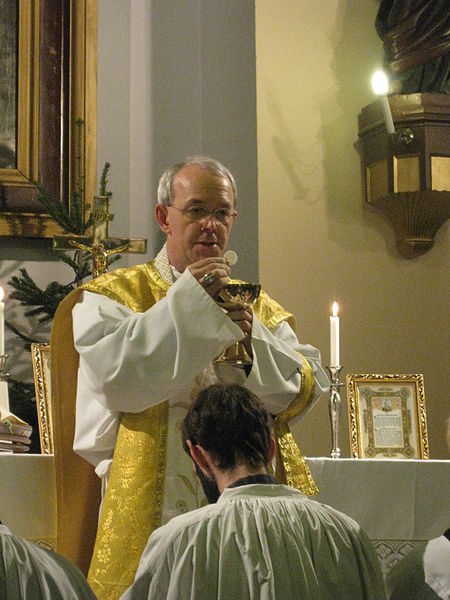
      File:Athanasius schneider 20091210.jpg
      Only on the basis of adoring and glorifying God can the Church adequately proclaim the word of the truth, i.e., evangelize. Before the world ever heard Jesus, the eternal Word made flesh, preach and proclaim the Kingdom, He quietly adored for thirty years. This remains forever the law for the Church’s life and action as well as for all evangelizers. “The way the liturgy is treated decides the fate of the Faith and of the Church,” said Cardinal Ratzinger, our current Holy Father Benedict XVI. The Second Vatican Council intended to remind the Church what reality and what action were to take the first place in her life. This is the reason for which the first of the Council’s documents was dedicated to the liturgy. The Council gives us the following principles: in the Church, and therefore in the liturgy, the human must be oriented towards the divine and be subordinate to it; likewise the visible in relation to the invisible, action in relation to contemplation, the present in relation to the future city to which we aspire (see Sacrosanctum Concilium, 2). According to the teaching of Vatican II our earthly liturgy participates in a foretaste of the heavenly liturgy of the holy city of Jerusalem (ibid., 2).

      Everything about the liturgy of the Holy Mass must therefore serve to express clearly the reality of Christ’s sacrifice, namely the prayers of adoration, of thanks, of expiation, and of impetration that the eternal High Priest presented to His Father.

      The rite and every detail of the Holy Sacrifice of the mass must center on glorifying and adoring God by insisting on the centrality of Christ’s presence, whether in the sign and representation of the Crucified or in His Eucharistic presence in the tabernacle, and especially at the moment of the Consecration and of Holy Communion. The more this is respected, the less man takes center stage in the celebration, the less the celebration looks like a circle closed in on itself. Rather, it is opened out on to Christ as in a procession advancing towards Him with the priest at its head; such a liturgical procession will more truly reflect the sacrifice of adoration of Christ crucified;the fruits deriving from God’s glorification received into the souls of those in attendance will be richer; God will honor them more.
      The more the priest and the faithful truthfully seek the glory of God rather than that of men in Eucharistic celebrations and do not seek to receive glory from each other, the more God will honor them by granting that their soul may participate more intensely and fruitfully in the Glory and Honor of His divine life.

      At present and in various places on earth there are many celebrations of the Holy Mass regarding which one might say, as an inversion of Psalm113:9: “To us, O Lord, and to our name give glory.” To such celebrations apply Jesus’ words: “How can you believe, who receive glory one from another: and the glory which is from God alone, you do not seek?” (Jn 5:44).


      III –The Six Principles of the Liturgical Reform

      The Second Vatican Council put forward the following principles regarding a liturgical reform:

      1. During the liturgical celebration, the human, the temporal, and action must be directed towards the divine, the eternal, and contemplation; the role of the former must be subordinated to the latter (Sacrosanctum Concilium, 2).
      2. During the liturgical celebration, the realization that the earthly liturgy participates in the heavenly liturgy will have to be encouraged (Sacrosanctum Concilium, 8).
      3. There must be absolutely no innovation, therefore no new creation of liturgical rites, especially in the rite of Mass, unless it is for a true and certain gain for the Church, and provided that all is done prudently and, if it is warranted, that new forms replace the existing ones organically (Sacrosanctum Concilium, 23).
      4. The rites of Mass must be such that the sacred is more explicitly addressed (Sacrosanctum Concilium, 21).
      5. Latin must be preserved in the liturgy, especially in Holy Mass (Sacrosanctum Concilium, 36 and 54).
      6. Gregorian chant has pride of place in the liturgy (Sacrosanctum Concilium, 116).

      The Council Fathers saw their reform proposals as the continuation of the reform of Saint Pius X (Sacrosanctum Concilium 112 and 117) and of the servant of God Pius XII; indeed, in the liturgical constitution, Pius XII’s Encyclical Mediator Dei is what is most often cited.

      Among other things, Pope Pius XII left the Church an important principle of doctrine regarding the Holy Liturgy, namely the condemnation of what is called liturgical archeologism. Its proposals largely overlapped with those of the Jansenistic and Protestant-leaning synod of Pistoia (see “Mediator Dei,” 63-64). As a matter of fact they bring to mind Martin Luther’s theological thinking.

      For this reason, already the Council of Trent condemned Protestant liturgical ideas, in particular the exaggerated emphasis on the notion of banquet in the eucharistic celebration to the detriment of its sacrificial character and the suppression of univocal signs of sacrality as an expression of the mystery of the liturgy (see Council of Trent, session 22).

      The magisterium’s doctrinal declarations on the liturgy, as in this case those of the Council of Trent and of the encyclical Mediator Dei and which are reflected in a centuries-old, or even millenia-old, liturgical praxis, these declarations I say, form part of that element of Holy Tradition that one cannot abandon without incurring grave spiritual damage. Vatican II took up these doctrinal declarations on the liturgy, as one can see by reading the general principals of divine worship in the liturgical constitution Sacrosanctum Concilium.

      As an example of a concrete error in the thought and action of liturgical action, Pope Pius XII cites the proposal to give to the altar the shape of table (Mediator Dei 62). If already Pope Pius XII refused the table-shaped altar, one imagines how much more he would have refused the proposal for a celebration around a table “versus populum”!

      When Sacrosanctum Concilium 2 teaches that, in the liturgy, contemplation has the priority and that the entire celebration must be oriented to the heavenly mysteries (ibid. 2 and 8), it is faithfully echoing the following declaration of the Council of Trent: “And whereas such is the nature of man, that, without external helps, he cannot easily be raised to the meditation of divine things; therefore has holy Mother Church instituted certain rites, to wit that certain things be pronounced in the mass in a low, and others in a louder, tone. She has likewise employed ceremonies, such as mystic benedictions, lights, incense, vestments, and many other things of this kind, derived from an apostolic discipline and tradition, whereby both the majesty of so great a sacrifice might be recommended, and the minds of the faithful be excited, by those visible signs of religion and piety, to the contemplation of those most sublime things which are hidden in this sacrifice” (Session 24, chap. 5).

      The Church’s magisterial teachings quoted above, especially Mediator Dei, were certainly recognized as fully valid by the Fathers of the Council. Therefore they must continue to be fully valid for all of the Church’s children even today.


      IV –The five wounds of the liturgical mystical body of Christ

      In the letter to all the bishops of the Catholic Church that Benedict XVI sent with the 7 July 2007 Motu Proprio Summorum Pontificum, the Pope made the following important declaration: “In the history of the liturgy there is growth and progress, but no rupture.  What earlier generations held as sacred, remains sacred and great for us too.” In saying this the Pope expressed the fundamental principle of the liturgy that the Council of Trent, Pope Pius XII, and the Second Vatican Council had taught.

      Taking an unprejudiced and objective look at the liturgical practice of the overwhelming majority of churches throughout the Catholic world where the Ordinary Form of the Roman rite is used, no one can honestly deny that the six aforementioned liturgical principles of Vatican II are never, or hardly ever, respected, despite the erroneous claim that such is the liturgical practice that Vatican II desired. There is a certain number of concrete aspects of the currently prevailing liturgical practice in the ordinary rite that represent a veritable rupture with a constant and millennium-old liturgical practice. By this I mean the five liturgical practices I shall mention shortly; they may be termed the five wounds of the liturgical mystical body of Christ. These are wounds, for they amount to a violent break with the past since they deemphasize the sacrificial character (which is actually the central and essential character of the Mass) and put forward the notion of banquet. All of this diminishes the exterior signs of divine adoration, for it brings out the heavenly and eternal dimension of the mystery to a far lesser degree.

      Now the five wounds (except for the new Offertory prayers) are those that are not envisaged in the ordinary form of the rite of Mass but were brought into it through the practice of a deplorable fashion.

      A) The first and most obvious wound is the celebration of the sacrifice of the Mass in which the priest celebrates with his face turned towards the faithful, especially during the Eucharistic prayer and the consecration, the highest and most sacred moment of the worship that is God’s due. This exterior form corresponds, by its very nature, more to the way in which one teaches a class or shares a meal. We are in a closed circle. And this form absolutely does not conform to the moment of the prayer, less yet to that of adoration. And yet Vatican II did not want this form by any means; nor has it ever been recommended by the Magisterium of the Popes since the Council. Pope Benedict wrote in the preface to the first volume of his collected works: “[t]he idea that the priest and the people in prayer must look at one another reciprocally was born only in the modern age and is completely foreign to ancient Christianity. In fact, the priest and the people do not address their prayer to one another, but together they address it to the one Lord. For this reason they look in the same direction in prayer: either towards the East as the cosmic symbol of the Lord’s return, or where this in not possible, towards an image of Christ in the apse, towards a cross, or simply upwards.”

      The form of celebration in which all turn their gaze in the same direction (conversi ad orientem, ad Crucem, ad Dominum) is even mentioned in the rubrics of the new rite of the Mass (see Ordo Missae, 25, 133, 134). The so-called “versus populum” celebration certainly does not correspond to the idea of the Holy Liturgy as mentioned in the declaration of Sacrosanctum Concilium, 2 and 8.

      B) The second wound is communion in the hand, which is now spread nearly throughout the entire world. Not only was this manner of receiving communion in no way mentioned by the Vatican II Council Fathers, but it was in fact introduced by a certain number of bishops in disobedience to the Holy See and in spite of the negative majority vote by bishops in 1968. Pope Paul VI legitimized it only later, reluctantly, and under specific conditions.

      Pope Benedict XVI, since Corpus Christi 2008, distributes Communion to the faithful kneeling and on their tongue only, both in Rome and also in all the local churches he visits. He thus is showing the entire Church a clear example of practical Magisterium in a liturgical matter. Since the qualified majority of the bishops refused Communion in the hand as something harmful three years after the Council, how much more the Council Fathers would have done so!

      C) The third wound is the new Offertory prayers. They are an entirely new creation and had never been used in the Church. They do less to express the mystery of the sacrifice of the Cross than that of a banquet; thus they recall the prayers of the Jewish Sabbath meal. In the more than thousand-year tradition of the Church in both East and West, the Offertory prayers have always been expressly oriented to the mystery of the sacrifice of the Cross (see e.g. Paul Tirot, Histoire des prières d’offertoire dans la liturgie romaine du VIIème au XVIème siècle [Rome, 1985]). There is no doubt that such an absolutely new creation contradicts the clear formulation of Vatican II that states: “Innovationes ne fiant . . . novae formae ex formis iam exstantibus organice crescant” (Sacrosanctum Concilium, 23).

      D) The fourth wound is the total disappearance of Latin in the huge majority of Eucharistic celebrations in the Ordinary Form in all Catholic countries. This is a direct infraction against the decisions of Vatican II.

      E) The fifth wound is the exercise of the liturgical services of lector and acolyte by women as well as the exercise of these same services in lay clothing while entering into the choir during Holy Mass directly from the space reserved to the faithful. This custom has never existed in the Church, or at least has never been welcome. It confers to the celebration of the Catholic Mass the exterior character of informality, the character and style of a rather profane assembly. The second council of Nicaea, already in 787, forbad such practices when it lay down the following canon: “If someone is not ordained, it is not permitted for him to do the reading from the ambo during the holy liturgy“ (can. 14). This norm has been constantly followed in the Church. Only subdeacons and lectors were allowed to give the reading during the liturgy of the Mass. If lectors and acolytes are missing, men or boys in liturgical vestments may do so, not women, since the male sex symbolically represents the last link to minor orders from the point of view of the non-sacramental ordination of lectors and acolytes.

      The texts of Vatican II never mention the suppression of the minor orders and of the subdiaconate or the introduction of new ministries. In Sacrosanctum Concilium no. 28, the Council distinguishes “minister” from “fidelis” during the liturgical celebration, and it stipulates that each may do only what pertains to him by the nature of the liturgy. Number 29 mentions the “ministrantes”, that is the altar servers who have not been ordained. In contrast to them, there are, in keeping with the juridical terms in use at that time, the “ministri,” that is to say those who have received an order, be it major or minor.


      V –The Motu Proprio: putting an end to rupture in the liturgy

      In the Motu Proprio Summorum Pontificum, Pope Benedict XVI stipulates that the two forms of the Roman rite are to be regarded and treated with the same respect, because the Church remains the same before and after the Council. In the letter accompanying the Motu Proprio, the pope wishes the two forms to enrich each other mutually. Furthermore he wishes that the new form “be able to demonstrate, more powerfully than has been the case hitherto, the sacrality which attracts many people to the former usage.”

      Four of the liturgical wounds, or unfortunate practices (celebration versus populum, communion in the hand, total abandonment of Latin and of Gregorian chant, and intervention of women for the service of lectorship and of acolyte), have in and of themselves nothing to do with the Ordinary Form of the Mass and moreover are in contradiction with the liturgical principles of Vatican II. If an end were put to these practices, we would get back to the true teaching of Vatican II. And then, the two forms of the Roman rite would come considerable closer so that, at least outwardly, there would be no rupture to speak of between them and, therefore, no rupture between the Church before and after the Council either.

      As concerns the new Offertory prayers, it would be desirable for the Holy See to replace them with the corresponding prayers of the extraordinary form, or at least to allow for the use of the latter ad libitum. In this way the rupture between the two forms would be avoided not only externally but also internally. Rupture in the liturgy is precisely what the Council Fathers did not what. The Council’s minutes attest to this, because throughout the two thousand years of the liturgy’s history, there has never been a liturgical rupture and, therefore, there never can be. On the other hand there must be continuity, just as it is fitting for the Magisterium to be in continuity.

      The five wounds of the Church’s liturgical body I have mentioned are crying out for healing. They represent a rupture that one may compare to the exile in Avignon. The situation of so sharp a break in an expression of the Church’s life is far from unimportant—back then the absence of the popes from Rome, today the visible break between the liturgy before and after the Council. This situation indeed cries out for healing.

      For this reason we need new saints today, one or several Saint Catherines of Sienna. We need the “vox populi fidelis” demanding the suppression of this liturgical rupture. The tragedy in all of this is that, today as back in the time of the Avignon exile, a great majority of the clergy, especially in its higher ranks, is content with this rupture.

      Before we can expect efficacious and lasting fruits from the new evangelization, a process of conversion must get under way within the Church. How can we call others to convert while, among those doing the calling, no convincing conversion towards God has yet occurred, internally or externally? The sacrifice of the Mass, the sacrifice of adoration of Christ, the greatest mystery of the Faith, the most sublime act of adoration is celebrated in a closed circle where people are looking at each other.

      What is missing is “conversio ad Dominum.” It is necessary, even externally and physically. Since in the liturgy Christ is treated as though he were not God, and he is not given clear exterior signs of the adoration that is due to God alone because the faithful receive Holy Communion standing and, to boot, take it into their hands like any other food, grasping it with their fingers and placing it into their mouths themselves. There is here a sort of Eucharistic Arianism or Semi-Arianism.

      One of the necessary conditions for a fruitful new evangelization would be the witness of the entire Church in the public liturgical worship. It would have to observe at least these two aspects of Divine Worship:

      1) Let the Holy Mass be celebrated the world over, even in the ordinary form, in an internal and therefore necessarily also external “conversio ad Dominum”.
      2) Let the faithful bend the knee before Christ at the time of Holy Communion, as Saint Paul demands when he mentions the name and person of Christ (see Phil 2:10), and let them receive Him with the greatest love and the greatest respect possible, as befits Him as true God.

      Thank God, Benedict XVI has taken two concrete measures to begin the process of a return from the liturgical Avignon exile, to wit the Motu Proprio Summorum Pontificum and the reintroduction of the traditional Communion rite.

      There still is need for many prayers and perhaps for a new Saint Catherine of Sienna for the other steps to be taken to heal the five wounds on the Church’s liturgical and mystical body and for God to be venerated in the liturgy with that love, that respect, that sense of the sublime that have always been the hallmark of the Church and of her teaching, especially in the Council of Trent, Pope Pius XII in his encyclical Mediator Dei, Vatican II in its Constitution Sacrosanctum Concilium and Pope Benedict XVI in his theology of the liturgy, in his liturgical magisterium, and in the Motu Proprio mentioned above.

      No one can evangelize unless he has first adored, or better yet unless he adores constantly and gives God, Christ the Eucharist, true priority in his way of celebrating and in all of his life. Indeed, to quote Cardinal Joseph Ratzinger: “It is in the treatment of the liturgy that the fate of the Faith and of the Church is decided.”

      Bishop Athanasius Schneider,
      Réunicatho, 15 January 2012

      Thursday, March 15, 2012

      Ben & Jerry’s Ice Cream Container Has Two Men Atop a Wedding Cake


      From Laughing Squid:
      "As the government debates whether to legalise same sex marriage, we’ve partnered with gay rights organisation, Stonewall, to raise awareness about the importance of marriage equality by renaming our Apple Pie flavour, Apple-y Ever After!

      You can help support this campaign by “marrying” someone of the same sex here, where you and your “loved one” will have the chance of scooping a tub of your favourite flavour. (Because everyone is equal and deserves to live Apple-y Ever After!)"

      Catholic is the New Cool!


      Wednesday, March 14, 2012

      Father Marcel Guarnizo’s Response

      From RORATE CÆLI:

      Here are the facts: On Saturday, February 25th I showed up to officiate at a funeral Mass for Mrs. Loetta Johnson. The arrangements for the Mass were also not my own. I wish to clarify that Ms. Barbara Johnson (the woman who has since complained to the press), has never been a parishioner of mine. In fact, I had never met her or her family until that morning.

      The funeral celebration was to commence at 10:30a.m.

      From 9:30 to 10:20, I was assigned to hear confessions for the parish and anyone in the funeral party who would have chosen to receive the sacrament.

      A few minutes before the Mass began, Ms. Johnson came into the sacristy with another woman whom she announced as her “lover." Her revelation was completely unsolicited. As I attempted to follow Ms. Johnson, her lover stood in our narrow sacristy physically blocking my pathway to the door. I politely asked her to move and she refused.

      I understand and agree it is the policy of the archdiocese to assume good faith when a Catholic presents himself for communion; like most priests I am not at all eager to withhold communion. But the ideal cannot always be achieved in life.


      In the past ten days, many Catholics have referenced Canon 915 in regard to this specific circumstance. There are other reasons for denying communion which neither meet the threshold of Canon 915 or have any explicit connection to the discipline stated in that canon.

      If a Quaker, a Lutheran or a Buddhist, desiring communion had introduced himself as such, before Mass, a priest would be obligated to withhold communion. If someone had shown up in my sacristy drunk, or high on drugs, no communion would have been possible either. If a Catholic, divorced and remarried (without an annulment) would make that known in my sacristy, they too according to Catholic doctrine, would be impeded from receiving communion. This has nothing to do with Canon 915. Ms. Johnson’s circumstances are precisely one of those relations which impede her access to communion according to Catholic teaching. Ms. Johnson was a guest in our parish, not the arbitrer of how sacraments are dispensed in the Catholic Church.

      During the two eulogies (nearly 25 minutes long), I quietly slipped for some minutes into the sacristy lavatory to recover from the migraine that was coming on. I never walked out on Mrs. Loetta Johnson’s funeral and the liturgy was carried out with the same reverence and care that I celebrate every Mass. I finished the Mass and accompanied the body of the deceased in formal procession to the hearse, which was headed to the cemetery. I am subject to occasional severe migraines, and because the pain at that point was becoming disabling, I communicated to our funeral director that I was incapacitated and he arranged one of my brother priests to be present at the cemetery to preside over the rite of burial.

      Furthermore, as the testimony of the priest that was at the cemetery conveys, he was present when the Johnson family arrived, and in fact mentioned that being called to cover the burial rite is quite normal, as many priests for reasons much less significant than mine (rush hour traffic, for example) do not make the voyage to the cemetery. He routinely covers for them. This change in plans, was also invisible to the rest of the entourage. Regrets and information about my incapacitating migraine were duly conveyed to the Johnson family.

      I have thanked the funeral director and the priest at the burial site, for their assistance that day. Mrs. Loetta Johnson was properly buried with every witness and ceremony a Catholic funeral can offer. I did not and would not refuse to accompany Barbara Johnson and her mother to the cemetery because she is gay or lives with a woman. I did not in any way seek to dishonor her memory, and my homily at the funeral should have made that quite evident to all in the pews, including the Johnson family.

      I would like to extend again to Ms. Johnson and her family, my sincerest condolences on her mother’s death. I would never intentionally want or seek to embarrass anyone publicly or increase anyone’s emotional distress during such a difficult time. I did not seek or contrive these circumstances.

      But I am going to defend my conduct in these instances, because what happened I believe contains a warning to the church. Such circumstances can and will be repeated multiple times over if the local church does not make clear to all Catholics that openly confessing sin is something one does to a priest in the confessional, not minutes before the Mass in which the Holy Eucharist is given.

      I am confident that my own view, that I did the only thing a faithful Catholic priest could do in such an awkward situation, quietly, with no intention to hurt or embarrass, will be upheld.

      Otherwise, any priest could--and many will--face the cruelest crisis of conscience that can be imposed. It seems to me, the lack of clarity on this most basic issue puts at risk other priests who wish to serve the Catholic Church in Washington D.C.

      As to the latest allegations, I feel obliged to alleviate unnecessary suffering for the faithful at St. John Neumann and others who are following the case.

      I wish to state that in conversation with Bishop Barry Knestout on the morning of March 13, he made it very clear that the whole of the case regarding the allegations of “intimidation” are circumscribed to two conversations; one with the funeral director and the other with a parish staff member present at the funeral. These conversations took place on March 7th and 8th, one day before the archdiocese’s latest decision to withdraw faculties (not suspend, since Cardinal Wuerl is not my bishop) on the 9th of March. I am fully aware of both meetings. And indeed contrary to the statement read on Sunday, March 11th during all Masses at St. John Neumann, both instances have everything to do with the Eucharistic incident. There is no hidden other sin or “intimidation” allegations that they are working on, outside of these two meetings.

      The meetings in question, occurred in our effort to document from people at the funeral Mass in written form a few facts about the nature of the incident. We have collected more than a few testimonies and affidavits, testifying to what really took place during the funeral liturgy.

      My personal conversation with both parties in question were in my view civil, professional and in no way hostile. I respect both individuals in question and really do not know the nature of their grievance.

      On March 13, I asked Bishop Knestout about detail on this matter but he stated that he was not at liberty to discuss the matter. I would only add for the record, that the letter removing me from pastoral work in the Archdiocese of Washington, was already signed and sealed and on the table when I met with Bishop Knestout on March 9, even before he asked me the first question about the alleged clash.

      In the days to come I look forward to addressing any confusion about the above conversations if the archdiocese or the persons involved wish to talk about it publicly or privately.

      I am grateful for all the good wishes and prayers I have received. And sincerely, having lost my own mother not long ago, I again extend my condolences to the Johnson family. I finally wish for the good of the Universal Church, the archdiocese, my parish and the peace of friends and strangers around the world, that the archdiocese would cease resolving what they call internal personnel matters of which they cannot speak, through the public media.

      I remain my bishop’s and my Church’s, and above all Christ Jesus’ obedient servant,

      Very truly yours,

      Father Marcel Guarnizo

      Link:
      Related:

      Marines told to disarm before Panetta speech

      By Chris Lawrence, with reporting from pool producer Larry Shaughnessy

      http://www3.pictures.gi.zimbio.com/Leon+Panetta+Gives+First+Public+Speech+Since+-NyPGaerl48l.jpg(CNN) U.S. Marines waiting for Defense Secretary Leon Panetta to speak at Camp Leatherneck in Afghanistan Wednesday were ordered to leave the room and place their weapons outside.

      The request, relayed by Sgt. Maj. Brandon Hall, was unusual because it's not customary to disarm for a defense secretary visit, but the Marines did as they were told. About two dozen unarmed Afghan soldiers also were in attendance.

      Panetta arrived in Afghanistan Wednesday for a two-day visit amid heightened tensions after an American soldier allegedly killed 16 Afghan civilians in their homes Sunday.The order to disarm came from Maj. Gen. Mark Gurganus, who commands troops in Helmand province.

      Asked about the move, Hall told the New York Times' Elisabeth Bumiller: "Somebody got itchy, that's all I've got to say. Somebody got itchy; we just adjust."

      Gurganus later told reporters the decision had nothing to do with the weekend shooting, and said it was because the Afghan soldiers in attendance were unarmed and he did not want them treated differently than the Marines.

      "This is not a big deal," Gurganus said. But he then added that "you've got one of the most important people in the world in the room," referring to Panetta. When it was pointed out that this had not been the custom, Gurganus - who is new to the post - replied, "There's a new sheriff in town."

      A senior defense official told CNN that Gurganus made the decision to have all coalition troops disarm on Tuesday, but "the order never got passed down the line to the individual units. So, unfortunately, it wasn't until all the Marines were sitting down Wednesday that anyone realized what the general really wanted. It looked bad. But at that point they needed to comply with the order."

      Several Marines said they had never seen a situation like this, although they do not believe the decision resulted from any security concerns..

      Wyoming Native American tribe gets rare permit to kill bald eagles

      http://a57.foxnews.com/static/managed/img/U.S./396/223/BaldEagles.jpg(AP) CHEYENNE, Wyo. – The U.S. Fish and Wildlife Service has taken the unusual step of issuing a permit allowing an American Indian tribe in Wyoming to kill two bald eagles for religious purposes.

      The agency's decision comes after the Northern Arapaho Tribe filed a federal lawsuit last year contending the refusal to issue such permits violates tribal members' religious freedom. Although thousands of American Indians apply for eagle feathers and carcasses from a federal repository, permits allowing the killing of bald eagles are exceedingly rare, according to both tribal and legal experts on the matter.

      "I've not heard of a take permit for a bald eagle," Steve Moore, lawyer with the Native American Rights Fund, or NARF, in Boulder, Colo., said Tuesday. "I see it and NARF would see it as a legitimate expression of sovereignty by the tribe, and respect for that sovereignty by the Fish and Wildlife Service."

      Federal law prohibits the killing of bald eagles in almost all cases. The government keeps eagle feathers and body parts in a federal repository and tribal members can apply for them for use in religious ceremonies...

      Russian Orthodox Church calls for nationwide ban on homosexualist propaganda aimed at minors

      by Matthew Cullinan Hoffman

      March 13, 2012 (LifeSiteNews.com) - Officials of the Russian Orthodox Church are hailing a new law signed recently by St. Petersburg governor Georgy Poltavchenko, which prohibits homosexualist propaganda targeting minors, and asking that it be extended to the whole country.

      “The law passed in St. Petersburg will help protect children from information manipulations by minorities promoting sodomy,” said Dimitri Pershin, a Russian Orthodox priest and expert with the State Duma Committee on Family, Women, and Children, in an interview with the Russian news agency Interfax.

      “The persistence of sexual minorities and their intention to rally near children’s establishments indicate that this regional law is highly needed and should be urgently given federal status,” Pershin said, referring to homosexualist activist Nikolay Alexeyev’s stated intention to organize rallies near children’s establishments to protest the new law.

      Vsevolod Chaplin, a spokesman for Moscow’s Orthodox leadership, said that while the Orthodox Church hadn’t initiated the legislation, “many believers” were eager to see its passage.

      Homosexual propaganda, “should not take place where minors can feel its influence; the same is true about heterosexual lechery…. Public manifestations of this way of life are unacceptable for the majority of society. It is our duty to secure our children against it. They have no right to promote their way of life,” he said, as reported by the Christian Science Monitor.

      St. Petersburg, Russia’s second largest city, now fines individuals up to $170 and companies up to $17,000 for “public actions aimed at promoting sodomy, lesbianism, bisexuality and transgenderism among minors.” The measure is similar to others that have been passed in the Astrakhan, Ryazan, and Kostroma regions, according to RIA Novosti. The same agency reports that an overwhelming majority of Russians, 74 percent, regard homosexuals as “amoral” and “mentally defective,” according to a 2010 poll by an independent agency

      The success of the legislation reflects a growing desire in Russia and other Slavic countries to buck the international political and cultural establishment and resist the homosexual political agenda.

      The government of Moscow is continuing to prohibit “gay pride” parades after years of pressure, despite a ruling against the city by the European Court of Human Rights.

      Monday, March 12, 2012

      Obama "Generally Proud" of U.S. Troops

      http://images.politico.com/global/2012/03/120312_obama_gas_prices_ap_328.jpg

      (Fox News) WASHINGTON – President Barack Obama is calling the alleged slaying of 16 Afghan civilians by a U.S. soldier "absolutely tragic and heartbreaking" and said that he is still "proud generally" of what U.S. troops have achieved in Afghanistan while working under "enormous strain."

      But he says it is important to make sure the U.S. is not in Afghanistan any longer than it needs to be.

      The U.S. and its NATO allies say the weekend shooting does not change plans to turn over security operations to Afghan troops by the end of 2014.

      A U.S. staff sergeant is accused of wandering off his base to two nearby villages and shooting them in the middle of the night.

      Obama made his remarks Monday in an interview with Denver television station KCNC.

      Law on same-sex marriages mean churches 'will be forced to conduct gay weddings'

      By Steve Doughty

      (Mail Online) A law to allow same-sex marriages will force Christians to conduct gay weddings in church, it was claimed yesterday.

      An analysis of equality law by Church of England lawyers suggests assurances from David Cameron and his ministers that no church will be compelled to provide such ceremonies are worthless.

      Ministers have repeatedly said since the plan for same-sex marriage was announced five months ago that it would apply in civil law only and that gay wedding ceremonies would not be imposed on churches.

      But lawyers working at the CofE’s Church House headquarters have said equality laws will mean churches have to treat gay couples asking for a wedding in the same way they treat heterosexual couples.

      They have told Church leaders that the CofE and other churches do not need to offer civil partnership ceremonies to gay couples because they are legally distinct from marriage.

      ‘If Parliament were in due course to legislate for same-sex marriage, as recently suggested by the Prime Minister, we would of course be in new territory,’ a paper for the General Synod, the CofE’s parliament, warned.

      It added that the question of gay weddings in church ‘would have to be addressed in the course of that new legislation’.

      Ministers are expected to lay out plans for same-sex marriage in a consultation paper later this month.

      The scheme is expected to propose civil gay marriage, with churches left out.

      But equality laws introduced by Labour in 2007 have already disrupted 11 Roman Catholic adoption agencies because they are no longer allowed to decline to place children with gay couples.

      And the same laws, now enshrined in the 2010 Equality Act which was voted into law by the Coalition, will, CofE lawyers believe, make churches offer weddings to same-sex couples if the law permits them to marry.

      The scheme, which Mr Cameron introduced saying that ‘I don’t support gay marriage in spite of being a Conservative. I support gay marriage because I am a Conservative,’ is expected to propose civil gay marriage, with churches left out and gay wedding ceremonies to be held in state register offices or ‘approved premises’ like stately homes.

      It has attracted a series of outspoken attacks from both Anglican and Roman Catholic leaders over the past fortnight.

      Yesterday an opinion poll found that a big majority of the population think that gay marriage should not be a priority for the Government and that few more than a third of Tory supporters agree with Mr Cameron...

      How to make onion-ring eggs

      By


      (BoingBoing) The Apron Strings cooking blog continues its run of excellent ideas for making molded eggs by frying them inside vegetable cross-sections with this lovely recipe for onion-ring eggs: just half-cook rings of sliced onion, turn over, and crack in an egg. Add some water to the pan and cook covered over low heat. Be sure to click through for links to other variations, including some perfectly lovely flower-power eggs cooked in sectioned, floral-looking sweet peppers.

      AF2011-A1 Double Barrel .45 Pistol