(CWN) Call to Action Pennsylvania, Catholics for Social Justice, Pittsburgh
Area Pax Christi and the Association of Pittsburgh Priests are seeking
permission from a judge to file a friend-of-the-court brief in defense
of the HHS mandate.
The four organizations criticized the Diocese of Erie, which has filed
suit to overturn the mandate, for “join[ing] the attack on an important
legislative effort to provide universal health care -- a vital human
right that Church teaching has supported for decades as a natural right
possessed by all people as a matter of social justice.”
The diocese’s opposition to the mandate “inappropriately inserts the
Church into a civil dispute publicly viewed as partisan,” the
organizations added.
One of the four organizations, the Association of Pittsburgh Priests, is
not an official diocesan organization; rather, it is a self-described
group “of ordained and non-ordained women and men who act on our
baptismal call to be priests and prophets.” The National Catholic Reporter estimated in 1999 that 10% of Pittsburgh priests belong to the organization.
Link:

Showing posts with label Call to Action. Show all posts
Showing posts with label Call to Action. Show all posts
Thursday, August 9, 2012


Monday, February 6, 2012
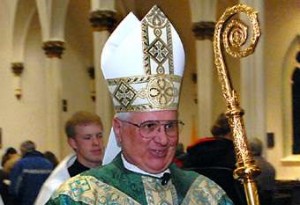
Bishop Fabian Bruskewitz is Keeper of the Flame
By Leslie Reed
 (Omaha World-Herald) LINCOLN — Perhaps the story of Bishop Fabian Bruskewitz's 20-year watch over the Lincoln Diocese of the Roman Catholic Church could be told as a parable of two men.
Both were trained as priests at a select seminary in Rome, their time there overlapping during the late 1950s and early 1960s.
The slightly older priest revered church tradition as a living connection between believers and Jesus Christ, established through a succession of priests tracing back to St. Peter himself. That priest, a Milwaukee native ordained in 1960, has had a storied career and went on to become the eighth bishop of Lincoln.
The younger man visualized the church as a champion of social justice, embracing all people and ending discrimination. John Krejci, a South Omaha native ordained in 1962, grew disillusioned. He left the priesthood in 1971 to become a professor of social work.
Three decades later, Bruskewitz and Krejci crossed paths again in Lincoln. Their clash of values ended with Bruskewitz excommunicating Krejci and other local members of a Catholic reform group known as Call to Action.
One of their strongest areas of contention: the role of women and girls in worship services.
Under Bruskewitz's leadership, the Lincoln Diocese remains the last in the United States to prohibit girls from being altar servers. Krejci not only would like to see altar girls, he wants the church to consider married priests and female priests and seeks more discussion of matters such as birth control and same-sex marriage.
As Bruskewitz nears the end of his time as bishop, the 15-year battle over the two opposing concepts of Catholicism is a signature theme of his tenure. It is a battle that helped win him a national reputation as a traditionalist among the nation's 65 million Catholics.
In a recent interview, Bruskewitz said his duty is to preserve Catholic faith, "unmutilated, undiluted and undistorted."
"Relativism is a great danger," he said. "There is such a thing as truth."
***
 Reverence for tradition would not be the only defining characteristic of Bruskewitz's tenure, of course.
Bruskewitz turned 75 in September 2010 and, as required by church law, submitted his letter of resignation. Ordained as Lincoln's bishop in May 1992, he will step down once Pope Benedict XVI names his successor, likely within the year.
Now the oldest-serving bishop in the United States, Bruskewitz in effect serves as chief executive officer of the Diocese of Lincoln, a territory covering Nebraska from border to border south of the Platte River.
By many measures, his Lincoln career has been one of accomplishment. Church membership has grown, the parochial schools are strong, new seminaries and convents have been established, social services have been expanded, and church finances are solid.
"His influence has been profound," said Doug Curry, a retired executive with the Lincoln Electric System and a member of St. Michael Church, a fast-growing parish in southeast Lincoln.
Bruskewitz set in motion the first ever diocesewide fund drive in 1999, raising $28 million to support Catholic schools, priests' retirement, a new seminary and other projects.
Five new Catholic grade schools and five new parishes have been established, including Lincoln's Cristo Rey Church, a predominantly Hispanic congregation, and St. Andrew Dung-Lac, a predominantly Vietnamese congregation. St. Michael School, which opened in August 2011, is the newest Catholic elementary school in the state.
 "The Lord has blessed us," Bruskewitz said in a recent interview. "I don't take any credit. Good things happen because of God's grace."
***
Since Bruskewitz became bishop, the number of Catholics in the diocese has grown from about 80,000 to more than 95,000.
A number of factors contributed to the growth, including an influx of Hispanic and other immigrants and new Catholic converts. But some Catholics have moved into the diocese because of its emphasis on tradition.
Paul Lewandowski and his wife, Terri, have lived in five dioceses, including in the Chicago area, Denver and Birmingham, Ala., and returned to Nebraska 11 years ago. Paul Lewandowski, an aviation professional, took a job at Lincoln's Duncan Aviation in part because of the Lincoln Diocese's reputation.
"You hear about it all over the United States and all over the world that Lincoln is a strong or devout diocese," he said. "You hear good things — that it's Rome in the United States. Or you hear bad things — it's so conservative or it's stuffy and there's no freedom."
He finds the Lincoln Diocese's emphasis on tradition to be reassuring — proof that the Catholic faith has been handed down generation to generation from Jesus.
 He even likes that the diocese prohibits altar girls: "The role of altar boy is one reserved for preparation for the priesthood. It sets up boys to become men who serve."
Lewandowski said that when his family lived in Chicago, waiting lists and cost prevented him and his wife from placing their six children in Catholic school. Rather than enroll them in public school, they home-schooled.
That leads him to another major benefit of the Lincoln Diocese: the affordability of parochial school education. Bruskewitz's policy requires churches to contribute to the cost of educating children from their parish.
Senior year tuition at Lincoln's Pius X High School costs $1,800. For comparison, senior year tuition at Omaha Skutt High School is $8,325.
"It makes it so affordable, you can't afford not to send your kids to Catholic school," Lewandowski said.
***
Patty Hawk is not among those attracted to the traditionalism of the Lincoln Diocese.
The 48-year-old assistant professor of communication studies at Nebraska Wesleyan University moved to the Lincoln area from Chadron, Neb., in 1985. Growing up, she helped serve Holy Communion at her parish church and deliver it to shut-ins. She was disappointed to find that women aren't allowed to do that in the Lincoln Diocese.
"I found out there were only two ways I could help in my church: I could be in the music ministry and I could clean," she said.
She became attracted to Call to Action in the early 1990s because of its goals of giving women and lay people more leadership opportunities. She joined the group's Lincoln chapter soon after it was formed in 1996.
As Call to Action was being organized, however, Bruskewitz warned that the group's beliefs were incompatible with church doctrine. Those who joined it anyway would be excommunicated and barred from receiving Communion.
***
Other than the absence of altar girls, the differences between a Catholic Mass in a Lincoln Diocese church and one in another diocese are subtle, almost imperceptible to the uninitiated.
Lincoln Catholics note that the language used to consecrate the bread and wine for Communion precisely follows the liturgical text of the Roman Missal, in one example.
The tabernacle, used to house Communion wafers after they have been consecrated, is always at the highest place in the church.
They say some churches in other dioceses may be more relaxed on those points.
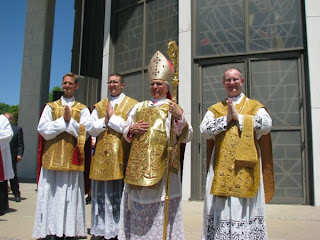 Some churches in the Lincoln Diocese, though not all, tap women to read Scripture and to lead prayers from the pulpit.
The differences may be more obvious in the school system. The row of young priests attending football games at Pius X High School. The nun teachers who wear their habits in the classroom. The daily Mass at the elementary schools.
Those factors, Catholics say, contribute to the high number of young people who decide to enter the priesthood or join a convent. A 2006 study by Catholic World Report cited the Diocese of Lincoln as having the highest per-capita number of seminarians in the country.
During Bruskewitz's tenure, 67 men in the diocese have been ordained as priests. About 35 of them graduated from the St. Gregory the Great Seminary in Seward, Neb., which Bruskewitz helped establish in 1998.
The Rev. Steve Thomlison, once a political campaign consultant who helped conservative Jon Christensen unseat then-U.S. Rep. Peter Hoagland in 1994 in the 2nd District, left the hard-hitting world of politics in 2003 to study for the priesthood.
Thomlison, who was ordained in 2010, said he found his calling in part because Bruskewitz fostered an especially welcoming environment for priests.
Bruskewitz stresses the fundamentals for his priests, Thomlison said, much as a basketball coach who drills his athletes on the basics so they can excel on game day.
"He is this great lion that cares for us and protects us."
***
 Sandy Danek, the president of Nebraska Right to Life, converted to Catholicism after her marriage more than 30 years ago. One of her sons is studying for the priesthood at the Seward seminary.
"He's just a delightful, delightful person," she said of Bruskewitz.
She disputes that the diocese stifles women.
"I'm so busy that some days I don't know how I could do much more," she said.
In addition to her anti-abortion involvement, she serves as a cantor, or song leader, for Mass and helped start a ministry for grieving people more than 20 years ago.
Last week, at least a half-dozen girls participated in a Mass presided over by Bruskewitz at St. Michael School.
Some read Scripture and led prayers. Fifth-graders Maggie Stamper and Grace Gokie concluded the service with thank-yous for parents and volunteers and a report to the bishop that students had offered up hundreds of prayers for him.
But only boys aided the priests as they prepared and served Communion.
"I believe gender equality is not the same thing as gender interchangeability," Bruskewitz said, adding that "the most splendid creature God ever made was Mary, who gave Jesus flesh to redeem us."
As the mother of four grown sons and a grown daughter, Danek said she accepts the diocese's policy that only boys can be altar servers because it has helped cultivate more priests in the diocese. Her son Timothy has told her that serving as an altar boy led him to decide to be a priest.
"Some would call it conservative; I would call it orthodoxy," she said of Bruskewitz's philosophy. "That strength in leadership is doing amazing things."
***
It is not unusual for the bishop to take a hard-nosed position.
He refused to participate in a voluntary annual audit of diocesan policies against child sexual abuse requested by the U.S. Conference of Catholic Bishops.
In an interview, he said he sees no purpose to the audit.
Incidents of abuse are "vile, they damage people for life. Few things are more horrible. They require immediate action, and it is a crime not to report them."
In recent weeks, Bruskewitz made headlines again, issuing a blistering letter calling for Catholics in the diocese to fight a federal ruling requiring insurance coverage for birth control, female sterilization procedures and the morning-after pill.
The letter is part of a nationwide effort by U.S. Catholic bishops to oppose the requirement included in the federal health care law.
 In his letter, Bruskewitz referred to Health and Human Services Secretary Kathleen Sebelius as a "bitter fallen-away Catholic" and urged Catholics to be prepared to incur heavy fines or imprisonment if necessary to oppose the measure, which affects religious-run social service agencies.
In an interview, Bruskewitz said he views it as a matter of religious freedom, not politics.
"This is a requirement that requires me to pay for something that happens in my view to be completely immoral," he said. "It's a distortion of the land of the free, and they know it."
***
The showdown with Call to Action occurred not long after Bruskewitz's arrival in Lincoln. The group was one of a dozen that Bruskewitz identified as antithetical to Catholic teachings. Others included the pro-suicide Hemlock Society, Planned Parenthood, the Freemasons and its affiliated organizations, and even an ultra-conservative Catholic organization that followed pre-Vatican II precepts without the pope's authorization.
It was the Call to Action group that attracted the most attention, however.
The organization is fairly small, with about 50 active members in the diocese. Its members say their goal is to strengthen the church, not undermine it, and they object strenuously to being denied Communion.
Krejci on occasion simply has taken the bread, despite attempts by priests to wave him off. As recently as last year, he said, priests in the diocese were sent reminder letters that they should not knowingly provide Communion to Call to Action members.
Many members travel outside the diocese to receive Communion.
It's a matter that causes some anguish for Jim McShane, a retired English professor from the University of Nebraska-Lincoln.
It reached a crisis point several weeks ago as McShane prepared for surgery to repair a stroke-like injury on the surface of his brain. He did not know whether he would be alive or fully functioning afterward.
 His excommunication put him in a position, he said, "where if you were to die, you'd be damned to hell," he said. "This is an unsettling prospect."
Yet to be restored to the sacraments, he would have to renounce Call to Action.
"That causes me to assert something I do not believe is true," McShane said.
"My resolution is to say that one must trust the justice of God," he said. "So I do."
***
Bruskewitz expresses no second thoughts about the controversial decisions that have marked his tenure and dismisses labels like "conservative" or "authoritarian" as political words that don't fit religious leaders.
Asked whether he found it sorrowful to deny Communion to believers, he said it was more sorrowful for errant Catholics to put their priests in an uncomfortable position.
Bruskewitz said he finds it a tragedy that his one-time fellow seminarian now leads an "anti-Catholic sect."
"Their creed does not resemble the Catholic Church," he said. "If they want to walk their own way, let them walk their own way."

Both were trained as priests at a select seminary in Rome, their time there overlapping during the late 1950s and early 1960s.
The slightly older priest revered church tradition as a living connection between believers and Jesus Christ, established through a succession of priests tracing back to St. Peter himself. That priest, a Milwaukee native ordained in 1960, has had a storied career and went on to become the eighth bishop of Lincoln.
The younger man visualized the church as a champion of social justice, embracing all people and ending discrimination. John Krejci, a South Omaha native ordained in 1962, grew disillusioned. He left the priesthood in 1971 to become a professor of social work.
Three decades later, Bruskewitz and Krejci crossed paths again in Lincoln. Their clash of values ended with Bruskewitz excommunicating Krejci and other local members of a Catholic reform group known as Call to Action.
One of their strongest areas of contention: the role of women and girls in worship services.
Under Bruskewitz's leadership, the Lincoln Diocese remains the last in the United States to prohibit girls from being altar servers. Krejci not only would like to see altar girls, he wants the church to consider married priests and female priests and seeks more discussion of matters such as birth control and same-sex marriage.
As Bruskewitz nears the end of his time as bishop, the 15-year battle over the two opposing concepts of Catholicism is a signature theme of his tenure. It is a battle that helped win him a national reputation as a traditionalist among the nation's 65 million Catholics.
In a recent interview, Bruskewitz said his duty is to preserve Catholic faith, "unmutilated, undiluted and undistorted."
"Relativism is a great danger," he said. "There is such a thing as truth."
***

Bruskewitz turned 75 in September 2010 and, as required by church law, submitted his letter of resignation. Ordained as Lincoln's bishop in May 1992, he will step down once Pope Benedict XVI names his successor, likely within the year.
Now the oldest-serving bishop in the United States, Bruskewitz in effect serves as chief executive officer of the Diocese of Lincoln, a territory covering Nebraska from border to border south of the Platte River.
By many measures, his Lincoln career has been one of accomplishment. Church membership has grown, the parochial schools are strong, new seminaries and convents have been established, social services have been expanded, and church finances are solid.
"His influence has been profound," said Doug Curry, a retired executive with the Lincoln Electric System and a member of St. Michael Church, a fast-growing parish in southeast Lincoln.
Bruskewitz set in motion the first ever diocesewide fund drive in 1999, raising $28 million to support Catholic schools, priests' retirement, a new seminary and other projects.
Five new Catholic grade schools and five new parishes have been established, including Lincoln's Cristo Rey Church, a predominantly Hispanic congregation, and St. Andrew Dung-Lac, a predominantly Vietnamese congregation. St. Michael School, which opened in August 2011, is the newest Catholic elementary school in the state.
"The Lord has blessed us," Bruskewitz said in a recent interview. "I don't take any credit. Good things happen because of God's grace."***
Since Bruskewitz became bishop, the number of Catholics in the diocese has grown from about 80,000 to more than 95,000.
A number of factors contributed to the growth, including an influx of Hispanic and other immigrants and new Catholic converts. But some Catholics have moved into the diocese because of its emphasis on tradition.
Paul Lewandowski and his wife, Terri, have lived in five dioceses, including in the Chicago area, Denver and Birmingham, Ala., and returned to Nebraska 11 years ago. Paul Lewandowski, an aviation professional, took a job at Lincoln's Duncan Aviation in part because of the Lincoln Diocese's reputation.
"You hear about it all over the United States and all over the world that Lincoln is a strong or devout diocese," he said. "You hear good things — that it's Rome in the United States. Or you hear bad things — it's so conservative or it's stuffy and there's no freedom."
He finds the Lincoln Diocese's emphasis on tradition to be reassuring — proof that the Catholic faith has been handed down generation to generation from Jesus.
He even likes that the diocese prohibits altar girls: "The role of altar boy is one reserved for preparation for the priesthood. It sets up boys to become men who serve."Lewandowski said that when his family lived in Chicago, waiting lists and cost prevented him and his wife from placing their six children in Catholic school. Rather than enroll them in public school, they home-schooled.
That leads him to another major benefit of the Lincoln Diocese: the affordability of parochial school education. Bruskewitz's policy requires churches to contribute to the cost of educating children from their parish.
Senior year tuition at Lincoln's Pius X High School costs $1,800. For comparison, senior year tuition at Omaha Skutt High School is $8,325.
"It makes it so affordable, you can't afford not to send your kids to Catholic school," Lewandowski said.
***
Patty Hawk is not among those attracted to the traditionalism of the Lincoln Diocese.
The 48-year-old assistant professor of communication studies at Nebraska Wesleyan University moved to the Lincoln area from Chadron, Neb., in 1985. Growing up, she helped serve Holy Communion at her parish church and deliver it to shut-ins. She was disappointed to find that women aren't allowed to do that in the Lincoln Diocese.
 |
She became attracted to Call to Action in the early 1990s because of its goals of giving women and lay people more leadership opportunities. She joined the group's Lincoln chapter soon after it was formed in 1996.
As Call to Action was being organized, however, Bruskewitz warned that the group's beliefs were incompatible with church doctrine. Those who joined it anyway would be excommunicated and barred from receiving Communion.
***
Other than the absence of altar girls, the differences between a Catholic Mass in a Lincoln Diocese church and one in another diocese are subtle, almost imperceptible to the uninitiated.
Lincoln Catholics note that the language used to consecrate the bread and wine for Communion precisely follows the liturgical text of the Roman Missal, in one example.
The tabernacle, used to house Communion wafers after they have been consecrated, is always at the highest place in the church.
They say some churches in other dioceses may be more relaxed on those points.
 Some churches in the Lincoln Diocese, though not all, tap women to read Scripture and to lead prayers from the pulpit.
The differences may be more obvious in the school system. The row of young priests attending football games at Pius X High School. The nun teachers who wear their habits in the classroom. The daily Mass at the elementary schools.
Those factors, Catholics say, contribute to the high number of young people who decide to enter the priesthood or join a convent. A 2006 study by Catholic World Report cited the Diocese of Lincoln as having the highest per-capita number of seminarians in the country.
During Bruskewitz's tenure, 67 men in the diocese have been ordained as priests. About 35 of them graduated from the St. Gregory the Great Seminary in Seward, Neb., which Bruskewitz helped establish in 1998.
The Rev. Steve Thomlison, once a political campaign consultant who helped conservative Jon Christensen unseat then-U.S. Rep. Peter Hoagland in 1994 in the 2nd District, left the hard-hitting world of politics in 2003 to study for the priesthood.
Thomlison, who was ordained in 2010, said he found his calling in part because Bruskewitz fostered an especially welcoming environment for priests.
Bruskewitz stresses the fundamentals for his priests, Thomlison said, much as a basketball coach who drills his athletes on the basics so they can excel on game day.
"He is this great lion that cares for us and protects us."
***
Sandy Danek, the president of Nebraska Right to Life, converted to Catholicism after her marriage more than 30 years ago. One of her sons is studying for the priesthood at the Seward seminary."He's just a delightful, delightful person," she said of Bruskewitz.
She disputes that the diocese stifles women.
"I'm so busy that some days I don't know how I could do much more," she said.
In addition to her anti-abortion involvement, she serves as a cantor, or song leader, for Mass and helped start a ministry for grieving people more than 20 years ago.
Last week, at least a half-dozen girls participated in a Mass presided over by Bruskewitz at St. Michael School.
Some read Scripture and led prayers. Fifth-graders Maggie Stamper and Grace Gokie concluded the service with thank-yous for parents and volunteers and a report to the bishop that students had offered up hundreds of prayers for him.
But only boys aided the priests as they prepared and served Communion.
"I believe gender equality is not the same thing as gender interchangeability," Bruskewitz said, adding that "the most splendid creature God ever made was Mary, who gave Jesus flesh to redeem us."
As the mother of four grown sons and a grown daughter, Danek said she accepts the diocese's policy that only boys can be altar servers because it has helped cultivate more priests in the diocese. Her son Timothy has told her that serving as an altar boy led him to decide to be a priest.
"Some would call it conservative; I would call it orthodoxy," she said of Bruskewitz's philosophy. "That strength in leadership is doing amazing things."
***
It is not unusual for the bishop to take a hard-nosed position.
He refused to participate in a voluntary annual audit of diocesan policies against child sexual abuse requested by the U.S. Conference of Catholic Bishops.
In an interview, he said he sees no purpose to the audit.
Incidents of abuse are "vile, they damage people for life. Few things are more horrible. They require immediate action, and it is a crime not to report them."
In recent weeks, Bruskewitz made headlines again, issuing a blistering letter calling for Catholics in the diocese to fight a federal ruling requiring insurance coverage for birth control, female sterilization procedures and the morning-after pill.
The letter is part of a nationwide effort by U.S. Catholic bishops to oppose the requirement included in the federal health care law.
In an interview, Bruskewitz said he views it as a matter of religious freedom, not politics.
"This is a requirement that requires me to pay for something that happens in my view to be completely immoral," he said. "It's a distortion of the land of the free, and they know it."
***
The showdown with Call to Action occurred not long after Bruskewitz's arrival in Lincoln. The group was one of a dozen that Bruskewitz identified as antithetical to Catholic teachings. Others included the pro-suicide Hemlock Society, Planned Parenthood, the Freemasons and its affiliated organizations, and even an ultra-conservative Catholic organization that followed pre-Vatican II precepts without the pope's authorization.
It was the Call to Action group that attracted the most attention, however.
The organization is fairly small, with about 50 active members in the diocese. Its members say their goal is to strengthen the church, not undermine it, and they object strenuously to being denied Communion.
Krejci on occasion simply has taken the bread, despite attempts by priests to wave him off. As recently as last year, he said, priests in the diocese were sent reminder letters that they should not knowingly provide Communion to Call to Action members.
Many members travel outside the diocese to receive Communion.
It's a matter that causes some anguish for Jim McShane, a retired English professor from the University of Nebraska-Lincoln.
It reached a crisis point several weeks ago as McShane prepared for surgery to repair a stroke-like injury on the surface of his brain. He did not know whether he would be alive or fully functioning afterward.
 His excommunication put him in a position, he said, "where if you were to die, you'd be damned to hell," he said. "This is an unsettling prospect."
Yet to be restored to the sacraments, he would have to renounce Call to Action.
"That causes me to assert something I do not believe is true," McShane said.
"My resolution is to say that one must trust the justice of God," he said. "So I do."
***
Bruskewitz expresses no second thoughts about the controversial decisions that have marked his tenure and dismisses labels like "conservative" or "authoritarian" as political words that don't fit religious leaders.
Asked whether he found it sorrowful to deny Communion to believers, he said it was more sorrowful for errant Catholics to put their priests in an uncomfortable position.
Bruskewitz said he finds it a tragedy that his one-time fellow seminarian now leads an "anti-Catholic sect."
"Their creed does not resemble the Catholic Church," he said. "If they want to walk their own way, let them walk their own way."
Thursday, August 20, 2009
Call to Apostasy
Thursday, August 20, 2009 by Eugene Michael
 The new executive director of Call to Action is Jim FitzGerald, formerly of Planned Parenthood. Here are some selected excerpts about him from an article in the National Catholic Reporter:
“What’s missing in our church is the freedom to talk without fear about issues like abortion or gay marriage or stem cell research.
“That’s what I love about Call to Action: Everyone’s at the table,” he says, quoting the theme for Call to Action’s November conference. “It’s easy to be in conversation with people who think like you. But if we only do that, we miss out on something that could be very positive for Catholicism.”
…Call to Action staff and board members say they hope FitzGerald’s history and views will help spark respectful conversation within the organization — as is starting to happen around the country — on the issue of abortion.
“If people of goodwill are willing to listen, it will help us all understand that there is no simple answer to this issue,” said Call to Action board member Tom Honoré, who served on the search committee for the position.
Honoré said FitzGerald “respects life as much as any of us,” though the new director’s views are solidly pro-choice.
FitzGerald eschews labels, but thinks abortion should be legal and doesn’t believe life begins at conception. “This issue is extremely complex,” he said. “I honor the person who follows their conscience on it.”
He (FitzGerald) doesn’t see any problem with being Catholic and working for Planned Parenthood.
“No organization — Catholic or otherwise — has done more to prevent abortion than Planned Parenthood,” he (FitzGerald) said, citing its comprehensive sex education services as well as access to affordable birth control.
I wonder how long it will be before Mr. FitzGerald is invited to Rochester to speak at St. Bernard’s? They better hurry-the window of opportunity closes in less than 3 years.
Sunday, March 1, 2009

Monday, November 24, 2008
"Great Leap Forward"


"The major Catholic Church reform organisations in the United States are in the process of organising a large scale, joint meeting in 2011 tentatively titled an "American Catholic Council". Catholica is aware discussions have been underway between leaders of the largest reform organisations such as Call to Action (CtA), Voice of the Faithful (VoTF), and the Association for the Rights of Catholics in the Church (ARCC) and leaders of a number of other major lay organisations have also been involved in the discussions and are at various stages of consulting their wider memberships. Combined these organisations have tens of thousands of members. The scale of this initiative is of particular interest as it could well be the largest lay-generated reform initiative that has ever occurred anywhere in the world. The development might suggest that the continued attrition in Church membership is now cutting into sectors of the population who are no longer prepare to leave the Church without voicing their criticisms of where the ecclesial leaders have been taking Catholicism.The idea has been promoted for a number of years by the President of ARCC, Professor Leonard Swidler, but recent developments including Pope Benedict's visit to America earlier this year and the clearly decisive divisions that have emerged between the outlooks of the lay faithful in America and their bishops in the recent Presidential election appear to have added impetus to the initiative.
In a newsletter sent to ARCC members on Friday Professor Swidler writes:
The Reform Movement of the Catholic Church in America — in the spirit of Vatican II — is on the cusp of a "Great Leap Forward", to borrow a phrase from Mao. ARCC has for several years been promoting the idea of all the major Catholic Reform groups in the U.S. joining together in an American Catholic Council to move our common agenda forward. That Great Leap Forward is now being launched! The largest of the American Catholic Reform organizations– Call to Action and Voice of the Faithful–are on board, along with, of course, ARCC, and others.
Professor Swidler goes on to outline four major points that have been agreed upon in the discussions that have taken place at the leadership levels of the reform organisations. They are:
- The basic Resources of the American Catholic Council are the documents of Vatican II and the processes and documents of the 1976 Call To Action led by the National Council of Bishops and involving massive numbers of laity, religious, and priests.
- The major focus will be on church governance. None of the diverse concerns of the various U.S. Catholic reform organizations will be attainable unless there are structural means to work toward their implementation. That means, minimally, striving for Catholic Church decision-making structures that are built on the democratic principles of accountability, transparency, representativeness, and due process of law.
- There will be the widest possible solicitation of input from all levels of Catholics around the country. Techniques that have already been discussed include national public hearings (as was done in 1976), approaches to parish organizations as well as organizations of laity, religious, and clergy, internet and other electronic means. Concrete suggestions in this area are especially solicited from you!
- The initial aim will be the coming together of thousands of chosen delegates and interested Catholics from around the country in an American Catholic Council in the year 2011.
The proposal will be of interest to Australian Catholics following the recent call by one of the organisers of last year's 17,000 signature petition to the Australian Catholic Bishops, Frank Purcell, for the calling of a Synod of the Australian Catholic Church."
___________________________________
"Great Leap Forward." What an appropriate name for this:
"The Great Leap Forward of the People's Republic of China (PRC) was an economic and social plan used from 1958 to 1961 which aimed to use China's vast population to rapidly transform mainland China from a primarily agrarian economy dominated by peasant farmers into a modern, agriculturalized and industrialized communist society. Mao Zedong based this program on the Theory of Productive Forces.
The Great Leap Forward is now widely seen – both within China and outside – as a major economic failure and great humanitarian disaster with estimates of the number of people who starved to death during this period ranging from 14 to 43 million."
____________________________________
Subscribe to:
Posts (Atom)