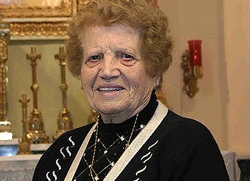
VATICAN CITY, JUNE 11, 2008 (Zenit.org).- American Catholics have changed their image of Benedict XVI and the Catholic Church after the Pope's April visit to the United States, says the Vatican nuncio in that country.
Archbishop Pietro Sambi told L'Osservatore Romano that the American people "discovered" the Holy Father during his visit, which they viewed in an overwhelmingly positive way.
"Benedict XVI was little and badly known in the United States," Archbishop Sambi said. "Those who expected an 'inflexible policeman of the Holy Office' have been conquered by the pastor, the father, the persuasive teacher.
"The Pope has been 'discovered' as an attentive expert on what happens in the heart of the man of today, as a bearer of substantial and life-giving answers, offered with clarity, with humility, almost with timidity."
And in response to this, the prelate affirmed, "the affection, attention, respect and love of a whole population has exploded."
From among the many details of the visit, Archbishop Sambi emphasized the Pontiff's visit to ground zero, which was "a moment of intense identification of the American people, regardless of their faith, with Benedict XVI."
"Even the press, which normally makes no secret of its sharpness with the Catholic Church, has written of and transmitted the visit of the Pope with interest, respect and liking," explained the nuncio. The secular press "defined the visit as 'an event that exceeded every expectation.' And, given the power and resonance of the U.S. mass media, a success here implies a success in the whole world."
Hope
Archbishop Sambi suggested that the Pope was able to connect with the American people because he spoke of hope.
He explained: "In the homily in Nationals Stadium in Washington, the Pontiff said, 'Americans have always been a people of hope […] Hope, hope for the future, is very much a part of the American character.' On Sept. 11, 2001, when the Twin Towers in New York and the Pentagon in Washington were attacked, the American people, just like in all their difficult moments, headed to the churches and the temples, finding in God's presence trust, unity and courage.
"Speaking of hope, the Pope has touched on a theme that is profoundly rooted in the history and the culture of this people, and he has struck a particularly sensitive chord for these times.
"The success of the Pope can be explained by Benedict XVI's capacity to understand the motivations of the American people and to contribute, with humility, the answers they need."
Another important moment, according to the prelate, was the Pope's meeting with President George Bush -- as the Pontiff himself noted later at the general audience of April 30.
Also during that audience, Archbishop Sambi recalled, in which the Holy Father gave a review of the trip, he referred to the "healthy secularism" characteristic of American society, which "was built from the outset on the foundations of a felicitous combination of religious, ethical and political principles."
"The Pope spoke of the 'valid example of healthy secularism' in the United States, describing it as: '[W]here the religious dimension, with the diversity of its expressions, is not only tolerated but appreciated as the nation's "soul" and a fundamental guarantee of human rights and duties' -- a description of 'healthy secularism' that deserves to be attentively studied," Archbishop Sambi affirmed.
Instilling courage
The nuncio said another effect of the trip was instilling new courage in American Catholics.
"On the Catholic radio of the Archdiocese of New York, the Pope said he had come to confirm them in their faith, 'but in reality it is you who have confirmed me, with your response, with your enthusiasm, with your affection.' These spontaneous words have touched the heart of American Catholics, and they have been perceived as appreciation and encouragement," the prelate said.
According to Archbishop Sambi, after the visit, "the Catholic Church has been renewed in courage. We are getting reports from parishes that many of the faithful who had for some time abandoned their religious practices, have returned to confession and Sunday Mass."
Saturday, June 14, 2008
We may all be space aliens: study
PARIS (AFP) - Genetic material from outer space found in a meteorite in Australia may well have played a key role in the origin of life on Earth, according to a study to be published Sunday.
European and US scientists have proved for the first time that two bits of genetic coding, called nucleobases, contained in the meteor fragment, are truly extraterrestrial.
Previous studies had suggested that the space rocks, which hit Earth some 40 years ago, might have been contaminated upon impact.
Both of the molecules identified, uracil and xanthine, "are present in our DNA and RNA," said lead author Zita Martins, a researcher at Imperial College London...
Friday, June 13, 2008
Sea Dragon

A male weedy sea dragon carries eggs on his tail at the Georgia Aquarium in Atlanta, Thursday, June 11, 2008. For only the third time ever in a U.S. aquarium, one of the endangered creatures is pregnant.
NBC’s Tim Russert dead at 58

http://www.msnbc.msn.com/id/25145431/
"It's just a shame. Tim was a regular guy with that perpetual smile he wore naturally all the time. He loved life and got everything he could out of it. Whether it was at dinner here in Florida while his son was taking golf lessons, or on the set of Meet The Press, Tim was always the same with me: genuine. He never condescended to anyone and was the consummate professional. He will be hard to replace. He was the closest thing there was at any of the networks to an objective journalist." - Rush Limbaugh
And let perpetual Light shine upon him.
May his soul
And the souls of all the faithful departed
Through the mercy of God
Rest in peace.
Amen.
George W Bush meets Pope amid claims he might convert to Catholicism
George W Bush and Pope Benedict XVI have held an intimate meeting in Rome as rumours mounted in Italy that the president may follow in Tony Blair's footsteps and convert to Catholicism.

The two men spoke for half an hour in the 12th century Tower of St John, a private area in the Vatican gardens which is used by the pope for private reflection.
The usual protocol for heads-of-state is a meeting in the pope's library in the Apostolic Palace, but a spokesman for the Vatican said Benedict wanted to reward Mr Bush for the "warmth" of his reception at the White House earlier this year.
The two men have grown increasingly close in the past two years, and Mr Bush was overheard whispering: "What an honour, what an honour, what an honour!" as he ascended the steps to the tower.
After a stroll through the Vatican gardens, the men listened to a recital by the choir of the Sistine Chapel. However, Mr Bush did not, as expected, kneel in prayer before the Grotto of the Madonna of Lourdes. It was thought that he may have prayed with the pope in private. Mr Bush prayed with Benedict in the Oval Office during the Papal visit to the US in April.
Several Italian newspapers cited Vatican sources suggesting that Mr Bush may be prepared to convert. One source told Il Foglio, an authoritative newspaper, that "Anything is possible, especially for a born-again Christian such as Bush."
He added that while the Holy See deplored the war in Iraq, "on ethical matters he has always had a line that is practically identical to that of the Vatican." Mr Bush has spoken out against gay marriage, abortion and stem cell research. He proposed amending the US constitution to "fully protect marriage" as the "union of man and woman as husband and wife".
He has repeatedly made clear his admiration for Benedict and has even claimed to have read some of the pope's theological books.
A source close to the Vatican said that Mr Bush was the most "Catholic-minded" president since John F Kennedy, who famously played down his Catholicism. Mr Bush belongs to a Methodist church in Texas and prays at an Episcopal church in Washington.
However, George William Rutler, a New York-based priest who is close to the president, was quoted by the Washington Post earlier this year saying that Mr Bush "is not unaware of how evangelism, by comparison with Catholicism, may seem more limited both theologically and historically".
Mr Bush has filled the White House with Catholic speech-writers and consultants and is also thought to have asked a Catholic priest to bless the West Wing.
Before he became president, Karl Rove, his former political adviser, invited Catholic intellectuals to Texas to lecture the candidate on the church's teachings. Mr Bush appointed the Catholic judges Samuel Alito and John Roberts to the Supreme Court.
However, it is thought unlikely that Mr Bush would convert until after he has left office. Jeb Bush, the president's brother, has already converted to Catholicism.
Catholics have noted that during the contested election in 2000, Jeb Bush travelled to Mexico and prayed to the icon of Our Lady of Guadelupe. His victory was announced by the Supreme Court on December 12, the feast day of the Lady of Guadelupe.
Lisbon Treaty looks set to be rejected
The Lisbon Treaty referendum looks set to be rejected by the Irish people, according to the first official results and tallies taken as votes are counted around the country.
With seven of 43 constituencies having declared results, the No vote is leading by 57 per cent to 43 per cent...
Thursday, June 12, 2008
Alessandra Borghese: the prodigal daughter
European aristocrat, Princess Alessandra Borghese, talks to Peter Stanford about her well-documented return to Catholicism
The reformed rake is a familiar figure in the religious canon from the parable of the prodigal son onwards.
![]() | |
Princess Alessandra Borghese, 44-year-old scion of one of the grandest of Italian noble families, famous for its popes, cardinals and glorious villa and park in the centre of Rome, may never quite have been a rake, but otherwise neatly fits the mould.
In the 1990s, she was one of those European aristocrats whose names we came to know only because they were forever appearing in glossy magazines, attending all the right grand weddings and openings. She even published an A-to-Z guide to good manners with her great friend, the German Gloria von Thurn und Taxis, better known in the society pages as the 'punk princess' or 'Princess TNT'.
Alessandra Borghese's personal wealth - her mother, Countess Fabrizia Citterio, was one of the heirs to the San Pellegrino water fortune- funded her very own cultural centre in Rome, and she married into more money in the form Greek shipping tycoon, Constantine Niarcose. All of which feels a million miles away from the slight, guarded woman sitting opposite me, sipping an espresso in a London café, her clothes simple, her face without a hint of make-up, and her conversation all about God.
In 1999, she recalls, looking me straight in the eye, she had a meeting. 'Catholicism is not a philosophy, neither is it a theology, but it is a meeting with a person. So the moment you meet Jesus Christ, your life can change radically. That is when I started to look at everything differently.' Borghese has since that meeting, become Italy's best-known born-again Catholic.
Her 2004 book, With New Eyes, the story of her return to the fold, was a bestseller in her home country and over much of Catholic Europe. She has followed it with four other equally successful, equally personal, devotional works, including In The Footsteps of Joseph Ratzinger, her first outing in English, published this month.
As we talk, I find myself more than once referring to her conversion, but, as she points out, that is not the right word for she was raised Catholic. "I was brought up to know that my family had given a very important pope to the church, Paul V [at the start of the seventeenth century], so important that his name is written on the façade of Saint Peter's Basilica itself, along with our coat of arms.'
As she quotes the Latin inscription, she raises the little finger of her left hand to show me the same crest on the small ring she is wearing. 'But for me growing up, that was all history. I didn't participate in it.' She was, she says, 'very conformist' as a young woman. 'I couldn't care less about praying, about the Church, I had to be emancipated.'
Her distaste for such a notion is immediately apparent but is revealed in full later, when the question of women priests -banned by Catholicism - comes up. 'If you're Catholic and want to be a woman priest,' she protests, 'join the Anglicans or the Protestants. Why do you want to change the Catholic tradition according to your point of view? If you look at Holy Mary, you see that her grandeur was not because she did anything, but because she was able to stand behind something bigger.' It is not a position that sits easily with contemporary secular norms, but Borghese has a rather aristocratic disdain for conventional wisdom.
Her attachment to traditional Catholic values is as fierce as it is unapologetic. On the evening of our meeting, she is due to address an audience at the Brompton Oratory, bastion of the unreformed approach to the faith in London.
Her own successful career, as an author, has nothing to do with female emancipation, she insists. 'Sometimes you should try to make a step back, not forward, and you can be very useful to a bigger scheme. I know its difficult because we live in a society where we are all pushed to be in front, to be visible. If you don't appear, you don't exist. You have to be seen, be successful, be good looking, be cool. But it just isn't true.'
There is, arguably, an autobiographical reference to her own younger days in there. Was there a particular trigger for her return to Catholicism? The same date she quotes for it was also, I point out, the year when her husband died, reportedly of a cocaine overdose. 'No, it was not because of that. I wouldn't relate it to that.'
Up to now fluent, she suddenly gets flustered. 'No, no'. She pauses. 'My reasons were more banal. That is why I wanted to write it. Because it can happen to anyone.'
When With New Eyes first appeared, she recalls, she was overwhelmed by letters from people who had had similar experiences of drawing closer to God. Or who wanted that to happen. 'I think they felt encouraged because I was such an inappropriate person for this to happen to. But that is what made me so appropriate.'
It is a telling point, and, in making it, her confidence returns quickly. But what gives Borghese's new book its particular charm is that, for all her protestations of being ordinary, she clearly retains a privileged entrée in church circles. As In The Footsteps of Joseph Ratzinger demonstrates.
It is a kind of voyage around the Holy Father. Or, to be more particular, a voyage around his native Bavaria, in the company of Gloria von Thurn und Taxis whose 500-room Schloss St Emmeram is located there. 'To call it a house,' Borghese admits, 'might provoke a smile'.
The two princesses travel to various sites associated with the young Pope Benedict, meet his brother, also a priest, and end up, as the book's climax, being summoned for a private audience with the Pontiff as he makes his first visit to his homeland since his election in 2005.'Gloria and I,' Borghese writes, 'had intended to mix with the crowds and wait for the Pope anonymously. However, Providence arranged things otherwise.
The mayor, whom we had met only a few weeks previously, invited us to sit in seats that had been reserved for him…Entirely unexpectedly, [the Pope] also paused to greet us. I enthusiastically told him how much I had been struck by the beauty of his land. Kind as always, he nodded and thanked me'.
Sometimes, we have a tendency to see rulers - be they kings, presidents, prime ministers or popes - in terms of their policies rather than simply as individuals. With her unique access to man who, since his election, has not given interviews, how, I wonder, would Borghese describe the private Benedict XVI? 'He's very polite. He makes me feel immediately comfortable and important to him.
He looks into my eyes and asks me how I feel, how things are going, with a sweet politeness. And then he is a simple and straightforward person. Maybe a little bit shy.' Her focus on his roots in Bavaria inevitably raises the question about Benedict's attitude, as a young man, to the Nazi party. For, as she points out, Markel am Inn, where he was born in 1927, lies just across the river from Braunau am Inn where, 38 years earlier, Adolf Hitler, had entered this world.
'There is nothing to defend the Pope's reputation about,' she protests. 'People have tried to find hidden things, relationships with Nazis, but there is nothing. He was a young boy. He was a soldier. He did his job. He did what every other young boy would have done then. And then he became a priest. There is nothing to be discovered. No scandal.' Her expression makes plain there nothing more to discuss.
What, I can't help asking, do her old friends, from her pre-1999 days, think of her now in her role as arch-Catholic? 'Of course, they think I am strange. People look at me in a weird way, but others respect me. It is life. It doesn't worry me. Because the great thing when you rediscover faith is that you don't feel alone anymore. And so you are stronger.' The inference is that she felt alone before that rediscovery. 'No, its not that I felt alone, rather that, even though I had everything, something was missing.'
In the Borghese family tree there is a line that leads back, some say, to Saint Catherine of Siena, the fourteenth century mystic. She was, like many saints of the church, someone who turned her back on worldly goods in order to follow God. Is such a renunciation something Borghese has contemplated? She laughs at the comparison. 'I am a million kilometers away from being such a saint. But everybody has his or her own big or little mission.'
Hers, she makes clear, is simply to write, to be, as she puts it, 'a witness to the possibility in our age of rediscovering faith'. In her quieter moments, she works as a volunteer helper at the French Marian shrine of Lourdes - an experience that she has made into a book, just out in Italy and already, she tells me, another bestseller. And, recently, she stood as a candidate for the Italian Senate, on the list of the Union of Christian and Centre Democrats. 'But there was no hope of being elected,' she stresses. ' It is a tiny party, though if the electoral rules had been different. I could have won a seat.'
We are just moving on to her political ambitions - she is charmingly but firmly refusing to be drawn on what she thinks of Silvio Berlusconi - when we are joined by Gloria von Thurn und Taxis and her daughter. They are in London too and there are plans to visit Christie's. 'I think we have finished,' Borghese says. Her voice goes up at the end, as if asking a question, but her intention is clear.
I slip in a final question. When she looks back to her 'other life' in the 1990s, does she have any regrets? 'No,' she fires back immediately, 'because I haven't lost anything. I am a much freer person. Much more open to the world, so I see that time as a sort of preparation. I don't want to change what has happened. I want to change what I am living now.'
EXCLUSIVE-Air Force concedes errors in tanker estimates-Boeing
United States - By Andrea Shalal-Esa
WASHINGTON (Reuters) - The U.S. Air Force has conceded that Boeing (nyse: BA - news - people ) Co's proposed KC-767 aerial refueling tanker would cost less over time than the winning plane offered by Northrop Grumman Corp (nyse: NOC - news - people ) and its European subcontractor EADS, Boeing told auditors reviewing its protest against the Air Force decision.
News of Air Force errors in calculating the life cycle costs of the competing bids, which were also confirmed by Northrop, comes as the Government Accountability Office (GAO) prepares to rule by June 19 on the Boeing protest...
96 year-old activist is pride of Caritas Valencia volunteers

Valencia, Jun 12, 2008 / 05:21 pm (CNA).- Ninety six year-old Clotilde Veniel is the oldest Caritas volunteer in the Spanish Archdiocese of Valencia. She visits the sick and the elderly at their homes in the town of Bicorp. According to the AVAN news agency, “Veniel has been a member of Caritas in Bicorp since it was founded in 1989 and she helps make pastries for the poor.”
“The sick people in our town always want her to come and visit,” AVAN reported. She tries to “encourage them and talk to them about God and tell them to have faith and hope in Him.”
“Helping others is a great joy, because I can contribute to alleviating peoples’ suffering. It’s something my parents, who were very devout Catholics, taught me,” she said. “My six brothers and sisters and I were very close, we learned to share and to support each other in difficult times,” she recalled.
For years, Veniel worked as a maid in Barcelona to help her parents. She has two children and was widowed two years ago. She lives alone because, “thanks be to God I can still take care of myself.”
According her pastor Father Joaquin Civera, Veniel is “an affectionate woman, and she has a great sense of humor and extraordinary vitality and cheer.” He administers to her the Anointing of the Sick at the annual Mass for the infirm each year, because “this sacrament is not only for those who suffer an illness, but also for older people, which is why Clotilde receives it.”Bishop Trautman: Average Catholics Too Dumb to Understand New Prayers
Bp. Trautman doesn’t think you are smart enough to understand the proposed new translation of Mass
"I was alerted to this by one of the veteran WDTPRSers who added: "Does anyone care about this stuff anymore?"
Here is the headine:
Bishop Trautman objects to some proposed language changesSo, bishop near the end of his long career, firmly mired in the stale old ideas of yesteryear, bravely soldiering on under the baggage of the 1960’s, is still objecting to the Holy See’s norms set for liturgical translation.
His Excellency Donald W. Trautman of Erie is nothing if not consistent. He reminds me of a guy who might go to the same old restaurant every day for lunch, sit at the same place every day, and order exactly the same sandwitch… but to do so in Rome.
Here is the story with my emphases and comments:
BY DANA MASSING
dana.massing@timesnews.com [more details]
"Ineffable."
The word worries Erie Catholic Bishop Donald W. Trautman.
He doubts that "John and Mary Catholic," sitting in their church pew, would understand it. [Two things here. Again and again His Excellency has demonstrated in his comments about liturgical translation and the new norms that he doesn’t not believe that you are very smart. He thinks you are too dumb to understand the prayer. He thinks you are too thick or detached to wonder what it means if you don’t immediately understand and then think about it or look it up. Also, he thinks that every prayer must be immediately able to be clearly understood. This leaves no room for the effect of mystery.]
That’s why Trautman will try to tell other U.S. bishops that such words shouldn’t be in a new English translation of the Roman Missal.
U.S. Catholic bishops are holding their June general meeting today through Saturday in Orlando, Fla. They are expected to vote on an English version of the portion of the Roman Missal involving prayers for seasons like Advent and Lent, unless Trautman can convince them to delay a decision on the translation. [He wants to delay … the … translation. Get that? Because surely we haven’t waited long enough.]
"I am at this point reserved about endorsing it," Trautman said two days before the start of the meeting. "I will try to speak on the conference floor to point out what I consider some major deficiencies in the translation." [Please, O God Almighty and Omnipotent Father, in your ineffable way inspire the bishops of the conference to keep this fellow in check.]
A presentation on it is likely today, with voting probably on Friday, he said.
The portion of the Missal being discussed is the Proper of Seasons.
"These would be the prayers at Mass for the opening prayer, the prayer over the gifts, the prayer after Communion," Trautman said. "These would be the prayers for all of Advent, Christmas, Lent, Easter and then the Sundays of the year." [I have a copy of the draft of these prayers. I think you would like them.]
The Vatican wants a translation more faithful to the original Latin text. [Not … just … the VATICAN!]
Trautman said the draft includes words such as "ineffable" that would not be in the ordinary vocabulary of people.
"This should be the prayer of the people," Trautman said. "I’m not for having street language. ... We should certainly have elevated tone, but words like that are just beyond the common comprehension." [Okay… figure that out. Elevated language but not comprehensible.]
Catholics coming out of a lunchtime Mass at Erie’s St. Peter Cathedral weren’t familiar with "ineffable." [WDTPRS asks … SO WHAT? The problem here is that if you make everything immediately comprehensible to the lowest common denominator it will wind up being pretty much like what we have now in the old lame-duck ICEL prayers:
God,
you are big.
Help us be big like you.
If people hear and interesting word, they might… oh my gosh… wonder what it all means and slowly but surely get the idea that monosyllables and grunting might not actually convey what the Latin prayers convery.]
According to Webster’s New World College Dictionary, Fourth Edition, the word means "too overwhelming to be expressed or described in words; inexpressible; too awesome or sacred to be spoken."
It’s "not in my daily language," said Shirley Skiba, a member of St. Luke Catholic Church in Erie. [Maybe Shirely shouldn’t be the measuring stick for the language of liturgical prayer.]
Skiba said words used in the Mass should be "something we feel comfortable with." That’s the case with the current translation, for the most part, she said. [Enough said.]
"I think it should be language the everyday person can understand," she said.
Trautman called parts of the proposed translation "archaic" and "just clumsy language." [Then His Excellency should take the time to explain it to Shirley.]
One proposed change, for the first week in Advent, would replace "old way of life" with "ancient bondage," the Erie bishop said.
"Ancient bondage is very ambiguous and not clear enough to the people," he said. [Yes. But there is a problem. I ask you, dear reader, does "old way of life" mean the same thing, even on the surface, as "ancient bondage"?]
Regarding another change, he said, "They speak of ‘into the joy of true peace.’ Well, we would say ‘rejoice in true peace.’ That’s much more understandable." [However, entering into a state of joy means something different than simply being joyful.]
In another vote related to language, the bishops will decide whether to replace "vosotros" with the more familiar "ustedes" in Spanish-language Masses in the United States. Trautman compared using "vosotros" in Spanish to using "thou" in English. [Aaaaaaaaand…. that would be… bad?]
...
Listen as Erie Catholic Bishop Donald W. Trautman talks about what the U.S. Catholic bishops will be discussing during their June general meeting Thursday through Saturday in Orlando.
Some English words might be hard, but they are the perfect word to do the job. To replace that word, you need a circumlocution or paraphrase. That makes translations overly wordy. But it is part of the very nature of Roman prayer to be concise. Even the concision is meaningful.
Enough said. "
World's Priciest Stealth Plane Takes First Run to Vertical Landing
Flight testing has evolved significantly in the years since Tomlinson first flew STOVLs. Computers have so many responsibilities on these planes that they've taken some of the tactile feedback away from pilots. "In the Harrier family, the pilot took care of the aircraft," Tomlinson says. "With the F-35, the airplane takes care of the pilot."
The F-35, known widely as the Joint Strike Fighter, comes in three versions with the same fuselage, identical wing sweeps, and similar tail shapes. The first, a conventional Air Force airplane, A-1, has been flying for more than a year. The STOVL B-model, which will fly for the first time this week, is designed for the U.S. Marine Corps. The last C model will be a larger airplane more suitable for the Navy. (C models will be bulky enough to handle the stresses of the sharp stops associated with hooking cables while landing on aircraft carrier decks.)
Any armed force that operates from ships smaller than aircraft carriers has a soft spot for vertical landers because they can take off from short runways and land on a dime. That's why the U.S. Marines want a stealthy, STOVL airplane that can provide close air support and electronic-jamming missions.
The STOVL F-35 version uses a lift fan engine that can generate 40,000 pounds of lifting force—170 percent more powerful than current-generation STOVL fighters. At the heart of the system is an articulated exhaust outlet that bends to face the ground to support the airplane as it descends. [Check out video of a lift fan engine test from last month here.]
The lift fan that makes it possible for the plane to land vertically is located just 3 ft. behind the pilot's helmet, Tomlinson notes. "When that spins up, you hear this subdued rumble below your head," he says.
The British Harrier was designed in the 1960s, with constant upgrades possibly extending its life to 2020. Pilots who didn't know the airplane's quirks were in real danger, as opposed to the "fly-by-wire" approach of modern aircraft that keeps pilots out of trouble. "There were golden rules for flying Harriers, like ‘You can't let the sideslip or angle of attack build up, or you'll quickly end up killed,' " he says. "You had that drilled into your forehead during training."
In the case of the F-35, the airplane itself is built to react to pilots' commands and follow the golden rules, allowing pilots to concentrate on tactics and mission-related tasks instead of flying. But when a pilot wants this plane to turn a certain direction or pitch, the aircraft itself figures out the best mechanical way to make it happen.
This translates to less pressure for test pilots and far more for flight engineers. The F-35's engineers have filled the airplane's brain with models of flight situations. During the plane's testing phase the engineers need to make sure that those models match reality. It's a long process: F-35B engine and flight tests will stretch until 2009. Today's flight didn't feature an actual STOVL landing, but instead calculated the airplane's handling in conventional flight. Vertical landing test will begin early next year, Lockheed officials estimate.
June has already proven itself as a month of highs and lows for the Joint Strike Fighter program. Several countries, including Israel and Turkey, have deepened their commitments to the program. At the same time, a defense watchdog group released a leaked report from Defense Contract Management Agency that alleged that lead contractor Lockheed Martin lacked control over the project and could not accurately project its costs. Lockheed responds that the complaints are old and have been addressed, but on Capitol Hill, with a new administration on the way into the executive branch, there is blood in the political waters. The fighter program could use some good news this week.
Enter Tomlinson, whose flight will mark a visible milestone in the airplane's development. Flying this plane will be different from flying the F-35A: An F-35B demonstration model is a far heavier plane, but its engine should more than compensate for the girth. "It will still accelerate like a dingbat," says Tomlinson, his pinched English accent somehow making the phrase make sense. "It will still feel sporty in flying, but it will be more stable."
Check back for footage from the flight test later today. In the meantime, this clip below shows Lockeed's 2001 F-35 prototype executing a STOVL landing.
Exxon Leaving Retail Gas Business

(HOUSTON) — Exxon Mobil is getting out of the retail gasoline business, a market where profits have gotten tougher because of high crude oil prices.
The world's largest publicly traded oil company said Thursday it will sell its 820-company owned stations and another 1,400 outlets operated by dealers to gasoline distributors across the U.S...
Pope hails Irish role in Europe
Pope Benedict praised St Columbanus in his weekly audience |
The pope has timed a speech about the role of Ireland in European history to coincide with the eve of the Lisbon Referendum.
Pope Benedict has used his weekly audience to praise the central role of Irish missionaries in European history, a day before voters go to the polls to decide the future of the Lisbon Treaty.
Speaking to tens of thousands of pilgrims in St Peter's Square, the Pope gave a sermon about the life of St Columbanus, an Irish monk born in 543 who travelled to Europe to spread Christianity.
In his speech charting the saint's life, Pope Benedict said that Columbanus could be called a "European saint".
The Pope explained that Columbanus, who was born in Leinster, entered monastic life in Bangor aged 20, before leaving "with 12 companions to begin missionary work on the European continent, where the migration of peoples from the north and the east had caused entire Christian regions to lapse back into paganism".
He established three monasteries, including one built in Luxeuil which "became the centre for the expansion of monastic and missionary life of the Irish tradition on mainland Europe".
Columbanus and his Irish monks were expelled in 610 and "condemned to definitive exile" after a row with King Theodric over the monarch's "adulterous relationships," the Pope explained.
Unable to return to Ireland, they moved to Switzerland where they continued their work.
'Founding father of Europe'
The saint was an early advocate of European unity, at least in religious terms.
The church was split with schisms in northern Italy, prompting Columbanus to write "a letter to Pope Boniface IV to convince him to make certain decisive steps towards re-establishing unity".
Pope Benedict described Columbanus as one of the founding "Fathers of Europe".
"(Columbanus) spent all his energies to nourish the Christian roots of the nascent Europe.
"With his spiritual strength, with his faith, with his love of God and neighbour, he became one of the Fathers of Europe, showing us today the way to those roots from which our continent may be reborn," he said.
While the Pope did not urge a "yes" vote in Ireland, church sources said that the timing of his speech would not have been accidental.
He has frequently spoken about the need for European unity and for a Europe as a "community" which he has said must acknowledge its Christian heritage.
He also chose the name Benedict, as the last Pope Benedict was a vigorous advocate of European unity, striving to avoid the outbreak of World War.
While the Irish Catholic hierarchy has not taken a stance for or against the Lisbon Treaty, or directed its congregation on how to vote, a statement by Irish bishops last month was widely seen as supportive of the treaty.
It urged voters not to register a protest vote and condemned groups spreading "false information", a regular jibe by the "yes" campaign used against their opponents in the "no" camp.
"Those who seek to influence the outcome of the referendum either by offering misleading or patently incorrect advice or by introducing extraneous factors into the debate, ought to be condemned," the bishops said in their statement.
The bishops also said they believed the treaty would not change Ireland's constitutional prohibition on abortion, an argument put forward by some, including a number of clergy, against the treaty.
The Pope is close to the Catholic Archbishop of Dublin Diarmaid Martin, who was a senior figure and diplomat in the Vatican when Pope Benedict was cardinal.
Archbishop Martin presented the Irish Catholic bishops' statement on the Irish media, and is likely to have briefed the Vatican on the referendum.
Whether this inspired a speech by the Pope about Irish missionaries' historic role in Europe - just as the country's people determine the future shape of Europe in the referendum - is probably a Vatican decision likely to remain behind closed doors.
Nuncio: US Catholics Have New Concept of Pope
Reports Faithful Returning to Mass After April Visit
Novena to St. Anthony of Padua - Day 9
Say once a day for nine days, especially beginning on 4 June and ending on 12 June, the eve of the Feast of St. Anthony. Some pray a Novena to St. Anthony on thirteen consecutive Tuesdays, per the instructions of Pope Leo XIII, or on all Tuesdays.O White lily of purity, sublime example of poverty, true mirror of humility, resplendent star of sanctity. O glorious St Anthony, who didst enjoy the sweet privilege of receiving into thy arms the Infant Jesus, I beseech thee to take me under thy powerful protection. Thou in whom the power of working miracles shines forth among the other gifts of God, have pity upon me and come to my aid in this my great need.
(Mention your intentions here).
Cleanse my heart from every disorderly affection, obtain for me a true contrition for my sins and a great love of God and of my neighbour that serving God faithfully in this life, I may come to praise, enjoy and bless Him eternally with thee in Paradise. Amen
Recite one Our Father, one Hail Mary, and one Glory Be.
Wednesday, June 11, 2008
Ancient cave linked to early Christians in Jordan

By DALE GAVLAK, Associated Press Writer 27 minutes ago
AMMAN, Jordan - Archaeologists in Jordan have discovered a cave underneath one of the world's oldest churches and say it may have been an even more ancient site of Christian worship. But outside experts expressed caution about the claim.
ADVERTISEMENT
Archaeologist Abdel-Qader al-Housan, head of the Rihab Center for Archaeological Studies, said this week that the cave was unearthed in the northern Jordanian city of Rihab after three months of excavation and shows evidence of early Christian rituals.
The cave is under St. George's Church, which some believe was built in the year 230, though the date is widely disputed. That would make it one of the oldest churches in the world, along with one unearthed in the Jordanian southern port of Aqaba in 1998 and another in Israel discovered in 2005.
Al-Housan said there was evidence that the underground cave was used as a church by 70 disciples of Jesus in the first century after Christ's death, which would make it the oldest Christian site of worship in the world.
He described a circular worship area with stone seats separated from a living area that had a long tunnel leading to a source of water. He said the early Christians hid there from persecution.
A mosaic inscription on the floor of the later church of St. George above refers to "the 70 beloved by God and the divine" who founded the worship there.
S. Thomas Parker, a historian at North Carolina State University who led the team that discovered the church in Aqaba, said that while he hadn't seen the Rihab site, any such claim should be taken with a degree of caution.
"An extraordinary claim like this requires extraordinary evidence," he said. "We need to see the artifacts and dating evidence to suggest such an occupation in the 1st century A.D."
Parker asked how archeologists could be certain whether the "cave was actually a center of Christian worship."
The archaeologist also noted that mosaics are difficult to date unless there is a precise date in the text of the mosaic inscriptions themselves and typical mosaic inscriptions with Christian themes are from the 5th to 6th century.
"It's quite possible that there was a cave with earlier occupation which was later converted to Christian use. But to make the jump that this was actually used by Christians fleeing Jerusalem in the 1st century A.D. seems like a stretch to me," Parker said.
Australian archaeologist Kate da Costa of the University of Sydney, who works in northern Jordan where the cave was found, also said the evidence needs to be confirmed by other archaeologists.
"And even if the cave can be proved to have been in use in the first (century) A.D., there needs to be additional evidence that it was used by Christians," she told the AP.
She also said that St. George's church is not universally accepted as the oldest church in the world. Da Costa said a date of 230 for a constructed church "is over 200 years earlier than any other known church."
Archimandrite Nektarious, bishop deputy of the Greek Orthodox Archdiocese in Amman, hailed the discovery, calling it an "important milestone for Christians all around the world and right here at home."
"It confirms that Christians in this region are not strangers," he said. "They are real citizens who have always had roots in this region from those days until the present."
'Some of us are owed an apology': Traditionalists and the Latin Mass

Thomas Woods Jr. has been involved in the movement to liberate the Old Mass for well over a decade. Late last year, he released Sacred Then and Sacred Now: The Return of the Old Latin Mass, explaining the historic liturgy and the pope's reasons for reinstating it.
Thomas E. Woods Jr. (view website; send emailThis e-mail address is being protected from spam bots, you need JavaScript enabled to view it ), a senior fellow at the Ludwig von Mises Institute, won first place in the 2006 Templeton Enterprise Awards for his book The Church and the Market: A Catholic Defense of the Free Economy, which has been translated into Italian, Polish, and Spanish. His other books include How the Catholic Church Built Western Civilization (translated into Spanish, German, Polish, and Italian) and, most recently, Sacred Then and Sacred Now: The Return of the Old Latin Mass.
Holding Hands at Mass
Concerning holding hands in the Eucharistic Liturgy the Congregation for Divine Worship in Rome responded as follows:
QUERY: In some places there is a current practice whereby those taking part in the Mass replace the giving of the sign of peace at the deacon's invitation by holding hands during the singing of the Lord's Prayer. Is this acceptable?
REPLY: The prolonged holding of hands is of itself a sign of communion rather than of peace. Further, it is a liturgical gesture introduced spontaneously but on personal initiative; it is not in the rubrics. Nor is there any clear explanation of why the sign of peace at the invitation: "Let us offer each other the sign of peace" should be supplanted in order to bring a different gesture with less meaning into another part of the Mass: the sign of peace is filled with meaning, graciousness, and Christian inspiration. Any substitution for it must be repudiated: Notitiae 11 (1975) 226. [Notitiae is the journal of the Congregation in which its official interpretations of the rubrics are published.]
While this addresses the holding of hands at the Sign of Peace the reasons given apply also elsewhere in the Mass, including at the Our Father.
1) It is an inappropriate "sign," since Communion is the sign of intimacy. Thus, a gesture of intimacy is introduced both before the sign of reconciliation (the Sign of Peace), but more importantly, before Holy Communion, the sacramental sign of communion/intimacy within the People of God.
2) It is introduced on personal initiative. The Holy See has authority over the liturgy according to Vatican II's "Constitution on the Sacred Liturgy" #22 and canon 838 of the Code of Canon Law.
This gesture has come into widespread use, often leaving bishops and pastors at a loss as to how to reverse the situation. For individuals, I would recommend closed eyes and a prayerful posture as sufficient response, rather than belligerence. Most laity, and probably many priests, are blind to the liturgical significance of interrupting the flow of the Mass in this way. It is not necessary to lose one's peace over this or be an irritation to others. Some proportion is required. If asked why you don't participate, simply, plainly and charitably tell the questioner of your discovery. If some chance of changing the practice is possible talk to the pastor or work with other laity through the parish council. You can also write the bishop, as is your right in the case of any liturgical abuse not resolved at the parish level. If your judgment is that no change is possible then I believe you are excused from further fraternal correction.
Answered by Colin B. Donovan, STL
Can priests save Italian football's soul?
Like most of the nation, I shed a few tears and consigned myself to a summer of misery when England failed to qualify for Euro 2008. Then, I read about an alternative football tournament happening not in Austria or Switzerland, but in the world's smallest country - Vatican City.
This year, 72 nations were represented among the 18 teams taking part |
The Clericus Cup is like no other football tournament. The players are all trainee priests, drawn from Rome's seminary colleges.
Seventy two nations are represented among the 18 teams taking part, including Ukraine, Iraq, Malta, Zimbabwe, Swaziland, Papua New Guinea, Brazil and England.
The teams pray together before games and there is a strict code of sportsmanship - where fair play is more important than winning.
As one of the British players told me: "It's about competing, but competing in the right manner."
The tournament is the brainchild of Cardinal Tarcisio Bertone - the Vatican's secretary of state, effectively the Pope's number two. The 73-year-old Bertone is a lifelong Juventus fan. During his time as Archbishop of Genoa, he used to commentate on matches on local radio.
International dreams
At a press conference in late 2006, Bertone announced to the world's media that he dreamed of a time when the Vatican had their own football team.
Kickoff for the 2007 tournament in the shadow of St Peter's Dome |
"The Vatican could, in future, field a team that plays at the top level, with Roma, Inter Milan, Genoa and Sampdoria."
In theory, the Vatican could one day field its own team on the international stage. In the meantime though, Bertone has contented himself with organising the Clericus Cup.
The competition's slogan is "un altro calcio e possible" - a different football is possible.
The values of the tournament stand as a stark contrast to Italian professional football, which has been plagued by corruption and violence in recent years.
In May 2006, some of Italy's biggest clubs, including Juventus, AC Milan and Lazio, became embroiled in a match-fixing scandal that saw Juventus relegated as punishment to Serie B, the second tier of Italian football.
Then in February 2007, a policeman was murdered in violence between football fans and police. Nine months later a Lazio fan was shot accidentally by a policeman, sparking furious protests by fans against the police.
All these events were continuations of old themes in Italian football - excellence on the pitch but corruption, greed, violence and hate off it.
Code of conduct
The Church has now taken on the role of cleaning up football - going as far as getting involved in the running of a team.
Danny Robins with members of the philosophical British team |
The CSI brought in a new code of conduct for the team, which included players having to do community service as punishment for any red or yellow cards. On the plus side, they did get to meet the Pope.
The relationship between the Church and football is well established in Italy. The two are intertwined in the lives of children from an early age - most Italian kids play their first calcio at a church run youth club.
I asked a range of people I met which was more important to Italians, God or football. Their answers were split roughly down the middle.
Journalist and broadcaster Paddy Agnew, an expert on Italian football summed it up well:
"Ninety-six percent of Italians are nominal Catholics, but the same 96% are committed football fans."
It is tempting to view the Clericus Cup as a cynical attempt by the "old religion" to get some free advertising on the back of the "new religion', but the truth of the matter is that in Italy, everyone loves football, priests included.
Discipline
I arrived in Rome in April in time for the semi-finals of the Clericus Cup. On first glimpse, the astroturf pitch at the edge of town seemed a little underwhelming, but then, as I walked round the side of the pitch, I was struck by the most amazing vista - the pitch overlooks St Peter's Dome.
It is the most immediate and compelling reminder of what this tournament is all about.
The players range in age from those almost straight from school to the tournament's oldest player, 57 year old John Breen, Dean of Studies at Beda College.
| Tony Preston, British team captain |
"You get a bit of back chat, couple of tantrums and people storming off, but that's to be expected in the heat of the moment," said Francis, one of the British players.
There is the further innovation of a blue card, which, when shown to a player, sends him off to a 'sin bin' for five minutes to contemplate what he has done, and perhaps ask for absolution.
The teams pray before the match, but as tournament organiser Felice Alborghetti told me:
"All teams pray to the same God so he can have no favourites."
The fans are, to say the least, vocal. The American team from the Pontifical North American College, or PNAC, had one of the largest supports.
Nicknamed the Knackers, they were led by a priest in a cowboy hat. Their fans favourite chant is a rousing "Come on you Knackers, kick some Caboose."
The Americans seemed pretty confident, as one of their midfielders said:
"When you love God you can't lose." They lost 4-0.
The British team had already been eliminated by semi-final stage. In a horrible echo of Euro 2008 qualifying, they lost to a team of Croatian priests. Tony Preston, the team's captain seemed pretty philosophical:
"The whole idea, not to get too heavy, is the idea of sport bringing the finer qualities out of humanity, like humility in victory and gracious in defeat - we've got a bit of experience in that."
It's hard not to admire a tournament that sets out in a spirit of fair play. Perhaps the professional game could learn a thing or two from these priests.