Wednesday, April 16, 2008

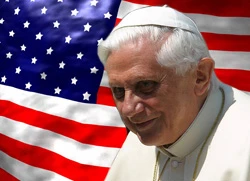
Text of President Bush's Address Welcoming the Pope

The image “http://d.yimg.com/us.yimg.com/p/afp/20080416/capt.cps.mxs87.160408211207.photo04.photo.default-512x356.jpg?x=400&y=278&sig=oNlyNpqyEkwZ8Bp8aOhKnQ--” cannot be displayed, because it contains errors.

The image “http://d.yimg.com/us.yimg.com/p/nm/20080416/2008_04_16t113622_450x331_us_pope_usa.jpg?x=400&y=294&sig=JgolKWJEAbBEKjYfyN4BUg--” cannot be displayed, because it contains errors.

WASHINGTON, April 16 (Reuters) - Following is the text of President George W. Bush's address on Wednesday at the White House, as he received Pope Benedict on the first full day of his six-day visit to the United States.

"Holy Father, Laura and I are privileged to have you here at the White House. We welcome you with the ancient words commended by St. Augustine: Pax tecum; peace be with you.

"You've chosen to visit America on your birthday. Well, birthdays are traditionally spent with close friends, so our entire nation is moved and honored that you have decided to share this special day with us. We wish you much health and happiness today and for many years to come.

"This is your first trip to the United States since you ascended to the chair of St. Peter. You will visit two of our greatest cities and meet countless Americans, including many who have traveled from across the country to be with you and to share in the joy of this visit.

"Here in America you'll find a nation of prayer. Each day, millions of our citizens approach our maker on bended knee, seeking his grace and giving thanks for the many blessings he bestows upon us.

"Millions of Americans have been praying for your visit. And millions look forward to praying with you this week.

"Here in America you'll find a nation of compassion. Americans believe that the measure of a free society is how we treat the weakest and most vulnerable among us. So each day citizens across America answer the universal call to feed the hungry and comfort the sick and care for the infirm.

"Each day, across the world, the United States is working to eradicate disease, alleviate poverty, promote peace and bring the light of hope to places still mired in the darkness of tyranny and despair.

"Here in America, you'll find a nation that welcomes the role of faith in the public square. When our founders declared our nation's independence, they rested their case on an appeal to the laws of nature and of nature's god.

"We believe in religious liberty. We also believe that a love for freedom and a common moral law are written into every human heart, and that these constitute the firm foundation on which any successful free society must be built.

"Here in America, you'll find a nation that is fully modern, yet guided by ancient and eternal truths.

"The United States is the most innovative, creative and dynamic country on Earth. It is also among the most religious. In our nation, faith and reason coexist in harmony. This is one of our country's greatest strengths and one of the reasons that our land remains a beacon of hope and opportunity for millions across the world.

"Most of all, Holy Father, you will find in America people whose hearts are open to your message of hope. And America and the world need this message. In a world where some invoke the name of God to justify acts of terror and murder and hate, we need your message that God is love. And embracing this love is the surest way to save men from falling prey to the teaching of fanaticism and terrorism.

"In a world where some treat life as something to be debased and discarded, we need your message that all human life is sacred and that each of us is willed, each of us is loved. And your message that each of us is willed, each of us is loved, and each of us is necessary.

"In a world where some no longer believe that we can distinguish between simple right and wrong, we need your message to reject this dictatorship of relativism and embrace a culture of justice and truth. In a world where some see freedom as simply the right to do as they wish, we need your message that true liberty requires us to live our freedom not just for ourselves, but in a spirit of mutual support.

"Holy Father, thank you for making this journey to America. Our nation welcomes you. We appreciate the example you set for the world. And we ask that you always keep us in your prayers."


President George W. Bush and Pope Benedict XVI listen to a band ...

Tuesday, April 15, 2008

Photos of Pope Benedict XVI's Arrival in the United States


Quiz: How Much Do You Know About Pope Benedict XVI?


I missed one. (I'm glad that I watched EWTN's coverage of the Holy Father's arrival this afternoon or I would have missed two more.) :)

Pope Benedict XVI Arrives at Andrews Air Force Base

BENEDICT XVI BEGINS HIS APOSTOLIC TRIP TO THE U.S.A.

VATICAN CITY, 15 APR 2008 (VIS) - At midday today, the Holy Father departed from Rome's Fiumicino airport. Following a flight of more than 7,000 kilometres, his plane is due to land at 4 p.m. local time (10 p.m. in Rome) at Andrews Air Force Base near Washington D.C. This is the Benedict XVI's eighth apostolic trip outside Italy and his first to the U.S.A. as Pope.

U.S. President George W. Bush and his wife Laura will welcome the Pope as he descends from his aircraft. No speeches are scheduled for this first meeting and the welcome ceremony proper will take place tomorrow at 10.30 a.m. local time (4.30 p.m. in Rome) at the White House, official residence of the U.S. president.

After landing, Benedict XVI will travel by car to the apostolic nunciature in Washington D.C where he will spend the rest of the day.

Tomorrow, 16 April, is the Pope's 81st birthday, and Saturday 19 April, will mark the third anniversary of his election to the pontifical throne.

President Bush Addresses Relationship With Pope Benedict, U.S. Catholics

Raymond Arroyo host of EWTN's The World Over

.- On Friday, President George W. Bush publicly addressed Pope Benedict XVI’s visit to the United States in an interview with EWTN. In addition, Bush also addressed concerns of interest to Catholics such as the position of Christians in Iraq, relations with China, and the creation of a “culture of life.”

The president explained the reasons he would meet Pope Benedict’s airplane upon its arrival at Andrews Air Force Base outside Washington, saying this unprecedented greeting was due to the particular significance of the Pope.

"One, he speaks for millions. Two, he doesn't come as a politician; he comes as a man of faith; and Three, I so subscribe to his notion that there’s right and wrong in life, that moral relativism undermines the capacity to have hopeful and free societies. I want to honor his convictions, as well,” the president said.

President Bush thought his administration’s foreign policy was connected to these convictions.

“One of the tenets of my foreign policy is that there is an Almighty, and a gift of that Almighty to every man, woman, and child, is freedom.”

The president, who described himself as a “believer in the value of human life,” said he thought the Pope spoke with clarity on such moral principles.

President Bush described his foreign aid policy as a “combination of faith and practicality.” Hopelessness, he said, encourages terrorist recruitment, and it “invigorates our soul” to know Americans have saved lives through foreign aid. Bush said “to whom much is given much is required” is one of his motivating beliefs.

The president was asked about his response to the anti-Christian violence in Iraq, which has resulted in 40 bombed churches, murders, and Christians becoming 40 percent of the refugee population.

The president said he had urged the Iraqi government to understand the “vital importance” of minority rights in democracies, saying these rights were important in Iraq, the Holy Land, and throughout the Middle East.

The murderers of Christians like Archbishop of Mosul Paulos Rahho, the president believed, used their crimes to send a message that it was not worthwhile to “help a free society deliver.”

Bush said the violence was not government sponsored, but committed by “a bunch of thugs and killers who have this kind of dark dim view of the world and are willing to kill anybody who is willing to stand up to it.

“The same type of mentality that caused people to fly airplanes into our buildings to kill 3,000 of our citizens,” he said.

The president said that the Iraqi violence would be ended by stationing American troops there long enough “to have a civil society emerge.”

He said he was committed to providing troops to ensure safety for all Iraqis. According to the president, the violence targeted not only Christian believers, but also other innocents. He claimed insurgents and terrorists wanted to drive the United States out of the Middle East “because they hate free societies.”

When asked about the influence of his personal faith, President Bush said one cannot disassociate faith from how one lives life.

“I am optimistic because I happen to believe in certain universal principles, and I do believe that freedom is universal and that, if given a chance, people will self-govern and live in a peaceful, free society. And history is my witness,” President Bush said.

When asked about what role his faith plays in sustaining him, the president said, “My faith has been so sustaining in the midst of what is a pretty hectic life, full of flattery and criticism. Faith keeps a person grounded. Faith reminds people that there is something a lot more important than you in life.”

He said he’d been “inspired” by prayers, and has come to understand more clearly “the story of the calm and the rough seas.”

President Bush also defended his decision to attend the 2008 Olympic Games in Beijing despite China’s poor human rights record. He said, “I can talk to them about religious freedom prior to the Olympics, during the Olympics, and after the Olympics. I don’t need the Olympics to express my opposition to the Chinese leadership on freedom. Because that’s all I have been doing as your president.”

The president insisted he had talked about human rights abuses in many foreign conflicts, citing Darfur, Burma, and the position of the Dalai Lama. “They know my position,” he said of the Chinese government. “If I politicize the Olympic Games, would it make less effective for me to deal with them, or more effective?”

The interview then turned to bioethical questions.

President Bush said that his decision to fund embryonic stem cell research that involved only cells from embryos that were already destroyed was the “right decision to begin with.” He said the embryonic stem cell dispute marked the beginning of a “very interesting debate that future presidents will have to deal with: science versus ethics, the value of life versus saving life, supposedly.”

“I have obviously drawn the line in the sand. Honoring life in all forms, is the touchstone for good science,” he said.

When EWTN host Raymond Arroyo asked President Bush whether there would be a pro-choice GOP nominee in the foreseeable future, Bush avoided a definite answer and instead talked about his own pro-life stand.

“A culture of life is in our national interests,” he said. “The politics of abortion isn’t going to change until people’s hearts change, and fully understand the meaning of life, what it means for a society to value life in all forms, whether it be the life of the unborn, or the life of the elderly, the life of the less fortunate among us or the life of the rich guy.”

President Bush said that Pope Benedict’s words provided support for politicians in difficult situations. The president said, “I want to remind his Holy Father how important his voice is in making easier for politicians like me to be able to stand and defend our positions, that are I think, very important positions to take.”

The image “http://d.yimg.com/us.yimg.com/p/nm/20080415/2008_04_15t035633_450x299_us_pope_usa_interfaith.jpg?x=400&y=266&sig=OlWDfIhvnqpvO.Po6jkeRQ--” cannot be displayed, because it contains errors.

Raymond Arroyo closed the interview by referring to President Bush’s words about looking into the eyes of Russian President Vladimir Putin and “seeing his soul.”

Arroyo asked President Bush what he saw when he looked into the eyes of Pope Benedict XVI.

“God,” the president answered.

Jimmy Carter Embraces Hamas Official

By DALIA NAMMARI – 2 hours ago

RAMALLAH, West Bank (AP) — Former President Jimmy Carter embraced a leading Hamas figure Tuesday, according to participants in a meeting that infuriated Israeli officials already upset by Carter's freelance Mideast peace mission.

Carter also laid a wreath at the grave of Yasser Arafat, whom the Bush administration and many Israelis blame for the breakdown of peace talks seven years ago and the violence that followed.

At a reception in the West Bank town of Ramallah organized by Carter's office, the former president hugged Nasser Shaer, a senior Hamas politician, meeting participants said. Embraces between men are a common custom in Arab culture.

"He gave me a hug. We hugged each other, and it was a warm reception," Shaer told The Associated Press. "Carter asked what he can do to achieve peace between the Palestinians and Israel ... and I told him the possibility for peace is high."

Carter's office refused to comment, saying he does not discuss closed meetings.

Sunday, April 13, 2008

Pope: All Vocations Have Missionary Character

Says Married Couples Called to Live Gospel in Every Area

VATICAN CITY, APRIL 13, 2008 (Zenit.org).- Vocation and mission are inseparable and the Church's many vocations should have an "intense missionary character," says Benedict XVI.

The Pope affirmed this today before he led the praying of the midday Regina Caeli with thousands gathered in St. Peter's Square. Today, the Fourth Sunday of Easter, focuses on Christ as the Good Shepherd and is also the World Day of Prayer for Vocations.

The Holy Father said that St. Paul, for whom "vocation and mission are inseparable," is a model for all Christians, particularly "those men and women who dedicate themselves totally to announcing Christ to those who still have not known him: a vocation which continues to maintain all of its validity."

"This missionary service is carried out, in the first place, by priests in offering the Word of God and the sacraments, and in manifesting the healing presence of Jesus Christ with their pastoral charity for everyone, above all for the ill, the little ones and the poor," Benedict XVI said. "We give thanks to God for these our brothers, who give themselves without reserve to pastoral ministry, sometimes sealing their fidelity to Christ with the sacrifice of their lives, as happened yesterday to two religious assassinated in Guinea and Kenya."

The Pontiff expressed his prayer that there would be "an increasing number of those who decide to radically live the Gospel through the vows of chastity, poverty and obedience -- men and women who have a primary role in evangelization."

"Some of them dedicate themselves to contemplation and prayer, others to a multifaceted educational and charitable work," he said. "All of them, nevertheless, are united in the same objective: to give witness to the primacy of God over all and to spread his Kingdom in every sphere of society."

Benedict XVI affirmed that those called to Christian marriage should also give their lives a missionary flavor.

He contended that "it mustn't be forgotten that Christian marriage is also a missionary vocation: The couple, in fact, is called to live the Gospel in the family, in the workplace and in parish and civil communities. In certain cases, moreover, they offer their valuable contribution to the missions 'ad gentes.'"

"Dear brothers and sisters," the Pope concluded, "let us invoke the maternal protection of Mary for the many vocations that exist in the Church so that they are developed with an intense missionary character. To her, Mother of the Church and Queen of Peace, I also commend the special missionary experience that I will live in the next few days with the apostolic trip to the United States and the visit to the United Nations, as I ask all of you to accompany me with your prayers."

Expelled

"There are people out there who want to keep science in a little box, where it can't possibly touch a higher power, cannot possibly touch God."

Saturday, April 12, 2008

Pope Memorabilia in High Demand

.- As Pope Benedict XVI, prepares to touch down in the U.S. next Tuesday, New Yorkers are gobbling up Pope-related merchandise, NBC reports.

Benedict XVI gear also seems to keep multiplying the forms in which it comes. His face is emblazoned on t-shirts, key chains, hats, mugs - even a bobblehead doll.

While it could be easily interpreted as another example of consumerism, Mt. Carmel Catholic book shop worker Neil Fusco says it's about spirituality, not sales.

"It's just about the Holy Father and making him known to the world," Fusco told NBC.

The Archdiocese of New York has also launched its own papal merchandise website, which includes devotional and every day items like t-shirts and coffee mugs.

"I still have my mementos from the 1995 visit of Pope John Paul II, and I'm sure the people from this visit will have something they'll cherish forever," said New York Archdiocese spokesman Joseph Zwilling.

With the advent of the internet, things have changed since Pope John Paul II’s visit. Not only has the variety of items increased, but the papal-themed gear is flying off the shelves.

USS Theodore Roosevelt

From WDTPRS:
In related news, from St. Monica's Kneeler:
"What is it with the military lately? My brother, who is in the Army, is on his way to Iraq; Father Echert, Air Force, just got called up and is on his way to Germany; and, now my husband has to do a project for the Navy.

Not just any ol' project. He's supposed to design a robot that assembles the bombs on the aircraft carriers for the F/A-18s (believe that's the plane)."

Thursday, April 10, 2008

Pope Benedict XVI Names Five U.S. Bishops in Advance of Visit

.- Pope Benedict XVI has named five new bishops for the United States, the largest number of prelates named in a single instance by a Pope during the last 10 years. The new bishops are Bishop Richard Edmund Pates of Des Moines, Bishop Anthony Basil Taylor of Little Rock, Auxiliary Bishop James Douglas Conley of Denver, Auxiliary Bishop Oscar Cantu of San Antonio and Auxiliary Bishop William J. Justice of San Francisco.

Editor's Note: An individual story on each bishop can be read by clicking on their name below.

Bishop Plates of Des Moines

The new bishop of Des Moines has up to now been Auxiliary Bishop of Saint Paul and Minneapolis. Bishop Richard Edmund Pates was born on February 12, 1943 in Saint Paul, Minnesota. After his elementary studies at St. Paul’s Catholic School, he entered the Nazareth Hall minor seminary and later studied theology at the Saint Paul Seminary.

He was ordained a priest on December 20, 1968 at St. Peter’s in Rome. He was rector of the Saint John Vianney Seminary from 1981-1987 and has been a member of the committee on Education of the U.S. Bishops’ Conference.


Bishop Taylor of Little Rock

The new bishop of Little Rock was born on April 24, 1954 in Forth Worth, Texas. He studied at the University of Oklahoma and after two years entered the Archdiocesan Seminary of Oklahoma City. He studied philosophy at Saint Meinrad Seminary in Indiana, and in 1976 he was invited to study at the North American College and the Gregorian University in Rome. He obtained a doctorate in theology from Fordham University.

He was ordained a priest on August 2, 1980, and has served as Parochial Vicar at Sacred Heart Church in Oklahoma City and as Parochial Vicar at St. Matthew’s Parish in Elk City, with special focus on serving Hispanic parishioners.

In addition, he has been a member of the Diocesan Finance Council, president of the Archdiocesan Presbyteral Council, member of the Archdiocesan Stewardship Commission and the Saint Gregory University Priests Advisory Council.


Auxiliary Bishop Conley of Denver

The new auxiliary bishop of Denver was born on March 19, 1955 in Kansas City, Missouri. He studied at the University of Kansas, where he obtained a Bachelor’s in English Literature. On December 6, 1975, at the age of 20, he left the Presbyterian church and was baptized at St. John the Evangelist Parish in Lawrence. He studied philosophy at St. Pius X Seminary in Erlanger, Kentucky, and theology at Mount Saint Mary’s Seminary in Emmitsburg, Maryland.

He was ordained a priest for the Diocese of Wichita on May 18, 1985. He has been Parochial Vicar at St. Patrick Parish in Wichita and director of the Respect Life Office. He obtained a degree in Moral Theology from the Alfonsian Academy in Rome. Since August 1, 2006, he has been serving as pastor of Blessed Sacrament Parish in Wichita.


Auxiliary Bishop Cantú of San Antonio

The new auxiliary bishop of San Antonio was born in December 5, 1966 in Houston, Texas. He entered Holy Trinity Seminary and obtained a degree in English Literature from the University of Dallas in 1989. He studied theology at St. Mary’s Seminary in Houston and obtained a Master’s degree in 1994. He also studied theology at the Gregorian University in Rome.

He was ordained a priest on May 21, 1994 for the Archdiocese of Galveston-Houston and has served as Parochial Vicar of St. Christopher’s Parish in Houston, Parochial Vicar of St. Cecilia’s Parish in Houston, Parochial Vicar of St. Francis Cabrini’s Parish in Houston, and Holy Name Parish in Houston.

When Bishop-elect Cantú is ordained, he will be the youngest bishop in the U.S. and the ninth youngest in the world.


Auxiliary Bishop Justice of San Francisco

The new auxiliary bishop of San Francisco was born on May 8, 1942. He obtained a degree in Philosophy and a Master’s in Divinity at St. Patrick’s Seminary. He was ordained a priest for the Archdiocese of San Francisco on May 17, 1968. He later obtained a Master’s in Applied Spirituality from the University of San Francisco. He has served as Parochial Vicar and for several years as Archdiocesan director of the permanent deaconate. He has been pastor at three different parishes and studied Spanish in Guadalajara, Mexico.

FUNTASTIC 'Hillbilly Teeth' Recalled

April 10, 2008

FUNTASTIC is recalling about 26,000 sets of "Hillbilly Teeth." The gray surface paint on the teeth contains excessive levels of lead, violating the federal lead paint standard.

This recall involves a 2-pack fake Hillbilly Teeth with item # 2657. The item number is printed on the packaging. The gums are brown and the teeth are yellow.

The false teeth were sold at grocery, drug, convenience, and mass retailers nationwide from March 2005 through March 2008 for about $2. They were made in China.

The Pope's Marshall Plan

St. Benedict: Father of Monasticism, Patron Saint of Europe

VATICAN CITY, 9 APR 2008 (VIS) - Benedict XVI dedicated his catechesis during this morning's general audience to St. Benedict of Nursia, "the father of western monasticism, who with his life and work exercised a fundamental influence on the development of European civilisation and culture". The audience, held in St. Peter's Square, was attended by 20,000 people.

The most important source for the life of the saint, the Pope explained, is the second book of "Dialogues" written by St. Gregory the Great, in which Benedict features as the "shining star" who shows the way out of the "dark night of history", in other words, the crisis of values and institutions caused by the fall of the Roman empire.

St. Benedict's work and his Rule led to "a true spiritual ferment which over the course of the centuries - well beyond the confines of his homeland and his time - changed the face of Europe and created, with the collapse of political unity, a new spiritual and cultural unity, that of the Christian faith shared by the people of the continent".

St. Benedict was born to a wealthy family around the year 480. He went to school in Rome but before completing his studies retired to a monastic community in Enfide. Subsequently he spent three years in a cave at Subiaco where he "underwent the three fundamental temptations that all human beings face: self-affirmation and the desire to place oneself at the centre, ... sensuality, ... and anger and revenge". This, said the Holy Father, was because "St. Benedict was convinced that only by overcoming these temptations would he be able find the right words to give others in their situations of need".

In the year 529 the founder of the Benedictine Order moved to Monte Cassino, "a height that dominates the surrounding plains and is visible from a distance". This was a symbolic decision on the saint's part, said the Pope, because "monastic life has its raison d'etre in withdrawal and concealment, but a monastery also has a public role in the life of the Church and of society".

Throughout his life St. Benedict "was immersed in an atmosphere of prayer, the main foundation of his existence. Without prayer there is no experience of God, but Benedict's spirituality was not an interior life divorced from reality. In the disquiet and confusion of his time, he lived under the gaze of God and with his own gaze fixed upon God, though without losing sight of his daily duties and the concrete needs of mankind".

St. Benedict died in 547. His famous Rule "provides useful advice not only to monks but to everyone seeking guidance on their journey to God. For its precision, its humanity, and its sober discernment between what is essential and what is secondary in spiritual life, the Rule has maintained its illuminating power up to today".

In 1964, Paul VI named Benedict as patron saint of Europe. "Having just emerged from a century profoundly marked by two world wars and following the collapse of the great ideologies, ... Europe today is searching for its own identity", remarked Pope Benedict.

"In order to create a new and lasting unity", the Pope concluded, "political, economic and juridical measures are necessary, but it is also necessary to generate an ethical and spiritual renewal which draws on the continent's Christian roots. Without this vital lifeblood, man remains exposed to the danger of succumbing to the ancient temptation of seeking redemption alone, a utopia which in 20th century Europe ... caused a retrocession without precedent in human history".

When the Pope Meets The President

BY PAUL KENGOR
April 13-19, 2008 Issue | Posted 4/8/08 at 1:07 PM

On April 16, 2008, Pope Benedict XVI will mark his 81st birthday with, among other things, a visit to the White House — only the second such visit by a pope in American history.

There, he will sit down with President George W. Bush, who will have welcomed him the day before at Andrews Air Force Base.

The New York Times and National Public Radio can be expected to run analyses focusing on how this president and this Pope disagree on the war in Iraq, just as they did in every story they ran on President Bush and the late Pope John Paul II.

They will indeed have a very good point. The president’s critics, however, will play up this angle to the exclusion of almost all else.

In fact, the big story between this president and this Pope — as it was with this president and the last Pope — has been their remarkable unity on the sanctity and dignity of human life.

Neither man majored in math in college, but they easily understand that 1,000 tragic deaths per year among enlisted soldiers in an American military operation is a smaller number than 1 million deaths per year among innocent babies in American abortion businesses.

(A truly illuminating article would be an analysis of why The New York Times and NPR are silent on the latter matter.)

It is because of their mutual commitment to a culture of Life — words that Bush himself has used — that this will be a pleasant meeting, not a hostile one.

There will not be the uneasy Kodak moments like at Denver’s International Stapleton Airport on Aug. 12, 1993, where Pope John Paul II, beside President Bill Clinton and first lady Hillary Rodham Clinton, and in front of a huge crowd, told the “pro-choice” president, his spouse and his country that all of the “great causes” led by the United States “will have meaning only to the extent that you guarantee the right to life and protect the human person.”

The Clintons were made quite uncomfortable by that unwelcome message, as they were on similar occasions down the road each time the Pope lectured them on the abomination of abortion.

That was not the case with John Paul II and Bill Clinton’s successor: President George W. Bush had immense respect for Pope John Paul II, whom he called a “great man,” a “great world leader,” a “rare man” and a “hero of history.”

In a July 2001 news conference in Rome, Bush spoke effusively of this “extraordinary man” and his “profound impact on the world.”

“I’m not poetic enough to describe what it’s like to be in his presence,” said the president of the Pope.

In a speech in Warsaw, Bush told the Polish people that communism in their land was “humbled” by two forces — a massive citizens’ movement and “the iron purpose and moral vision of a single man: Pope John Paul II.”

Also, in June 2004, Bush awarded John Paul America’s highest honor — the Presidential Medal of Freedom.

All of this, of course, occurred despite the widely reported differences between the two men over the Iraq situation.

Like Pope John Paul II before him, Pope Benedict XVI knows that the man in Rome and the man in the Oval Office have frequently parted ways on foreign policy and the question of going to war.

Yet, while the Vatican might think the White House is wrong on a dictator in a palace, it hopes and prays that the president will get it right on the defenseless in the womb. And when it comes to that, no president has been as solid as George W. Bush — on judges, legislation, executive orders, you name it.

From the outset, before he ever stepped foot into the Oval Office, Bush, as mere president-elect, held a private talk with abortion advocate Colin Powell, several weeks before naming Powell secretary of state.

He told Powell that as secretary of state he would be expected to purge any vestiges of the Clinton State Department’s program to promote global abortion rights. Powell told Bush that he understood and would follow his lead.

The change on abortion was immediate: On his first day in office, Bush authorized a ban on all U.S. funding of international abortion rights groups, reversing President Clinton’s previous executive order. It was a harbinger of the two terms of pro-life actions to come.

Further, George W. Bush also understands — are you listening, John McCain? — that being pro-life includes not only rejecting abortion but embryonic stem-cell research. He has spoken and acted eloquently on this and other life issues.

To cite just one example, from April 2002, Bush remarked:

“As we seek to improve human life, we must always preserve human dignity. … Advances in biomedical technology must never come at the expense of human conscience. As we seek what is possible, we must always ask what is right, and we must not forget that even the most noble ends do not justify any means. Science has set before us decisions of immense consequence. We can pursue medical research with a clear sense of moral purpose or we can travel without an ethical compass into a world we could live to regret. … Life is a creation, not a commodity. Our children are gifts to be loved and protected, not products to be designed and manufactured.”

Bush warned Americans of “a society in which human beings are grown for spare body parts, and children are engineered to custom specifications. … That’s not acceptable.”

The United States of America is the world’s most influential nation. The Catholic Church is the world’s most influential church. Abortion is the world’s most destructive force, and one that must be stopped, not encouraged — the leader of America and the Catholic Church, mercifully, agree on that.

When Pope Benedict celebrates his birthday with President Bush at the White House on April 16, he will be happy to be celebrating with a kindred spirit who also celebrates life.

Paul Kengor is professor of political science at Grove City College. He is the author of God and George W. Bush: A Spiritual Life (2004), and, most recently, The Judge: William P. Clark, Ronald Reagan’s Top Hand (Ignatius Press, 2007)

Wednesday, April 9, 2008

Pope Benedict XVI Remembers Slain Religious

Sister Mainetti Was Murdered in Satanic Ritual

VATICAN CITY, APRIL 9, 2008 (Zenit.org).- Benedict XVI remembered today Sister Maria Laura Mainetti, who was stabbed to death in 2000 by three young girls during a Satanic ritual in Italy.

After delivering the general audience in St. Peter's Square, the Pope greeted "the Daughters of the Cross and the laity that share the charism, united today in the memory" of Sister Maria Laura, who was murdered at the hands of three teenage girls in the small Italian town of Chiavenna.

The girls, two aged 17 and one 16, called Sister Maria Laura late June 6 telling her that one of them was pregnant and needed help. Upon arriving at the agreed location, the three grabbed her, stabbed her 19 times and stoned her.

Sister Maria Laura's last words were that of a prayer to God asking for pardon for the three youth.

The Italian sister, said Benedict XVI, "faithful to the total surrender of herself, sacrificed her life, praying for those who were beating her."

The Congregation for Saints' Causes recognized the murder of the religious in March as martyrdom, thus advancing the cause for her beatification.

Teresina Mainetti was born in Colico, Italy, in 1939. She taught in the schools of her congregation, and at the moment of her death she was the superior of the community of the Daughters of the Cross at the Institute of Mary Immaculate in Chiavenna.

The girls, who at first said the murder was "a game," confessed later that it was a Satanic ritual.

Monkey on a Motorcycle

Guns and Moses

By JEFFREY RESSNER | 4/6/08 4:51 PM EST

Last December, Bob Dylan literally stopped the music on his "Theme Time Radio Hour" show to honor Charlton Heston.

Following the soulful tune “Eve’s Ten Commandments,” Dylan mentioned Heston’s iconic role as Moses in the well-known biblical epic and added, “Charlton gets a bad rap for his strong conservative beliefs and involvement with the NRA, but truth to tell, he was a strong advocate for civil rights, many years before it became fashionable….”

Dylan ticked off Heston’s accolades, including the Kennedy Center Lifetime Achievement Award, and then added, admiringly, “Never mind the fact that he’s in a couple of our favorite movies, including ‘Touch of Evil,’ ‘The Big Country,’ ‘Planet of the Apes’ and of course ‘Soylent Green.’”

It could stand as a fitting eulogy for Heston, who died Saturday at the age of 84, except for one thing: He didn’t seem to mind that “bad rap” he got in liberal Hollywood for his political beliefs. Indeed, he embraced his political conservatism unlike any other actor in the business.

Using his image and celebrity to champion the Second Amendment and gun-rights legislation for more than two decades, Heston’s advocacy of a single political issue is matched by few modern actors. Certainly George Clooney, Michael J. Fox and Leonardo DiCaprio have all been closely identified with such issues as Darfur, stem cell research and environmentalism — but none is so contentious as that of gun control.

And Heston has never shied away from controversy. In 1992, he condemned the infamous Ice-T rap song “Cop Killer,” then released by a Time Warner-distributed music label. Biting the hand that had fed him, Heston showed up at a Time Warner shareholders’ meeting at the Beverly Wilshire Hotel covered by this reporter. He lashed out against the giant corporation whose studio had cast him in so many movies.

He harshly admonished its top executives for releasing the song, then simply, eloquently read the lyrics. Few there had ever heard the actual words before, and as Heston recited the homicidal, anti-police rant inspired by the Rodney King assault, the room filled with his booming baritone. When he finished, the place was so stunned you could hear a pin drop.

More recently, Heston’s presidency of the National Rifle Association of America from 1998 to 2003 defined him for a new generation. He made history at the first NRA convention of the new millennium by holding a handmade Brooks flintlock musket above his head and declaring that the then-presidential Democratic candidate Al Gore would have to pry his Second Amendment rights “from my cold, dead hands.”

Vilified by the left, he was condemned by Michael Moore in the Oscar-winning 2002 documentary “Bowling for Columbine,” with Moore haranguing him for supporting a pro-gun rally in Denver immediately following the Columbine High School massacre.

In a now-famous scene from the film, Heston starts to answer Moore’s questions but then just walks away in the middle of the interview, leaving the filmmaker alone at his L.A. home. On Sunday, Moore’s website featured a black-bordered photo of Heston, along with a caption noting the Heston family requested donations to the Motion Picture and Television Fund in lieu of flowers.

“Heston understood the power of image and celebrity to draw attention to issues” long before others did, says Howard Bragman of the Hollywood public relations firm Fifteen Minutes. “He played larger than life characters including Ben Hur and Moses, and realized the power that went along with those images.”

Even though his most famous characters lived in ancient times, “they stood for leadership and standing strong against people who didn’t agree with them,” says Bragman, adding that Heston’s “authenticity” gave him credibility to speak out for those issues he deemed important.

Of course, Ben Hur was a slave, and Heston’s first efforts in political activism came about in the early 1960s, when he protested segregationist policies. In May 1961, Heston walked a picket line in front of a whites-only restaurant in Oklahoma City, part of a long campaign involving thousands of demonstrators who fought against downtown businesses discriminating against black patrons. In his 1995 autobiography, “In the Arena,” he explained how civil rights “was also part of my expanded persona, riding the tiger.”

In later years, he would recall his early activism and tie it directly into his stance on gun owners’ rights, explaining that both struggles were bound into his support for the Constitution and the Bill of Rights.

“Jesse Jackson and Louie Farrakhan know I fought in their cultural war,” Heston told the Free Congress Foundation’s 20th anniversary gala in 1997. “I was one of the first white soldiers in the civil rights movement in 1961, long before it was fashionable in Hollywood — believe me — or in Washington for that matter. In 1963 I marched on Washington with Dr. Martin Luther King to uphold the Bill of Rights. I'm very proud of that. As [then-] vice president of the NRA I am doing the same thing.”

Heston would often talk about how he hunted as a child “only to put food on the table” during the Depression, and later spoke fondly of his Army Colt .45 pistol he brought back from duty as a bomber gunner during WWII, confessing that he always slept with the .45 beside his bed.

After opposing the Vietnam War and supporting liberal measures such as LBJ’s Gun Control Act of 1968 (“I was young and foolish,” he told Time Magazine), he voted for Richard Nixon in 1972. During the 1980s as the Reagan Revolution took hold, Heston became more vocal in the pro-gun movement and joined the conservative wing of the Republican Party, opposing affirmative action, decrying political correctness and speaking out against abortion.

But to many Americans, Heston’s legacy will rest on two touchstones: his iconic performance as Moses in “The Ten Commandments” and his emphatic support for the National Rifle Association.

He even got into a war of words with George Clooney back in 2003, when Clooney lamely joked that Heston’s ultra-conservative stance came from Alzheimer’s. Asked if he went too far with his remarks, Clooney said he didn’t care and that, because Heston was the head of the NRA, he deserved “whatever anyone says about him.”

But, indeed, Heston did suffer from Alzheimer’s disease and Clooney later wrote him a letter of apology.

Bishop Expects Pope to Challenge Politicians

Notes Pontiff's Unique Status as a World Leader

ORLANDO, Florida, APRIL 8, 2008 (Zenit.org).- When Shepherd One lands at Andrew's Air Force Base a week from today, Benedict XVI will disembark with a message to strengthen the faith, hope and love of U.S. Catholics, said one of the nation's bishops.

Bishop Thomas Wenski of Orlando, chairman of the U.S. bishops' Committee on International Policy, said this in a column in today's Orlando Sentinel, affirming that the primary purpose of the Pope's visit is pastoral.

"While he will only stop in Washington, D.C., and New York City, Catholics throughout the United States will welcome his visit," the bishop wrote. "We sense that he has something to say to us."

"He is not just another player in a global game of power politics," Bishop Wenski continued. "He is not a politician but the Bishop of Rome and the universal pastor of the Catholic Church. This is not to say that he does not have his pulse on the world. […] Benedict XVI will address the U.N. as a religious leader, a moral leader -- but a uniquely informed one. And just as he will have something to say to Catholics, he will have something to say to the U.N. and the world."

Bishop Wenski said he expects the Pope to "challenge the world's political leaders as well."

"Much of the turbulence in world politics today stems from the detachment of faith from reason and the loss of faith in reason," the prelate contended. "Like John Paul II before him, he will draw upon his faith to defend reason. In doing so, this Pope who began his career as a professor, will no doubt reintroduce world leaders to the universal moral law.

"This law written on the human heart and therefore knowable to human reason constitutes that 'grammar' of dialogue necessary for men and nations to build together a future of hope."

Prayer Request

Tuesday, April 8, 2008

Supreme Court Justice Antonin Scalia Again Says Abortion Right Nonexistent

by Steven Ertelt
LifeNews.com Editor
April 8, 2008

Bristol, RI (LifeNews.com) -- Supreme Court Justice Antonin Scalia continues to educate the law students of America and, once again, presented his explanation that no right to abortion exists in the Constitution to students at Roger Williams University. Last month, Scalia told students at the University of Central Missouri the same thing.

Scalia said a legal right to an abortion is not found in the document that guides our judicial process.

If abortion advocates wanted to create a legitimate abortion right, they should rely on passing laws in the legislature rather than asking courts to unilaterally create one, he said.

“You want the right to abortion? Create it the way most rights are created in a democracy. Persuade your fellow citizens it's a good idea — and pass a law,” Scalia said.

Pope Benedict XVI's Message to the United States

Update: Full Version

Break Out


Roman Bar Gives Discounts to "Poor Americans"

By Philip Pullella

ROME (Reuters) - Harry's Bar, the famed Venice watering hole where Ernest Hemingway held court over hearty food and stiff martinis, is offering a discount to "poor" Americans suffering from a weak dollar and subprime blues...

A sign posted outside the restaurant at the weekend reads:

"Harry's Bar of Venice, in an effort to make the American victims of subprime loans happier, has decided to give them a special 20 percent discount on all items of the menu during the short term of their recovery..."