Saturday, December 15, 2007

Astronomy Picture of the Day

2007, December 15


Mountains of Creation
Credit: Lori Allen (Harvard-Smithsonian CfA) et al., JPL-Caltech, NASA

Explanation: This fantastic skyscape lies at the eastern edge of giant stellar nursery W5, about 7,000 light-years away in the constellation Cassiopeia. An infrared view from the Spitzer Space Telescope, it features interstellar clouds of cold gas and dust sculpted by winds and radiation from a hot, massive star outside the picture (just above and to the right). Still swaddled within the cosmic clouds, newborn stars are revealed by Spitzer's penetrating gaze, their formation also triggered by the massive star. Fittingly dubbed "Mountains of Creation", these interstellar clouds are about 10 times the size of the analogous Pillars of Creation in M16, made famous in a 1995 Hubble Space Telescope view. W5 is also known as IC 1848 and together with IC 1805 it is part of a complex region popularly dubbed the Heart and Soul Nebulae. The Spitzer image spans about 70 light-years at the distance of W5.

_______________________________

2007, December 14

Click above pic to enlarge

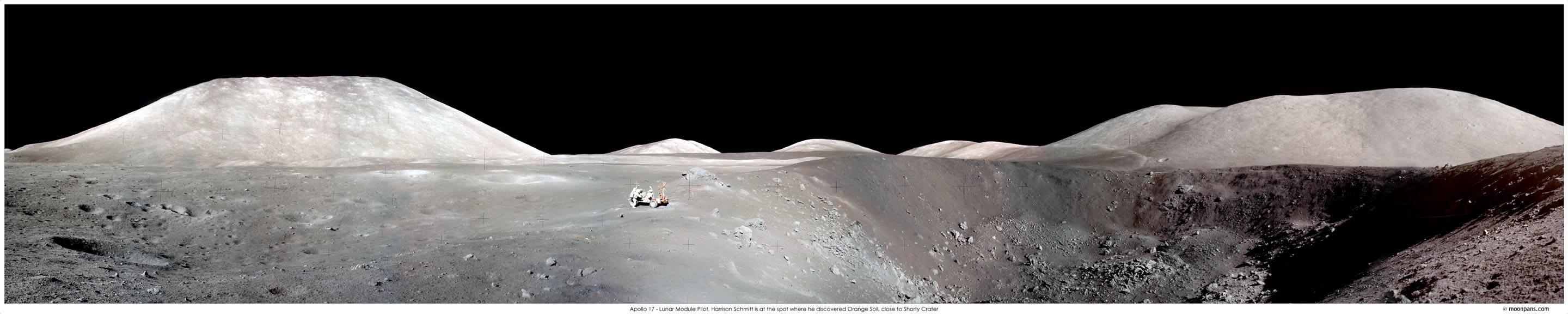
Apollo 17: Shorty Crater Panorama
Credit: Apollo 17 Crew, NASA; Panorama Assembly: Mike Constantine

Explanation: In December of 1972, Apollo 17 astronauts Eugene Cernan and Harrison Schmitt spent about 75 hours on the Moon in the Taurus-Littrow valley, while colleague Ronald Evans orbited overhead. This sharp panorama is digitally stitched together from pictures taken by Cernan as he and Schmitt roamed the valley floor. Starting with a view of the imposing South Massif, scrolling the panorama to the right will reveal Schmitt and the lunar rover at the edge of Shorty Crater, near the spot where geologist Schmitt discovered orange lunar soil. The Apollo 17 crew returned with 110 kilograms of rock and soil samples, more than was returned from any of the other lunar landing sites. Now thirty five years later, Cernan and Schmitt are still the last to walk on the Moon.

Link

Vento Steaks His Claim: Sign Isn't Discriminatory

By WILLIAM BENDER
Philadelphia Daily News

IT DOESN'T take a six-hour public hearing like yesterday's to know that Geno's Steaks owner Joey Vento and the Philadelphia Human Relations Commission have different approaches to dealing with the city's immigrants.

The commission, which enforces civil-rights laws and mediates inter-group disputes, distributes pamphlets that ask, "Are you a victim of discrimination?" - in seven languages.

Vento earns most of his cash selling one thing - cheesesteaks - and he wants you to order in one language.

"This is America. When ordering, please speak English."

That's what the sign says at Vento's South Philly sandwich shop on 9th Street and Passyunk Avenue.

But is there anything wrong with "The Sign"? Specifically, does it violate the city's Fair Practices Ordinance by discriminating against immigrants and non-English speakers who frequent Vento's business?

That question wasn't answered yesterday at the Arch Street Meeting House, where a three-person panel heard more than six hours of testimony from witnesses for the HRC, which wants the sign removed, and Vento, who refuses to comply.

A ruling won't come for at least a couple of months, said Joseph Centeno, who chaired yesterday's hearing panel. The panel will make a recommendation to the full commission, but the parties have about 60 days to file post-hearing briefs.

Vento, sporting a black leather jacket and lots of bling, showed up yesterday ready for battle, with his Atlanta-based legal team and dozens of supporters at his side. The sign, he said, posted more than two years ago, is designed to make a political statement and keep the line moving at the world-famous Geno's Steaks.

When Vento was called to testify, the 68-year-old grandson of Italian immigrants started paraphrasing Theodore Roosevelt so quickly that the court reporter had to ask him to slow down.

"To be an American, you have to be American and nothing else. For if you say you're something else, then you're not a true American," Vento said, drawing on the words of the 26th president.

"I'm an American of Italian descent," he said. "I'm not an Italian-American."

More than 100 people attended the hearing, which had a trial-like atmosphere and ran so late that the staff of the historic meeting house wanted to close the place down.

There were pro-immigration groups, Vento loyalists and even some tears from one of his attorneys during the closing arguments - all over a 4-inch-by-9-inch bumper sticker that asks customers to order their food in English.

Paul Hummer, the attorney prosecuting the complaint against Vento on behalf of the HRC, said the sign "discriminates on the basis of national origin because national origin and language are linked."

Hummer drew parallels between Vento's English-only policy and the Jim Crow era in the segregated South. He argued that it violates the section of the city's Fair Practices Ordinance that prohibits places of public accommodation from withholding services based on race, color, ancestry and other classifications.

"Philadelphia is better than this," said Regan Cooper of the Pennsylvania Immigration and Citizenship Coalition. "We can and should live up to our ideals as the City of Brotherly Love."

Another sign at Geno's that says employees have the right to refuse service to any customer, but Vento said it has been there for about 20 years and is not related to the speak-English sign. He testified that he has never turned anyone away because he couldn't order in English.

"Nobody goes away without a sandwich," Vento said.

"Do you think I'm stupid? I built the business from six dollars into a multimillion-dollar business . . . And you're gonna tell me I'm refusing service to people and I'm that successful?" he asked. "Well, if I am, I'm a very lucky guy and I should be on a plane to Las Vegas 'cause I'll probably break Las Vegas with this kinda luck."

Hummer countered that the sign "implies" that you can't get a cheesesteak there if you can't speak English, and is therefore discriminatory.

Meanwhile, Vento's business has been "phenomenal" since the controversy erupted last year, he said.

Vento, who still works the early-morning shift at his shop, has become an unlikely authority in the national immigration debate and probably the only cheesesteak vendor in the country whose presidential endorsement carries any weight. (He's backing Republican Rudy Giuliani, who visited Geno's in October.)

But, Vento said, he still doesn't understand all the fuss.

"The people that are protesting, I don't know where they're coming from," he said. "I'm not asking anybody to recite the Declaration of Independence." *

Pope Urges Students to Engage Culture

Pope Benedict XVI walks past an image of the Virgin Mary and baby Jesus at the end of a mass celebrated with the students of Roman Catholic Universities in St. Peter's Basilica, at the Vatican, Thursday, Dec. 13, 2007

Vatican, Dec. 14, 2007 (CWNews.com) - Pope Benedict XVI (bio - news) has urged university students to uphold the faith in a European culture whose thoughts have been "disengaged from God."

The Holy Father spoke to Rome's university students on Thursday evening in the Vatican basilica, after a Mass celebrated by Cardinal Camillo Ruini. He encouraged them to approach the future with confidence, recognizing that the faith is always alive. As evidence of the attractive power of Catholic truth, he pointed out that 150 students from Rome's universities have accepted the faith this year, and are planning to be confirmed at Pentecost 2008.

Tracing some of the thoughts that he presented in his encyclical Spe Salvi, the Pope said that Europe today is influenced by ideological trends formed in the 17th century, "according to which human progress is the work of science and technology, while faith concerns only the salvation of the soul." These trends, he said, led to a belief that economic and political measures can be enough to bring about "a just society in which peace, freedom and equality reign."

In practice, the Pope continued, those ideological trends have had a damaging impact, because the human soul is not shaped simply by economic and political factors, and "technological progress does not correspond to the moral development of mankind." Early in the 21st century, he argued, society has recognized that ideologies can be destructive, and the blind pursuit of technological conquest can be dangerous to society. Thus the time is ripe for a new assertion of Christian claims, he told his young audience.

Link

Friday, December 14, 2007

Inter Milan Sued Over 'Crusaders' Jerseys

A Turkish lawyer is taking legal action against Inter Milan, the Italian football team, for wearing a strip with “Crusader-style” red crosses that he alleges is ”offensive to Muslim sensibilities”.

Baris Kaska, a lawyer in Izmir who specialises in European law, said that he had lodged a complaint in a local court against Inter Milan, which last month played the Istanbul team Fenerbahce in a Champions League match at the San Siro stadium in Milan. The Inter players wore a new strip - a white shirt with a giant red cross on it - marking the club's centenary.

Mr Kaska said he was not only seeking damages but was also appealing to Uefa to annul the match, which Inter won 3-0. “That cross only brings one thing to mind - the symbol of the Templar Knights,” he said. “It made me think immediately of the bloody days of the past. While I was watching the game I felt profound grief in my soul.” Mr Kaska told the Spanish newspaper La Vanguardia that the cross symbolised “Western racist superiority over Islam”.

He said that Inter had “manifested in the most explicit manner the superiority of one religion over another”. He said the court had contacted both Uefa and Fifa to convey his demand that Inter should be “heavily fined for displaying an offensive symbol”. “How could Uefa allow this?“demanded the Turkish paper Radikal.

Inter Milan officials said that they were “astounded”. They said that in the first match between the two teams in September at Istanbul - which Fenerbahce won 1-0 - Inter had deliberately refrained from wearing the strip with the red cross but had felt entitled to use it on its home ground.

Inter officials also pointed out that a red cross on a white background is the symbol of the city of Milan. Many Italian football clubs incorporated the cross on their shirts, including Inter, founded in Milan in 1908. “The red cross has become an international political football,” Corriere della Sera commented...

Link

Incredible Talent

She's amazing:

Doctrinal Note on Some Aspects of Evangelization: Summary Points

Congregation for the Doctrine of the Faith

DOCTRINAL NOTE ON SOME ASPECTS OF EVANGELIZATION

SUMMARY POINTS

I. Introduction

1. The Doctrinal Note is devoted principally to an exposition of the Catholic Church’s understanding of the Christian mission of evangelization, which is to proclaim the Gospel of Jesus Christ; the word "Gospel" translates "evangelion" in the Greek New Testament. "Jesus Christ was sent by the Father to proclaim the Gospel, calling all people to conversion and faith. ‘Go out into the whole world and preach the Gospel to every creature’ (Mk 16,15)." [n. 1]

2. The Doctrinal Note cites Pope John Paul II’s Encyclical Letter "The Mission of the Redeemer" in recalling that "‘Every person has the right to hear the Good News [Gospel] of the God who reveals and gives himself in Christ, so that each one can live out in its fullness his or her proper calling.’ This right implies the corresponding duty to evangelize." [n. 2]

3. Today there is "a growing confusion" about the Church’s missionary mandate. Some think "that any attempt to convince others on religious matters is a limitation of their freedom," suggesting that it is enough to invite people "to act according to their consciences", or to "become more human or more faithful to their own religion", or "to build communities which strive for justice, freedom, peace and solidarity", without aiming at their conversion to Christ and to the Catholic faith.

Others have argued that conversion to Christ should not be promoted because it is possible for people to be saved without explicit faith in Christ or formal incorporation in the Church. Because "of these problems, the Congregation for the Doctrine of the Faith has judged it necessary to public the present Note." [n. 3]

II. Some Anthropological Implications

4. While some forms of agnosticism and relativism deny the human capacity for truth, in fact human freedom cannot be separated from its reference to truth. Human beings are given intellect and will by God that they might come to know and love what is true and good. The ultimate fulfillment of the vocation of the human person is found in accepting the revelation of God in Christ as proclaimed by the Church.

5. This search for truth cannot be accomplished entirely on one’s own, but inevitably involves help from others and trust in knowledge that one receives from others. Thus, teaching and entering into dialogue to lead someone in freedom to know and to love Christ is not inappropriate encroachment on human freedom, "but rather a legitimate endeavor and a service capable of making human relationships more fruitful." [n. 5]

6. The communication of truths so that they might be accepted by others is also in harmony with the natural human desire to have others share in one’s own goods, which for Catholics includes the gift of faith in Jesus Christ. Members of the Church naturally desire to share with others the faith that has been freely given to them.

7. Through evangelization, cultures are positively affected by the truth of the Gospel. Likewise, through evangelization, members of the Catholic Church open themselves to receiving the gifts of other traditions and cultures, for "Every encounter with another person or culture is capable of revealing potentialities of the Gospel which hitherto may not have been fully explicit and which will enrich the life of Christians and the Church." [n. 6]

8. Any approach to dialogue such as coercion or improper enticement that fails to respect the dignity and religious freedom of the partners in that dialogue has no place in Christian evangelization.

III. Some Ecclesiological Implications

9. "Since the day of Pentecost … the Gospel, in the power of the Holy Spirit, is proclaimed to all people so that they might believe and become disciples of Christ and members of his Church." "Conversion" is a "change in thinking and of acting," expressing our new life in Christ; it is an ongoing dimension of Christian life.

10. For Christian evangelization, "the incorporation of new members into the Church is not the expansion of a power-group, but rather entrance into the network of friendship with Christ which connects heaven and earth, different continents and ages." In this sense, then, "the Church is the bearer of the presence of God and thus the instrument of the true humanization of man and the world." (n. 9)

11. The Doctrinal Note cites the Second Vatican Council’s "Pastoral Constitution on the Church in the Modern World" (Gaudium et Spes) to say that respect for religious freedom and its promotion "must not in any way make us indifferent towards truth and goodness. Indeed, love impels the followers of Christ to proclaim to all the truth which saves." [n.10] This mission of love must be accomplished by both proclamation of the word and witness of life. "Above all, the witness of holiness is necessary, if the light of truth is to reach all human beings. If the word is contradicted by behavior, its acceptance will be difficult." On the other hand, citing Pope Paul VI’s Apostolic Exhortation Evangelii nuntiandi, the Note says that "even the finest witness will prove ineffective in the long run, if it is not explained, justified… and made explicit by a clear und unequivocal proclamation of the Lord Jesus." [n. 11]

IV. Some Ecumenical Implications

12. The CDF document points out the important role of ecumenism in the Church’s mission of evangelization. Christian divisions can seriously compromise the credibility of the Church’s evangelizing mission. The more ecumenism brings about greater unity among Christians, the more effective evangelization will be.

13. When Catholic evangelization takes place in a country where other Christians live, Catholics must take care to carry out their mission with "both true respect for the tradition and spiritual riches of such countries as well as a sincere spirit of cooperation." Evangelization proceeds by dialogue, not proselytism. With non-Catholic Christians, Catholics must enter into a respectful dialogue of charity and truth, a dialogue which is not only an exchange of ideals, but also of gifts, in order that the fullness of the means of salvation can be offered to one’s partners in dialogue. In this way, they are led to an ever deeper conversion to Christ.

"In this connection, it needs also to be recalled that if a non-Catholic Christian, for reasons of conscience and having been convinced of Catholic truth, asks to enter into the full communion of the Catholic Church, this is to be respected as the work of the Holy Spirit and as an expression of freedom of conscience and of religion. In such a case, it would not be question of proselytism in the negative sense that has been attributed to this term." [n. 12]

V. Conclusion

14. The Doctrinal Note recalls that the missionary mandate belongs to the very nature of the Church. In this regard it cites Pope Benedict XVI: "The proclamation of and witness to the Gospel are the first service that Christians can render to every person and the entire human race, called as they are to communicate to all God’s love, which was fully manifested in Jesus Christ, the one Redeemer of the world." Its concluding sentence contains a quotation from Pope Benedict’s first Encyclical Letter "Deus caritas est": "The love which comes from God unites us to him and ‘makes us a we which transcends our divisions and makes us one, until in the end God is all in all (1 Cor 15:28)’."

Link

Update: Father Z.'s comments (click)

Gifts

"Shhhhhhhh..."

Angela and Ray quietly delivered their gifts while Terry was distracted by the camera. (Cathy can be seen setting up her porch-tree in the background.)

Pope Backs Attacked Venezuelan Cardinal: Government Sympathizers Hit and Kicked Car

VATICAN CITY, DEC. 13, 2007 (Zenit.org).- Benedict XVI sent a message to Cardinal Jorge Urosa Savino, after the Caracas archbishop was attacked by a group of Hugo Chávez supporters called "The Hot Corner."

The cardinal was attacked verbally and physically Friday by the Venezuelan president's supporters in the capital's central Bolivar Plaza, as local police stood by.

The Pope said in a note sent Sunday: "Having known with concern the news of the attack suffered by Your Eminence by a violent group on the 7th, I hasten to show you my sincere closeness and solidarity in this unfortunate circumstance, and at the same time to assure you of a special remembrance in prayer, that you may be sustained and encouraged in the faithful fulfillment of your pastoral mission.

"As a sign of consolation and esteem, I cordially send you my apostolic blessing, which extends to all the pastors and faithful of that beloved nation."

Cardinal Urosa released a statement Saturday that said at 3:20 on Friday, when he left his residence in car with his driver, "I was violently attacked verbally and physically; even though I wasn't personally hit, they hit and kicked my car."

"There were 15 people, from the violent group 'The Hot Corner,'" he said, referring to a group of mostly unemployed individuals that congregate in the Bolivar Plaza.

"There was no protection by the Caracas police," lamented the cardinal.

"I have sent two messages about this issue to [Interior] Minister Pedro Carreño, who did not return my calls," added Cardinal Urosa. "Thanks be to God that this time I left unhurt."

Cardinal Urosa received several verbal attacks from Chávez during the campaign for the referendum on the socialist constitutional reform, which was defeated in the ballot boxes Dec. 2.

Link


Good Ole St. Nick: Celebrating the Real Santa in the Eternal City

By Elizabeth Lev

ROME, DEC. 13, 2007 (Zenit.org).- It may be overcast and rainy in Rome these days, but this Advent just keeps getting brighter. From the glorious opening of the season with Benedict XVI's new encyclical "Spe Salvi" (Saved in Hope), the wait for Christmas has taken on a greater meaning than the number of shopping days left.

Last Thursday, Dec. 6, was the feast of St. Nicholas, bishop of Myrna, whose fame resonates in every corner of the world. The fourth-century bishop was known for his generosity and his love for children; many stories of his miracles involve gifts or the protection of youth.

One of the most famous stories of the bishop recounts how a poor man had no money to dower his three daughters. Without dowries, the girls would be unable to marry and would be destined for slavery. Three balls of gold were tossed through his window where they landed in socks hanging by the fireplace. Herein lies the origin of St. Nick, bearer of presents for children.

Although he lived and died in Turkey, St. Nicholas' body was brought to Bari by Italian merchants in the 11th century. A dubious tradition places St. Nicholas in prison in Rome near the Forum in the little Church of San Nicola in Carcere, but the universal character of the devotion to Nicholas makes him worthy of a prominent place in the "Caput Mundi."

Hundreds crowded into Nicholas' tiny, but fascinating church by the Tiber, which is formed from the remains of three ancient temples. Tourists often come to San Nicola, one of the very few churches to be open through the lunch hour, to admire the remains of the temple of Jupiter Sospes, god of hospitality, and Juno, goddess of marriage and childbirth.

The third temple was dedicated to Spes, or hope, which in the ancient world meant the expectation of a safe journey home for sailors, but in the Christian tradition took on greater meaning.

But on the afternoon of Dec. 6, Polish Cardinal Zenon Grocholewski, prefect of the Congregation for Catholic Education, and titular cardinal of the Church, celebrated Mass there in honor of St. Nicholas.

Two huge golden reliquaries rose two feet from the altar, containing the largest amount of relics of the saint outside of Bari. The Mass in honor of St. Nicholas was celebrated in Latin, a tribute to his universal appeal as people from all over the world gathered in the church.

An impressive delegation from the Knights of Malta descended from their headquarters on the Aventine to participate in the ceremony.

Another regular attendee was a young American, John Sonnen, a third-year theology student at the Angelicum. During his three years of study in Rome, he has never missed this feast at San Nicola.

"My devotion to St. Nicholas started when I was living in Russia," Sonnen explained. "Together with St. George, he is the co-patron saint."

But for Sonnen, coming to Rome and discovering the relics at the church was the crowning joy of his dedication to the saint. "Here at this Mass I can do what every kid always dreams of: seeing Santa Claus."

Amid frenetic shopping surrounded by the now secularized symbols of Santa's bag laden with toys or brightly wrapped packages piled high under a tree, St. Nicholas' feast reminds us what the Christian idea of giving is all about.

Link


Thursday, December 13, 2007

Solemn High "Rorate" Mass on EWTN - December 15, 2007

The Rorate Mass is named from the words of Isaiah 45:8 in the Latin Vulgate, “Rorate, caeli, desuper, et nubes pluant iustum…” (Drop down dew, O heavens, from above, and let the clouds rain down the Just One…). It is offered during Advent in honor of the Blessed Virgin Mary and celebrated by candlelight, traditionally before dawn. The Very Rev. Fr. John Berg, FSSP, the Superior General of the Priestly Fraternity of St. Peter, will be celebrant and homilist, assisted by clergy and seminarians from the Fraternity's international seminary in Lincoln, Nebraska.

1. Mass Text - booklet format (PDF)

2. Mass Text - scrollable format (PDF)

Multimedia

New multimedia will be posted after the airing of the Rorate Mass.

Archive for EWTN Televised Extraordinary Form Masses

Link

Churches in Brussels - Credo lll

Snowball Fight!

Wednesday, December 12, 2007

"Just Flew in From Atlanta and Had to Share..."

"I was on a 5:45 PM flight from Atlanta to Newark, NJ on Delta tonight. As I went to my seat in row 44, I passed by a young man in fatigues (he was in row 42) and, as any Freeper would do, thanked him for his service and asked him if he was going to be home for the holidays. He said "yes I will be" and I wished him a merry Christmas and took my seat.

As we were landing, the flight attendant said that we had a young army man just back from Iraq who was coming home to his wife and two kids for the holidays and could we all remain seated so he could get off the plane first.

The entire plane erupted in applause (he was a bit embarrassed in his humility), but when the plane got to the gate NO ONE MOVED and he got off first to ANOTHER round of applause." - Pharmboy

Shameless...

Update: Speaking of beer...

Wednesday, November 28, 2007

Pope gets radical and woos the Anglicans

Two and a half years after the name "Josephum" came booming down from the balcony of St Peter's, making liberal Catholics weep with rage, Pope Benedict XVI is revealing his programme of reform. And it is breathtakingly ambitious.

The 80-year-old Pontiff is planning a purification of the Roman liturgy in which decades of trendy innovations will be swept away. This recovery of the sacred is intended to draw Catholics closer to the Orthodox and ultimately to heal the 1,000 year Great Schism. But it is also designed to attract vast numbers of conservative Anglicans, who will be offered the protection of the Holy Father if they covert en masse.


  • The liberal cardinals don't like the sound of it at all.

    Ever since the shock of Benedict's election, they have been waiting for him to show his hand. Now that he has, the resistance has begun in earnest - and the Archbishop of Westminster, Cardinal Cormac Murphy-O'Connor, is in the thick of it.

    "Pope Benedict is isolated," I was told when I visited Rome last week. "So many people, even in the Vatican, oppose him, and he feels the strain immensely." Yet he is ploughing ahead. He reminds me of another conservative revolutionary, Margaret Thatcher, who waited a couple of years before taking on the Cabinet "wets" sabotaging her reforms.

    Benedict's pontificate moved into a new phase on July 7, with the publication of his apostolic letter Summorum Pontificum.

    With a stroke of his pen, the Pope restored the traditional Latin Mass - in effect banned for 40 years - to parity with the modern liturgy. Shortly afterwards, he replaced Archbishop Piero Marini, the papal Master of Ceremonies who turned many of John Paul II's Masses into politically correct carnivals.

    Cardinal Murphy-O'Connor was most displeased. Last week, he hit back with a "commentary" on Summorum Pontificum.

    According to Murphy-O'Connor, the ruling leaves the power of local bishops untouched. In fact, it removes the bishops' power to block the ancient liturgy. In other words, the cardinal - who tried to stop Benedict issuing the ruling - is misrepresenting its contents.

    Alas, he is not alone: dozens of bishops in Britain, Europe and America have tried the same trick.

    Murphy-O'Connor's "commentary" was modelled on equally dire "guidelines" written by Bishop Arthur Roche of Leeds with the apparent purpose of discouraging the faithful from exercising their new rights.

    A few years ago the ploy might have worked. But news travels fast in the traditionalist blogosphere, and these tactics have been brought to the attention of papal advisers.

    This month, Archbishop Malcolm Ranjith, a senior Vatican official close to Benedict, declared that "bishops and even cardinals" who misrepresented Summorum Pontificum were "in rebellion against the Pope".

    Ranjith is tipped to become the next Prefect of the Congregation for Divine Worship, in charge of regulating worldwide liturgy. That makes sense: if Benedict is moving into a higher gear, then he needs street fighters in high office.

    He may also have to reform an entire department, the Pontifical Council for Promoting Christian Unity, which spends most of its time promoting the sort of ecumenical waffle that Benedict abhors.

    This is a sensitive moment. Last month, the bishops of the Traditional Anglican Communion, a network of 400,000 breakaway Anglo-Catholics based mainly in America and the Commonwealth, wrote to Rome asking for "full, corporate, sacramental union".

    Their letter was drafted with the help of the Vatican. Benedict is overseeing the negotiations. Unlike John Paul II, he admires the Anglo-Catholic tradition. He is thinking of making special pastoral arrangements for Anglican converts walking away from the car wreck of the Anglican Communion.

    This would mean that they could worship together, free from bullying by local bishops who dislike the newcomers' conservatism and would rather "dialogue" with Anglicans than receive them into the Church.

    The liberation of the Latin liturgy, the rapprochement with Eastern Orthodoxy, the absorption of former Anglicans - all these ambitions reflect Benedict's conviction that the Catholic Church must rediscover the liturgical treasure of Christian history to perform its most important task: worshipping God.

    This conviction is shared by growing numbers of young Catholics, but not by the church politicians who have dominated the hierarchies of Europe for too long.

    By failing to welcome the latest papal initiatives - or even to display any interest in them, beyond the narrow question of how their power is affected - the bishops of England and Wales have confirmed Benedict's low opinion of them.

    Now he should replace them. If the Catholic reformation is to start anywhere, it might as well be here.

  • Monday, November 19, 2007

    Z Man

    "As much I love the idea of a phone ringing in the offices of an expanded Commission, priests in cassocks and birettas sliding down fire poles, dashing to motorcycles, zipping off on jets with their Vatican passports to say Mass for groups who make requests…. Vincenzo could have fun with that..." - Father Z

    Wednesday, November 14, 2007

    "The geek cleric's holy grail"

    "While in the Holy City, I will do the usual plus the following: Pope watching, buy a new cassock and a high quality saturno, and quest for the geek cleric's holy grail, the fabled propeller zuccetto." - Fr. Richtsteig

    Monday, October 8, 2007

    "Send the Kids Out of the Room"


    Cathy wrote: "As frightening as it is, this is not a Halloween costume photo. This is a photo of Terry and Ray before Holy Mass. I think I need to start posting on appropriate Mass attire again. I don't know what Ter was thinking going off-the-shoulder this time of year. I don't know what Ray was thinking with that shirt-period."

    Saturday, October 6, 2007

    The Tale of a Nazi Mascot

    The image “http://www.telegraph.co.uk/news/graphics/2007/06/10/wnazi110a.jpg” cannot be displayed, because it contains errors.
    The Littlest Nazi: Alex Kurzem was paraded before Hitler in an SS uniform

    Almost all his life Alex Kurzem has kept a lonely secret. Born in Koidanov in the Minsk region of Belarus in 1935, he emigrated to Australia at 15, married and raised a family in Melbourne.

    His sons grew up listening, spellbound, to their father's poignant, though light-hearted, wartime tale: of how, as a five-year-old pigherd, he became separated from his peasant family and had to fend for himself for months in a forest before being found by a kindly Latvian family who brought him up.

    It was little more than a fairy story: the truth of Mr Kurzem's early life was, in fact, even more extraordinary and so brutally shocking that he had all but obliterated it from his memory.

    The reality was that as a five-year-old boy he had witnessed the massacre of his fellow villagers, among them his mother, baby brother and sister. Kurzem escaped into nearby woods where he survived by scavenging and stealing clothes from dead bodies, until he was found and handed over to Latvian police, who "adopted" him as a mascot.

    When the battalion changed its identity to that of a Nazi SS unit, it had a miniature uniform made for Kurzem, complete with the SS insignia and a full-length black leather coat and pistol. He was paraded for newsreels and newspapers as ''the Reich's youngest Nazi'' and taken to the Russian front with his squad.

    There he witnessed atrocities. He saw rapes, murders and massacres of Jews, and on one occasion was forced to fire his pistol at a Jewish teenager captured by the soldiers, as the unit rampaged across the country. On another, he had to watch the slaughter of 1,600 Jews who were herded into a synagogue at Slonim.

    The whole time, the young Kurzen was frantically trying to hide a secret that would have meant certain death for him: he, too, was a Jew. He watched atrocity after atrocity, unable to show the slightest compassion for those of his own faith.

    His commandant was Karlis Lobe, a notorious Latvian Nazi responsible for the slaughter of tens of thousands of Jews. Mr Kurzen is unsure, but suspects that the unit was responsible for the slaughter of his family.

    Still, when the war ended the child had no choice but to speak up for Lobe: the man who had sadistically murdered so many of Kurzem's countrymen had also protected him and ensured his survival while all around Jews were dying in massacres, in concentration camps and in the gas chambers.

    Today, Mr Kurzem is a grey-haired man in his seventies. He believes himself to be 72, though is uncertain of his exact age. His lined face and pained expression are testament to his torturous past.

    Until a decade ago, he kept his solitary secret. Then, one night in 1997, no longer able to live with his nightmares, or his sketchy memories, he began haltingly to pour out the true story to his son Mark.

    He gave a statement to the Holocaust Commission but, to his horror, it dismissed his tale, saying it could find no trace of the massacre in his home village, and going so far as to suggest he was a collaborator who was complicit in Lobe's war crimes.

    "I was devastated," Mr Kurzem says. "During those terrible years with the SS I could trust no one. My own people, the Russians, despised me because I wore the Nazi uniform. I was terrified the Nazis would discover I was Jewish.

    "Lobe was a monster, but he saved me and survival was all I had. I had to keep so many secrets that secrecy was a way of life. And then, to find that my own people didn't believe me when I finally told my story, was heart-breaking."

    But Kurzem's son was determined to discover the truth. Painstakingly, over the past 10 years he has investigated his father's past. Finally able to verify it all with documents and pictures, the Holocaust Commission has reversed its decision and Mark has now written a powerful book, The Mascot, revealing his father's remarkable and horrific story.

    The image “http://www.telegraph.co.uk/news/graphics/2007/06/10/wnazi110b.jpg” cannot be displayed, because it contains errors.
    Now in his seventies, Alex tells the story of his time as a Nazi mascot

    Kurzem, of course, is not Alex's real name: that was the name given to him by the soldiers. He now knows he was born Ilya Galperin. His first clear memory is of October 21, 1941, the day his family was slaughtered. The day before his father and the men of the village had been shot.

    That night two soldiers broke in and beat his mother. Once they departed, leaving her bloodied and bruised, she told her eldest son: "We are all going to die tomorrow." She knew the massacre of the Jewish women and children would be the next morning.

    She told him he must be brave and help her with his brother and sister. That night the young boy awoke thinking: "I don't want to die." In his nightclothes he fled, stumbling through pits filled with the bodies of the Jews shot the day before. In the morning he awoke to the sound of screams. From the tree in which he was hidden, he saw women and children, weeping in terror, being lined up in front of newly dug pits.

    "If only I had not looked," Mr Kurzem says softly. But he did. In front of him he saw his mother and siblings among those waiting to be shot. "I could see soldiers forcing people down the hill, using the bayonets. Then I saw my family. I wanted to call out. I wanted to go to her, but I couldn't. The soldiers shot my mother. They put the bayonets into my brother and sister. I had to bite my hands to stop myself screaming."

    As he recalls his family's deaths, Kurzem grows pale and his hands tremble. "People have asked me why I didn't take my brother and sister with me when I fled, but I had no idea where I was going. I was just a child myself. Then, to see them murdered. I did not want to watch but I could not look away. I felt I owed it to my mother. If she could bear to endure it, then surely I should bear to watch and be with her in my heart."

    Kurzem was in the woods for about nine months. He ate berries and dragged the great coat off a dead soldier. "What I remember most is the terrible cold and the constant hunger. And being so very alone," he recalls.

    On July 12, 1942, he was found by a local who was not a Jew and handed over to the Latvian soldiers. Lined up along with others to be shot, he knew he had to take any opportunity. While others cowered, he ran to the soldiers, begging on bended knee for bread. His antics amused them and one, a Sgt Kulis, took pity on him and dragged him out of the line. He decided to clean up the filthy little boy and bathed him. When he saw Kurzem naked, he saw he had been circumcised and realised that, although the child was fair haired and of "Aryan" appearance, he was a Jew.

    "I will never know why he saved and protected me," Mr Kurzem says. "But he did. He warned me no one must know or it would be certain death for us both."

    Before long the little boy, now about six, had become the Latvian SS's famous mascot. In his uniform he was feted before the Führer, filmed keeping charge of German children ("Me, a Jew.Had they but known," he says incredulously) and taken to the Russian Front.

    "I hated the soldiers' brutality, their inhumanity. But I don't deny that, as a little boy, I at times loved being the centre of attention. I was doing it to survive. To please them. But all the time I was terrified they would discover my real identity and I would also be shot for my faith."

    It was at the front that he witnessed the infamous Slonim massacre in which 1,600 Jews were burned alive. "Soldiers were prodding people into the synagogue, then they hammered wooden planks across the doors and windows. They put bunches of burning sticks and branches against the building and in a flash it caught fire. The flames spread quickly and then terrible wails began. Women and children broke out, running into the road in flames. No one helped them, they burned where they fell."

    On another occasion, the soldiers used the young boy to lure local girls to their camp where they savagely beat and raped them. And when the unit was used to round up Jews for the cattle trains to the death camps, Kurzem, resplendent in his uniform, was given the task of handing out chocolate bars to lure them inside.

    "They were smiling, they thought it a kindness. I didn't know where these trains were going but I had heard enough of the soldiers' talk to know they were going to despair and death."

    In 1944, as the tide of the war started to turn against the Nazis, Lobe sent Kurzem to live with a Latvian family who bullied him into writing an affidavit exonerating Lobe. Before long he was receiving anonymous hate mail from Jews who knew the truth of Lobe's atrocities.

    Terrified, he booked a working passage to Australia aboard the SS Nelly, late in 1949. "I just wanted to start a new life, away from all the memories that I wanted to lose." His only luggage was a battered brown suitcase in which he kept photographs and documents of his past life. He took odd jobs, one of them with a circus. Eventually, he set up his own carpentry business and set about assimilating himself into his adopted country. He never, he told friends, wanted to return to eastern Europe. He told his wife, Patricia, and his children nothing of the truth of his past.

    Then, that night in 1997, he could keep silent no longer. Since then, he and his son have travelled to his home village many times. He found pictures of his parents under the wardrobe of his old home and, when he summoned the courage, stood by the tree from which he had watched his mother and his siblings murdered.

    "Finally, after all this time, I have been able to lay a rose on the grave of my mother," he says, smiling at the memory. "But when I stood at that spot, as a grown man, where I saw her die so bravely, I still had to cram my fist in my mouth to stop screaming."

    Mr Kurzem is silent, his eyes moist. "Should I have been standing there with her, holding her hand? Holding the little ones? I have tortured myself with this. But one thing I know: my mother would have died desperately hoping I had survived."

    • The Mascot: The Extraordinary Story of a Young Jewish Boy and an SS Extermination Squad, by Mark Kurzem, is published by Rider Books

    Wednesday, October 3, 2007

    Father Z Arriving at the Sabine Farm

    (click above to enlarge)

    The Sabine Farm

    According to Cathy, "Yesterday, reports surfaced locally that a meteor was traveling over the Metro area from the NE to the SW.

    I wonder...."