Showing posts with label the Cross. Show all posts

Saturday, April 7, 2012

Cardinal Keith O'Brien calls on Christians to wear their crosses every day

Head of the Scottish Catholic church, Cardinal Keith O'Brien, says symbol shows you 'live by Christ's standards in daily life'

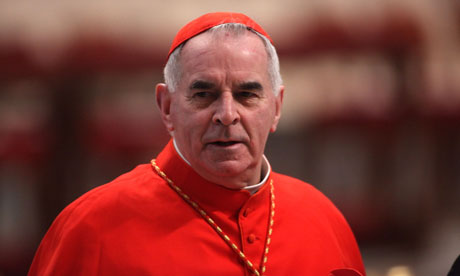
Cardinal Keith O'Brien at the Vatican, in February.
Cardinal Keith O'Brien at the Vatican, in February. Photograph: Franco Origlia/Getty Images

(The Guardian) Britain's most senior Catholic cleric has called on Christians to wear a cross every day as "a symbol of their beliefs" and to combat the marginalisation of religion in modern society.

The plea by Cardinal Keith O'Brien, head of the Catholic church in Scotland, to be made in his Easter sermon, comes as the Anglican archbishop of Canterbury, Dr Rowan Williams, appealed for more people to attend church this Sunday – even if they are "a bit vague" about religion.

Williams, who is marking his final Easter as leader of the Church of England, said he does not "lose sleep" over the fact many people only attend church at Easter and Christmas.

Speaking to BBC Radio 4, he said that he welcomed those with little connection to Christianity who just wanted to "let the story wash over them" knowing that they would not face a "doctrine examination".

But O'Brien will call on Christians to make the cross "more prominent in their lives". Due to speak at Edinburgh's St Mary's Cathedral on Sunday, he will tell them to "wear proudly a symbol of the cross of Christ on their garments each and every day of their lives"... (continued)

Sunday, February 12, 2012

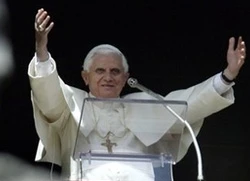
Pope Benedict XVI: The cry of Jesus from the Cross

http://cache.daylife.com/imageserve/00IwgLI1Bo6VP/610x.jpg
 AP Photo

(Vatican Radio) “In our relationship with the Lord, in front of the most difficult and painful situations, when it seems that God does not listen, we need not fear to entrust to Him all the weight we carry in our hearts, we must not be afraid to cry out to Him in our suffering”, said Pope Benedict XVI Wednesday as he continued his series of lessons on Christ’s prayer in his General Audience, this week focusing on the cry of Jesus from the Cross: “My God, my God, why have you forsaken me?”.

He said : “This cry comes after a three-hour period when there was darkness over the whole land. Darkness is an ambivalent symbol in the Bible – while it is frequently a sign of the power of evil, it can also serve to express a mysterious divine presence. Just as Moses was covered in the dark cloud when God appeared to him on the mountain, so Jesus on Calvary is wrapped in darkness. Even though the Father appears to be absent, in a mysterious way his loving gaze is focussed upon the Son’s loving sacrifice on the Cross.

In comments in Italian Pope Benedict said: “Jesus prays at the time of ultimate rejection by men, at the time of abandonment; he prays, however, aware of the presence of God the Father in this hour in which he feels the human drama of death. But we wonder: how could a God so powerful not intervene to save his Son from this terrible ordeal? It is important to understand that the prayer of Jesus is not the cry of one who goes to meet death with despair, nor is it the cry of one who knows himself to be abandoned. Jesus then makes his Psalm 22, the Psalm of the people of Israel that suffers, and in this way not only takes upon Himself the punishment of his people, but also that of all men who suffer from the oppression of evil and at the same time, brings all of this to the heart of God himself in the certainty that his cry will be heard in the resurrection”.

“This prayer of Jesus encloses the utmost confidence and abandonment in God's hands, even when He seems absent, even when He seems to remain silent, according to a design that is incomprehensible to us. His is a suffering in communion with us and for us, that comes from love and already carries within redemption, the victory of love”.

The Holy Father concluded: “Dear friends, in prayer we bring our daily crosses to God, in the certainty that He is present and hears us. The cry of Jesus reminds us that in prayer we must overcome the barriers of our "self" and our problems and open ourselves to the needs and suffering of others. The prayer of the dying Jesus on the Cross teaches us to pray with love for so many brothers and sisters who feel the weight of everyday life, who are experiencing difficult moments, who are in pain, without a word of comfort, so that they too can feel the love of the God who never abandons”.

Following his catechesis Pope Benedict launched an appeal for all the victims of a deadly cold snap that has gripped much of Europe this week: “In recent weeks a wave of cold and frost has swept some regions of Europe causing great inconvenience and considerable damage. I wish to express my closeness to people affected by this intense bad weather, while I invite prayers for the victims and their families. At the same time I encourage solidarity so that those who are suffering from these tragic events are generously supported”.

And finally he had greetings for pilgrims present in the Paul VI hall: “I greet all the English-speaking visitors and pilgrims present at today’s Audience, including groups from England, Ireland, Norway and the United States of America. I extend a special welcome to the many students who are here, and I pray that your studies may serve to deepen your knowledge and love of our Lord and Saviour Jesus Christ. Whatever darkness you experience in your lives, may you always remain firm in faith, hope and love. May God bless all of you!”

Tuesday, September 1, 2009

Father Corapi


"When we remove Christ from the cross, a cross without Christ, that's little more than they have in the oppressed communist countries. They have plenty of suffering and plenty of misery. But when you put Christ on the cross, you endow it with the power of redemptive love. As we've expunged sacrifice from the daily life of Catholics and Christians, we've expunged power."

Monday, February 2, 2009

Pontiff Reflects on Messianic Secret

http://d.yimg.com/us.yimg.com/p/rids/20090201/i/r3568221324.jpg?x=400&y=245&q=85&sig=rnaP3F6bI8SJxXmpg6lviQ--

Says Suffering Was Key to Christ's Mission

VATICAN CITY, FEB. 1, 2009 (Zenit.org).- Christ knew that to fulfill his mission he had to suffer and die on the cross. For this reason, he took great strides to keep his identity hidden, says Benedict XVI.

Reflecting on today's Gospel (Mark 1:21-28) before praying the Angelus with those gathered in St. Peter's Square, the Pope spoke about the "so-called 'Messianic secret.'"

"For the moment, Jesus does not want anyone outside the restricted group of his disciples to know that he is the Christ, the Son of God," the Pontiff explained. "This is why he often admonishes the apostles and the sick people whom he heals to not reveal his identity to anyone."

"Not only does Jesus chase demons out of people, freeing them from the worst slavery, but he prohibits the demons themselves from revealing his identity," he added.

The Holy Father said Christ insisted on this secret "because the fulfillment of his mission is at stake, on which our salvation depends."

"He knows in fact that to liberate humanity from the dominion of sin he must be sacrificed on the cross as the true paschal lamb," Benedict XVI explained. "The devil, for his part, tries to divert his attention and direct it instead toward a human logic of a powerful and successful messiah."

The Pope continued: "The cross of Christ will be the demon’s ruin, and this is why Jesus does not cease to teach his disciples that in order to enter into his glory he must suffer much, be rejected, condemned and crucified. Suffering is an integral part of his mission."

"Jesus suffers and dies on the cross for love," he added. "When we consider this, we see that it is in this way that he gave meaning to our suffering, a meaning that many men and women of every age understood and made their own, experiencing profound serenity even in the bitterness of difficult physical and moral trials."

Wednesday, October 29, 2008

The Cross teaches Christians to renounce pride and choose love, Benedict XVI says


.- In the presence of thousands of people at St. Peter's Square, Pope Benedict XVI continued his weekly teachings on St. Paul, speaking about the central place of the Cross of Jesus Christ in Paul's preaching. The Cross should teach Christians to renounce their own "superiority" and choose love, the Pope underscored.

The Pope began by noting that Paul's "existence was entirely consumed for souls." In his encounter with Jesus on the road to Damascus, the Holy Father said, Paul "understood that Jesus had died and risen for all and for him also."

"Both were important," Pope Benedict explained. Jesus really died for all, and he also died for me. Once Paul experienced this love "above all in himself," he became a believer and an apostle, the Holy Father added.

For Paul, his new life in Christ was a daily experience that “salvation was 'grace'," Benedict observed. The "gospel of grace, became for Paul the only way to understand the Cross, the reason not only for his new existence, but also the message in his preaching."

The importance of the Cross had an even greater impact than a personal one for St. Paul. The power of the Cross was so great in Paul’s teaching that he saw it as having “fundamental primacy in the history of humanity," Pope Benedict asserted.

Thus, St. Paul’s belief in the primacy of the Cross guided him when he was confronted by the Church in Corinth, where disarray and scandal were present and the community was threatened by internal division, the Holy Father taught. Instead of presenting himself with words or wisdom, Paul came proclaiming the “announcement of Christ crucified."

Benedict XVI then went on to highlight how "the 'stumbling block' and 'foolishness' of the Cross," of which St. Paul, speaks are to be found "in the fact that where there seemed to be only failure, suffering and defeat, there, in reality, is all the power of God's limitless Love."

In his First Letter to the Corinthians, Paul writes, "For the foolishness of God is wiser than human wisdom, and the weakness of God is stronger than human strength." The Holy Father explained that the Apostle Paul identifies himself with Christ who loved him and gave himself up for his sins and for those of all. This, Pope Benedict continued, "becomes the paradigm for all of us."

In Paul's Second Letter to the Corinthians, the Pontiff unfolded the way that Paul applies Jesus’ sacrifice through an "admirable synthesis" of the theology of the Cross: Christ died for all and God has reconciled us with him. This "ministry of reconciliation" is relevant for our life, as we must also renounce our own "superiority" and choose love, the Pope said.

"St. Paul renounced his own life and committed himself totally to the ministry of reconciliation, of the Cross which is salvation for us all, Pope Benedict said as he concluded his teaching on St. Paul. “This is something we must also do. We can find our strength in the humility of love and our wisdom in the weakness to renounce, thus to enter into the strength of God. ... We have to mold our lives on this true wisdom, not living for ourselves, but living in faith in the God of Whom we can all say: 'He loved me and gave Himself for me'."