Showing posts with label reform. Show all posts

Monday, September 22, 2014

The annulment argument: a quick quide to the two sides


By Dr. Edward Peters

(In the Light of the Law) There are basically two groups agitating for annulment reform, one saying that there are too many annulments, the other saying that there are too few. Let me suggest that (a) the first group is mistaken if it thinks the annulment problem lies in the annulment process (ie, Book VII of the 1983 Code and Dignitas connubii) and (b) the second group seeks not so much reform of the annulment process as its effective abolishment.

The first group (those holding that there are too many annulments), can scarcely suggest any procedural reforms (short of requiring tribunals to stamp DENIED on every annulment petition) for nothing about current canon and special law makes declaring marriage nullity easy. Under current ecclesiastical law, nullity must be proven, on specific grounds, based on sworn declarations and testimony, over the arguments of an independent officer, and confirmed on appeal. There are, that I can see, no gaps in the process through which marriage cases may slip quietly but wrongly into nullity. Not even the oft-reviled Canon 1095 (the “psychological” canon upon which most annulments around the world are based) can be written off as a mere legislative novelty for it articulates (as best positive law can) jurisprudence developed by the Roman Rota itself over the last 60 or 70 years.

No, the objections of the first group to the number of annulments being declared is, I suggest, not to the annulment process but to the people running that process. Tribunal officers are, it is alleged, too naive, too heterodox, or just too lazy to reach sound decisions on nullity petitions; they treat annulments as tickets to a second chance at happiness owed to people who care enough to fill out the forms. How exactly members of this first group can reach their conclusion without extended experience in tribunal work and without adverting to the cascade of evidence that five decades of social collapse in the West and a concomitant collapse of catechetical and canonical work in the Church is wreaking exactly the disastrous effects on real people trying to enter real marriages that the Church has always warned about, escapes me. Nevertheless that is essentially their claim: the process needs no major reform, processors do.

Neither can the second group (those holding that there are too few annulments) credibly point to specific reforms of the annulment process for (with two exceptions noted below) every phase of the current annulment process is required by natural law to serve the ends of justice (and, as Pope St. John Paul II repeatedly reminded us, the annulment process is about justice—not mercy, not charity, not warm fuzzy feelings, but justice); to eliminate any of these steps would be to gut the unavoidably juridic nature of the annulment process. Natural law requires that presumptions (here, of validity) be overturned only for specific reasons (here, grounds) demonstrated by objective information (here, declarations and testimony) weighed by independent minds (here, judges) subject to review by superiors (here, appeal). Remove any of these steps and, whatever ‘process’ one is left with, it’s not a legal one. Thus I say, push proponents of the second school to be clear, and what most of them must admit seeking is the “de-juridicization” of the annulment process. It’s their right, of course, to make such a proposal, but one should not confuse calls tantamount to elimination of a process with calls for reform of a process. More about that call, below.

First, though, it must be acknowledged that two aspects of the current annulment process are not required by natural law to achieve justice, namely... (continued)


Link:

Tuesday, October 1, 2013

Pope, in new interview, vows to change Vatican mentality

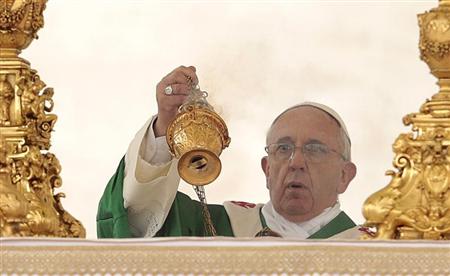
Pope Francis celebrates a mass in Saint Peter's square at the Vatican

By Philip Pullella

VATICAN CITY (Reuters) - Pope Francis has promised to do everything in his power to change the Vatican's mentality, saying in an interview published on Tuesday that it was too focused on its own interests.

He also revealed that he had briefly considered not accepting his election as the first non-European pope in 1,300 years when his fellow cardinals chose him in March.

In the long interview with the atheist editor of the left-leaning La Repubblica newspaper, he said too many previous popes in the Church's long history had been "narcissists" who let themselves been flattered by their "courtier" aides.

"The (papal) court is the leprosy of the papacy," said Francis, who has brought a new style of openness, consultation and simplicity to the papacy.

The interview, conducted last week in the pope's spartan residence in a Vatican guest house, appeared as he began a three-day, closed-door meeting with eight cardinals from around the world to help him reform the Vatican's troubled administration, known as the Curia.

There are some "courtiers" among the Curia's administrators, he said, but its main defect is that it is too inward-looking.

"It looks after the interests of the Vatican, which are still, in large part temporal interests. This Vatican-centric vision neglects the world around it and I will do everything to change it," he said.
Francis said the eight cardinals he had chosen to make up his advisory board did not have selfish motives.

"They are not courtiers but wise people who are inspired by my same feelings. This is the start of a Church with an organisation that is not only vertical but also horizontal," he said.

Speaking of his personal faith, Francis said: "A Catholic God does not exist...

"I believe in Jesus Christ, his incarnation. Jesus is my master and my pastor, but God, the father ... is the light and the creator. This is my being."

In the interview, the Argentine pope said that on the night fellow cardinals elected him in the Sistine Chapel on March 13, before formally accepting, he had asked to go to an adjoining room to be alone.

"My head was completely empty and a great anxiety came over me. To make it go away and relax I closed my eyes and every thought went away, even that of not accepting, which the liturgical procedures permitted," he said.

On September 19, Jesuit journals published a landmark interview with Francis in which he said the Catholic Church must shake off an obsession with teachings on abortion, contraception and homosexuality and become more merciful.

Francis did not discuss themes of sexual morality in the La Repubblica interview.

Link:
Related:

Monday, September 30, 2013

Pope convenes cardinals for church reform talks


By Nicole Winfield

VATICAN CITY (AP) — Pope Francis convenes his parallel cabinet on Tuesday for a first round of talks on reforming the Catholic Church, bringing eight cardinals from around the globe together in a novel initiative to get local church leaders involved in helping make decisions for the 1.2-billion strong universal Catholic Church.

While the aim is for Francis to get advice, the Argentine Jesuit has already started making a mark on his own, with important Vatican appointments already made and clear-cut indications of the direction he wants to take the church that have elated liberals and alarmed many conservatives.

Francis' recent interview with a Jesuit journal, in which he called for more balance between the church's rules on issues like abortion, homosexuality and contraception and the need for it to be a more welcoming, merciful place for all, has become the must-read mission statement of his papacy.

It's unclear which of those issues feature in the 80-odd documents that will be considered by the pope and his so-called "Group of Eight" cardinals meeting behind closed doors this week. One core agenda item is certain: overhauling the Vatican bureaucracy, an antiquated administration that is universally disparaged as unhelpful to both the pope and the bishops it's designed to serve.

The scandal over leaked documents last year showed the Vatican bureaucracy to be a dysfunctional warren of political infighting and turf battles, fueling calls for reform from the cardinals who elected Francis pope.

Beyond the scandal, local church leaders have long bemoaned that Vatican courts take years to process requests for annulments and that Vatican offices are simply unresponsive to requests from them and lay faithful. Francis himself is a critic, frequently telling Vatican officials to be more pastors than bureaucrats. Just this weekend he told the Vatican police force that it was their job to stop the "devil" from creating internal wars through Vatican employees spreading gossip.

"It's a war that you don't fight with weapons, but with your tongue," he said.

How the pope's chosen cardinal cabinet will interact, if at all, with the existing Vatican cabinet is a topic for much speculation among Vatican watchers.

The Curia is organized according to a 1988 document "Pastor Bonus," which metes out the work and jurisdictions of the congregations, councils, courts and other offices that make up the governance of the church.

Honduran Cardinal Oscar Andres Rodriguez Maradiaga, who heads the pope's advisory commission, said the planned reform won't just make a few changes to the document.

"No, that constitution is over," he told the Catholic channel Salt and Light Television. "Now it's something different. We need to write something different. But it's not going to take one month or two months."

Indeed, no decisions are expected this week from the talks, and the pope has said reform takes time.

That hasn't stopped reform groups from pinning their hopes for a more progressive church on Francis and his council of cardinals, who hail from North and South America, Africa, Asia, Europe and Australia.

The worldwide church reform group We Are Church has written Francis asking for greater say among lay Catholics about the selection of bishops and for church officials to be removed from office if they mishandled cases of sexually abusive priests.

"Our fondest hope is that Pope Francis will accept a delegation of our leaders at the Vatican," organizer Rene Reid said in a statement. "He has been reaching out to atheists, gays and others. He wants dialogue. We want that too."

Conservatives and traditionalists, however, have reacted with dismay and downright alarm at the direction Francis has taken, particularly in the interview with the Jesuit-run La Civilta Cattolica, in which he bemoaned the church's obsession with "small-minded rules."

American canon lawyer Edward Peters suggested that Francis wasn't referring to abortion in rejecting such rules, but rather more superfluous ones like the one dictating who can march under the flag of certain religious societies on feast days.

Conservative commentator George Neumayr went further, writing in The American Spectator that Francis was in sore need of "correcting." Francis' "culturally conditioned liberalism threatens to undermine the unity and orthodoxy of the faith," he wrote.

Link: