(Note: this is not a recent article but I've just read it for the first time).Shrine Authorities Disrupt Pilgrimage of Reparation

The four bishops from the Society of Saint Pius X, along with the pilgrims, kneel in front of the Little Chapel of the Apparitions, making reparation for the Hindu ceremony enacted there on May 5, 2004.
by John Vennari
“I think they would have been more intelligent to leave us alone,” said Bishop Richard Williamson. “As it is, they fired up a sense of combat in quite a few combative Catholics.”
A unique Pilgrimage of Reparation was organized, primarily by the Society of Saint Pius X, to make public reparation for the May 5, 2004 desecration of the Fatima Shrine. On that day, as documented in Catholic Family News with pictures from a television broadcast of the event, Hindus were permitted by the Shrine Rector to commandeer the sanctuary. A Hindu priest at the Catholic altar in the Little Chapel of the Apparitions chanted a prayer for peace to the false gods of Hinduism. A Hindu congregation chanted Hindu responses.
This public defilement called for public atonement. On August 21 and 22, thousands of concerned Catholics from around the world converged on Fatima to make this Act of Reparation. I traveled to Portugal for the event with a Pilgrimage organized by Father Gruner’s Fatima Center. I file this report from Fatima on the day of the Act of Reparation.
From the time that the Hindus desecrated the Sanctuary, Fatima Shrine Rector Luciano Guerra has been hostile to traditional Catholics protesting the outrage. That hostility reared its head during the day of reparation on August 22.
 |
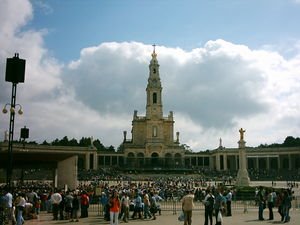
Procession into the Fatima Shrine for the Act of Reparation.
The hideous new modernist basilica is seen under construction in the background. |
On the previous day — Sunday, August 21 — a solemn High Mass was celebrated for the pilgrims in a field about a mile from the Fatima Shrine. Bishop Bernard Fellay, Superior General of the Society of Saint Pius X, was celebrant. Then on Monday, a low Mass was held at the same outdoor site, followed by a procession to the Shrine.
Upon arriving at the Shrine, the hundreds of priests, four bishops, many religious, and thousands of faithful, confronted a barricade that blocked their way to the Little Chapel of the Apparitions, even though the SSPX had made an agreement with Shrine authorities to be at the Little Chapel at that hour.
This coincided with another oddity. We arrived at 1:30 p.m. as had been long-planned and announced, and the Shrine had their charwomen vacuuming the sanctuary. One priest who has often been to Fatima said he never saw this before — women vacuuming the sanctuary in the middle of the day.
 |
| Pilgrims praying during the Act of Reparation, despite the attempts by Shrine authorities to disrupt their prayers. |
The men from the procession opened up the barricade themselves, and the huge crowd took its place in front of the Little Chapel of the Apparitions. We never entered the Chapel itself. The four bishops of the Society of Saint Pius X knelt in front of the Little Chapel. The ensemble of pilgrims chanted the Litany of the Sacred Heart, and then began to pray the Rosary in Latin.
At about the third decade of the Rosary, three nuns from the Fatima Shrine approached the podium in the sanctuary, as if they were going to start a ceremony of their own. We had just finished a decade, so we began to sing Christus Vinces. Immediately after we started our hymn, the nuns from the Shrine began to sing over the microphone a different hymn from ours, in an attempt to disrupt our prayers.
It was a dramatic standoff. We stood at full height and sang louder. The nuns continued the challenge, singing their own hymns over the microphone. It was as bizarre as it was childish. Tension mounted. We were outraged that the Shrine representatives would hurl such contempt at our group, which was merely praying the Rosary at the Fatima Shrine.
This “got the Irish up” of an Irish Brother who stepped over the small outside wall around the Little Chapel and made his way toward the nuns. His plan, he later told me, was to pull the microphone away from these peculiar Sisters treating us with derision.
 |
| Part of the procession from the outdoor Mass site to the Shrine. |
As he approached the nuns, he was seized by Shrine guards. A scuffle ensued. Various pilgrims in the crowd gasped in horror. Bishop Alfonso de Galarreta from the SSPX rose to his feet to establish calm. The guards released the Brother. The Shrine nuns withdrew from the sanctuary and we continued our prayers.
Within two minutes, the Shrine authorities retaliated.
Sacred music suddenly began to blast from the Shrine’s sound system. It was full volume, so loud that I could barely hear the Rosary recited by the people around me. The entire esplanade vibrated from the Shrine’s state-of-the-art sound system, designed to project sound to tens-of-thousands of people.
Later, a hotel owner who has been in Fatima for twenty years, and whose establishment is a twenty minute walk from the Shrine, said he has never heard Shrine music from his hotel before. Today was the first time.
It was Sacred music used as a weapon against traditional Catholics. Clearly, the Shrine authorities blasted the music to drown us out and drive us out.
They may have drowned us out, but they did not get rid of us.
We continued the Rosary as the music blared. The bishops, priests and people renewed the Act of Consecration to the Immaculate Heart of Mary. The pilgrims sang a final hymn to Our Lady and broke into applause while doing so. Then the entire group solemnly processed from the Little Chapel.
The Act of Reparation was concluded. We completed what we set out to do, despite the Shrine authorities’ clumsy attempt at disruption.
Afterwards, I interviewed priests and bishops from the Society of Saint Pius X for their reaction.
Australia’s Father Kevin Robinson said, “We’ve just witnessed an incredible scene. This is the power of Tradition over the devil-inspired new religion. I think everybody here is very happy to have experienced the Consecration of the Society. And please God we can overcome these modernists.”
I asked Father Robinson if he sensed that when the Shrine authorities cranked up the music, it strengthened the resolve of the entire group. It bolstered everyone to stand taller, pray longer and sing louder.
“That’s exactly what happened,” he responded. “They provoked us to pray more, to pray for their conversion. This is the place where conversions happen.”
Bishop Bernard Fellay, Superior General of the Society of Saint Pius X, said, “We had, during our little Act of Reparation, a very, very nasty reaction from the side of the Sanctuary. They provoked, but there was a happy end.” The happy end he refers to is the fact that the priest and pilgrims did not budge. They completed the Act of Reparation as they had set out to do.
Father Geraldo Zendejas, Prior of Saint Ignatius Retreat House, said, “We came here for a public act of Reparation. And we received the answer from them (the Shrine). They want to silence us. Everybody’s accepted here, even the Hindus. But today, we were rejected. We were 2,000 people just praying on our knees for the glory of God ...”
This is true. Under Rector Guerra, Hindus were welcome to pray at the altar. Interfaith Congresses were held at the Fatima Shrine’s conference center. Anglicans have conducted retreats at the Shrine. But Traditional Catholics, who believe everything the Church has always taught and practiced, are not welcome.
Father Jean Violette, District Superior of Canada, made a similar point: “I’m sure if we would have worn turbans, the Rector would have greeted us at the Statue. We all would have held hands, and we would have had a nice ecumenical meeting. Instead, we were received very rudely — a typical, Novus Ordo, ecumenical gesture.”
Father Anthony Mary from the traditionalist Redemptorists in Great Britain, said, “I heard from Father Schmidberger that everything had been organized. They (at the Shrine) knew we were coming.” Conditions, he explained, were agreed to with the Shrine regarding the public prayer in front of the Little Chapel. “We kept the conditions to do the consecration ... and Father Schmidberger said that he was very surprised that they broke the conditions (the agreement). And once they at the Shrine broke the conditions of keeping the arrangement, then, well, we actually had to break through the barriers to get through. So I think the whole attitude of them was despicable. The least they could have had was the simple, natural charity to let us say our prayers and not try to interrupt it. But it’s wonderful that we managed to do what we had to do and I’m sure graces will be won for the Fraternity (SSPX), for Tradition, and reparation done as well.”