Showing posts with label nebula. Show all posts

Wednesday, March 11, 2009

See Explanation.  Clicking on the picture will download  the highest resolution version available.

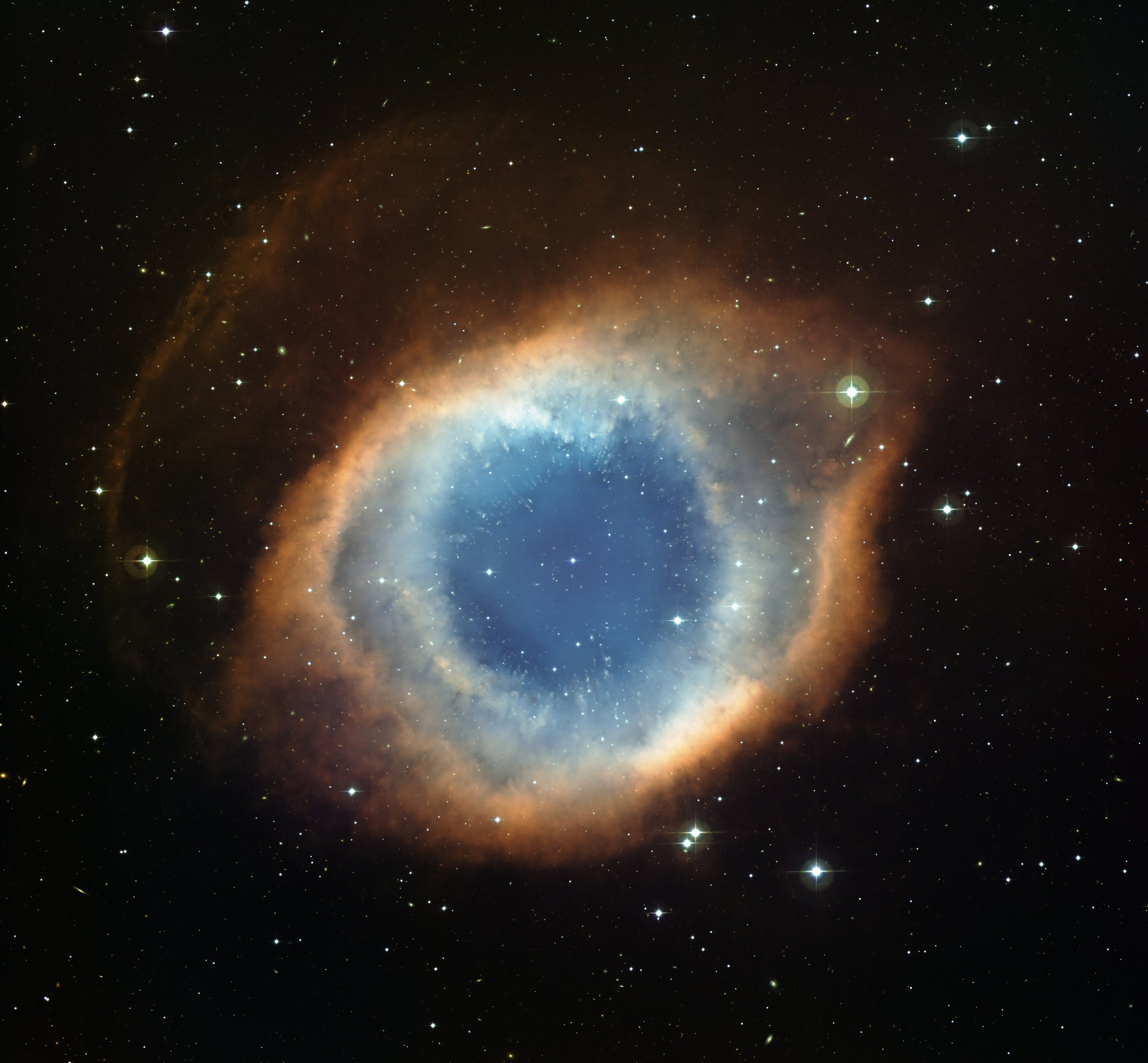
The Helix Nebula from La Silla Observatory
Credit: WFI, MPG/ESO 2.2-m Telescope, La Silla Obs., ESO

Explanation: Will our Sun look like this one day? The Helix Nebula is one of brightest and closest examples of a planetary nebula, a gas cloud created at the end of the life of a Sun-like star. The outer gasses of the star expelled into space appear from our vantage point as if we are looking down a helix. The remnant central stellar core, destined to become a white dwarf star, glows in light so energetic it causes the previously expelled gas to fluoresce. The Helix Nebula, given a technical designation of NGC 7293, lies about 700 light-years away towards the constellation of Aquarius and spans about 2.5 light-years. The above picture was taken by the Wide Field Imager on the 2.2-meter Telescope at the European Southern Observatory's La Silla Observatory. A close-up of the inner edge of the Helix Nebula shows complex gas knots of unknown origin.

Sunday, February 15, 2009

Astronomy Picture of the Day

See Explanation.  Clicking on the picture will download  the highest resolution version available.
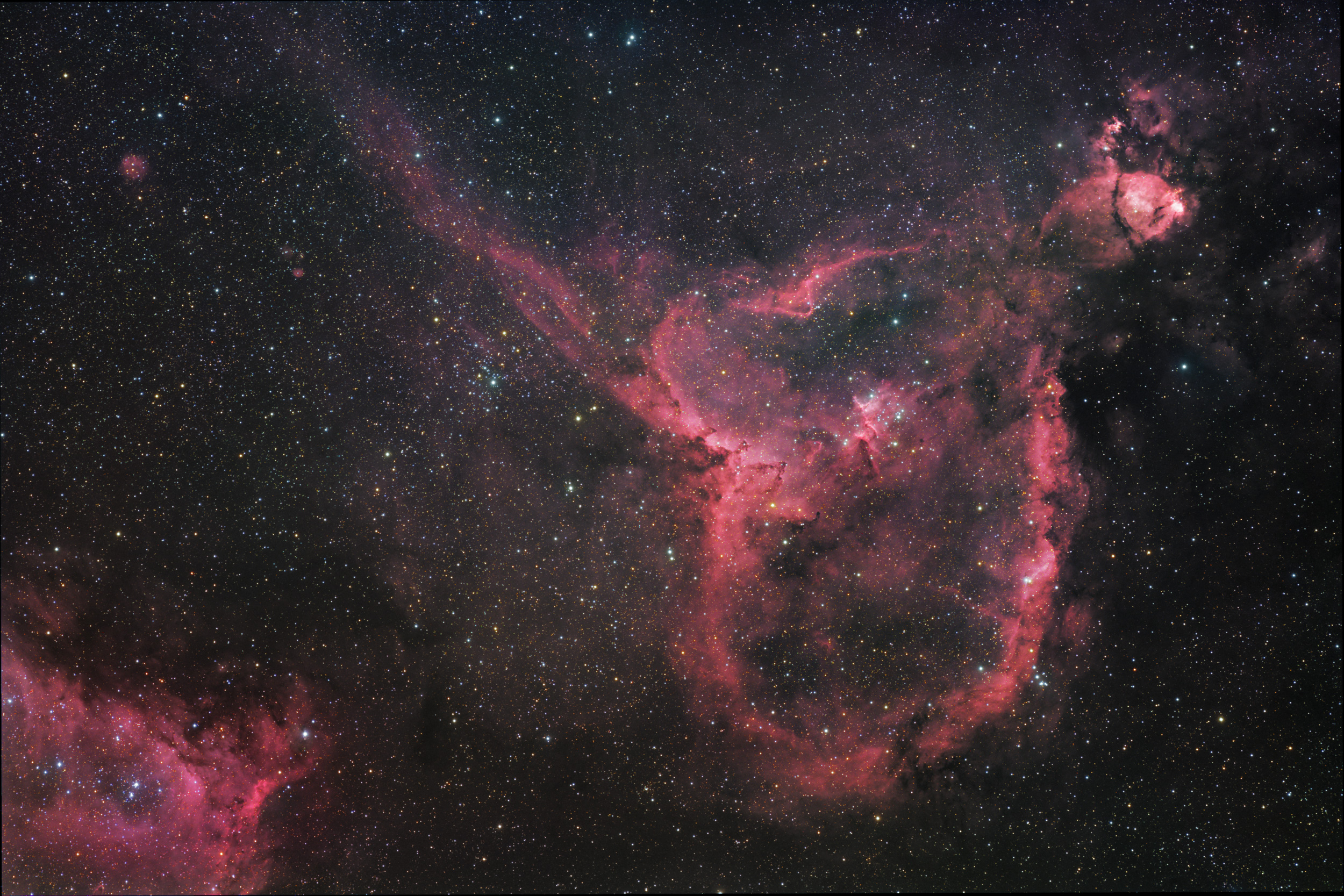
IC 1805: The Heart Nebula
Credit & Copyright: Daniel Marquardt

Explanation: Sprawling across almost 200 light-years, emission nebula IC 1805 is a mix of glowing interstellar gas and dark dust clouds. Derived from its Valentine's-Day-approved shape, its nickname is the Heart Nebula. About 7,500 light-years away in the Perseus spiral arm of our galaxy, stars were born in IC 1805. In fact, near the cosmic heart's center are the massive hot stars of a newborn star cluster also known as Melotte 15, about 1.5 million years young. A little ironically, the Heart Nebula is located in the constellation Cassiopeia. From Greek mythology, the northern constellation is named for a vain and boastful queen. This deep view of the region around the Heart Nebula, cropped from a larger mosaic, spans about 2.5 degrees on the sky or about 5 times the diameter of the Full Moon.

  • Link