Showing posts with label martyrology. Show all posts

Sunday, May 12, 2013

Pope Francis gives church hundreds of new saints

Pope Francis, middle, kisses the altar as he arrives to celebrate his first canonization ceremony in St. Peter's Square at the Vatican, Sunday, May 12, 2013. The pontiff will canonize Antonio Primaldo and his companions, also known as the Martyrs of Otranto, Laura di Santa Caterina da Siena Montoya of Colombia, and Maria Guadalupe Garcia Zavala of Mexico in a ceremony at the Vatican on Sunday. (AP Photo/Alessandra Tarantino)

By FRANCES D'EMILIO
 
VATICAN CITY (AP) - Pope Francis on Sunday gave the Catholic church new saints, including hundreds of 15th-century martyrs who were beheaded for refusing to convert to Islam, as he led his first canonization ceremony Sunday in a packed St. Peter's Square.

The "Martyrs of Otranto" were 813 Italians who were slain in the southern Italian city in 1480 for defying demands by Turkish invaders who overran the citadel to renounce Christianity.

Their approval for sainthood was decided upon by Francis' predecessor, Benedict XVI, in a decree read at the ceremony in February where the former pontiff announced his retirement.

Shortly after his election in March, Francis called for more dialogue with Islam, and it was unclear how the granting of sainthood to the martyrs would be received. Islam is a sensitive subject for the church, and Benedict stumbled significantly in his relations with Muslims.


The first pontiff from South America also gave Colombia its first saint: a nun who toiled as a teacher and spiritual guide to indigenous people in the 20th century.

With Colombia's President Juan Manuel Santos among the VIPS, the Argentine pope held out Laura of St. Catherine of Siena Montoya y Upegui as a potential source of inspiration to the country's peace process, attempted after decades-long conflict between rebels and government forces.

Francis prayed that "Colombia's beloved children continue to work for peace and just development of the country." He also canonized another Latin American woman. Maria Guadalupe Garcia Zavala, a Mexican who dedicated herself to nursing the sick, helped Catholics avoid persecution during a government crackdown of the faith in the 1920s.

Also known as Mother Lupita, she hid the Guadalajara archbishop in an eye clinic for more than a year after fearful local Catholic families refused to shelter him.

Francis prayed that the new Mexican saint's intercession could help the nation "eradicate all the violence and insecurity," an apparent reference to years of bloodshed and other crime largely linked to powerful drug trafficking clans.

Francis told the crowd that the martyrs are a source of inspiration, especially for "so many Christians, who, right in these times and in so many parts of the world, still suffer violence." He prayed that they receive "the courage of loyalty and to respond to evil with good."

The pope didn't single out any country. But Christian churches have been attacked in Nigeria and Iraq, and Catholics in China loyal to the Vatican have been subject to harassment and sometimes jail over the last decades. Christians in Saudi Arabia must worship out of the public eye because the ultraconservative kingdom does not officially permit churches and non-Muslim religious sites.


Francis, the first pope from the Jesuit order, which is known for its missionary zeal, praised the Colombian saint for "instilling hope" in the indigenous people. He said she taught them in a way that "respected their culture." Many Catholic missionaries over the centuries have been criticized for demanding natives renounce local traditions the outsiders viewed as primitive.

He hailed the Mexican saint for renouncing a comfortable life to work with the sick and poor, even kneeling on the bare floor of the hospital before the patients to serve them with "tenderness and compassion."

Mother Lupita's example, said Francis, should encourage people not to "get wrapped up in themselves, their own problems, their own ideas, their own interests, but to go out and meet those who need attention, comprehension, help" and other assistance.

After shaking hands with the prelates and VIPS in the front rows at the end of the Mass, Francis shed his ceremonial vestments. Wearing a plain white cassock, he climbed into an open white popemobile to ride up and down the security paths surrounding the crowd of more than 60,000.

He stopped to pat children on the head, kiss babies and bantered in his native Spanish with some at the edge of the crowd.

Link:

Tuesday, April 9, 2013

Humility, Martyrdom Among Francis' Homily Reflections

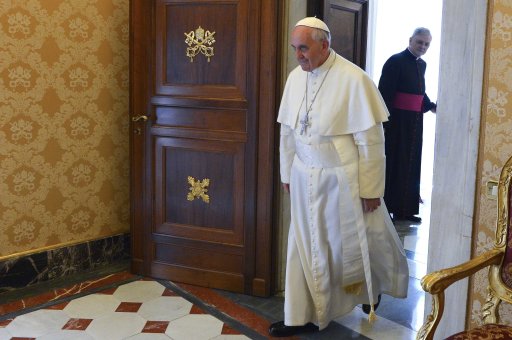
Pope Francis walks to meet U.N. Secretary-General Ban Ki-moon during a meeting at the Vatican

Invites Praying: "Lord, Thank You So Much for My Faith"

Vatican City, (Zenit.org)

Progress means "lowering oneself" on the road of humility in order to allow God's love to emerge and be clearly seen.

This was the central focus of Pope Francis' homily this morning at Mass in the Domus Sanctae Marthae chapel, according to L'Osservatore Romano. The feast of the Annunciation was marked today, as it was moved from the typical date of March 25, since that fell within Holy Week this year.

Among the congregation were Sisters of Charity who renewed their vows, the staff of the Vatican Television Center, staff of the Brazilian section of Vatican Radio, and longtime Papal photographer, Arturo Mari.

The way of Christian humility rises up to God, as those who bear witness to it "stoop low" to make room for charity, the Holy Father reflected.

The Pope said that the road taken by Mary and Joseph to Bethlehem for the imperial census was a road of humility. There was the humility of Mary, who "did not understand well," but "[entrusted] her soul to the will of God." Joseph was humble, as he "lowered himself" to take on the "great responsibility" of the bride who was with child.

"So it is always with God's love," said Francis, "that, in order to reach us, takes the way of humility." This was the same way that Jesus walked, a way that humbled itself even unto the Cross. Pope Francis went on to say that, for a Christian, "[T]his is the golden rule," according to which progress and advancement always come through lowering oneself. "One can take no other road," he said, adding, "if I do not lower myself, if you do not lower yourself, you are not a Christian."

Pope Francis went on to say, "Being humble does not mean going on the road," with "downcast eyes." Such was not the humility of Jesus, or his mother or his foster father, Joseph. The Holy Father underlined that the way of humility is the one that leads to the triumph of the Resurrection. "Let us ask God for the grace of humility," he prayed, "that humility, which is the way by which charity surely passes," for, "if there is no humility, love remains blocked, it cannot go [forward]."

Persecuted

At his Saturday morning Mass, L'Osservatore Romano reported that the Pontiff spoke about martyrdom.
"To find martyrs we don't need to go to the Catacombs or to the Colosseum: today martyrs are alive in a great many countries. Christians are persecuted for their faith. In some countries they cannot carry the cross: they are penalized for doing so. Today, in the 21st century, our Church is a Church of martyrs," he said.
Pope Francis began his homily commenting with a quip on the Gospel passage of St Mark (16:9-15), in which are recounted the appearances of Jesus to Mary Magdalene, to the disciples of Emmaus and to the Eleven. "When I read this Gospel it occurs to me that St Mark may not have liked Mary Magdalen much, since he recalled that the Lord had driven seven demons out of her, didn't he? It was a question of liking...".
He then presented a reflection on faith: "a grace", and "a gift of the Lord" which should not be glossed over — and is thus extended "to the peoples who believe in you", as the Collect of Mass says, for "we are not attached to a fantasy", but "to a reality we have seen and heard."

The Pope mentioned the passage from the Acts of the Apostles (4:13-21) proclaimed in the First Reading. In response to the order given by the head priests and Pharisees not to speak of Jesus, Peter and John, "stood firm in the faith" saying, "we cannot but speak of what we have seen and heard."

Their testimony, he added, "reminds me of our faith. And what is our faith like? Is it strong? Or is it at times a little like rosewater, a somewhat watered down faith? When problems arise are we brave like Peter or inclined to be lukewarm?"

Peter, Pope Francis said, teaches us that "faith is not negotiable. Among the People of God this temptation has always existed: to downsize faith, and not even by 'much.'" However, he explained, we must must get the better of "the temptation to behave more or less 'like everyone else', not to be too, too rigid", because it is "from this that a path which ends in apostasy unfolds."

Indeed, "when we begin to cut faith down, to negotiate faith and more or less to sell it to the one who makes the best offer, we are setting out on the road of apostasy, of non fidelity to the Lord".

Yet the very "example of Peter and John helps us, gives us strength"; as does the example of the martyrs in the Church's history. It is they "who say, like Peter and John, 'we cannot but speak'. And this gives strength to us, whose faith is at times rather weak. It gives us the strength to carry on living with this faith we have received, this faith which is the gift that the Lord gives to all peoples".

The Pope ended by suggesting a daily prayer: "Lord, thank you so much for my faith. Preserve my faith, increase it. May my faith be strong and courageous. And help me in the moments when, like Peter and John, I must make it public."

Link:

Wednesday, June 6, 2012

ROMAN MARTYROLOGY - JUNE 7

From Timwhit:

Martyrology-June 7th

Roman Martyrology-June 7th- on this date in various years-

For 2012 The Feast of the most Sacred Body of Christ.

At Constantinople, the birthday of St. Paul, bishop of that city. For the Catholic faith, he was often driven out of his see by the Arians, but restored to it by the Roman Pontiff, St. Julius I. Finally the Arian emperor Constantius banished him to Cucusum, a small town of Cappadocia. There, by the intrigue of the Arians, he was barbarously strangled, and thus departed for the heavenly kingdom. His body was taken to Constantinople with the greatest honour during the reign of Emperor Theodosius.

At Cordova in Spain, the holy martyrs Peter, a priest, Wallabonsus, a deacon, Sabinianus, Wistremund, Habentius, and Jeremias, all of whom were monks. Their throats were cut at the time of the Arab persecution because they had confessed Christ.

At Hermopolis in Egypt, St. Licarion, martyr, who had his body lacerated, was scourged with heated iron rods, and endured other horrible torments, after which his martyrdom was completed by beheading.

At Placentia, St. Anthony Mary Gianelli, bishop of Bobbio, and founder of the Congregation of Sisters of our Lady of the Garden. Pope Pius XII numbered him among the saints of heaven.

In England, St. Robert, an abbot of the Cistercian Order.

And elsewhere in divers places, many other holy martyrs, confessors, and holy virgins.

R. Thanks be to God.

Link: