Showing posts with label Sistine Chapel. Show all posts

Thursday, March 14, 2013

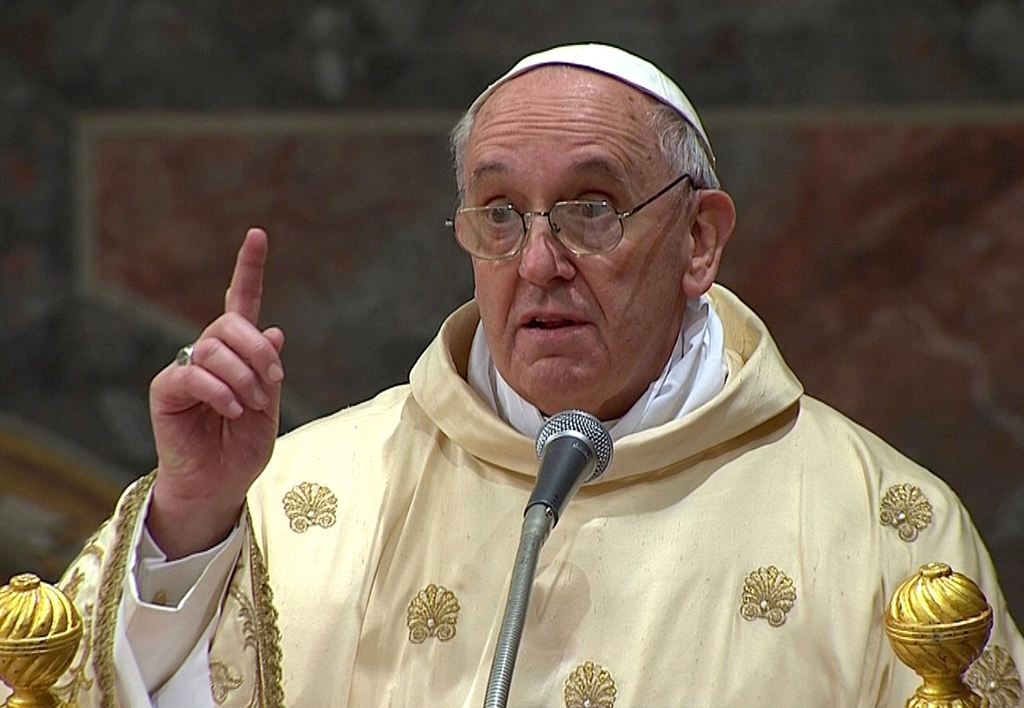
Pope Francis' First Homily

"When we journey without the cross ... and when we confess a Christ without the cross, we are not disciples of the Lord"

Vatican City, March 14, 2013 (Zenit.org)

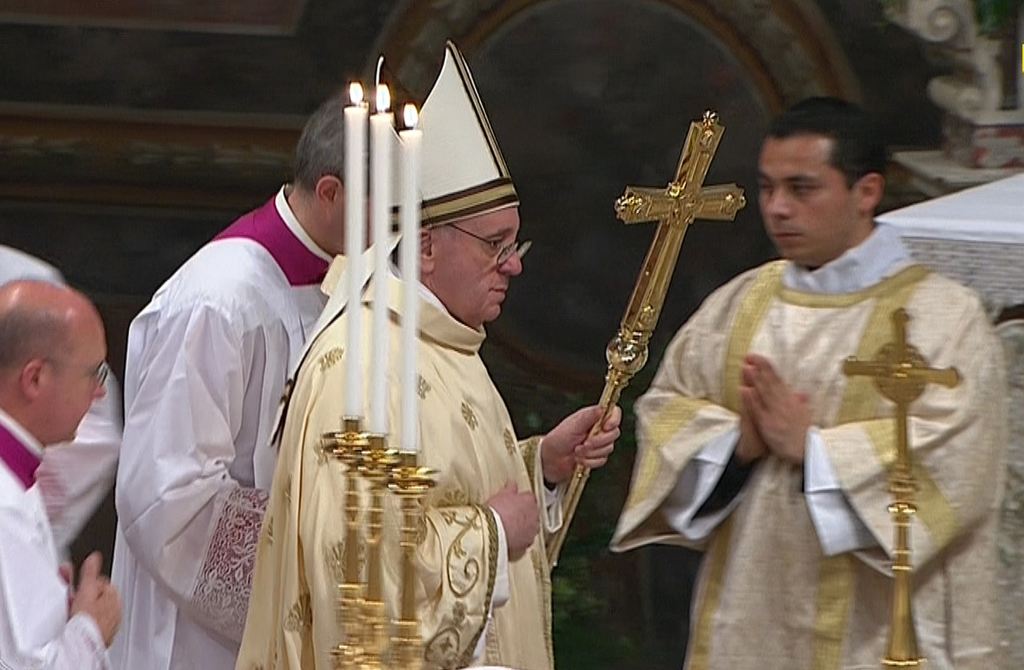
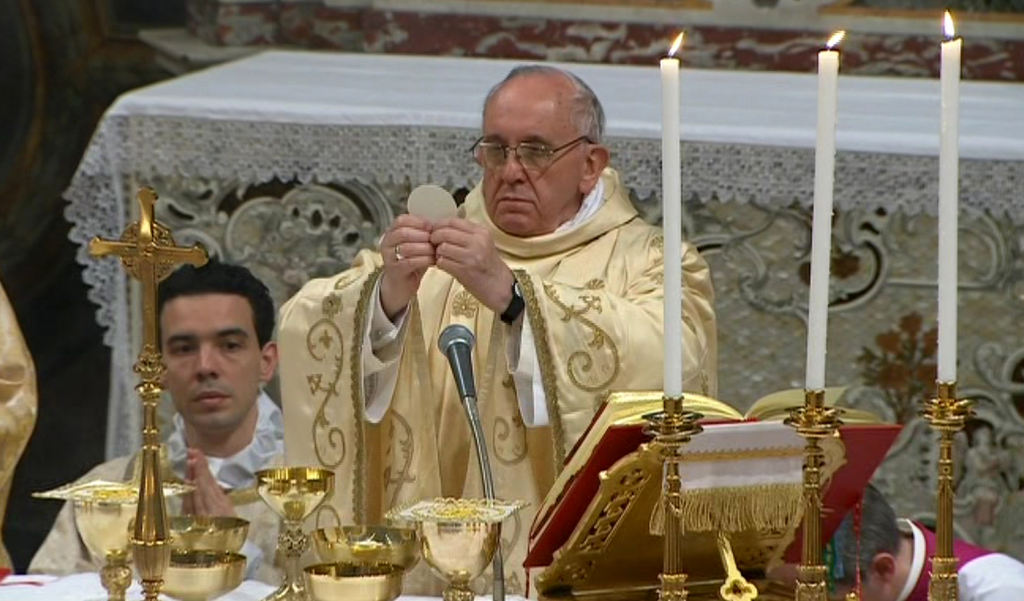
Here is a translation of the homily Francis gave this morning at Mass with the cardinals in the Sistine Chapel. He spoke in Italian without a text.

There is something that I see that these three readings have in common: movement. In the first reading it is the movement of a journey; in the second reading it is the movement in building the Church; in the third, the Gospel, it is the movement of confession. Journeying, building, confessing.

Journeying. “House of Jacob, come, let us walk together in the light of the Lord” (Isaiah 2:5). This is the first thing that God said to Abraham: Walk in my presence and you will be blameless. Journey: our life is a journey and when we stop it does not go on. Journey always in the presence of the Lord, in the light of the Lord, seeking to live with that blamelessness that God asked of Abraham in his promise.

Building. Building the Church. Stones are spoken of: the stones have a consistency, but they are the living stones, stones anointed by the Spirit. Building the Church, the Bride of Christ, upon that cornerstone that is the Lord himself. Building is another form of movement in our life.

Third, confessing. We can journey as much as we want, we can build many things, but if we do not confess Jesus Christ, the thing does not work. We will become a welfare NGO but not the Church, the Bride of Christ. When we do not journey, we stop. When we do not build upon the stones, what happens?

Everything collapses, loses its consistency, like the sandcastles that children build on the beach. When we do not confess Jesus Christ, I am reminded of the words of Léon Bloy: “Whoever does not pray to the Lord, prays to the devil.” When we do not confess Jesus Christ, we confess the worldliness of the devil, the worldliness of the demon.

Journeying, building-constructing, confessing. But it is not that easy, because in journeying, in constructing, in confessing, there are problems, there are movements antithetical to the journey: they are movements that take us backward.

This Gospel continues with an important moment. The same Peter who had confessed Jesus Christ said to him: You are the Christ, the Son of the living God. I will follow you, but let’s not talk about the cross. This is not a part of it. I will follow you in other directions, but not to the cross. When we journey without the cross, when we build without the cross and when we confess a Christ without the cross, we are not disciples of the Lord: we are worldly, we are bishops, priests, cardinals, popes, but not disciples of the Lord.

I would like for us all, after these days of grace, to have courage, precisely the courage, to walk in the Lord’s presence, with the cross of the Lord; to build the Church upon the blood of the Lord, which was poured out on the cross; and to confess the only glory there is: Christ crucified. And in this way the Church will go forward.

It is my wish for all of us that the Holy Spirit – through the prayer of Our Lady, our Mother – bestow upon us the grace of journeying, building, confessing Jesus Christ crucified. Amen.

[Translation by Joseph G. Trabbic]

Link:

Monday, October 1, 2012

Vatican in row over 'drunken tourist herds' destroying Sistine Chapel's majesty

Author Pietro Citati calls for limit on crowd numbers to preserve Michelangelo's art in Vatican City, Rome

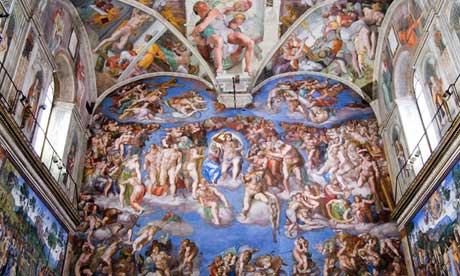
The Last Judgement
Millions surge throught the chapel every year to view Michelangelo’s famous frescoes, including The Last Judgement. Photograph: Alex Segre / Alamy/Alamy 

By

(The Observer) A fierce row has broken out over the future of the Sistine Chapel, after one of Italy's most respected writers slammed it as an "unimaginable disaster" where tourists resemble "drunken herds".

Centred on the image of God reaching out to give life to Adam, the chapel ceiling is renowned as Michelangelo's masterpiece and offers a defining image of the Christian faith.

But as the crush of visitors grows year by year, this home to Michelangelo's majestic 16th-century frescoes often feels more like a packed, sweaty, and very noisy railway station.

Five million tourists surge through the chapel every year, craning their necks to get a glimpse of the scenes painted on the 130ft-long ceiling, flouting the ban on flash photography and ignoring pleas from guards to lower their voices.

In an article in Corriere della Sera, Pietro Citati, a leading literary critic and biographer, has demanded that the Vatican limit access to the chapel, claiming it would save the frescoes from damage and restore some decorum to the consecrated site.

Describing a visit, Citati claimed that "in the universal confusion, no one saw anything" and "any form of contemplation was impossible". The answer, he said, was to reduce the number of visitors drastically.

"The church needs money for its various activities, but these monstrous conditions are not possible," said the writer, a close friend of the late novelist Italo Calvino.

The manager of the Vatican museums, which include the chapel, fought back on Friday in the pages of the Holy See's daily paper, L'Osservatore Romano.

"The days when only Russian grand dukes and English lords or [American art expert] Bernard Berenson could gain access to the great masterpieces are definitely over," wrote Antonio Paolucci. "We have entered the era of large-scale tourism, and millions want to enjoy our historical culture," he said. "Limiting numbers is unthinkable."

Michelangelo set to work on the chapel ceiling in 1508 after devising the perfect scaffolding for painting his biblical scenes 20 metres off the ground. The chapel, which also features works by Botticelli, Perugino and Pinturicchio, boasts 300 figures painted across 2,500 square metres and is dominated at one end by The Last Judgment, which Michelangelo filled with nude males reportedly inspired by his visits to Rome's brothels.

Today, the chapel is used during conclaves, when cardinals huddle to select the next pope, and when the pontiff baptises babies there once a year. At all other times, it fills with the 20,000 tourists and pilgrims who form a daily queue that snakes around the Vatican walls.

Paolucci said he had tripled the number of guards to handle the crowds, but last week one guard, who declined to be named, said the chapel was undermanned. "There are two of us against thousands; you'd need 10 guards."

"When it fills up, you can feel the heat rising. We even get pickpockets in here, just like at a street market," he added.

"It's often wall to wall or worse in here," said one tour guide.

Paolucci himself sounded the alarm bell two years ago after restorers gently scrubbed what he described as "unimaginable amounts" of dirt off the frescoes while working at night, after the last tourists had left. The air extraction system designed to suck out the humid breath, sweat, skin flakes, hair, dust and pollution wafting up towards the frescoes was almost 20 years old and urgently needed replacing, he said.

Air conditioning was also needed to reduce the body heat of visitors before they even entered the room, Paolucci said, promising to publish details of plans for a new, sophisticated system in the chapel by year end.
"They should start timed visits," said Cindy Rowlett, a pensioner from Ohio, as she jostled for space. "When they do timed visits at the Met in New York it is more intimate, while this doesn't feel very religious to me."

Paolucci said because the chapel was a place of prayer, timed visits were impossible. "This chapel is a compendium of theology, a catechism in images. Could you limit access to Lourdes?" he wrote. But Citati told the Observer: "Why can't you limit numbers at a holy place if it is at risk? We are condemning it to disaster."

Amid the throng in the chapel, Steve Ferrara, a tourist from Washington DC, said it was the noise that got to him. "This is one of the greatest creations of mankind, if people want to talk they should at least whisper out of respect."

After asking a group of tourists not to sit on the marble steps at the foot of The Last Judgment, the guard watched as his colleague clapped loudly and yelled "silence please" as the hubbub grew.

"Clapping is not exactly elegant," he said, "and after a few minutes people just start talking again."

Link:

Wednesday, April 14, 2010

Tuesday, October 21, 2008

Scripture and the Meaning of Holiness

http://d.yimg.com/us.yimg.com/p/ap/20081018/capt.169fc7a7c12f4b96843038992f0780a8.vatican_orthodox_oss104.jpg?x=400&y=265&q=85&sig=mrD9XQ_EMXdJo.kNgF9SmQ--

Pope and Patriarch Preside Over Vespers

Father Thomas Rosica, CSB

VATICAN CITY, OCT. 19, 2008 (Zenit.org).- One of the topics mentioned in a good number of the synod presentations was that of the saints and blessed who offer the Church concrete examples of lives rooted in the sacred Scriptures and the living Word of God.

When Archbishop Angelo Amato, the new prefect of the Congregation for Saints' Causes, addressed the synod Tuesday, he offered a very graphic image of lives rooted in the sacred Scriptures: For more than 2,000 years men and women, old and young, wise and ignorant, in the East as in the West, applied themselves to the school of the Lord Jesus, which caused this sublime commandment to echo in their hearts and minds: "You must therefore be perfect, just as your heavenly Father is perfect" (Matthew 5:48).

This does not mean that man-made perfection is the goal to be reached, rather it is the heights of divine perfection. With simplicity and humility, even youth -- like 14-year-old Domenico Savio and 13-year-old Laura Vicuña -- have taken the Lord's words seriously and taken up the path toward sainthood.

Their library was largely composed of the life and words of Jesus: Blessed are the poor, blessed are those who mourn, blessed are the gentle, blessed are those who hunger and thirst for uprightness, blessed are the merciful, blessed are the pure in heart, blessed are the peacemakers, blessed are those who are persecuted. The saints, understanding that the beatitudes are the essence of the Gospel and the portrait of Christ Himself, became their imitators.

In this picture made available by the Vatican newspaper L'Osservatore ...

The theme of the saints and holiness reached a crescendo on Saturday evening during the solemn vespers ceremony celebrated in the Sistine Chapel by Benedict XVI, the Ecumenical Patriarch Bartholomew I of Constantinople, and all delegates and participants in this world Synod of Bishops on the Word of God in the life and mission of the Church.

Backdoor

We were told at the end of the morning session to begin making our way around 4 p.m. through the "back way" to the Sistine Chapel: walking around the basilica, through parts of the Vatican Gardens, past the palace and manicured gardens of the Governatorato, and into the courtyard of St. Damaso.

Basilian Bishop Ronald Fabbro of London, Canada, and I took our time walking along the quiet path and into the maze of inner courtyards until we arrived at San Damaso. We joined many other cardinals, bishops and synodal delegates who were then escorted by Swiss Guards up the "seconda loggia."

http://d.yimg.com/us.yimg.com/p/ap/20081019/capt.a9289efe7ff945a09192ce078d19cd7a.italy_pope_pompeii_visit_gb109.jpg?x=400&y=285&q=85&sig=XcSWRCpfJwDf7cNa0XXjLQ--

Once we arrived in the Sistine Chapel, there was a hush over the audience, many of whom had arrived a full hour early just to pray under and before the beauty around us. Shortly before the vespers began, a Vatican monsignor from the Office of Pontifical Ceremonies spoke to us about the historic and ecclesial significance of this chapel's artwork, commissioned by Pope Julius II. The chapel was built with the same dimensions of the Holy of Holies in the Temple of Jerusalem. The monsignor did not, however, touch upon some things I remember about this grandiose room from my art history classes while I was a university student years ago.

For example, Pope Julius was referred to as "Il Terrible." His life reminds us of one of the colorful characters of Rabelais's world: Julius was a wild hunter, a boastful warrior and bullish fighter, and somewhat of a problematic character. "E' stato un papa abbastanza curioso" (He was quite a curious Pope), one Vatican diplomat said -- diplomatically!

Contrary to popular opinion, Michelangelo Buonarotti didn't paint the frescos in the reclining position, nor did he do them alone. He and his helpers prepared and painted the vault from the standing position (albeit leaning back a bit). The artist had many assistants -- to scrape, prepare the wall for plaster, to mix the paints, and to carry up supplies from the floor 60 feet below. He did a few of the later characters free hand, but most were detailed in "cartoons" (preparatory drawings).

Often, work had to be done while services were going on below. The bishops and cardinals often complained back then about the dust and noise. There were no complaints from bishops and cardinals on Saturday night. Only awe and gratitude for being in this room.

Vatican first

At exactly 5 p.m., the papal and patriarchal procession entered the Sistine Chapel as the Sistine choir began its haunting chants. The significance of this sight unfolding before us was lost on no one in the Sistine Chapel.

In this picture made available by the Vatican newspaper L'Osservatore ...

Benedict XVI and the Ecumenical Patriarch Bartholomew I entered the chapel walking side by side. Behind them came their closest collaborators working in the areas of Christian unity in their respective churches. This was history in the making: the first time an Orthodox patriarch was taking part in a world Synod of Bishops, or co-presiding, if you will, in this historic and magnificent place.

Following the vespers, the Pope invited Patriarch Bartholomew to address us, and did he ever speak, in flawless English. The Ecumenical Patriarch's talk was divided into three sections: on hearing and speaking the Word of God through the Holy Scriptures; on seeing God's Word in nature and above all in the beauty of the icons; and finally on touching and sharing God's Word in the communion of saints and the sacramental life of the Church."

The talk was a masterpiece meriting further study, meditation and contemplation. Click here for full text: http://zenit.org/article-23981?l=english

Like fire

The third section of the Patriarch's magisterial lesson really struck me. Here are some excepts of Bartholomew's reflection on the saints and holiness:

"Within the life of the Church, the unfathomable self-emptying and generous sharing of the divine Logos is reflected in the lives of the saints as the tangible experience and human expression of God's Word in our community. In this way, the Word of God becomes the Body of Christ, crucified and glorified at the same time. As a result, the saint has an organic relationship with heaven and earth, with God and all of creation. In ascetic struggle, the saint reconciles the Word and the world [...]

"This is why the saint loves with warmth and spaciousness that are both unconditional and irresistible. In the saints, we know God's very Word, since -- as St. Gregory Palamas claims -- God and his saints share the same glory and splendor. [...]

"In the gentle presence of a saint, we learn how theology and action coincide. In the compassionate love of the saint, we experience God as "our father" and God's mercy as "steadfastly enduring." (Ps. 135) The saint is consumed with the fire of God's love. This is why the saint imparts grace and cannot tolerate the slightest manipulation or exploitation in society or in nature. [...]

"And within the communion of saints, each of us is called to 'become like fire' (Sayings of the Desert Fathers), to touch the world with the mystical force of God's Word, so that -- as the extended Body of Christ -- the world, too, might say: 'Someone touched me!' (cf. Mt 9.20)

"Evil is only eradicated by holiness, not by harshness. And holiness introduces into society a seed that heals and transforms. Imbued with the life of the sacraments and the purity of prayer, we are able to enter the innermost mystery of God's Word.

"It is like the tectonic plates of the earth's crust: the deepest layers need only shift a few millimeters to shatter the world's surface. Yet for this spiritual revolution to occur, we must experience radical metanoia -- a conversion of attitudes, habits and practices -- for ways that we have misused or abused God's Word, God's gifts and God's creation."

Archbishop Angelo Amato spoke of the personal library, composed of the life and words of Jesus, especially of the great blueprint for the Christian life found in the beatitudes.

The Ecumenical Patriarch spoke not just of words imprinted on the hearts and minds of the holy ones, but also of the gift of the fire of God's Word that must be alive and burning within the hearts of the saints.

It is this fire, this dynamism, that will burn away the evil within us and around us and cause holiness to burst forth, healing and transforming the society and culture surrounding us.

* * *

Basilian Father Thomas Rosica is the Vatican's English-language press attache for the 2008 world Synod of Bishops. A Scripture scholar and university lecturer, he is the chief executive officer of the Salt and Light Catholic Media Foundation and Television Network in Canada, and a member of the General Council of the Congregation of St. Basil.

Pope Benedict XVI (L) speaks with Orthodox Christian Patriarch ...

Saturday, January 12, 2008

January 13, 2008: Mass ad orientem in the Sistine Chapel

From Father Z.:
"Big news.

Step by step we have seen the Holy Father and his new MC, Msgr. Guido Marini, reintroducing elements of a more traditional liturgical style.

For the Sunday of the Baptism of the Lord, 13 January, the Holy Father will as usual celebrate Holy Mass in the Sistine Chapel. However, instead of setting up an ironing board in front of the main altar (beneath the Last Judgement of Michaelangelo), the Holy Father will actual use the main altar..."