Showing posts with label Our Lady of Guadalupe. Show all posts

Sunday, December 13, 2009

Our Lady of Guadalupe ‘completely beyond' scientific explanation, says researcher


.- Researcher and physicist Dr. Aldofo Orozco told participants at the International Marian Congress on Our Lady of Guadalupe that there is no scientific explanation for the 478 years of high quality-preservation of the Tilma or for the miracles that have occurred to ensure its preservation.

Dr. Orozco began his talk by confirming that the conservation of the Tilma, the cloak of St. Juan Diego on which Our Lady of Guadalupe appeared 478 years ago, “is completely beyond any scientific explanation.”

“All the cloths similar to the Tilma that have been placed in the salty and humid environment around the Basilica have lasted no more than ten years,” he explained. One painting of the miraculous image, created in 1789, was on display in a church near the basilica where the Tilma was placed. “This painting was made with the best techniques of its time, the copy was beautiful and made with a fabric very similar to that of the Tilma. Also, the image was protected with a glass since it was first placed there.”

However, eight years later, the copy of the image of Our Lady of Guadalupe was thrown away because the colors were fading and threads were breaking. In contrast, Orozco said, “the original Tilma was exposed for approximately 116 years without any kind of protection, receiving all the infrared and ultraviolet radiation from the tens of thousands of candles near it and exposed to the humid and salty air around the temple.”

Dr. Orozco then discussed the Tilma’s fabric. He noted that “one of the most bizarre characteristics of the cloth is that the back side is rough and coarse, but the front side is ‘as soft as the most pure silk, as noted by painters and scientists in 1666, and confirmed one century later in 1751 by the Mexican painter, Miguel Cabrera.”
Following an analysis of some of the fibers in 1946, it was concluded that the fibers came from the Agave plant, however, noted Dr. Orozco, the researchers couldn’t figure out which of the 175 Agave species the Tilma was made from. Years later, in 1975, “the famous Mexican researcher Ernesto Sodi Pallares said that the species of the agave was Agave popotule Zacc,” Orozco explained, “but we don’t know how he reached this conclusion.”

Before concluding his presentation, Dr. Orozco made mention of two miracles associated with the Tilma.

The first occurred in 1785 when a worker accidentally spilled a 50 percent nitric acid solvent on the right side of the cloth. “Besides any natural explanation, the acid has not destroyed the fabric of the cloth, indeed it has not even destroyed the colored parts of the image,” Orozco said.

The second miracle was the explosion of a bomb near the Tilma in 1921. Dr. Orozco recalled that the explosion broke the marble floor and widows 150 meters from the explosion, but “unexpectedly, neither the Tilma nor the normal glass that protected the Tilma was damaged or broken.” The only damage near it was a brass crucifix that was twisted by the blast.

He continued, “There are no explanations why the shockwave that broke windows 150 meters afar did not destroy the normal glass that protected the image. Some people said that the Son by means of the brass crucifix protected the image of His Mother. The real fact is that we don’t have a natural explanation for this event.”

Dr. Orozco thanked the audience for listening to his presentation and closed by reassuring them that “Our Lady visited Mexico 478 years ago, but she remains there to give Her Love, Her Mercy and Her Care to anyone who needs it, and to bring Her Son, Jesus Christ to everyone who receives Him.”

Sunday, October 18, 2009

Ex-abortionist says Divine Mercy is answer to worldly cynicism

.- A former abortionist has said he believes that Our Lady of Guadalupe enlightened him about the destructive nature of his work, adding that Jesus’ mercy has affected and forgiven him. Devotion to The Divine Mercy, he said, is an answer to the pessimism, skepticism, relativism and cynicism of the world.

Dr. John Bruchalski, who founded the pro-life Tepeyac Family Center in Virginia in 1994, performed abortions before his return to the Catholic faith.

He is a speaker at the upcoming North American Congress on Mercy and discussed his conversion in an interview published at the Congress’ website.

The doctor recounted that in 1987 he was a “typical gynecologist” who believed that contraceptives would liberate women. On a visit to the Basilica of Our Lady of Guadalupe, he said, he “very distinctly” heard the words “Why are you hurting me?”

“It was an internal voice. It was a woman's voice — very loving, very non-threatening. It was very clear, but I didn't entirely understand it. I believe that voice was Our Lady of Guadalupe trying to make me see what I was doing. But it would be years before I fully understood the message.”

For his residency, Bruchalski worked at an in-vitro fertilization center that was also a contraceptive research and development center. His mother took him on a pilgrimage to Medjugorje in Yugoslavia, where he said the nature of his actions became very clear to him.

Even though he built contraceptive devices and performed abortions, he insisted that God “can save any one of us.”

“None of us are too far away. None of us are too lost,” he told the Mercy Congress organizers.

“Yes, Jesus' mercy affected me. Christ doesn't look back on my past. I have been forgiven. ‘Repent and believe.’ The Chaplet [of The Divine Mercy] is so important to me — I have to say it over and over again for me to believe it.”

Bruchalski said everyone can learn from mercy, from the Diary of St. Faustina, and from the Chaplet of Divine Mercy.

“Remember: the Holy Spirit does the hard work. I know that if you take time and engage Christ, He will speak to you,” he commented.

The doctor said Divine Mercy should be emphasized because “society is in the slop.”

“Pessimism, skepticism, relativism, and cynicism are abundant everywhere you look.”

“Divine Mercy gives us hope. And when you're in the slop, you need hope,” he added.

Returning to the topic of his medical practice, Bruchalski explained that he named the Tepeyac Family Center to remind him why he was doing what he was doing.

Tepeyac is the site where St. Juan Diego had his vision of Our Lady of Guadalupe.

The center treats the person “body, soul and spirit.” The doctor reported that he is “absolutely not hesitant” to speak about God when treating patients, who come from a wide variety of beliefs.

“What we try to do is to meet people where they are. What we do is we try to encourage people if they are not praying or meditating, they need to do that, to get them in touch with that higher power.

“You can't slam them over the head and talk to them in a language they don't understand. Over time, God does the hard work,” he explained, adding that all the center’s patients appreciate knowing they are being prayed for.

The doctor told the Mercy Congress that he saw four basic negative attitudes in his mainstream medical practice: fear, malformed conscience, arrogance towards human life, and the loss of a view of health that integrates religion.

There is fear of getting pregnant and the fear of overpopulation, both fears which treat the child as “a sexually transmitted disease.” There is also the fear of being sued, the fear of personal impoverishment, and the fear of not making enough money. Christian doctors also fear they will have no patients if they follow their faith.

“The answer to fear is ‘Jesus, I trust in You’,” Bruchalski commented.

He explained that in contemporary society people sometimes are viewed as objects.

“Michael Vick and dog fighting received more press time than the partial-birth abortion debate. Embryos are being pitched around in scientific experiments. They're being tested. They're being frozen. And yet, there's human life there.”

Tepeyac Family Center and its companion organization Divine Mercy Care are efforts to correct those attitudes, Bruchalski said.

“What happens in medicine is that science and technology bring progress; they don't bring redemption. The only person who brings redemption is Christ. So if you can't tie the two together, you're lost,” he told the Mercy Congress.

The North American Congress on Mercy will take place Nov. 14-15 at the Basilica of the National Shrine of the Immaculate Conception in Washington, D.C. The Congress says its focus will be the mercy of God as a source of hope, healing and renewal for people of all creeds.

Its website is at http://mercycongress.org.

Saturday, March 28, 2009

Hillary Clinton leaves flowers for Our Lady of Guadalupe, asks ‘Who painted it?’

.- During her recent visit to Mexico, U.S. Secretary of State Hillary Clinton made an unexpected stop at the Basilica of Our Lady of Guadalupe and left a bouquet of white flowers “on behalf of the American people,” after asking who painted the famous image.

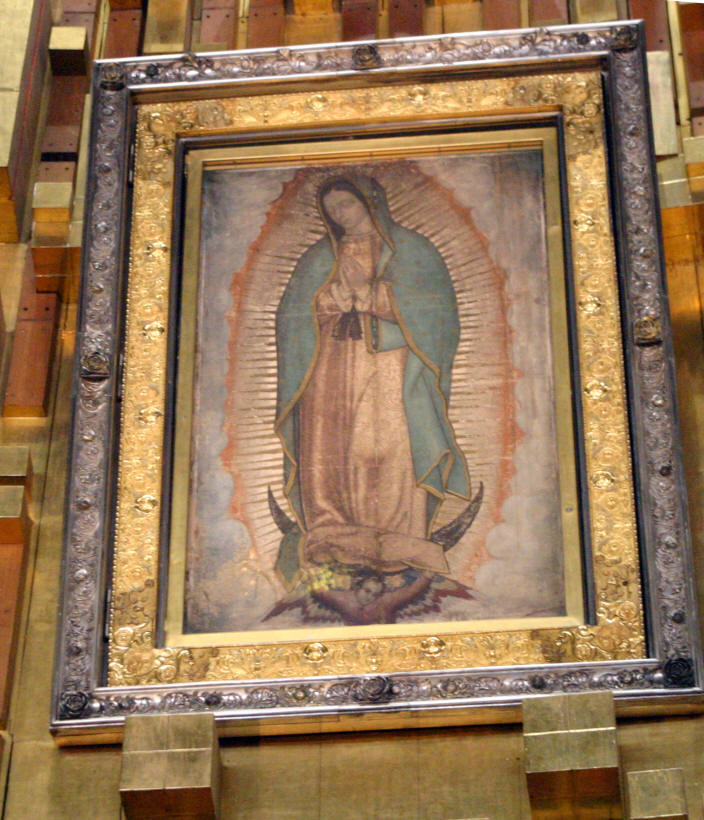
The image of Our Lady of Guadalupe was miraculously imprinted by Mary on the tilma, or cloak, of St. Juan Diego in 1531. The image has numerous unexplainable phenomena, such as the appearance on Mary’s eyes of those present in the room when the tilma was opened and the image’s lack of decay.

Mrs. Clinton was received on Thursday at 8:15 a.m. by the rector of the Basilica, Msgr. Diego Monroy.

Msgr. Monroy took Mrs. Clinton to the famous image of Our Lady of Guadalupe, which had been previously lowered from its usual altar for the occasion.

After observing it for a while, Mrs. Clinton asked “who painted it?” to which Msgr. Monroy responded “God!”

Clinton then told Msgr. Monroy that she had previously visited the old Basilica in 1979, when the new one was still under construction.

After placing a bouquet of white flowers by the image, Mrs. Clinton went to the quemador –the open air area at the Basilica where the faithful light candles- and lit a green candle.

Leaving the basilica half an hour later, Mrs. Clinton told some of the Mexicans gathered outside to greet her, “you have a marvelous virgin!”

This evening Secretary of State Hillary Clinton is set to receive the highest award given by Planned Parenthood Federation of America -- the Margaret Sanger Award, named for the organization's founder, a noted eugenicist. The award will be presented at a gala event in Houston, Texas.

Tuesday, July 29, 2008

Archbishop Burke to dedicate new national shrine for Our Lady of Guadalupe

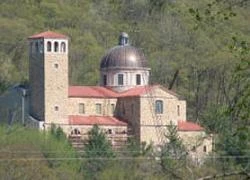
.- Archbishop Raymond Burke is flying back from Rome to dedicate the new Shrine of Our Lady of Guadalupe this coming Thursday, the sixth anniversary of the canonization of Guadalupe visionary St. Juan Diego. The shrine, near the western Wisconsin town of La Salle, is to be a pilgrimage destination for the faithful where they can show their devotion to the Virgin Mary under her title Patroness of the Americas.

Shrine project architect Michael Swinghamer told the Milwaukee Journal Sentinel that the church is in the style of 17th-century Italianate Renaissance design. Its interior seats 450 and features Italian artwork, a 54-rank organ, Italian marble, and a mosaic of Our Lady of Guadalupe positioned behind a marble-columned canopy over the altar.

The turquoise dome bears stars in the pattern of the night sky near Mexico City in 1531, when the Virgin Mary is said to have appeared to Juan Diego. The turquoise is the same color as Mary’s mantle in the miraculous image made on Juan Diego’s cloak, which is known as a tilma.

The church’s exterior includes a tower with a 25-bell carillon and a plaza with a duplicate of the bronze statue of Juan Diego at the Basilica of Guadalupe in Mexico. The church itself sits high on a hill on a 103-acre site, which also has shaded, wooded walks among outdoor artwork pieces.

“In the tradition of pilgrimage churches, the shrine is located high upon a hill outside of the city with a campanile and dome which will be visible from afar,” said Duncan Stroik, a South Bend, Indiana church architect who worked with Swinghamer.

Archbishop Burke, who was then Bishop of La Crosse, announced plans for the project in 1999.

"Because of the loss of hope in our time and the immensity of the moral difficulties which we face, there is a great desire for a place of pilgrimage in which faith and hope can be renewed," he said at the time.

Dave Clements, executive director of the La Crosse Area Convention and Visitors Bureau, estimated that the shrine had more than 50,000 visitors last year and should get 75,000 to 100,000 visitors in 2008.
He told the Milwaukee Journal Sentinel that the shrine could top 200,000 visitors in 2010, estimating that pilgrims could bring anywhere from $6 to $10 million in income for area businesses.

Visitors to the shrine last week found some portions closed in preparation for the dedication, but were still positive.

"What we could see, I was in awe," said Iowan Linda Miller. "It's very inspirational."

Duncan Stroik, who is the director of the Institute for Sacred Architecture and an associate professor of architecture at the University of Notre Dame, described the shrine to CNA as “a very devotional building, a place for the liturgy, a place for the sacraments,” noting its three confessionals and ten shrines to different saints.

“More than a parish church, it’s a place for people to come and pray, or light a candle, or recite a rosary with their children, not necessarily just a place for the liturgy,” he continued.

The main focus of the building, Stroik explained, is upon the nave and the tabernacle to create a “crescendo” unifying the Eucharist, the liturgy, the image of the Crucifixion of Christ, and the image of the Blessed Virgin. The architects had to “develop an interior which leads your eye to the sanctuary, and in the sanctuary it all comes together.”

According to Stroik, Archbishop Burke wanted to emphasize the image of Our Lady of Guadalupe as a main focus in the church, like it is the Basilica of Guadalupe in Mexico City.

“People would see it immediately and know the focus is on the story of the Virgin and Juan Diego,” he said.

Stroik told CNA that the image of Our Lady of Guadalupe is not a photographic reproduction of the tilma, but rather a mosaic based on a very high-quality resolution photo of the original tilma.

“It allows people to see it’s the image of the tilma and not the tilma itself,” he explained.

One of the challenges of the project, according to Stroik, was to build something that was “grand and monumental” for a church that was not very large.

Stroik said that the land surrounding the shrine was “a beautiful but very steep site.” Planners, including Archbishop Burke, wanted pilgrims to “go up to house of the Lord” like the “great churches of the hill towns in Italy.” However, these aims limited the possibilities for construction.

“It was a labor of love,” Stroik concluded. “It’s been almost seven years in coming, and we’ve used artists and craftsmen from around the world.”

“It has been a great pleasure.”