Monday, September 22, 2014
The Generosity of God
By Marcellino D'Ambrosio, Ph.D.
(The Crossroads Initiative) “But that’s not fair!” Most parents have heard this phrase umpteen times. The notion of fairness also known as justice, is built into us. It makes us aware that each of us has certain rights that need to be respected.
But it also means that we each have duties. If others have the right to be paid for their work, those who benefit from that work have the duty to pay them. If others have the right to life, liberty, and the pursuit of happiness, we have the duty not to let our pursuit of happiness infringe on their rights.
But we have to widen our perspective a bit. God, the creator of all, is responsible for all the blessings we enjoy. Life in this world was given to each of us as an undeserved, free gift. We have unequal physical talents, features, and abilities, plus diverse spiritual and intellectual gifts as well. They vary a lot from person to person, but what they all have in common is that they come as free gifts from God who didn’t have to create any of us.
This is the necessary background to fully understand a parable that at first shocks our sensibilities. Matthew (20:1-16) records a story of an employer who hires workmen to harvest grapes. He hires members of the crew at various times of the day, so that at the end of the day, some have only worked a few hours while others have worked all day long. There’s grumbling when everyone is paid the same standard day’s wage, regardless of how long they worked. To add insult to injury, those who started last got paid first. “No fair!”
Wait a minute. The master paid those who worked all day exactly what he told them they’d get. He just decided to be generous and pay everybody, even the latecomers, a full day’s wage. Justice does not preclude generosity.
The Pharisees thought that they had always done the will of God and deserved more than the rest, especially the rabble Jesus appeared to favor–including tax collectors and sinners. It roiled them to think that these Johnny-come-lately’s would sit along them in the Kingdom of God.
Truth be told, neither they, nor any of us, are really like the folks who consistently did the will of the Master, working uninterruptedly at the assigned task. Our assigned job is to love the Lord our God with ALL our heart, ALL our soul, and ALL of our strength (Deut 6:4-5) every day of our life. This is only fair since we owe God absolutely everything. But we’ve all unfairly walked off the job at various moments–thumbing our noses at him through our disobedience, pride, and selfishness. Some have gone AWOL longer than others, and some’s sins are more spectacular than others. But the bottom line is that, in terms of strict justice, God does not owe any of us anything except, perhaps, punishment.
But in his extraordinary generosity, the Lord has offered us a deal–if we will accept His beloved Son in faith as Savior and Lord, and through the power of the Spirit seek to do His will, and if we will repent each time we fail, He will give us what we do not deserve–friendship with Him here that opens out to eternal glory hereafter. The first takers for this offer have typically been those most aware of their need for mercy. And this is why the last have usually been first when it comes to the Kingdom of God.
Seems fair to me.
Link:
Friday, October 5, 2012
Marriage and Family: All You Need is Love
By Dr. Marcellino D'Ambrosio
Is annulment just a Catholic Divorce? This article explains the unpopular Roman Catholic position on marital intimacy, divorce, remarriage, and the meaning of a decree of nullity.
(The Crossroads Initiative) The Beatles wrote a song that was the sensation of 1967, “All you need is love.” This the same point made a few years earlier by an ecumenical council of the Catholic Church.
Gadium et Spes 24, Vatican II’s Constitution on the Church in the Modern World, says this: God is Trinity, a communion of persons who pour themselves out in love to one another from all eternity. If we human beings are made in the image and likeness of God, then we are clearly designed for love. In fact, we really can’t find ourselves without giving ourselves in love sincerely and completely.
That’s also the central point of this Sunday’s readings. Genesis 2 shows Adam in paradise, surrounded by splendor and comfort, but nevertheless unfulfilled. God creates the animals as companions. He can enjoy their company and be their loving master. But he cannot have communion, true fellowship, with them.
So God fashions woman from his own flesh. When he wakes up and sees her, he is thrilled. In every way, she is a perfect fit–in body, soul, and spirit. She complements and completes him. But she is not created as a commodity for his use, much less a disposable one to be used and discarded. The love that makes us like God is a communion that is the fruit not of taking, but of giving. And it is not about partial giving, but giving of one’s entire self.
Now one of the characteristics of human beings is that we have a future. Total self-giving means giving ourselves not only in the present moment, but giving our entire future as well. For this reason, the relationship of authentic marriage founded on true love, has to be “till death do us part.” This is why Jesus, in this Sunday’s gospel, is so uncompromising on this point, and why the Catholic Church to this day maintains the Lord’s unpopular position against divorce and remarriage.
Ah, but what about that “Catholic Divorce” known as annulment? A decree of nullity is not “Catholic divorce.” Divorce means the splitting apart of those who have become one body and one spirit. But what makes a man and woman one flesh and one spirit is not a ceremony presided over by judge or priest. It is the sincere gift of self on the part of both parties that is free, total, exclusive, permanent, and open to a further act of self-giving love called parenthood. A decree of nullity means that, after an extensive investigation by Church authorities, it has been discovered that despite the ceremony, something essential was lacking in the gift of self of one or both of the spouses and therefore the bond was not forged.
It could be that one or the other of the spouses did not intend this union to be “till death do us part,” but rather “till it becomes inconvenient.” Or it could also be because one or the other never intended to accept children lovingly from God and planned from the outset to use every means to thwart such fruitfulness. Such an arrangement is not marriage, in the biblical and Catholic meaning of the term, despite what society thinks.
But here’s another question–if we are made for love, and Adam was incomplete until he found fulfillment in marriage, then what does that say about those who never marry? Are they doomed to unhappiness and a life that is not fully human?
Far from it. The Lord Jesus was the perfect man and, Da Vinci Code fantasy aside, was never married. He poured himself out in suffering love “till death do us part.”
Many follow in his footsteps in consecrated celibacy. Others follow in his footsteps in a more hidden way, without canonical vows, but quietly and tirelessly giving of themselves to family, friends, patients, clients, and those in need who come to them.
The Beatles were right. Love is all you need. But, though God created marital intimacy and called it good, the essence of love is not romance but rather self-giving.
Link:
Monday, February 13, 2012
Lessons from the Leper
(The Crossroads Initiative) Catholics are often confused about suffering. Some writers extol its surpassing value. But does that mean that we should look for suffering? Or, if suffering should come our way, that it would be unspiritual to seek relief from it?The story of Jesus and the leper in Mark 1:40-45 provides us with a case study on the subject. In biblical times, “leprosy” encompassed many different skin diseases. We don’t know what kind of leprosy the man had, exactly. It could have been Hansen’s disease, which is what we call leprosy today. In that case, he would not have been in a lot of physical pain, since this disease takes away one’s ability to feel much of anything in many parts of the body. This, in fact is one of the problems with the disease. Pain actually is supposed to be a gift from God–it tells us that there is something wrong that we must attend to before it gets worse. Without this unpleasant sensation we might be tempted, for example, to ignore an infection or continue to put stress on an overworked muscle that desperately needs a rest. The consequence can be permanent damage to the organ in question, and this is why lepers are often horribly disfigured, with missing digits and extremities. This hideous appearance causes the leper further suffering.
But regardless of what kind of leprosy the man had, there is yet another kind of suffering experienced by all lepers in ancient Israel. Leviticus 13 tells us that, to guard against infecting others, lepers had to isolate themselves from the rest of society, living as outside city limits, obliged to warn all who approached them that they were “unclean.”
So the leper asked Jesus to rid him of his despicable disease, with all it ugly consequences. Jesus promptly healed him. He did this not to prove he was a prophet, the messiah, indeed, the Son of God. In fact, he gave the man strict orders not to broadcast the news of the miracle. Jesus healed him, instead, out of compassion. It was a work of mercy, which is loves response to suffering. Notice Jesus did not scold him for wanting to be relieved of the suffering associated with this dreadful disease. He had the power to free him from it and so he did.
So there are at least two lessons here–it’s OK to seek relief from suffering and, should we encounter it in others, we must do all we can to relieve it.
But there is more. Jesus took away one source of suffering but imposed another. The former leper was understandably thrilled at his change of fortune and passionately wanted to tell everyone about it. Jesus commanded him to restrain his passion and be quiet. This by the way, was for the good of others–to make it possible for Jesus to move freely through the towns of Galilee preaching the gospel and revealing his identity in his own way and according to his own timetable.
But the leper would not accept the discipline imposed upon him by the Son of God, and the result was that from that point on it was Jesus, instead of the leper, who had to stay out in the wilderness, away from the towns.
We need not go looking for suffering. It will inevitably find us. Generally, we should seek relief from many forms of suffering, such as physical illness. But as long as we find suffering to be our traveling companion, we should bear it with as much joy and faith as possible in the name of the Lord, who suffered for us, joining our suffering to His for the redemption of the world. This is what St. Paul says – whatever we do, and whatever we have to endure, we must do for the glory of God and the salvation of all (I Cor 10:31-33).
Thursday, September 9, 2010
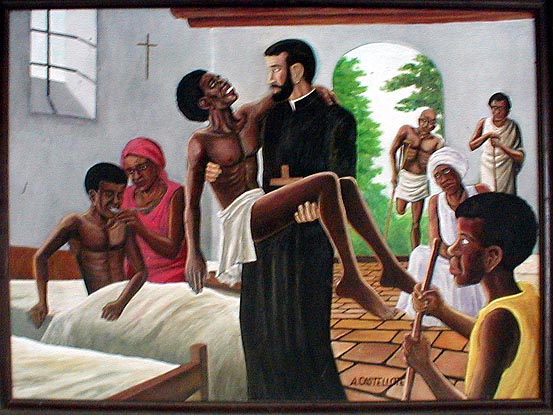
Saint Peter Claver's Ministry to African Slaves

"Yesterday, May 30, 1627, on the feast of the Most Holy Trinity, numerous blacks, brought from the rivers of Africa, disembarked from a large ship. Carrying two baskets of oranges, lemons, sweet biscuits, and I know not what else, we hurried toward them. When we approached their quarters, we thought we were entering another Guinea. We had to force our way through the crowd until we reached the sick. Large numbers of the sick were lying on wet ground or rather in puddles of mud. To prevent excessive dampness, someone had thought of building up a mound with a mixture of tiles and broken pieces of bricks. This, then, was their couch, a very uncomfortable one not only for that reason, but especially because they were naked, without any clothing to protect them.
We lad aside our cloaks, therefore, and brought from a warehouse whatever was handy to build a platform. In that way we covered a space to which we at last transferred the sick, by forcing a passage through bands of slaves. Then we divided the sick into two groups: one group my companion approached with an interpreter, while I addressed the other group. There were two blacks, nearer death than life, already cold, whose pulse could scarcely be detected. With the help of a tile we pulled some live coals together and placed them in the middle near the dying men. Into this fire we tossed aromatics. Of these we had two wallets full, and we used them all up on this occasion. Then, using our own cloaks, for they had nothing of this sort, and to ask the owners for others would have been a waste of words, we provided for them a smoke treatment, by which they seemed to recover their warmth and the breath of life. The joy in their eyes as they looked at us was something to see.
This was how we spoke to them, not with words but with our hands and our actions. And in fact, convinced as they were that they had been brought here to be eaten, any other language would have proved utterly useless. Then we sat, or rather knelt, beside them and bathed their faces and bodies with wine. We made every effort to encourage them with friendly gestures and displayed in their presence the emotions which somehow naturally tend to hearten the sick.
After this we began an elementary instruction about baptism, that is, the wonderful effects of the sacrament on body and soul. When by their answers to our questions they showed that they had sufficiently understood this, we went on to a more extensive instruction, namely, about the one God, who rewards and punishes each one according to his merit, and the rest. We asked them to make an act of contrition and to manifest their detestation of their sins. Finally, when they appeared sufficiently prepared, we declared to them the mysteries of the Trinity, the Incarnation and the Passion. Showing them Christ fastened to the cross, as he is depicted on the baptismal font on which streams of blood flow down from his wounds, we led them in reciting an act of contrition in their own language."
For more Catholic resources to feed your faith, visit the Crossroads Initiative Homepage.
Friday, July 10, 2009
Miracles Jesus Couldn’t Do
Over the last two Sundays, the gospel of Mark has been making it abundantly clear that Jesus is indeed God Almighty, ruler of the world and lord over life and death.
But this week we come to a story that leaves us scratching our heads. Jesus goes to his own native place, and receives less than an jubilant reception. “They found him too much for them.” That may not be so surprising to those of us accustomed to family life. But what does come as a shock are these words: “He could work no miracle there . . . so much did their lack of faith distress him.”
Wait a minute. I thought that Jesus was God and therefore omnipotent. Wouldn’t it be admitting that he is not God to say that he was unable to work miracles in a given place?
Hardly. God’s exercises his power only in a way befitting his nature. God is a lover, not a rapist. He seeks to give his love to those who freely accept it and open their hearts to him. He refuses to violate the wishes of those whom he has created in his image and likeness, who possess intellect and free will. He directly controls the wind and the waves through a word of simple command, for wind and waves are inanimate forces. But with regards to human beings, he makes himself available and waits for an invitation. That invitation whereby we ask him to come into our lives and calm our interior storms is called faith.
Faith is not, therefore, an emotion. It is not about an inner assurance, a feeling of confidence that is free of all shadow of doubt or fear. It is rather a decision, sometimes made with knees knocking. It is a yes that gives God permission to work in our lives and rearrange the furniture if he so chooses. That means blessing, healing, salvation and miracles. But it also means yielding to his will, his plan, his timetable. And of course, that is the part we don’t like. What will others think of me? Will I still be able to spend Saturday nights the way I’ve always spent them? I work hard for a living and deserve to be able to blow off some steam! Will I still be able to hang out with Joe, to live with Mary?
Sometimes we are not really happy with the way things are, but at least they are familiar. We know what to expect. We are in control, or at least we think we are. Faith means handing over control, and that scares us. We are free to say no, and quite frankly we often do. Sometimes we say no in small ways–we only let God take us so far. Sometimes it’s a very firm “no”, that shuts God completely out of our lives.
This is the sort of “no” that Jesus encountered during his visit to Nazareth, and which the prophets before him often encountered from the people of Israel.
So if Jesus was divine and therefore all-knowing, why did he bother to go to Nazareth at all? For the same reason that God sent Ezekiel to the Israelites and told him in advance that they’d resist. The Lord wanted to take away all excuses. God loved his people enough to offer them every opportunity for the healing and deliverance that they prayed for. He called their bluff, so to speak. Jerusalem pleaded for deliverance from the Babylonians and the people of Nazareth probably prayed for healing for Uncle Jacob or food for the town orphans. But in both cases when God showed up, ready to pour out his gifts, they didn’t like the packaging and rejected the terms.
At the last judgment, when our lives flash before our eyes, we’ll be reminded of the times that God made a house call and we slammed the door in his face. I say it’s time to apologize, unbolt the door, and roll out the red carpet.