Showing posts with label Henry VIII. Show all posts

Thursday, March 1, 2012

Henry VIII's Nobles Threatened Pope Clement VII Over Annulment

Secret letter from Vatican archives unveiled

By Nick Squires, Daily Telegraph
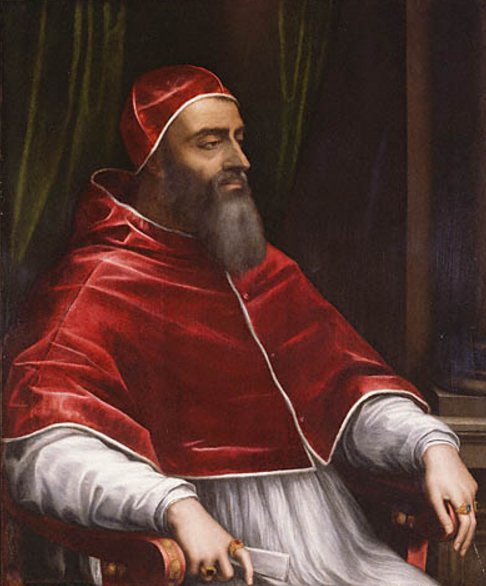
File:Clement VII. Sebastiano del Piombo. c.1531..jpg(Vancouver Sun) English nobles threatened "extreme remedies" against the Roman Catholic Church unless the Pope annulled Henry VIII's marriage to Catherine of Aragon, a letter from the Vatican Secret Archives discloses.

The nine-metre wide parchment, with 81 wax seals and red silk ribbons, made public for the first time this week, was sent on Henry's orders to Pope Clement VII in 1530. It was signed by members of the English Parliament, bishops, abbots and the archbishops of York and Canterbury.

They urged the Pope to annul the king's marriage to Catherine so that he could marry Anne Boleyn, one of her ladies-in-waiting, in the hope of producing a male heir. "If the Pope is unwilling, we are left to find a remedy elsewhere. Some remedies are extreme, but a sick man seeks relief in any way he can find," the lords wrote in a barely veiled threat.

The letter is one of the highlights of an exhibition of 100 documents chronicling more than 1,200 years of the Vatican's dealings with kings, conquerors and caliphates.

Henry had fallen in love with Boleyn in 1526 and was desperate for his first marriage to be annulled - a struggle that he referred to as his "great matter."

He married Boleyn in 1533 but Clement VII declared the union invalid and five years later the king was excommunicated. The confrontation led to a split from the Catholic Church and fuelled the English Reformation.

The letter was consigned to the Secret Archives, in a palazzo at the heart of the Vatican City State, but went missing in the late 19th century. It was rediscovered in 1926, hidden in a small chest beneath a chair.
Many of the archive's documents are written in ornate Latin script but other languages include Arabic, Persian and Chippewa - the tongue of a North American Indian tribe that wrote to the Vatican on birch bark in the 19th century.

They include the world's oldest document in Mongolian - an order made in 1279 by a khan granting safe conduct to papal ambassadors.

The exhibition in Rome marks the 400th anniversary of the Secret Archives in their present form - they were established in 1612 by Pope Paul V. They originally comprised just three rooms, but now line more than 55 miles of shelves.

Monsignor Sergio Pagano, the prefect of the Secret Archives, said that the aim of the exhibition was to "shed light on this ancient institution."

Wednesday, May 13, 2009

Vatican Reveals Letter on Henry VIII’s Papal Plea

Published: May 12, 2009

The Vatican has opened its secret archives, the repository of centuries worth of documents pertaining to the Holy See, to let the world get a closer look at a document presaging England’s split from the Church of Rome. Dated July 13, 1530, and addressed to Pope Clement VII, the letter, right, asks for the annulment of Henry VIII’s marriage to Catherine of Aragon and includes the seals of dozens of peers of England who concurred with the request. A reproduction of the document will go on sale next month for about $68,000 from the Venice-based publisher Scrinium, which plans a limited run of 199 copies. A second, more damaged copy of the document is in England, at the National Archives in Kew. The reproduction and accompanying scholarly texts will allow for closer perusal of “the cause of Henry VIII,” Monsignor Sergio Pagano, the Vatican archive’s prefect, told journalists on Tuesday. It will be officially presented in June, on the occasion of the 500th anniversary of Henry’s coronation, but the timing is a coincidence, Monsignor Pagano said. “We do not celebrate kings, only popes.”

__________________________________________________

ADDRESS OF THE PEERS OF ENGLAND TO POPE CLEMENT VII
ASKING FOR THE ANNULMENT OF KING HENRY VIII’S MARRIAGE
[ex Anglia], 1530 July 13th


Parchment, mm 950x458; open envelope on which (dark red) ribbons are sewn, bearing 85 seals of just as many signers of the document. The seals, in red wax, nearly all navette-shaped, are contained in tin caskets.
ASV, A. A., Arm. I‑XVIII, 4098 A (XC); detail of the seals (XCI)

Whatever the remote cause of the Anglican schism, there is no doubt that the most immediate and determining cause was Henry VIII’s (1509-1547) wish to get rid of his legitimate wife, Catherine of Aragon, daughter of Ferdinand and Isabella of Spain and aunt of the future emperor Charles V, in order to get married with Anne Boleyn, lady-in-waiting, who wanted to belong to him only as a wife. The sovereign did not hide his intentions and was ready to take any decision in order to achieve his aim. In fact, in 1527, Henry VIII undertook some initiatives with the local archbishops and with the papal legate, Cardinal Wolsey, so that the cause of nullity of the sovereign’s marriage with Catherine of Aragon (who had given birth to 6 children, of whom only Mary Tudor survived) was dealt with in England, where it was easy for the King to exercise his pressure. This was by no means allowed by the Pontiff, who moved the trial of the case to Rome.

Due to the delicate implications the case implied, both for its juridical nature and for the ecclesiastic policy, Clement VII took time before pronouncing a sentence. And during this difficult situation the King and his ministers never ceased to put pressure on Rome, so that the issue could be quickly resolved. Also the Peers of England, all together, acted in favour of the sovereign and with the present document – in an intentionally solemn form – in 1530 asked the Pope to put an end to their long wait and to that of the entire English Nation.

Their request has an urging nature, and is definitely not a plea for the annulment, which they take for granted, considering the favourable opinion already given by the English, French and Italian scholars, as well as the benevolence always shown by the King towards the Holy See (from line 5: Sufficere sane alioquin debuisset causae ipsius iusticia eruditissimorum virorum calculis passim probata celeberimarum academiarum suffragiis iudicata ab Anglis, a Gallis, ab Italis prout quisque apud eos ceteros eruditione antecellit pronunciata et diffinita ut Sanctitas Vestra, etiam nemine petente et reclamantibus quibuscumque, suo ore suaque auctoritate aliorum sentencias confirmaret, presertim cum causae diffinicio eum regem, illud regnum respiciat, quod de Sede illa Apostolica tam multis nominibus benemeritum sit). At the end of the text, the Peers declare their intention to agree with the Pontiff whatever his sentence may be (third last line: Interim vero Deum Optimum Maximum, quem ipsam esse veritatem certissimo testimonio cognoscimus, comprecabimur, ut Sanctitatis Vestre consilia ita informare atque dirigere dignetur, ut quod sanctum, iustum ac verum est a Vestre Sanctitatis auctoritate obtinentes, ab omni alia assequende veritatis molestia liberemur). It is well-know that the Pope then declared legitimate Henry VIII’s marriage with Catherine of Aragon, and therefore indissoluble, and how the sovereign, hindered from carrying out his plans, got married again and declared the separation of the Church of England from the Church of Rome (the Anglican schism).

Saturday, April 4, 2009

'Exciting discovery' reveals Henry VIII as firm believer in Catholicism

Henry VIII, known as the scourge of the Catholic church, has been revealed as having been a firm believer in the religion he later tried to destroy, thanks to a new discovery.

Roya Nikkhah, Arts Correspondent

A prayer roll once belonging to Henry and inscribed with his own handwriting, has been brought to light ahead of a major new exhibition on his life.

It will be shown in public for the first time at the British Library's exhibition Henry VIII: Man and Monarch, which opens later this month and marks the 500th anniversary of Henry's accession to the throne.

The roll, which is around 13 feet long and 5 inches wide, is made of narrow strips of parchment stitched together.

It bears Henry's official badge of arms and the Tudor rose, and is decorated with a series of illuminations including the Trinity, the Crucifixion and scenes from Christ's Passion.

Under the central image of Christ's Passion is an inscription written by Henry, which reads: "Willyam Thomas, I pray yow pray for me your lovyng master: Prynce Henry."

The roll is also inscribed with Latin prayers and rubrics, or religious instructions, explaining how the devotions are to be performed and what rewards the faithful might expect, such as remission of time in Purgatory and protection against illness.

It is believed that the teenage Henry gave the roll to William Thomas, one of his personal servants in his Privy Chamber, some time between 1505 and 1509, when Henry was the Prince of Wales...

More