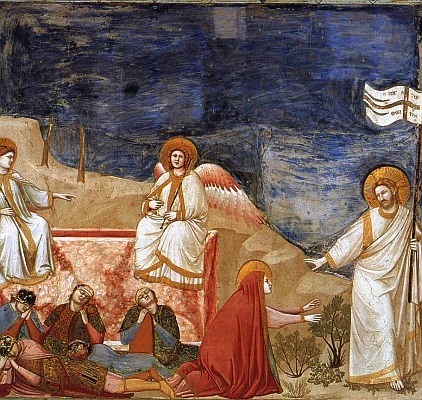
The Temple of Christ's Body is restored; He is risen, alleluia!
Today is the Feast of Feasts!
On this, the holiest day of the entire year, and for the entire Octave of Easter, Latin Catholics greet each other with the words of Luke 24:34, "Surrexit Dominus vere, alleluia!" ("The Lord is risen indeed!"). The person so greeted responds, "Et apparuit Simoni, alleluia!" ("And hath appeared unto Simon!"). Catholics may even answer their telephones with this greeting. An old Ukrainian legend relates that, after His Resurrection, Christ threw Satan into a deep pit, chaining him with twelve iron chains. When Satan has chewed through each of the twelve chains, the end of the world will come. All year long, the Evil One gnaws at the iron, getting to the last link in the last chain -- but too late, for it is Easter, and when the people cry "Christ is risen!" all of Satan's efforts are reversed. When the faithful stop saying the Easter acclamation, the end of time has come...
Throughout the entire Easter Season, the Angelus prayer that is offered, when possible, at the ringing of the Angelus bells, is replaced by the joyous Regina Coeli, which begins, "Queen of Heaven rejoice, alleluia: For He whom you merited to bear, alleluia, Has risen as He said, alleluia."
On this most beautiful of Feasts, the Easter table should be adorned with the best of everything -- the most beautiful china, a pure, white tablecloth, the best possible wine, flowers (especially pussy willow, lilies, and spring bulb flowers), etc., all with the colors white and gold -- symbolizing purity and glory -- and the traditional symbols of Easter predominating. And we should look our best, too; it is common for those who can afford it to buy a new outfit to wear on this day. This custom springs from the idea of "newness" inherent in the entire Season -- the new members of the Church baptized at the Vigil in their new Baptismal albs, the New Law, a new life in Christ.
The Paschal Candle representing the Light of Christ (Lumen Christi) is the centerpiece of the table today and, like the Paschal Candle at church, is relit each day (such as at dinner and during family prayer) until the Feast of the Ascension in 40 days when the Light of the World leaves us to ascend to His Father. The candle should be large and white, and should be surrounded with flowers and the symbols of Easter. It can be carved with the Cross and the numbers for the current year as the church's Paschal Candle was yesterday -- first the Cross, then the Greek letters, then the numbers of the current year as in the diagram below. The cuts can be painted to make them stand out (try gold or deep red paint), and 5 grains of incense can be inserted at the ends and center of the Cross to symbolize the 5 Wounds (some people use cloves in place of incense at home, but if you have 5 grains of incense blessed on the Feast of the Epiphany, all the better) . The words to pray when making the cuts: 1 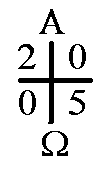
| While cutting the vertical branch of the Cross: | | Christus heri et hódie | Christ yesterday and today. | | While cutting the horizontal branch of the Cross: | | Princípium et Finis, | the Beginning and the End, | | While cutting the Greek letters: | | Alpha et Omega. | Alpha and Omega. | | While cutting the millenial figure of the year at the upper left quadrant: | | Ipsíus sunt témpora | His are the times | | While cutting the second figure of the year in the upper right quadrant: | | et sæcula. | and ages. | | When cutting the decade figure of the year in the lower left quadrant: | | Ipsi glória et impérium | To Him be glory and dominion | | When cutting the last figure of the year in the lower right quadrant: | | per univérsa æternitátis sæcula. Amen. | through all ages of eternity. Amen | | When inserting incense for the First Wound: | | Per sua sancta vúlnera | By His holy | | When inserting incense for the Second Wound: | | gloriósa | and glorious wounds | | When inserting incense for the Third Wound: | | custódiat | may He guard | | When inserting incense for the Fourth Wound: | | et consérvet nos | and preserve us, | | When inserting incense for the Fifth Wound: | | Christus Dóminus. Amen. | Christ the Lord. Amen. | | As the candle is lit: | | Lumen Christi glorióse resurgéntis díssipet ténebras cordis et mentis. | May the light of Christ in glory rising again dispel the darkness of heart and mind. |
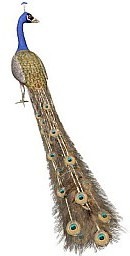
It was once believed that the flesh of the peacock never corrupts, so peacocks became the classic symbol of immortality. They are an ancient Christian symbol of the Resurrection, and representations of them are found on the tombs of ancient Christians as an expression of their hope to follow Christ in His defeat of death.
Bells are another lovely symbol for the day as they are said to have gone to Rome on Maundy Thursday only to have started returning home at last evening's Easter Vigil to ring joyfully (in France and Belgium, it is these bells, not the Easter bunny, that bring the Easter eggs -- see below).
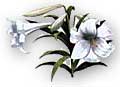
In the United States, the most common symbol of that glorious resurrection for the entire Easter Season is the lily (lilium longiflorum). Jesus loved lilies!:
 | Luke 12:27
Consider the lilies, how they grow: they labour not, neither do they spin. But I say to you, not even Solomon in all his glory was clothed like one of these. | The lily represents purity, chastity, innocence, and St. Gabriel's trumpet, and is a symbol of Our Lady and used to depict the purity of the Saints, especially SS. Joseph, Francis, Clare, Anthony of Padua, and Catherine of Siena. In America, it has become, too, a symbol of the Resurrection. Legend says that lilies originated with Eve's tears when the first couple was banished from the Garden of Eden. Other legend says that they sprang up from the ground when drops of blood fell to the foot of the Cross. It is interesting that these two legends exist, because Christ, the New Adam, wipes away the tears of the children of Eve who became the children of Mary when Christ gave her to us, through John, from the Cross. Mary herself is symbolized also by another lily, lilium candidum, or the Madonna Lily (or "Annunciation Lily").2
 Butterflies, too, are an apt symbol of the day's meaning. Beginning life as lowly humble caterpillars, they "entomb" themselves in cocoons only to emerge with jewel-colored wings and the ability to soar. What better symbol of the Resurrection -- except maybe for eggs, which had always been symbols of Spring and were items of wonderment to all -- an inanimate object out of which comes life. For Christians, they became the perfect symbol of the tomb Christ conquered, and Jews used (and used) them on their Passover, too, as the Haggadot specifically calls for it as a symbol of rebirth (this is a rabbinical command, not a Scriptural one). 3 Butterflies, too, are an apt symbol of the day's meaning. Beginning life as lowly humble caterpillars, they "entomb" themselves in cocoons only to emerge with jewel-colored wings and the ability to soar. What better symbol of the Resurrection -- except maybe for eggs, which had always been symbols of Spring and were items of wonderment to all -- an inanimate object out of which comes life. For Christians, they became the perfect symbol of the tomb Christ conquered, and Jews used (and used) them on their Passover, too, as the Haggadot specifically calls for it as a symbol of rebirth (this is a rabbinical command, not a Scriptural one). 3
Another level of symbolism is that the egg represents birth, the Creation, the elements, and the world itself, with the shell representing the firmament, the vault of the sky where the fiery stars lie; the thin membrane symbolizing air; the white symbolizing the waters; and the yolk representing earth. Painted red, eggs are a demonstration that the salvation and re-birth of the world comes through Christ's Blood and Resurrection. Old legend has it that St. Mary Magdalen went to Rome and met with the Emperor Tiberius to tell him about the Resurrection of Jesus. She held out an egg to him as a symbol of this, and he scoffed, saying that a man could no more rise from the dead than that egg that she held could turn scarlet. The egg turned deep red in her hands, and this is the origin of Easter eggs, and the reason why Mary Magdalen is often portrayed holding a scarlet egg. 
|
Because of this legend and all of the egg's symbolism, and because eggs are special because they were once forbidden during Lent, Christians make great use of them on this day, eating them, decorating them, and decorating with them. Red is the classic color to use when dying eggs to be eaten, but other colors are more often used these days (pastels being the most 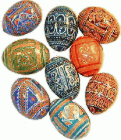 common in the United States). Eggs used only for decorative purposes may have their contents blown out and their shells turned into highly ornamental works of art ("Longshanks" -- King Edward I of England, 1239-1307 -- paid to have 450 eggs decorated with gold leaf to give out to the members of his household). Or the "eggs" may be wooden or ceramic and used to adorn the Easter table. The exquisite pysanky of Eastern Europe, made by subsequent applications of wax and dipping in dyes, are one of Easter's treasures, and the forty-nine ceramic, bejewelled eggs created -- only one or two each year at Eastertime -- for the Russian royal family by master jeweller, Peter Carl Fabergé (1846-1920), are museum pieces.
Easter eggs that are to be eaten may be blessed by the priest (sometimes on Holy Saturday with the rest of the Easter foods brought to church in a basket, or sometimes after the liturgy today) with the following blessing from the Roman Ritual:
| P: Adjutorium nostrum in nomine Domini | | P. Our help is in the Name of the Lord |
| R: Qui fecit caelum et terra. |
| R. Who made Heaven and earth |
| P: Dominus vobiscum. |
| P. The Lord be with you. |
| R: Et cum spiritu tuo. |
| R. And with thy spirit. |
| Subveniat, quaesumus Domine, tuae benedictionis + gratia, huic Ovorum creaturae: ut cibus salubris fiat fidelibus tuis, in tuarum gratiarum actione sumentibus, ob resurrectionem Domini nostri Jesu Christi, qui tecum vivit et regnat in saecula saeculorum. Amen. |
| May the grace of Thy blessing, we beseech Thee, O Lord, + come upon these eggs, that they may become a wholesome food for Thy faithful, who gratefully receive them in honor of the Resurrection of our Lord Jesus Christ, who liveth and reigneth unto endless ages. Amen. |
There is yet another tradition involving Easter eggs: at the dinner table, each family member has his own egg. The first person turns to the person next to him and they strike their eggs against each other. When hitting the eggs together, the eggs can only touch rounded end to rounded end; they can't make contact from the side. The person whose egg cracks, which symbolizes the breaking open of Christ's tomb, yells the Easter greeting mentioned above, "Surrexit Dominus vere, alleluia!" ("The Lord is risen indeed!"). The person with the intact egg responds, "Et apparuit Simoni, alleluia!" ("And hath appeared unto Simon!") and then goes to the next person and repeats the egg smashing. And so it goes around the table, with the survivor of each round turning to the next person in line and trying to crack his next opponent's egg. If your egg cracks, you're out. The person who remains at the end with the intact egg will be blessed for the year.
For another great Easter egg idea, see this page on "Confetti Eggs ("Cascarones")." And now for a basic method of making dyed eggs:
Red Easter Eggs
Uncooked, older eggs (not large or jumbo-sized)
Pinch of salt
Hot water to cover by an inch
Red Easter (Pasch) egg dye from a Greek grocery
Olive oil
A few cotton ballsLet the eggs sit out until they are at room temperature, but not for over two hours. With clean hands, set eggs in a large pot of cold water, to which a pinch of salt has been added, so that they're covered by at least an inch of water. Bring to a hard boil, then cover, remove from heat and let sit for 15 minutes (if they are overcooked, they will be rubbery and the yolks will have a green tint). Remove them carefully from the pot and place in ice cold water to cool for a few minutes (this also prevents the greening of the yolk).
Dye according to instructions on dye package, and allow to dry. As soon as they are dry, wipe eggs with an oil-soaked cotton ball, then wipe each egg with a clean dry cloth. Arrange prettily on a platter, or in a bowl or basket and keep in refrigerator. Serve cold, with horseradish and beets. (Note: for boiled eggs, it is best not to use eggs that are too fresh; they always stick to the shell. The larger sized eggs have thinner shells and crack more easily. So, try to use older -- at least 1 week old -- and smaller eggs. Hardboiled eggs keep for 1 week in the refrigerator, but don't leave them at room temperature for more than two hours.)
Each country has its own version of an Easter bread, which, like the eggs, also has its own blessing:
| P: Adjutorium nostrum in nomine Domini |
| P. Our help is in the Name of the Lord |
| R: Qui fecit caelum et terra. |
| R. Who made Heaven and earth |
| P: Dominus vobiscum. |
| P. The Lord be with you. |
| R: Et cum spiritu tuo. |
| R. And with thy spirit. |
| Domine Jesu Christe, panis Angelorum, panis vivus aeternae vitae, benedicere + dignare panem istum, sicut benedixisti quinque panes in deserto: ut omnes ex eo gustantes, inde corporis et animae percipiant sanitatem. Qui vivis et regnas in saecula saeculorum. Amen. | | O Lord Jesus Christ, Bread of the Angels and Living Bread of eternal life, deign to bless + this bread as Thou didst bless the five loaves in the desert: that all who taste it may receive health in body and soul. Thou who livest and reignest unto endless ages. Amen. |
Aside from the Easter eggs and Easter bread, the most traditional Easter foods are those made with all the things once forbidden or restricted during Lent (meats, butter, etc.), but the Easter food of all Easter foods is, of course, lamb, in honor of the Paschal lambs slain by the Israelites and whose blood was painted over their doors so death would pass them by, all prefiguring the Lamb of God Who takes away the sins of the world. Below is a recipe for a Roasted Leg of Lamb:
Roasted Leg of Lamb (serves 8)
1 nine-pound leg of lamb, bone in, trimmed of excess fat
1 tablespoon plus 1/4 teaspoon olive oil
1 1/2 teaspoons salt
1/2 teaspoons freshly ground black pepper
1 medium head garlic
1/4 cup extra-virgin olive oil
1/4 cup fresh lemon juice
1 tablespoon dried oregano
1/4 cup chopped fresh flat-leaf parsley
1 tablespoon all-purpose flour
1/3 cup brandy
1 1/2 cups homemade chicken stock, or canned low-sodium chicken broth, skimmed of fat
1. Let lamb stand at room temperature for one hour. Heat oven to 325° Remove all but a thin layer of fat from the lamb. Rub lamb with 1 tablespoon oil; sprinkle with 1 teaspoon salt and 1/4 teaspoon pepper. Place on a rack in a heavy roasting pan.
2. Meanwhile, rub head of garlic with 1/4 teaspoon oil; wrap loosely in foil. Bake until garlic is very soft, about 1 hour. Let cool.
3. Cut off top of garlic head; squeeze roasted garlic into a bowl. Using a fork, mash garlic to a paste. Add extra-virgin olive oil, lemon juice, oregano, parsley, and remaining 1/4 teaspoon salt and 1/4 teaspoon pepper; mix well.
4. Rotate pan after lamb has roasted 1 1/4 hours. After 30 minutes more, slather lamb with roasted-garlic paste. Roast an additional hour (for a total roasting time of about 2 3/4 hours), or until an instant-read thermometer inserted at the thickest part reads 160°. Remove from oven, and let rest 20 minutes.
5. Transfer lamb to a carving board. Pour off fat from roasting pan; place over medium-high heat. Sprinkle with flour, and stir with a wooden spoon. Pour in brandy; scrape up brown bits from bottom of pan. Lower heat to medium; let liquid reduce by half. Add stock, stirring until incorporated. Add rosemary and salt and pepper to taste.
6. Slice lamb; serve with sauce on the side. (Recipe from Martha Stewart)
 Another Easter folk custom -- one known all over Europe -- is that of watching the sun "dance" in joy for the risen Lord on Easter morning. The sun, already a symbol of Christ, is especially a symbol of Him as it rises and pierces the dawn on Easter Sunday. In the olden days, most people would go to a hilltop in the morning -- at dawn, just as the sun was rising like Christ rising from His tomb -- and wait to see if they could see the spectacle, sometimes watching the reflection of the sun in a lake or in a bucket of water. But a basin of water on an eastward-facing windowsill served (and serves) just as well. Of course, parents might surreptitiously give the basin a tiny shake to cause the waves that make the "miracle" manifest! (And, of course, too, God can well make the sun truly dance without our help!)
Many customs surrounding Easter are totally secular in origin, such as the German egg-laying Easter bunny traditions -- which are fine as long as they don't detract from the Season's meaning or become its focal point. Parents often put out baskets of candy "from the Easter Bunny" for the children to find on Easter morning -- baskets decorated with flowers and ribbons, lined inside with grass, and filled with chocolate bunnies, chocolate eggs, Jordan almonds, jelly beans, and other candies. In any case, here's one recipe to help you fill an Easter basket:
Easter Nests (makes 15) 2 cups butterscotch chips
1 cup peanut butter chips
2 TBSP shortening (not butter, margarine, or oil)
3 cups crunchy Chow Mein noodles
Jelly beans, Jordan almonds, Peanut M&Ms, or other egg-shaped candies
In double boiler or microwave, melt together all the chips and the shortening. Fold in noodles and stir to coat. On waxed paper, using 1/3 cupful of the mixture for each one, form 3-inch nests. Chill for 30 minutes. Place a few of your favorite candies in each nest to appear as eggs. Store airtight in refrigerator. Chocolate chips can be used in place of butterscotch chips for a different flavor and look.
Parents often hold Easter egg hunts for the children, too -- hiding painted eggs around the yard for them to find. One egg is often painted a special color, and the child who finds this one is a winner of the contest as is the child who finds the most number of eggs.
-- but, as said, all of these fun things need to be kept in check so that the focus of the day isn't lost. I strongly, strongly urge your telling your children the story of Moses and the Passover (Exodus 2-12), and their being types of -- their foreshadowing -- Christ and the hope of salvation through the Blood of Christ as evidenced by the Resurrection.
Some, such as the French, attribute the candy to the bells that flew away on Maundy Thursday to return on Easter, bringing candy with them. Children will get up early in the morning to see what sorts of candies the bells have left, looking up to the skies to see if they can catch a glimpse of them flying away first -- only to be told by parents that they're a little too late. An old French lullaby tells the story of the Easter bells:
Do-do-ding, ding dong sleep little man,
Do-do-ding, ding dong,
The bells have gone to Rome.
It is time to sleep,
The bells have flown away.
They have gone to Rome,
Down there, down there, far away, you see,
To visit the Pope, a saintly man,
An old man, dressed in white is he.
The bell of each church
To him secretly speaks
Of all the good little ones,
And he himself le Bon Dieu tells
The name of each good child.
Do-do-ding, ding dong, sleep little man.
And now for a few gorgeous readings for you to read over Easter dinner. The first is a sermon given by St. John Chrysostom (A.D. 347-407); the second was written by Fortunatus, who lived ca. A.D. 530 - 609. Fortunatus was a student at Ravenna, Italy when he became almost blind. He was healed when he annointed his eyes with oil that burned in a lamp before an altar to St. Martin of Tours, for whom he later wrote a lengthy poem (one of his poems, by the way, inspired St. Thomas Aquinas's Pange Lingua). He made a pilgrimage to St. Martin's shrine in Gaul and remained there the rest of his life, becoming a priest, and then Bishop of Poitiers.
You can download these in Microsoft Word .doc format, too: Easter Sermon by St. John Chrysostom (2 pages) and Easter Poem by Venantius Fortunatus (2 pages).
Readings
Easter Sermon
By St. John Chrysostom
Is there anyone who is a devout lover of God? Let them enjoy this beautiful bright festival! Is there anyone who is a grateful servant? Let them rejoice and enter into the joy of their Lord!
Are there any weary with fasting? Let them now receive their wages! If any have toiled from the first hour, let them receive their due reward; If any have come after the third hour, let him with gratitude join in the Feast! And he that arrived after the sixth hour, let him not doubt; for he too shall sustain no loss. And if any delayed until the ninth hour, let him not hesitate; but let him come too. And he who arrived only at the eleventh hour, let him not be afraid by reason of his delay.
For the Lord is gracious and receives the last even as the first. He gives rest to him that comes at the eleventh hour, as well as to him that toiled from the first. To this one He gives, and upon another He bestows. He accepts the works as He greets the endeavor. The deed He honors and the intention He commends.
Let us all enter into the joy of the Lord! First and last alike receive your reward; rich and poor, rejoice together! Sober and slothful, celebrate the day!
You that have kept the fast, and you that have not, rejoice today for the Table is richly laden! Feast royally on it, the calf is a fatted one. Let no one go away hungry. Partake, all, of the cup of faith. Enjoy all the riches of His goodness!
Let no one grieve at his poverty, for the universal kingdom has been revealed. Let no one mourn that he has fallen again and again; for forgiveness has risen from the grave. Let no one fear death, for the Death of our Savior has set us free. He has destroyed it by enduring it.
He destroyed Hades when He descended into it. He put it into an uproar even as it tasted of His flesh. Isaias foretold this when he said, "You, O Hell, have been troubled by encountering Him below."
Hell was in an uproar because it was done away with.
It was in an uproar because it is mocked.
It was in an uproar, for it is destroyed.
It is in an uproar, for it is annihilated.
It is in an uproar, for it is now made captive.
Hell took a body, and discovered God.
It took earth, and encountered Heaven.
It took what it saw, and was overcome by what it did not see.
O death, where is thy sting?
O Hades, where is thy victory?
Christ is Risen, and you, O death, are annihilated!
Christ is Risen, and the evil ones are cast down!
Christ is Risen, and the angels rejoice!
Christ is Risen, and life is liberated!
Christ is Risen, and the tomb is emptied of its dead; for Christ having risen from the dead, is become the first-fruits of those who have fallen asleep.
To Him be Glory and Power forever and ever. Amen!
A Poem on Easter
By Venantius Honorius Clementianus Fortunatus
The seasons blush varied with the flowery, fair weather, and the gate of the pole lies open with greater light. His path in the heaven raises the fire-breathing sun higher, who goes forth on his course, and enters the waters of the ocean. Armed with rays traversing the liquid elements, in this brief night he stretches out the day in a circle. The brilliant firmament puts forth its clear countenance, and the bright stars show their joy. The fruitful earth pours forth its gifts with varied increase, when the year has well returned its vernal riches. Soft beds of violets paint the purple plain; the meadows are green with plants, and the plant shines with its leaves. By degrees gleaming brightness of the flowers comes forth; all the herbs smile with their blossoms. The seed being deposited, the corn springs up far and wide in the fields, promising to be able to overcome the hunger of the husbandman. Having deserted its stem, the vine-shoot bewails its joys; the vine gives water only from the source from which it is wont to give wine. The swelling bud, rising with tender down from the back of its mother, prepares its bosom for bringing forth. Its foliage having been torn off in the wintry season, the verdant grove now renews its leafy shelter. Mingled together, the willow, the fir, the hazel, the osier, the elm, the maple, the walnut, each tree applauds, delightful with its leaves. Hence the bee, about to construct its comb, leaving the hive, humming over the flowers, carries off honey with its leg. The bird which, having closed its song, was dumb, sluggish with the wintry cold, returns to its strains. Hence Philomela attunes her notes with her own instruments, and the air becomes sweeter with the re-echoed melody.
Behold, the favour of the reviving world bears witness that all gifts have returned together with its Lord. For in honour of Christ rising triumphant after His descent to the gloomy Tartarus, the grove on every side with its leaves expresses approval, the plants with their flowers express approval. The light, the heaven, the fields, and the sea duly praise the God ascending above the stars, having crushed the laws of hell. Behold, He who was crucified reigns as God over all things, and all created objects offer prayer to their Creator. Hail, festive day, to be reverenced throughout the world, on which God has conquered hell, and gains the stars! The changes of the year and of the months, the bounteous light of the days, the splendour of the hours, all things with voice applaud. Hence, in honour of you, the wood with its foliage applauds; hence the vine, with its silent shoot, gives thanks. Hence the thickets now resound with the whisper of birds; amidst these the sparrow sings with exuberant love.
O Christ, Thou Saviour of the world, merciful Creator and Redeemer, the only offspring from the Godhead of the Father, flowing in an indescribable manner from the heart of Thy Parent, Thou self-existing Word, and powerful from the mouth of Thy Father, equal to Him, of one mind with Him, His fellow, coeval with the Father, from whom at first the world derived its origin! Thou dost suspend the firmament, Thou heapest together the soil, Thou dost pour forth the seas, by whose government all things which are fixed in their places flourish. Who seeing that the human race was plunged in the depth of misery, that Thou mightest rescue man, didst Thyself also become man: nor wert Thou willing only to be born with a body, but Thou becamest flesh, which endured to be born and to die. Thou dost undergo funeral obsequies, Thyself the author of life and framer of the world, Thou dost enter the path of death, in giving the aid of salvation. The gloomy chains of the infernal law yielded, and chaos feared to be pressed by the presence of the light. Darkness perishes, put to flight by the brightness of Christ; the think pall of eternal night falls.
But restore the promised pledge, I pray Thee, O power benign! The third day has returned; arise, my buried One; it is not becoming that Thy limbs should lie in the lowly sepulchre, nor that worthless stones should press that which is the ransom of the world. It is unworthy that a stone should shut in with a confining rock, and cover Him in whose fist all things are enclosed. Take away the linen clothes, I pray; leave the napkins in the tomb: Thou art sufficient for us, and without Thee there is nothing. Release the chained shades of the infernal prison, and recall to the upper regions whatever sinks to the lowest depths. Give back Thy face, that the world may see the light; give back the day which flees from us at Thy death.
But returning, O holy conqueror, Thou didst altogether fill the heaven! Tartarus lies depressed, nor retains its rights. The ruler of the lower regions, insatiably opening his hollow jaws, who has always been a spoiler, becomes a prey to Thee. Thou rescuest an innumerable people from the prison of death, and they follow in freedom to the place whither their leader approaches. The fierce monster in alarm vomits forth the multitude whom he had swallowed up, and the Lamb withdraws the sheep from the jaw of the wolf. Hence re-seeking the tomb from the lower regions, having resumed Thy flesh, as a warrior Thou carriest back ample trophies to the heavens. Those whom chaos held in punishment he has now restored; and those whom death might seek, a new life holds, Oh, sacred King, behold a great part of Thy triumph shines forth, when the sacred laver blesses pure souls! A host, clad in white, come forth from the bright waves, and cleanse their old fault in a new stream. The white garment also designates bright souls, and the shepherd has enjoyments from the snow-white flock. The priest Felix is added sharing in this reward, who wishes to give double talents to his Lord. Drawing those who wander in Gentile error to better things, that a beast of prey may not carry them away, He guards the fold of God. Those whom guilty Eve had before infected, He now restores, fed with abundant milk at the bosom of the Church. By cultivating rustic hearts with mild conversations, a crop is produced from a briar by the bounty of Felix. The Saxon, a fierce nation, living as it were after the manner of wild beasts, when you, O sacred One, apply a remedy, the beast of prey resembles the sheep. About to remain with you through an age with the return of a hundred-fold, you fill the barns with the produce of an abundant harvest.
May this people, free from stain, be strengthened in your arms, and may you bear to the stars a pure pledge to God. May one crown be bestowed on you from on high gained from yourself, may another flourish gained from your people.
Footnotes:
1 An unscented candle can be scented by burning it a while, and then adding a few drops of fragrance oil (not essential oil, which is rather volatile) to the melted wax. For Easter, why not try floral and green scents? 
2 When you buy an Easter Lily, get one that has some unopened buds on it. Care for it by watering carefully, being careful not to let it sit in water or get waterlogged. Keep it cool, out of direct sunlight, and away from drafts and heat. Cut off dead blossoms and remove the yellow pollen anthers to prolong the bloom (be careful; lily pollen stains clothing!). After blooming has finished, keep the plant (with its foliage) in a cool, bright area inside the house. When all danger of frost has passed, shake the plant from its pot and plant it in your garden three to six inches deep, depending on the size of the bulb, on a slight hill for good drainage, in a sunny spot in loose soil. Mound 3 inches of soil over the bulb, and when foliage turns brown and dry, cut its stems back to the mound surface. Fertilize and keep watered. Mulch in the Winter. Your lily will grow new foliage the first Summer, and, though it probably won't bloom again that first Summer, it might bloom next year. Please note that Easter Lilies are highly toxic to kitty-cats!
3 In 2006, a 250-tomb 2,000-year-old Christian burial ground was discovered inside the walls of the Vatican, complete with frescoes, mosaics, mausoleums and Latin headstones. Among those buried there was an infant -- who was buried holding a hen's egg to symbolize his parents' hope in his resurrection.
Notes: the earliest possible date for this, the greatest Feast of the entire liturgical year (followed by the Pentecost and then Christmas) is March 22, and the latest possible date for it is April 25.
The Monday and Tuesday following Easter have customs that vary from country to country, usually involving playful tormenting of one sex by the other, with boys doing something to girls on Monday, and girls retaliating on Tuesday. In other places, it is just Monday that is devoted to this sort of banter, with both sexes "tormenting" each other in some way. For example, in Eastern European countries, people throw water on each other on Easter Monday (even complete strangers); in other places, boys and girls will try to smack each other (playfully) with a pussy willow branch or some such. Not too long ago in England, the practice involved lifting each other up in chairs three times. Also, in almost all places, Easter Monday is the day for visiting, especially the old and sick.