


ROME, MAY 29, 2009 (Zenit.org).- Benedict XVI expressed his desire that everyone should enjoy religious freedom in a message written for the new ambassador from India, where Christians were the object of a wave of violence last year in the eastern state of Orissa.
The Pope said this today in a written statement he gave to Chitra Narayanan. The Pontiff received the envoy in an audience together with seven other ambassadors representing Mongolia, Benin, New Zealand, South Africa, Burkina Faso, Namibia and Norway. He addressed the eight as a group, and then gave each one a written statement that addressed concerns particular to each county.
In his message to Narayanan, the Holy Father said that "as Chief Shepherd of the Catholic Church, I join religious and governmental leaders throughout the world who share a common desire that all members of the human family enjoy the freedom to practice religion and engage in civil life without fear of adverse repercussions on account of their beliefs."
"I therefore cannot help but express my deep concern for Christians who have suffered from outbreaks of violence in some areas within your borders," he said.
Ongoing Hindu-Christian tensions flared into a wave of violence last August after Hindu extremists in Orissa blamed the slaying of a Hindu leader on Christians. Dozens of Christians, including a priest, were killed, and more than 54,000 fled their homes. Thousands of them are still living in displacement camps.
The violence spread to more than 392 towns, where some 5,000 houses, 149 churches, and 40 schools were destroyed or burned to the ground.
Benedict XVI recognized the government's efforts "to provide the afflicted with shelter and assistance, relief and rehabilitation, as well as for the measures taken to implement criminal investigations and fair judicial processes to resolve these issues."
"I appeal to all to show respect for human dignity by rejecting hatred and renouncing violence in all its forms," he added.
The Pontiff continued: "For her part, the Catholic Church in your country will continue to play a role promoting peace, harmony and reconciliation between followers of all religions, especially through education and formation in the virtues of justice, forbearance and charity.
"Indeed, this is the inherent goal of all genuine forms of education since -- in conformity with the dignity of the human person and the call of all men and women to live in community -- they aim at cultivating moral virtues and preparing young people to embrace their social responsibilities with a refined sensibility for what is good, just and noble."
--- --- ---
On ZENIT's Web site:
Full text: www.zenit.org/article-26030?l=english

Thursday, June 25, 2009
'Ark of the Covenant' about to be unveiled?
Update: (click here)
________________________________________
Ethiopian patriarch tells pope he will show artifact to world

The patriarch of the Orthodox Church of Ethiopia says he will announce to the world Friday the unveiling of the Ark of the Covenant, perhaps the world's most prized archaeological and spiritual artifact, which he says has been hidden away in a church in his country for millennia, according to the Italian news agency Adnkronos.
Abuna Pauolos, in Italy for a meeting with Pope Benedict XVI this week, told the news agency, "Soon the world will be able to admire the Ark of the Covenant described in the Bible as the container of the tablets of the law that God delivered to Moses and the center of searches and studies for centuries."
The announcement is expected to be made at 2 p.m. Italian time from the Hotel Aldrovandi in Rome. Pauolos will reportedly be accompanied by Prince Aklile Berhan Makonnen Haile Sellassie and Duke Amedeo D'Acosta.

Abuna Pauolos, patriarch of the Orthodox Church of Ethiopia
"The Ark of the Covenant is in Ethiopia for many centuries," said Pauolos. "As a patriarch I have seen it with my own eyes and only few highly qualified persons could do the same, until now."
According to Pauolos, the actual Ark has been kept in one church, but to defend the treasure, a copy was placed in every single church in Ethiopia.
He said a museum is being built in Axum, Ethiopia, where the Ark will be displayed. A foundation of D'Acosta will fund the project.
The Ark of the Covenant is the sacred container of the Ten Commandments as well as Aaron's rod and a sample of manna, the mysterious food that kept the Israelites alive while wandering in the wilderness during their journey to the promised land.
The Bible says the Ark was built to the specifications of God as He spoke to Moses. It was carried in advance of the people and their army by priests. It was also carried in a seven-day procession around the walled city of Jericho.
 Sketch of Ark of the Covenant based on a description by the late explorer Ron Wyatt (wyattmuseum.com) |
The idea that the Ark is presently in Ethiopia is a well-documented, albeit disputed, tradition dating back to at least 642 B.C. The tradition says it was moved to Elephantine Island in Egypt, then to Tana Kirkos Island in Ethiopia and finally to its present site at St. Mary's of Zion Church in Axum.
Ethiopians believe it is destined to be delivered to the Messiah when He reigns on Mount Zion – the Temple Mount in Jerusalem.
Jeremiah 3:16 points to a time when the Ark will vanish not only physically, but from the minds of the people: "And it shall come to pass, when ye be multiplied and increased in the land, in those days, saith the LORD, they shall say no more, The ark of the covenant of the LORD: neither shall it come to mind: neither shall they remember it; neither shall they visit it; neither shall that be done any more."
The Book of Revelation says the Ark is in the temple of God in heaven (Rev. 11:19). Muslim scholars say it will be found near the end of times by the Mahdi – a messianic figure in Islam.
Pope Pius XII canonization obstacles
By Sarah Delaney
Catholic News Service
ROME (CNS) -- A top proponent of the beatification of Pope Pius XII said Pope Benedict XVI has not moved the cause forward because Jewish groups have warned it would permanently damage Catholic-Jewish relations.
Jesuit Father Peter Gumpel said Pope Benedict has not given the green light to proceed with the controversial beatification, a major step toward sainthood, because he was concerned about the warnings by the World Jewish Congress, the Anti-Defamation League and other groups.
After Father Gumpel spoke, the Vatican swiftly issued a statement saying that the pope alone is in a position to determine the progress of the cause and that any interference was "unjustified and inopportune."
Speaking at a Vatican bookstore in Rome June 19, Father Gumpel said Pope Benedict has not signed the decree recognizing the heroic virtues of Pope Pius XII because representatives of several Jewish groups have told him "loud and clear" that "if you do the least thing in favor of the cause of Pius XII, relations between the Catholic Church and the Jews are definitively and permanently compromised."
Pope Pius has been criticized by many Jews and some historians who say he did not speak out forcefully enough against Nazi Germany and the deportation and extermination of millions of European Jews in World War II.
Defenders say Pope Pius did all he could by encouraging Catholic institutions to hide Jews from Nazi persecution, and that an open clash with the Germans under Adolf Hitler would have resulted in many more deaths.
Distancing the Vatican from Father Gumpel's declarations, Jesuit Father Federico Lombardi, Vatican spokesman, said late June 19 that "signing the decrees regarding beatifications are the exclusive competence of the pope, who must be left totally free in his evaluations and decisions."
"If the pope thinks that more study and reflection on the cause of Pius XII is required," the statement continued, "this position must be respected without unjustified and inopportune interference."
Statements by Father Gumpel, a German who said that as a boy he knew the future Pope Pius when he served as papal nuncio to Germany and who has worked enthusiastically on the sainthood cause for decades, have prompted clarification by the Vatican in the past.
When his most recent statements caused a stir in the media, Father Gumpel said he had been misinterpreted.
During the bookstore conference June 19, Father Gumpel said he has a good relationship with Pope Benedict and did not judge him negatively for his position, "which I understand." The current pontiff, he said, "wants to do everything he can to promote better relations with Jews, and this is very admirable."
Still, he said, he thought it was time that "these people change, the attacks stop and we make them realize that they are mistaken and that Pius XII did much for the Jews."
However, Rabbi Riccardo di Segni, the chief rabbi of Rome, told the Italian news agency ANSA June 19, "I doubt that the responsibility lies with the Jewish associations that have expressed reservations regarding the beatification of Pius XII."
The rabbi said he believed the delay is the result of "an internal problem of the church, first of all. Evidently this is something burdensome that divides the church itself."
Father Gumpel said all the necessary documents for the beatification of Pope Pius had been gathered by the Vatican Congregation for Saints' Causes by 2004. Subsequent evaluations by historians, theologians and a panel of cardinals and bishops, he said, had resulted in the "enthusiastically positive" recommendation to proceed with the advancement of the beatification process.
Verification of a miracle attributed to Pope Pius cannot go ahead until the signing of the decree recognizing the pope lived the Christian virtues heroically, he said, adding that there are a number of allegedly miraculous healings waiting to be evaluated by medical authorities.
Progress with the cause also has been hindered by ideologically motivated media, he said, but "things are changing, and I hope that the Holy Father realizes this and signs the decree."
Pope Benedict, he said, "has great admiration for Pius XII; he knows he saved hundreds of thousands of Jews and wants the procedure to continue."
"When it will happen, I don't know; we are not in a hurry," said Father Gumpel. "Sooner or later, the beatification and then the canonization will go through."
In October 2008, Father Lombardi issued a statement requesting a halt to all pressure on Pope Benedict regarding Pope Pius, whether for or against the sainthood cause. He was prompted by a statement by Father Gumpel who said that a visit to Israel by Pope Benedict "would be a scandal for Catholics" because of a critical caption on a photograph of Pope Pius in the museum of the Yad Vashem Holocaust Memorial in Jerusalem.
Father Gumpel said that when the pope visited the memorial in May he did not enter the museum where the photograph with the "scandalous" caption is displayed. "He visited the monument to the victims of the Shoah, and this was admirable," Father Gumpel said. "But he didn't set foot in the room with the photograph, because if he had Catholics would never have forgiven him."
Wednesday, June 24, 2009
What would Scooby Doo?
Aside from being in comic books, that is?

They are all Catholics...from devout to lapsed.
Check out all your favorite super heros on the Comic Book Religion database.
Even Phil Donohue, Ted Kennedy, Frank Sinatra and Dante were on the list. Seems they all had been in a comic book at one point. In the case of the first three, that seems only fitting.
The Comic Book religion site has a breakdown by religion, by publisher, nation, occupation, character type and team (like Justice League). They list Jewish super heros, LDS super heros, and even some religions I've never even heard of! Found out that Invisible Girl is an Episcopalian.
Below is their pick for the best Catholic super hero.
Greatest Catholic Super Hero
The title of "greatest Catholic super-hero" is also a highly contested one, and there may be some disagreement with our choice. But, Kurt Wagner, the blue-skinned mutant member of the X-Men known as Nightcrawler would certainly be at the top or near the top of most everybody's list.
Nightcrawler has become one of the best-known overtly Catholic comic book characters ever. When the religious affiliation of super-heroes is discussed, Nightcrawler is usually one of the first characters mentioned. His devout Catholicism was even on display in the second X-Men movie: X2 (2003) (i.e,. "X-Men United"). In published comics, Nightcrawler spent a long time training to become a priest. Depending on how one reads the applicable tales, he actually did become a Catholic priest or only seemingly became a priest. Numerous stories show him wearing a Catholic priest's collar.
Nightcrawler was raised in Germany by a Gypsy circus family. His adoptive mother was a Roma sorceress and his biological mother was the villainous and decidedly non-religious mutant named Mystique. Nightcrawler appears to actually be a convert to Catholicism, or at least somebody raised with little connection to the church who embraced it as an adult. In any case, Nightcrawler's Catholic faith is entirely of his own choosing: it has nothing to do with his powers or family or culture. The always-likable, ever-hopeful "fuzzy elf" is famous for his many deep religious discussions with more "skeptical" characters such as his teammate, Wolverine.
Nightcrawler has also emerged as a leader among the mutant super-hero community, having led the British team Excalibur as well as various squads of X-Men.
Nightcrawler is not be a perfect example of Catholic faith and ethical teachings, but he is probably one of the best examples of fictional Catholics that you can find in popular fiction.
Runners-Up: There are far too many Catholic super-heroes to mention in passing here, many of which are quite well known and/or quite devout. DC's Blue Devil (who has had his own series and now stars in Shadowpact) is a particularly faithful Catholic superhero. Bonita Juarez, the Avenger and Ranger known as Firebird is also particularly devout. Batman's ally the Huntress, with her love/hate relationship to the Catholic Church could also be mentioned. Some Catholic super-heroes (such as Batman and the Hulk are considerably more famous than these, but they're very poor examples of Catholics, and their Catholic religious affiliation is less widely known.
Perhaps the top runner-up is Matt Murdock, the blind hero of Hell's Kitchen known as Daredevil. Murdock is well known, he has starred in his own series almost non-stop since the founding years of Marvel, and he has been portrayed on the big screen. It is arguable whether Daredevil is as well known as Nightcrawler has become. Although the character has been around longer, Nightcrawler has been featured as a regular character in various X-Men animated series, something that can't be said about Daredevil. And the X-Men are certainly one of the world's best-known and top-selling comic book teams. Murdock is also famously Catholic. We have seen him in confession and church. His mother even became a Catholic nun! What tips the scale in Nightcrawler's favor is his adherence to Catholic teachings. Matt Murdock may have a strong Catholic identity and Catholicism has sometimes been central to stories about him, but he's often a really bad Catholic! Daredevil is a stalwart super-hero, but Catholic teachings about sexual morality seem to have largely been lost on him. He can also be brutally violent in ways that Nightcrawler never approaches. Nightcrawler isn't portrayed as an angelic "choir boy" (we're not sure what goes on behind closed doors between him and Amanda Sefton), but he is consistently and intentionally portrayed as a devout Catholic, while Daredevil is consistently portrayed as a Catholic who is less than devout.
*Comic Book Religion site
Monday, June 22, 2009
5 Myths about 7 Books
Here are the answers to five common arguments Protestants give for rejecting the Deuterocanonical books of the Old Testament.
People don't talk much about the deuterocanon these days. The folks who do are mostly Christians, and they usually fall into two general groupings: Catholics — who usually don't know their Bibles very well and, therefore, don't know much about the deuterocanonical books, and Protestants — who may know their Bibles a bit better, though their Bibles don't have the deuterocanonical books in them anyway, so they don't know anything about them either. With the stage thus set for informed ecumenical dialogue, it's no wonder most people think the deuterocanon is some sort of particle weapon recently perfected by the Pentagon. The deuterocanon (ie. "second canon") is a set of seven books — Sirach, Tobit, Wisdom, Judith, 1 and 2 Maccabees, and Baruch, as well as longer versions of Daniel and Esther — that are found in the Old Testament canon used by Catholics, but are not in the Old Testament canon used by Protestants, who typically refer to them by the mildly pejorative term "apocrypha." This group of books is called "deuterocanonical" not (as some imagine) because they are a "second rate" or inferior canon, but because their status as being part of the canon of Scripture was settled later in time than certain books that always and everywhere were regarded as Scripture, such as Genesis, Isaiah, and Psalms.
Why are Protestant Bibles missing these books? Protestants offer various explanations to explain why they reject the deuterocanonical books as Scripture. I call these explanations "myths" because they are either incorrect or simply inadequate reasons for rejecting these books of Scripture. Let's explore the five most common of these myths and see how to respond to them.
Myth 1
The deuterocanonical books are not found in the Hebrew Bible. They were added by the Catholic Church at the Council of Trent after Luther rejected it.
The background to this theory goes like this: Jesus and the Apostles, being Jews, used the same Bible Jews use today. However, after they passed from the scene, muddled hierarchs started adding books to the Bible either out of ignorance or because such books helped back up various wacky Catholic traditions that were added to the gospel. In the 16th century, when the Reformation came along, the first Protestants, finally able to read their Bibles without ecclesial propaganda from Rome, noticed that the Jewish and Catholic Old Testaments differed, recognized this medieval addition for what it was and scraped it off the Word of God like so many barnacles off a diamond. Rome, ever ornery, reacted by officially adding the deuterocanonical books at the Council of Trent (15645-1564) and started telling Catholics "they had always been there."
This is a fine theory. The problem is that its basis in history is gossamer thin. As we'll see in a moment, accepting this myth leads to some remarkable dilemmas a little further on.
The problems with this theory are first, it relies on the incorrect notion that the modern Jewish Bible is identical to the Bible used by Jesus and the Apostles. This is false. In fact, the Old Testament was still very much in flux in the time of Christ and there was no fixed canon of Scripture in the apostolic period. Some people will tell you that there must have been since, they say, Jesus held people accountable to obey the Scriptures. But this is also untrue. For in fact, Jesus held people accountable to obey their conscience and therefore, to obey Scripture insofar as they were able to grasp what constituted "Scripture."
Consider the Sadducees. They only regarded the first five books of the Old Testament as inspired and canonical. The rest of the Old Testament was regarded by them in much the same way the deuterocanon is regarded by Protestant Christians today: nice, but not the inspired Word of God. This was precisely why the Sadducees argued with Jesus against the reality of the resurrection in Matthew 22:23-33: they couldn't see it in the five books of Moses and they did not regard the later books of Scripture which spoke of it explicitly (such as Isaiah and 2 Maccabees) to be inspired and canonical. Does Jesus say to them "You do greatly err, not knowing Isaiah and 2 Maccabees"? Does He bind them to acknowledge these books as canonical? No. He doesn't try to drag the Sadducees kicking and screaming into an expanded Old Testament. He simply holds the Sadducees accountable to take seriously the portion of Scripture they do acknowledge: that is, He argues for the resurrection based on the five books of the Law. But of course, this doesn't mean Jesus commits Himself to the Sadducees' whittled-down canon.
When addressing the Pharisees, another Jewish faction of the time, Jesus does the same thing. These Jews seem to have held to a canon resembling the modern Jewish canon, one far larger than that of the Sadducees but not as large as other Jewish collections of Scripture. That's why Christ and the Apostles didn't hesitate to argue with them from the books they acknowledged as Scripture. But as with the Sadducees, this doesn't imply that Christ or the Apostles limited the canon of Scripture only to what the Pharisees acknowledged.
When the Lord and His Apostles addressed Greek-speaking Diaspora Jews, they made use of an even bigger collection of Scripture — the Septuagint, a translation of the Hebrew Scriptures into Greek — which many Jews (the vast majority, in fact) regarded as inspired Scripture. In fact, we find that the New Testament is filled with references to the Septuagint (and its particular translation of various Old Testament passages) as Scripture. It's a strange irony that one of the favorite passages used in anti-Catholic polemics over the years is Mark 7:6-8. In this passage Christ condemns "teaching as doctrines human traditions." This verse has formed the basis for countless complaints against the Catholic Church for supposedly "adding" to Scripture man-made traditions, such as the "merely human works" of the deuterocanononical books. But few realize that in Mark 7:6-8 the Lord was quoting the version of Isaiah that is found only in the Septuagint version of the Old Testament.
But there's the rub: The Septuagint version of Scripture, from which Christ quoted, includes the Deuterocanonical books, books that were supposedly "added" by Rome in the 16th century. And this is by no means the only citation of the Septuagint in the New Testament. In fact, fully two thirds of the Old Testament passages that are quoted in the New Testament are from the Septuagint. So why aren't the deuterocanonical books in today's Jewish Bible, anyway? Because the Jews who formulated the modern Jewish canon were a) not interested in apostolic teaching and, b) driven by a very different set of concerns from those motivating the apostolic community.
In fact, it wasn't until the very end of the apostolic age that the Jews, seeking a new focal point for their religious practice in the wake of the destruction of the Temple, zeroed in with white hot intensity on Scripture and fixed their canon at the rabbinical gathering, known as the "Council of Javneh" (sometimes called "Jamnia"), about A.D. 90. Prior to this point in time there had never been any formal effort among the Jews to "define the canon" of Scripture. In fact, Scripture nowhere indicates that the Jews even had a conscious idea that the canon should be closed at some point.
The canon arrived at by the rabbis at Javneh was essentially the mid-sized canon of the Palestinian Pharisees, not the shorter one used by the Sadducees, who had been practically annihilated during the Jewish war with Rome. Nor was this new canon consistent with the Greek Septuagint version, which the rabbis regarded rather xenophobically as "too Gentile-tainted." Remember, these Palestinian rabbis were not in much of a mood for multiculturalism after the catastrophe they had suffered at the hands of Rome. Their people had been slaughtered by foreign invaders, the Temple defiled and destroyed, and the Jewish religion in Palestine was in shambles. So for these rabbis, the Greek Septuagint went by the board and the mid-sized Pharisaic canon was adopted. Eventually this version was adopted by the vast majority of Jews — though not all. Even today Ethiopian Jews still use the Septuagint version, not the shorter Palestinian canon settled upon by the rabbis at Javneh. In other words, the Old Testament canon recognized by Ethiopian Jews is identical to the Catholic Old Testament, including the seven deuterocanonical books (cf. Encyclopedia Judaica, vol. 6, p. 1147).
But remember that by the time the Jewish council of Javneh rolled around, the Catholic Church had been in existence and using the Septuagint Scriptures in its teaching, preaching, and worship for nearly 60 years, just as the Apostles themselves had done. So the Church hardly felt the obligation to conform to the wishes of the rabbis in excluding the deuterocanonical books any more than they felt obliged to follow the rabbis in rejecting the New Testament writings. The fact is that after the birth of the Church on the day of Pentecost, the rabbis no longer had authority from God to settle such issues. That authority, including the authority to define the canon of Scripture, had been given to Christ's Church.
Thus, Church and synagogue went their separate ways, not in the Middle Ages or the 16th century, but in the 1st century. The Septuagint, complete with the deuterocanononical books, was first embraced, not by the Council of Trent, but by Jesus of Nazareth and his Apostles.
Myth 2
Christ and the Apostles frequently quoted Old Testament Scripture as their authority, but they never quoted from the deuterocanonical books, nor did they even mention them. Clearly, if these books were part of Scripture, the Lord would have cited them.
This myth rests on two fallacies. The first is the "Quotation Equals Canonicity" myth. It assumes that if a book is quoted or alluded to by the Apostles or Christ, it is ipso facto shown to be part of the Old Testament. Conversely, if a given book is not quoted, it must not be canonical.
This argument fails for two reasons. First, numerous non-canonical books are quoted in the New Testament. These include the Book of Enoch and the Assumption of Moses (quoted by St. Jude), the Ascension of Isaiah (alluded to in Hebrews 11:37), and the writings of the pagan poets Epimenides, Aratus, and Menander (quoted by St. Paul in Acts, 1 Corinthians, and Titus). If quotation equals canonicity, then why aren't these writings in the canon of the Old Testament?
Second, if quotation equals canonicity, then there are numerous books of the protocanonical Old Testament which would have to be excluded. This would include the Song of Songs, Ecclesiastes, Esther, Obadiah, Zephaniah, Judges, 1 Chronicles, Ezra, Nehemiah, Lamentations and Nahum. Not one of these Old Testament books is ever quoted or alluded to by Christ or the Apostles in the New Testament.
The other fallacy behind Myth #2 is that, far from being ignored in the New Testament (like Ecclesiastes, Esther, and 1 Chronicles) the deuterocanonical books are indeed quoted and alluded to in the New Testament. For instance, Wisdom 2:12-20, reads in part, "For if the just one be the son of God, he will defend him and deliver him from the hand of his foes. With revilement and torture let us put him to the test that we may have proof of his gentleness and try his patience. Let us condemn him to a shameful death; for according to his own words, God will take care of him."
This passage was clearly in the minds of the Synoptic Gospel writers in their accounts of the Crucifixion: "He saved others; he cannot save himself. So he is the king of Israel! Let him come down from the cross now, and we will believe in him. He trusted in God; let Him deliver him now if he wants him. For he said, ÔI am the Son of God'" (cf. Matthew 27:42-43).
Similarly, St. Paul alludes clearly to Wisdom chapters 12 and 13 in Romans 1:19-25. Hebrews 11:35 refers unmistakably to 2 Maccabees 7. And more than once, Christ Himself drew on the text of Sirach 27:6, which reads: "The fruit of a tree shows the care it has had; so too does a man's speech disclose the bent of his mind." Notice too that the Lord and His Apostles observed the Jewish feast of Hanukkah (cf. John 10:22-36). But the divine establishment of this key feast day is recorded only in the deuterocanonical books of 1 and 2 Maccabees. It is nowhere discussed in any other book of the Old Testament. In light of this, consider the importance of Christ's words on the occasion of this feast: "Is it not written in your Law, ÔI have said you are gods'? If he called them Ôgods,' to whom the word of God came — and the Scripture cannot be broken — what about the One Whom the Father set apart as His very own and sent into the world?" Jesus, standing near the Temple during the feast of Hanukkah, speaks of His being "set apart," just as Judas Maccabeus "set apart" (ie. consecrated) the Temple in 1 Maccabees 4:36-59 and 2 Maccabees 10:1-8. In other words, our Lord made a connection that was unmistakable to His Jewish hearers by treating the Feast of Hanukkah and the account of it in the books of the Maccabees as an image or type of His own consecration by the Father. That is, He treats the Feast of Hanukkah from the so-called "apocryphal" books of 1 and 2 Maccabees exactly as He treats accounts of the manna (John 6:32-33; Exodus 16:4), the Bronze Serpent (John 3:14; Numbers 21:4-9), and Jacob's Ladder (John 1:51; Genesis 28:12) — as inspired, prophetic, scriptural images of Himself. We see this pattern throughout the New Testament. There is no distinction made by Christ or the Apostles between the deuterocanonical books and the rest of the Old Testament.
Myth 3
The deuterocanonical books contain historical, geographical, and moral errors, so they can't be inspired Scripture.
This myth might be raised when it becomes clear that the allegation that the deuterocanonical books were "added" by the Catholic Church is fallacious. This myth is built on another attempt to distinguish between the deuterocanonical books and "true Scripture." Let's examine it.
First, from a certain perspective, there are "errors" in the deuterocanonical books. The book of Judith, for example, gets several points of history and geography wrong. Similarly Judith, that glorious daughter of Israel, lies her head off (well, actually, it's wicked King Holofernes' head that comes off). And the Angel Raphael appears under a false name to Tobit. How can Catholics explain that such "divinely inspired" books would endorse lying and get their facts wrong? The same way we deal with other incidents in Scripture where similar incidents of lying or "errors" happen.
Let's take the problem of alleged "factual errors" first. The Church teaches that to have an authentic understanding of Scripture we must have in mind what the author was actually trying to assert, the way he was trying to assert it, and what is incidental to that assertion.
For example, when Jesus begins the parable of the Prodigal Son saying, "There was once a man with two sons," He is not shown to be a bad historian when it is proven that the man with two sons He describes didn't actually exist. So too, when the prophet Nathan tells King David the story of the "rich man" who stole a "poor man's" ewe lamb and slaughtered it, Nathan is not a liar if he cannot produce the carcass or identify the two men in his story. In strict fact, there was no ewe lamb, no theft, and no rich and poor men. These details were used in a metaphor to rebuke King David for his adultery with Bathsheba. We know what Nathan was trying to say and the way he was trying to say it. Likewise, when the Gospels say the women came to the tomb at sunrise, there is no scientific error here. This is not the assertion of the Ptolemiac theory that the sun revolves around the earth. These and other examples which could be given are not "errors" because they're not truth claims about astronomy or historical events.
Similarly, both Judith and Tobit have a number of historical and geographical errors, not because they're presenting bad history and erroneous geography, but because they're first-rate pious stories that don't pretend to be remotely interested with teaching history or geography, any more than the Resurrection narratives in the Gospels are interested in astronomy. Indeed, the author of Tobit goes out of his way to make clear that his hero is fictional. He makes Tobit the uncle of Ahiqar, a figure in ancient Semitic folklore like "Jack the Giant Killer" or "Aladdin." Just as one wouldn't wave a medieval history textbook around and complain about a tale that begins "once upon a time when King Arthur ruled the land," so Catholics are not reading Tobit and Judith to get a history lesson.
Very well then, but what of the moral and theological "errors"? Judith lies. Raphael gives a false name. So they do. In the case of Judith lying to King Holofernes in order to save her people, we must recall that she was acting in light of Jewish understanding as it had developed until that time. This meant that she saw her deception as acceptable, even laudable, because she was eliminating a deadly foe of her people. By deceiving Holofernes as to her intentions and by asking the Lord to bless this tactic, she was not doing something alien to Jewish Scripture or Old Testament morality. Another biblical example of this type of lying is when the Hebrew midwives lied to Pharaoh about the birth of Moses. They lied and were justified in lying because Pharaoh did not have a right to the truth — if they told the truth, he would have killed Moses. If the book of Judith is to be excluded from the canon on this basis, so must Exodus.
With respect to Raphael, it's much more dubious that the author intended, or that his audience understood him to mean, "Angels lie. So should you." On the contrary, Tobit is a classic example of an "entertaining angels unaware" story (cf. Heb. 13:2). We know who Raphael is all along. When Tobit cried out to God for help, God immediately answered him by sending Raphael. But, as is often the case, God's deliverance was not noticed at first. Raphael introduced himself as "Azariah," which means "Yahweh helps," and then rattles off a string of supposed mutual relations, all with names meaning things like "Yahweh is merciful," "Yahweh gives," and "Yahweh hears." By this device, the author is saying (with a nudge and a wink), "Psst, audience. Get it?" And we, of course, do get it, particularly if we're reading the story in the original Hebrew. Indeed, by using the name "Yahweh helps," Raphael isn't so much "lying" about his real name as he is revealing the deepest truth about who God is and why God sent him to Tobit. It's that truth and not any fluff about history or geography or the fun using an alias that the author of Tobit aims to tell.
Myth 4
The deuterocanonical books themselves deny that they are inspired Scripture.
Correction: Two of the deuterocanonical books seem to disclaim inspiration, and even that is a dicey proposition. The two in question are Sirach and 2 Maccabees. Sirach opens with a brief preface by the author's grandson saying, in part, that he is translating grandpa's book, that he thinks the book important and that, "You therefore are now invited to read it in a spirit of attentive good will, with indulgence for any apparent failure on our part, despite earnest efforts, in the interpretation of particular passages." Likewise, the editor of 2 Maccabees opens with comments about how tough it was to compose the book and closes with a sort of shrug saying, "I will bring my own story to an end here too. If it is well written and to the point, that is what I wanted; if it is poorly done and mediocre, that is the best I could do."
That, and that alone, is the basis for the myth that the deuterocanon (all seven books and not just these two) "denies that it is inspired Scripture." Several things can be said in response to this argument.
First, is it reasonable to think that these typically oriental expressions of humility really constitute anything besides a sort of gesture of politeness and the customary downplaying of one's own talents, something common among ancient writers in Middle Eastern cultures? No. For example, one may as well say that St. Paul's declaration of himself as "one born abnormally" or as being the "chief of sinners" (he mentions this in the present, not past tense) necessarily makes his writings worthless.
Second, speaking of St. Paul, we are confronted by even stronger and explicit examples of disclaimers regarding inspired status of his writings, yet no Protestant would feel compelled to exclude these Pauline writings from the New Testament canon. Consider his statement in 1 Corinthians 1:16 that he can't remember whom he baptized. Using the "It oughtta sound more like the Holy Spirit talking" criterion of biblical inspiration Protestants apply to the deuterocanonical books, St. Paul would fail the test here. Given this amazing criterion, are we to believe the Holy Spirit "forgot" whom St. Paul baptized, or did He inspire St. Paul to forget (1 Cor. 1:15)?
1 Corinthians 7:40 provides an ambiguous statement that could, according to the principles of this myth, be understood to mean that St. Paul wasn't sure that his teaching was inspired or not. Elsewhere St. Paul makes it clear that certain teachings he's passing along are "not I, but the Lord" speaking (1 Cor. 7:10), whereas in other cases, "I, not the Lord" am speaking (cf. 1 Cor. 7:12). This is a vastly more direct "disclaimer of inspiration" than the oblique deuterocanonical passages cited above, yet nobody argues that St. Paul's writings should be excluded from Scripture, as some say the whole of the deuterocanon should be excluded from the Old Testament, simply on the strength of these modest passages from Sirach and 2 Maccabees.
Why not? Because in St. Paul's case people recognize that a writer can be writing under inspiration even when he doesn't realize it and doesn't claim it, and that inspiration is not such a flat-footed affair as "direct dictation" by the Holy Spirit to the author. Indeed, we even recognize that the Spirit can inspire the writers to make true statements about themselves, such as when St. Paul tells the Corinthians he couldn't remember whom he had baptized.
To tweak the old proverb, "What's sauce for the apostolic goose is sauce for the deuterocanonical gander." The writers of the deuterocanonical books can tell the truth about themselves — that they think writing is tough, translating is hard, and that they are not sure they've done a terrific job — without such admissions calling into question the inspired status of what they wrote. This myth proves nothing other than the Catholic doctrine that the books of Sacred Scripture really were composed by human beings who remained fully human and free, even as they wrote under the direct inspiration of God.
Myth 5
The early Church Fathers, such as St. Athanasius and St. Jerome (who translated the official Bible of the Catholic Church), rejected the deuterocanonical books as Scripture, and the Catholic Church added these books to the canon at the Council of Trent.
First, no Church Father is infallible. That charism is reserved uniquely to the pope, in an extraordinary sense and, in an ordinary sense, corporately to all the lawful bishops of the Catholic Church who are in full communion with the pope and are teaching definitively in an ecumenical council. Second, our understanding of doctrine develops. This means that doctrines which may not have been clearly defined sometimes get defined. A classic example of this is the doctrine of the Trinity, which wasn't defined until A.D. 325 at the Council of Nicaea, nearly 300 years after Christ's earthly ministry. In the intervening time, we can find a few Fathers writing before Nicaea who, in good faith, expressed theories about the nature of the Godhead that were rendered inadequate after Nicaea's definition. This doesn't make them heretics. It just means that Michael Jordan misses layups once in awhile. Likewise, the canon of Scripture, though it more or less assumed its present shape — which included the deuterocanonical books — by about A.D. 380, nonetheless wasn't dogmatically defined by the Church for another thousand years. In that thousand years, it was quite on the cards for believers to have some flexibility in how they regarded the canon. And this applies to the handful of Church Fathers and theologians who expressed reservations about the deuterocanon. Their private opinions about the deuterocanon were just that: private opinions.
And finally, this myth begins to disintegrate when you point out that the overwhelming majority of Church Fathers and other early Christian writers regarded the deuterocanonical books as having exactly the same inspired, scriptural status as the other Old Testament books. Just a few examples of this acceptance can be found in the Didache, The Epistle of Barnabas, the Council of Rome, the Council of Hippo, the Third Council of Carthage, the African Code, the Apostolic Constitutions, and the writings of Pope St. Clement I (Epistle to the Corinthians), St. Polycarp of Smyrna, St. Irenaeus of Lyons, St. Hippolytus, St. Cyprian of Carthage, , Pope St. Damasus I, the , St. Augustine, and Pope St. Innocent I.
But last and most interesting of all in this stellar lineup is a certain Father already mentioned: St. Jerome. In his later years St. Jerome did indeed accept the Deuter-ocanonical books of the Bible. In fact, he wound up strenuously defending their status as inspired Scripture, writing, "What sin have I committed if I followed the judgment of the churches? But he who brings charges against me for relating the objections that the Hebrews are wont to raise against the story of Susanna, the Son of the Three Children, and the story of Bel and the Dragon, which are not found in the Hebrew volume (ie. canon), proves that he is just a foolish sycophant. For I wasn't relating my own personal views, but rather the remarks that they [the Jews] are wont to make against us" (Against Rufinus 11:33 [A.D. 402]). In earlier correspondence with Pope Damasus, Jerome did not call the deuterocanonical books unscriptural, he simply said that Jews he knew did not regard them as canonical. But for himself, he acknowledged the authority of the Church in defining the canon. When Pope Damasus and the Councils of Carthage and Hippo included the deuterocanon in Scripture, that was good enough for St. Jerome. He "followed the judgment of the churches."
Martin Luther, however, did not. And this brings us to the "remarkable dilemmas" I referred to at the start of this article of trusting the Protestant Reformers' private opinions about the deuterocanon. The fact is, if we follow Luther in throwing out the deuterocanonical books despite the overwhelming evidence from history showing that we shouldn't (ie. the unbroken tradition of the Church and the teachings of councils and popes), we get much more than we bargained for.
For Luther also threw out a goodly chunk of the New Testament. Of James, for example, he said, "I do not regard it as the writing of an Apostle," because he believed it "is flatly against St. Paul and all the rest of Scripture in ascribing justification to works" (Preface to James' Epistle). Likewise, in other writings he underscores this rejection of James from the New Testament, calling it "an epistle full of straw . . . for it has nothing of the nature of the gospel about it" (Preface to the New Testament).
But the Epistle of James wasn't the only casualty on Luther's hit list. He also axed from the canon Hebrews, Jude, and Revelation, consigning them to a quasi-canonical status. It was only by an accident of history that these books were not expelled by Protestantism from the New Testament as Sirach, Tobit, 1 and 2 Maccabees and the rest were expelled from the Old. In the same way, it is largely the ignorance of this sad history that drives many to reject the deuterocanonical books.
Unless, of course, we reject the myths and come to an awareness of what the canon of Scripture, including the deuterocanonical books, is really based on. The only basis we have for determining the canon of the Scripture is the authority of the Church Christ established, through whom the Scriptures came. As St. Jerome said, it is upon the basis of "the judgment of the churches" and no other that the canon of Scripture is known, since the Scriptures are simply the written portion of the Church's apostolic tradition. And the judgment of the churches is rendered throughout history as it was rendered in Acts 15 by means of a council of bishops in union with St. Peter. The books we have in our Bibles were accepted according to whether they did or did not measure up to standards based entirely on Sacred Tradition and the divinely delegated authority of the Body of Christ in council and in union with Peter.
The fact of the matter is that neither the Council of Trent nor the Council of Florence added a thing to the Old Testament canon. Rather, they simply accepted and formally ratified the ancient practice of the Apostles and early Christians by dogmatically defining a collection of Old Testament Scripture (including the deuterocanon) that had been there since before the time of Christ, used by our Lord and his apostles, inherited and assumed by the Fathers, formulated and reiterated by various councils and popes for centuries and read in the liturgy and prayer for 1500 years.
When certain people decided to snip some of this canon out in order to suit their theological opinions, the Church moved to prevent it by defining (both at Florence and Trent) that this very same canon was, in fact, the canon of the Church's Old Testament and always had been.
Far from adding the books to the authentic canon of Scripture, the Catholic Church simply did its best to keep people from subtracting books that belong there. That's no myth. That's history.
Mark P. Shea "5 Myths about 7 Books." Envoy 2001.
See also, Whose Bible is it Anyway, by Karl Keating, National Catholic Register (November 12-18, 2000).
Sunday, June 21, 2009
Wednesday, June 17, 2009
Tuesday, June 16, 2009
Missa Tridentina

The Asperges
From the site:
...a book presenting the entirety of the Old Latin Mass along with the hymns and prayers associated with Benediction and the Canticles of the Hours in traditional Gothic Text.
Monday, June 15, 2009
Solemnity of the Sacred Heart

"I promise you in the excessive mercy of my Heart that my all-powerful love will grant to all those who receive Holy Communion on the First Fridays in nine consecutive months the grace of final perseverance; they shall not die in my disgrace, nor without receiving their sacraments. My divine Heart shall be their safe refuge in this last moment" (Jesus to St. Margaret Mary).
Sixteenth century Calvinism and seventeenth century Jansenism preached a distorted Christianity that substituted for God's love and sacrifice of His Son for all men the fearful idea that a whole section of humanity was inexorably damned.
The Church always countered this view with the infinite love of our Savior who died on the cross for all men. The institution of the feast of the Sacred Heart was soon to contribute to the creation among the faithful of a powerful current of devotion which since then has grown steadily stronger. The first Office and Mass of the Sacred Heart were composed by St. John Eudes, but the institution of the feast was a result of the appearances of our Lord to St. Margaret Mary Alacoque in 1675. The celebration of the feast was extended to the general calendar of the Church by Pius IX in 1856.
Close to the Heart of the Son is the Heart of the Mother
The Church, in this month of June, giving us the solemnity of the Most Sacred Heart of Jesus, wishes us to understand the consequential devotion to Our Lady traditionally lived in the Marian month par excellence: the month of May. The Heart of Jesus is the See and Throne of Divine Mercy, revealed to the world in the passion, death and resurrection of Christ.
The Holy Father Pope Benedict XVI speaking of the solemnity of the Sacred Heart of Jesus two years ago said: “In biblical language, "heart" indicates the centre of the person where his sentiments and intentions dwell. In the Heart of the Redeemer we adore God's love for humanity, his will for universal salvation, his infinite mercy. Practising devotion to the Sacred Heart of Christ therefore means adoring that Heart which, after having loved us to the end, was pierced by a spear and from high on the Cross poured out blood and water, an inexhaustible source of new life” (Benedict XVI, Angelus 5 June 2005).
The call which comes from this important feast day is first of all a call to Eucharistic adoration, because in the Sacred Host the Lord Jesus is truly present and He offers each of us His Heart, His Merciful Love. To spend time in the Presence of the Eucharistic Lord, to adore Him, is the best expression of devotion to the Sacred Heart of Jesus which, as we know, spread all over the world thanks to Jesus' revelations to Saint Margherita M. Alacoque in the 17th century: “Behold the Heart which so loved mankind”!
As a prolongation and accomplishment of this message, the Lord appeared to another Sister in the 20th century revealing the abyss of His unfathomable mercy; she was Saint Faustina Kowalska who wrote in her Diary, now world famous, these words of Jesus: “I have opened my Heart as a living source of Mercy, from it all souls draw life, all approach with deep confidence this sea of Mercy. Sinners will obtain justification and the just will be strengthened in goodness. I will fill the souls of those who put their trust in My Mercy with My divine peace at the hour of their death. My daughter, continue to spread devotion to My Mercy, in doing so you will refresh My Heart which burns with the fire of compassion for sinners. Tell my priests that hardened sinners will be softened by their words if they speak of my boundless Mercy and of the compassion which My Heart feels for them. I will give priests who proclaim and exalt My Mercy wondrous power, unction to their words and I will move all the hearts to which they speak” (Book 5, 21 January 1938).
The deepest longing of Christ's Heart is that we discover how much he loves us, the extent of his tender love for creatures who, cooled by their selfishness, look only inwards at themselves, as if they were afraid to let themselves be loved unconditionally by their Creator, who asks nothing and gives all!
How society, culture, economy, politics today need this Heart! It is really true, the more man distances himself from God-Love the more he becomes 'heartless', agitated about a thousand things because he has mislaid the principal one: to let oneself be loved by Christ and to respond to this Love with our love.
Many times during history the Supreme Pontiffs have reminded humanity that without the Lord Jesus life has no real meaning, man gropes in the dark to find himself! The Servant of God John Paul II introduced the Church into the Third Millennium with a mandate to become “Apostles of Divine Mercy”. The Holy Father Pope Benedict XVI picked up where his Predecessor left off and never tires to remind us of the necessity to rediscover the merciful Heart, this infinite Love of God, who reveals Himself in our lives if we open to Him. “Open, open wide the doors to Christ” the voice of the Holy Spirit continues to say. By means of Eucharistic adoration we are “opened” from within by His invisible working in us. The Most Holy Eucharist, celebrated and adored, as the Church teaches us, is the greatest and most effective treasure of our salvation, an infinite treasure which must be safeguarded with profound respect and deepest devotion.
Close to the Heart of the Son is the Heart of the Mother whom the Church celebrates the day after the solemnity of the Sacred Heart of Jesus. Let it again be the Holy Father who illuminates us with regard to this mystery: “The heart that resembles that of Christ more than any other is without a doubt the Heart of Mary, his Immaculate Mother, and for this very reason the liturgy holds them up together for our veneration. Responding to the Virgin's invitation at Fatima, let us entrust the whole world to her Immaculate Heart, which we contemplated yesterday in a special way, so that it may experience the merciful love of God and know true peace” (Benedict XVI, Angelus 5 June 2005).
— Rev. Luciano Alimandi, Agenzia Fides 13/6/2007
Things to Do:
Enthronement of the Sacred Heart of Jesus: Sacred Scripture by Bishop Raymond Burke.
Consecration to the Sacred Heart
Bake a heart shaped cake or cookies in honor of the Sacred Heart of Jesus.
Recipe for Heart Cakes
INGREDIENTS
1 package (6 ounces) semisweet chocolate pieces (1 cup)
2 Tablespoons vegetable shortening
packaged cake layers or layers made from mix
1 cup heavy cream
2 Tablespoons sugar
1/2 teaspoon peppermint flavoring
Details
Serves: 6
Yield: 6 heart cakes
Prep Time: 45 minutes
Difficulty: • • • •
Cost: $$$$
For Ages: 11+
SOURCE
Sunday, June 14, 2009
Saturday, June 13, 2009
Specious origins
By George Sim Johnston
Catholics should not hesitate to get involved in the debate over Darwin’s theory, especially since they occupy a reasonable middle ground between scientific and biblical fundamentalists.
"A few years ago, a Catholic friend of mine visited a dying relative in the hospital. The old woman had led a good life, but could not see her way to a belief in God. She was not a militant atheist, simply an agnostic, like so many modern people. God, in her view, had not given enough "proof" that He exists. My friend gently tried to argue the point, but to no avail. Finally, she produced the trump card which so often ends these discussions: "But, Jim, evolution has been proved by science. So the Bible can't be true!"
Few issues are more difficult for Christian apologetics than evolution. Even highly educated Catholics can be at a loss to explain how the creation account in Genesis squares with what modern science tells us about the origins of man and the animal kingdom.
In the autumn of 1996, Pope John Paul II complicated the picture by making some remarks about evolution in a message to the Pontifical Academy of Sciences. Or rather, the media complicated the picture by inaccurately reporting what he said. The Holy Father did not, for example, throw in the towel and "admit the truth" of Darwin's theory (as so many secular and religious news reports erroneously purported). Darwin's name appeared nowhere in the document, and much of what the pope said was by implication critical of modern evolutionary theory.
On the other hand, the pope did say that evolution per se is not incompatible with Catholic doctrine. But his discussion of the issue was nuanced. In other words, it could not be easily packaged in CNN sound bytes.
What the pope wanted to make clear is that evolution is not a simple subject. It involves more than just fossils and DNA. So if we want to understand the Church's position on evolution, we have to do some homework. We have to dig into science and philosophy. And we have to pay attention to what the Magisterium says about how to read and understand the Bible.
Pope John Paul II, to begin with, is not afraid of science, and this ought to be the attitude of every Catholic. The legitimate findings of science can never contradict Revelation. In fact, no one is more aware than the Holy Father that modern science, in the words of G. K. Chesterton, is racing toward the mysteries of the Faith with the speed of an express train. Discoveries in the areas of physics and quantum mechanics have banished forever the notion of the universe as a closed, mechanical system with nothing for a Creator to do. Theologians are quite comfortable in the finite, highly intricate, roughly 12-billion-year-old universe described by modern science.
We are nonetheless bombarded with pseudo-scientific ideas in the guise of "proven facts" which seem to contradict Christian belief. As the pope mentions in his letter, these "facts" often have more to do with the philosophies which inspire them than with anything observed in nature. And no "fact" has been more mischievous than Darwin's idea that man and other species are the result of a blind "hit or miss" process which did not have them in mind.
A Dicey Theory
What are Catholics to make of Darwin? And where exactly does his theory of evolution stand among scientists today? These are questions of vital importance, because if it is true that man is a "frozen accident," a fortuitous twig on the tree of life, then the famous words of the Second Vatican Council are false: "Man is the only creature on earth that God willed for itself."
Man either came about by blind chance or he did not. Darwin's theory of natural selection is the only one available which purports to explain how man and other life forms are the result of a random throw of nature's dice. This is why the debate over Darwin's theory, and not evolution itself, is so important. The fact that most writing on the subject makes no distinction between "evolution" and Darwinism only muddles the issue.
Charles Darwin, in fact, did not discover evolution. The idea that life forms have changed over long periods of time has been around since the ancient Greeks. St. Augustine was a kind of evolutionist, although hardly a Darwinist. In his second commentary on Genesis, written around the year 410, he speculated that God had planted "rational seeds" in nature which eventually fructified into plants and animals. This would be evolution in the strict meaning of the word, an unfolding of what is already there, like an acorn turning into an oak. Being directed and purposeful, however, St. Augustine's version of evolution is utterly non-Darwinian: it is, rather, creation on the installment plan.
A century before Darwin published his Origin of Species (1859) the French zoologist Buffon proposed evolution as a serious scientific theory. Then a number of thinkers in France and England, including Darwin's paternal grandfather, Erasmus, began to champion the idea. Indeed, by the time Darwin wrote his book, the notion that man was descended from some early fish-like creature was the talk of London dinner tables. It was hardly Darwin's "discovery."
What put Darwin on the map was his explanation of how evolution had occurred. This was his theory of natural selection. It was so simple that the great Victorian biologist Thomas Huxley exclaimed, "How stupid [I was] not to have thought of that!"
The usual PBS documentary has the lightbulb going off over Darwin's head while observing the animals on the Galapagos Islands in 1835 during the voyage of the Beagle. But in reality the idea of natural selection came later, in his London study, when he read Malthus's famous (and discredited) essay On Population. Malthus proposed the theory that population tends to multiply faster than food supply and so there will be a "struggle for existence" which only the fittest survive. Darwin took this theory of "struggle" among humans and applied it to plants and animals.
Darwin's idea was that species tend to have offspring which vary slightly from their parents and that natural selection will favor the survival of those creatures whose peculiarities (sharper teeth, faster limbs) render them best fit in the "struggle for survival." Darwinian evolution, then, is a two-step process: random mutation as to raw material, natural selection as the guiding force.
Once he struck on the idea of natural selection, Darwin spent endless hours observing animal breeders at work in and around London. He noticed that through selective breeding pigeons could be made to develop certain desirable characteristics: wider wingspan, longer beak, and so forth. Darwin extrapolated from these observations the idea that over huge stretches of time such "micro" changes could add up to "macro" changes (ie. brand new species), the only difference being that natural selection, and not man, would be the breeder.
Darwin could in no single instance prove that one species had changed into another. His case was entirely theoretical; it rested on a train of thought rather than empirical observation. He staked everything on the idea that species were not hard-edged, that they had a virtually unlimited potential to change into something new. But here he ran into problems, as do his disciples today.
The question is: Was Darwin's extrapolation of "macro" evolution from these "micro" changes warranted? An increasing number of scientists have concluded that it wasn't. And if that's true, then we have to close Darwin's book and look elsewhere for a scientific explanation for the origin of species.
Thursday, June 11, 2009
Tuesday, June 9, 2009
Indulgences for the Year of the Priest
As has been announced, the Holy Father Benedict XVI has decided to establish a special Year for Priests on the occasion of the 150th anniversary of the death of St John Mary Vianney, the holy Curé d'Ars, a shining model of a Pastor totally dedicated to the service of the people of God.
During the Year for Priests which will begin on 19 June 2009 and will end on 19 June 2010, the gift of special Indulgences is granted as described in the Decree of the Apostolic Penitentiary, published on 12 May.
Shortly the day will come on which will be commemorated the 150th anniversary of the pious departure to Heaven of St John Mary Vianney, the Curé d'Ars. This Saint was a wonderful model here on earth of a true Pastor at the service of Christ's flock.
Since his example is used to encourage the faithful, and especially priests, to imitate his virtues, the Supreme Pontiff Benedict XVI has established that for this occasion a special Year for Priests will be celebrated, from 19 June 2009 to 19 June 2010, in which all priests may be increasingly strengthened in fidelity to Christ with devout meditation, spiritual exercises and other appropriate actions.
This holy period will begin with the Solemnity of the Sacred Heart of Jesus, a day of priestly sanctification on which the Supreme Pontiff will celebrate Vespers in the presence of the holy relics of St John Mary Vianney, brought to Rome by the Bishop of Belley-Ars, France.
The Most Holy Father will likewise preside at the conclusion of the Year for Priests in St Peter's Square, in the presence of priests from across the world who will renew their fidelity to Christ and the bond of brotherhood.
May priests commit themselves, with prayer and good works, to obtaining from Christ the Eternal High Priest, the grace to shine with Faith, Hope, Charity and the other virtues, and show by their way of life, but also with their external conduct, that they are dedicated without reserve to the spiritual good of the people something that the Church has always had at heart.
The gift of Sacred Indulgences which the Apostolic Penitentiary, with this Decree issued in conformity with the wishes of the August Pontiff, graciously grants during the Year for Priests will be of great help in achieving the desired purpose in the best possible way.
A. Truly repentant priests who, on any day, devoutly recite at least morning Lauds or Vespers before the Blessed Sacrament, exposed for public adoration or replaced in the tabernacle, and who, after the example of St John Mary Vianney, offer themselves with a ready and generous heart for the celebration of the sacraments, especially Confession, are mercifully granted in God the Plenary Indulgence which they may also apply to their deceased brethren in suffrage, if, in conformity with the current norms, they receive sacramental confession and the Eucharistic banquet and pray for the Supreme Pontiff's intentions.
Furthermore the Partial Indulgence is granted to priests who may apply it to their deceased confreres every time that they devoutly recite the prayers duly approved to lead a holy life and to carry out in a holy manner the offices entrusted to them.
B. The Plenary Indulgence is granted to all the faithful who are truly repentant who, in church or in chapel, devoutly attend the divine Sacrifice of Mass and offer prayers to Jesus Christ the Eternal High Priest, for the priests of the Church, and any other good work which they have done on that day, so that he may sanctify them and form them in accordance with His Heart, as long as they have made expiation for their sins through sacramental confession and prayed in accordance with the Supreme Pontiff's intentions: on the days in which the Year for Priests begins and ends, on the day of the 150th anniversary of the pious passing of St John Mary Vianney, on the first Thursday of the month or on any other day established by the local Ordinaries for the benefit of the faithful.
It will be most appropriate, in cathedral and parish churches, for the same priests who are in charge of pastoral care to publicly direct these exercises of devotion, to celebrate Holy Mass and to hear the confession of the faithful.
The Plenary Indulgence will likewise be granted to the elderly, the sick and all those who for any legitimate reason are confined to their homes who, with a mind detached from any sin and with the intention of fulfilling as soon as possible the three usual conditions, at home or wherever their impediment detains them, provided that on the above-mentioned days they recite prayers for the sanctification of priests and confidently offer the illnesses and hardships of their lives to God through Mary Queen of Apostles.
Lastly, the Partial Indulgence is granted to all the faithful every time they devoutly recite five Our Fathers, Hail Marys and Glorias, or another expressly approved prayer, in honour of the Sacred Heart of Jesus, to obtain that priests be preserved in purity and holiness of life.
This Decree is valid for the entire duration of the Year for Priests. Anything to the contrary notwithstanding.
Given in Rome, at the Offices of the Apostolic Penitentiary on 25 April, the Feast of St Mark the Evangelist, in the year of the Incarnation of our Lord 2009.
Cardinal James Francis Stafford
Major Penitentiary
+ Gianfranco Girotti, O.F.M. Conv.
Titular Bishop of Meta, Regent
Sunday, June 7, 2009
Monday, June 1, 2009
Obama may meet pope during July visit to Italy: report
 ROME (AFP) — US President Barack Obama may meet with Pope Benedict XVI in July when he is in Italy for a Group of Eight summit, the ANSA news agency reported Sunday, without citing its sources.
It would most likely take place as the G8 leaders wrap up their July 8-10 summit to be held in L'Aquila, the Italian town devastated by an earthquake in April that killed some 299 people, the agency said.
ANSA added that "the most likely date would be July 10, although there has been no official confirmation."
It would the first meeting between the pope and the US leader...
Squirrel Steals Flags at Cemetery
Every Memorial Day, volunteers place the flags next to the graves of nearly 1,000 veterans buried at Mount Hope Cemetery about 55 miles northeast of Detroit. The flags were undisturbed during a Mass held Monday.

Does this look like a criminal? This squirrel has been stealing small American flags from graves at the Mount Hope Cemetery in Port Huron, Mich. Workers who noticed the squirrel taking the flags said it carries them up a tree, using them for its nest.
Attorney general directs U.S. marshals to protect abortion clinics, providers
U.S. Attorney General Eric Holder dispatched the U.S. Marshals Service to protect “appropriate people and facilities around the nation” in the wake of the killing Sunday morning of late-term abortion provider Dr. George Tiller in Wichita, Kan.
Likely top candidate for federal protection: Boulder physician Warren Hern, believed to be the last remaining doctor in the world to provide very late-term abortions.
Hern, director of the Boulder Abortion Clinic, told The Colorado Independent that Tiller’s assassination is the “absolutely inevitable consequence” of decades of anti-abortion fanaticism.
“Every doctor that does abortions has been under an assassination threat for decades,” Hern said Sunday afternon. “The anti-abortion movement message is, ‘Do what we tell you to do or we will kill you,’ and they do. This is a fascist movement.”
Here’s the statement Holder issued after Tiller’s assassination:
“The murder of Doctor George Tiller is an abhorrent act of violence, and his family is in our thoughts and prayers at this tragic moment. Federal law enforcement is coordinating with local law enforcement officials in Kansas on the investigation of this crime, and I have directed the United States Marshals Service to offer protection to other appropriate people and facilities around the nation. The Department of Justice will work to bring the perpetrator of this crime to justice. As a precautionary measure, we will also take appropriate steps to help prevent any related acts of violence from occurring.”
Radio Replies First Volume: Christian Science
Christian Science was founded by Mary Baker Eddy in 1875. Mary Baker was born in 1821. She married a Mr. Asa Gilbert Eddy, after securing a divorce from Mr. Patterson, whom she had married after the death of her first husband, Colonel Glover. Despite its title, her religion if really but an unscientific heresy. It denies the existence of suffering, matter, human beings, sin, death, and a whole lot of other things which we know quite well to exist.
314. Does not Christian Science rely upon prayer through belief in Christ's words, "Whatever you ask in My name, it shall be granted"?
I am afraid that it requires more belief in Mrs. Eddy than in Christ It relies also far more upon auto-suggestion and self-persuasion than upon prayer. After all, favors must be asked in the Name of Christ, and therefore in conformity with the Will of God. But God expects us to use the natural means He has put at our disposal. His ordinary law for our health is the use of natural remedies and medical aid. It is absurd to say that He provided these things uselessly, and does not intend us to use them. If we deliberately neglect God's ordinary means we cannot expect Him to help us in some extraordinary way of our own devising.
315. Do not Christian Scientists produce miracles just as at Lourdes?
No. They exploit the natural powers of auto-suggestion, but no cure at Lourdes which could be due to auto-suggestion is ever accepted and registered officially as a miracle. Auto-suggestion will not mend a broken leg. Also it will not avail for infants who have not attained the age of reason. Yet Lourdes has seen the cure of broken and deformed bones, and the recovery of little children who could not possibly have suggested themselves back to health. Christian Science cannot produce any really authenticated miracles.
Sunday, May 31, 2009
Benedict XVI tells children he never imagined he would become Pope
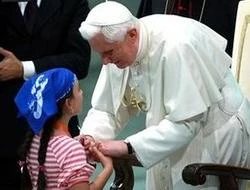 .- During a festive meeting with missionary children at the Vatican on Saturday, Pope Benedict XVI said that he never thought about becoming the Pope, and that even today he still has a hard time getting used to the fact.
“My name is Letizia and I would like to ask you a question.” a little girl said to the Pope.
“Dear Pope Benedict XVI, what did the motto ‘the children help the children’ mean to you when you were a boy?
Did you ever think of becoming the Pope?” another Italian girl asked the Holy Father.
“To tell you the truth,” Pope Benedict responded, “I never thought of becoming the Pope, because as I have already explained, I used to be a fairly naïve young boy in a small country town very far away from [urban] centers in a forgotten province.”
“We were happy to be in this province and we did not think about other things,” he added.
“Obviously, we knew, venerated and loved the Pope, at that time Pius XI, but for us he was at an unreachable height, almost another world. He was our father, nevertheless, a reality that was way above all of us,” the Pope also said.
“And I must say that even today I have difficulty understanding how the Lord could think of me and choose me for this ministry. But, I received it from His hands, even if it is something so surprising that I believe is beyond my strength. But the Lord helps me,” he said.
Pope Benedict XVI Photos

Pope Benedict XVI (C) kneels as he prays in front of the reproduction of the Lourdes Grotto in the Vatican Gardens to mark the end to Marian month May 30, 2009.
REUTERS/Alessia Pierdomenico (VATICAN RELIGION)


Saint Peter's Basilica dome is seen from the Vatican Gardens before Pope Benedict XVI celebrates the end of the Marian month May 30, 2009.
REUTERS/Alessia Pierdomenico (VATICAN RELIGION)
Pope Benedict XVI (R) reads his message in front of the reproduction of the original Lourdes Grotto in the Vatican Gardens to mark an end to the Marian month May 30, 2009.
REUTERS/Alessia Pierdomenico (VATICAN RELIGION)


Roman Catholic Diocese of Bridgeport files civil lawsuit against State of Connecticut officials
These officials are requiring the Diocese – and presumably all other organizations – to register as a lobbyist in order to engage in activities such as a rally at the State Capitol or using its website to encourage its members to contact their elected representatives. Application of the law in this manner would subject the First Amendment rights of Freedom of Speech, Freedom of Religion, and Freedom of Assembly to government oversight and penalties...
Saturday, May 30, 2009
Father Muñoz, Update
Attacks Against Christians Trouble Pontiff
Notes Concern When Greeting India's Ambassador
State ethics office investigates Connecticut diocese as lobbying group
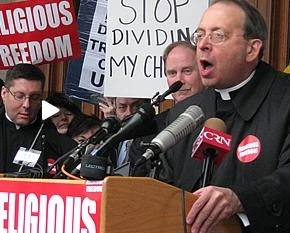 .- In response to its efforts to fight a bill that would have redefined the financial and pastoral structure of the Catholic Church in Connecticut, the Diocese of Bridgeport is now being investigated by the Office of State Ethics (OSE) for acting as a lobbying group without registering as one. Today, the diocese filed a lawsuit challenging the constitutionality of the investigation.
According to the Diocese of Bridgeport, a letter was received on April 23, 2009 from Thomas K. Jones, Ethics Enforcement Officer for the OSE, who informed the diocese that it was "the subject of an Office of State Ethics evaluation." The Church is suspected to have violated several Connecticut General Statutes (1-94, 1-95 and 1-96) which deal with “failing to register as a lobbyist in Connecticut,” “failing to submit all other appropriate lobbyist filings” and “failing to follow all applicable registration procedures."
The letter from the OSE argues that the diocese acted as a lobbying organization by participating in a rally at the State Capitol opposing Bill 1098 and using its website to encourage members to contact their elected representatives to oppose proposed legislation.
Bishop William E. Lori of Bridgeport reacted to the investigation earlier today, saying, "Following the surprise introduction of Bill 1098, a proposal that singled out Catholic parishes and would have forced them to reorganize contrary to Church law and the First Amendment, our Diocese responded in the most natural, spontaneous, and frankly, American, of ways: we alerted our membership – in person and through our website; we encouraged them to exercise their free speech by contacting their elected representatives; and, we organized a rally at the State Capitol.
“How can this possibly be called lobbying?" he asked.
Over the weekend, all parishes in the Bridgeport Diocese will hear a letter read to them from Bishop Lori addressing the investigation. In his letter, the bishop explains what he believes the consequences of the state requiring to register as a lobbying organization would be.
“Once again,” writes Lori, “we should be outraged. 'Lobbying'? Exhortations from the pulpit, information posted to the world wide web, a rally in the middle of the day on the State’s most public piece of property? This cannot possibly be what our Legislature had in mind when it enacted lobbying laws to bring more transparency and oversight to a legislative process that has been corrupted by special interests and backroom deals.
“Let’s be clear: we violated no law.” Bishop Lori states in his letter.
In response to the investigation, the diocese announced on Friday afternoon that it had filed a lawsuit in U.S. District Court against Thomas Jones, OSE Ethics Enforcement Officer, and against Carol Carson, Executive Director of the OSE. The Bridgeport Diocese is seeking a court order to prevent further action against it by the Office of State Ethics.
"I believe that an order from the Court barring Mr. Jones and his colleagues at the OSE from applying the lobbying laws to the Diocese in this manner is necessary to enable the Diocese to continue to carry out its mission without fear of incurring civil penalties, exposure to possible criminal prosecution, burdensome administrative requirements, and intrusive oversight by the State," Bishop Lori said.