Showing posts with label riots. Show all posts

Friday, August 15, 2014

Rand Paul: We Must Demilitarize the Police


Anyone who thinks race does not skew the application of criminal justice in this country is just not paying close enough attention, Sen. Rand Paul writes for TIME, amid violence in Ferguson, Mo. over the police shooting death of Michael Brown 

By

(Time) The shooting of 18-year-old Michael Brown is an awful tragedy that continues to send shockwaves through the community of Ferguson, Missouri and across the nation.

If I had been told to get out of the street as a teenager, there would have been a distinct possibility that I might have smarted off. But, I wouldn’t have expected to be shot.

The outrage in Ferguson is understandable—though there is never an excuse for rioting or looting. There is a legitimate role for the police to keep the peace, but there should be a difference between a police response and a military response.

The images and scenes we continue to see in Ferguson resemble war more than traditional police action.

Glenn Reynolds, in Popular Mechanics, recognized the increasing militarization of the police five years ago. In 2009 he wrote:
Soldiers and police are supposed to be different. … Police look inward. They’re supposed to protect their fellow citizens from criminals, and to maintain order with a minimum of force.

It’s the difference between Audie Murphy and Andy Griffith. But nowadays, police are looking, and acting, more like soldiers than cops, with bad consequences. And those who suffer the consequences are usually innocent civilians.

The Cato Institute’s Walter Olson observed this week how the rising militarization of law enforcement is currently playing out in Ferguson:

Why armored vehicles in a Midwestern inner suburb? Why would cops wear camouflage gear against a terrain patterned by convenience stores and beauty parlors? Why are the authorities in Ferguson, Mo. so given to quasi-martial crowd control methods (such as bans on walking on the street) and, per the reporting of Riverfront Times, the firing of tear gas at people in their own yards? (“‘This my property!’ he shouted, prompting police to fire a tear gas canister directly at his face.”) Why would someone identifying himself as an 82nd Airborne Army veteran, observing the Ferguson police scene, comment that “We rolled lighter than that in an actual warzone”?
Olson added, “the dominant visual aspect of the story, however, has been the sight of overpowering police forces confronting unarmed protesters who are seen waving signs or just their hands.”

How did this happen?

Most police officers are good cops and good people. It is an unquestionably difficult job, especially in the current circumstances.

There is a systemic problem with today’s law enforcement.

Not surprisingly, big government has been at the heart of the problem. Washington has incentivized the militarization of local police precincts by using federal dollars to help municipal governments build what are essentially small armies—where police departments compete to acquire military gear that goes far beyond what most of Americans think of as law enforcement.

This is usually done in the name of fighting the war on drugs or terrorism. The Heritage Foundation’s Evan Bernick wrote in 2013 that, “the Department of Homeland Security has handed out anti-terrorism grants to cities and towns across the country, enabling them to buy armored vehicles, guns, armor, aircraft, and other equipment.”

Bernick continued, “federal agencies of all stripes, as well as local police departments in towns with populations less than 14,000, come equipped with SWAT teams and heavy artillery.”

Bernick noted the cartoonish imbalance between the equipment some police departments possess and the constituents they serve, “today, Bossier Parish, Louisiana, has a .50 caliber gun mounted on an armored vehicle. The Pentagon gives away millions of pieces of military equipment to police departments across the country—tanks included.”

When you couple this militarization of law enforcement with an erosion of civil liberties and due process that allows the police to become judge and jury—national security letters, no-knock searches, broad general warrants, pre-conviction forfeiture—we begin to have a very serious problem on our hands.

Given these developments, it is almost impossible for many Americans not to feel like their government is targeting them. Given the racial disparities in our criminal justice system, it is impossible for African-Americans not to feel like their government is particularly targeting them.

This is part of the anguish we are seeing in the tragic events outside of St. Louis, Missouri. It is what the citizens of Ferguson feel when there is an unfortunate and heartbreaking shooting like the incident with Michael Brown.

Anyone who thinks that race does not still, even if inadvertently, skew the application of criminal justice in this country is just not paying close enough attention. Our prisons are full of black and brown men and women who are serving inappropriately long and harsh sentences for non-violent mistakes in their youth.

The militarization of our law enforcement is due to an unprecedented expansion of government power in this realm. It is one thing for federal officials to work in conjunction with local authorities to reduce or solve crime. It is quite another for them to subsidize it.

Americans must never sacrifice their liberty for an illusive and dangerous, or false, security. This has been a cause I have championed for years, and one that is at a near-crisis point in our country.

Let us continue to pray for Michael Brown’s family, the people of Ferguson, police, and citizens alike.

Paul is the junior U.S. Senator for Kentucky.

Link:

Wednesday, August 10, 2011

London Riot Photographs

http://cache.daylife.com/imageserve/04w30a73t2gTK/610x.jpg
Getty Images

British riot police arrive in front of a burning building in Croydon, South London on August 8, 2011. Now in it's third night of unrest, London has seen sporadic outbreaks of looting and clashes both north and south of the river Thames. Numerous buildings were set on fire in Croydon including a 140 year old furniture store as hundreds of looters plundered high street shops of their goods.

http://cache.daylife.com/imageserve/03hpcuH8AFc7M/610x.jpg
Reuters Pictures

A riot police runs after students during an anti-government rally to demand changes in the public state education system in Valparaiso city, about 121 km (75 miles) northwest of Santiago, August 9, 2011.

http://cache.daylife.com/imageserve/01e1dBf6701XT/610x.jpg
Reuters Pictures

Police officers in riot gear return to their vehicles during disturbances in Birmingham, central England August 9, 2011. Violence flared in English cities and towns on Tuesday night but London, where thousands of extra police had been deployed, was largely peaceful after three turbulent nights in which youths rampaged across the capital virtually unchecked.

http://cache.daylife.com/imageserve/00vj0kd1ow4TE/610x.jpg
Getty Images

A double decker bus burns as riot police try to contain a large group of people on a main road in Tottenham, north London on August 6, 2011. Two police cars were on Saturday set ablaze in north London following a protest over the fatal shooting of a 29-year-old man in an armed stand-off with officers. The patrol cars were torched as dozens gathered outside the police station on the High Road in Tottenham.


http://cache.daylife.com/imageserve/04fY5Es8XlgKA/610x.jpg
Reuters Pictures

Riot police wait in an estate in east London August 9, 2011. Riots flared in English cities and towns on Tuesday night as London waited anxiously to see if thousands of police deployed on its streets could head off the youths who had rampaged across the capital virtually unchecked for three nights.

http://cache.daylife.com/imageserve/07o0cxXfGnf3h/610x.jpg
AP Photo

Riot police stand by on Market Street during civil disturbances in Manchester, England, Tuesday, Aug. 9, 2011. Britain began flooding London's streets with 16,000 police officers Tuesday, nearly tripling their presence as the nation feared its worst rioting in a generation would stretch into a fourth night. The violence has turned buildings into burnt out carcasses, triggered massive looting and spread to other U.K. cities.

http://cache.daylife.com/imageserve/08AE3eY71Ef8G/x610.jpg
Getty Images

A shop burns as riot police try to contain a large group of people on a main road in Tottenham, north London on 6 August 2011. Two police cars were on Saturday set ablaze in north London following a protest over the fatal shooting of a 29-year-old man in an armed stand-off with officers. The patrol cars were torched as dozens gathered outside the police station on the High Road in Tottenham.

Picture: Lewis Whyld/PA

Saturday 6 August 2011: Fire rages through a building in Tottenham, north London, as trouble flared after members of the community took to the streets to protest over the police shooting of local man Mark Duggan

Picture: Matthew Lloyd/Getty Images

Buildings burn on Tottenham High Road, London after youths protested against the killing of Mark Duggan by armed police in an attempted arrest

http://cache.daylife.com/imageserve/0bo6gp4eUSfQG/x610.jpg
Getty Images

LONDON, ENGLAND - AUGUST 08: A riot police officer looks on in Peckham on August 8, 2011 in London, England. Pockets of rioting and looting continues to take place in various boroughs of London this evening, as well as in Birmingham, prompted by the initial rioting in Tottenham and then in Brixton on Sunday night. It has been announced that the Prime Minister David Cameron and his family are due to return home from their summer holiday in Tuscany, Italy to respond to the rioting. Disturbances broke out late on Saturday night in Tottenham and the surrounding area after the killing of Mark Duggan, 29 and a father-of-four, by armed police in an attempted arrest on August 4.

http://i.dailymail.co.uk/i/pix/2011/08/09/article-2024001-0D5CB5C100000578-825_642x603.jpg

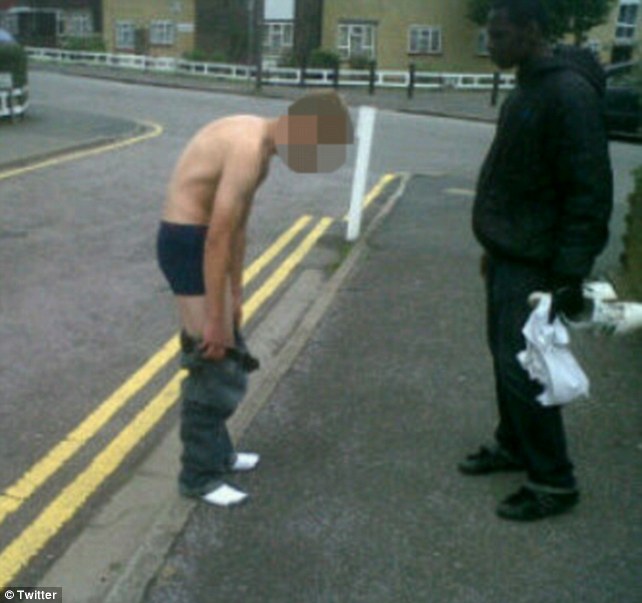
Humiliation: A young man is forced to strip to his underpants in the street, having apparently already handed his T-shirt and trainers to a looter. There were unconfirmed reports last night of victims being made to strip in Deptford, south London, and in Birmingham.

http://cache.daylife.com/imageserve/08dg6u15Lnfxh/610x.jpg
Getty Images

British riot policemen stand in front of a burning building in Croydon, South London on August 8, 2011. Now in it's third night of unrest, London has seen sporadic outbreaks of looting and clashes both north and south of the river Thames. Numerous buildings were set on fire in Croydon including a 140 year old furniture store as hundreds of looters plundered high street shops of their goods.

http://i.dailymail.co.uk/i/pix/2011/08/09/article-0-0D5C41AF00000578-709_638x348.jpg

Daylight robbery: The boy becomes aware of what is happening as the gang closes in around him


Lowest of the low: The teenager continues to tend to the wounds on his face as thieves make off with the contents of his rucksack

Lowest of the low: The teenager continues to tend to the wounds on his face as thieves make off with the contents of his rucksack

Picture: Lewis Whyld/PA

Fire fighters attempt to put out a blaze in a building in Tottenham

Everything must go: A youth poses with a large sack of Tesco Value Basmati rice, proving that items need not be valuable to be targeted by looters

(Daily Mail) Everything must go: A youth poses with a large sack of Tesco Value Basmati rice on the third night of rioting in London, proving that items need not be valuable to be targeted by looters

Brazen: A masked up woman has her arm full of bottles as rioters loot a shop in Hackney, north-east London Youths loot a Carhartt store in Hackney on August 8, 2011

(Daily Mail) Brazen: Looters carry armfuls of goods as shops are ransacked in Hackney, north-east London

Stripped bare: The looters jumped over counters and threw food such as crisps and sweets to the floor in order to get to the things they wanted
(Daily Mail) Stripped bare: The looters jumped over counters and threw food such as crisps and sweets to the floor in order to get to the things they wanted

Rioters are seen looting a shop in Hackney, north London
(Daily Mail) Rioters are seen looting a shop in Hackney, north London


From Father Tim Finigan at The Hermeneutic of Continuity : The above picture shows people in Clapham with their brooms engaged in #cleanup which shows that Twitter can be used for other purposes than organising opportunistic looting. I have seen plenty of articles asking whether Twitter or Blackberry broadcast was responsible for the riots. To my mind, you might as well blame paper manufacturers for the Russian Revolution.

If you are looking for an explanation of what is behind the "civil unrest" that seems to have taken everyone by surprise, here is an account from two girls in my childhood home, Croydon:


"Just showin the Police and the rich people we can do what we want" about sums it up, I think. "I can do what I want" is the net result of moral relativism applied by the ordinary teenager affected by original sin and educated in a system that undermines any real foundation of duty to God, country or neighbour.

Few people have noted the irony of the appeals by the Police to parents to "contact their children." For several decades our country has undermined marriage, the family, and the rights of parents. Agents of the state can teach your children how to have sex, give them condoms, put them on the pill, give them the morning-after pill if it doesn't work, and take them off for an abortion if that fails - and all without you having any say in the matter or necessarily even knowing about it. Now all of a sudden, we want parents to step in and tell their teenage children how to behave. - Read More...