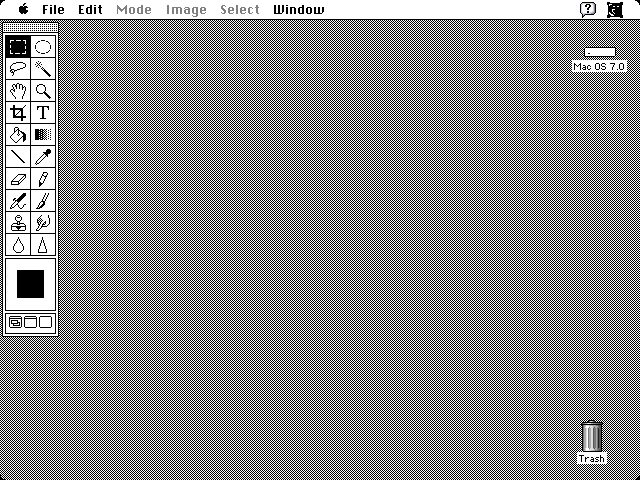
In the fall of 1987, Thomas Knoll, a doctoral candidate in computer vision, was trying to write–as a diversion from his doctoral–programming code to display grayscale images on a black-white bitmap monitor. Because it wasn't directly related to his thesis on computer vision, Knoll thought it had limited value at best. The code was called Display. Knoll wrote it on his Mac Plus computer at home. Little did he know that this initial code would be the very beginning of the phenomenon that would be known as Photoshop.

Splash screen for version .07 of Display.
Thomas' program caught the attention of his brother, John, who worked at Industrial Light and Magic (ILM) in Marin County, California. ILM was the visual effects arm of Lucasfilm, the famous motion picture company founded by George Lucas. With the release of Star Wars, Lucas had proved that really cool special effects, combined with heroic characters and a "shoot-em up script," could produce a blockbuster motion picture. To that end, John was experimenting with computers to create special effects. He asked his brother Thomas to help him program a computer to process digital image files, and Display was a great starting point. So began their collaboration.
John arranged to purchase a new Macintosh II, the first color-capable model, through his father, a professor at the University of Michigan. Before it was shipped to his brother, Thomas got hold of it and rewrote the code for Display to work in color. In the ensuing months, Thomas and John worked on expanding Display's capability. At John's urging, Thomas added the ability to read and write various file formats, while John developed image processing routines that would later become filter plug-ins. Thomas developed the unique capability to create soft-edged selections that would allow local changes. He also developed such features as Levels for adjusting tonality; Color Balance, Hue, and Saturation for adjusting color, and painting capabilities.
In the summer of 1988, John thought they might have the basis of a commercially viable product. Thomas was reluctant: "Do you have any idea how much work it is to write a commercial application?" he asked John. But with his naive optimism, John convinced Thomas it would be worth the effort. "I'll figure out how to make money with this," he told his brother. Well, John was right, but so was Thomas. It did take a lot of work.
Thomas changed the name of their software several times. Each time he found one he liked, it had already been taken. ImagePro, and even PhotoHut were considered. Then, during a program demo, he confided to someone that he was having problems naming the program. The confidant suggested PhotoShop, and that became the program's working name. To this day, neither Thomas nor John know for sure who first said the name "PhotoShop". Note: in it's first iteration, the 'S' of shop was capitalized. Later the inter cap was removed.
John started shopping around for a company to invest in Photoshop. Thomas remained in Ann Arbor, Michigan, fine-tuning the program, while John traveled all over Silicon Valley giving program demos including a company named Adobe Systems, Inc. John kept pushing his brother to add new features. John even wrote a simple manual to make the program more understandable.
Finally he succeeded in attracting the attention of somebody–a scanner manufacturer. Barneyscan decided that the program would be of use to people who owned their scanners. A short-term deal was worked out, and the first public iteration of the software was introduced as Barneyscan XP. About 200 copies of the program, now in Version 0.87, were shipped with Barneyscan scanners.
Around this time, John demonstrated the program to engineers at Apple computer. It was a huge hit. They asked John to leave a couple of copies. There followed the first incident of Photoshop pirating. Seems that the Apple engineers shared the program with some friends, a lot of friends!
Subsequently, John returned to Adobe for another demonstration. Russell Brown, Adobe's primary art director, was blown away by the program. He had just signed an NDA disclosure agreement with Letraset, to view their new image-editing program, ColorStudio. He was convinced that Photoshop was better.
Timing is everything. With a great deal of enthusiasm, Adobe decided to buy the license to distribute Photoshop. It was September 1988 and the Knoll brothers and Fred Mitchell, head of Adobe Acquisitions, made the deal with a handshake. It would be April before the final legal agreements were worked out.
The key phrase in that deal was "license to distribute." Adobe didn't completely buy-out the program until years after Photoshop had become a huge success. It was a smart move on the Knolls' part to work out a royalty agreement based upon distribution. After the legal agreements were signed, Thomas and John started developing a shipping version. Adobe decided to keep the working name Photoshop, but without an exhaustive attempt to find a better name. Thomas wrote all the code for the application in Ann Arbor, while John developed and wrote plug-ins in California. Some of the Adobe people thought John's features were gimmicky and didn't belong in a serious application. They viewed the product as a tool for retouching, not special effects, so John had to find a way to "sneak" them into the program. Those plug-ins have become one of the most powerful aspects of Photoshop.
Between April 1989 and the official release of the program in early 1990, development continued, with no official beta testers. At Adobe, Russell Brown and others worked with the program and made suggestions. Thomas would write and then rewrite the code, while John, Russell, and Fred pushed him to add features. John was particularly good at coaxing Thomas to make improvements.
Finally, in February 1990, Photoshop 1.0 shipped. The rest of course, is Photoshop history. . .