Showing posts with label magisterium. Show all posts

Monday, August 22, 2016

Cardinal Burke insists he is serving Francis, not opposing him

Cardinal Raymond Leo Burke attends a news conference by the conservative Catholic group "Voice of the Family" in Rome on Oct. 15, 2015. Photo courtesy of REUTERS/Alessandro Bianchi

By David Gibson

(RNS) Ever since Pope Francis was elected in March 2013, he has faced strong opposition from traditionalists unhappy with his push for church reforms — and the face of that opposition has often been Cardinal Raymond Burke, an American prelate who has worked in senior positions in Rome for most of the past decade.

Francis eventually moved Burke out of key Vatican jobs and into a more ceremonial post as patron to the Knights of Malta, an apparent downgrade that both Burke and the pope insist wasn’t tied to the cardinal’s criticisms.

But Burke, a former archbishop of St. Louis who has a devoted following among conservatives, has continued to use his Roman platform to speak his mind.

He did that again most recently in a book-length interview in which he hits many of the themes that have drawn attention in the past: critiquing “radical feminism” and homosexuality (“a wounding of nature,” he calls it) as well as the “secularization” and moral relativism that he says have infected society and the Catholic Church.

The reforms that followed the Second Vatican Council of the 1960s are also a recurrent target, as he again champions a return to the old Latin Mass and voices nostalgia for the Catholicism of his boyhood (Burke says that he first felt a tug to the priesthood at the age of 8). The cardinal also has a provocative new take on Islam, which he said “wants to govern the world.”

Notably absent from the book, however, and from direct criticism, is Francis himself. Throughout the extended interview with French journalist Guillaume d’Alançon, which was published under the title, “Hope for the World: To Unite All Things in Christ,” Burke approvingly and frequently cites Saint John Paul II, the pope who named him a bishop back in 1995, and Pope Emeritus Benedict XVI, who brought him to Rome in 2008 and made him a cardinal two years later.

He even praises Saint Pius X, the pope who a century ago was famous for his campaign to expunge the heresy of “Modernism” from the church — errors that the cardinal says “are still current.”
But Francis is mentioned only in passing, which seems just fine by Burke.

“I know about all these depictions. People call me ‘the enemy of the pope’ and so forth. I have never been and I am not presently the enemy of the pope,” Burke told RNS by telephone recently from his home state of Wisconsin, where he was spending time this summer.

“I have never, in anything I’ve said, shown disrespect to the papal office, because the Catholic Church doesn’t exist without the office of Peter,” he said, referring to the apostle who Catholic tradition views as the first bishop of Rome and therefore the first pope in an unbroken succession up to the present day.

“I’ve said to the pope himself, in conversations with him — and these by the way are friendly conversations — I told him, ‘Holy Father, the only way I can serve you is by speaking the truth in the best and clearest way possible.’ His response to me is: ‘That’s what I want.’”

The cardinal said that his own critics — his outspokenness has left no shortage of those — “would like to construe my relationship with the Holy Father as some kind of ongoing hostility or war between this reform of the church, this revolutionary reform (that Francis is promoting), and these old die-hards who resist it. That simply is not the case.”

During the course of a half-hour conversation, Burke did continually return to his commitment “to simply speak up to defend what the church has always taught and practiced.”

That commitment means that Burke will continue to push hard against the heart of Francis’ reformist approach, and that he will continue to be seen as, if not an enemy of the pope, at least his counterweight, and a favorite of those who would love to see the 68-year-old Burke one day succeed Francis, who turns 80 in December.

One of the chief targets for Burke of late has been the pope’s controversial document, “Amoris Laetitia,” or “The Joy of Love,” in which Francis synthesized the intense debates about church teachings and the modern family that took place across two major meetings of bishops from around the world that Francis convened in Rome in 2014 and 2015.

The pontiff’s lengthy exhortation, as it is known, was viewed as enshrining a new, more welcoming approach to Catholics who do not fit the textbook ideal of the catechism — single parents and gays, for example, and divorced and remarried Catholics.

“The Joy of Love” seems to leave open the possibility that divorced and remarried Catholics could receive Communion, for example. It has opened the door to the kind of discernment and appeals to conscience that critics say are misguided and in fact undermine long-standing Catholic doctrines and practices, and that’s why it has become a focal point for conservative dissent.

Burke is one of those critics. One of his main arguments of late is that the papal exhortation is not an expression of the “magisterium,” that is, authoritative church teaching, but that parts of it may be correct but others are not. “A mixture of opinion and doctrine,” as Burke put it in his interview with RNS.

“We can’t understand this document to be magisterium in the way other documents have been because Pope Francis simply has a different approach to the papacy,” the cardinal said. “In his documents he mixes his own thoughts and approaches, which are personal, with questions of doctrine.”

Burke says he knows some disagree with him, but he said that he and “many serious-minded people” in the church hierarchy are calling for Francis to issue a follow-up document.

“I trust that something will have to happen also because some very formal calls for clarification are in process and they simply will demand a response,” Burke said, “not in any kind of hostile or aggressive way, but simply for the sake of souls because people are getting confused.”

Indeed, “confusion” is the word that Burke said he would use to describe the mood in Rome these days over “what direction the church is going...” (continued)


Link:

Sunday, October 6, 2013

Assent and Papal Magisterium


By Father Tim Finigan

(The Hermeneutic of Continuity) Various questions have arisen recently concerning the assent that we ought to give to the words of the Holy Father. I thought it might be helpful to give a few notes concerning the papal magisterium from classical Catholic theology. I have referred to the excellent Jesuit manual Sacrae Theologiae Summa published by BAC.

When the Pope defines ex cathedra a doctrine concerning faith or morals, he enjoys that infallibility with which Our Lord willed the Church to be endowed. To these definitions, we must give the assent of faith. Obvious examples are the definition of the Immaculate Conception by Blessed Pius IX in 1854 and the definition of the Assumption by Pope Pius XII in 1950.

The Pope also teaches with an authentic magisterium (teaching authority) that is not infallible. Examples of such teaching are the encyclical letters of the Pope, and decrees issued by the Holy See in forma specifica.

Decrees of the Holy See may be issued merely in forma communi. This approval means that they are legitimate, authentic and to be promulgated. But this approval does not make such statements to be formal decrees of the Supreme Pontiff. To such statements or decrees, we must give obedience, though we may internally disagree with them.

Decrees of the Holy See that are issued in forma specifica are those that are expressly published as the Supreme Pontiff’s own decrees. They are inferior to ex cathedra statements but, as part of the authentic magisterium of the Supreme Pontiff, they do not require the assent of faith but they do demand our religious submission of mind and will. Lumen Gentium n.25 affirms this.

Popes may also teach privately. Such teaching would be expressed, for example, in sermons, interviews or books. When Pope Benedict published his book Jesus of Nazareth, he said:
It goes without saying that this book is in no way an exercise of the magisterium, but is solely an expression of my personal search "for the face of the Lord" (cf. Ps 27:8). Everyone is free, then, to contradict me. I would only ask my readers for that initial goodwill without which there can be no understanding.
I mentioned this in a post three years ago and, I think reasonably, said that the same would apply to papal interviews with journalists... (continued)


Link:
h/t to Fr. Z

Wednesday, April 18, 2012

Vatican Orders Overhaul of U.S. Nun Group Over Liberal Stances on Sexuality & Abortion


(The Blaze/AP) — The Vatican’s orthodoxy watchdog announced Wednesday a full-scale overhaul of a group representing most U.S. nuns and named an American archbishop to oversee the reform. The timing of the announcement is intriguing, especially considering ongoing angst within faith communities about the Obama administration’s contraceptive mandate, among other related issues.

The Vatican agency cited the Leadership Conference of Women Religious (LCWR), the largest umbrella group for Roman Catholic religious sisters in the United States, for using materials that “do not promote church teaching” on family life and sexuality, for sometimes taking positions in opposition to the nation’s bishops and for being “silent on the right to life from conception to natural death, a question that is part of the lively public debate about abortion and euthanasia in the United States.”

Representatives for the women’s group, based in Silver Spring, Md., did not immediately respond to requests for comment.

Seattle Archbishop Peter Sartain will manage the five-year reform, which will include rewriting the group’s statutes, reviewing all its plans and programs — including approving speakers — and ensuring the group properly follows Catholic prayer and ritual.

The report specifically cites a social justice group associated with the conference called NETWORK, which played a key role in supporting the Obama administration‘s health care overhaul despite the bishops’ objections. The announcement Wednesday made no direct mention of President Barack Obama’s health care law, but said Sartain will review the Leadership Conference’s ties with NETWORK.

 A screen shot from the LCWR web site

The review, which began in 2008, was a “doctrinal assessment” by the Congregation for the Doctrine of the Faith. When the inquiry was initially announced, many religious sisters and their supporters said the inquiry reflected church officials’ misogyny and was an insult to religious sisters, who run hospitals, teach, and play other vital service roles in the church.

Conservative Catholics, however, have long complained that the majority of sisters in the U.S. have grown too liberal and flout church teaching.

Link:
Related:

Wednesday, November 9, 2011

Father Gordon MacRae - The Duty of a Priest: Father Frank Pavone and Priests for Life

From Father Gordon MacRae at These Stone Walls:


https://blogger.googleusercontent.com/img/b/R29vZ2xl/AVvXsEgFROD0A1fv655FfNdddaxBGcKnwH2PwmQVNY4imoc14WX3UyRmkC-rBrpefbfN6eovWlOCIECNFR1uybymtLY3_MdX_LP-7qiHyCfL6tsEVp3XBikA0bCrAFYDtcpSOT62MWVRWZwf9FA/s1600/FrMacRae.jpgPart of the agenda among the more radical wing of the Catholic left has been to get about the business of removing any Magisterial authority from our faith experience. The goal is to  carve out a distinctly American Catholic church with identifiably American Catholic values that mirror the now disintegrating American wing of the Church of England, the Episcopal church. But that’s a whole other blog post for some other day – such as next week, perhaps.

It’s time for American Catholic liberals to see and admit that their own views and causes are being hi-jacked by this radical wing. For them, organizations like Priests for Life are seen as an anachronistic hindrance to social progress. A nice little scandal undermining Priests for Life would be most welcomed in some circles right about now, not least among them some purportedly Catholic circles.

But there isn’t a scandal. Father Frank Pavone hasn’t been accused of anything, though I do worry about his extreme vulnerability. There are agendas at work even in our Church that would be bolstered by the destruction of Father Pavone, his career, and his reputation. That fact must be a part of the equation as Catholics evaluate this story. Father Frank Pavone first was a target long before he was a suspect...

BISHOPS AS PROSECUTORS

I cannot speak to the internal disagreements between Father Frank Pavone and Bishop Patrick Zurek. I know none of the details. But I can speak in a broader sense of the necessity for any priest in the current climate to preserve his rights under Church law. I can only relate some of what transpired with my own bishop in a canonical proceeding to shed light on some of what may be happening behind the scenes in the Diocese of Amarillo.

Father Pavone came under recent attack in some circles because his bishop scheduled a personal meeting which Father Pavone declined to attend. There were some people – some very well intentioned – who saw in this some shades of culpability on the part of Father Pavone, using it to cast suspicion on his own transparency and desire to cooperate with his bishop.

It is likely, however, that Bishop Zurek has declined to allow a meeting to take place with Father Pavone’s Canonical Advocate present. I do not know this for certain, but I have read that Father Pavone’s Canonical Advocate has requested mediation in this matter between Father Pavone and his bishop. It was apparently on the advice of the Advocate that Father Pavone declined to meet without his Advocate or a mediator present. Both Father Pavone and his Canonical Advocate, Father David Deibel, J.D., J.C.L. have come under some public fire for this.

Church Law insists that any priest in a canonical forum has a right to advocacy. I stand by what I wrote in “Thy Brother’s Keeper“:

“I bow also to Father Pavone’s resolve to protect his rights under the higher authority of the law of the Church, for the [Dallas] Charter makes one thing clear now: Some bishops will neither protect nor respect those rights.”
I speak from experience. Throughout the last decade of attempting to defend myself before both a court of law and a court of public opinion, I have also had to simultaneously defend myself against a one-sided effort by my bishop to bring about a canonical dismissal from the priesthood with no defense whatsoever offered by me. Throughout this process, my bishop has steadfastly refused to meet or even converse with my Canonical Advocate regarding the matter of preserving my rights under Church law.

Far worse, when my bishop learned that I am seeking an opportunity to bring forward a new appeal of my conviction, my bishop hired his own lawyers to conduct a secret evaluation of my trial to present in Rome and circumvent my own efforts to defend myself. He has repeatedly refused to share with me or my Canonical Advocate the findings of that secret assessment.

My bishop has acted throughout in the role of a prosecutor, but it’s even worse than that.  In America, prosecutors are required to turn over to the defense the nature of charges and any evidence that supports them.  When I tried to assert my rights under Church law in this matter, my bishop responded with silence and has remained silent ever since.

I believe I could safely say that every organization formed on behalf of priests to assist in protecting their rights under Canon Law would now state that no priest in even a hint of an adversarial circumstance with his bishop should ever agree to a one-on-one meeting without his Canonical Advocate present. It would not only be foolish, it could be destructive. It would be akin to a prosecutor demanding to meet privately with a defendant without his lawyer present.

As the priesthood crisis became critical in 2002, Cardinal Avery Dulles gave bishops and priests a clear reminder of their rights and obligations under Church law.  His fine article, “The Rights of Accused Priests” is reprinted under “Articles” on These Stone Walls. Given these rights and obligations, I admire that Father Pavone is determined to resolve this matter in unity with his bishop. No bishop can in justice order him or any priest to set aside his rights under Church law... (continued)


Link:
Related:

Thursday, October 2, 2008

What Benedict sowed in April, Bishops are reaping today.


From WDTPRS:

"I am watching a wonderful developing story.

Bishops in the USA, one by one, are coming out with statements, those statements are getting better and better.

It strikes me that the bishops are using each other’s statements, along with the fine book by Archbishop Chaput, to craft ever stronger letters.

Ever stronger.

Do you share the impression that the bishops are strengthening each other … after Peter came to the USA to strengthen the brethren?

That is my thought.

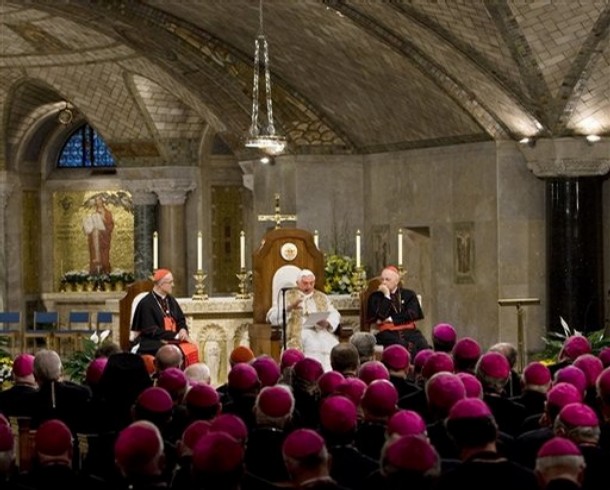
On 16 April 2008, His Holiness spoke the assembled bishops of the United States and said:

Clearly, the Church’s influence on public debate takes place on many different levels. In the United States, as elsewhere, there is much current and proposed legislation that gives cause for concern from the point of view of morality, and the Catholic community, under your guidance, needs to offer a clear and united witness on such matters. Even more important, though, is the gradual opening of the minds and hearts of the wider community to moral truth. Here much remains to be done. Crucial in this regard is the role of the lay faithful to act as a "leaven" in society. Yet it cannot be assumed that all Catholic citizens think in harmony with the Church’s teaching on today’s key ethical questions. Once again, it falls to you to ensure that the moral formation provided at every level of ecclesial life reflects the authentic teaching of the Gospel of life.

He said: 'it falls to you to ensure that the moral formation provided at every level of ecclesial life reflects the authentic teaching of the Gospel of life.'"