By Christie Wilcox | July 4, 2012
(
Huffington Post) We human beings are very attached to our brains. We’re proud of them – of their
size and their
complexity.
We think our brains set us apart, make us special. We scare our children with tales of monsters that eat them, and
obsessively study how they work, even when these efforts are often fruitless. So, of course, we are downright offended
that a simple, single-celled organism can manipulate our favorite organ, influencing the way we think and act.
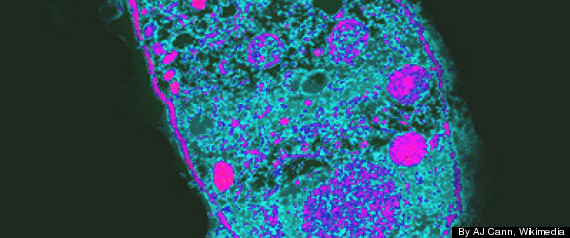
 Toxoplasma gondii
is arguably the most interesting parasite on the planet. In the guts of
cats, this single-celled protozoan lives and breeds, producing egg-like
cells which pass with the cats bowel movements. These find their way
into other animals that come in contact with cat crap. Once in this new
host, the parasite changes and migrates, eventually settling as cysts in
various tissues including the host’s brain, where the real fun begins.
Toxoplasma can only continue its life cycle and end up a happy adult in a cat’s gut if it can find its way
into
a cat’s gut, and the fastest way to a cat’s gut, of course, is to be
eaten by a cat. Incredibly, the parasite has evolved to help ensure that
this occurs. For example,
Toxoplasma infection alters rat behavior with surgical precision,
making them lose their fear of (and even
become sexually aroused by!) the smell of cats by hijacking neurochemical pathways in the rat’s brain.
Of course, rats aren’t the only animals that
Toxoplasma ends up in. Around 1/3 of people on Earth carry these parasites in their heads. Since
Toxoplasma
has no trouble affecting rats, whose brains are similar in many ways to
our own, scientists wonder how much the parasite affects the big,
complex brains we love so much. For over a decade, researchers have
investigated how this single-celled creature affects the way we think,
finding that indeed,
Toxoplasma alters our behavior and
may even play a role in cultural differences beween nations.
The idea that this tiny protozoan parasite can influence our minds is
old news. Some of the greatest science writers of our time have waxed
poetic about how it
sneaks its way into our brains and
affects our personalities.
Overall, though, the side effects of infection are thought to be minor
and relatively harmless. Recently, however, evidence has been mounting
that suggests the psychological consequences of infection are much
darker than we once thought.
In 2003, E. Fuller Torrey of the Stanley Medical Research Institute in Bethesda, Maryland his colleagues noted a link between
Toxoplasma and schizophrenia – specifically, that
women with high levels of the parasite were more likely to give birth to schizophrenics-to-be. The hypothesis given for this phenomenon is that while for most people who are infected,
Toxoplasma
has minor effects, for some, the changes are much more pronounced. The
idea has gained traction – a later paper found, for example,
that anti-psychotics worked just as well as parasite-killing drugs in restoring normal behaviors in infected rats, affirming the similarities between psychological disorders and
Toxoplasma infection.
Continuing to work with mental patients, scientists later discovered
a link between suicide and parasite infection. But, of course, this link was in people who already have mental illness. Similarly, a study found that
countries with high Toxoplasma infection rates also had high suicide rates -
but the connection between the two was weak, and there was no direct
evidence that the women who committed suicide were infected.
What scientists really wanted to understand is whether
Toxoplasma affects people with no prior disposition to psychological problems. They were in luck: in Denmark, serum antibody levels for
Toxoplasma gondii were taken from the children of over 45,000 women as a part of
a neonatal screening study to better understand how the parasite is transmitted from mother to child.
Since children do not form their own antibodies until three months
after birth, the antibody levels reflect the mother’s immune response.
Thus the scientists were both able to passively screen women not only
for infection status, but degree of infection, as high levels of
antibodies are indicative of worse infections. They were then able to
use the Danish Cause of Death Register, the Danish National Hospital
Register and the Danish Psychiatric Central Research Register to
investigate the correlation between infection and self-directed
violence, including suicide.
The results were clear. Women with
Toxoplasma infections were
54% more likely to attempt suicide – and twice as likely to succeed. In
particular, these women were more likely to attempt violent suicides
(using a knife or gun, for example, instead of overdosing on pills). But
even more disturbing: suicide attempt risk was positively correlated
with the level of infection. Those with the highest levels of antibodies
were 91% more likely to attempt suicide than uninfected women. The
connection between parasite and suicide held even for women who had no
history of mental illness: among them, infected women were 56% more
likely to commit self-directed violence.
While these results might seem frightening, they make sense when you think about how
Toxoplasma is known to affect our personalities. In 2006,
researchers linked Toxoplasma infection to neuroticism in both men and women. Neuroticism – as defined by psychology – is the “
an enduring tendency to experience negative emotional states,” including depression, guilt and insecurity.
The link between neuroticism and suicide is well established, thus if the parasite does make people more neurotic, it’s not surprising that it influences rates of self-violence.
How does a parasite affect how we think? The authors suggest that our
immune system may actually be to blame. When we are infected with a
parasite like
Toxoplasma gondii, our immune system goes on the
offensive, producing a group of molecules called cytokines that activate
various immune cell types. The trouble is, recent research
has connected high levels of cytokines to depression and violent suicide attempts.
The exact mechanism by which cytokines cause depression and other
mental illnesses is poorly understood, but we do know they are able to
pass the blood-brain barrier and
alter neurotransmitters like serotonin and dopamine in the brain.
But the authors caution that even with the evidence, correlation is
not causation. “Is the suicide attempt a direct effect of the parasite
on the function of the brain or an exaggerated immune response induced
by the parasite affecting the brain? We do not know,” said Teodor T.
Postolache, the senior author and an associate professor of psychiatry
and director of the Mood and Anxiety Program at the University of
Maryland School of Medicine, in
a press release. “We can’t say with certainty that
T. gondii caused the women to try to kill themselves.”
“In fact, we have not excluded reverse causality as there might be
risk factors for suicidal behavior that also make people more
susceptible to infection with
T. gondii,” Postolache explained.
But given the strong link between the two, there is real potential for
therapeutic intervention. “If we can identify a causal relationship, we
may be able to predict those at increased risk for attempting suicide
and find ways to intervene and offer treatment.” The next step will be
for scientists to affirm if and how these parasites cause negative
thoughts. Not only could such research help target at-risk individuals,
it may help scientists understand the dark neurological pathways that
lead to depression and suicide that the sinister protozoan has tapped
into. But even more disconcerting is that
scientists predict that Toxoplasma prevalence is on the rise,
both due to how we live and climate change. The increase and spread of
this parasitic puppeteer cannot be good for the mental health of
generations to come.
Citation:
Pedersen, M.G., Mortensen, P.B., Norgaard-Pedersen, B. & Postolache, T.T. Toxoplasma gondii Infection and Self-directed Violence in Mothers, Archives of General Psychiatry, DOI: 10.1001/archgenpsychiatry.2012.668
Need help? In the U.S., call 1-800-273-8255 for the National Suicide Prevention Lifeline.
Link: