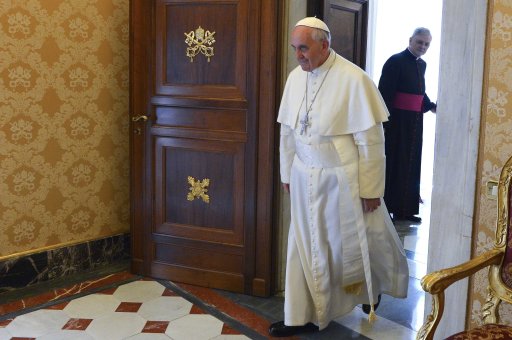
Pope Francis (R) embraces Pope Emeritus Benedict XVI during a ceremony
at the Vatican July 5, 2013. Pope Francis issued his first encyclical on
Friday with a message on the importance of Christian faith that showed
he plans no radical departure from the doctrinal stance of his
predecessor Benedict. REUTERS/Osservatore Romano
Progress means "lowering oneself" on the road of humility in order to allow God's love to emerge and be clearly seen.
This was the central focus of Pope Francis' homily this morning at
Mass in the Domus Sanctae Marthae chapel, according to L'Osservatore
Romano. The feast of the Annunciation was marked today, as it was moved
from the typical date of March 25, since that fell within Holy Week this
year.
Among the congregation were Sisters of Charity who renewed their
vows, the staff of the Vatican Television Center, staff of the Brazilian
section of Vatican Radio, and longtime Papal photographer, Arturo Mari.
The way of Christian humility rises up to God, as those who bear
witness to it "stoop low" to make room for charity, the Holy Father
reflected.
The Pope said that the road taken by Mary and Joseph to Bethlehem for
the imperial census was a road of humility. There was the humility of
Mary, who "did not understand well," but "[entrusted] her soul to the
will of God." Joseph was humble, as he "lowered himself" to take on the
"great responsibility" of the bride who was with child.
"So it is always with God's love," said Francis, "that, in order to
reach us, takes the way of humility." This was the same way that Jesus
walked, a way that humbled itself even unto the Cross. Pope Francis went
on to say that, for a Christian, "[T]his is the golden rule," according
to which progress and advancement always come through lowering oneself.
"One can take no other road," he said, adding, "if I do not lower
myself, if you do not lower yourself, you are not a Christian."
Pope Francis went on to say, "Being humble does not mean going on the
road," with "downcast eyes." Such was not the humility of Jesus, or his
mother or his foster father, Joseph. The Holy Father underlined that
the way of humility is the one that leads to the triumph of the
Resurrection. "Let us ask God for the grace of humility," he prayed,
"that humility, which is the way by which charity surely passes," for,
"if there is no humility, love remains blocked, it cannot go [forward]."
Persecuted
At his Saturday morning Mass, L'Osservatore Romano reported that the Pontiff spoke about martyrdom.
"To find martyrs we don't need to go to the Catacombs or to the
Colosseum: today martyrs are alive in a great many countries. Christians
are persecuted for their faith. In some countries they cannot carry the
cross: they are penalized for doing so. Today, in the 21st century, our
Church is a Church of martyrs," he said.
Pope Francis began his homily commenting with a quip on the Gospel
passage of St Mark (16:9-15), in which are recounted the appearances of
Jesus to Mary Magdalene, to the disciples of Emmaus and to the Eleven.
"When I read this Gospel it occurs to me that St Mark may not have liked
Mary Magdalen much, since he recalled that the Lord had driven seven
demons out of her, didn't he? It was a question of liking...".
He then presented a reflection on faith: "a grace", and "a gift of
the Lord" which should not be glossed over — and is thus extended "to
the peoples who believe in you", as the Collect of Mass says, for "we
are not attached to a fantasy", but "to a reality we have seen and
heard."
The Pope mentioned the passage from the Acts of the Apostles
(4:13-21) proclaimed in the First Reading. In response to the order
given by the head priests and Pharisees not to speak of Jesus, Peter and
John, "stood firm in the faith" saying, "we cannot but speak of what we
have seen and heard."
Their testimony, he added, "reminds me of our faith. And what is our
faith like? Is it strong? Or is it at times a little like rosewater, a
somewhat watered down faith? When problems arise are we brave like Peter
or inclined to be lukewarm?"
Peter, Pope Francis said, teaches us that "faith is not negotiable.
Among the People of God this temptation has always existed: to downsize
faith, and not even by 'much.'" However, he explained, we must must get
the better of "the temptation to behave more or less 'like everyone
else', not to be too, too rigid", because it is "from this that a path
which ends in apostasy unfolds."
Indeed, "when we begin to cut faith down, to negotiate faith and more
or less to sell it to the one who makes the best offer, we are setting
out on the road of apostasy, of non fidelity to the Lord".
Yet the very "example of Peter and John helps us, gives us strength";
as does the example of the martyrs in the Church's history. It is they
"who say, like Peter and John, 'we cannot but speak'. And this gives
strength to us, whose faith is at times rather weak. It gives us the
strength to carry on living with this faith we have received, this faith
which is the gift that the Lord gives to all peoples".
The Pope ended by suggesting a daily prayer: "Lord, thank you so much
for my faith. Preserve my faith, increase it. May my faith be strong
and courageous. And help me in the moments when, like Peter and John, I
must make it public."
At 12 minutes 30 seconds into this video at the Western GOP Debate, Las Vegas, NV, started a question
that Newt Gingrich gave the most important and best answer in the whole debate.
ANDERSON COOPER, CNN ANCHOR AND DEBATE MODERATOR: And welcome back to the CNN GOP debate live from the Venetian in Las Vegas.
Let's continue. We've got an e-mail question that was left at cnnpolitics.com.
This is from a Mike Richards who says:
"With the controversy surrounding Robert Jeffress, is it acceptable to let the issue of a candidate's faith shape the debate?"
Senator Santorum, this is in reference to a Baptist pastor who, at the Values Voter Summit, after introducing Governor Rick Perry, said of --
said that "Mitt Romney is not a Christian," and that "Mormonism is a cult."
Those were his words.
Should...
(BOOING)
COOPER:Should voters pay attention to a candidate's religion?
SANTORUM: I think they should pay attention to the candidate's values, what the candidate stands for.
(CHEERING AND APPLAUSE)
SANTORUM: That's what is at play. And the person's faith --
and you look at that faith and what the faith teaches with respect to morals and values that are reflected in that person's belief structure.
So that's -- those are important things.
I -- I'm a Catholic. Catholic has social teachings.
Catholic has teachings as to what's right and what's wrong.
And those are legitimate things for voters to look at,
to say if you're a faithful Catholic, which I try to be --
fall short all the time, but I try to be
-- and -- and it's a legitimate thing to look at as to what the tenets and teachings of that faith are
with respect to how you live your life and -- and how you would govern this country.
With respect to what is the road to salvation, that's a whole different story.
That's not applicable to what -- what the role is of being the president or a senator or any other job.
(APPLAUSE)
COOPER: Speaker Gingrich, you agree with that? GINGRICH: Well, I think if the question is,
does faith matter? Absolutely.
How can you have a country which is founded on truths which begins
we are endowed by our creator with certain inalienable rights?
How can you have the Northwest Ordinance of 1787 which says
religion, morality and knowledge being important, education matters.
That's the order: religion, morality and knowledge.
Now, I happen to think that none of us should rush in judgment of others in the way in which they approach God.
And I think that all of us up here I believe would agree.
(APPLAUSE)
But I think all of us would also agree that
there's a very central part of your faith in how you approach public life.
And I, frankly, would be really worried if somebody assured me
that nothing in their faith would affect their judgments,
because then I'd wonder, where's your judgment --
how can you have judgment if you have no faith?
And how can I trust you with power if you don't pray?
(APPLAUSE)
Who you pray to, how you pray, how you come close to God is between you and God.
But the notion that you're endowed by your creator sets a certain boundary on what we mean by America.